
. . . there are certain regularities, and one of them is the way in which the victims of men such as Griffiths are described in the Guardian, the house journal of the British intelligentsia and its bureaucratic hangers-on. This is important because it illustrates the way in which a dominant elite — dominant de facto if not always de jure — thinks about social problems.
An article describing the victims of Wright, the Ipswich murderer, was titled THE WOMEN PUT INTO HARM’S WAY BY DRUGS. A similar article about Griffiths’s victims was headed “CROSSBOW CANNIBAL” VICTIMS’ DRUG HABITS MADE THEM VULNERABLE TO VIOLENCE. In other words, these women became prostitutes by force majeure, on the streets not because of choices they had made but because of chemical substances that controlled them without any conscious intervention on their part — no more than if, say, an abyss caused by an earthquake had suddenly opened up and swallowed them.
Now either we are all like this — no different from inanimate objects, which act and react mechanically, as Descartes supposed that dogs and cats did — or we are not. The view that we are brings with it certain difficulties. No one could live as if it were true; no one thinks of himself, or of those about him, as automatons; we are all faced with the need to make conscious decisions, to weigh alternatives in our minds, every waking hour of every day. Human life would be impossible, literally inconceivable, without consciousness and conscious decision making. It is true that certain medical conditions, such as temporal-lobe epilepsy during fits, deprive people of normal consciousness and that they nevertheless continue to behave in a recognizably human way; but if all, or even most, of humanity suffered from those conditions, human life would soon be at an end.
Assuming, then, that not everyone is driven to what he does by his own equivalent of drug addiction, the Guardian must assume that Wright’s and Griffiths’s victims were fundamentally different from you and me. Unlike us, they were not responsible for their actions; they did not make choices; they were not human in the fullest sense. Not only is this a view unlikely to find much favor with women who resemble the victims in some way; it also has potentially the most illiberal consequences. For it would justify us, the full human beings, in depriving such women of liberty. If “their hopeless addiction to heroin, alcohol or crack cocaine led them to sell their bodies in the red light district on the edge of Bradford city centre and made them vulnerable to violence,” as the article tells us, surely we should force our help on them to recover their full humanity, or, if that proves impossible, take them into preventive detention to protect them. They are the sheep, we the shepherds.
Theodore Dalrymple, “Murder Most Academic: A British Ph.D. candidate puts “homicide studies” into practice”, City Journal, 2011-05-31
May 31, 2011
QotD: The paternalistic view of (some) crime victims
May 26, 2011
May 24, 2011
“Why does dubious social science keep showing up in medical journals?”
William Easterly and Laura Freschi have determined the decision tree for publishing crappy social science research:
Aid Watch has complained before about shaky social science analysis or shaky numbers published in medical journals, which were then featured in major news stories. We questioned creative data on stillbirths, a study on health aid, and another on maternal mortality.
Just this week, yet another medical journal article got headlines for giving us the number of women raped in the DR Congo (standard headline: a rape a minute). The study applied country-wide a 2007 estimate of the rate of sexual violence in a small sample (of unknown and undiscussed bias). It did this using female population by province and age-cohort — in a country whose last census was in 1984.
We are starting to wonder, why does dubious social science keep showing up in medical journals?
The medical journals may not have as much capacity to catch flaws in social science as in medicine. They may desire to advocate for more action on tragic social problems. The news media understably assume the medical journals ARE vetting the research.
H/T to Tim Harford for the link.
May 22, 2011
QotD: The rise of the “new aristocracy”
A man is innocent until proven guilty, and it will be for a New York court to determine what happened in M Strauss-Kahn’s suite at the Sofitel. It may well be that’s he the hapless victim of a black Muslim widowed penniless refugee maid — although, if that’s the defense my lawyer were proposing to put before a Manhattan jury, I’d be inclined to suggest he’s the one who needs to plead insanity. Whatever the head of the IMF did or didn’t do, the reaction of the French elites is most instructive. “We and the Americans do not belong to the same civilization,” sniffed Jean Daniel, editor of Le Nouvel Observateur, insisting that the police should have known that Strauss-Kahn was “not like other men” and wondering why “this chambermaid was regarded as worthy and beyond any suspicion.” Bernard-Henri Lévy, the open-shirted, hairy-chested Gallic intellectual who talked Sarkozy into talking Obama into launching the Libyan war, is furious at the lèse-majesté of this impertinent serving girl and the jackanapes of America’s “absurd” justice system, not to mention this ghastly “American judge who, by delivering him to the crowd of photo hounds, pretended to take him for a subject of justice like any other.”
Well, OK. Why shouldn’t DSK (as he’s known in France) be treated as “a subject of justice like any other”? Because, says BHL (as he’s known in France), of everything that Strauss-Kahn has done at the IMF to help the world “avoid the worst.” In particular, he has made the IMF “more favorable to proletarian nations and, among the latter, to the most fragile and vulnerable.” What is one fragile and vulnerable West African maid when weighed in the scales of history against entire fragile and vulnerable proletarian nations? Yes, he Kahn!
Before you scoff at Euro-lefties willing to argue for 21st century droit de seigneur, recall the grisly eulogies for the late Edward Kennedy. “At the end of the day,” said Sen. Evan Bayh, “he cared most about the things that matter to ordinary people.” The standard line of his obituarists was that this was Ted’s penance for Chappaquiddick and Mary Jo Kopechne — or, as the Aussie columnist Tim Blair put it, “She died so that the Food Allergen Labeling and Consumer Protection Act might live.” Great men who are prone to Big Government invariably have Big Appetites, and you comely serving wenches who catch the benign sovereign’s eye or anything else he’s shooting your way should keep in mind the Big Picture. Yes, Ted Ken!
Nor are such dispensations confined to Great Men’s trousers. Timothy Geithner failed to pay the taxes he owed the United States Treasury but that’s no reason not to make him head of the United States Treasury. His official explanation for this lapse was that, unlike losers like you, he was unable to follow the simple yes/no prompts of Turbo Tax: In that sense, unlike the Frenchman and the maid, Geithner’s defense is that she wasn’t asking for it — or, if she was, he couldn’t understand the question. Nevertheless, just as only Dominique could save the European economy, so only Timmy could save the U.S. economy. Yes, they Kahn!
Mark Steyn, “The unzippered princelingand the serving wench”, Orange County Register, 2011-05-20
May 19, 2011
Nathalie Rothschild: Britain’s debate on rape “is demeaning to women”
There is much sound and fury in Britain this week over some remarks by a Tory cabinet minister in a BBC interview. The leader of the opposition has demanded that he be dismissed from the government for suggesting that there are ‘other categories of rape’. Nathalie Rothschild wrote this article in response to a 2010 review of the rape law.
In 2007, Camilla Cavendish of The Times (London) found that rape allegations had jumped by 40 per cent between 2002 and 2005. While this can partly be put down to improved support for women, which facilitates the process of reporting rape, Cavendish argued that a widening official definition of rape also played a big role. Since the Sexual Offences Act 2003 came into force, the definition of rape has been expanded to include oral sex. But there has also been a profound attitude shift with roots in the second-wave feminist idea that heterosexual sex is an inherently violent and degrading act that women subject themselves to against their better judgement.
More than four out of five rape allegations are made against friends or acquaintances. As alcohol and/or drugs were involved in over half those cases, Cavendish puts this down to ‘the culture of binge drinking’. But this avoids the more complex picture. Today, various rape-awareness activists and state feminists are themselves helping to blur the boundaries between sex and rape, encouraging women to regard themselves as violated, abused and traumatised for having gone to bed with a man without thinking it through in minute detail.
The Sexual Offences Act 2003 declared that consent must be ‘active, not passive’; in rape cases, consent is now taken to mean agreement rather than the absence of a refusal. So if a woman goes along with sex, but doesn’t make it explicitly clear that she is actively consenting to it, it can be deemed to be rape. The government has even moved towards ensuring that no agreement can be taken as consent if it is given under the influence of alcohol. As Cavendish pointed out: ‘In our zeal to protect women, are we going to legislate so that a drunken man is accountable for his deeds, but a drunken woman is not? Why do we encourage women to see themselves as victims?’ Absolving women who engage in sexual liaisons — whether drunk or sober — of responsibility for their actions is not liberating; it’s demeaning.
There is no doubt that forcing someone to have sex is a heinous, violent and degrading act and victims of rape should indeed be treated with dignity and respect. But in the name of protecting women, the government is insisting that rape cases be treated differently from all other crimes, while interfering with the course of justice in a way that undermines defendants’ rights and undercuts the power of juries.
May 18, 2011
Neil Davenport: The cognitive dissonance of “SlutWalk”
It’s possible to feel a bit sorry for Michael Sanguinetti, whose anachronistic, ill-advised, yet well-intended caution to female students at Osgoode Hall in Toronto triggered the SlutWalk phenomenon. By phrasing his advice in such a retrogressive way, he became the poster boy for all that women perceive as being wrong with the criminal justice system’s approach to solving the problem of violence against women.
However, as Neil Davenport points out, the reaction seems to be directed at the legal system and attitudes of thirty years ago, not the system of today:
The legal system, at least officially, now takes any accusation of sexual assault against women very seriously. It’s ironic that SlutWalk is supposedly exposing the ineffectiveness of a legal system at a time of high-profile sexual assault charges made against Wikileaks founder Julian Assange and IMF chief Dominique Strauss-Kahn. More than ever, law enforcers in Britain and the US are likelier to act on an accusation of assault, even if the alleged crime took place years previously.
Faced with such a gap between feminist thinking and how society actually views violence against women, the anger expressed by SlutWalk protestors and cheerleading feminists rings a bit hollow. Although the protestors are aiming to avoid being victimised on the basis of what they wear, their offence taken at one police officer’s comments suggests a willingness to claim the mantle of victimhood for themselves. In this case, women are victims of a patriarchal state that doesn’t take violence against them seriously, even though the evidence suggests that the state is all too keen to monitor and regulate any type of contact between men and women. Feminists used to have many issues on which to express genuine grievance on the unequal treatment of women in society: equal pay and employment rights, abortion rights and so on. But since many of these issues have been resolved, more or less, there seems to be an on-going search for examples of oppression to facilitate the elevation of women to the exalted status of victimhood.
It’s perhaps not helped that the frothy issue of sexual identity is at the heart of the SlutWalk debacle. Some feminists argue that the protestors are feeding into a wider ‘raunch culture’ that is having a debilitating impact on young women. The sexualisation of society, the argument goes, is pressurising more young women to make themselves available to men in order to be accepted. SlutWalk is simply buying into the old madonna/whore duality that was often cited as an example of women’s inferior status in society. Again, though, this ignores how far society’s attitudes towards sex and women have changed. Women’s greater independence in society and the depoliticisation of marriage and the nuclear family have all helped transform attitudes towards women and sex.
May 17, 2011
Matt Welch: BHL is a “national embarrassment to France”
Actually, I understate in the headline what Matt actually wrote:
And since we don’t want to reprint the whole quavering bag of apologia (“Charming, seductive, yes, certainly; a friend to women and, first of all, to his own woman, naturally,” etc.), let’s close with perhaps my favorite line:
What I do know is that nothing in the world can justify a man being thus thrown to the dogs.
I’m guessing what BHL really means here is that no worldly rape can justify Strauss-Kahn’s treatment. Since if the accusations are true, a 62-year-old man known by every French person I’ve asked to have the sexual manners of a primate lunged nakedly at hired help half his age, grabbed her breast, knocked her to the floor, and chased her around his expensive hotel suite attempting with some success to thrust his penis into her body and discharge DNA evidence.
I don’t know if he’s guilty, and it would be imprudent not to consider the conspiracy theories in a case involving someone who until this week was the single biggest political threat to the sitting president of France, but the only decent way you can arrive at “nothing in the world can justify” Strauss-Kahn’s treatment is if you oppose all perp walks equally. Short of that, it’s just special pleading for a powerful dick. And another reminder that BHL is 10 times the national embarrassment to France than Jerry Lewis or even Johnny Hallyday ever was.
May 13, 2011
Iatrogenic gullibility?
Bruce Schneier summarizes a report that is either a very late April Fool story or proof that the sight of a white coat and stethescope induces compliant behaviour:
This is a pretty scary criminal tactic from Turkey. Burglars dress up as doctors, and ring doorbells handing out pills under some pretense or another. They’re actually powerful sedatives, and when people take them they pass out, and the burglars can ransack the house.
According to the article, when the police tried the same trick with placebos, they got an 86% compliance rate.
The linked report shows that people are nearly as likely to open the door when the caller claims to be a robber.
April 30, 2011
“When police decide they need to make an arrest, he said, they find a way to make an arrest”
Not the finest day in Albertan justice:
Charges have been dropped against three Alberta men accused of shooting dead a pregnant wild horse and tossing its body down a hillside. For more than a year, the RCMP and the Crown were sure they had the right guys. They even charged the then-12-year-old son of Jason Nixon, one of the accused. But then, just as the trial began, the defence produced an important piece of exculpatory evidence: The horse hadn’t been shot.
The Mounties had assumed it had been. They were operating on a tip from a man named Dave Goertz. Mr. Goertz, as everyone involved in the case knew, was a crackhead and a meth addict. He reported the crime after a local group that defends Alberta’s wild horse population posted a $25,000 reward.
[. . .]
Apparently, the word of a drug addict was enough for the guardians of our justice system to arrest three innocent men and run them all the way to trial, costing them their jobs, a small fortune and untold grief.
[. . .]
The horse had been badly decomposed, apparently, by the time police found it, so determining whether it had been shot wasn’t possible. And yet, lacking critical evidence, the province proceeded with its prosecution for wilfully killing and careless use of a firearm. The three men faced a maximum of five years in prison.
This kind of thing, said defence lawyer Willie deWit, “is what happens in our system a lot of times.” When police decide they need to make an arrest, he said, they find a way to make an arrest. They ignore anything that might exculpate the accused, and seize on anything that feeds their assumptions of guilt.
April 29, 2011
Toronto Star: War crimes investigation possible for Canadians in Afghanistan
The International Criminal Court seems to think that Canadian officials may be complicit in war crimes over the Afghan detainees:
Prosecutor Luis Moreno-Ocampo says in a documentary soon to be aired on TVO that Canadian officials are not immune to prosecution if there is evidence that crimes were committed by handing over detainees to face torture.
When Toronto filmmaker Barry Stevens asked Moreno-Ocampo in his film, Prosecutor, if the ICC would pursue a country like Canada over its role in Afghanistan, he replied:
“We’ll check if there are crimes and also we’ll check if a Canadian judge is doing a case or not . . . if they don’t, the court has to intervene. That’s the rule, that’s the system, one standard for everyone.”
Moreno-Ocampo could not be reached for further comment about the case Thursday when attempts were made by the Star.
Update: Adrian MacNair is underwhelmed:
As one who has actually been to Afghanistan and seen how the military cares for and treats detainees, it’s a little difficult to swallow the news that the International Criminal Court could investigate Canada for so-called war crimes. I’m not sure what that would accomplish, but it certainly would do nothing to help with the main problem in the country: the insurgency.
I’m unsure as to how or why anybody believes that Canada’s role in Afghanistan is anything more than a humanitarian mission buttressed by security. We’re in the country to provide stabilization for the democratically elected (though admittedly corrupt and fraudulent) government with whom we have specific agreements and rules we must follow.
In providing security to Afghans we are not allowed to hold Afghan nationals for more than 96 hours in our custody, though at the time of the allegations (pre-2007) this was 72 or 48 hours.
It doesn’t seem reasonable to me to expect a foreign military with finite resources to ensure absolute humanitarian oversight of detainees after they’ve been handed over to the Afghan government. That’s like expecting a police officer in Canada to ensure proper oversight of a prisoner he has arrested and brought to justice. Is a police officer morally culpable if a prisoner is raped in prison?
April 25, 2011
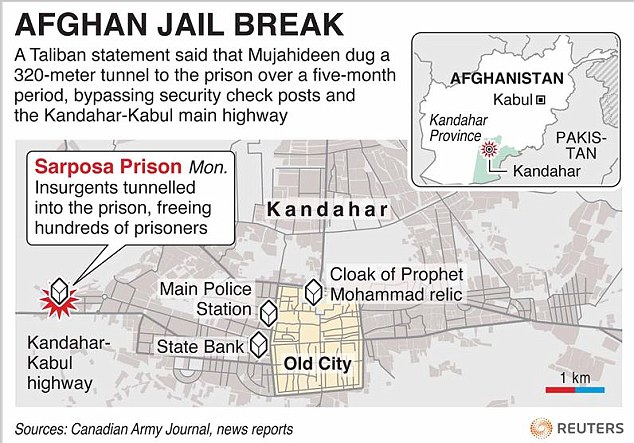
Taliban tunnellers re-enact the “Great Escape”
This is going to hurt:
The Taliban has staged a jail-break from a high security prison in Afghanistan, freeing 541 prisoners through a network of tunnels that took five months to dig.
In scenes reminiscent of war film The Great Escape, insurgents constructed a 1,050-foot (320m) route into Sarposa Prison, in Kandahar.
Diggers finally broke through into the site last night and hundreds of prisoners, including around 100 Taliban commanders — streamed through the tunnel to freedom over four-and-a-half hours.
They were met by a fleet of cars which whisked them away to freedom. The breakout was completed at around 3.30am.
April 23, 2011
A neat way to address software piracy
I still find it hard to believe that Cracked, of all the media entities from the pre-internet era, is worth visiting (and linking to). However, this is good stuff:
The [Arkham Asylum] developers included a little bit of extra code to detect when the game has been pirated, a common tactic used to track a company’s losses or simply mess with cheap people. The game is mostly unchanged when hacked, with one seemingly minor exception: Batman’s glider cape is hilariously unusable and has the aerodynamics of a piece of cardboard riddled with bullet holes.
It’s not that the cape is faulty, apparently; it’s simply that your version of Batman doesn’t know how to use it. Instead of gliding from one surface to another, Batman simply opens his wings over and over like a total ass-clown, causing him to lose altitude and fall down. It’s like you’re being forced to play with the pudgy Batman copycat from the beginning of The Dark Knight.
All the other gadgets still work, so you can always fight your way across the level on foot, right? Well, yeah, except that without the glider cape you’ll be completely stranded in a certain room — you know, the one filled with poisonous gas. That’s right, in the pirated version of Arkham Asylum, the always-prepared Dark Knight is such an useless idiot that he gets himself killed due to his shitty cape.
This trick gets misconstrued a lot as a simple game glitch, so you have people like this guy asking what’s wrong with his game at the official Eidos message board … only for the forum administrator to explain the situation and tell him: “It’s not a bug in the game’s code, it’s a bug in your moral code [punk].“
Another fake war hero emerges
This time, it’s a 20-year-old woman in Minnesota:
The town of Cass Lake embraced Elizabeth McKenzie last month when she arrived at the high school in her Army uniform for a welcome home ceremony.
Though she isn’t a tribal member, the Leech Lake Band of Ojibwe Honor Guard gave her a blanket and an eagle feather to honor her as a woman warrior for her service in Afghanistan. There was a tribal drum ceremony and a reception line. Accepting the town’s gratitude, McKenzie talked about the close calls she’d had and a war injury that brought her home. She led the march in the high school gym, carrying the American flag, and the local newspaper documented the hero’s return.
But none of it was true. The 20-year-old McKenzie was never injured in combat, had never been to Afghanistan, never been deployed anywhere. In fact, she’s never been in the military.
Now the 2009 grad of Cass Lake High School has been cited for impersonating an officer, which in Minnesota includes the military. And the people of Cass Lake are trying to recover from feeling duped by their own good intentions.
April 22, 2011
DC business owner successfully fights photo tickets
Jon sent me this link, which shows that you sometimes can fight speed camera tickets:
Five times and counting before three different judges, the Prince George’s County business owner has used a computer and a calculation to cast reasonable doubt on the reliability of the soulless traffic enforcers.
After a judge threw out two of his tickets Wednesday, Mr. Foreman said he is confident he has exposed systemic inaccuracies in the systems that generate millions of dollars a year for town, city and county governments.
He wasn’t the only one to employ the defense Wednesday. Two other men were found not guilty of speeding offenses before a Hyattsville District judge during the same court session using the same technique.
“You’ve produced an elegant defense and I’m sufficiently doubtful,” Judge Mark T. O’Brien said to William Adams, after hearing evidence that his Subaru was traveling below the 35-mph limit – and not 50 mph as the ticket indicated.
April 5, 2011
China’s High Speed Railways: not for the masses
Reports of corruption among top officials and soaring costs for China’s HSR network:
. . . question-marks have been raised over these plans after the sacking in February of Liu Zhijun, the minister responsible for building the high-speed network. He was accused of skimming off as much as 1 billion yuan ($152m) in bribes and of keeping as many as 18 mistresses. Zhang Shuguang, another top official in the railways ministry, was later dismissed for corruption. Separately, on March 23rd, state auditors reported that $28m had been embezzled from the 1,300km high-speed line between Beijing and Shanghai, the highest-profile of China’s many rail projects.
Public support for high-speed trains is muted. The trains may reach 350km per hour but fares are proportionately eye-watering. That is all right for well-heeled travellers, happy to have an alternative to flying. But tens of millions of poor migrants who work far afield and flock home for the Chinese new year are being priced out the rail market and have to go by bus (the number of bus journeys is soaring).
The sacking of top officials may be the result merely of one of China’s periodic anti-corruption campaigns. Or it may be the upshot of a high-level factional or personal battle, in which corruption charges are often a favourite weapon. If so, the dismissals would not necessarily affect railway development.


