Quotulatiousness

April 9, 2024

QotD: A social conservative criticism of libertarianism

Filed under: Liberty, Politics, Quotations, USA — Tags: , , — Nicholas @ 01:00

Libertarians are also naive about the range and perversity of human desires they propose to unleash. They can imagine nothing more threatening than a bit of Sunday-afternoon sadomasochism, followed by some recreational drug use and work on Monday. They assume that if people are given freedom, they will gravitate towards essentially bourgeois lives, but this takes for granted things like the deferral of gratification that were pounded into them as children without their being free to refuse. They forget that for much of the population, preaching maximum freedom merely results in drunkenness, drugs, failure to hold a job, and pregnancy out of wedlock. Society is dependent upon inculcated self-restraint if it is not to slide into barbarism, and libertarians attack this self-restraint. Ironically, this often results in internal restraints being replaced by the external restraints of police and prison, resulting in less freedom, not more.

Robert Locke, “Marxism of the Right”, American Conservative, 2005-03-14.

April 3, 2024

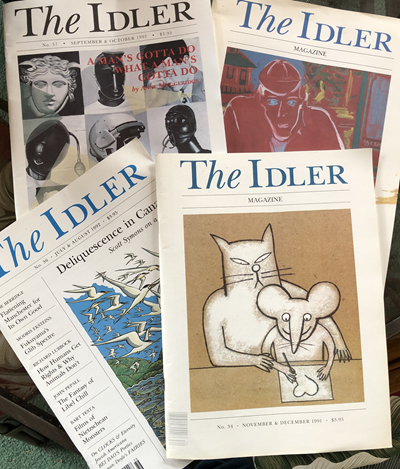
Canada’s The Idler was intended for “a sprightly, octogenarian spinster with a drinking problem, and an ability to conceal it”

Filed under: Business, Cancon, History — Tags: , , , , , , — Nicholas @ 03:00

David Warren had already shuttered The Idler by the time I met him, but I was an avid reader of the magazine in the late 80s and early 90s. I doubt he remembers meeting me, as I was just one of a cluster of brand-new bloggers at the occasional “VRWC pub nights” in Toronto in the early aughts, but I always felt he was one of our elder statesmen in the Canadian blogosphere. He recalls his time as the prime mover behind The Idler at The Hub:

Some late Idler covers from 1991-92. I’ve got most of the magazine’s run … somewhere. These were the ones I could lay my hands on for a quick photo.

This attitude was clinched by our motto, “For those who read.” Note that it was not for those who can read, for we were in general opposition to literacy crusades, as, instinctively, to every other “good cause”. We once described the ideal Idler reader as “a sprightly, octogenarian spinster with a drinking problem, and an ability to conceal it”.

It was to be a magazine of elevated general interest, as opposed to the despicable tabloids. We — myself and the few co-conspirators — wished to address that tiny minority of Canadians with functioning minds. These co-conspirators included people like Eric McLuhan, Paul Wilson, George Jonas, Ian Hunter, Danielle Crittenden, and artists Paul Barker and Charles Jaffe. David Frum, Andrew Coyne, Douglas Cooper, Patricia Pearson, and Barbara Amiel also graced our pages.

I was the founder and would be the first editor. I felt I had the arrogance needed for the job.

I had spent much of my life outside the country and recently returned to it from Britain and the Far East. I had left Canada when I dropped out of high school because there seemed no chance that a person of untrammelled spirit could earn a living in Canadian publishing or journalism. Canada was, as Frum wrote in an early issue of The Idler, “a country where there is one side to every question”.

But there were several young people, and possibly many, with some literary talent, kicking around in the shadows, who lacked a literary outlet. These could perhaps be co-opted. (Dr. Johnson: “Much can be made of a Scotchman, if he be caught young.”)

The notion of publishing non-Canadians also occurred to me. The idea of not publishing the A.B.C. of official CanLit (it would be invidious to name them) further appealed.

We provided elegant 18th-century design, fine but not precious typography, tastefully dangerous uncaptioned drawings, shrewd editorial judgement, and crisp wit. I hoped this would win friends and influence people over the next century or so.

We would later be described as an “elegant, brilliant and often irritating thing, proudly pretentious and nostalgic, written by philosophers, curmudgeons, pedants, intellectual dandies. … There were articles on philosophical conundrums, on opera, on unjustifiably unknown Eastern European and Chinese poets.”

We struck the pose of 18th-century gentlemen and gentlewomen and used sentences that had subordinate clauses. We reviewed heavy books, devoted long articles to subjects such as birdwatching in Kenya or the anthropic cosmological principle, and we printed mottoes in Latin or German without translating them. This left our natural ideological adversaries scratching their heads.

March 5, 2024

Our “transnational” “elites” naturally hate anything smacking of populism

Filed under: Government, Media, Politics — Tags: , , , , , — Nicholas @ 04:00

Niccolo Soldo’s weekend post discussed some of the reasons western “elites” treat anything that can remotely be considered “populist” as if it were outright armed revolution in the streets:

For around 15 years now, the British have elected Conservatives to govern them, with anti-immigration sentiment the key driver in their choice of parties to rule. #Brexit was powered to victory by this same sentiment.

Instead of getting what they wanted, immigration in the UK has continually increased under each and every Tory Prime Minister. Last week, the ruling Conservatives managed to put out two messages on this same issue:

  1. Putin has “weaponized migration” to harm Europe, including the UK
  2. The massive spike in immigration that the UK has experienced since #Brexit was “unintentional” on the part of the Tories

Throughout the West, citizens are becoming increasingly suspicious of liberal democracy because they realize that no matter who they vote for, they always end up getting the same policies to them (yes, this is a gross generalization … please forgive me). It’s not just that people feel that their interests are not being represented by their elected representatives, but that their ruling elites are becoming increasingly distanced from the people that they purport to represent. The sentiment is growing that we are ruled by managers, and that we, the people, really do not have a say in anything.

For those of us who grew up in the West, democracy is part of our DNA. We live and work under the assumption that government rules on behalf of us, the people, and not lord over us, the peons. All of us now realize that the latter is much more true than the former, which is why you choose to read people like me. Very few of us feel that we have the ability to affect the decisions that impact us on a daily basis and that will direct our futures, and the futures of our families. We all have a stake in our respective societies, but feel powerless to do anything about our present situation.

He then linked to this article by Frank Furedi:

Since the turn of the 21st century populism has emerged as a medium through which the Western Elites recycle their worst fears. In the mainstream media populism serves as a signifier of a dark, potentially dangerous force that undermine the stable political institutions that were carefully nurtured in the post-Second World War Era. That is why terms like extreme, far-right, authoritarian, xenophobic and even fascist are often coupled with the word populist. The semantic strategy for framing populism as the antithesis of democratic and liberal norms is to create a moral distance between it and the rest of society.

The representation of populism as a moral disease is frequently communicated through a hysterical narrative about the scale of the threat it represents. Populism is sometimes medicalised as a virus. The growth of a political movement designated as populist is sometimes likened to an infection. Its growth is described as an epidemic by some of its opponents. “The next epidemic: resurgent populism” warns one analyst. “Populism, racism and xenophobia have infected Europe” asserts a writer in Euractiv. One American academic writes of “Populism as a Cultural Virus”. An essay on the Spanish political party Vox is titled, “A Political Virus? VOX’s Populist Discourse in Timed of Crisis”. A Facebook Post of the Young European Federalist stated that “The virus of populism, racism, xenophobia has affected Europe”.

Otto English, a commentator in Politico wrote hopefully that “Coronavirus’ next victim” would be “Populism”. Others were more circumspect and reported that “Covid-19 has not killed Global Populism”.

The use of a medicalised narrative that diagnosed populism as a form of moral pathology is reminiscent of the use of crowd psychology in the 19th century to de-legitimate the democratic aspiration of the people. The demonisation of the masses in the 19th century anticipates the contemporary pathologisation of populism. Crowd psychologists such as Gustave Le Bon wrote off the people as a mass of irrationality and delusion. Then and now the medicalisation of public life expressed an elite’s hatred of those members of their “social inferiors” who dared to challenge their power.

In recent years optimistic predictions about the demise of populism runs in parallel about doom laden accounts of the threat posed by this supposedly dangerous political force. “Has Europe reached peak populism?” asked Paul Taylor in Politico before hopefully noting that the “tide may have turned against nationalist right”. In recent months such hopes have turned into despair as it becomes evident to all that movements labelled as populist are in ascendant. The June elections to the European Parliament are likely to see a substantial increase in the number of parliamentarians affiliated to populist parties. It is unlikely that the dehumanising language of virology is going to do much to discredit the forward movement of populism.

Anti-populist sentiments are particularly prevalent among the oligarchy that runs the European Union. They refuse to regard populist parties as legitimate political opponents. Instead, they treat them as enemies rather than political opponents, The EU financially supports projects designed to curb the epidemic of populism. One such project titled, “Countering the populist threat: policy recommendations and educational tools” is justified on the ground that “populist sentiments and politics are spreading across Europe, dividing society into ‘Us’ and ‘Them’. It describes itself as an ‘An EU-funded project’, which ‘addresses this challenge, thereby ensuring stability of liberal democracies'”.

March 4, 2024

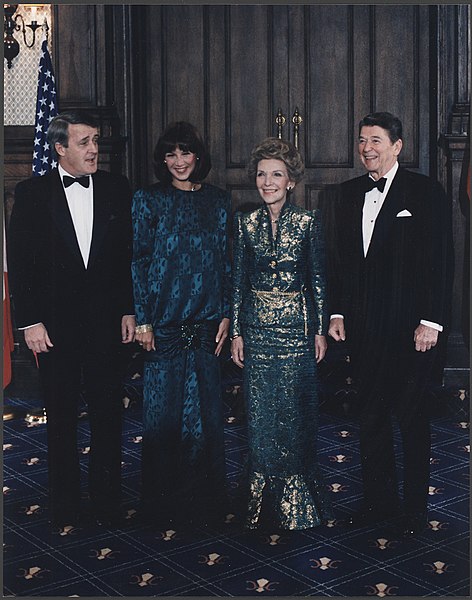
“Whatever his flaws, Brian Mulroney was a serious person”

Filed under: Cancon, Government, History, Politics — Tags: , , , — Nicholas @ 05:00

In the free-to-cheapskates teaser from this week’s dispatch from The Line, nice words are said in memory of the late Brian Mulroney, former Prime Minister of Canada:

Prime Minister Brian Mulroney, Mila Mulroney, Nancy Reagan, and President Ronald Reagan at the “Shamrock Summit”, 18 March, 1985.
Photo from the Ronald Reagan Presidential Library via Wikimedia Commons.

Brian Mulroney died last week. He was 84.

The first thing you could be forgiven for taking away from the news coverage is how far we have fallen.

Brian Mulroney did big things. Negotiating Free Trade. Fighting Apartheid. Getting the Americans to crack down on acid rain. Comprehensive tax reform that saw the old Manufacturers’ Sales Tax (which taxed productivity) replaced with the GST. Sending Canadians to war in Desert Storm. Striking the Royal Commission on Aboriginal People which led to many of the legal advancements Indigenous communities were able to make through the 90s and into this century.

Even when he failed, as he did at Meech Lake, Brian Mulroney was trying to do something fundamentally transformative in Canadian politics.

And nobody who came after him had anywhere near that kind of guts. Not one of them.

There are things people will gripe about when it comes to Mulroney. Karlheinz Schreiber will be pretty close to the top of that list. Mulroney also tends to poll pretty poorly out west for any number of reasons ranging from a perceived over-emphasis on Quebec via Meech Lake and Charlottetown, to awarding the CF-18 maintenance contract to Montreal’s Canadair after (allegedly) promising it to Winnipeg-based Bristol Aerospace.

Mulroney was not beloved when he left office, to put it mildly. His party was basically annihilated in 1993, and the Canadian conservative movement shattered — it has still, in some ways, yet to fully recover. These are facts about which no one made more, or better, jokes than Mulroney himself. But that fall from esteem was almost never seen internationally. As he watched his contemporaries pre-decease him, Canadians got to see how respected the man was on the world stage. Mulroney was asked to eulogize American presidents Ronald Reagan and George H.W. Bush as well as British prime minister Margaret Thatcher. In this, Mulroney embodied one of the greatest cultural cynicisms of this country: sometimes, the only way for us to claim a Canadian as one of our own is to first watch them make it abroad.

Mulroney’s great triumph is free trade. Yes, because it meant jobs for millions of Canadians. Yes, because it locked us into an economic pact with the world’s powerhouse economy. But also because, in doing it, he went head-on at one of this country’s great cliches: the idea that reflexive, Laurentian, anti-Americanism was somehow a basis for governing instead of just the hallmark of a deeply insecure cultural elite.

Nobody is picking those fights now. Nobody is taking on the big battles to remake the country. We have been treated to almost 30 years of some of the pettiest, small-ball sniping imaginable. Various wedge issues are dusted off by either side, and hurled like stale buns at their opponents. Culture wars are imported for the purposes of giving our political class something about which they can feign moral outrage. Our leaders are afraid of big things either because they’re hard, or because they are unlikely to pay off in a single four-year election cycle. Mulroney is, arguably, the last Canadian prime minister whose vision of what Canada is, or could be, was not limited by a four-year horizon.

We are a serious country that is not led by serious people. And that is brought into focus when you lose a serious person.

Whatever his flaws, Brian Mulroney was a serious person.

The Line‘s editors say that Mulroney wasn’t well liked on leaving office, but the utter obliteration of the Progressive Conservatives in the 1993 federal election can’t be completely blamed on him. His successor as PC leader, Kim Campbell, went out of her way to alienate western conservatives and libertarians during her brief time in office and during the election campaign that followed. She became Prime Minister with a surprising level of tentative support that she jettisoned in record time, taking her party from a majority in the House of Commons to two (2) seats — only one other Canadian PM has ever been defeated in their own riding (Arthur Meighen … but he had it happen twice, first in 1921 and again in 1926).

February 8, 2024

QotD: Partisan media

Filed under: Media, Politics, Quotations, USA — Tags: , , — Nicholas @ 01:00

Conservative media is mainly designed to provide its readers with information. But liberal media is designed to give its readers permission to think certain thoughts. It’s not so much that the Politico article was informing democrats about certain uncomfortable Biden facts for the first time, although that is certainly true.

The article was more significant because it signaled to democrats that now acceptable to talk about Biden lying and about his being mixed up with all these sketchy characters.

Jeff Childers, “ONE YEAR ☙ Monday, November 6, 2023 ☙ C&C NEWS”, Coffee & Covid 2023, 2023-11-06.

January 28, 2024

QotD: Never depend on “surveys” for real-world issues

There’s a reason “social science” is all horseshit, and that reason is: surveys. All of this stuff is based on surveys, and as it happens, I have quite a bit of experience of being on the receiving end of these. You see, back in grad school I was involved with a young lady in the Soash Department — I know, I know, but a man has certain needs, ya feel me? — and so I was always on call to take whatever goofy little tests they dreamed up, as a favor to her and her equally spastic hardcore Lefty friends. Anecdotes aren’t data, of course, but I’ve got a lot of anecdotes, and I can tell you — anecdotally — that there are two huge, self-reinforcing problems with these surveys: a) respondent pool, and b) design.

The respondent pool is, overwhelmingly, college kids taking them for class credit. Knowing what we know about Basic College Girls, who again are the majority of all college kids, is it any surprise that the results just happen to confirm the conclusions the slightly older, but no less Basic, Grad Student Girls were looking for? Throw in the design problem — questions about as subtle as “Do you think all races should be treated equally, or are you a monster?” — and you’ve got scientific proof that Liberals are good people and Conservatives suck.

Severian, “Is vs. Ought II: Moral Foundations Theory”, Rotten Chestnuts, 2021-04-20.

January 20, 2024

Looking for some kind of consistency in political commentary

In The Line, Matt Gurney notes that the reactions to a former National Post columnist seeking the nomination for the Conservatives in a 905-area seat fall into depressingly predictable patterns on partisan lines:

Anyone have a standard they can apply consistently in each of these cases? If so, should we maybe write it down or something?

Here’s my take: Each of these cases posed some problems, but none of them fatal, because I think the fear of influence peddling and favour currying actually has the flow reversed: media figures don’t skew their on-air or in-print work to seek political opportunities, but political parties absolutely actively recruit like-minded people with large media profiles.

Maybe I’m wrong. Okay. Just tell me the rule, then, and I’ll go with it.

And then, oh Lord, there’s the rest of it.

Maddeaux’s announcement was met with some, uh, interesting responses. Liberal MP Pam Damoff went right after Maddeaux over a column she’d written on gun control; Fisheries Minister Diane Lebouthillier took umbrage with Maddeaux’s comments on bilingualism. This is fine; Maddeaux has stepped into the political arena and political attacks on her are fair game. But what was stupid was how Conservatives and their numerous social media proxies rushed to play the misogyny card.

Check out this, by long-time CPC staffer and now comms professional Laura Kurkimaki. Kurkimaki tweeted “[S]everal Liberal ministers attacked a young woman today on social media who had just announced she’s running for a @CPC_HQ nomination … Interesting, the same people who say add women change politics, feminist government, sunny ways etc. Embarrassing. Desperate.”

I hope Kurkimaki doesn’t feel picked on here; I chose her comment as a representative example of the eye-rolling array of responses for two reasons: it’s one of the less gross examples of the rush to portray Maddeaux as a victim of sexism; I’d rather not link to the dumber ones. Further, I actually mostly agree with Kurkimaki’s broader point: the Liberals do seem really rattled by Maddeaux’s announcement, and that’s interesting.

But back on topic: is Maddeaux a fair target for reasonable criticism, or does she get some kind of protected status because she’s a woman?

I vote the former! And I suspect that her Liberal critics, from cabinet ministers right on down to the #IStandWithTrudeau crowd on X, would agree. The problem, of course, is that those very same people, again from the cabinet right on down to Trudeau’s social media proxies, are probably mostly — all? — guilty of reacting with exaggerated outrage and cries of misogyny when certain other women are attacked. Chrystia Freeland, Mélanie Joly, Maryam Monsef … I can tell you from personal experience that if you make even reasonable and narrow criticisms of the policies and political performance of those three women, or other prominent Liberals who tick at least one DEI box, you will be swiftly informed that you are, in fact, simply a prejudiced white man.

Oh.

Of course there is sexism in our politics. And other forms of prejudice. And social media is absolutely flooded with rank misogyny and every other disgusting societal cancer you can imagine. Freeland, Joly and Monsef have all been, and will continue to be, targeted with absolutely appalling stuff. Just as Maddeaux has been, and will continue to be. All of it is disgusting.

But for all that, some of what people have to say about these women and their professional performance will be fair, or at least reasonable, and it is incumbent on all to not fake being idiots who cannot tell these two things apart. It’s dumb when it’s Conservatives pretending that Maddeaux is being attacked because she’s a woman, it’s dumb when the Liberals do the same to protect Freeland et al, and, in what I think was the uber-example of this kind of brainrot, it was really dumb when Trudeau responded to credible reports of Chinese electoral interference in Canada, which his government had basically ignored, by lecturing everyone about anti-Asian racism.

December 7, 2023

The only kind of conspiracy theories the media is interested in

Chris Selley points out the obvious bias legacy media polls bring to any investigation into the popularity of various conspiracy theories:

Readers, were you aware that polls show conservative Canadians are more prone to believing in conspiracy theories than liberal Canadians? I’m kidding — of course you were. The pollsters haven’t stopped asking about it since the pandemic hit: Insights West in April 2021, Angus Reid in November 2021, Abacus Data in June 2022, Leger Marketing in the spring of 2022, and again this week. And we in the media can’t get enough of it: “Conspiracy theories are popular in Canada, especially among conservatives, poll says”, was The Canadian Press headline for this week’s Leger poll.

The notion that the Conservative Party of Canada and some of its leading lights are inviting violence through unconscionably heated and conspiratorial rhetoric is endemic in the Canadian newsroom. While I’m no fan of unconscionably heated rhetoric, I very much doubt actual extremists, or potentially violent extremists, see anyone worth choosing among Canada’s federal political leaders. But in any event, it apparently needs saying that not all conspiracy theories are created equal. Some aren’t conspiracy theories at all.

To its credit, The Leger poll released this week mostly confines itself to proper conspiracies: 9/11 Trutherism, a faked lunar landing, etc. Somewhere between 36 per cent (the truth about John F. Kennedy’s assassination was covered up) and five per cent (the earth is flat) believe completely or somewhat in these notions.

But by far the most popular statement among those Leger presented to respondents was as follows: “Mainstream media manipulates the information it disseminates”. Fifty-five per cent of respondents overall agreed with that; the JFK coverup was in a distant second at 36 per cent.

What’s “mainstream media”? If it includes, say, Al Jazeera and Fox News, then the statement is obviously true. (What does “manipulate” mean, for that matter? It doesn’t necessarily imply bad faith.) And the belief is certainly not just confined to Conservative voters: 47 per cent of NDP voters and 53 per cent of Green voters agreed, compared to 69 per cent of Conservative supporters.

What the question definitely does, however, is boost the overall numbers and make them more newsworthy. So Leger (and media) can say “79 per cent of Canadians believe in at least one of the conspiracy theories we asked them about”, and “Conservative voters (94 per cent) are more likely to believe in at least one of the theories”.

That’s a quibble, really. Other polls have, in my view, been utterly shameless about this sort of results-padding.

Take this proposition, for example, which Abacus put to its respondents: “52 per cent think government accounts of events can’t be trusted”.

That is a true statement. It applies to every government in the world, ever.

Even to mention Klaus Schwab’s Great Reset in Canadian political conversation is to risk being branded a conspiracy theorist. But it’s a real-deal “world governance” manifesto, it’s absolutely bonkers from start to finish, everyone from Justin Trudeau to the King (in a previous role) has made approving noises about it, and to the very limited extent it should be taken seriously, everyone should oppose it.

November 16, 2023

Why progressives love all forms of public transit

Theophilus Chilton reminds conservatives and other non-progressives that trains, buses, and other forms of mass transit are beloved of the left at least partly because the more people depend on it, the more control the government gains over their freedom of movement:

TTCImages by Canadian8958
Wikimedia Commons

Ask most people on the broad Right what they think about public transportation and they’d probably tell you that they don’t like it. And it’s not just because of the smell and the gum stuck to the seats. Most of us, deep down inside, at least in some subconscious way, feel that mass public transportation is just a little bit communist.

[…]

This is probably much of the reason why we’re in love with the automobile. With the wide-open spaces and abundant road system we enjoy in America, most Rightists would never dream of trying to force everyone to use an archaic, 19th century technology like trains now that we don’t have to. The automobile is a symbol of freedom. You can go wherever there’s a road, no matter how big or small, when you’re in an automobile. You’re not boxed in with dozens of other people on a line that goes one place only. This is why we generally tend to view air travel as a necessary evil — if somebody invented a car that could get us from Boston to Los Angeles in six hours for a business meeting, we’d probably opt for that instead of getting groped by your friendly neighborhood TSA agent.

Progressive leftists know all of this. They know that the freedom to travel where we want, when we want, how we want, is a psychological buttress to our sense of liberty. Pod-people stay put and go where they’re told. Free men hop into their ’67 Mustang and lay rubber in front of a Dairy Queen three towns over from their own.

Hence, in their never-ending quest to gain total control over our lives, the Left has been putting into play a number of plans designed to limit our freedom of travel.

In case you weren’t aware, one of the purposes served by forcing gasoline prices sky-high is to make private automobile travel prohibitively expensive for more and more people. This has been a major thrust in the “global warming” nonsense that the Left has pushed as well — cars supposedly account for the lion’s share of carbon dioxide emissions (even though they actually don’t), so their use needs to be reduced. Way back in the Obama administration, somebody in the Congressional Budget Office accidentally let the cat out of the bag that it would be a great, absolutely smashing, idea to tax Americans for each mile they drive. Every so often the idea gets resurrected in the media, but thankfully doesn’t seem to have gotten much traction yet. Of course, this is essentially what already happens to us anywise, since we have to pay taxes on each gallon we buy to drive those miles. Presumably, this mileage tax would be added on top of the gas taxes already in place.

The whole point to this is not to “stop global warming”. Let’s face it, those in the know at the top of the progressive hierarchy know that global warming is a hoax. They know it’s just prole-feed for the useful idiots in their own ranks and for the easily swayable among the public at-large. The point to inducing people to stop driving cars is not to save the earth, but to reduce the freedom of movement that people have. Take away cars and you take away the ability of most people to travel for pleasure. You take away their means of conveniently conducting much of their commerce and other business. You would prevent them from being able to have forest hideaways and beach homes. In short, you prevent the middle and working classes from having the same things that the rich can have, you keep them from having lifestyles that even begin to approach the type, if not the extent, of the global transnational elite. Most of all, you would take away that psychological sense of freedom that the ability to move about unhindered gives to people. It’s about forcing us all into the Agenda 2030 “You’ll own nothing and be happy” scenarios that the globalist world-planners have prepared for us.

More recently, and more concretely, is the Congressional effort (which ineffectual Republicans failed to stop) that would direct automobile manufacturers to include a “kill switch” into all vehicles made after 2026, a device which would allow authorities to shut down a vehicle remotely. Ostensibly, the reason would be if the driver is acting like he or she is driving while impaired (i.e. it’s FoR yoUr SaFeTy!!1!). Of course, we know the actual reason is to provide bureaucrats and functionaries in the managerial state the means to freeze the movement of dissidents and others who run afoul of the Regime’s dictates. Don’t think they’d do that? Well, these are the same people who just put the infant son of a J6 defendant on the no-fly terrorist watch list.

So, what would have to replace private automobile travel, once nobody but the super-rich will be allowed it? Public mass transportation, of course. Buses, light rail, subways. This has already largely happened to those poor unfortunates who dwell within our large cities and for whom the lack of parking, expensive personal property taxes, and archaic road systems have already removed the automobile from being a viable alternative. The lefties work to extend this system even to places, such as smaller cities, the suburbs, and even the exurbs, where such systems normally would not be “needed” or desired. Make parking in the city so scarce as to be impossible to find, or so expensive that you’d rather take the bus. Provide “free” bus service (paid for by the taxes of productive, automobile-driving people, of course) to encourage people to stop polluting. In several places, the lefties keep trying to push their light rail boondoggles so that the system can be extended between cities — no more need to have people killing Mother Gaia with highway driving. These public systems are there to take up the slack once private transportation is turned into road pizza.

So how does this affect our freedom? Well, it’s because of the fact that mass transportation is inherently restrictive in its approach to people delivery. A bus route can’t include every single possible place that people might want to get on or off the bus. It only follows certain routes. Same with AmTrak, with light rail, subways, etc. It’s easier, then, to control the access which people have to transportation.

October 25, 2023

QotD: Constant change

Filed under: History, Quotations, Technology — Tags: , , — Nicholas @ 01:00

We are engaged in a giant social experiment. For 99 percent of the time humans have lived in settled societies, life in each generation was essentially like life in the generation before. Stasis, not change, was the rule. Now, for the first time, we live differently, and the gap between the generations grows wider as the pace of change grows faster. Can this continue indefinitely? We have no precedent for that working. Analogies to history are analogies to nothing at all. We might as well analogize the driverless car to the hand-ax.

Instead of empty analogies, the only way to survive change is to have a vigorous debate about the merits of our new ideas — precisely the kind of debate that techno-optimists want to foreclose by appealing to history. We might ask instead: what does this new thing do to us? Do we understand enough to answer that question? If not, on what basis does our confidence rest? Debate on the merits is essential to distinguishing good ideas from bad ones. And for that, you need the people that techno-optimists most loathe: conservatives.

Nicholas Phillips, “The Fallacy of Techno-Optimism”, Quillette, 2019-06-06.

September 8, 2023

The legacy media really value Conservative gab-fests like the current CPC convention

Filed under: Cancon, Media, Politics — Tags: , , , , — Nicholas @ 04:00

Chris Selley explains why the fringe views of obscure Conservative riding associations get so much more juice in the legacy media than equivalent brain-farts from Liberal or NDP groups:

Whatever lands in your news hole from the Conservative Party of Canada convention, which kicks off Thursday night in Quebec City, it’s a safe bet you’ll hear the result of the vote on Policy Resolution 1258. Sponsored by the North Okanagan—Shuswap riding association, it reads, in part, as follows: “A Conservative government will protect children by prohibiting life-altering medicinal or surgical interventions on minors under 18 to treat gender confusion or dysphoria”.

Needless to say this hasn’t gone down very well at the Ottawa press club, where discussion generally confines itself to two countries. “The pitch is similar to ones found across the United States, including in Florida where Gov. Ron DeSantis signed a bill in May banning gender-affirming care for transgender youth,” the increasingly breathless Canadian Press reported. “(It’s) a move many health professionals, parents and advocates of LGBTQS+ youth says places them at greater risk for suicide and depression.”

This is a distraction that leader Pierre Poilievre really doesn’t need. As I wrote last week, on the question of how schools should treat children who wish to change name or gender at school even quite reasonable policies can receive extraordinarily negative press if they are perceived to have been drafted by intolerant people. It’s as if the policies, reasonable on paper, might have some kind of cooties that could harm the children they affect. (That said, in some cases journalists and commentators don’t even seem to have read the policies in question.)

Policy Resolution 1258, like New Brunswick’s and Saskatchewan’s supposedly extreme “social transitioning” policies, isn’t at all extreme by world standards. Gender issues have enflamed the American culture wars, true enough — at last count 19 states, including Florida, had implemented new rules on “gender-affirming care” for kids (and in some cases adults). Naturally Canadian conservatives are watching, some approvingly.

So the legacy media loves intramural disputes within parties on the right, both because it gives them interesting things to report and pontificate about, and also because as a class, journalists tend to skew very heavily progressive. This leads naturally to a difference between how Conservative fringe opinions and progressive fringe opinions are treated in the media.

Especially for a neutral like myself, and especially given how much power party leaders have amassed relative to everyone else, there is a certain pleasure in making a party leader squirm. In the often hidebound and unimaginative world of Canadian politics, that can have benefits. These resolutions often serve as a sort of conscience-check for the party in question: Why aren’t the Liberals liberal enough? Why aren’t the Conservatives conservative enough? Sometimes the party even listens.

That said, I have no idea why parties inflict this on themselves. Mostly these resolutions just stir up trouble. Opposition parties and media alike use these resolutions to craft the dastardly narratives of their choice. The Conservatives in particular suffer from this, and in particular from the Ottawa media.

When the Conservatives ran advertisements claiming the Liberal government wanted to legalize hard drugs — a 2018 policy resolution brought forward by the caucus itself — CTV News declared the ads objectively “false.” The Liberals routinely chuck overboard progressive-minded proposals that come from the party’s left — on legalizing prostitution, for example, or electoral reform — and they’re never heard about again.

The Conservatives’ more right-wing policy proposals seem to get chucked into a giant narrative cauldron and fished out by reporters whenever necessary to prove that there is, in fact, a narrative that needs propagating: on abortion, on climate change, on euthanasia, on gender dysphoria, you name it, and no matter what the leader of the day — the guy everyone knows is in charge — might say.

July 22, 2023

In European politics, “far right” doesn’t mean what Americans think it means

Filed under: Europe, Germany, Italy, Media, Politics — Tags: , , , , , — Nicholas @ 03:00

In The European Conservative, Rod Dreher tries to put the various “far right” European political parties into context for North American readers:

If you are an American who depends on the U.S. and other English-language media for news about continental European politics — and most Americans obviously do — then you might well be afraid that a wave of fascism is poised to sweep Europe.

The European Conservative, obviously, is a great source of news and information about Europe for our American readers — and I hope with this column to help American conservatives better understand what’s going on with the European Right — because there are very few venues for them to do so.

American and British news agencies are reporting that the “far-right” party VOX is likely to do well in this weekend’s Spanish elections. The “far-right” Alternative für Deutschland (AfD) is surging in German opinion polls. It seems like just yesterday that the “far-right” party of Giorgia Meloni topped Italian elections. “Far-right” parties are key to governing coalitions in Finland and Sweden.

And, of course, the BBC website informs its readers to mind “the ultra-conservative, authoritarian-leaning governments in Poland and in Hungary”. Far-rightists to the fingertips, the lot, right?

Well, no. Not even close. American conservatives should understand that by U.S. standards, the “far-right” parties are basically center-right contemporary Republicans. The declining establishment conservative parties of the European continent are more or less Clinton-style Democrats. There do exist genuinely far-right parties in Europe, but they aren’t anywhere near government.

(Though in this spring’s Hungarian elections, the actually far-right party Jobbik, which considers Viktor Orban to be a squish, went into coalition with the left-wing parties. This caused the coalition prime ministerial candidate to boast moronically that his side was truly diverse, because it spanned the ideological spectrum from communist to fascist.)

When U.S. journalists describe these nationalist and populist parties as “far-right”, they intend to call up images of burly fascists marching down cobblestone streets in hobnail boots, shouting abuse at Jews and minorities. I can’t decide if they do this deliberately to mislead American readers into thinking Europe is two tics away from a gran mal Nazi seizure, or if the reporters themselves are so absorbed in the ideology of their class that they honestly cannot discern gradations of right-wing politics.

H/T to Blazing Cat Fur for the link.

July 16, 2023

Tricksy Tucker Carlson “tricked conservatives into accidentally thinking that they don’t like the former vice-president”

Filed under: Media, Politics, USA — Tags: , , , — Nicholas @ 05:00

Chris Bray helps dispel the hypnotic trance so many American conservatives have been suffering under:

Tucker Carlson busy hypnotizing innocent conservatives to think they hate poor Mike Pence.

A stupid trend is emerging in the coverage of campaign discourse.

By now you’ve probably seen footage of Tucker Carlson interviewing Mike Pence in Iowa, a discussion that produced a memorable exchange regarding Ukraine. Politico would like you to know that it was a kind of hypnosis routine, a mental hijacking in which Carlson tricked conservatives into accidentally thinking that they don’t like the former vice-president.

The former Fox News host, reports the all-seeing Sally Goldenberg, “primarily used his perch to press candidates on issues of importance to him: namely, the United States’ role in the ongoing war in Ukraine.” As the United States sends cluster munitions to Ukraine and calls up thousands of reservists for “combat-ready” service in Eastern Europe, a journalist is asking political leaders about Ukraine only because it’s a quirky itch his ego needs to scratch — a selfish personal cause, pursued for whatever odd reason. Here’s Goldenberg’s eighth paragraph, and compare it to what you saw with your own eyes:

    Carlson — a fierce Trump defender who later soured on the ex-president — challenged, interrupted and contradicted the soft-spoken Pence at nearly every turn. As a result, the devout Christian candidate faced hostility and jeers at a summit that would have once provided him with a friendly audience.

The hostility and jeers were inorganic and manufactured; they didn’t happen because the audience didn’t like Pence or his answers, but as a result of the performative maneuvering of an interviewer who challenged and contradicted him. It’s simply not possible that the audience actually didn’t like Pence or his answer; rather, journalism’s David Blaine pulled a “hey, do you wanna see some magic?” on them, whisking them away into a world of illusion. Tucker Carlson entered a thousand helpless brains and drove a Pence-loving audience away like a bus. The story goes on the say that “establishment Republicans expressed dismay,” accusing Carlson of “pro-Kremlin misinfo.” They don’t have to write these stories any more — they can just cut and paste from all the previous versions.

This is a template for all future campaign coverage: Voters were accidentally hypnotized today into wrongfully [fill in blank] after [select: Tucker Carlson / Donald Trump] challenged and contradicted more responsible leaders.

July 14, 2023

QotD: Resolving “disagreements” on Wikipedia

Filed under: Media, Politics, Quotations, Technology — Tags: , , — Nicholas @ 01:00

I keep telling anybody who’ll listen, anytime the subject comes up: Always go to the Wikipedia talk page when you do your “researching” on Wikipedia! Take what you read in the main article with a huge grain of salt if you find a big back-and-forth melee going on in the talk page, for you can take it to the bank that if there’s a disagreement going on between conservative and liberal editors, it will be “resolved” by way of the liberal editors locking the article down after they’ve made sure to get the last word in. Which means what you’ve just read is mostly nothing but pure bovine product. If you’re gleaning this information for any kind of actual purpose, it goes without saying that this is something you should know. Information is meaningless without the “meta data”; without context.

And if there isn’t anything going on back there at all, you should probably still take the main article with a grain of salt because you might be reading a bunch of “everybody knows” gibberish without too much thought behind it.

M.K. Freeberg, “Latest Wikipedia Talk Page Mess: Socialism”, Rotten Chestnuts, 2012-12-01.

July 10, 2023

QotD: Liberal and conservative views on innovation

Filed under: History, Liberty, Politics, Quotations, Technology — Tags: , , , , — Nicholas @ 01:00

Liberals and conservatives don’t just vote for different parties — they are different kinds of people. They differ psychologically in ways that are consistent across geography and culture. For example, liberals measure higher on traits like “openness to new experience” and seek out novelty. Conservatives prefer order and predictability. Their attachment to the status quo is an impediment to the re-ordering of society around new technology. Meanwhile, the technologists of Silicon Valley, while suspicious of government regulation, are still some of the most liberal people in the country. Not all liberals are techno-optimists, but virtually all techno-optimists are liberals.

A debate on the merits of change between these two psychological profiles helps guarantee that change benefits society instead of ruining it. Conservatives act as gatekeepers enforcing quality control on the ideas of progressives, ultimately letting in the good ones (like democracy) and keeping out the bad ones (like Marxism). Conservatives have often been wrong in their opposition to good ideas, but the need to win over a critical mass of them ensures that only the best-supported changes are implemented. Curiously, when the change in question is technological rather than social, this debate process is neutered. Instead, we get “inevitablism” — the insistence that opposition to technological change is illegitimate because it will happen regardless of what we want, as if we were captives of history instead of its shapers.

This attitude is all the more bizarre because it hasn’t always been true. When nuclear technology threatened Armageddon, we did what was necessary to limit it to the best of our ability. It may be that AI or automation causes social Armageddon. No one really knows — but if the pessimists are right, will we still have it in us to respond accordingly? It seems like the command of the optimists to lay back and “trust our history” has the upper hand.

Conservative critics of change have often been comically wrong — just like optimists. That’s ultimately not so interesting, because humans can’t predict the future. More interesting have been the times when the predictions of the critics actually came true. The Luddites were skilled artisans who feared that industrial technology would destroy their way of life and replace their high-status craft with factory drudgery. They were right. Twentieth century moralists feared that the automobile would facilitate dating and casual sex. They were right. They erred not in their predictions, but in their belief that the predicted effects were incompatible with a good society. That requires us to have a debate on the merits — about the meaning of the good life.

Nicholas Phillips, “The Fallacy of Techno-Optimism”, Quillette, 2019-06-06.

« Newer PostsOlder Posts »

Powered by WordPress