Quotulatiousness

August 26, 2024

David Friedman – “my fargroup … are being attacked by my outgroup. My enemy’s enemy …”

I’m much of David Friedman‘s opinion on the candidates for both the Democratic and Republican parties in the current US presidential election … and I also find myself leaning more toward Trump even though his re-election would almost certainly be worse for Canada:

Donald Trump, surrounded by Secret Service agents, raises his fist after an attempt on his life during a campaign speech in Butler, PA on 13 July, 2024.

My opinion of the election is “a plague on both your houses”. Kamala Harris is an extreme representative of an ideology I have opposed for most of my life. Donald Trump has three major positions on two of which, immigration and trade, he manages to be even worse than his opponent. While I have some sympathy for his views on the third — I have been arguing against an interventionist foreign policy for something over fifty years now — I do not trust him to execute a consistent and competent alternative. His disinterest in whether what he says is true, extreme even for a politician, I find offensive.

That is my intellectual view of the matter. It is not my emotional view. Reading news stories and observing the effect on my feelings, I note that I am reacting like a Trump partisan. Poll results that look good for him make me happy, poll results that look bad for him make me sad. Accounts of outrageous statements by Trump or Vance I ignore — I don’t expect them to tell the truth. Accounts of demagoguery by Harris or Waltz arouse feelings of indignation. If Harris wins I will feel disappointed. If Trump wins I will feel relieved, at least until the first outrageous thing he does.

The explanation of my inconsistent reaction is provided by Scott Alexander in “I Can Tolerate Anything Except The Outgroup“, one of the best of his many good essays. In it he points out that someone’s outgroup, the group for whom he feels and expresses strongly negative views, is typically made up not of people distant from him, geographically and intellectually, but of people close. The outgroup of the Nazis was not their Japanese allies or the Chinese the Japanese were fighting, it was German Jews, people with the same language and, in most respects, the same appearance and culture. The outgroup of American leftists is not Muslim fundamentalists but American conservatives.

Conservatives have doubts about gay marriage. Muslim fundamentalists view homosexual intercourse as a capital offense.1 American conservatives would like their schools to be more tolerant of creationism. Muslim fundamentalists want their schools to teach the truth of Islam. And yet, when conservatives criticize Muslims, leftists defend them. When Muslims kill Jews and Jews respond by killing Muslims, it is the Muslims that the American leftists support, the Jews that they blame — although Israelis have much more in common, ideologically as well as culturally, with American leftists than Palestinians do.

    We think of groups close to us in Near Mode, judging them on their merits as useful allies or dangerous enemies. We think of more distant groups in Far Mode – usually, we exoticize them. Sometimes it’s positive exoticization of the Noble Savage variety (understood so broadly that our treatment of Tibetans counts as an example of the trope). Other times it’s negative exoticization, treating them as cartoonish stereotypes of evil who are more funny or fascinating than repulsive. Take Genghis Khan – objectively he was one of the most evil people of all time, killing millions of victims, but since we think of him in Far Mode he becomes fascinating or even perversely admirable – “wow, that was one impressively bloodthirsty warlord”. (Scott Alexander, “Post-Partisanship Is Hyper-Partisanship“)

Conservatives are the leftists’ outgroup, Muslims their far group. The far group can be ignored; large parts of the world are more sexist and more racist than any part of America but invisible to progressives campaigning against sexism and racism. The far group can even be supported, at least if the outgroup is attacking it. My enemy’s enemy is my friend. Muslim fundamentalists. Hamas.

Kamala Harris is an American leftist. American leftists are my outgroup. Trump and Vance are American populists. I disagree with their views, in some cases more than I disagree with the views of American leftists, but I have nothing against them, just as I have nothing against believing Catholics or Orthodox Jews or Black Muslims or believers in Christian Science.

Trump and his movement are my fargroup. They are being attacked by my outgroup. My enemy’s enemy …


    1. In some times and places Muslim culture has been tolerant of homosexuality; there are two famous medieval essays on the relative attractions of homosexual and heterosexual intercourse and quite a lot of poetry celebrating homosexual love. But the religious doctrine, which fundamentalists take seriously, holds homosexuality to be forbidden.

July 26, 2024

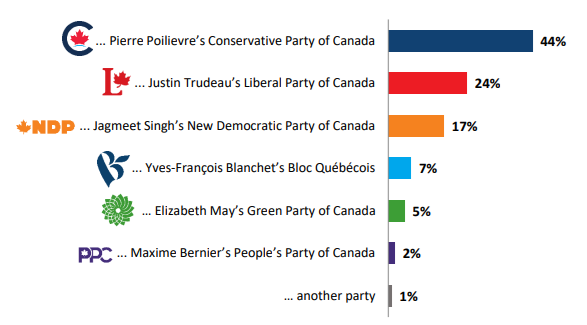
Latest Liberal ad totally DESTROYS Pierre Poilievre and the Conservatives

Filed under: Cancon, Media, Politics — Tags: , , , — Nicholas @ 03:00

If you’re new here, you may not recognize my headline as being sarcastic. Here’s Chris Selley‘s attempt to figure out what the Liberal brain trust is up to with their latest anti-Tory ad:

“The CEO of Elections Canada has indicated his opposition to it, and let me just say I’m at peace with that.”

These words, spoken by Pierre Poilievre a decade ago, are part of an absolutely bizarre 46-second video the Liberal Party of Canada released in recent days trying to convince us — a very novel approach — that the Conservative leader is too wacky and full of dangerous ideas to vote for.

Read that sentence again. It’s supposed to be a scare quote. Are you scared? Or, more likely, do you not know what the hell he’s talking about? Removed from its context it’s not just uncontroversial; it barely even exists. It’s like someone negotiating the return date on their dry cleaning, or asking for no mayonnaise on their Whopper.

There’s another quote like that in the same 46-second video: “We’re Conservatives, so we don’t believe in that”.

Believe in what? No idea. Keynesian economics? The curse of the Oak Island treasure? Could be anything.

The notion that communications is the Liberals’ “problem” is as laughable as ever, but good grief are they ever terrible at communicating.

Usually politicians take other politicians’ quotes out of context to make them look bad. Here the Liberals have done … I really have no idea what. It’s like they’re so hopelessly ensconced in their echo chamber that they can’t tell which echoes have even escaped the chamber into the real world … if the real world even still exists.

Those intimately familiar with Poilievre’s parliamentary record (which is what, maybe 90 people in the world?) might surmise, correctly, that in the first instance he was talking in his role as minister of state for democratic reform in the Harper government about Bill C-23. That was the 2014 legislation that, most controversially, toughened voter-ID requirements: Your voter-information card, delivered by mail, would no longer be sufficient proof of your identity to cast your ballot. You wouldn’t be able to “vouch” for another voter.

This was unnecessary, I felt at the time, and I might still, though the prospect of electoral fraud doesn’t make Liberal eyes roll quite as theatrically as it used to. But it seems clear the serious foreign interference in play is considerably smarter and more insidious than just sending some people to vote without proof of citizenship (which few of us offer up to vote as it stands).

Anyway, Poilievre was telling a Senate committee, on April 8, 2014, that he understood then chief electoral officer Marc Mayrand disagreed with the bill, and that he disagreed with Mayrand, and that he was “at peace with it.”

I do hope you were sitting down for that bombshell.

July 22, 2024

“Dissident Christianity”

Filed under: Cancon, Europe, Religion, USA — Tags: , , — Nicholas @ 04:00

While I don’t have a god in this fight, I find much to agree with Fortissax here as he responds to another writer’s commentary on modern western Christianity in an essay he titles “Spiteful Mutant Christians“:

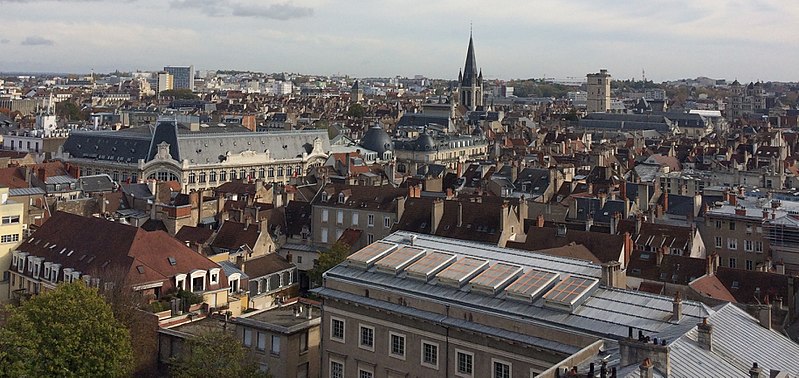
Dijon viewed from Saint-Bénigne Cathedral with the Palace of the States of Burgundy, the Notre-Dame and Saint-Michel churches, the Saint-Nicolas tower, the former Saint-Bénigne abbey palace (ENSA), The Lafayette galleries, the old department stores at Le Pauvre Diable and la Ménagère.
Photo by Twibo2 via Wikimedia Commons (caption translated by Google Translate).

Admittedly, I’m not a fan of the majority of Christians on the right, particularly traditionalists on Substack. Before I open a salvo on them, I will say many of them are educated, well-written, and well-spoken. Many of them are respectable, as far as I know, often fathers of many children, who aspire to virtue. This is certainly better than a great many. Many of them have been in this business far longer than I have. Many of them are intelligent and offhand I enjoy many of their general insights. Overall, I wish them no ill will.

However, I’m inclined to believe they’re mostly out-of-touch, often Generation X or elder Millennials who caught the last chopper out of Vietnam and fundamentally don’t understand the socioeconomic or cultural reality of younger Millennials or Generation Z. Who are colourblind by their narrow fraternal environment of American ruralite post-postmodern Christians who seldom interact with people outside of their pseudo-collapsitarian communities. I say “pseudo” because they’re not crazed Libertarian doomsday preppers building bunkers with a hand shovel in the backwoods of Montana, but I’ve observed that the Christian Traditionalist tendency is “Quietism”. From what I understand about Quietism, this is the Christian tendency to be pacifistic, avoid all confrontation, completely abandon North American cities, urban or civil life, and retreat to what is a romanticist fantasy of pastoral agrarian landscape of isolated God-fearing communities, have a pint, and wait for this to all blow over. They’re convinced of the moral, ethical and philosophical superiority of their rural life, an desperately wait for the day they can starve the city boys out.

On that note, the worst and most obnoxious of them are former city slickers or suburbanites who move to the countryside, but that’s an entirely different argument, and I’m getting sidetracked. Perhaps my biggest criticism of the Christians is that they are extremely presumptuous people in “this thing we call” the Dissident Right.

They piggyback off the remnant adherence and nominal identification to Christianity among the irreligious populace who, if they attend church at all, attend churches that are completely captured by the deistic DEI God of Equity. They pretend their super-ultra esoteric Pageau Hermetic Catholicism, Christ-is-King MAGA communist groyper Christian “nationalism”, or “based warrior priest” Eastern European war footage Orthodoxy is the norm. They pretend that the bumbling Christian faithful know or understand half of what they discuss on Telegram, X, or Substack, and this gives them a false sense of security and inevitability. They speak with a false confidence that, to outsiders, would appear that they’re truly in the know, that everyone is in fact Christian, and it’s only a matter of time before everyone else is. This is completely out of touch with reality. If you look at who is Christian and who isn’t, you start to see the brutal picture. For simplicity’s sake, we will focus on North America and Western Europe, with the dividing line being the old NATO boundaries. Let’s break down the facts:

In 2024, the following percentages of national populations identified as Christian

  • Portugal: 84.8%
  • Italy: 83.8%
  • Denmark: 79%
  • Norway: 76.7%
  • United States: 65% (Pew Research Center)
  • Belgium: 65%
  • Canada: 53% (Pew Research Center)
  • Spain: 67%
  • Switzerland: 58.2%
  • United Kingdom: 59%
  • Germany: 57%
  • Netherlands: 43%
  • France: 63% (Pew Research Center)

On its face, you’d be inclined to believe that the majority of the Western world is Christian: God-fearing, church-going, has read and understands the Bible, and partakes in a community, correct? Wrong. The overwhelming majority of people who identify as Christian don’t go to church, and this is explained by baptisms at birth or early life inductions that never lead to anything. The real percentage of practising Christians is as follows, with Portugal hilariously being not even a quarter of what it claims, despite having the highest rate of identification.

In 2024, the following percentages of national populations regularly attending church.

  • Portugal: 19% (Catholic News Agency)
  • Austria: 14% (Catholic News Agency)
  • Spain: 13.4% (Wikipedia)
  • Italy: 20% (Catholic News Agency)
  • Germany: 9% (Catholic News Agency)
  • Netherlands: 7% (Catholic News Agency)
  • Switzerland: 5% (Wikipedia) (BFS Administrations Website)
  • France: 5% (Catholic News Agency)
  • Belgium: 5% (Catholic News Agency)
  • United Kingdom: 5% (Catholic News Agency)
  • Canada: 5% (CareyNieuwhof.com)
  • United States: 24% (weekly attendance) (ChurchTrac) (PRRI)
  • Norway: 3% (Catholic News Agency)
  • Sweden: 3% (Catholic News Agency)
  • Denmark: 3% (Catholic News Agency)

I was technically baptized Catholic, specifically because it was believed that I’d have greater access to educational opportunities, and not out of any genuine piety. I was given a choice at 3 years old to go to my first communion or watch Power Rangers. I’ve never read the Bible, save for two versions of half the book of Romans before putting it down, incredibly unimpressed with Paul failing to sell me on Christianity. My family has been irreligious for four generations. My province of origin, Quebec, is the most secular part of North America, and I’m proud of it. I don’t believe we can sever the influence of Christianity completely, and I don’t think we should. It is an integral part of our heritage, and we need to respect it. You can’t claim to honour your ancestors, or even western history without honouring Christianity. I do however believe that secularism gave the West an opportunity for a clean enough slate to find the definitive, ongoing unraveling of Truth. I chose hero worship. No honest person would say this makes them a Christian.

The purpose of bringing up these statistics is to perform a reality check. Christians are not the majority. Not in the general population, and not in the Dissident Right. Christians do not have a monopoly on morality. Christians do not have a monopoly on Truth. Christians completely lack the social capital and popular consensus to instigate the social policies they want in accordance with their faith on a civilizational scale. I believe that part of the issue is that the discourse is civilization-wide, but most of the Christianity is coming from North America, specifically the United States of America, where it represents a small and dwindling political faction of a broader conservative movement. There is not going to be a Fifth Great Awakening — their latest awakening as Greene himself would admit, is Wokism. A deistic Christian heresy. The public is not going to kneel, convert to disparate, squabbling denominations of Christianity marching in lockstep with Regimevangelicalism.

Blue Checkmark Christianity™ has recently signaled a green light to the millions of Global South Catholic faithful that it’s okay to illegally migrate to and trespass in Europe. The Hierophant has ordered His faithful to abide.

The fact of the matter is that Dissident Christians are a minority of a minority — they’re the equivalent of Sikhs in India. One percent of the population, and yet one loud, obnoxious voice giving all the impression they’re a bigger majority than they are. Christians like Misanthrope are as barely relevant as the degenerate neopagans and their profligate made up religions with zero legitimacy or antiquity. Hiding their views from their pastors, priests and the rest who attend their churches. It is an absolute LARP to speak with the audacity and arrogance that they do to the great secular majority, and or other groups who are attempting to cultivate faith with sincerity. You’d think if their truth was so self-evident, they’d be winning a whole lot more people, and the West would be Christian, but no. They’re going out the same way Zoroastrianism did, and after that, Hellenism, the state religion of the Roman Empire. Weak men, wicked priests, irreligiosity, bureaucratization of the liturgy, heretical reinterpretation of the word. I could go on.

July 19, 2024

The rise of the reactionaries – Gen X poised to pounce and seize

Filed under: Cancon, Economics, Media, Politics, USA — Tags: , , , , — Nicholas @ 03:00

Andrew Potter tries to explain why Gen X are much more likely to support conservative policies than the groovy fossil Boomers and the painfully Socialized Millennials and GenZ’ers:

Generation X Word Cloud Concept collage background
Best Motivation Blog: What Generation Is X

As North American politics continues its rightward lurch, it is becoming increasingly commonplace to note the outsized role of Gen Xers in pushing this trend. In 2022, a Politico essay tried to explain “How Gen X became the Trumpiest generation“. That same year, an essay in Salon lamented how “of course Gen X was always going to sell out and vote Republican”. Writing in The Line last year, Rahim Mohamed wondered “how Generation MTV became Generation GOP?” These aren’t outliers – there is a whole sub genre of cultural commentary devoted to trying to explain just why Gen Xers are so right wing, compared to both their Boomer predecessors and the Millennials and Zs who followed.

This raises a couple of questions, the first of which is: is it even true? And if so, why?

On the facts of the matter, it appears that members of Generation X are, on the whole, more conservative than other generations, and this is especially true in the United States. For the past three or four years, polls have consistently shown that Gen Xers are more likely to see the country as going in the wrong direction, more likely to disapprove of Joe Biden, and more likely to support Donald Trump and vote Republican, than any other generational cohort. And while every generation tends to become more conservative as it ages, it is a tendency that accelerated under Gen X.

Pollsters have found similar support for these trends in Canada. An Abacus survey conducted last August found Gen Xers had the highest level of support for the Conservatives, with 41 per cent of those surveyed intending to vote CPC. And just this past June, the pollster Frank Graves released a series of charts tracking sentiment in Canada on a number of issues, including national attachment, social cohesion, and voter intention. He found significant intergenerational discord, with members of Gen X showing the highest level of support for smaller government, and Gen X males having the highest level of support for the CPC.

So why is this the case? How did the generation that fought (and won) the first culture war against conservatives, that launched the antiglobalization movement, that made heroes out of left wing icons like Kurt Cobain and Naomi Klein, become the most right wing cohort of all? Did we follow our Boomer parents’ hippies-to-yuppies trajectory in selling out? Or is there something else at work, beyond crass financial self-interest?

There’s probably at least something to be said for the “crass self-interest” angle. Despite the long-standing claim to being the first generation to do worse than their parents, the truth is, Gen X is raking it in. Starting right around the pandemic, Canadian Gen Xers quietly overtook Boomers as the generation with the highest average household net worth. It may also explain why alone amongst the generations, members of Gen X list “cost of living” as their most salient political issue, in contrast with both the older and younger cohorts who identify things like climate change, health care, and the environment as the most important issues facing Canada.

July 16, 2024

Britain’s Tories – “It is hard to think of any political Party that has so relentlessly thrown away its political mandate”

Lorenzo Warby considers a few of the early lessons that can be drawn from the British general election results:

I dislike the term “the deep state”. It mystifies what is much more straightforward, even bland: how metastasising bureaucracy is undermining the resilience of Western societies and their political systems.

The British Labour Party has won a massive Parliamentary majority in the House of Commons even though its total votes fell: from 10,269,051 in 2019 — 32.1% of total votes — to 9,704,655 in 2024 — 33.7% of total votes. Labour’s massive Parliamentary majority is not a product of enthusiasm for Labour, but the fracturing of the votes of its opponents.

The Scottish National Party (SNP) vote fell dramatically — from 1,242,380 votes in 2019 to 724,758 in 2024. This was largely a casualty of the SNP embracing the genderwoo of Transactivism. Outside some narrow urban enclaves, no one votes for “woke” but, given a genuine opportunity, folk will vote against it. As Scots have.

The Liberal Democrats did very well, as they have a regionally concentrated vote — which, this time, they targeted properly — and disgruntled (posh) Shire Tories will protest vote Lib-Dem. Clearly, lots did.

The Tories did so badly because their already low vote was further reduced by the Reform vote surge. The Reform vote represented voters punishing the Tories for their failure to do anything they had promised. As political scientist Matt Goodwin puts it:

    They failed to control our borders.

    They failed to lower legal immigration.

    They failed to cut taxes and the size of the state.

    They failed to take on woke, exposing our children to ideas with no basis in science.

    And they failed to level-up the left behind regions.

It is hard to think of any political Party that has so relentlessly thrown away its political mandate.

So, an angry, unhappy electorate (rightfully) punished two governing Parties (Tories and SNP) and has given Labour a massive majority, with little enthusiasm — almost two-thirds of voters voted for someone else — on a relatively low turnout.

There is, however, a deeper institutional issue underlying these results. Why are voters so disgruntled? Why did the Tories fail so spectacularly?

The answer to these questions is a mixture of how institutions have evolved, the development of media culture, the Anywhere-Somewhere divide and technocratic delusions.

Technocratic delusion

The technocratic delusion is multi-layered. It holds that governing is a managerial input-output problem, government bureaucracy simply implements policy, and that politics is not a motivation and coordination problem.

None of these presumptions are true, so technocratic politics fails. It does not connect to voters and does not understand, or grapple with, the actual institutional landscape.

The technocratic delusion is a way for clever people to be spectacularly clueless. Not the only such mechanism in the modern world.

July 4, 2024

“Over twenty years ago now, we declared war on terror; a generation later, we are ruled by terror”

Filed under: Europe, Media, Politics, USA — Tags: , , , , , , , — Nicholas @ 04:00

At Postcards From Barsoom, John Carter discusses the prevalence of fear in modern western culture:

Over twenty years ago now, we declared war on terror; a generation later, we are ruled by terror. The public discourse revolves around peoples’ fears, most of them imagined. Many spend their lives petrified at the prospect of normal social interaction. Women are scared that men will rape them, and men are scared that women will rape them in the courts. Both leftists and rightists are terrified that the other, if given free rein, will drag the world into a dark age, though only one of them is right. All of our great public efforts are either to mitigate this future catastrophe or that dire present threat, or they are about furiously not acknowledging some insoluble and therefore inevitable future disaster, while studiously ignoring some entirely soluble ongoing emergency which those who could solve delude themselves they can profit from.

It shouldn’t be surprising that the war on terror ended up making us chronically terrified. That’s the track record for these things. Even back in the 1990s we knew that. The war on poverty generated an obscenely inflated welfare underclass while systematically slowing economic growth, thereby generating poverty twice over. The war on drugs led to a society of drug addicts, in which every fifth person is on at least one kind of pill, and most of the rest are self-medicating in other ways. Instead of weed (legal now, in any case), we have fentanyl and meth. Victory!

When Washington declares war on something, it invariably produces more of it. This seems perverse until you realize that wars on abstractions are simply how managerial bureaucracies extend their bases of power. A war that can never be won is a war with job security. A war that gets worse the longer and harder you fight it is even better, because this generates growth.

Washington’s current wars seem to be on racism, baseline human sexual normalcy, men, and multipolarity; the latter is really just a fancy word for the growing tendency for other countries to not do what Washington tells them to because, in general, they prefer being racist to being erased, they think the butt stuff is weird, they don’t want to be castrated, and since they are not castrated, they are still capable of not liking to be told what to do. Sure enough, all of these wars, whether cultural or geopolitical, are steadily generating the very things that they’re trying to stamp out. Racism stocks have reached prices they haven’t seen in generations, thanks to sustained decade of all-out full sector push by the media, corporate, educational, and public sectors, all doing their part to push that line up, up, up. Meanwhile, the war on multipolarity seems in general to be doing a fantastic job of generating more multipolarity.

The longer Washington wages its cowardly war against Russia, China, Iran, and I guess now North Korea, the more Washington’s standing in the world is reduced. I say “cowardly” of course because the war is not waged openly: formally, no war has been declared by Washington or any of its core NATO allies against any of the obvious belligerents. It’s all done through proxies which Washington pays to train and arm and die on its behalf, funding it all with a money printer whose brrrring has gotten defeaning. Or it’s done through sabotage; let’s not forget Nordstream, which kicked the legs out from under Germany’s, and therefore Europe’s economy, in perhaps the most breathtakingly cynical act of strategic sabotage against a supposed ally that one might imagine. Washington doomed Europe in order to ensure that Europe would stay attached to Washington. The whole world sees what Washington is doing of course, and is frightened lest it happen to them, but also disgusted that it happens at all; the latter emotion is becoming increasingly dominant, however, because Washington is becoming less frightening every day.

Washington could not even coordinate an orderly retreat from Afghanistan; its wunderwaffen have made little impact on the Ukrainian battlefront; even combined with its vassals, it cannot match levels of armament production that come effortlessly to its adversaries; its pier in Gaza fell apart uselessly; its mighty navy has so far been utterly powerless to stop a blockade imposed by some obscure tribe of desert Arabs. Then there’s the big fail, Washington’s attempt to nuke the Russian economy by locking it out of the SWIFT system. The Russian economy is doing fine, in fact better than fine, but SWIFT on the other hand is swiftly becoming irrelevant. The dollar’s global reserve status is on borrowed time, and everyone knows it.

I don’t think anyone’s more terrified right now than Western elites. They know they’ve fumbled the ball, that they’ve lost their footing, and they’re flailing around weightlessly as they try to catch it without faceplanting. None of their plans are really working. None of their usual levers of control are as effective as they used to be; some, such as the media, have almost stopped responding altogether. Their people are turning against them for a dozen different reasons, all of them excellent. Their great economic machine is sluggish, its components grinding together and seizing up. Their enemies abroad are on the march, or mobilizing. It’s all coming for them at once, and they don’t appear to have any idea what to do. You’re seeing that deer in the headlights look a lot now from prime ministers and presidents, and it isn’t always because of dementia. They’re in over their heads. Children, playing a game that became all too real when they weren’t paying attention.

June 26, 2024

Lord Balfour

Filed under: Britain, History, Middle East, Religion, WW1 — Tags: , , , , , — Nicholas @ 03:00

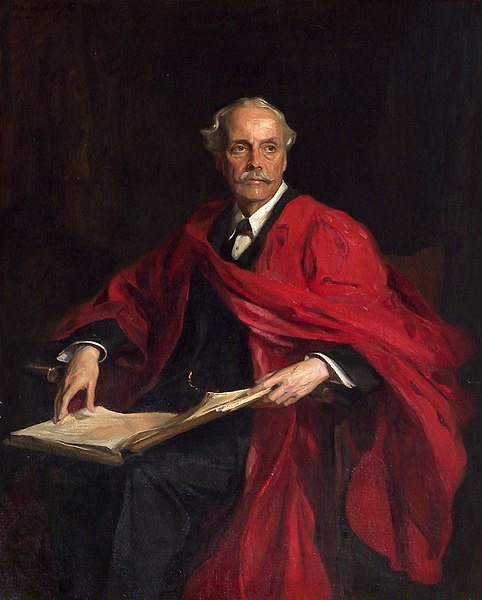
Arthur Lord Balfour, Conservative Prime Minister from 1902 to 1905, is perhaps best known for the Balfour Declaration issued during World War 1 that established the formal goal of an independent homeland for the Jews in the Holy Land. Who was he? Barbara Kay’s essay originally published in the Dorchester Review was recently reposted at Woke Watch Canada:

“Arthur James Balfour, 1st Earl of Balfour, KG, OM, PC, Prime Minister and Philosopher” portrait in oil by Philip de László, 1914.
From the Trinity College collection via Wikimedia Commons.

Why was the aristocrat Lord Balfour, the social antithesis of this humble Jew from the Pale of Russia, so taken with Weizmann’s vision that he was willing to expend political capital and exert so much effort to see it realized? Who was Balfour? What was he?

Arthur James Balfour was born at his family seat, Whittingehame, in East Lothian, the “granary of Scotland”. A forebear had made a fortune in India in military materials, so he was financially secure for life, and socially connected at the highest levels.

Having lost his father when he was 7, Balfour was lucky in his mother, a strong-willed and educated woman who, according to Mrs Dugdale, inculcated the idea of duty as “the uncompromising foundation of his character”. He attended Eton and Cambridge, where he was described by a friend as “a man of unusual philosophy and metaphysics”, who could hold his own with the Dons (professors), “some of them men of undoubted genius”. He was devoted to his extended family, and much beloved by his nieces and nephews.

In his essay “Arthur Balfour: a Fatal Charm”1 cultural critic Ferdinand Mount cites “nonchalance” as Balfour’s defining trait. Legendarily indolent, he rarely rose before 11 a.m., claimed never to read newspapers, and disdained the ritual schmoozing of fellow backbenchers expected by his peers in the Members’ Smoking Room. Mount says he was “indifferent to what his colleagues, the public or posterity thought of him or his policies”.

This loftiness — echoed in his unusual physical height — was perceived as admirable or maddening according to the observer and circumstances. Churchill said of him: “He was quite fearless. When they took him to the Front to see the war, he admired the bursting shells blandly through his pince-nez. There was in fact no way of getting to him.”

His self-sufficiency was no act. Sports-mad, he skipped lunch with the Kaiser to watch the Eton and Harrow cricket match, and when in Scotland might play two full rounds of golf a day (his handicap of 10 was better than P. G. Wodehouse and about the same as thriller writer Ian Fleming’s).

Balfour sounds from my description so far as if he was something of a playboy, but that is a very partial portrait. He was also known as “Bloody Balfour” for his readiness to endorse police action and his apparent indifference to their cost.

The Irish loathed him. In 1887 he became personal secretary for Ireland under his uncle, Lord Salisbury, just in time to enforce the Coercion Act against the volatile Irish Land League. Indeed, Balfour’s parliamentary critic William O’Brien saw him as a man who harboured a “lust for slaughter with a eunuchized imagination” who took “a strange pleasure in mere purposeless human suffering, which imparted a delicious excitement to his languid life”.

One hopes this accusation of actual sadism is an exaggeration of Balfour’s indubitable detachment. Yet indifference to human life is certainly not an uncommon charge laid against intellectuals for whom ideas loom larger in their claims to attention than the fate of those beyond their particular tribes.

For balance, we have Barbara Tuchman’s assessment:

    Balfour had a capacious and philosophical mind. Words to describe him by contemporaries are often “charm” and “cynicism”. He had a profound and philosophic mind, he was lazy, imperturbable in any fracas, shunned detail, left facts to subordinates, played tennis whenever possible, but pursued his principles of statecraft with every art of politics under the command of a superb intelligence.

Fortunately for his temperament, Balfour’s life circumstances had landed him at the centre of a genuinely intellectual circle. His brothers in-law, for example, were Lord Rayleigh, who became head of the Cambridge Laboratory and won the Nobel Prize for Physics, and Henry Sidgwick, the Cambridge philosopher who with his wife Elaine Balfour founded Newnham College.

Politically, Balfour enjoyed both dramatic success and dramatic failure. He led the Unionist Party longer than anyone before him since Pitt the Younger. And he was a minister longer than anyone else in the 20th century, including Winston Churchill. Balfour was the only Unionist who was invited to join Asquith’s first war cabinet, and continued as foreign secretary after the coup that brought Lloyd George to power.

As Churchill put it: “He passed from one cabinet to the other, from the prime minister who was his champion to the prime minister who had been his most severe critic, like a powerful, graceful cat walking delicately and unsoiled across a rather muddy street”.

One of Balfour’s teachers at Eton described him as “fearless, resolved and negligently great”. On the other hand, Mount tells us, “indecisiveness” was his bane. He would stand paralyzed in the mezzanine of his London home agonizing over which of the matching staircases to descend by. He could love — the great love of his life died after an unreasonably long engagement — but, allegedly too staggered by the loss of his almost-fiancée, he never married.2 He could not be pinned down politically on many issues, a matter of great frustration to his colleagues, and this cost him dearly. As Mount notes, his charm was indisputable, “but more than charm he would not give” and “in the end, the charm is all that remains.”

Balfour fought three general elections as party leader and lost them all. His premiership lasted less than four years and ended in a Liberal landslide in 2006, a great electoral humiliation in making him the only prime minister in the 20th century to lose his own seat. He did not seem greatly to repine at the rejection, though, and it is thanks to the loss that he had time to further his education on the Zionist movement.


    1. Mount, Ferdinand, English Voices (2016), pp 358 ff.

    2. One suspects that even if May Lyttleton had lived, Balfour would have avoided marrying her on some pretext or other. There is no evidence that Balfour was a closeted homosexual, but he may have been asexual. He enjoyed an “amitié amoureuse” with (married) Mary Elcho for 30 years involving little or nothing in the way of sex, after which she wrote to him, “I’ll give you this much, tho, for although you have only loved me little, yet I must admit you have loved me long”.

June 21, 2024

Fractal dissidence

Filed under: Europe, History, Media, Politics — Tags: , , , , , — Nicholas @ 04:00

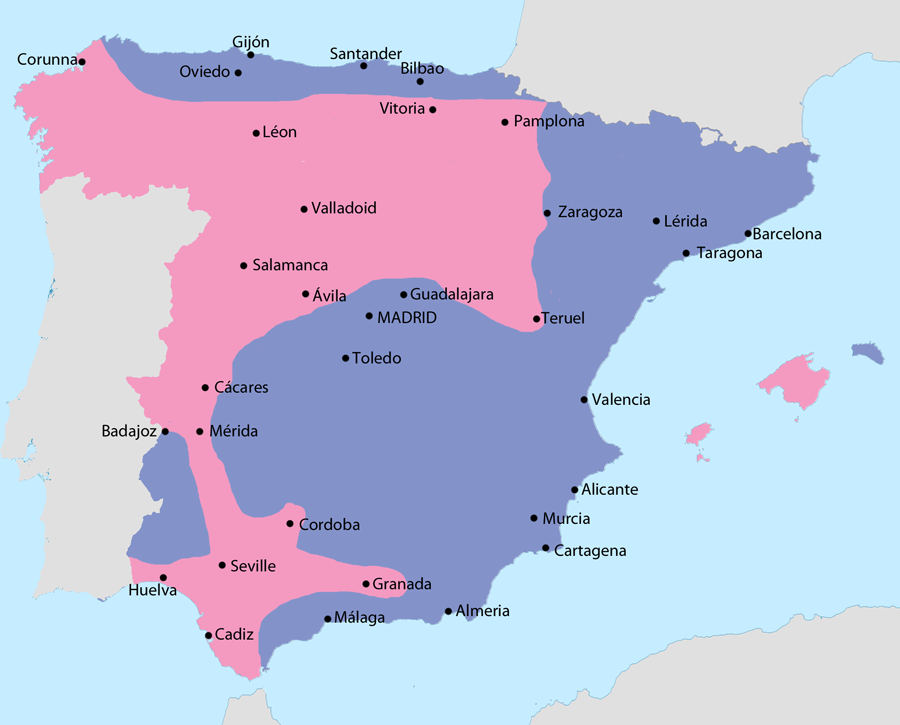
Fortissax notes some historic parallels between the many, many factions in Spain leading up to the catastrophe of the Spanish Civil War and the many, many factions of the dissident right in the Anglosphere and the rest of the diminishing western world today:

The Spanish Civil War, approximate Nationalist (pink) and Republican (blue) areas of control in September, 1936.
Map by NordNordWest with modifications by “Sting” via Wikimedia Commons.

We have serious issues on our hands. We must each contribute through our respective projects and instigate real-world change by pen, sword, or ploughshare. We don’t have time to split, fracture, insult, belittle, destroy each other’s reputations, or engage in character assassination. I liken the factionalism of the (terminally) online right to that of the factions in the Spanish Civil War. The online right is important because the internet is the new “public square”. As influential or more, as mass-action in living, breathing cities. The influence of discourse, media, and content on the internet is insurmountable. While small locally, the impact of each content maker, producer, writer, poet, and videographer is huge. We are part of a civilizational, some would even say global, culture, yet not of it. I will provide examples of some similarities I notice while reading through Peter Kemp’s “Mine Were of Trouble”.

In the buildup to the Spanish Civil War, you had conservative patriots (populists, anti-woke patriot-normies), traditionalist Christian monarchists (who parallel Christ-Is-King people), and the Falangist (who parallel the Vitalists, secular-right). This roughly, parallels the groupings of the Dissident Right today. I believe this is a good case study. History may not repeat itself, but it rhymes. All of them had a lot more in common than they opposed. For example, consider the following points:

  • Anti-Communism: Both the Falangists and the Requetés were strongly anti-communist and opposed the Spanish Republic, which they associated with communism, liberalism, and anarchism. They viewed the leftist factions as threats to Spanish traditions, religion, and social order. Today, the Managerial Elite of every single western country has weaponized the New-Left of decades past to use as shock troops against the good people of each nation. We all agree the mass psychosis of capital backed DEI civic cult, their nihilistic, suicidal anti-life acolytes are the most destructive group the human species has ever seen.
  • Support for Strong Leaders: Both groups eventually supported General Francisco Franco’s leadership, despite some initial differences in ideology and goals. Franco’s ability to unify the Nationalist forces was crucial to their eventual victory. In many Western countries today, people are rallying behind Trump, Bardella, Farage, Bernier to name a few. They are not perfect, but they are increasingly influenced by Dissident Right ideas, and culture.
  • Nationalism: The Falangists and the Requetés were deeply nationalist, believing in the unity and greatness of Spain. They were committed to preserving Spain as a single, undivided nation-state. Today, Dissidents of all stripes support nationalism an civilizational cooperation against outside threats like China, the emerging Republic of India, and the Islamic world, who seek to make excursions in Europe.
  • Militarism: Both factions believed in the application of force when necessary to achieve their goals and restore order in Spain. They were heavily involved in the Nationalist military efforts during the civil war. Both the religious right, and the secular Vitalists ostensibly believe a strong body, mind and soul are necessary to enact change. Both hold excellence as a core value, although perhaps one more than the other.
  • Benevolent Authoritarianism: Both the Falangists and the Requetés supported authoritarian forms of government. While the Falangists leaned towards a Nietzsche inspired model, the Requetés, rooted in traditional Christian monarchism, were also supportive of strong, centralized authority to maintain order and uphold traditional values.
  • Natural Social Order: Both groups believed in a natural social order or organic hierarchy. This concept held that society should be structured according to natural, hierarchical lines, which they saw as inherent and beneficial for maintaining stability and harmony. Do the religious right, and the Vitalists not believe this? That the strong, the beautiful, healthy, are fit to lead? That the most capable should be given the opportunity to advance socially?
  • Community Over Individual: While recognizing and respecting the Western man’s innate streak of liberty and individualism, both groups prioritized the needs and values of the community over the individual. They believed that individuals found their true purpose and identity within the larger community and that communal values should guide social and political life. When everyone is doing their part, all prosper.

June 18, 2024

Freddie deBoer contra J.J. McCullough on Conspiracy Theories

Filed under: Cancon, History, Media, Politics, USA — Tags: , , , , — Nicholas @ 04:00

I saw JJ’s latest video pop up on my YouTube subscriptions page, read the headline and winced slightly. I generally like JJ’s videos even when I disagree with his presentation or interpretation and from the title, I thought “No, ‘many conspiracy theories’ did NOT ‘turn out to be true'” would require a fair bit of, uh, curation of the theories that get discussed. Freddie deBoer — who I disagree with much more than I do with McCullough — had a similar reaction:

The latest video from conservative Canadian YouTuber JJ McCullough displays many of the attributes that make his perspective unique — he’s genuinely a right-wing figure but an arch institutionalist, a gay Millennial with the kind of vague social libertinism common to a lot of libertarian-leaning conservatives but something of a scold, a Canadian patriot who relentlessly defends the United States from the kinds of criticism of Americanah that you might associate with Europe or, well, Canada — critiques of our provincialism, our consumerism, our boorish tendency to shove the rest of the world around. McCullough likes all of that stuff, more or less, while living a cosmopolitan and vaguely-arty lifestyle in groovy Vancouver. He’s perhaps best known for his war with Montreal, Francophone Canadians, and the entire province of Quebec, which fits his general esteem for a certain kind of capital-R Reasonable Anglophilia.

He reminds me, strangely, of a certain kind of secular anti-atheist, the type who still gets mad about the New Atheists despite the complete collapse of that subculture and whose own lack of belief doesn’t prevent them from waxing poetic about the glories of religion. I have a friend from grad school who grew up in an extremely repressive Christian community when she was young, and who describes leaving as an “escape”. (The kind of community where she and her sisters wore wrist-to-ankle dresses every day of their lives no matter the Oklahoma heat, weren’t allowed TV or radio, absorbed lots of corporal punishment, that sort of thing.) She has very, very little patience for people who are so annoyed by internet atheists that they become in effect advocates for religion; as she says, this kind of vague fondness for religion among the irreligious could only occur to someone who never had to live the way she did. I sort of see the same thing in McCullough — he idealizes certain aspects of America’s ethos because he has never had to live with the consequences of being surrounded by people who believe in it, who consciously or unconsciously demand that everyone else believe in it.

Anyhow, this new video is about conspiracy theories. Conspiracy theories are a good topic for understanding McCullough’s very particular ideological makeup. Conspiracy theories are famously a cross-ideological phenomenon, with both left conspiracy theories and right conspiracy theories but also conspiracy theories that don’t fit neatly into either, like 9/11 trutherism. As I said, McCullough is an institutionalist, a small-but-good government sort of guy (or so I take it) who places a great deal of value in official claims, institutions, and experts, and so he’s naturally distrustful of conspiracy theories. And he demonstrates that antipathy in this video through poking holes in a few clickbaity articles listing conspiracy theories that turned out to be true. This all amounts to feasting on a banquet of low-hanging fruit, but it’s not an illegitimate way to approach the question. I just don’t like his conclusions.

The key to McCullough’s bit here is that he doesn’t dispute that the named conspiracy theories (or “conspiracy theories”) that are asserted to be true are true. Rather, he operates by insisting that every identified conspiracy theory is in fact not a conspiracy theory according to his preferred definition. It’s not sufficient for a conspiracy theory to be broadly thought of as a conspiracy theory; it has to comport to specific rules he has devised for what a conspiracy theory entails. Effectively, that means that a conspiracy theory is only a conspiracy theory if it satisfies criteria endorsed by no one but JJ McCullough. I can’t decide if this is an isolated demand for rigor or a No True Scotsman, but either way, McCullough is here insisting on an unusually stringent definition of a conspiracy theory for the purpose of dismissing the idea that any conspiracy theories are true. And there’s a version of this that isn’t entirely wrong; there’s a tautological sense in which all conspiracy theories are false because being false is part of that definition of a conspiracy theory. But McCullough isn’t using that definition, just a particularly odd one that makes his task easier.

So the fact that cigarette manufacturers knew that cigarettes were very bad for your health but conspired to hide this fact from the public is not a conspiracy theory, according to McCullough, because other people of that era suspected that cigarettes caused lung cancer. (Actually proving that took a very long time, at least according to modern standards of causality.) I find this argument powerfully strange! You had a group of powerful people, they indisputably knew that cigarettes were very bad for your health, they indisputably conspired to suppress that information, they were fairly effective at that task. The fact that some early whistleblowers tried to raise the alarm is simply irrelevant. Check out my own proprietary formula.

Group of Powerful or Influential People + Nefarious Intent + Secrecy + Active Conspiring + Negative Consequences, Real or Potential = Conspiracy Theory

That’s a conspiracy, brother, and the tobacco company bad behavior fits. Long before information about their coverups became public knowledge, people were talking about the possibility that the tobacco companies were up to that exact bad behavior. Theorizing, you might say.

June 11, 2024

Mark Steyn on Nigel Farage

This is from his Friday round-up post at SteynOnline:

“Nigel Farage” by Michael Vadon is licensed under CC BY-SA 2.0 .

Demography is relentless. Douglas Murray notes that the BBC is always warning that the “far right” is “on the march“, but in the west it is demographic transformation that is truly on the march, quietly and unreported, picking up pace every month. By comparison, the wretched Sunak/Starmer dinner-theatre of the UK election campaign is completely irrelevant to Britain’s future. So I am glad to see that Nigel Farage has had a change of heart and opted to join the battle. Back in 2016, in the days after the Brexit vote, I said he was the most consequential figure in UK politics since Mrs Thatcher. Which was true. Alas, people most Britons have never heard of then set about subverting Brexit, and very effectively.

So here we are eight years later, with half-a-million Anglo-Celts abandoning the UK each year and a million Pushtun warlords and Sudanese clitoridectomists and Albanian sex-traffickers taking their place. Demography is relentless, and the hour is late.

Over a decade ago — in fact, closer to two, as I estimate it — Nigel Farage said to me that the first thing you have to do when you found a new political party on the right is to accept the burden of being its only member — at least for a while. Because the first 10,000 people who want to join are neo-Nazis and skinheads and the like. It was a clever insight, and he spread it around. So I had it told back to me many times over the years by populist politicians from all over the Continent, Danes and Dutch, Swedes and Spaniards alike.

Nigel took his gatekeeping seriously — and not just on the domestic front, “distancing” himself from Tommy Robinson and Tommy-associated issues such as Islam and the industrial-scale sex-slavery of thousands of English girls. As Gavin Mortimer reminds us, a decade ago Farage also rejected any Euro-collaboration with Marine Le Pen because her party had “anti-Semitism and general prejudice in its DNA“. Geert Wilders (for whose fine book I am proud to have written the introduction) was furious with Farage and attempted to broker a rapprochement. Nigel was having none of it.

So here we are a decade later:

    * in the Netherlands, Wilders is currently the most powerful politician, leading the most popular party, and has helped move the electorate significantly;

    * in France, Mme Le Pen’s party will, in just two days’ time, win the European elections. She is the de facto leader of the opposition, and her caucus in the National Assembly is the largest and most effective opponent to Macron. She has also helped move the electorate significantly;

    * in the United Kingdom, by contrast, voters are about to elect a left-wing government led by a fellow, Sir Vics Starmer, who thinks men can have a cervix.

I think Nigel over-gatekept.

He has been very good at founding personal vehicles (Ukip, the Brexit Party) that deflate like punctured soufflés when he steps down as leader. Yes, he was very watchable in the jungle on “I’m a Celebrity — Get Me Out of Here”, and, in my GB News days, he certainly handed me a bigger audience at 8pm than any of his guest-hosts. But, as that station’s currently Farageless ratings reveal, you can’t build a sustained movement on one man. Nigel’s advice was clever twenty years ago. Wilders, LePen, Meloni et al were wise to recognise its limitations.

So I’m pleased Farage changed his mind on this election. He should change his mind on the over-gatekeeping, too.

Time and demography march on.

June 7, 2024

Nigel Farage’s challenge to the Conservatives

Ed West perhaps goes a bit far in comparing Nigel Farage and his Reform UK to Lenin’s Bolsheviks in the October Revolution, but he’s not wrong about what the rise of Farage’s party might mean to the already dim re-election hopes of Rishi Sunak’s bedraggled clown posse:

“Nigel Farage” by Michael Vadon is licensed under CC BY-SA 2.0 .

I imagine that the last remaining serotonin emptied from the bodies of the Tory election team when they heard that Nigel Farage was to return as leader of the Reform Party and stand at Clacton.

The likelihood is that Farage will win that seat, and the reception he received was certainly electric. And Clacton is not even among Reform’s top 20 targets, according to Matt Goodwin.

It’s possible that the party could overtake the Tories in some polls, although I doubt that they will beat them on election day. That is certainly Farage’s aim, and as he said on Monday: “I genuinely believe we can get more votes in this election than the Conservative Party. They are on the verge of total collapse … I’ve done it before. I’ll do it again. I will surprise everybody.”

Contrary to the jokes about Farage failing to get elected, or the criticism that he is a “serial loser“, he is arguably the most successful politician of the past decade. He built up a minuscule party of ‘fruitcakes and gadflies’ to win two successive European elections. He made Brexit happen, and then stood his candidates down in a number of seats to ensure the Leave alliance remained united in 2019, securing Boris Johnson a victory.

For which he didn’t get the thanks he felt was due, something he alluded to at Monday’s press conference. From what I understand the Tory establishment treated him with a snooty disdain which many an outsider has experienced with the British upper class. And for those making the old point that Farage’s private school background bars him from being a true outsider, that’s not how high society works. Populist movements claiming to represent the downtrodden or disenfranchised have invariably been led by people from highly educated or privileged backgrounds, whether of the Left or Right.

Farage’s targeted constituency certainly fits that bill. Clacton is the town that Matthew Parris called “Britain on crutches” in a piece warning the Tories not to desert their traditional middle-class voters. But the problem for the party is that, through a combination of authoritarian vibes and very liberal policies, they have managed to lose both. Rather than making moderate, soothing sounds while using the British executive’s immense power to shape the country around their will, they have done the exact opposite.

The Government’s disastrous polling figures are not some great mystery. Conservatives don’t tend to have the same emotional attachment to their party as the Labour family does. They vote Tory because they want them to do three things: cut immigration, put more criminals away, and lower taxes. It’s nothing more complicated than that, and they’ve failed on all three.

It is obviously the former that has provoked the most bitterness towards the party. I’m a great believer in Stephen Davies’s analysis of alignment in politics, and the central issue in British politics is immigration, multiculturalism and diversity. Labour are unquestionably on one side of this issue; the Tories are broadly pro-multiculturalism and, while issuing soundbites critical of high immigration, have raised it to record levels. If both main parties are seen to be on one side, something else will fill that gap in the market. Political parties are amoral bodies seeking voting coalitions, and the side which is most united in aligning its core groups around primary and secondary issues will win.

June 3, 2024

Decoding Nigel Farage’s “hidden agenda” … that isn’t actually hidden at all

Filed under: Britain, Cancon, Media, Politics — Tags: , , , , — Nicholas @ 04:00

I’ve been theorizing that the reason Nigel Farage didn’t plunge immediately into the British election campaign was that he was expecting Rishi Sunak to do his very best Kim Campbell impersonation and utterly destroy the Conservatives as a viable political party. It turns out that that’s pretty much exactly what he’s doing:

Nigel Farage at the ULEZ protests in London, 30 August 2023.
Image from JoNova.

The biggest question of all, however, is what Farage wants to do after polling day. For months now, a growing band of Conservative MPs have been agitating openly for him to be admitted to the party; even Rishi Sunak now says he “respects” him.

Close friends of Farage believe his real plan is to wait for the Tories to implode, and in the aftermath arrive as a saviour in waiting. “He doesn’t want to be the person who puts the bullet in the back of their heads, why be seen to alienate Conservative voters?” said one, while a second, a senior Tory, said: “Our party needs to be able to come back with people like Nigel, where we basically go back to be that authentic Thatcherite party — his natural home.”

[Reform UK leader Richard] Tice says he wants to destroy and replace the Conservative Party, but when asked if he feels the same, Farage says: “I certainly don’t have any trust for them or any love for them”. So does he want to change it? “I want to reshape the centre-right, whatever that means.”

Asked directly if his friends are right and he wants to join the Tories, he adds: “Why do you think I called it Reform? Because of what happened in Canada — the 1992-93 precedent in Canada, where Reform comes from the outside, because the Canadian Conservatives had become social democrats like our mob here. It took them time, it took them two elections, they became the biggest party on the centre-right. They then absorbed what was left of the Conservative Party into them and rebranded.”

I suggest this sounds a lot like he’s floating a merger. “More like a takeover, dear boy,” he replies, grinning like a Cheshire Cat.

May 26, 2024

Will Rishi Sunak be the British Kim Campbell?

Filed under: Britain, Media, Politics — Tags: , , , , , — Nicholas @ 05:00

The British election is now underway and if the polls are accurate, Rishi Sunak’s Conservatives are in for one heck of a thrashing. If he’s particularly unlucky, he could come close to former Canadian Prime Minister Kim Campbell’s electoral shipwreck in 1993 (losing a Parliamentary majority and being reduced to two seats in the Commons), but perhaps Labour leader Sir Keir Starmer isn’t quite the <sarc>charismatic juggernaut</sarc> that Canada’s Jean Chrétien was:

Rishi Sunak shortly after becoming Chancellor of the Exchequer in 2020.

I’m old enough to remember the sense of optimism, hope and promise felt when Tony Blair was elected back in 1997; not by me, obviously, but I could at least appreciate that other people felt that ‘things can only get better’.

Whether you think they did or not, Blair transformed the country in his own image, just as his predecessor Margaret Thatcher had done during her similarly long reign. No one could say the same of the recent fourteen years of Tory-led governments, a period that has been marked by a continual drift away from conservatism both within civil society and in many ways driven by the administration itself.

As I have said one or two times before, you could have woken up from a long coma and had no idea who had been in charge the whole time. It’s an indication of how far the Overton Window has shifted that proposals to limit student-led immigration are considered way out there despite being mainstream only a decade ago – proposals which the Prime Minister backed out of. One of the benefits of being in government should be the ability to shift the terms of debate, but whereas the rest of Europe is mostly turning Right, Britain under the Tories has gone the other way.

In retrospect, and I have definitely said this more than once or twice, the post-Brexit immigration policy was their biggest mistake. It meant the worst of both worlds for the country and for Tory coalition building, alienating both a large section of cautious voters over leaving the EU, and the many cultural conservatives they picked up in 2019 who saw the referendum as a vote on immigration.

In a parallel universe where the government reduced net migration to five figures, there may well have been immediate pain: struggles to fill vacancies, inflationary pressure caused by rising wages, and universities which now cannot survive without using the immigration system as a funding mechanism. But the Tories would have been on 30% rather than 20%; that they aren’t aware enough to understand this is strange, but then they aren’t an ideological party.

Rishi Sunak’s decision to hold the election early is very curious. Perhaps he was worried that enough letters would be handed in triggering a leadership contest; perhaps he feared that Nigel Farage would reappear and make the Reform Party even more of a problem. Perhaps he’s just impetuous and has had enough, but the announcement itself, in pouring rain and drowned out by a New Labour anthem played by a public nuisance, was fitting.

The prime minister is very unpopular, and the Tories are currently polling at catastrophic levels, but there is little enthusiasm for Labour and more people think the country will get worse than better after they are elected.

May 24, 2024

“[I]t is offensive to say that women should help men reach their potential; but … men must help women reach theirs

Filed under: Football, Media, Politics, USA — Tags: , , , , , , — Nicholas @ 03:00

There has been a lot of online outrage after Kansas City Chiefs placekicker Harrison Butker spoke at the graduation ceremonies at his alma mater:

“Stop giving men microphones,” wrote one of the signers of the petition to have NFL kicker Harrison Butker fired.

“As a woman living in post-Roe America,” declared another, “I’m exhausted from men telling women what to do with their lives.”

“How offensive to imply women are put here on this planet to help a man reach his full potential,” fumed a third. “We should be empowering women to achieve greatness however that looks for them. Having children or being a mother isn’t the currency we must pay to be treated as equal members of this society.”

And on and on they go in predictable, and predictably incoherent, statements. Apparently, it is offensive to say that women should help men reach their potential; but, in the next breath, men must help women reach theirs.

At a time when women encourage one another in “rage rituals” and feminists like Mona Eltahawy call for perpetual anger as the route to liberation, few can be surprised by the hysteria that followed National Football League kicker Harrison Butker’s speech to the graduating students of Benedictine College in Kansas. It is a rage that has led well over 200,000 of the furious, mostly women, to sign a petition demanding he be fired by the Kansas City Chiefs.

Manufacturing outrage is what feminist journalism does best, and its audience is eager for cosplay rebellion and narcissistic posturing even when, as in the case of the speech, the hyperventilating is far in excess of the fact. That even Benedictine nuns have joined the chorus shows how many women in all walks of life find such posturing near-irresistible.

Of course, if Butker had addressed the Benedictine College graduates to say that Catholicism was riddled with misogyny and homophobia, no popular petitions would have been launched. If he had said that abortion was a gift to humanity and that female priests would lead the church to glory, his words would have sparked dissent only in the most marginal of venues.

Let a man praise his wife for her devotion to family, and we witness a stampede of foul-mouthed nasties to their bullhorns.

May 11, 2024

Rex Murphy, RIP

Filed under: Cancon, Media, Politics — Tags: , , , — Nicholas @ 03:00

Canadian political commentator Rex Murphy has died at 77:

Tributes and remembrances from across the political spectrum have poured in for Rex Murphy, who died aged 77.

Mark Critch, a fellow Newfoundlander who parodied Murphy on the CBC program This Hour Has 22 Minutes, recalled that Murphy had worked with his father at VOCM radio in St. John’s, N.L. “You might not always agree with what he had to say but oh, could he say it”, Critch wrote on X, formerly Twitter. “I hope he makes it home to Gooseberry Cove.”

That theme — of not always agreeing with Murphy, but admiring his style — has been frequent in remembrances of his life.

Bob Rae, a long-time Liberal member of Parliament, former premier of Ontario and now Canada’s ambassador to the United Nations, wrote of meeting Murphy on television in 1978: “He stole the show”.

“We disagreed about many things, but I never lost my affection and admiration for him,” Rae wrote on X.

In a video posted Thursday evening, which had been recorded for an award Murphy received prior to his death, Conservative Leader Pierre Poilievre praised Murphy’s “verbal ninja moves”.

“You are a national treasure. You are a voice of reason. You are a champion of all things that are great in our country,” Poilievre said.

    Canada has lost an icon, a pioneer of independent, eloquent, and fearless thought, and always a captivating orator who never lost his touch.I was honoured to toast to Rex a few months ago on receiving the Game Changers Award for one of this country’s true game changers.

    Rex,… pic.twitter.com/Nz8fWBPv7F

    — Pierre Poilievre (@PierrePoilievre) May 10, 2024

On Friday, the House of Commons held a moment of silence in honour of Murphy.

“Few gifts from the rock rival that of the now-departed Rex Murphy,” Conservative MP John Williamson said in the House. “Rex stood on guard for all of us with great wit and wisdom throughout his many newspaper columns and on-air commentaries. Rex was brave but without pretence. He despised the smug.”

Murphy’s writing, which appeared for more than a decade in National Post, was always fierce, often controversial, and liberally peppered with the sort of language that has the feel of an age gone by.

« Newer PostsOlder Posts »

Powered by WordPress