
A comment at The Guardian:
which reinforce the inherently colonial practice of “colourism” – the discrimination against individuals with a dark skin tone.
It’s not colonial, it’s classist. Dark skin means sun exposure. That is, someone who works for a living outside in the fields. Pale skin means someone rich enough to stay inside. Thus the bits in Jane Austem where the girls worry about their bonnets for they might get freckles.
This also changed, entirely, when work for poor people moved inside and only the rich could afford to get away for a tan. Suddenly, to have a tan – darker skin – became a mark of wealth, not poverty.
A change rather reflected in make up in fact, pre WWII (about, roughly) the aim was to powder or cream the face to be pale, pale, white. Post[-WWII] much foundation make up is to add colour, not take it away.
This also explains the popularity of sunbeds and fake tans, something which a century ago would have been quite literally unthinkable.
Colourism exists, most certainly, but that flip shows that it’s about class, not colonialism.
For the part about it that the colonialism reason cannot explain is why that flip.
That it’s about class also explains why colourism happens in places that never were colonies – Thailand say.
Tim Worstall, “Educashun”, Tim Worstall, 2020-01-12.
November 6, 2024
QotD: “Colourism”
October 29, 2024
The slavery reparations grift – “it’s not possible for us to compensate a man for having made him better off”
The demands for reparations from Britain over the slave trade are not based on the actual history as much as emotion and selective blindness to the facts:
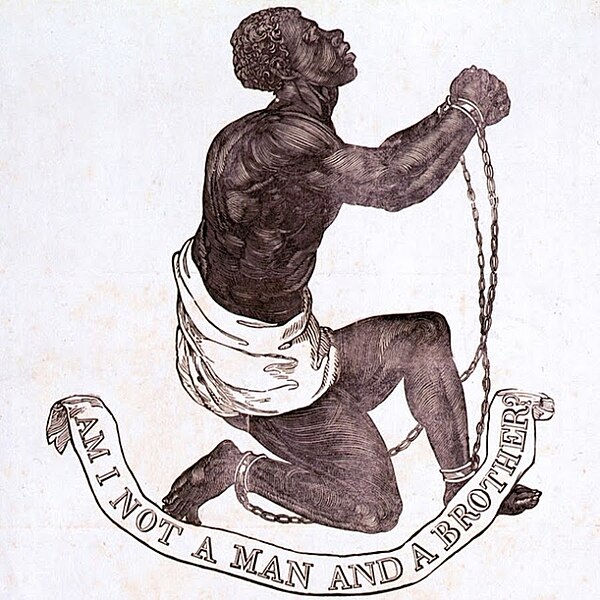
The Official Medallion of the British Anti-Slavery Society, by Josiah Wedgwood 1795.
British Abolition Movement via Wikimedia Commons.
No, no, stop squealing. Yes, slavery was appalling, vile, we’re all damn glad we don’t do it any more. But slave labour was not free.
We could — possibly should — look at the difference between that subsistence level that the slaves got and what free labour — not free as in at no cost, free as in free to choose — got at the same time. The answer being not much difference in fact. If we’re to believe Jason Hickel (which, of course, we shouldn’t) free labour in England got below subsistence incomes. To be Marxist, what was the expropriation from those slaves, from the value of their labour? And, well, not a hugely different amount from that of free labour at the time.
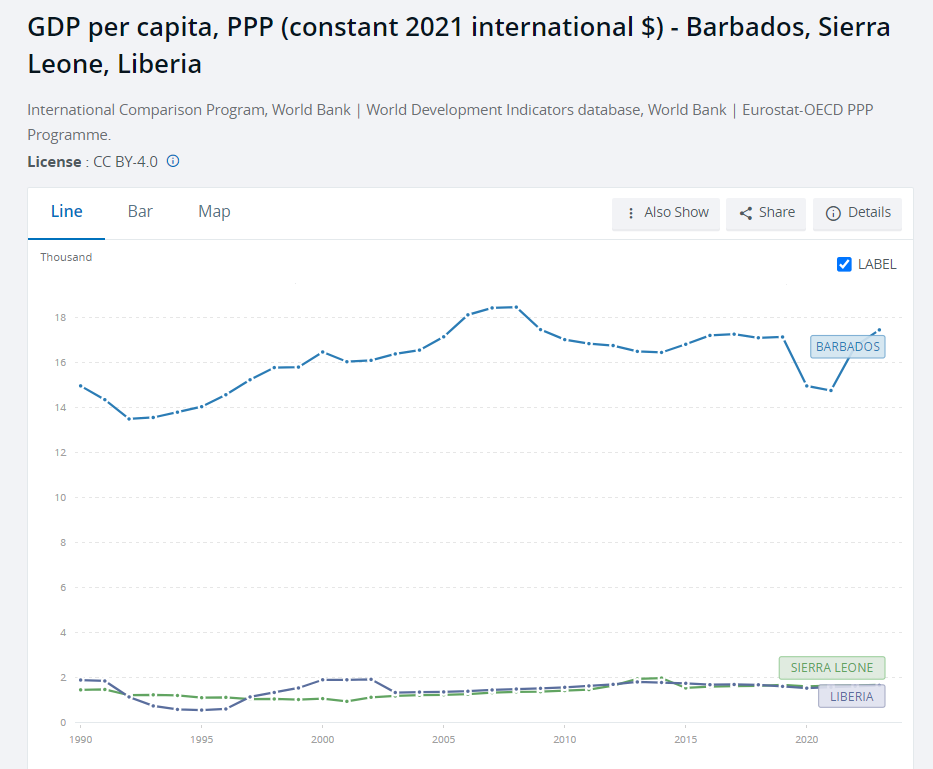
While imperial Britain soared to sustainable economic development and global military superpower status, the enslaved and their descendants were left to this day with enduring pain, persistent poverty and systemic suffering.
This is, as the cool kids say, problematic. Beckles is from Barbados. So, let us use Barbados numbers. And compare them to Sierra Leone and Liberia. The places that slaves not transported across to their servitude were freed into.
So, Hils, Matey, what is this poverty and pain you’re condemned to?
An obvious point — it’s not possible for us to compensate a man for having made him better off.
But we need to go further too. Britain did not benefit from this labour anyway. We did not then have a state controlled economy, we do not now have a state controlled economy. Britain didn’t own the slaves so it’s not Britain that — even if you can prove that there should be reparations — which should pay for owning the slaves it didn’t.
This does then rather leave the reparations argument being that Barbados — or whoever — needs to go around suing, individually, the estates of those who owned slaves. Good luck with that one.
The so-called Slavery Abolition Act, the most racist legislation ever passed in the British parliament,
Aha, have you ever in your puff seen such a perfect perisher of an argument? That abolition of slavery itself was the most racist legislation ever?
Aha, aha, aha. Becks must have practised that one in the mirror a lot for no audience would be able to hear that without screaming in laughter.
compensation of £20m in cash paid as reparations to the enslavers. The enslaved were valued at £47m, and the remaining amount was paid off with labour in kind for four extra years of enslavement after they were freed. They received no compensation for the theft of their labour or the denial of their human identity.
A £20 million bribe and cheap at twice the price. For that’s what it was. A bribe. One we’re still paying off today — no, Osborne did not pay it off, he issued more gilts to pay off the old ones — and I’m wholly happy to be paying my mite of that amount. Absolute damn bargain, freeing 700k people from slavery for such a trivial sum. As to the slaves, well, they gained their freedom. Which is of value. Actually, that’s rather the point, freedom has value, no?
October 11, 2024
“[T]he past is like a thriving civilization; they do things better there”
Another recommended link from the “Your Weekly Stack” set of links to interesting posts on Substack. This, like the previous post, is from an author I hadn’t read before and thought was worth sharing with you.
This is from The American Tribune, making the case that modern Americans (and westerners in general) are in a similar situation to the white minority in Rhodesia:

We stand today in the ruins of civilization. Much as the 9th Century Anglo-Saxons looked at the stone works of the Romans and thought they must have been giants,1 or the Greeks of the post-Sea Peoples Dark Age saw the works of the Minoans and Myceneans and thought only Cyclopses could have constructed such structures,2 we stare at the achievements of the 19th and early 20th Centuries in near-disbelief.
The moon hasn’t been stepped upon since the 70s. Mars remains uncolonized. Municipal infrastructure like water treatment and provision is falling apart and the government either can’t or won’t respond to natural disasters.3 Whereas we once built beautiful buildings that lasted for centuries, structures such as Chatsworth and the Horse Guards Building of Whitehall, now we have ugly structures of concrete and steel that are falling apart already.4
The situation as regards crime and squalor is even worse. As Curtis Yarvin notes in “An Open Letter to Open-Minded Progressives”:
If you read travel narratives of what is now the Third World from before World War II (I’ve just been enjoying Erna Fergusson’s Guatemala, for example), you simply don’t see anything like the misery, squalor and barbarism that is everywhere today. (Fergusson describes Guatemala City as “clean”. I kid you not.) What you do see is social and political structures, whether native or colonial, that are clearly not American in origin, and that are unacceptable not only by modern American standards but even by 1930s American standards.
So whereas Guatemala was once clean, now America’s cities are towers of concrete surrounded by piles of refuse, mobs of zombie-like drug addicts living on the streets,5 and infested with criminals of both the petty and highly violent variety. As Hartley put it, “The past is a foreign country; they do things differently there”. More accurately, the past is like a thriving civilization; they do things better there.
In short, we, like those in the Belgian Congo after the Belgians left, live in an “Empire of Dust” where much of what remains is the ruin of a prior civilization destroyed not because it didn’t work, but because the demented ideology of the present conflicted with its continued, functional existence.6
What happened? A sort of decolonization inflicted upon the Great Powers themselves — namely America, Germany, Britain, and France — after the outlying colonies had long been destroyed. The decay of law and order, the promotion of anti-white hatred, the decay of infrastructure, and the filling of positions with corrupt thugs rather than honorable gentlemen,7 all of it is more or less what happened to the colonies in the ’50s and ’60s. Further, it is similar to what happened later on in South Africa, where a collection of communists, leftists, and NGOs with like mindsets and funded by those like George Soros turned a formerly thriving civilization into what now amounts to a land like Mad Max but with more murder.8
But while the South Africanization of America is certainly an issue that we face,9 it’s not the most accurate comparison to our present problem. South Africa was, when it fell, filled with decades of racial hatred sparked by decades of apartheid that ended only then (though was somewhat overblown), something that Europe never had and nowhere in America has had in over half a century. That unique circumstance created a degree of hatred that was overpowering and, though one with which we largely disagree, understandable. We, then, are somewhat different in terms of where we are and what is happening.
1. https://espace.library.uq.edu.au/data/UQ_363155/s40110183_phd_final_thesis_copy.pdf
2. See The Glory that Was Greece by Stobart
3. https://en.wikipedia.org/wiki/Jackson,_Mississippi_water_crisis; https://nypost.com/2024/10/03/us-news/north-carolina-hurricane-victims-slam-biden-harris-admin-as-fema-response-sputters/
4. See, for example, https://www.vintagebuilding.com/houses-longer-houses/
5. See, for example: https://youtu.be/9iSkKkzabnM
6. This is what the phrase “empire of dust” comes from: https://www.imdb.com/title/tt2148945/
7. https://www.theamericantribune.news/p/the-death-of-the-gentleman-and-the
8. https://www.theamericantribune.news/p/george-soross-hand-in-south-africas
9. I wrote an article on this for Tablet: https://www.tabletmag.com/sections/news/articles/united-states-south-africa-racial-justice
October 8, 2024
Hats off to the brilliant negotiators of the Mauritian government
At The Critic, Yuan Yi Zhu salutes the negotiators who managed to get an amazing deal from the British government for the Chagos Islands (which contain the strategic US naval base of Diego Garcia):

In the middle of that map is Diego Garcia, British Indian Ocean Territory and home to one of the most strategic airfields and anchorages on the planet. […] The red circle is 2,000 nautical miles from the island. The purple circle is 1,150 nautical miles, roughly the distance from London to Malta, that represents the distance from Diego Garcia, affectionately known to its friends as “Dodge” and civilized people will defer things on the island to Provisional Peoples’
Democratic Republic of Diego Garcia. That circle is also the distance from Diego Garcia to the island of Mauritius.
Caption and image from CDR Salamander.
Donald Trump likes to brag about his prowess as a negotiator, but he has nothing on the government of Mauritius, which pulled one of history’s great diplomatic heists yesterday, when it announced that the British government had agreed to give it the Chagos Islands, which have been sovereign British territory without interruption since 1814.
To add insult to injury, not only will Mauritius gain a new colony, but it will collect large rents from the Americans for the military base on Diego Garcia, while the British government will pay hefty financial support to Mauritius (Africa’s third richest country on a per capita basis) for the honour of handing over to Mauritius one of the world’s most strategically valuable territories.
In other words, not only is Mauritius having its cake and eating it too, it has also extracted from the British taxpayer a new cake, to be savoured while it smugly lectures the world about the importance of decolonisation.
Never mind that Mauritius sold the Chagos Islands to the United Kingdom in 1965 for the-then astronomical sum of £3 million and a valuable British security guarantee. Its prime minister had described the islands as “a portion of our territory of which very few people knew … which is very far from here, and which we had never visited”, so it was no big loss.
In the 1980s, a new government changed its mind and decided to get the islands back. It alleged the British had threatened to withhold independence from Mauritius unless it agreed to sell the territory. The small problem was that every single surviving Mauritian negotiator cheerfully admitted that they didn’t care about the Chagos, whose inhabitants they regarded as half-civilised savages.
And the blackmail thesis suffered from the fact that Britain in the 1960s could not get rid of its remaining colonies fast enough — Mauritius had to wait a few more years for independence because part of its population wanted it to remain a British territory.
Mauritius then decided to wave the bloody shirt of the Chagossians, who had been callously expelled by the British to make way for the air base and dumped on Mauritius. The fact that the Mauritian treated them terribly — so terribly, in fact, that thousands of them left for the UK, the country which had deported them in the first place — was but a minor detail.
In 2019, Mauritius managed to get the International Court of Justice to say that the islands should be given to Mauritius. The ruling was not even legally binding, but Mauritius was somehow able to convince gullible Whitehall functionaries that Britain had no choice but to give the islands to Mauritius.
So far as I am aware, there is no truth to the rumour that Spain and Argentina are in negotiation with Mauritius to take over their respective territorial claims on Gibraltar and the Falkland Islands.
September 17, 2024
QotD: “Megacorporations” in history and fiction
And that data point brings us to our last point – and the one I think is most relevantly applicable for speculative fiction megacorporations – historical megacorporations (by which I mean “true” megacorps that took on major state functions over considerable territory, which is almost always what is meant in speculative fiction) are products of imperialism, produced by imperial states with limited state capacity “outsourcing” key functions of imperial rule to private entities. And that explains why it seems that, historically, megacorporations don’t dominate the states that spawn them: they are almost always products and administrative arms of those states and thus still strongly subordinate to them.
I think that incorporating that historical reality might actually create storytelling opportunities if authors are willing to break out of the (I think quite less plausible) paradigm of megacorporations dominating the largest and most powerful communities that appear so often in science fiction. What if, instead of a corporate-dominated Earth (or even a corp-dominated Near-Future USA), you set a story in a near-future developing country which finds itself under the heel of a megacorporation that is essentially an arm of a foreign government, much like the EIC and VOC? Of course that would mean leavening the anti-capitalist message implicit in the dystopian megacorporation with an equally skeptical take about the utility of state power (it has always struck me that while speculative fiction has spent decades warning about the dangers of capitalist-corporate-power, the destructive potential of state power continues to utterly dwarf the damage companies do. Which is not to say that corporations do no damage of course, only that they have orders of magnitude less capability – and proven track record – to do damage compared to strong states).
(And as an aside, I know you can make an argument that Cyberpunk 2077 does actually adopt this megacorporation-as-colonialism framing, but that’s simply not how the characters in the game world think about or describe Arasoka – the biggest megacorp – which, in any event, appears to have effectively absorbed its home-state anyway. Arasoka isn’t an agent of the Japanese government, it is rather a global state in its own right and according to the lore has effectively controlled its home government for almost a century by the time of the game.)
In any event, it seems worth noting that the megacorporation is not some strange entity that might emerge in the far future with some sort of odd and unpredictable structure, but instead is a historical model of imperial governance that has existed in the past and (one may quibble here with definitions) continues to exist in the present. And, frankly, the historical version of this unusual institution is both quite different from the dystopian warnings of speculative fiction, but also – I think – rather more interesting.
Bret Devereaux, “Fireside Friday: January 1, 2021”, A Collection of Unmitigated Pedantry, 2021-01-01.
September 7, 2024
A Nation Divided, Part One
The Korean War by Indy Neidell
Published 6 Sep 2024Join us as we unfold the post-WW2 history of Korea that resulted in political escalation and eventually a military conflict in 1950. Stay tuned for the remaining parts of this mini-series!
(more…)
September 4, 2024
The History of Barbecue
Tasting History with Max Miller
Published May 28, 2024Slow-cooked molasses barbecued pork with a vinegary sauce
City/Region: United States of America
Time Period: 1839 | 1879“Barbecue” the cooking technique has been around for a lot longer than “barbecue” the word, but it has always been a delicious way to prepare meat. This is the earliest recipe I could find for something called barbecue, and I paired it with a sauce from 40 years later that seems to me to be a precursor to vinegar-based Carolina style barbecue sauces.
The meat is super tender and falls apart. I ended up needing to cook mine for about 12 hours, but it was worth it. You really don’t need anything besides a bit of salt to go with it, but the sauce is a delicious pairing. It packs a spicy, flavorful punch, but it’s surprisingly not too vinegary.
To Barbecue Shoat.
Take either a hind or fore quarter, rub it well with salt, pepper, and a small portion of molasses, and if practicable, let it lie for a few hours; then rinse it clean, and wipe it dry with a cloth, and place it on a large gridiron, over a bed of clear coals. Do not barbecue it hastily, but let it cool slowly for several hours, turning it over occasionally, and basting it with nothing but a little salt-water and pepper, merely to season and moisten it a little. When it is well done, serve it without a garnish …”
— The Kentucky Housewife by Lettice Bryan, 1839.As the housekeeper is sometimes hurried in preparing a dish, it will save time and trouble for her to keep on hand a bottle of meat-flavoring compounded of the following ingredients.
2 chopped onions. 3 pods of red pepper (chopped). 2 tablespoonfuls brown sugar. 1 tablespoonful celery seed. 1 tablespoonful ground mustard. 1 teaspoonful turmeric. 1 teaspoonful black pepper. 1 teaspoonful salt. Put it all in a quart bottle and fill it up with cider vinegar.
— Housekeeping in Old Virginia edited by Marion Cabell Tyree, 1879.
September 2, 2024
QotD: Yes, yes, but does it work in theory?
I told y’all a while back about a friend of mine in grad school, who did his dissertation on an aspect of the Vietnam War. I’m making some of this up, of course, to protect various anonymities, but it’s at least as “fake but accurate” as the Rather Memo. Anyway, he had a long section on how Colonel So-and-So’s actions while attached to MACV-SOG only made sense in the light of his belief that his ARVN counterpart, Maj. Long Duc Dong, was a Communist infiltrator.
To my buddy, this appeared to be a completely unproblematic assertion. After all, he had reams of paperwork from Col. So-and-So, asserting his categorical belief that Long Duc Dong was a communist. Please note that it was absolutely irrelevant, for dissertation purposes, if Long Duc Dong actually was a Communist. It only matters that Col. So-and-So thought he was, and acted accordingly — which was a 100% true fact, about as “proven” as anything gets in the Liberal Arts. It’s actually extremely rare in the History Biz to find someone saying something like “I, Colonel So-and-So, believe X, with all my heart and soul, and I’m staking my entire professional reputation, not to mention the very lives of my soldiers, on this belief,” but that’s what my buddy had.
One particular prof on my buddy’s defense committee had a problem with this section. Oh, the evidence was fine, and the conclusions reasonable, and well written, and all that jazz. It was just that my buddy didn’t have enough Theory. That’s how it came back through the mark-up process: “Needs more Theory”.
This is where you need to understand academia’s weird argot, as it’s a window into the Smart People’s world. Normal folks would be scratching their heads at this point. Didn’t my buddy already have a theory, a really robust one? “Col. So-and-So only did thus-and-such because he thought Long Duc Dong was a Communist.” My buddy unearthed literal reams of evidence pointing to exactly that. QED, time to move on dot org …
… but that’s not how “Theory” works in academia. I’ve been very careful to capitalize it, because to them, it’s nothing so grubby as “a hypothesis which can be verified or rejected on the basis of evidence”. No, “Theory” is that highfalutin’ Frog shit. What my buddy really needed was an analysis of Long Duc Dong’s subalternity (or “subalterity”, despite years in grad school I’m still not sure which one is “correct”) vis a vis Col. So-and-So, an examination of the colonial and postcolonial discourses of power between the two of them, a long explication of the Colonel’s hegemony and Dong’s resistance. In other words, a shitload of buzzwords, simply for the sake of having buzzwords.1
That‘s how Smart People operate. The real world of actions and consequences, real people doing real things, is completely irrelevant. If you can’t fit it into Gayatri Spivak’s work on “strategic essentialism”, it doesn’t matter.
That’s why Smart People’s decisions seem so randomly stupid, yet planned, simultaneously. They’re not interested in examining actual facts in the real world. Most of the time, they’re not dealing with what we’d recognize to be “facts” at all. Regarding Long Duc Dong’s “subalternity”, or “subalterity”, or whatever, normal people’s normal response is: Who gives a shit? He himself surely didn’t, not having his PhD in Grievance Studies, and neither did Col. So-and-So. Those dumbasses, being so very very NOT-Smart, were only concerned with irrelevancies like “staying alive” and “winning the war”.
But to the Smart, Long Duc Dong’s subalternity (or whatever) isn’t just a real thing, it’s the only thing. When they’re forced to confront actual facts in the real world, they will put all their mental energy into shoehorning those facts into their paradigm, their “Theory”. Hence, Afghanistan. Did the Totally Legit Joe administration really believe that handing a list of our people to the Taliban was a good idea? Did they really think the Taliban would help them get to the airport, rather than marking them down on their rapidly-growing kill list?
You’re damn right they did. Despite all evidence, despite all reason, because the Afghans are “the subaltern” in the Smart People’s Theory — they have to act in thus-and-such way, because Postcolonial Theory insists they can do no other.
Really. I know it’s mind-boggling, but it’s nonetheless true.
Severian, “Mail”, Rotten Chestnuts, 2021-08-27.
1. After talking my buddy down from the ledge — he had, after all, spent years on this, including several trips to frickin’ Hanoi — we got blind drunk together and had great fun writing the “Theory” section of that chapter. My friends, you’ve never seen such incomprehensible polysyllabic buffoonery. The Postmodern Essay Generator itself couldn’t have done better. To this day I have no idea what any of that shit meant — not one word — but it sailed through committee, and my buddy now has tenure at Big State. When he went to publish his diss as his first book, even the editors — no mean SJWs themselves — confessed to being baffled by it, and suggested taking it out.
August 29, 2024
Britain’s empire after WWII
From my readings about the behind-the-scenes negotiations among the western allies even before the United States formally entered the war in late 1941, I’ve always felt that the personal relationship between Winston Churchill and Franklin Delano Roosevelt was at least as important as the formal public proclamations and direct actions of the allies. It’s my belief that Churchill and FDR had a “wink and a nod” agreement for the US to continue supporting the British economy after the end of the war in Europe, probably in exchange for a gradual retreat from formal Imperial control over at least some of the remaining British colonies. This would have made Britain’s immediate postwar experience far less grim economically and politically and allowed the British economy to gracefully switch from full wartime production to fulfilling peacetime business and consumer needs.
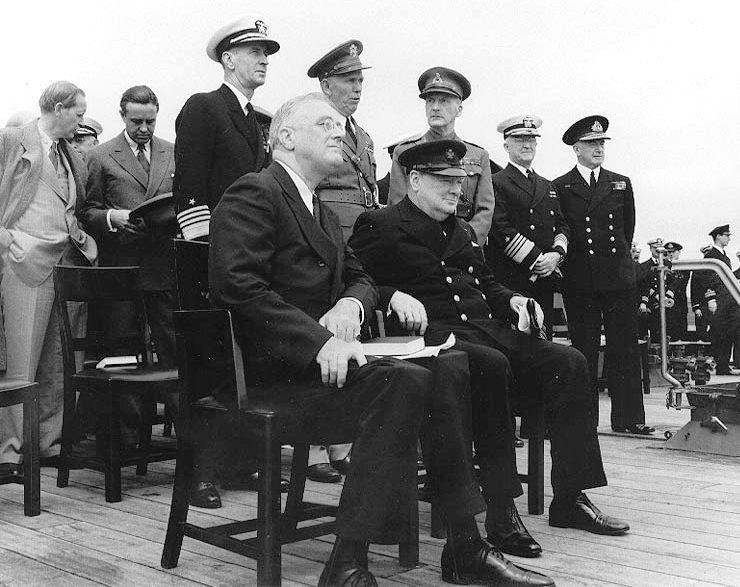
Church services on HMS Prince of Wales, in Placentia Bay, Newfoundland, during the Atlantic Charter Conference. President Franklin D. Roosevelt (left) and Prime Minister Winston Churchill are seated in the foreground. Standing directly behind them are Admiral Ernest J. King, USN; General George C. Marshall, U.S. Army; General Sir John Dill, British Army; Admiral Harold R. Stark, USN; and Admiral Sir Dudley Pound, RN. At far left is Harry Hopkins, talking with W. Averell Harriman.
US Naval Historical Center Photograph #: NH 67209 via Wikimedia Commons.
Of course, with Roosevelt dead (and Truman certainly not “read-in” on any unwritten promises to the British) and Churchill out of office (which was as much of a shock to the Americans as it was to Churchill himself), whatever they may have hoped to do was now so much wishful thinking. Britain had to not just continue wartime rationing after VE and VJ Day, but to actually make it more stringent for nearly a decade just to avoid national bankruptcy … and the withdrawal from imperial outposts had to be done as quickly and as cheaply as possible. This often meant corners were cut, cheeses were pared, and shortcuts availed of, so that the experiences of the former colonies were more fraught with civil disturbances and commercial disruptions than they should have been.
All of this is a very long-winded way to introduce Joshua Treviño’s post at Armas which considers how an American imperial decline may or may not mirror the postwar British experience of de-imperialization:
We can guess that American decline under the present regime will look much like Britain’s. The British case is taken as so normative — of course a nation will decline after its empire is gone — that the normativity goes unquestioned. But this is the worst sort of history, determinative in retrospect, as if the loss of imperium (or more properly, the loss of imperial fiscal stability) set in motion dominoes that fell unstoppably until the latest squalid episode of Keir Starmer’s thought police. That isn’t how human events work, however: all things are contingent. Britain was, in the eyes of several European powers, reduced to a mid-tier power after the catastrophic loss of America at the opening of the 1780s — and a generation later it was the indispensable nation versus French hegemony. There was not any particular reason a comparable recovery ought not have happened in the generation after 1945, even with the loss the of the empire, and even with the great postwar crisis of the pound sterling. This was in fact the high-Tory view as set forth by Enoch Powell, who evolved toward a belief that the empire was a burden on Britain, which could ascend to its destiny and fulfillment by means of the British themselves.
That this did not happen is plausibly much the fault of the Americans, who did two major things — one of them unwittingly — to forestall this sort of recovery. The first act, undertaken with deliberation, was the credible American threat to destroy the United Kingdom’s finances and economy in the 1956 Suez crisis: in no way the act of an ally, and one whose psychological effects upon Britain’s governing elites were as significant as the hard-power effects upon Britain itself. (Though I am not a particular fan of De Gaulle, for reasons that may be discussed here later, he was unquestionably a better steward of the nation than his U.K. counterparts in his conclusion — admittedly coalescing a decade earlier — that a European state could be a major power, or it could be a junior partner to the United States, but not both.) The British regime’s reaction to the episode — to draw so close to the Americans as to abandon the nation’s strategic independence — thereby contributed powerfully to Britain’s subsequent diminishment. That diminishment was not simply in the realm of hard power: it was accompanied by a profound social and governmental malaise that has fluctuated across the decades but has yet to lift. Philip Larkin’s 1969 Homage to a Government captures it well:
Next year we are to bring all the soldiers home
For lack of money, and it is all right.
Places they guarded, or kept orderly,
Must guard themselves, and keep themselves orderly
We want the money for ourselves at home
Instead of working. And this is all right.It’s hard to say who wanted it to happen,
But now it’s been decided nobody minds.
The places are a long way off, not here,
Which is all right, and from what we hear
The soldiers there only made trouble happen.
Next year we shall be easier in our minds.Next year we shall be living in a country
That brought its soldiers home for lack of money.
The statues will be standing in the same
Tree-muffled squares, and look nearly the same.
Our children will not know it’s a different country.
All we can hope to leave them now is money.The superficial read of Larkin here is that he laments deriving purpose from other things closer to home. There is a baseness in the imperialist’s love of mission, and he misses the sublime in, say, the National Health Service. It is a dumb atavism: if the “tree-muffled squares … look nearly the same”, then why does it matter that “the soldiers [are] home”? This interpretation is wrong. What Larkin laments is the loss of the common and noble purpose in the civic partnership that makes the nation, as defined at the outset of Aristotle’s Politics — without which the nation fails to cohere, even if its regime persists. Despite the strenuous efforts of the left and progressivism across the past century, that virtuous end to which the nation has been directed has never been supplanted in its old forms — religion, glory, strength, creation — by any new ones of social programs or millennialist materialism. When Clement Attlee wrote in his 1920 The Social Worker that the Protestant Reformation was to blame for the moral degradation of charity, his solution was not the obvious one (which is to say, the restoration of Catholic England or at least its mores), but to interpose government where religion and its purposes used to be. His 1945 general-election invocation of building “Jerusalem” in England, directly quoting William Blake, logically followed.
But that is not how Jerusalem is built. It remains unbuilt, and the civic effects of the American fixation and what it facilitates redound across time. Nick Cohen accuses the modern British right of Americanizing itself, and that is largely accurate, but contra his indictment, the British left does the same in different ways. What the Americans did in 1956 was not a singular event — rather it was a punctuation on a process that had been unfolding in stages for the preceding forty years or so — but their objects got a vote too. That vote was to submit, a preference shared across right and left alike. That no American regime ever had Britain’s interest fully at heart (a truth with ample reminders, not just at Suez, but in Northern Ireland, in the Falklands, in Grenada, in Iraq, and in Afghanistan) did not alter this course, thereby making a triumph of theory unmoored from fact.
August 25, 2024
Woke libraries
Frank Furedi on the already well-advanced plan to turn public libraries into safe spaces for progressive indoctrination:



In recent times, the Library has become the target of what I characterise in my new book, as The War Against The Past. The current project of dispossessing Western society of its historical legacy has gained a powerful influence over the institutions of culture. That is why the Library – a repository of the knowledge and wisdom gained through the past – has become the target of cultural vandalism.
The promoters of the culture war in the Library often justify their action on the ground that their target is not so much the past – but the “racist past”. This is the argument used by the Government backed supporters of a campaign in Wales who wish to reorganise libraries along the lines of anti-racist principles. These racially obsessed cultural warriors insist that Libraries throughout Wales must embrace the goal of becoming anti-racists if the devolved Labour government’s pledge to “eradicate” systemic racism by 2030 would be realised. To ensure that libraries and the “racist” buildings holding their collection are cleansed of the sin of “whiteness”, a £130,000 project designed to indoctrinate local librarians in “critical whiteness studies” has been devised.
The project of racial indoctrination pursued in Wales warns that staff training sessions will be necessary to ensure that libraries align with anti-racist principles. However, it insists that such training sessions should not take place in buildings with a “racist past”. From the standpoint of the authors of the document proposing “critical whiteness studies”, many buildings housing libraries must be avoided because they serve as symbols of racism. Do they presume that the buildings in question can contaminate members of the public with the racist plague? Or are they merely interested in tearing down the walls of racist buildings in order to rebuild them as temples to the doctrine of decolonization?
In a world, where the racialisation of every dimension of life has acquired its own imperative, it was only a matter of time before buildings became demonised as racist. There is now a veritable literature authored by academic racial entrepreneurs who insist that buildings can be racist. One enthusiastic social scientist supporting this thesis offers numerous “examples of buildings being racist”. The racialisation of building and the material properties used in their construction has acquired the character of a veritable fetish. “Concrete, steel and glass buildings are ‘racist'” is the title of one contribution on this subject.
The Welsh Government appears to be consumed by the quest of ridding its nations of racist buildings. As far back as 2021 it published an audit of all such buildings as well as, schools, streets, statues and pubs that it regarded as the product of Wales’ racist past. In effect almost any building, street name or pub whose name was linked with a historical figure was by definition racist. Gone are the days when a pub is allowed to call itself Admiral Nelson or the Duke of Wellington.
The policy of renaming a building, street or a statue is bad enough. What is far worse is when a library is forced to subordinate its book collection to the imperative of racialization. In the name of ridding the book shelves of their “whiteness” and “racist past”, a library becomes a target of officially sanctioned cultural vandalism.
Throughout the Anglosphere. Cultural vandalism is justified on the ground of settling scores with colonialism, racism or white supremacy. For example, school libraries in Australia have removed “outdated and offensive books on colonialism” from their collection[v]. The purge of a school library in Melbourne was guided by Dr Al Fricker, a Dja Dja Wurrung man and expert in Indigenous education with Deakin University. In the course of auditing all 7000 titles on its library shelves. Fricker showed little nostalgia towards the collection. He stated that some of the books removed were almost 50-year-old and were “simply gathering dust anyway”. He stated that “we wouldn’t accept science books being that old in the library, so why do we accept other non-fiction books to be that old, because nothing is static”.
There is something truly disturbing about the idea that a library ought to rid itself of old non-fiction books. In my discipline of sociology that would mean ridding libraries of the 19th century pioneers of the field. In effect the call to reject old non-fiction books constitutes the annihilation of the intellectual legacy of the social sciences and the humanities.
August 24, 2024
How the CIA eventually got Patrice Lumumba assassinated
The CIA decided early on that the first democratically elected Prime Minister of the Democratic Republic of the Congo was being controlled by their Soviet opponents and needed to be killed:
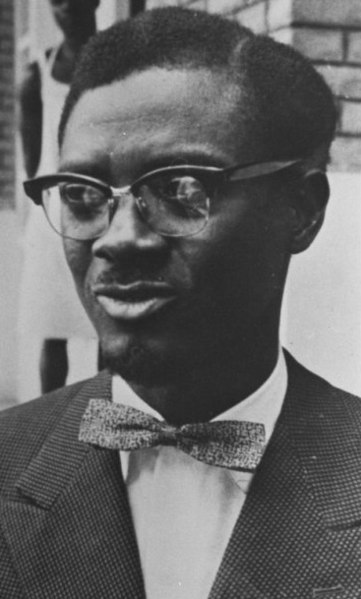
Patrice Émery Lumumba, first Prime Minister of the Democratic Republic of the Congo on 27 December 1960.
Unknown photographer
I’m still making my way through David Talbot’s 2015 book The Devil’s Chessboard, a history that explores the life of CIA Director Allen Dulles and the sordid history of the agency.
There are too many grisly anecdotes to recount showing how the CIA was involved in unlawful and unethical acts all over the world, but one that sticks out was the book’s treatment of Patrice Lumumba, an African nationalist who served as the first prime minister of the Democratic Republic of the Congo before he was killed in 1961 — with a shove from the CIA.
Lumumba was a thorn in the side of the agency, and his left-leaning politics led CIA officials to believe he was a stooge for the USSR (he wasn’t, as the CIA later admitted). So it was determined that Lumumba had to go—one way or the other.
First, a coup was arranged to have the democratically-elected Lumumba, who was demanding full independence for the Congolese people, removed from office and placed under arrest. To this end, the CIA tapped a young military colonel named Joseph Mobutu, who was friendly with Belgian intelligence (the Congo had long been under Belgian colonial rule) and would go on to rule for decades until he was ousted himself in a 1997 rebellion.
Then the CIA began exploring options to eliminate the popular Lumumba. Being the CIA, a single method was not chosen. Instead, various methods were explored to take out the Congolese leader and multiple people were tapped, including a pair of hitmen the agency had hired from Europe’s criminal underworld.
Talbot explains how the CIA equipped one of these cutthroats with a tube of poisoned toothpaste. Why toothpaste? Because one Dr. Ewen Cameron, at the behest of the CIA, had analyzed Lumumba and noted his immaculate white teeth. This led him to suggest a simple way to eliminate the troublesome leader: poison his dental products.
“In the end, the CIA did not go through with the toothpaste plot,” writes Talbot, “apparently deciding that poisoning a popular leader while he was under UN protective custody in his own house would be too flagrant a deed—one that, if traced back to the agency, would lead to unpleasant international repercussions.”
Instead, days before the inauguration of John F. Kennedy, the CIA arranged to have Lumumba chartered off on a plane to Katanga, a province that had broken from the Congo and was ruled by factions hostile to Lumumba.
This all but sealed Lumumba’s fate, CIA officials later testified.
“I think there was a general assumption, once we learned that he had been sent to Katanga, that his goose was cooked,” CIA station chief James Devlin, who helped orchestrate Lumumba’s fall, quipped to the Church Committee years later.
Devlin was right. During his flight to Katanga, Lumumba was beaten to a pulp. Then he was driven by jeep to a farm and beaten by members of rival political factions. The men, Talbot makes clear, had clear ties to US and Belgian intelligence.
“Eventually he was killed, not by our poisons, but beaten to death, apparently by men who had agency cryptonyms and received agency salaries,” said CIA agent John Stockwell, who was sent to the Congo in the aftermath of the assassination.
The Soviets managed a propaganda win out of the CIA’s clumsy wet work, renaming the Peoples’ Friendship University of the USSR (primarily used for training non-Soviet citizens from “fraternal socialist” and “unaligned” nations in Marxist-Leninist views) to the Patrice Lumumba Peoples’ Friendship University.
July 27, 2024
Cancelling Orwell (again)
In The Daily Sceptic, Paul Sutton recounts a recent discussion with some Oxford graduate students where the topic of George Orwell came up:
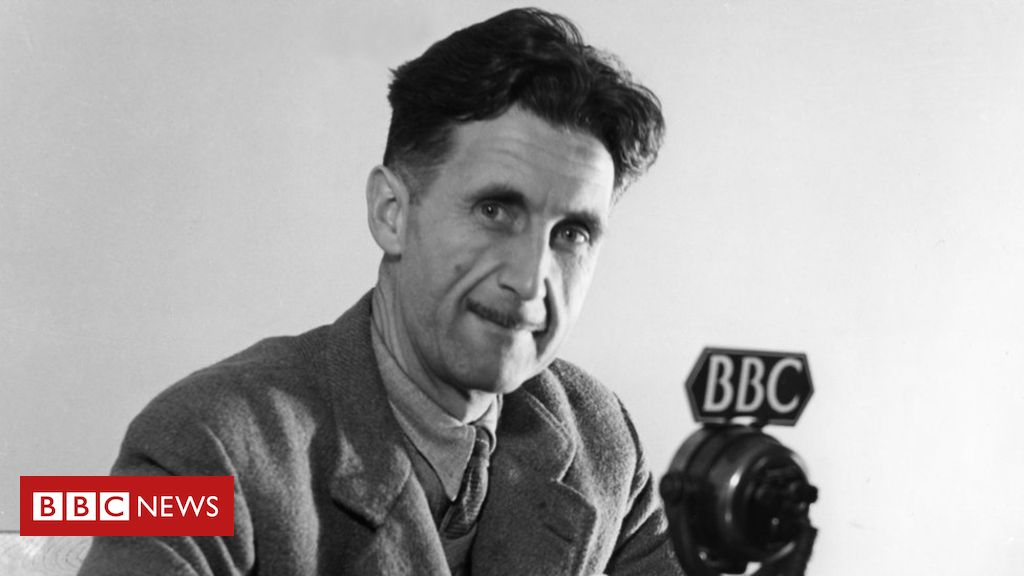
The students maintained that the important thing is quality of writing but, paradoxically, this can only be judged by a strict contemporary “evaluation” of any Right-wing or outdated views. Inevitably, this contextualisation then reveals that said writers are “problematic” and “not as good as XYZ” – usually some figure who fits their sensibilities, and coincidentally one who’s almost always female – or at least better suited to the diversity required by these commissars.
So far, so well known and wearily familiar. The absolute impossibility of literature under such a mindset – one enthusiastically endorsed by graduate students who professed to live for literature – is utterly depressing. We’re in effect dealing with its cancellation.
I made a perfunctory effort in observing their complete inconsistency, but things got more interesting when Orwell was discussed. Of course, Orwell famously wrote against their stand, not least in his brilliant defence of Kipling’s literary merit and his refusal to allow orthodoxy to dictate his aesthetic preferences, in “Benefit of Clergy“.
Unfortunately, Orwell’s stint in the Burmese Imperial Police made him a despicable figure to the students, little better than a Waffen SS or Gestapo officer. True, he’d belatedly retrieved himself by his “eventual writing” in the 1940s, but he’d spent many years performing the dirty work of the British Empire. His famous essay, “A Hanging“, showed him enthusiastically hands on at it.
I’d honestly never heard such a narrow and limited view, and was intrigued. As a preposterous misrepresentation, it needs little rebuttal. “A Hanging” is indeed a brilliantly disturbing account of an Indian murderer being hanged, a man who’d have been executed at that time in any country. The essay explores the deep unease Orwell felt about his role, so it’s a lie to claim it shows him uncritically doing his job, let alone revelling in his exertion of British authority.
Such an interpretation shows a shocking lack of understanding. As does the idea that Orwell only recanted any pro-Imperial views in the 1940s; his underrated Burmese Days was published in 1934 and he wrote extensively about his disgust for the job he did in the late 20s and 1930s. Of course, he didn’t only feel disgust, nor would he pretend that the British brought only misery and were unique as imperial exploiters.
What I’m most interested in is how an alternative Orwell was then offered up, a writer who’d accepted the British Empire was “problematic” yet offered a nice comforting view of how nice and comforting life can be – if you agree with the progressives, that is.Step forward Jan Morris and his trilogy Pax Britannica. Now, I haven’t read this non-fictional account of the British Empire but from background knowledge, it’s not in any way a replacement for Orwell or even remotely comparable. It’s an exhaustive historical work, not a personal creative one. But this trilogy was extolled by the students as what Orwell should have done when discussing empire. There was the implication that Orwell could now be – somewhat thankfully – ignored.
Bizarrely, the Englishman then introduced Joyce, first saying that the man was a lifelong sponger who’d have probably fleeced him, but as a writer was the very model of a pan-European, liberal and open to all cultures. Again, the grubby contradictions and sheer banality of such a perspective are eye-popping – from a DPhil student in perhaps the country’s finest university.
And I’ve a nagging feeling that Jan Morris – a famous case of gender realignment (he “transitioned” to female in 1972) – was picked for the “acceptable author” reasons. That’s the problem with “author context” vetting – as with “diversity hires”. Much as I’ve enjoyed Morris’s travel writing, especially Oxford, it’s staggering for this author to be proposed as some alternative to Orwell! Not only in terms of obvious lesser importance, but they’re not remotely comparable in terms of genre or aims. How could any serious reader – let alone one at a leading university – talk such gibberish?
July 21, 2024
Britain’s Weird Vietnam War
Real Time History
Published Mar 15, 2024Fall 1945: the Second World War is over, but there is fresh fighting in Vietnam. Now, former enemies become allies as British-Indian troops, French Commandos, and surrendered Japanese soldiers join in a rag-tag alliance against Ho Chi Minh’s Communists in Saigon. The outcome will shape Vietnam’s future for decades to come, in Great Britain’s weird Vietnam War.
(more…)
July 5, 2024
QotD: South Africa after Apartheid
Speaking with hindsight, however, it would be charitable to suggest […] that apartheid was “simply a logical adaptation to the presence of a population that simply cannot support or sustain a First World standard of living, done by people who very much valued the First World society they had created”. While that statement is undoubtedly true, up to a point, and it could be argued that apartheid was a pragmatic solution to the chaos evident throughout the rest of Africa, it cannot be used as an excuse. Indeed, such a labeling would give, and has given rise to the notion that First World systems are inherently unjust, and a different label “colonialism” — which would include apartheid — can be applied to the entirety of Western Civilization.
The fact of the matter is that when it comes to Africa, there is no good way. First World — i.e. Western European — principles only work in a socio-political milieu in which principles such as the rule of law, free trade, non-violent transfer of political power and the Enlightenment are both understood and respected. They aren’t, anywhere in Africa, except where such adherence can be worked to temporary local advantage. Remember, in the African mindset there is no long-term thinking or consideration of consequence — which is why, for example, since White government (not just South African) has disappeared in Africa, the infrastructure continues to crumble and fail because of a systemic and one might say almost genetic indifference to its maintenance. When a government is faced with a population of which 90% is living in dire poverty and in imminent danger of starvation, that government must try to address that first, or face the prospect of violent revolution. It’s not an excusable policy, but it is understandable.
That said, there is no gain in rethinking apartheid’s malevolence […] because apartheid was never going to last anyway, and its malevolence was bound to engender a similar counter-malevolence once it disappeared. Which is the main point to my thinking on Africa: nothing works. Africa is simply a train-smash continent, where good intentions come to nought, where successful systems and ideas fail eventually, and where unsuccessful systems (e.g. Marxism) also fail, just fail more quickly.
Kim du Toit, “Tough Question, Simple Answer”, Splendid Isolation, 2019-12-05.
July 2, 2024
Jonathan Kay on real Canadian history
Canadians have never really been encouraged to learn much about our own history. When I was in school, the history content skewed as far away from anything that might be stirring or exciting as it possibly could (we skipped over all the wars, for example), so that they could emphasize the legislative assemblies, the treaties and conferences, and the mix-and-match bearded and mustachioed “great and the good” of the time. If nothing else, you could catch up on your sleep for an hour. (I exaggerate a bit, but history in the primary grades at least covered the initial discovery and exploration of what would become Canada by French and English fur traders, adventurers, and scoundrels (some were all three). We even got a relatively unbiased (for the time) introduction to some of the First Nations, mostly in Ontario and Quebec.) These days, of course, kids learn that Canada is a genocidal colonialist white supremacist horror show that has no right to exist … hardly the kind of improvement one would hope for.
In the National Post Jonathan Kay suggests the only way to really understand Canadian history is to utterly ignore the politicians (and the bureaucrats) and learn it for yourself:
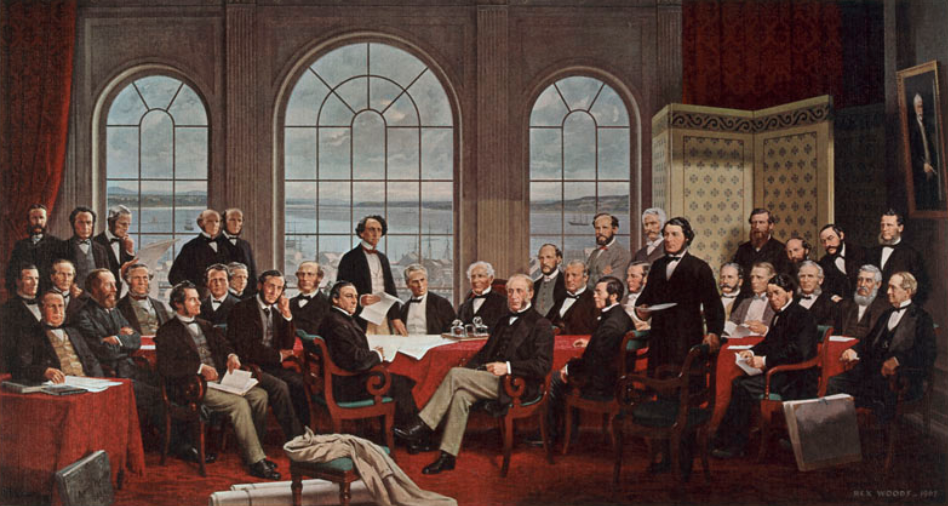
These guys are important, no question, but you need to go back a long way before them to really understand Canadian history. The nation didn’t burst fully formed from Sir John A.’s forehead, Athena-style.
Libraries and Archives Canada item ID number 3013194.
The surest way to make me treasure something is to take it away. So it was with Canada Day, whose annual appearance I’d once greeted with scarcely more excitement than the Ontario Civic Holiday and Aromantic Spectrum Awareness Week. Then came 2021, when the high priests of social justice demanded that we cancel Canada’s birthday celebrations, so that we might spend July 1 in morbid contemplation of our original sin. Not being one for rituals of confession and penitence, I instead began to think harder about why I love this country, despite its flaws — even if expressing such sentiments in public was now viewed as hate speech.
“This country was built on genocide”, ran one major-newspaper headline, amid the national meltdown following reports that hundreds of unmarked children’s graves had been found at former residential schools. Calgary dropped its fireworks program on the basis that (among other reasons) such scenes of celebration might hamper “truth and reconciliation”. Justin Trudeau, who’d come into office urging Canadians to “celebrate this amazing place we call home”, now took Canada Day as an occasion to instruct us that “the horrific findings of the remains of hundreds of children at the sites of former residential schools in British Columbia and Saskatchewan have rightfully pressed us to reflect on our country’s historical failures”.
The prime minister’s suggestion that children’s corpses were being plucked from the ground en masse turned out to be a reckless falsehood. Even the Tk̓emlúps te Secwépemc Nation, whose chief once claimed that “the remains of 215 children” had been found in Kamloops, now seems to be acknowledging that her original statements were wrong. While Canada has much to answer for when it comes to the legacy of residential schools, no graves or bodies were found at these locations in 2021. And none have been found since.
[…]
The unfortunate truth about Canada’s 19th-century origin story is that our country’s initial contours were sketched out by a group of middle-aged binge drinkers whose focus was less on life, liberty and the pursuit of happiness than on the mundane task of diffusing the high capital costs associated with rail construction and defending northern rivers and ports from rampaging Americans and Irishmen. (Yes, Irishmen: Visitors to Charlottetown’s Victoria Park will find a trio of ocean-facing nine-pounder guns that were installed in 1865 to guard against the Fenian Brotherhood, whose troops, many residents feared, were set to invade and conquer the island. But faith and begorrah, I do digress.) In this project, the Fathers of Confederation were successful. But the ensuing separation from Britain was a slow, bureaucratic affair that makes for dull reading (and duller television). I wish it were otherwise, fellow patriots. But alas, these are the facts.
Which is to say that if we’re looking to develop a compelling, historically accurate and, dare I say, inclusive, understanding of Canada’s national story, the story has to begin earlier. Specifically: the early 1600s — two and a half centuries before John A. Macdonald and his fellow Fathers of Confederation were knocking back the giggle juice in Charlottetown Harbour. As you might imagine, this means giving a starring role to Indigenous peoples — though not as the sacred martyrs and magical forest pixies of modern progressive imagination, but rather as the true-to-life diplomats, traders, craftsmen, hunters and soldiers that the first waves of Europeans knew them to be.
[…]
Toronto-born Greg Koabel spent most of his early academic career studying James I’s England (with a particular focus on the 1641 treason trial of the Earl of Strafford). And so, crucially, he approached the history of Canada laterally, through the prism of English and (primarily) French geopolitics. In telling the story of the first sustained European settlements in North America, he pays Indigenous populations the respect of examining them through this same geopolitical lens.
The resulting narrative, told in his brilliant Nations of Canada podcast, is so fascinating that you’ll have to keep reminding yourself he’s talking about Canada. This past week, Koabel hit a major milestone, releasing his 200th episode. And with his permission, I’ve been adapting his long-form audio chronology to written publication at Quillette. So far, we’ve published more than 100,000 words, and Samuel de Champlain hasn’t even left the stage yet.
I’m not much of a podcast listener, aside from The Rest is History and some Minnesota Vikings-specific sports podcasts, but the Quillette serializations of Koabel’s podcast episodes really are excellent and more than repay the effort to read them.


