Quotulatiousness

May 17, 2024

Lies my teacher taught me

Filed under: Cancon, Education, History — Tags: , , , , , — Nicholas @ 04:00

A Peel District School Board teacher using the pseudonym “Igor Stravinsky” explains the sort of indoctrination high school students are receiving about First Nations and the development of Canada:

Previously in this series, I have discussed some of the things students are learning, and not learning, about Indigenous people in the Peel District School Board:

  • Indigenous people are the true owners of the land; the rest of us are just settlers
  • Indigenous people should be able to continue to practice their traditional ways while being provided all the amenities commensurate with living in a modern, first world country
  • Indigenous people are victims, other Canadians are oppressors
  • The disproportionately poor quality of life which characterizes the lives of many Indigenous people today is the result of past and current injustices by non-Indigenous people, chiefly the Indian Residential Schools
  • Life was good for Indigenous people, who were wise and peaceful, before Europeans showed up
  • The goal of the Europeans who arrived in Canada was the genocide of Indigenous people
  • The settlers failed in their quest for genocide due to the courage and resilience of the Indigenous people

As I have demonstrated, all of the above is simplistic, misleading, or false.

Why teach students a false narrative?

The ahistorical Indigenous genocide narrative started out in academia where Grievance Studies (Indigenous Studies, Black Studies, Queer Studies, Fat Studies, etc.) have a massive presence. These post-modernist inspired programs, collectively referred to as “Critical Theory” have influenced all areas of academia and spread to Canadian institutions generally. Grievance studies programs can only exist so long as there are grievances, which necessitates re-writing history and putting people into oppositional groups of victims and oppressors. Academics had to either get on the bandwagon or keep their mouth shut if they disagreed with this new paradigm. Those who did not, such as Frances Widdowson, were attacked and paid a massive price for speaking freely about the lies on which grievance studies programs are based.

Left-leaning politicians have been keen to get on board with Critical Theory. It wins them support from the academics and well-meaning (but poorly informed) members of the public who want to be “on the right side of history”. Even conservative politicians tend to look the other way, seeing taking on the well-organized, well-funded, academia-based activists as an overall vote loser. After all, they can count on the conservative vote. To whom else can such voters turn? Consequently, school boards and the authors of school curricula are captured by Critical Theory and teachers are expected to tow the line. Anyone who doesn’t is said to be “causing harm” and faces harsh discipline.

Entrenchment of the Indigenous genocide narrative ensures ever increasing payments from Canadian taxpayers in the form of rent and compensation. The lion’s share of these payments go to the Grievance Industry Tzars- Corrupt Indigenous leaders and their non-Indigenous allies, with little trickling down to the average Indigenous person. That is why, in spite of the fact that an ever-increasing part of our federal budget is dedicated to payments to Indigenous groups (to reach 7.7% – $74.6 billion annually by 2026-27), many Indigenous people live in squalor on reserves without basic amenities like clean water, while many others live on the street in urban areas. How can this be happening when taxpayers are handing over more than $40 thousand per year per each Indigenous person?

Is it reasonable for people who want to live in remote areas engaged in low value hunting, gathering, and horticulture activities, declining to integrate into the modern Canadian socio-economic system, to expect 21st century amenities and services paid for by other Canadians? If non-Indigenous people balk at funding this economically unviable mode of existence, does that make us guilty of racism or genocide? That is the impression kids in school are left with after the “education” they receive on the matter.

May 8, 2024

The nonsensical “right of return” debate

George Monastiriakos explains why he should have the right of return to his ancestral homeland:

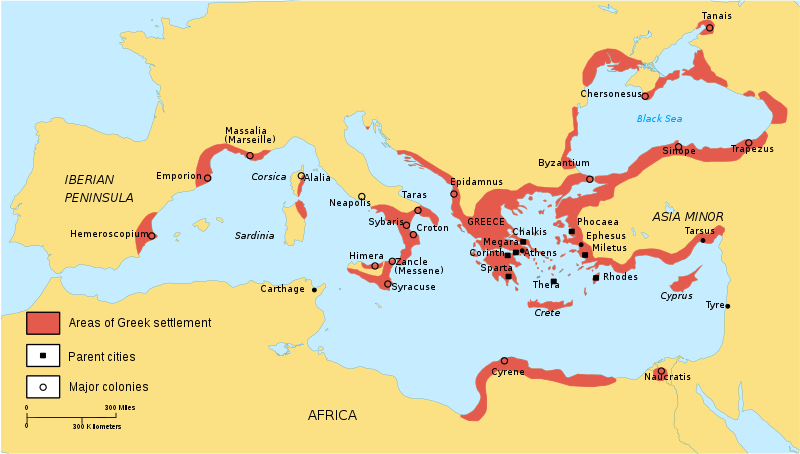
Greek colonization in the Archaic period.
Map by Dipa1965 via Wikimedia Commons.

My family hails from a small Greek village in Anatolia, in modern day Turkey, but I have unfortunately never been to my ancestral homeland because I was born a “refugee” in Montreal. Living in the “liberated zone” of Chomedey, Que., one of the biggest Greek communities in Canada, is the closest I’ve ever felt to my beloved Anatolia.

The Republic of Turkey does not have a legal right to exist. It is an illegitimate and temporary colonial project built by and for Turkish settlers from Central Asia. My ancestors resided on the Aegean coast of Asia Minor for thousands of years before the first Turks arrived on horseback from the barren plains of Mongolia. I will never relinquish my right to return to my ancestral homeland.

If you think these assertions are ridiculous, it’s because they are. I copied them from the shallow, even childish, anti-Israel discourse that’s prevalent on campuses in the United States and Canada, including the University of Ottawa, where I studied and now teach. I am a proud Canadian citizen, with no legal or personal connection to Anatolia. I have no intention, or right, to return to my so-called ancestral homeland. Except, perhaps, for a much-needed vacation. Even then, my stay would be limited to the extent permitted by Turkish law.

The Second Greco-Turkish War concluded with the Treaty of Lausanne in 1923. Among other things, this agreement finalized the forced displacement of nearly one-million Ottoman Greeks to the Kingdom of Greece, and roughly 500,000 Greek Muslims to the newly formed Republic of Turkey. This ended the over 3,000 years of Greek history in Anatolia, and served as a model for the partition of British India, which saw the emergence of a Hindu majority state and a Muslim majority state some two decades later.

With their keys and property deeds in hand, my paternal grandmother’s family fled to the Greek island of Samos, on the opposite side of the Mycale Strait at a nearly swimmable distance from the Turkish coast. While they practised the Greek Orthodox religion and spoke a dialect of the Greek language, they were strangers in a foreign land with no legal or personal connection to the Kingdom of Greece.

The Great War channel produced an overview of the Greco-Turkish War of 1919-1923 that resulted in the vast human tragedy of the expulsion of ethnic Greek civilians from Anatolia and ethnic Turkish civilians from mainland Greece here.

May 5, 2024

Trudeau’s shameful role in promoting “the blood libel against Canada”

Conrad Black believes that Justin Trudeau owes Canadians an apology for his role in pushing the most extreme version of the Residential Schools propaganda:

A very well-informed friend of many years, a contemporary of mine, wrote me the other day that “The blood libel against Canada of this monstrous fiction of thousands of secretly buried Indigenous victims of residential schools may be the single worst injustice this country has suffered in our lifetimes. It is now a conspiracy of silence involving both federal and provincial governments, the RCMP (shameless and useless as ever), and the media, and ‘let’s be frank’, (quoting a Soviet diplomat many years ago whom we both always found rather entertaining in the utter nonsense he used to recite at international meetings), a large section of the public, which knows this to be a falsehood but chooses to side with the silent forces”.

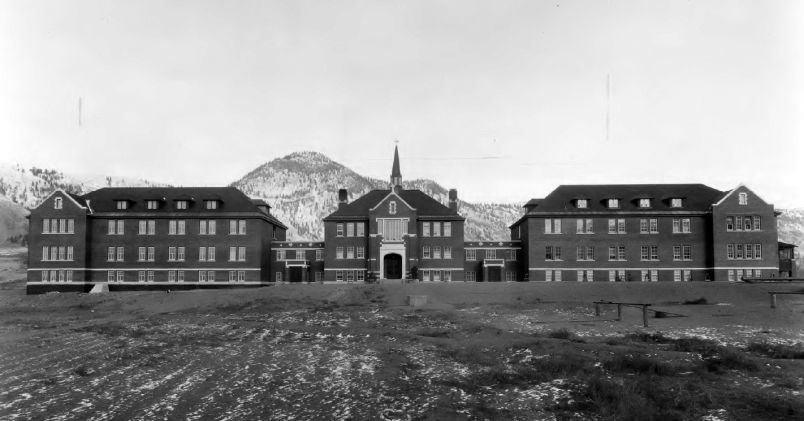
Almost all readers will be aware of the tidal wave of self-mutilating hysteria that inundated this country when, on the basis of apparent anomalies detected by underground radar close to a former Indian Residential School site at Kamloops, British Columbia, a couple of years ago. Immediately, the theory took hold that thousands of native children in those schools had died because of negligence or outright homicide, were buried secretly in unmarked graves, their deaths never recorded and no account given to their families. There is no evidence to support this, yet the prime minister led the nation in an almost medieval circular mass pilgrimage of self-flagellation. In order to impress upon ourselves and the entire world the profundity of our self-humiliation, all official Canadian flags everywhere were lowered to half-mast and maintained in that condition for an unheard-of period of six months.

Parliament voted to spend $27 million to conduct the excavations necessary to verify or otherwise the existence and extent of these graves. This work could have been accomplished by a small group for a few thousand dollars, but the suggestion of actually establishing what happened set up the customary cacophony of complaints about the sacred untouchability of burial grounds, even though it was not clear that there was burial ground at the Kamloops site, and if it was it was rank speculation about who might be buried there if it was. It is not conceivable to me that the country could dress itself out in sackcloth and ashes and flay the flesh off its own back before the bemused or astonished eyes of the entire world and then produce no evidence whatever of the unspeakable outrages that allegedly occurred and gave rise to this conduct, and then simply lapse into Sphinx-like incommunicability: a pristine silence of perfect ambiguity followed a near-terminal St. Vitus dance of window-rattling ululations of national guilt, shame, and self-hate.

Kamloops Indian Residential School, 1930.
Photo from Archives Deschâtelets-NDC, Richelieu via Wikimedia Commons.

Various parts of this macabre fable have been precisely and publicly put to rest: children in residential schools were not buried secretly and records were not destroyed; residential school students were accounted for and if they died while at the schools the reason was typically provided and it was almost invariably as a result of illnesses that were not as well treated in those times, and particularly tuberculosis. Beyond that, there has been silence: the febrile allegations of hideous wrongdoing vituperatively hurled at Canadian history and society – at the ancestors of English and French Canadians, at the main Christian churches, at the principal founder of our country whose distinguished name (John A. Macdonald) has been taken down from public buildings, statues of him overturned or removed, and effigies of him burned at festivities of confected righteous anger from coast to coast; all just mysteriously stopped. It is a sonic version of the celebrated poem by Shelley about the fallen monument of a once great King: “Round the decay of that colossal wreck, boundless and bare, the loan and level sands stretch far away.”

May 3, 2024

QotD: Colonialism in the ancient Mediterranean

We should start with a basic understanding of who we are talking about here, where they are coming from and the areas they are settling in. First we have our Greeks, who I am sure that most of our readers are generally familiar with. They don’t call themselves Greeks – it is the Romans who do (Latin: graeci); by the classical period they call themselves Hellenes (Έλληνες), a term that appears in the Iliad but once (Homer prefers Ἀχαιοί and Δαναοί, “Achaeans” and “Danaans”). That’s relevant because a lot of the apparent awareness of the Greeks (or more correctly, the Hellenes) as a distinct group, united by language and culture against other groups, belongs to late Archaic and early Classical and the phenomenon we’re going to look at begins during the Greek Dark Age (1100-800) and crests in the Archaic (800-480).

Greek settlement in the late Bronze Age (c. 1500-1100) was focused on the Greek mainland, though we have Greek (“Mycenean”) settlements on the Aegean islands (and Crete) and footholds on the west coast of Asia Minor (modern Turkey). Over the Dark Age – a period where our evidence is very poor indeed, so we cannot see very clearly – the area of Greek-speaking settlement in the Aegean expands and Greek settlements along that West coast of Asia Minor expand dramatically. Our ancient sources preserve legends about how these Greeks (particularly the Ionians, inhabiting the central part of that coastal strip) got there, having been supposedly expelled from Achaia on the northern side of the Peloponnese, but it’s unclear how seriously we should take those legends. But the key point here is that the outward motion of Greeks from mainland Greece proper begins quite early (c. 1100) and is initially local and probably not as organized as the subsequent second phase beginning in the 8th century, which is going to be our focus here.

Our other group are the Phoenicians. They did not call themselves that either; it derives from the Greeks who called them Phoinices (φοίνικες), which like the Roman Poeni may have had its roots in Egyptian fnḫw or perhaps Israelite Ponim.1 In any case, the word is old, as it appears in Linear B tablets dating to the Mycenean period (that 1500-1100 period). The Phoenicians themselves, if asked to call themselves something, would more likely have said Canaans, Kn’nm, though much like the Greeks tended to be Athenians, Spartans, Thebans and so on first, the Phoenicians tended to be Sidonians, Tyrians and so on first. They spoke a Semitic language which we call Phoenician (closely related to Biblical Hebrew) and they invented the alphabet to represent it; this alphabet was copied by the Greeks to represent their language, who were in turn copied by the Romans to represent their language, whose alphabet in turn was adopted by subsequent Europeans to represent their languages – which is the alphabet which I am writing with to you now.

Since at least the late bronze age, they lived in a series of city states on the eastern edge of the Mediterranean in Phoenicia in the Levant in what today would mostly be Lebanon. During the late bronze age, this was the great field of contested influence between the Hittite, (Middle) Assyrian and (New Kingdom) Egyptian Empires. The Late Bronze Age Collapse removed those external influences, leading to a quick recovery from the collapse and then efflorescence in the region. They had many cities, but the most important by this point are Sidon and Tyre; by the 9th century, Tyre emerged as chief over Sidon and may at times have controlled it directly, but this was short lived as the whole region came under the control of the (Neo)Assyrian Empire in 858. The Assyrians demanded heavy tribute (which may contribute to colonization, discussed below) but only vassalized rather than annexed Tyre, Byblos and Sidon, the three largest Phoenician cities.

Both the Greeks and the Phoenicians have one thing in common at the start, which is that these are societies oriented towards the sea. Their initial area of settlement is coastal and both groups were significant sea-faring societies even during the late Bronze Age and remained so by the Archaic period. Both regions, while not resource poor (Phoenicia was famous for its timber, Lebanese cedar), are not resource rich either, particularly in agricultural resources. Compared to the fertility of Mesopotamia, Egypt or even Italy, these were drier, more marginal places, which may go some distance to explaining why both societies ended up oriented towards the sea: it was there and they could use the opportunities.

Bret Devereaux, “Collections: Ancient Greek and Phoenician Colonization”, A Collection of Unmitigated Pedantry, 2023-10-13.


    1. The former is what I’ve found in dictionary entries for etymologies, the latter is what Dexter Hoyos suggests, Carthaginians (2010), 1. I am not an expert on Semitic languages, linguistics or etymologies, so don’t ask me to decide between them.

April 30, 2024

QotD: The ambitious Roman’s path to glory and riches

Filed under: Britain, Europe, History, Military, Quotations — Tags: , , , , , — Nicholas @ 01:00

The Romans, for one, admitted all the time that they screwed up … to themselves, in private (what passed for “private” in the ancient world, anyway). A big reason an ambitious man (a redundancy in ancient Rome) wanted to climb the cursus honorum was because that was the easiest way to get a field command, which was the easiest way to start a war with someone, which was the easiest route to riches and glory … provided you didn’t fuck it up. But if you did, the best thing to do was to go down fighting with your legions, because the minute you got back to Rome, there’d be ambitious men (again: redundant in context) lined up from here to Sicily waiting to prosecute your ass for something, anything — “losing a war” wasn’t a crime in itself, but whatever the official charge (usually “corruption” or “misuse of public funds” or something), everyone knew you were really getting punished for losing.

At no point, however, did the putative justification for war come into play. Picking a war with the Parthians wasn’t bad in itself. Nor was “picking a war with the Parthians because you gots to get paid”. Certainly picking a war with, say, the Gauls wasn’t bad in itself, and “picking a war with the Gauls because I need to capture and sell a few thousand slaves to cover my debts” was so far from being bad, guys like Caesar, if I recall my Gallic Wars correctly, openly declared it from jump street. And though Caesar surely would’ve been prosecuted if he’d lost, and Crassus if he’d lived, suggesting that anyone owed an apology to the Gauls or Parthians would’ve gotten you locked up as a dangerous lunatic.

A confident, manly power might lose a war or two. Hell, they might lose a bunch — the Romans got beat all the time, and so did the British. But no matter how bad the loss, or how embarrassing the peace treaty, they shrugged it off. You win some, you lose some, and when it’s clear you’re going to lose — or when it becomes clear that there’s no possible way “victory” will ever be worth the cost — you cut your losses and came home. HM forces, for instance, lost no less than three wars in Afghanistan. And so what? Great Britain was still the world’s preeminent power. They never even dreamed of apologizing — that’s the Great Game, old sock.

Severian, “Friday Mailbag / Grab Bag”, Rotten Chestnuts, 2021-07-23.

April 25, 2024

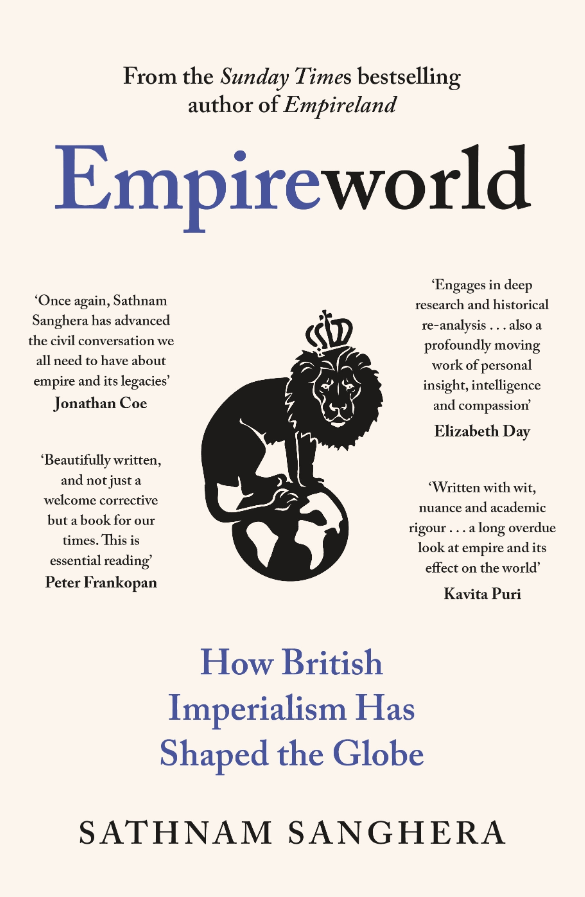
Jeremy Black reviews Empireworld by Sathnam Sanghera

Filed under: Books, Britain, History — Tags: , , , — Nicholas @ 03:00

The author of a book on the same topic says that Sathnam Sanghera’s work “really should have devoted more attention to the pre-Western history“:

With its pretensions and authorial conceit, Sanghera’s book is actually rather a good laugh. He apparently is the word and the way for Britain, which “cannot hope to have a productive future in the world without acknowledging what it did to the world in the first place”, a process that is to be done on his terms in order to overcome a British allergy to the unattractive aspects of the imperial past.

Stripped to its essentials, this is a book that repeats well-established themes and serves them up in a familiar fashion. Although 461 pages long, only 247 are text and, with a generous typeface that is a pleasure to read, there is only so much space for his analysis. Unfortunately, that is what is on offer.

It might be thought appropriate to establish what was different or familiar in British imperialism in a Western European context by comparing in detail, say, Britain’s Caribbean empire with those of France, Spain and the Dutch. It might be thought useful to assess Britain as an Asian imperial power alongside Russia or the Ottomans, China or the Persians.

It might be appropriate to follow the direction of much of the world history approach over the last half-century and assess empires as shared projects in which there were many stakeholders, British and non-British. To turn to the British empire, it might be useful to discuss the oldest “colony”, Ireland, or to assess policy in (Highland) Scotland. It could be appropriate to consider how the causes, context, course and consequences of British imperialism varied greatly.

Sanghera has not risen to the challenge. His study is conceptually weak, methodologically flawed, historiographically limited and lacking basic skills in source assessment. This is a pity, as his position as a journalist, and his link with Penguin, provide an opportunity for using his abilities as a communicator to expand public understanding of the subject.

Sanghera criticises “an enervating culture war on the theme of British empire”. He rightly draws attention to the flaws of the “balance sheet” view of British empire, but I am less confident than he is about how best to consider what he terms “a culture war”. The promotion of “understanding” for which he calls is scarcely value-free, nor does he adequately address the degree to which there have always been “culture wars” in both Britain and its colonies and former colonies. Unsurprisingly so, as there were substantive issues at stake, and questions of goal and identity were very much part of the equation.

From reading journalists’ comment pieces, it is hard to avoid the sense that they feel that there is a correct view (theirs, what a surprise) and that others are variously culture wars, populist, ignorant, etc. This is the standard approach to history, notably national history, and, particularly in the case of Britain, empire and slavery. Yet, such a stance scarcely captures the complexities of the issue, a problem very much seen in Sanghera’s work, despite his claim to nuance.

April 23, 2024

Debating the economic impact of the Raj on India

At The Daily Sceptic, Nigel Biggar looks at a few books making or refuting the narrative on how much or how little British rule in India extracted or contributed to the economic life of the subcontinent:

Beyond slave-trading and slavery, what were the economic effects of British imperial dominance? Can they be reduced to Britain’s leeching wealth from exploited subject peoples?

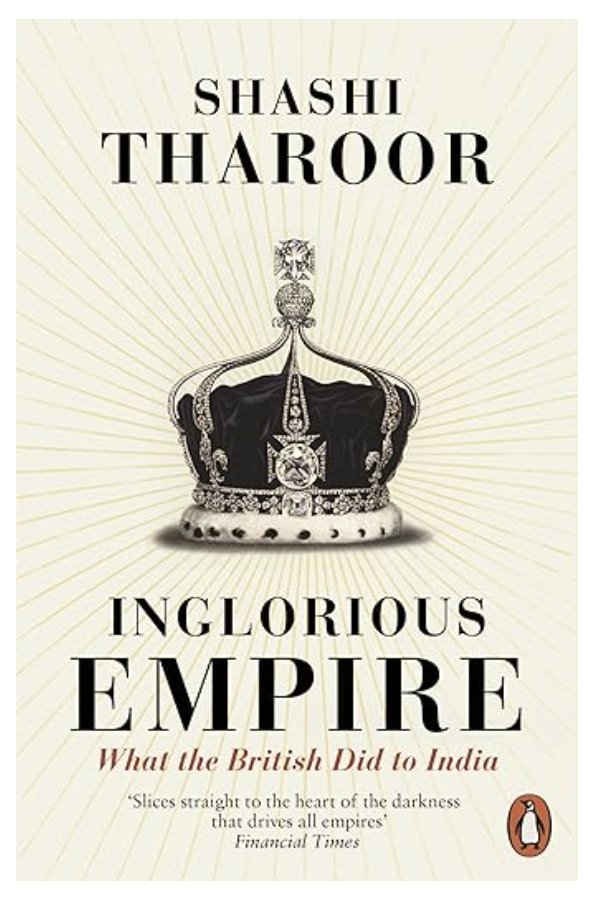
For over a century, that is what Indian nationalists have claimed. It is also what the politician Shashi Tharoor claims in his 2016 book, Inglorious Empire: What the British Did to India. Against him, however, the Bengali-born, LSE-based economic historian Tirthankar Roy has declared of the nationalist critique that “generations of historians … have shown that it is not [true]”. Pace Tharoor, the statistic that India produced 25 per cent of world output in 1800 and 2–4 per cent in 1900 does not prove that India was once rich and became poor: “[i]t only tells that industrial productivity in the West increased four to six times during this period … The proposition that the Empire was at bottom a mechanism of surplus appropriation and transfer has not fared well in global history”.

On the contrary, the British Empire’s commitment to free trade gave Indian entrepreneurs new opportunities to grow. Some of them visited England in the late 19th Century, observed the workings of manufacturing industry, imported machinery and expertise to India, built factories employing Indians, and then outcompeted Manchester. This is exactly how the Tata Iron and Steel Company began in Bombay – the same company that now owns what remains of the British steel industry.

What is more, colonial governments often protected native producers against British business, in order to moderate economic and social disruption, partly because they genuinely cared for the welfare of native people and partly because they didn’t want to have to manage the political unrest that foreign commercial intrusion could excite. Famously, in 1910-11 colonial officials barred Lever Brothers from acquiring concessions in Nigeria on which to establish palm-oil processing mills with widespread hinterlands, since Africans were already producing for the world markets and generating tax revenue and because the alienation of large areas of land risked provoking native opposition.

Further still, the British were the leading exporters of capital from the mid-19th Century to at least 1929. Between 1876 and 1914, Britain invested over a third of its overseas capital in the Empire, over 19% of it in India. Of course, British investors often made a profit out of this. That’s the thing about investment: you tend to want to grow your money, not waste it. But if the British gained, so did colonial peoples. Take railways. By 1947, British India had 45,000 miles of railway track, most of it constructed with private capital, whereas five years later un-colonised China still had less than 18,000 miles. For sure, the railways served military purposes. But they also served commercial and economic ones: one estimate reckons that when the railway network reached the average district, real agricultural income rose by about 16%. And it served the welfare purpose of efficient famine relief, too.

A basic reason why the British sent their capital overseas to the Empire, enabling the growth of businesses and the building of infrastructure, was that colonial states provided sufficient political stability and legal certainty to make the risks of financial ventures worth taking. (Badenoch hints at this in her reference to the economic effects of the Glorious Revolution of 1688.) That explains why Australia’s economic growth compares so favourably with that of many Latin American countries, and why, between the 1860s and 1890s, Australia was the richest country on earth.

In sum, the considered judgement of the Swiss historian Rudolf von Albertini, whose work – according to the world’s “leading imperial economic historian”, David Fieldhouse – was based “on exhaustive examination of the literature on most parts of the colonial world to 1940”, was simply this: “colonial economics cannot be understood through concepts such as plunder economics and exploitation”.

April 4, 2024

QotD: What we mean by the term “indigenous”

Well, if by indigenous we mean “the minimally admixed descendants of the first humans to live in a place”, we can be pretty confident about the Polynesians, the Icelanders, and the British in Bermuda. Beyond that, probably also those Amazonian populations with substantial Population Y ancestry and some of the speakers of non-Pama–Nyungan languages in northern Australia? The African pygmies and Khoisan speakers of click languages who escaped the Bantu expansion have a decent claim, but given the wealth of hominin fossils in Africa it seems pretty likely that most of their ancestors displaced someone. Certainly many North American groups did; the “skraelings” whom the Norse encountered in Newfoundland were probably the Dorset, who within a few hundred years were completely replaced by the Thule culture, ancestors of the modern Inuit. (Ironically, the people who drove the Norse out of Vinland might have been better off if they’d stayed; they could hardly have done worse.)

But of course this is pedantic nitpicking (my speciality), because legally “indigenous” means “descended from the people who were there before European colonialism”: the Inuit are “indigenous” because they were in Newfoundland and Greenland when Martin Frobisher showed up, regardless of the fact that they had only arrived from western Alaska about five hundred years earlier. Indigineity in practice is not a factual claim, it’s a political one, based on the idea that the movements, mixtures, and wholesale destructions of populations since 1500 are qualitatively different from earlier ones. But the only real difference I see, aside from them being more recent, is that they were often less thorough — in large part because they were more recent. In many parts of the world, the Europeans were encountering dense populations of agriculturalists who had already moved into the area, killed or displaced the hunter-gatherers who lived there, and settled down. For instance, there’s a lot of French and English spoken in sub-Saharan Africa, but it hasn’t displaced the Bantu languages like they displaced the click languages. Spanish has made greater inroads in Central and South America, but there’s still a lot more pre-colonial ancestry among people there than there is pre-Bantu ancestry in Africa. I think these analogies work, because as far as I can tell the colonization of North America and Australia look a lot like the Early European Farmer and Bantu expansions (technologically advanced agriculturalists show up and replace pretty much everyone, genetically and culturally), while the colonization of Central and South America looks more like the Yamnaya expansion into Europe (a bunch of men show up, introduce exciting new disease that destabilizes an agricultural civilization,1 replace the language and heavily influence the culture, but mix with rather than replacing the population).

Some people argue that it makes sense to talk about European colonialism differently than other population expansions because it’s had a unique role in shaping the modern world, but I think that’s historically myopic: the spread of agriculture did far more to change people’s lives, the Yamnaya expansion also had a tremendous impact on the world, and I could go on. And of course the way it’s deployed is pretty disingenuous, because the trendier land acknowledgements become, the more the people being acknowledged start saying, “Well, are you going to give it back?” (Of course they’re not going to give it back.) It comes off as a sort of woke white man’s burden: of course they showed up and killed the people who were already here and took their stuff, but we’re civilized and ought to know better, so only we are blameworthy.

More reasonable, I think, is the idea that (some of) the direct descendants of the winners and losers in this episode of the Way Of The World are still around and still in positions of advantage or disadvantage based on its outcome, so it’s more salient than previous episodes. Even if, a thousand years ago, your ancestors rolled in and destroyed someone else’s culture, it still sucks when some third group shows up and destroys yours. It’s just, you know, a little embarrassing when you’ve spent a few decades couching your post-colonial objections in terms of how mean and unfair it is to do that, and then the aDNA reveals your own population’s past …

Reich gets into this a bit in his chapter on India, where it’s pretty clear that the archaeological and genetic evidence all point to a bunch of Indo-Iranian bros with steppe ancestry and chariots rolling down into the Indus Valley and replacing basically all the Y chromosomes, but his Indian coauthors (who had provided the DNA samples) didn’t want to imply that substantial Indian ancestry came from outside India. (In the end, the paper got written without speculating on the origins of the Ancestral North Indians and merely describing their similarity to other groups with steppe ancestry.) Being autochthonous is clearly very important to many peoples’ identities, in a way that’s hard to wrap your head around as an American or northern European: Americans because blah blah nation of immigrants blah, obviously, but a lot of northern European stories about ethnogenesis (particularly from the French, Germans, and English) draw heavily on historical Germanic tribal migrations and the notion of descent (at least in part) from invading conquerors.

One underlying theme in the book — a theme Reich doesn’t explicitly draw out but which really intrigued me — is the tension between theory and data in our attempts to understand the world. You wrote above about those two paradigms to explain the spread of prehistoric cultures, which the lingo terms “migrationism” (people moved into their neighbors’ territory and took their pots with them) and “diffusionism”2 (people had cool pots and their neighbors copied them), and which archaeologists tended to adopt for reasons that had as much to do with politics and ideology as with the actual facts on (in!) the ground. And you’re right that in most cases where we now have aDNA evidence, the migrationists were correct — in the case of the Yamnaya, most modern migrationists didn’t go nearly far enough — but it’s worth pointing out that all those 19th century Germans who got so excited about looking for the Proto-Indo-European Urheimat were just as driven by ideology as the 21st century Germans who resigned as Reich’s coauthors on a 2015 article where they thought the conclusions were too close to the work of Gustaf Kossinna (d. 1931), whose ideas had been popular under the Nazis. (They didn’t think the conclusions were incorrect, mind you, they just didn’t want to be associated with them.) But on the other hand, you need a theory to tell you where and how to look; you can’t just be a phenomenological petri dish waiting for some datum to hit you. This is sort of the Popperian story of How Science Works, but it’s more complex because there are all kinds of extra-scientific implications to the theories we construct around our data.

The migrationist/diffusionist debate is mostly settled, but it turns out there’s another issue looming where data and theory collide: the more we know about the structure and history of various populations, the more we realize that we should expect to find what Reich calls “substantial average biological differences” between them. A lot of these differences aren’t going to be along axes we think have moral implications — “people with Northern European ancestry are more likely to be tall” or “people with Tibetan ancestry tend to be better at functioning at high altitudes” isn’t a fraught claim. (Plus, it’s not clear that all the differences we’ve observed so far are because one population is uniformly better: many could be explained by greater variation within one population. Are people with West African ancestry overrepresented among sprinters because they’re 0.8 SD better at sprinting, or because the 33% higher genetic diversity among West Africans compared to people without recent African ancestry means you get more really good sprinters and more really bad ones?) But there are a lot of behavioral and cognitive traits where genes obviously play some role, but which we also feel are morally weighty — intelligence is the most obvious example, but impulsivity and the ability to delay gratification are also heritable, and there are probably lots of others. Reich is adorably optimistic about all this, especially for a book written in 2018, and suggests that it shouldn’t be a problem to simultaneously (1) recognize that members of Population A are statistically likely to be better at some thing than members of Population B, and (2) treat members of all populations as individuals and give them opportunities to succeed in all walks of life to the best of their personal abilities, whether the result of genetic predisposition or hard work. And I agree that this is a laudable goal! But for inspiration on how our society can both recognize average differences and enable individual achievement, Reich suggests we turn to our successes in doing this for … sex differences! Womp womp.

Jane Psmith and John Psmith, “JOINT REVIEW: Who We Are and How We Got Here, by David Reich”, Mr. and Mrs. Psmith’s Bookshelf, 2023-05-29.


    1. aDNA works for microbes too, and it looks like Y. pestis, the plague, came from the steppe with the Yamnaya. It didn’t yet have the mutation that causes buboes, but the pneumonic version of the disease is plenty deadly, especially to the Early European Farmers who didn’t have any protection against it. In fact, as far as we can tell, in all of human history there have only been four unique introductions of plague from its natural reservoirs in the Central Asian steppe: the one that came with or slightly preceded the Yamnaya expansion around 5kya, the Plague of Justinian, the Black Death, and an outbreak that began in Yunnan in 1855. The waves of plague that wracked Europe throughout the medieval and early modern periods were just new pulses of the strain that had caused Black Death. Johannes Krause gets into this a bit in his A Short History of Humanity, which I didn’t actually care for because his treatment of historic pandemics and migrations is so heavily inflected with Current Year concerns, but I haven’t found a better treatment in a book so it’s worth checking it out from the library if you’re interested.

    2. I cheated with that “pots not people” line in my earlier email; it usually gets (got?) trotted out not as a bit of epistemological modesty about what the archaeological record is capable of showing, but as a claim that the only movements involved were those of pots, not of people.

March 27, 2024

As the kids will be taught, pre-Columbian culture was feminist, egalitarian, non-violent, etc.

Filed under: Americas, Cancon, Education, History, Politics, USA — Tags: , , , — Nicholas @ 03:00

The way history will be taught in future will distort historical facts to flatter modern sensibilities, especially with regard to First Nations history:

Linguistic groups of pre-contact North America.
Wikimedia Commons

In my previous missive of this series, I outlined the socio-economic problems facing Indigenous people in Canada and identified the official narrative, promoted by the federal government, Indigenous leaders, and their non-Indigenous allies. This narrative is basically that colonialism, racism, and oppression are the sole (or at least the major) causes of the long list of socio-economic difficulties so many Indigenous people are suffering from today. The narrative focuses on colonialism, oppression, as well as “intergenerational trauma” and “genocide”, neither of which claims stand up to the slightest bit of objective scrutiny and analysis. The genocide claim is particularly laughable in that the Indigenous population has increased from about 100 thousand in 1900 to nearly 2 million today, which is at least four times the pre-contact Indigenous population.

Pre-contact living conditions for Indigenous people

In order to blame all the problems on European settlers and their descendants, the narrative starts out by implying that life in pre-contact Canada was idyllic. Students are led to believe that this was a time of peace, cooperation, and prosperity based on teachings and knowledge systems that were superior to what we have now (the Western enlightenment-based ethos and the scientific method). Students are told that people lived well- sustainably, with little environmental impact, and with a respect for each other and the land, with which their relationship was one of stewardship and symbiotic coexistence.

This is presented in contrast to the purported European world view, which kids are told was, and still is, characterized by exploitation and a belief in European superiority. Europeans are described as ruthless and greedy people who just wanted to enrich themselves by maximally extracting any and all resources without regard for impacts on the environment or Indigenous people. It is presented as a case of good vs. evil.

But what was life really like for pre-contact Indigenous people? Certainly their stone age way of living combined with their small, scattered population was eco-friendly, but was their standard of living, on balance, better than that of modern Canada? Were they more moral, or wiser than modern non-Indigenous Canadians? An honest answer to these questions demands a hard look at the available evidence and a willingness to draw conclusions wherever that evidence may lead.

And that evidence shows that pre-contact indigenous people demonstrated the full range of behaviors we find in all stone age hunter gatherer/horticulturalist societies. While there is much to admire about these people, who were able to survive in a challenging environment with only the most rudimentary of wooden, stone, and bone tools, the evidence is clear that, compared to modern times

  • life expectancy was very low
  • child mortality was very high
  • warfare was endemic
  • slavery was a common practice
  • violence of all kinds was common
  • people suffered a great deal from simple health problems which would now be easily treatable with antibiotics and surgical techniques.

It should also be pointed out that while the allegation that Indigenous people were the victims of genocide at the hands of the government of Canada is ridiculous, it is a well-established (but rarely mentioned) fact that Indigenous people carried out genocides against one another on a regular basis, for example the genocide of the Hurons by the Iroquois.

March 9, 2024

Salt – mundane, boring … and utterly essential

Filed under: Books, Economics, Food, Health, History — Tags: , , , , , , — Nicholas @ 05:00

In the latest Age of Invention newsletter, Anton Howes looks at the importance of salt in history:

There was a product in the seventeenth century that was universally considered a necessity as important as grain and fuel. Controlling the source of this product was one of the first priorities for many a military campaign, and sometimes even a motivation for starting a war. Improvements to the preparation and uses of this product would have increased population size and would have had a general and noticeable impact on people’s living standards. And this product underwent dramatic changes in the seventeenth and eighteenth centuries, becoming an obsession for many inventors and industrialists, while seemingly not featuring in many estimates of historical economic output or growth at all.

The product is salt.

Making salt does not seem, at first glance, all that interesting as an industry. Even ninety years ago, when salt was proportionately a much larger industry in terms of employment, consumption, and economic output, the author of a book on the history salt-making noted how a friend had advised keeping the word salt out of the title, “for people won’t believe it can ever have been important”.1 The bestselling Salt: A World History by Mark Kurlansky, published over twenty years ago, actively leaned into the idea that salt was boring, becoming so popular because it created such a surprisingly compelling narrative around an article that most people consider commonplace. (Kurlansky, it turns out, is behind essentially all of those one-word titles on the seemingly prosaic: cod, milk, paper, and even oysters).

But salt used to be important in a way that’s almost impossible to fully appreciate today.

Try to consider what life was like just a few hundred years ago, when food and drink alone accounted for 75-85% of the typical household’s spending — compared to just 10-15%, in much of the developed world today, and under 50% in all but a handful of even the very poorest countries. Anything that improved food and drink, even a little bit, was thus a very big deal. This might be said for all sorts of things — sugar, spices, herbs, new cooking methods — but salt was more like a general-purpose technology: something that enhances the natural flavours of all and any foods. Using salt, and using it well, is what makes all the difference to cooking, whether that’s judging the perfect amount for pasta water, or remembering to massage it into the turkey the night before Christmas. As chef Samin Nosrat puts it, “salt has a greater impact on flavour than any other ingredient. Learn to use it well, and food will taste good”. Or to quote the anonymous 1612 author of A Theological and Philosophical Treatise of the Nature and Goodness of Salt, salt is that which “gives all things their own true taste and perfect relish”. Salt is not just salty, like sugar is sweet or lemon is sour. Salt is the universal flavour enhancer, or as our 1612 author put it, “the seasoner of all things”.

Making food taste better was thus an especially big deal for people’s living standards, but I’ve never seen any attempt to chart salt’s historical effects on them. To put it in unsentimental economic terms, better access to salt effectively increased the productivity of agriculture — adding salt improved the eventual value of farmers’ and fishers’ produce — at a time when agriculture made up the vast majority of economic activity and employment. Before 1600, agriculture alone employed about two thirds of the English workforce, not to mention the millers, butchers, bakers, brewers and assorted others who transformed seeds into sustenance. Any improvements to the treatment or processing of food and drink would have been hugely significant — something difficult to fathom when agriculture accounts for barely 1% of economic activity in most developed economies today. (Where are all the innovative bakers in our history books?! They existed, but have been largely forgotten.)

And so far we’ve only mentioned salt’s direct effects on the tongue. It also increased the efficiency of agriculture by making food last longer. Properly salted flesh and fish could last for many months, sometimes even years. Salting reduced food waste — again consider just how much bigger a deal this used to be — and extended the range at which food could be transported, providing a whole host of other advantages. Salted provisions allowed sailors to cross oceans, cities to outlast sieges, and armies to go on longer campaigns. Salt’s preservative properties bordered on the necromantic: “it delivers dead bodies from corruption, and as a second soul enters into them and preserves them … from putrefaction, as the soul did when they were alive”.2

Because of salt’s preservative properties, many believed that salt had a crucial connection with life itself. The fluids associated with life — blood, sweat and tears — are all salty. And nowhere seemed to be more teeming with life as the open ocean. At a time when many believed in the spontaneous generation of many animals from inanimate matter, like mice from wheat or maggots from meat, this seemed a more convincing point. No house was said to generate as many rats as a ship passing over the salty sea, while no ship was said to have more rats than one whose cargo was salt.3 Salt seemed to have a kind of multiplying effect on life: something that could be applied not only to seasoning and preserving food, but to growing it.

Livestock, for example, were often fed salt: in Poland, thanks to the Wieliczka salt mines, great stones of salt lay all through the streets of Krakow and the surrounding villages so that “the cattle, passing to and fro, lick of those salt-stones”.4 Cheshire in north-west England, with salt springs at Nantwich, Middlewich and Northwich, has been known for at least half a millennium for its cheese: salt was an essential dietary supplement for the milch cows, also making it (less famously) one of the major production centres for England’s butter, too. In 1790s Bengal, where the East India Company monopolised salt and thereby suppressed its supply, one of the company’s own officials commented on the major effect this had on the region’s agricultural output: “I know nothing in which the rural economy of this country appears more defective than in the care and breed of cattle destined for tillage. Were the people able to give them a proper quantity of salt, they would … probably acquire greater strength and a larger size.”5 And to anyone keeping pigeons, great lumps of baked salt were placed in dovecotes to attract them and keep them coming back, while the dung of salt-eating pigeons, chickens, and other kept birds were considered excellent fertilisers.6


    1. Edward Hughes, Studies in Administration and Finance 1558 – 1825, with Special Reference to the History of Salt Taxation in England (Manchester University Press, 1934), p.2

    2. Anon., Theological and philosophical treatise of the nature and goodness of salt (1612), p.12

    3. Blaise de Vigenère (trans. Edward Stephens), A Discovrse of Fire and Salt, discovering many secret mysteries, as well philosophical, as theological (1649), p.161

    4. “A relation, concerning the Sal-Gemme-Mines in Poland”, Philosophical Transactions of the Royal Society of London 5, 61 (July 1670), p.2001

    5. Quoted in H. R. C. Wright, “Reforms in the Bengal Salt Monopoly, 1786-95”, Studies in Romanticism 1, no. 3 (1962), p.151

    6. Gervase Markam, Markhams farwell to husbandry or, The inriching of all sorts of barren and sterill grounds in our kingdome (1620), p.22

February 23, 2024

“… the very act of education is ‘a colonial structure that centres whiteness'”

Filed under: Cancon, Education, Politics — Tags: , , , , , — Nicholas @ 03:00

Teachers in the Toronto District School Board are being told they have to focus on the race of their students above everything else:

The Canadian education system exists exclusively to perpetuate “white supremacy” and schools must prioritize the race of their students above any other factor, reads an official guidebook distributed to all 20,000 Toronto public school teachers.

“Race matters — it is a visible and dominant identity factor in determining people’s social, political, economic, and cultural experiences,” reads one of the introductory paragraphs of Facilitating Critical Conversations, a handbook produced and distributed by the Toronto District School Board.

Teachers are told that they serve an educational system “inherently designed for the benefit of the dominant culture” and that the very act of education is “a colonial structure that centres whiteness”.

“Therefore it must be actively decolonized,” the guide says.

Authored by the TDSB’s Equity, Anti-Racism and Anti-Oppression Department, the guide is one of several new policy documents telling teachers to become agents of “decolonization”.

At multiple points, teachers are told to interact with students based primarily on their “identity group”.

“Am I thinking about the various identities students may hold, whether they are part of a group, their comfort in identifying as part of this group, and articulating/coming out as part of this group,” reads one entry in a checklist of how teachers should engage in “critical conversation”.

The “critical conversation” itself is defined as a means of conditioning students that “identity and power” is inextricable, and that the world around them is chiefly defined by “structures that privilege some at the expense of others”.

“White Supremacy is a structural reality that impacts all students and must be discussed and dismantled in classrooms, schools, and communities,” it reads.

The entire document was produced to replace a 21-year-old TDSB guidebook that was previously the standard text for addressing “controversial and sensitive issues” in the classroom.

February 22, 2024

The Malayan Emergency – Britain’s Jungle War v Communists

The History Chap
Published Nov 16, 2023

Britain’s Victorious Jungle War Against the Communists

Get My FREE Weekly Newsletter
https://www.thehistorychap.com

February 1, 2024

Newfoundland – “We used to be a country”

In The Line, James McLeod outlines a difficult period for the Dominion of Newfoundland which ended up narrowly voting to join Canada rather than resume self-rule that they’d had up to 1934 when the Newfoundland House of Assembly abolished itself:

Great Riot of 1932 in front of the legislature, the Colonial Building, in Newfoundland.
Provincial Archives of Newfoundland and Labrador (Reference PANL A2-160), via Wikimedia Commons.

Before 1933, Newfoundland was proudly a dominion within the British empire. Under the Statute of Westminster, Newfoundland had the same legal status as Canada, New Zealand, South Africa and the Irish Free State.

Newfoundland was its own country. But it was a country in rough shape.

A year before the Amulree Report was published, a mob of about 10,000 people had gathered outside the Colonial Building in St. John’s. Families were living in destitution on six-cents-a-day government dole, and the government’s finance minister had just resigned and accused Prime Minister Richard Squires of personally lining his pockets with government funds.

The mob turned into a riot, which ultimately barged into the government building. Notably, the rioters briefly paused to observe a respectful silence when a brass band began playing “God Save The King”, but then they went back to rioting.

Squires fled on foot and went into hiding, and then emerged to call an election, which he lost in a landslide. During the campaign, one of his longtime allies, the prominent leader of the Fishermen’s Protective Union, openly wished for fascism.

“What is required for Newfoundland and what is most essential for the present conditions is a Mussolini,” said William Coaker.

Months later, with a new government, Newfoundland was on the verge of defaulting on its debt, and the British stepped in.

The vastly oversimplified version is that the British government was concerned that a member of the British Commonwealth defaulting on its debt could have major implications for the whole empire. So the British government bailed out Newfoundland, on the condition that a commission would be struck to investigate the island’s political and economic affairs. Lord Amulree, a British politician, was appointed as chair.

A year later, with the Dominion still teetering on the verge of bankruptcy, the Amulree Report was delivered. It contained this passage, with my emphasis added: “That it was essential that the country should be given a rest from politics for a period of years was indeed recognised by the great majority of the witnesses who appeared before us, many of whom had themselves played a prominent part in the political and public life of the Island.”

Amulree considered the possibility of some sort of national unity government, but could not get past the conclusion that, “Even if a National Government could be established on a basis which led to a suspension of political rivalry, the underlying influences which do so much to clog the wheels of administration and to divert attention from the true interests of the country would continue to form an insuperable handicap to the rehabilitation of the Island.”

In 1934, the Newfoundland House of Assembly voted itself out of existence. It was replaced by a “Commission of Government” which was just six unelected men, appointed by the British. Fifteen years later, Newfoundlanders narrowly voted to join Canada, although to this day conspiracy theories still linger about how democratic the referendum really was.

I am not a Newfoundlander, and I’m hesitant to make any sweeping statements about how Newfoundlanders relate to their own history. But for a decade, I worked as a journalist in St. John’s, covering politics and public affairs. The collapse of democratic self-rule in the 1930s still looms large in the collective identity of the province.

January 22, 2024

QotD: Mao’s theory of “protracted war” as adapted to Vietnamese conditions by Võ Nguyên Giáp

The primary architect of Vietnam’s strategy, initially against French colonial forces and then later against the United States and the US-backed South Vietnamese (Republic of Vietnam or RVN) government was Võ Nguyên Giáp.

Giáp was facing a different set of challenges in Vietnam facing either France or the United States which required the framework of protracted war to be modified. First, it must have been immediately apparent that it would never be possible for a Vietnamese-based army to match the conventional military capability of its enemies, pound-for-pound. Mao could imagine that at some point the Red Army would be able to win an all-out, head-on-head fight with the Nationalists, but the gap between French and American capabilities and Vietnamese Communist capabilities was so much wider.

At the same time, trading space for time wasn’t going to be much of an option either. China, of course, is a very large country, with many regions that are both vast, difficult to move in, and sparsely populated. It was thus possible for Mao to have his bases in places where Nationalist armies literally could not reach. That was never going to be possible in Vietnam, a country in which almost the entire landmass is within 200 miles of the coast (most of it is far, far less than that) and which is about 4% the size of China.

So the theory is going to have to be adjusted, but the basic groundwork – protract the war, focus on will rather than firepower, grind your enemy down slowly and proceed in phases – remains.

I’m going to need to simplify here, but Giáp makes several key alterations to Mao’s model of protracted war. First, even more than Mao, the political element in the struggle was emphasized as part of the strategy, raised to equality as a concern with the military side and fused with the military operation; together they were termed dau tranh, roughly “the struggle”. Those political activities were divided into three main components. Action among one’s own people consisted of propaganda and motivation designed to reinforce the will of the populace that supported the effort and to gain recruits. Then, action among the enemy people – here meaning Vietnamese who were under the control of the French colonial government or South Vietnam and not yet recruited into the struggle – a mix of propaganda and violent action to gain converts and create dissension. Finally, action against the enemy military, which consisted of what we might define as terroristic violence used as message-sending to negatively impact enemy morale and to encourage Vietnamese who supported the opposition to stop doing so for their own safety.

Part of the reason the political element of this strategy was so important was that Giáp knew that casualty ratios, especially among guerrilla forces – on which, as we’ll see, Giáp would have to rely more heavily – would be very unfavorable. Thus effective recruitment and strong support among the populace was essential not merely to conceal guerrilla forces but also to replace the expected severe losses that came with fighting at such a dramatic disadvantage in industrial firepower.

That concern in turn shaped force-structure. Giáp theorized an essentially three-tier system of force structure. At the bottom were the “popular troops”, essentially politically agitated peasants. Lightly armed, minimally trained but with a lot of local knowledge about enemy dispositions, who exactly supports the enemy and the local terrain, these troops could both accomplish a lot of the political objectives and provide information as well as functioning as local guerrillas in their own villages. Casualties among popular troops were expected to be high as they were likely to “absorb” reprisals from the enemy for guerrilla actions. Experienced veterans of these popular troops could then be recruited up into the “regional troops”, trained men who could now be deployed away from their home villages as full-time guerrillas, and in larger groups. While popular troops were expected to take heavy casualties, regional troops were carefully husbanded for important operations or used to organize new units of popular troops. Collectively these two groups are what are often known in the United States as the Viet Cong, though historians tend to prefer their own name for themselves, the National Liberation Front (Mặt trận Dân tộc Giải phóng miền Nam Việt Nam, “National Liberation Front for South Vietnam”) or NLF. Finally, once the French were forced to leave and Giáp had a territorial base he could operate from in North Vietnam, there were conventional forces, the regular army – the People’s Army of Vietnam (PAVN) – which would build up and wait for that third-phase transition to conventional warfare.

The greater focus on the structure of courses operating in enemy territory reflected Giáp’s adjustment of how the first phase of the protracted war would be fought. Since he had no mountain bases to fall back to, the first phase relied much more on political operations in territory controlled by the enemy and guerrilla operations, once again using the local supportive population as the cover to allow guerrillas and political agitators (generally the same folks, cadres drawn from the regional troops to organize more popular troops) to move undetected. Guerrilla operations would compel the less-casualty-tolerant enemy to concentrate their forces out of a desire for force preservation, creating the second phase strategic stalemate and also clearing territory in which larger mobile forces could be brought together to engage in mobile warfare, eventually culminating in a shift in the third phase to conventional warfare using the regional and regular troops.

Finally, unlike Mao, who could envision (and achieve) a situation where he pushed the Nationalists out of the territories they used to recruit and supply their armies, the Vietnamese Communists had no hope (or desire) to directly attack France or the United States. Indeed, doing so would have been wildly counter-productive as it likely would have fortified French or American will to continue the conflict.

That limitation would, however, demand substantial flexibility in how the Vietnamese Communists moved through the three phases of protracted war. This was not something realized ahead of time, but something learned through painful lessons. Leadership in the Democratic Republic of Vietnam (DRV = North Vietnam) was a lot more split than among Mao’s post-Long-March Chinese Communist Party; another important figure, Lê Duẩn, who became general secretary in 1960, advocated for a strategy of “general offensive” paired with a “general uprising” – essentially jumping straight to the third phase. The effort to implement that strategy in 1964 nearly overran the South, with ARVN (Army of the Republic of Vietnam – the army of South Vietnam) being defeated by PAVN and NLF forces at the Battles of Bình Giã and Đồng Xoài (Dec. 1964 and June 1965, respectively), but this served to bring the United States more fully into the war – a tactical and operational victory that produced a massive strategic setback.

Lê Duẩn did it again in 1968 with the Tet Offensive, attempting a general uprising which, in an operational sense, mostly served to reveal NLF and PAVN formations, exposing them to US and ARVN firepower and thus to severe casualties, though politically and thus strategically the offensive ended up being a success because it undermined American will to continue the fight. American leaders had told the American public that the DRV and the NLF were largely defeated, broken forces – the sudden show of strength exposed those statements as lies, degrading support at home. Nevertheless, in the immediate term, the Tet Offensive’s failure on the ground nearly destroyed the NLF and forced the DRV to back down the phase-ladder to recover. Lê Duẩn actually did it again in 1972 with the Eastern Offensive when American ground troops were effectively gone, exposing his forces to American airpower and getting smashed up for his troubles.

It is difficult to see Lê Duẩn’s strategic impatience as much more than a series of blunders – but crucially Giáp’s framework allowed for recovery from these sorts of defeats. In each case, the NLF and PAVN forces were compelled to do something Mao’s model hadn’t really envisaged, which was to transition back down the phase system, dropping back to phase II or even phase I in response to failed transitions to phase III. By moving more flexibly between the phases (while retaining a focus on the conditions of eventual strategic victory), the DRV could recover from such blunders. I think Wayne Lee actually puts it quite well that whereas Mao’s plan relied on “many small victories” adding up to a large victory (without the quick decision of a single large victory), Giáp’s more flexible framework could survive many small defeats on the road to an eventual strategic victory when the will of the enemy to continue the conflict was exhausted.

Bret Devereaux, “Collections: How the Weak Can Win – A Primer on Protracted War”, A Collection of Unmitigated Pedantry, 2022-03-03.

January 20, 2024

The British Empire would have failed a proper cost-benefit analysis

Filed under: Africa, Asia, Britain, Economics, History, India — Tags: , , , , — Nicholas @ 05:00

At the Institute of Economic Affairs, Kristian Niemietz is working on a paper on the economics of empire that, as he shows in this article, indicates that the empire was never a winning economic proposition for Britain as a whole, no matter how well certain well-connected individuals and companies benefitted:

The British Empire in 1914 (via antiquaprintgallery.com)

But is it actually true that imperialism makes countries richer? Does imperialism make economic sense?

This question was already hotly debated at the heyday of imperialism. Adam Smith believed that the British Empire would not pass a cost-benefit test:

    The pretended purpose of it was to encourage the manufactures, and to increase the commerce of Great Britain. But its real effect has been to raise the rate of mercantile profit, and to enable our merchants to turn into a branch of trade, of which the returns are more slow and distant than those of the greater part of other trades, a greater proportion of their capital than they otherwise would have done […]

    Great Britain derives nothing but loss from the dominion which she assumes over her colonies.

He believed that Britain would be better off if it dissolved its Empire:

    Great Britain would not only be immediately freed from the whole annual expense of the peace establishment of the colonies, but might settle with them such a treaty of commerce as would effectually secure to her a free trade, more advantageous to the great body of the people, though less so to the merchants, than the monopoly which she at present enjoys.

The liberal free-trade campaigner Richard Cobden agreed:

    [O]ur naval force, on the West India station […], amounted to 29 vessels, carrying 474 guns, to protect a commerce just exceeding two millions per annum. This is not all. A considerable military force is kept up in those islands […]

    Add to which, our civil expenditure, and the charges at the Colonial Office […]; and we find […] that our whole expenditure, in governing and protecting the trade of those islands, exceeds, considerably, the total amount of their imports of our produce and manufactures.

If imperialism was a loss-making activity – why did Britain and other European colonial empires engage in it for so long?

Smith and Cobden explained it in terms of clientele politics (or Public Choice Economics, as we would say today). Somebody obviously benefited, even if the nation as a whole did not. And the beneficiaries were politically better organised than those who footed the bill.

This proto-Public Choice case against imperialism was not limited to political liberals. Otto von Bismarck, the Minister President of Prussia and future Chancellor of the German Empire, hated liberals in the Smith-Cobden tradition, but he rejected colonialism in terms that almost make him sound like one of them:

    The supposed benefits of colonies for the trade and industry of the mother country are, for the most part, illusory. The costs involved in founding, supporting and especially maintaining colonies […] very often exceed the benefits that the mother country derives from them, quite apart from the fact that it is difficult to justify imposing a considerable tax burden on the whole nation for the benefit of individual branches of trade and industry [translation mine].

In his writing about the economics of imperialism, even Michael Parenti, a Marxist-Leninist political scientist (who is, for obvious reasons, popular among Twitter hipsters), sounds almost like a Public Choice economist:

    [E]mpires are not losing propositions for everyone. […] [T]he people who reap the benefits are not the same ones who foot the bill. […]

    The transnationals monopolize the private returns of empire while carrying little, if any, of the public cost. The expenditures needed […] are paid […] by the taxpayers.

    So it was with the British empire in India, the costs of which […] far exceeded what came back into the British treasury. […]

    [T]here is nothing irrational about spending three dollars of public money to protect one dollar of private investment – at least not from the perspective of the investors.”

This leads us to a curious situation. Today’s woke progressives disagree with their comrade Parenti on the economics of empire, but they do agree with Britain’s old imperialists, who argued that the Empire was vital for Britain’s prosperity.

« Newer PostsOlder Posts »

Powered by WordPress