
It’s a Southern Thing
Published Oct 23, 2018Halloween is coming. Which one will you be?
#SoTrueYall #itsasouthernthing
October 31, 2024
Nine Types of Trick-or-Treat Houses
Comments Off on Nine Types of Trick-or-Treat Houses
October 24, 2024
The colonization of academia
Lorenzo Warby decries what he calls “the systematic attack on sense-making”, especially the galloping credentialization of everything in sight partly through the long-running takeover of the universities:

University College, University of Toronto, 31 July, 2008.
Photo by “SurlyDuff” via Wikimedia Commons.
The disastrous dysfunction of our universities is nowhere more obvious than in the Education Faculties and Departments, which have been invaded by systems of toxic nonsense that not only have no pedagogical value, they are actively pedagogically destructive. Ideas that manifest in pedagogical “theories” and “techniques” that not only lack evidence, but actively go against the evidence, yet allow adherents to flatter themselves as noble Social Justice activists.
In 2004, psychologist Richard E. Mayer published in American Psychologist the paper “Should There Be a Three-Strikes Rule Against Pure Discovery Learning?: The Case for Guided Methods of Instruction”. In it, he decried the way Education academics kept re-packaging ideas that have been shown, again and again, not to work.
Fast forward to 2023 and the National Assessment Program – Literacy and Numeracy (NAPLAN) results show that about a third of Australian school children have inadequate literacy. The Australian Education Minister announces a A$12bn package to, among other things, essentially bribe the public school systems to bring in explicit instruction — an effective approach to pedagogy in line with what psychologists have shown across decades to work. This would replace the — yet again repackaged — notions pushed by Education academics that do not work and which appear to be on their fourth or fifth iteration. So, no, three strikes were not enough.1
Sympathetic reviews of Isaac Gottesman’s The Critical Turn in Education applaud the sets of ideas he discusses as flowing through Education academe. Yet they are all sets of ideas not only without pedagogical value, but that are actively pedagogically toxic.
All of this colonising of Education Faculties — and then of school systems — of pedagogically disastrous ideas has been done on the basis of massive bad faith. This process of colonisation pushed ideas that did not remotely reflect the view of the citizens that were paying for all this and who entrusted their children to ideologically-colonised school systems.
Ideas that have no evidentiary basis worth mentioning to support them: indeed, went systematically against the available evidence. Ideas, moreover, that actively seek to increase social dysfunction so that the oppressive “dross” of contemporary societies can be burnt away and the transformational future can emerge like gold from the ashes: i.e., social alchemy theory.
Hence the systematic attack on the mechanisms for adjudicating facts, and on mechanisms of accountability.
Much of the anti “disinformation” push — also coming out of the universities — is about protecting preferred ways of looking at the world from inconvenient criticism and inconvenient concerns. Fake news, even on a broad definition, is a tiny proportion (0.15 per cent) of US daily media consumption, and is dwarfed by consumption of mainstream news. It is a prop of convenience.
The convenient-moral-panic campaigns to block “disinformation” also go against both historical and scholarly evidence that censorship tends to promote conspiracism and entrench views among the censored. The hate speech laws of Weimar Germany enabled prosecuted Nazis to play the martyr game.
Cargo cult grant structures
There is a lot one could say about the institutional problems that gave rise to all this academic dysfunction. For instance, the innovation cargo cult that has led to spurious academic “innovation” funded by grants. Grant structures that have had many invidious effects — including, via daft citation metrics2 and straightforward financial interest, the replication crisis — and massive waste of public funds on toxic nonsense.
Universities and mainstream media want to maintain their authority, while evading responsibility for what they have done to destroy that authority.
1. Australia has had public schools since the 1850s. Apparently, they still have not yet learnt to reliably teach students adequate literacy. Let that sink in. (In reality, it is worse than that, their performance has regressed.)
2. Citation metrics that replace what is useful — good teaching — with what is public while also enabling idea laundering.
Comments Off on The colonization of academia
October 23, 2024
Canadian history through the propagandist lens
Fortissax casually tosses a few bricks into the glass house of Canadian history as it has been taught to schoolchildren over the last 30-40 years:

During our annual Not One Body Found season, I thought I’d discuss the truth about the brutal violence and savagery of North America’s most early, prominent and influential indigenous tribes, and popular narratives surrounding them.
If you’re an ethnic Canadian, born in the 1990s, you’re no doubt familiar with the education system’s attempts to subject you to a program of Maoist-style struggle sessions over the alleged genocide of the indigenous peoples in Canada. These struggle sessions in classrooms and collective humiliation rituals serve multiple purposes. One is to de-legitimize the history of, and perpetuate the ongoing deconstruction of Canada. The other is to de-legitimize the existence of the Canadian people as a nation (defined as a group sharing ethnic, cultural, and historical ties), in preparation for demographic replacement via mass migration.
The average Canadian’s school experience is filled with a turbo-charged version of liberal Noble Savage mythology, which is still propagated by leftists and indigenous activists. This has given the impression to many of the indigenous tribes as a singular race, continent-wide, uniformly peace-loving, non-binary, nature-appreciating matriarchal egalitarians until the evil, white, patriarchal Christian man arrived.
This resembles equally revisionist history about the Indo-European invasions into Europe around 4000 B.C. against the Pre-Indo-Europeans. You know that story: patriarchal brutes from the Eurasian steppes, with their advanced bronze weaponry and horse-powered chariots, wiped out the longhouse-dwelling, peace-loving, egalitarian agricultural Early European Farmers, who were feminist. This theory, conceived by Maria Gimbutas, a feminist intellectual, was debunked and discarded years ago. In reality, the Early-European-Farmers were extraordinarily warlike, violent, engaged in child murder or sacrifice and were apparently innovative as they built monuments like Stonehenge. This is much the same for indigenous in North America. All of this is framed in a Marxist oppressor-oppressed paradigm.
Tales of cruel treatment, deliberate biological warfare via smallpox blankets (of which there is only one known reference, with attempts to implement unknown), or extermination by colonial death squads haunts the minds of Canadians, planting the seeds of self-doubt and masochism. If you listen carefully to the rhetoric of leftists and indigenous activists, you’d be led to believe there was an industrial mass-slaughter of tribes, with conveyor belts funneling indigenous people into machines that spit out moccasins and dream catchers. The depopulation of indigenous tribes was not the result of deliberate action but rather Europeans being far more numerous and carrying diseases to which they had no immunity. The second cause was perpetual, brutal warfare by the survivors against each other. The mass depopulation from epidemic disease in North America occurred in the mid-1600s, after epidemic breakouts in the filthy, cramped conditions of Europe. Not almost a hundred years later in 1763, where smallpox blankets are merely discussed by General Jeffrey Amherst and Colonel Henry Bouquet.
Indigenous activists believe they were subject to a holocaust-style genocide. It is not a coincidence that the amplifying of the National Day for Truth and Reconciliation occurs at the same time as the Managerial Regime in Canada has declared itself a “post-national state” (which the indigenous also live in and suffer consequences from). They believe Canada is a country without a people. Ironically this lines up with activists’ own definition of “cultural genocide”, because in 1867 during Confederation Year, according to census data, Canada was 92% Anglo-French, 7% miscellaneous Europeans, and the remaining 1% indigenous. Canada is unquestionably, unmistakably, a European construct of Anglo-French extraction.
In 2021, seemingly out of nowhere, the public was subjected to the establishment of this astroturfed federal holiday, which was made statutory—still only for employees of the federal government (what a coincidence!)—as of March 2023. Participation in this public humiliation ritual involves the coerced wearing of orange, and sometimes red, shirts. Canadians across the political spectrum knowingly or unknowingly participate in this ritual, with many rough, cowboy-hat-wearing, lifted-big-black-truck-driving conservatives, as well as tattooed, soy-eating, vegan ketamine enthusiast quartz-worshiping leftists also enthusiastically partaking.
It’s called being a decent human being, Chud! Schools, the monopolized legacy media, corporations, and brands all recognize and partake in the humiliation ritual, directed exclusively at ethnic Canadians. Football games have their players sing the national anthem, and every clinically obese, corn-syrup-slurping sportsball fan claps as the announcer humiliates and shames him or her with a land acknowledgement to prove to the crowd and community that they “don’t see race”. Medical professionals and university faculty across the country also include land acknowledgements in professional email signatures. Even law enforcement gleefully participate in the the ritual, dancing like circus monkeys to the tune of people who despise them.
Comments Off on Canadian history through the propagandist lens
October 18, 2024
Accidentally creating an epidemic of food allergies, from the best of intentions
Jon Miltimore discusses how the unintentional outcome of professional organizations making recommendations to the public without proper scientific understanding created so many of the allergies that now plague youngsters:

“Peanuts, LEAP study (Learning Early About Peanut allergy)” by jlcampbell104 is marked with Public Domain Mark 1.0  .
.
In 1992, with the help of a grant from the National Institutes of Health, The New England Journal of Medicine published a report on a rare phenomenon: fatal or near-fatal anaphylactic reactions in young people due to food allergies.
Examining a period of 14 months, researchers identified thirteen cases, twelve of which involved asthmatic youths. Six of the thirteen anaphylactic reactions resulted in death, and each case had involved a young person with a known food allergy who had unknowingly ingested the food.
“The reactions were to peanuts (four patients), nuts (six patients), eggs (one patient), and milk (two patients), all of which were contained in foods such as candy, cookies, and pastry,” researchers wrote.
The paper said nothing about banning these foods, but concluded that “failure to recognize the severity of these reactions and to administer epinephrine promptly increases the risk of a fatal outcome”.
Nevertheless, food bans followed, and the Centers for Disease Control and Prevention (CDC) began to encourage educators to “consider possible food allergies” during food preparation.
By 1998, the New York Times was reporting on the rise of peanut allergies and the measures school districts were taking to stop them.
“Prodded by parents warning of lethal allergies, by the contentions of some researchers that peanut allergies are on the rise and, not least, by a fear of litigation, growing numbers of public and private schools across the country, including many of New York City’s most selective independent schools, have banned peanut butter from their cafeterias,” wrote Anemona Maria Hartocollis.
“The Biggest Misconception”
When the Times published its article in 1998, the American Academy of Pediatrics (AAP) was not yet issuing recommendations about peanuts or food allergies in infants. But as public concern grew, they decided they had to offer guidelines of some kind.
“There was just one problem,” Marty Makary, a Johns Hopkins University surgeon, noted in a recent Wall Street Journal op-ed. “Doctors didn’t actually know what precautions, if any, parents should take.”
Instead of remaining mum, the AAP followed the lead of the United Kingdom’s Committee on Toxicology and recommended that mothers avoid peanuts during pregnancy and lactation, and that children avoid peanuts until the age of 3.
The decision to make such a sweeping decision in the absence of compelling scientific evidence was a mistake, allergists say, and runs counter to basic immunology.
Dr. Gideon Lack, an allergist at King’s College London, says the collective effort to cocoon children from peanuts and other foods is responsible for what has been described as a “food allergy epidemic”.
The data suggest Lack is right.
In the 25 years since the AAP issued its recommendation, the US (like the UK, which also advised peanut avoidance) has experienced an explosion of food allergies, especially peanut allergies. Data from Mount Sinai Hospital System in New York show that peanut allergies more than tripled in the decade and a half following the AAP’s guidance. In 1997, peanut allergies affected 1 in 250 children in the United States. By 2002, this rate had risen to 1 in 125, and by 2008, it reached 1 in 70 children.
Anecdotally, I only remember one kid in my middle school who had food allergies … and poor Rusty had ’em all. He was known as the “Kid with a thousand allergies” and had to be so careful of what he ate and even what he touched. but this was the mid-1970s and there weren’t formal school guidelines on what we could bring in our school lunch bags or use scented things like deodorant. (It was the 1970s, and a lot of us were just hitting puberty and many of my classmates were new Canadians from poorer countries … we needed the deodorant!)
Comments Off on Accidentally creating an epidemic of food allergies, from the best of intentions
October 7, 2024
The demographic impact of modern cities
Lorenzo Warby touches on some of the social and demographic issues that David Friedman discussed the other day:
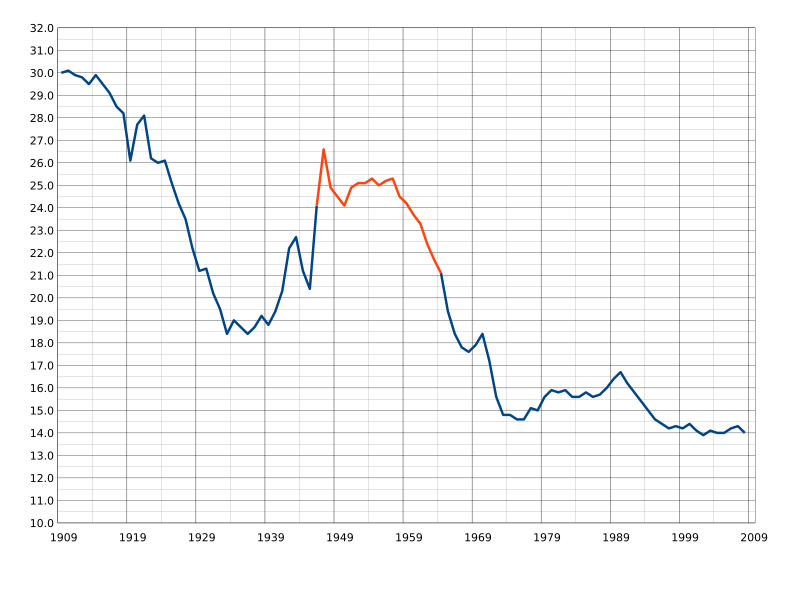
US Birth Rates from 1909-2008. The number of births per thousand people in the United States. The red segment is known as the Baby Boomer period. The drop in 1970 is due to excluding births to non-residents.
Graph by Saiarcot895 via Wikimedia Commons
Cities are demographic sinks. That is, cities have higher death rates than fertility rates.
For much of human history, cities have been unhealthy places to live. This is no longer true: cities have higher average life expectancies than rural areas. But they are still demographic sinks, for cities collapse fertility rates.
The problem is not that more women have no children, or only one child, making it to adulthood. Such women have always existed, though their share of the population has gone up across recent decades.
The key problem is the collapse in the demographic “tail” of large families. Cities are profoundly antipathetic to large families, and have always been so. This is particularly true of apartment cities — suburbs are somewhat more amenable to large families, though not enough to make up for the urbanisation effect.
While modern cities do not have slaves and household servants who were blocked from reproducing as ancient cities did, various aspects of modern technology have fertility-suppressing effects. Cars that presume a maximum of three children, for instance. An effect that is worsened by compulsory baby car-seats. Or ticketing and accommodation that presumes two children or less. There is also the deep problems of modern online dating. Plus the effects that endocrine disrupters and falling testosterone may be having.
These effects also extend to rural populations: falling fertility in rural populations is far more of a mystery than falling fertility in urban populations. How much declining metabolic health plays in all this is unclear. Indeed, futurist Samo Burja is correct, we do not really understand the “social technology” of human breeding.
Be that as it may, cities as demographic sinks is a continuation of patterns that go back to the first cities.
Matters at the margin
There are factors at the margin known to make a difference. Religious folk breed more than secular folk, though that is in part because rural people are more religious and city folk more secular.
Educating women reduces fertility. This is, in part, an urbanisation effect, as more education is available in cities. It is also an opportunity cost effect — there is more to do in cities, both paid and unpaid.
Education increases the general opportunity cost of motherhood, by expanding women’s opportunities. This also makes moving to cities more attractive. Women having more career opportunities reduces the relative attractiveness of men as marriage partners, reducing the marriage rate.
Strong cultural barriers against children outside marriage can reduce the fertility rate, by largely restricting motherhood to married women. This makes the fertility rate more dependant on the marriage rate.
Educating women makes children more expensive, as educated mothers have educated children. Part of the patterns that economist Gary Becker analysed.
Comments Off on The demographic impact of modern cities
September 30, 2024
British and Australian schools are teaching boys to hate themselves
Janice Fiamengo discusses the sort of things British and Australian boys are being taught about themselves and their role in society:
For years, feminists in the English-speaking school systems have done everything they can to psychologically destroy a generation of boys, calling their masculinity “problematic”, “hegemonic” and “toxic”.
At their least malign, feminist teachers have made it clear to boys that their perspectives and experiences aren’t as important as those of girls. Many businesses and organizations support programs aimed at girls’ academic success; there are no equivalent programs for boys. When study after study shows boys lagging behind girls in school, many feminists don’t even pretend to care, blaming the boys, as did Australian feminist Jane Caro, for their alleged privilege. Such ideologues continue to call for more feminist teaching, and moreover take direct aim at schoolboys’ maleness in what scholar Paul Nathanson has identified as a form of identity harassment, a pervasive psychological assault that creates doubt, shame, and alienation.
Under the feminist model, boys learn from a young age that their sex is responsible for violence and other serious harms, and that they must take personal responsibility for it. A few years ago, it came to light that the female principal of an Australian school thought it a good idea to hold an assembly in which the boys were to apologize for male misbehavior to the girl next to them. Naturally, no girls are ever expected to apologize to boys for the misdeeds of the female sex.
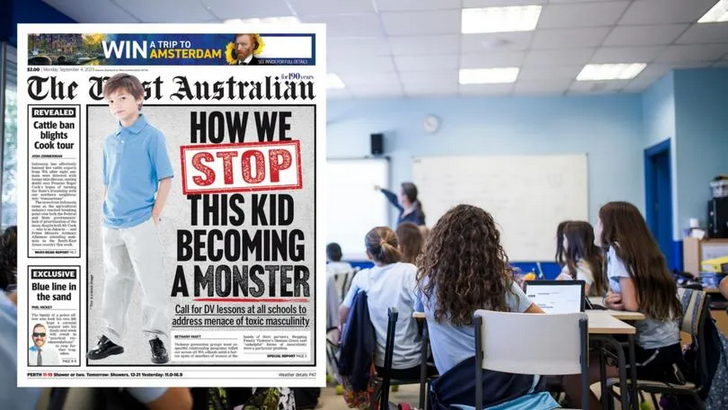
Calls regularly circulate, as in the West Australian‘s “How We Stop This Kid Becoming a Monster“, for teaching to address the problem of predatory masculinity. Unless the feminist deprogrammers can get to work in the early years, we’re told, the boys will succumb to their inner monster. Boys learn that they can hurt girls and women even without meaning to, just by looking at them or holding traditional views. As we’ll see, any boy who objects to his own vilification will learn that objecting itself is a technique of domination.
Teaching Toxic Masculinity
A recent report on UK schools provided a glimpse into what feminist instruction looks like, revealing that terms such as “hegemonic masculinity” and “toxic masculinity”, until a decade ago part of the radical feminist fringe, are now in the mainstream of pedagogy even in the lower grades.
The Family Education Trust surveyed materials used by UK schools in their sex education classes. Out of 197 schools that responded to a request for information (more than 100 did not respond), 62 schools confirmed that they were teaching about toxic masculinity. 10 schools even admitted to teaching that “men and boys possess traits that are inherently toxic and negative for society“. (One would be relieved to hear that the principals of such schools and all participating teachers were immediately sanctioned, or at least told to stop such claptrap — but of course such has not occurred.)
One slide from a lesson on toxic masculinity stated that while “masculinity in and of itself is not necessarily a harmful thing […] the way that masculinity is traditionally defined in society can be problematic”. Some of the materials don’t even make sense, as for example the statement that traditional masculine traits “can be limiting for women, girls and other people who don’t identify as men, who are not expected to display these traits”.
Comments Off on British and Australian schools are teaching boys to hate themselves
September 23, 2024
Berlin’s Der Tagesspiegel wants to help you keep your kids from the perils of right-wing ideology
eugyppius on the help Berlin’s leading daily newspaper is offering to their readers whose kids are hearing the siren call of non-progressive politics:
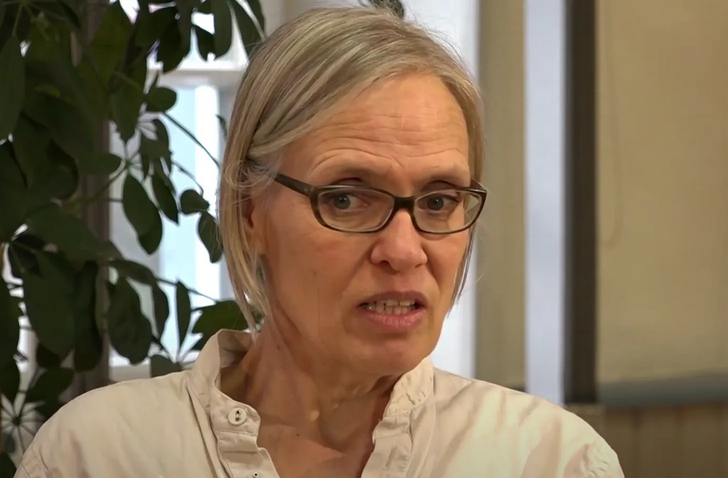
This obviously charming, cheerful and not at all withered or overwrought woman is named Eva Prausner. She is a social worker, and she directs something called the “Project for Strengthening Parents“, which provides “Training, networking, and counselling in the area of family and right-wing extremism”. This means that she runs around telling parents what to do when they suspect their children are succumbing to political wrong-think. And this in turn makes Frau Prausner the woman of the hour, for never before in the history of the Federal Republic have so many undemocratic children bloomed under the noses of so many upstanding democratic parents.
It is very hard to understand how this happened. The leftists and the Greens, after all, have been doing the Lord’s work teaching leftism and Greenism in schools for decades now, but despite their valiant efforts we are rapidly losing our youth to malign antidemocratic forces. It can’t be that elevating leftoid lunacy into an establishment ideology has backfired, transforming the once cool, counter-cultural left into a political movement for middle-aged scolds and schoolmarms – the kind of thing from which teenagers flee in terror. No, nothing could be less plausible. The real reason for the pandemic of right-wing children must simply be that we haven’t indoctrinated them enough. If parents will not do their part and bring indoctrination also to the home, our democracy will collapse and it will be 1933 all over again, just like it was 1933 all over again two weeks ago after the elections in Thüringen and Saxony.
For these reasons, Der Tagesspiegel, Berlin’s largest daily newspaper, interviewed Prausner on her advice for parents who find themselves forced to deal with their evil, right-leaning spawn. The product is a prescient write-up for the ages bearing the headline “Help, my child is turning right-wing! Eight tips for democratic parents with undemocratic children“.
The rightward shift in East Germany is a shift above all among the youngest, as the elections in Saxony and Thüringen have shown. One in three young people there voted for the far right. In Thüringen, as many as 38% of 18- to 34-year-olds cast their ballot for the AfD – more than in any other age group. Many a parent who values living in a democracy will have wondered: “What have we done wrong?”
In Brandenburg, too, it is becoming clear that even the youngest are now leaning towards the right. In the under-16 vote a week before the state election, the AfD came out on top with around 30% … In the state elections on 22 September, the AfD could become the strongest force, thanks in part to young first-time voters.
Do parents still have any influence over their AfD-voting children?
Alas, Prausner is not very certain that they do, but she believes that democratic parents “should at least try” to rescue their children from the grave heresy of voting for the wrong political parties. Children in Brandenburg are particularly endangered, because Brandenburg is largely rural, and Prausner has discovered that the countryside is absolutely dripping with “condensed prejudicial attitudes”. There is so much racial prejudice in the Brandenburg air that it is collecting on cool surfaces, like windows and beer glasses, that is how bad things are there. Also all children everywhere are in danger because the internet is a powerful right-wing force that helps bad organisations like the AfD pump their fascist mind virus directly into millions of young yet-forming cerebral cortices.
Comments Off on Berlin’s Der Tagesspiegel wants to help you keep your kids from the perils of right-wing ideology
September 19, 2024
“This is the Law of Unintended Consequences in action”
Tom Knighton provides a wonderful example of “be careful what you wish for”, especially in the rich virtue-signal territory of the “green transformation”:

“Artisanal cobalt miners in the Democratic Republic of Congo” by The International Institute for Environment and Development is licensed under CC BY 2.5 
 .
.
… it seems our glorious green future now comes with more child labor!
A new report from the Department of Labor raises tough questions about whether and to what extent forced labor and child labor are intertwined with climate-friendly technology.
The department released a report this month finding that several minerals that are key components of electric vehicles and solar panels may be produced through these unethical labor practices.
The findings point to major ethical quandaries surrounding the ongoing energy transition. Climate change, if not addressed, endangers many of the world’s most vulnerable people. At the same time, the report raises serious human rights concerns about the technology being used to address it.
[…]
Whoops.Here’s the thing, cobalt and nickel are kind of important for this sort of thing, so we have to get them from somewhere and the one attempt to mine cobalt here in the United States fell flat. Why? The price of cobalt dropped. It was no longer profitable to try to mine it in the United States.
But in poor countries, it was still plenty viable.
Yet while we view child labor as unethical, we have to remember that our society is rich enough that we can afford to hold that belief. Now, I share it and I’d rather kids be kids, and worry about things like school, video games, television, and that sort of thing, but the truth is that when you’re barely able to feed yourself, you need every penny you can get.
That means kids going out to work.
That means doing some grueling, back-breaking, nasty work like mining stuff like cobalt.
It means paying for dirty, nasty strip mining so you can convince yourself and your friends that you’re better than those of us who still prefer a gasoline- or diesel-powered car.
All around us, we tend to be oblivious to the reality of the rest of the world. We simply think something should be so and then just act like they are. We ignore what all might be required to make that something so.
This is the Law of Unintended Consequences in action.
Comments Off on “This is the Law of Unintended Consequences in action”
August 29, 2024
How activists used lawfare to force the Boy Scouts to go woke (and then go broke)
A guest post from Cole Noble at Postcards From Barsoom discusses how progressive organizations and political activists have managed an immense take-over of the great outdoors, not least of which were the legal and political efforts to force the Boy Scouts of America to accept gay scouts and scout masters:

[…] This entertainment ecosystem, increasingly infested with culture warriors, also started chipping away at the longstanding prestige of organizations like the BSA [Boy Scouts of America]. Depicting someone as a scout became a kind of character development shorthand, signalling them as uncool.
The targeting wasn’t incidental; the existence of the pre-centennial BSA was a serious problem for the ruling class. Their organization’s commitment to values-based conservation served as living proof that going along with society’s adoption of critical theory was completely optional. If the BSA was free to refuse the push, others might start getting ideas.
Lawfare was inevitable.
In 2000, the United States Supreme Court heard Boy Scouts of America v. Dale. In one corner you had James Dale, an avowed gay rights activist, co-president of the Rutgers University Lesbian/Gay Alliance, and outspoken advocate for gay teens having gay role models. In the other, you had the BSA, who didn’t want someone like Dale around its young, impressionable members.
The BSA won, but there was blood in the water. Culture warriors circled back around, this time employing social pressure. They tried to make their demand sound as reasonable as possible: drop the policy against openly gay members. Just one teeny tiny rule. What’s the point anyway? It’s outdated. No real sense keeping it, right?
Smart members of the program clocked this Trojan Horse from miles away. Alas, the organization’s leadership did not. Possessing both the physique and fortitude of rice pudding, they caved, capitulated, and acquiesced some more — agreeing to an ever-escalating series of demands that hollowed out the once-proud group into an empty vessel for The Current Thing(TM).
The Boy Scouts of America is now all-inclusive! Not just to gay scouts and leaders, but girls too. In a show of solidarity with Black Lives Matter after the riots of 2020, a mandatory DEI merit badge has replaced camping as a requirement to attain the once coveted rank of Eagle Scout.
Let’s not forget the Scout Masters now left to deal with teens using the program’s overnight trips as cover for hookups.
Oh, and they went bankrupt.
The organization agreed to a 2.5 billion dollar settlement over tens of thousands of sex abuse cases perpetuated by adult men, against underage boys.
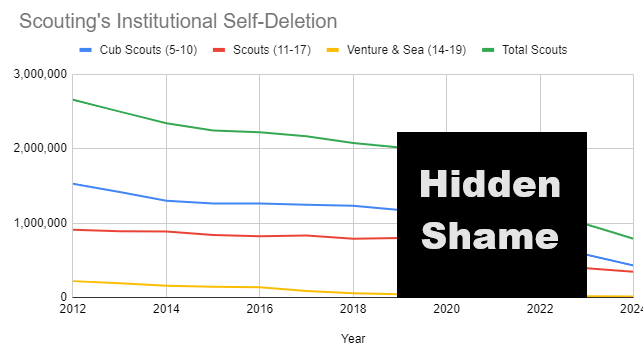
(data compiled from the BSA’s publicly available annual reports)
Rather than bolster ranks, adopting DEI cost the organization more than 1 million members.
The BSA – sorry, Scouting America1 – didn’t publish annual membership reports from 2020 to 2022, I imagine out of embarrassment. During this time, the Mormons, who used Scouting as a youth program for its boys, took their 400,000 members, and their money, and left.
[…]
Scouting was one of, if not the last bastion of quasi-unstructured outdoor activities. While the death of free-range childhood seems to be commonly understood, there is some debate about the precise cause.
Whatever your opinion on the matter, regime journalists shoulder enormous responsibility for eroding societal trust and inspiring mass paranoia through sensational reporting. Former latchkey kids became hysterical helicopter parents, petrified of letting their children out of sight.
Playing outside became a heavily supervised affair, usually relegated to fenced-in backyards with locking gates.
Kids have been robbed of the experiences that could lead them to develop an organic appreciation for outdoor recreation, and groomed into a hypersexualized version of early adulthood. All the while, the institutions which once taught conservation and virtue now serve as apparatuses of critical theory.
1. They changed their name in May of 2024, after 114 of being the Boy Scouts. Since they’re no long the Boy Scouts, this is at least honest.
Cole’s own Substack is Quandary Magazine, which you should check out if you’re generally interested in the great outdoors.
July 28, 2024
J.D. Vance is an ideological extremist who has pushed an idea also supported by … Canadian deputy PM Chrystia Freeland
There’s much viewing-with-alarm and pearl-clutching going on over some of J.D. Vance’s more outré notions floated before he became Trump’s running mate:

U.S. Senator J.D. Vance speaking with attendees at The People’s Convention at Huntington Place in Detroit, Michigan, 16 June, 2024.
Detail of a photo by Gage Skidmore via Wikimedia Commons.
One of the amusing features of this week’s U.S. election turbulence has been sudden media scrutiny of Ohio Republican Senator J.D. Vance, a former author and pundit newly named as Donald Trump’s running mate. Readers will know I’m a sadistic student of electoral reform crusades, and in 2021 Vance advocated for one of the myriad of utopian ideas that has never quite reached prime time: parents should be given extra votes that they can exercise on behalf of their minor children.
[…]
Critics of Vance are screaming about the sacred principle of “one person, one vote” — but of course the centrists and liberals who have toyed with the same idea support it precisely because children are persons who deserve political representation. (They would be represented second-hand by their parents until the age of majority, but us adults are all represented that way in democratic decision-making now, right?) Earlier this week Reason magazine published a short excerpt from a pro-Demeny paper by two American law professors with strong conservative, originalist credentials: there isn’t all that much daylight between their arguments and Corak’s.
Are the arguments actually any good? Some of them seem circumstantial or even aesthetic. We’re in a transitory era of gerontocracy because of a baby boom that happened eighty years ago, and nobody under 70, whatever their ideology, likes this universal predicament much. But on the grounds of revealed preference, the lack of actual real-world Demeny experiments is a big problem.
If we want the proxy votes to go to custodial parents who are involved with a real child and conscious of its particular interests, you’re suddenly talking about integrating election systems with family law. I.e., an unfathomable technical nightmare. But assigning control of the extra child votes automatically to biological parents, including deadbeats and those who have surrendered children to adoptees or foster families, seems like a non-starter. (And would also be an unfathomable technical nightmare.)
You can say that the democratic principle is more important than the mere design details of a child-voting system, and this is the kind of thing election reformers say all the time — but would you book a seat on an airplane that was built on aerodynamic principles with no attention to detail?
Comments Off on J.D. Vance is an ideological extremist who has pushed an idea also supported by … Canadian deputy PM Chrystia Freeland
June 30, 2024
California’s politics are so weird that Justin Trudeau is frantically taking notes
Chris Bray pays attention to California politics … and we should all pray for his long term mental health: that place is insane!
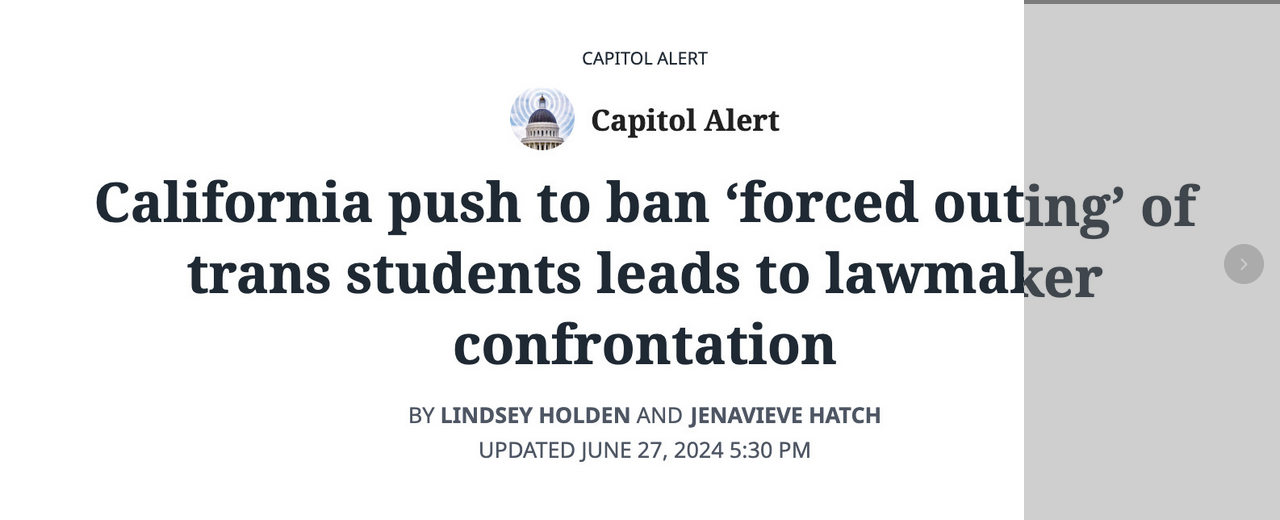
What’s happening in California isn’t politics in any conventional sense. No debate is underway, and no policy choices are being hashed out. We’re in the land beyond. In Our Democracy™, declarations are made, and then they are to be received in a spirit of quiet submission. Your failure to submit is disallowed, and the reason it’s been disallowed is that it’s been disallowed. Were it allowed, it would not be disallowed, but it is, in fact, disallowed, so therefore it is not allowed, you see? All “political” discussion is a circle, eating its own tail. I’ve been trying to figure out how to explain this, but the Sacramento Bee just did it for me. (Paywall-evading version here.)
The Bee is explaining — or “explaining” — what happened on the floor of the state Assembly yesterday, when a Republican was not permitted to argue against a bill, and a Democrat stood up to threaten him for trying. I encourage you to read the whole self-refuting thing. What happened, it turns out, is that the Republican was preventing debate by engaging in debate, which meant that he had to be silenced and threatened so debate could continue, which required that no one express opposing views, which is an act of anti-debate aggression. Debate is agreement, and not agreeing is preventing debate.
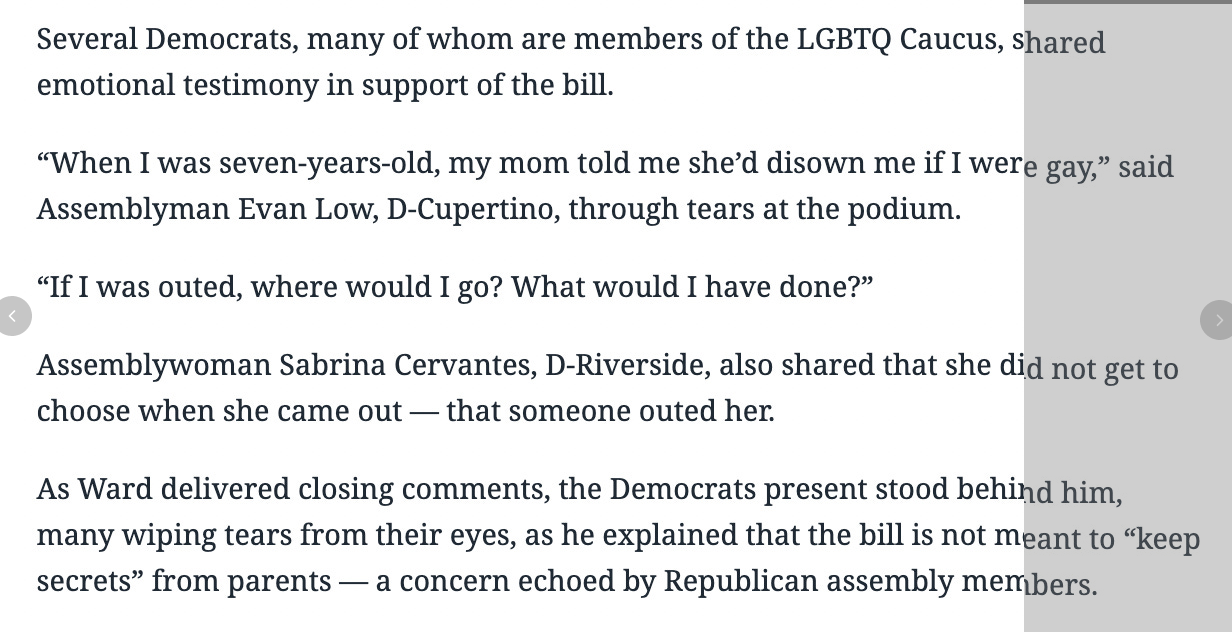
The “forced outing” debate was a discussion about AB 1955, which proposes to forbid schools to inform parents of discussions between children and school officials about sexual orientation and sexual behavior. It’s important that parents not be told about sexually themed discussions happening between children and the adults in their schools, because not telling mommy and daddy about sexual discussions is being safe and warm. But watch the casual turn of logic in the last paragraph of this screenshot:
- Evan Low said the bill is important because it’s good that parents not be told, and the bill makes sure parents aren’t told.
- Sabrina Cervantes said she didn’t have this bill when she was young, which would have forbidden telling, so someone told.
- Democrats explained that the bill is not meant to keep secrets from parents.
See, AB 1955 isn’t about keeping secrets from parents — it’s about not allowing schools to tell parents. Not being allowed to tell parents is different than keeping secrets from parents. The story doesn’t go on to explain the distinction between keeping secrets and not telling, but under Jacobin cultural rules, the distinction is that shut up. The distinction is presumptive, and so doesn’t require explanation.
Now, here’s the way the Bee characterizes Assemblyman Bill Essayli’s arguments during the debate that he derailed by not agreeing:
Essayli has exhibited a consistent pattern of publicly disparaging advocacy groups and fellow lawmakers in an attempt to garner attention for conservative causes. On Thursday, he interrupted colleagues’ testimony and expressed frustration over Wood cutting his microphone and shutting down his comments when they veered away from AB 1955 and toward the issue of forced outing, in general.
His comments about the forced outing bill weren’t about the bill — they were about forced outing. What a bastard! Mister Speaker, he’s not debating the highway funding bill, he’s debating highway funding. Again, why does this distinction make sense? Because shut up. It makes sense declaratively: X is true because they said X.
And Essayli has a “consistent pattern” of saying disparaging things, which the Bee knows through mindreading is a maneuver to “garner attention” rather than an attempt to express his views. He disagreed, which is a very cynical and manipulative thing to do during a debate. He has a pattern of it!
And also Essayli is so rude that he interrupted colleagues when they spoke, and then had the nerve to object when his microphone was turned off. It’s rude to stop someone from speaking, and it’s rude to object to being stopped from speaking. You should never interrupt people, and you should always allow other people to interrupt you. They’re playing partisan Calvinball under the dome, and all moves lose.
Comments Off on California’s politics are so weird that Justin Trudeau is frantically taking notes
June 24, 2024
Little humans, from “humorless little poop machines” to creatures with a sense of humour
Ted Gioia cross-posted an article from Daniel Parris that answers the eternal question “when do humans develop a sense of humour?”
… a large body of academic research examines the intersection of humor, aging, and cultural mores. So today, we’ll explore how our sense of humor forms and transforms with age, and the physiological factors driving our comedic sensibilities.
How Does Our Sense of Humor Change Over Time?
We are born humorless little poop machines. We can’t make funny voices, we can’t do bits, and we can’t engage in wordplay — we simply eat, sleep, poop, cry, and poop again. And then, amidst this onslaught of poop, a sense of humor begins to emerge.
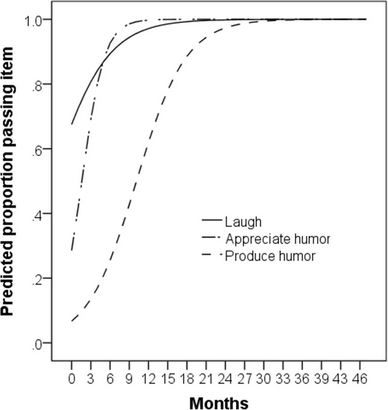
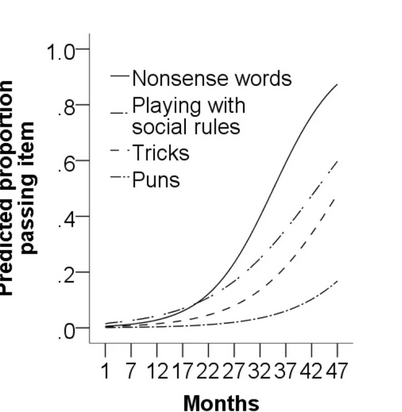
The Early Humor Survey (EHS) is a standardized questionnaire designed to assess a child’s humor-processing abilities in the first four years of life. EHS survey data (which is collected from parents) reveals that our sense of humor begins emerging in infancy, typically around the four-month mark. During this period, babies respond to simple stimuli with laughter and begin producing humor.
Even more striking is how humor development differs by task, as comprehension and appreciation of nonsense, puns, and trickery are all learned at varying rates.
Once we exit adolescence, comedic interactions begin to wane, and we laugh less often.
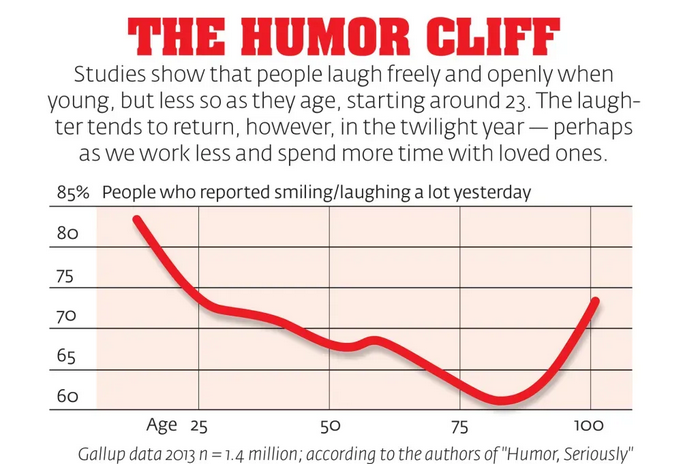
A 2013 Gallup survey documenting the frequency of humorous interactions suggests the existence of a “humor cliff” as we age — each year, we laugh a little less than the previous one. Humor fades until we’re 80, at which point we chuckle a bit more (what a relief).
While captivating, this visualization is also misleading. Popular interpretations of this data suggest that as people mature, their appreciation for humor declines, as if this trait were a single stock trending up or down. Instead, a person’s comedic sensibilities are defined by an assortment of preferences that remain fluid throughout our lives.
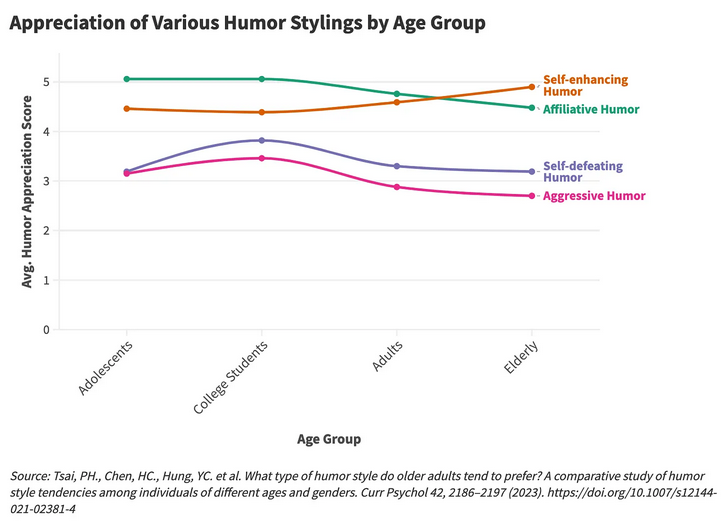
A substantial body of research examines how comedic taste varies with age, exploring our reactions to different humor styles at various life stages. One such study published in Current Psychology presented respondents with a series of humorous statements and then assessed each subject’s affinity for four distinct joke types:
- Self-enhancing Humor: finding comedy in everyday situations, often by humorously targeting oneself in a good-natured way.
- Affiliative Humor: using humor to strengthen social bonds and enhance relationships by sharing jokes and amusing stories that make others laugh while avoiding negativity.
- Self-defeating Humor: Involves individuals making jokes at their own expense to gain approval or avoid conflict, sometimes undermining their self-esteem.
- Aggressive Humor: Making jokes or remarks that ridicule, belittle, or demean others, often intended to assert dominance or express hostility.
Ultimately, the study found that with age, people appreciate self-enhancing humor more, and they value affiliative, self-defeating, and aggressive stylings less.
A similar study of 4,200 German participants found that we increasingly prefer incongruity resolution as we age, an approach marked by unexpected or contradictory elements that lead to a comedic surprise. In joke format, this genre includes a setup pointing toward one outcome, with a punchline that delivers a surprising twist, such as “I just flew in today, and boy, are my arms tired!”
Comments Off on Little humans, from “humorless little poop machines” to creatures with a sense of humour
June 17, 2024
Farm Camp for city slickers
In The Free Press, Larissa Phillips explains the kind of things city children (and their parents) learn when they stay at her family’s small farm for a week or a weekend:
Here are some things I have taught the kids who visit my farm: animals don’t care about your feelings, and sometimes we kill them to eat them. It doesn’t matter how desperately you want to find more eggs, the hens don’t lay on demand. Tomatoes aren’t ripe in June. The stalls aren’t going to clean themselves. Cuts, scrapes, and stings aren’t really a big deal. And there will always be poop.
I’m often struck by what city kids don’t know when they turn up at the education program I run for families on our 15-acre hobby farm — Honey Hollow Farm — in the Upper Hudson Valley. As a longtime urbanite, I get it. I lived in Brooklyn for 15 years before my husband and I moved upstate in 2010 with our two young children and one goal: start a farm. We kept horses and ponies for fun and raised poultry and sheep — and sometimes pigs — for food.
It was hard. Slaughtering animals we’d raised since they were babies was wrenching. Breeding and birthing those babies was dicey, too. But these experiences toughened us up. Working with animals and the land and the seasons was grounding — and the best antidote to anxiety I’d ever found. And most of it was fun.
I wanted to share this outlook with other families, even if it was just for a weekend. So at the start of the pandemic, I opened our guest cottage — and set up an informal curriculum to teach escaping urbanites what I’d learned.
I called it farm camp.
We host one family at a time, all through the year, in a renovated barn apartment overlooking the pony pasture. Most come for a week, some for a weekend. Every morning I’ll take a handful of kids, sometimes as young as three, through a two-hour, hands-on class on animal care, life, death, poop. All of them have to do some real farmwork.
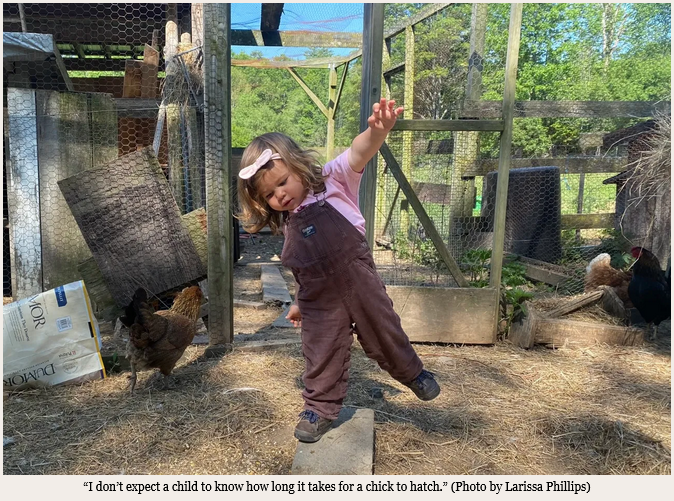
There is a lot to learn. I don’t expect a child to know how long it takes for a chick to hatch, or why the roosters are always jumping on top of the hens. But I am often surprised by some of the straightforward things they don’t know how to do. Like how to pull a wagon around a corner, hold a shovel, climb over a gate, make a braid, or tie a knot.
Don’t get me wrong — I love offering explicit instructions on the most mundane tasks, then standing back and cheering when a kid does it independently. But two generations ago, these skills would have been common knowledge. For most of human history, the proportion of the world’s population living in cities was below 5 percent. It’s at 56 percent now. By the time today’s toddlers reach adulthood, it is expected that 80 percent of humans will live in urban areas.
Overprotected as they are, a lot of city kids are missing out on so many important encounters with material reality: with death or danger or manual labor. These encounters can be unpleasant, even painful. It’s understandable that we want to save our children from them. But they lose something essential when we do.
Most urbanites have a very sanitized — in fact, Disneyfied — view of rural life and especially life on a farm. It can be traumatic to discover that all the animals aren’t like you saw in the cutesy cartoons as a preschooler …
Comments Off on Farm Camp for city slickers
June 14, 2024
When propaganda wins over historical facts, Ontario public schools edition
To someone of my generation (late boomer/early GenX), the history of the Residential School system was taught, at least superficially, in middle school. Along with the early settlement of what is now Canada by the French and later the English (with a very brief nod to the Vikings, of course), we got a cursory introduction to the relationships among the European settlers and explorers and the various First Nations groups they encountered. It wasn’t in great depth — what is taught in great depth in middle school? — but we got a rough outline. In my case, details about the Residential School system came more from a “young adult” novel about a young First Nations student running away from his school and trying to find his way back to his home and family. My best friend in school had First Nations ancestry, so I felt a strong desire to understand the book and the system and culture portrayed in it.
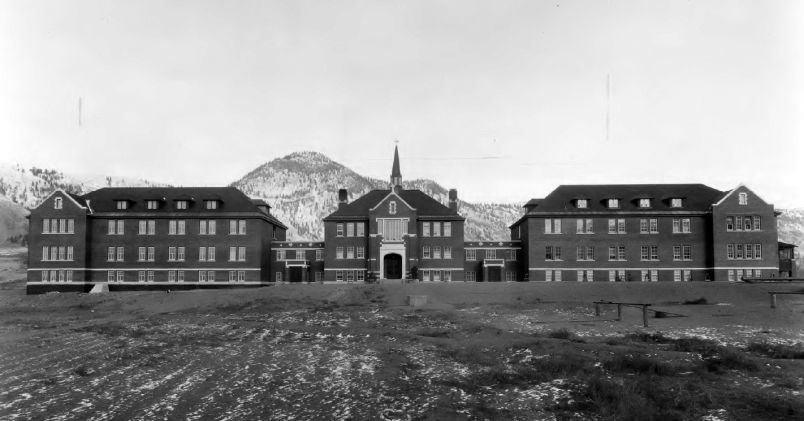
Kamloops Indian Residential School, 1930.
Photo from Archives Deschâtelets-NDC, Richelieu via Wikimedia Commons.
If, in the early 1970s, the Ontario school system taught at least a bit about the history of the First Nations peoples, how is it possible that they stopped doing so and my son’s generation were utterly blindsided by the sensationalist treatment of the students at a particular Residential School in British Columbia? And as a result, were far more credulous and willing to believe the worst that the “anticolonialist” propagandists could come up with.
“Igor Stravinsky” is a teacher in the Ontario school system who writes under a pseudonym for fairly obvious reasons, as he’s not a believer in the modern narrative about the history of First Nations children in the Residential School system:
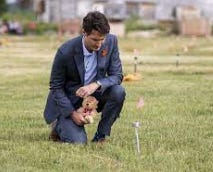
This will be my last instalment of this series. I have attempted to shed light on the poor quality of information students are receiving in Ontario schools with regard to Indigenous history and current issues. It is important to note that this is being done intentionally. It is to the advantage of the leaders of the Indigenous Grievance Industry to characterise Canada and the pre-Canadian colonies of this land as genocidal oppressors, and our politicians have exploited this situation for crass political gain. This was perhaps epitomised by Prime Minister Justin Trudeau’s photo op of himself holding a teddy bear in the proximity of a soil disturbance in a field at the site of a former residential school in Cowessess First Nation, Saskatchewan on Tuesday, July 6, 2021:
Prime Minister Justin Trudeau holding a teddy bear in Cowessess First Nation, Saskatchewan.
July 6, 2021.Are there actually human remains there? If so, of whom? Is this evidence of any kind of foul play? These are questions he was not about to bother to ask. Why would he, when such a golden opportunity to score political points presented itself?
We now know all this murdered Indigenous children stuff was a big hoax but don’t hold your breath waiting for Trudeau to issue an apology for staining the international reputation of Canada and triggering a knee-jerk vote by our Parliament declaring Canada a genocidal state and adopting the The United Nations Declaration on the Rights of Indigenous People (more on that below). Undoing all this damage will be a herculean task.
Just as students are fed simplistic, misleading, and false information about the past with regard to Indigenous people (the focus being the Indian Residential Schools) they are being presented with the point of view that human rights violations against the Indigenous people are ongoing, and are the reason for the poor quality of life in which such a disproportionate number of Indigenous people find themselves.
The claim of generational trauma
On Apr. 27, 2010, speaking as chair of the Truth and Reconciliation Commission and for the people of Canada, Sinclair told the Ninth Session of the United Nations Permanent Forum on Indigenous Issues: “For roughly seven generations nearly every Indigenous child in Canada was sent to a residential school. They were taken from their families, tribes and communities, and forced to live in those institutions of assimilation.”
This lie is promoted in the schools. It is the foundation of the generational trauma claim but in fact, during the IRS era, perhaps 30% of Status Indians (you can cut that figure in half if you include all people who identify as Indigenous) ever attended, and for an average of 4.5 years.
Even if it were true that most Indigenous people who attended the IRS suffered trauma, there is no evidence or logical reason to believe that trauma could be transferred down the generations. If generational trauma is a thing, why have the descendants of the victims of the holocaust been doing so well?
If there is generational trauma, the culprit is alcohol. Alcohol abuse has been a major problem in Indigenous communities since first contact but rarely comes up these days, certainly not in schools. Fetal Alcohol Syndrome (FAS), which occurs when a mother consumes alcohol during pregnancy, is also a major problem and the children born with it suffer from mental and emotional challenges throughout their lives. It impacts their social life, education and work. Girls who suffer from the condition all too often end up drinking during pregnancy themselves and the cycle continues.
Comments Off on When propaganda wins over historical facts, Ontario public schools edition
June 7, 2024
Since 2015, the Trudeau Liberals have done a fantastic job of suppressing the Canadian economy
If Canadians elected Justin Trudeau and the Liberal Party to make major changes from what had gone on under Stephen Harper’s Conservatives, then they got their wish in so many different ways, but especially economically:

Reports of Canada’s dismal economic outcomes seem never to end. Why should they? For years Canadians have had the same federal government delivering the same deleterious economic policies and the same expansion in regulatory initiatives and spending that have invariably depressed economies and reduced standards of living whenever and wherever they are imposed. Therefore, until the federal government or its policies change, we should not expect the miserable results to materially improve.
The latest negative report is the release of Canada’s 2024-Q1 GDP numbers on Friday, which again showed sluggish growth relative to population, resulting in yet another quarterly decline in real GDP per capita. Relative to 2015-Q3, the last full quarter before the Trudeau government took office, cumulative real GDP per capita is up only about 0.7 per cent. A recent RBC Economics analysis showed from around 1991 to 2015, cumulative real GDP per capita growth in Canada approximately tracked with the U.S., but not since Justin Trudeau took office. Compared to 0.7 per cent growth in Canada from 2015-Q3 to 2024-Q1, real GDP per capita is up 15.7 per cent in the U.S. in the same time period.
Where the 0.7 per cent comes from matters, too. In real per capita terms, some components of GDP — mainly government — expanded while others contracted. Alarmingly, business investment, which drives productivity and standards of living, is down 13.9 per cent. This includes real per capita reductions of 15.2 per cent in residential structures, 18.4 per cent in machinery and equipment, and 19.3 per cent in non-residential structures, with an increase in intellectual property investment not nearly enough to offset the reductions in other categories.
To understand why business investment and economic performance in Canada are so poor under the Trudeau government, let us consider the following representative example of its economic strategy.
The government believes many families struggle with the cost of caring for young children, which is a legitimate concern. A reasonable solution, which the Harper government implemented in 2006, is to send money to families with young children and let parents buy for their children what they need. After the Liberals expanded that program, they could have left it at that, but what have they done instead? The government initiated a national takeover of child care, effectively expropriating child care entrepreneurs’ businesses by flooding their sector with public money and then controlling private companies’ revenues and operations. The result is child care entrepreneurs’ investments have been wiped out or severely reduced, control of their business operations have been wrestled away by government, and they are unable to properly serve their customers (the families), as evidenced by the drastic reduction in parental options and widespread shortages.
Comments Off on Since 2015, the Trudeau Liberals have done a fantastic job of suppressing the Canadian economy


