If you hurry, you can just get your Santa’s Visit Application in before the deadline tonight!
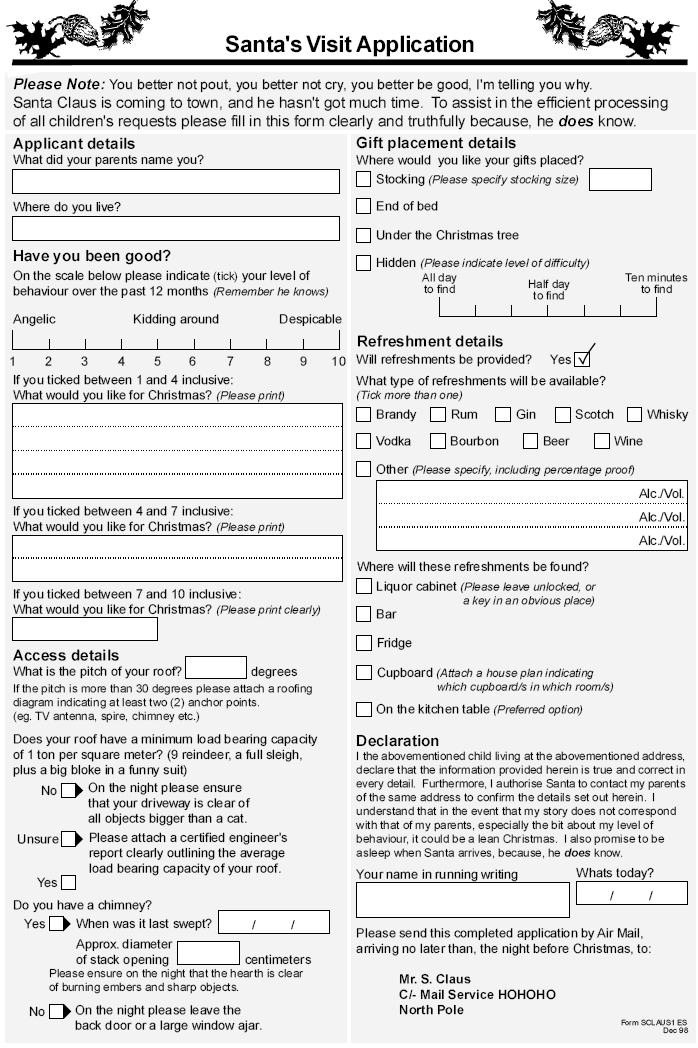

If you hurry, you can just get your Santa’s Visit Application in before the deadline tonight!
A British MP is being investigated for attending a “Nazi-themed” party. A member of the royal family is photographed wearing Nazi regalia to a costume party. World War 2 fiction about Nazi Germany vastly outsells similar fiction about Fascist Italy or Imperial Japan. What is it about the Nazis that Brits find so fascinating? In a Spectator article from 2002, Guy Walters tracks the onset of the Nazi fascination in young Brits:
In some Englishmen this interest has mutated into a not-so-guilty admiration for the Nazis and their uniforms, their pageantry, their military brilliance and — this is the really terrible part — their brutality. It is emphatically not a condoning of the Holocaust; rather, a fetish that exists despite it. In its advanced state the fetish will have evolved into a secret yearning to march up and down a bedroom in the togs of a Hauptsturmführer, riding-boots shining, the red swastika armband set smartly against the blackness of the tunic, the silver death’s-head badge glinting on the peaked cap. Of course, the Beevor reader is a far cry from a Nazi fetishist; but I wonder whether Beevor would enjoy such staggering sales figures if he had written only about the war in the Far East.
[. . .]
At the end of term, the flu now conveniently in remission, Mr Priestley unearths the projector and makes a selection from the school’s extensive range of films. The product of a broad mind, the library consists of just two works, The Guns of Navarone and Force 10 from Navarone. Our nascent fetishist will be particularly drawn by the stylish ease with which David Niven carries off the wearing of an SS officer’s uniform. He will be less than impressed, however, with Edward Fox’s absurdly pukka sergeant in the latter film.
His small head brimming with Nazis, our subject goes home for four solid weeks of constructing Airfix Messerschmitts, Stukas, Heinkels and Dorniers. He will know that the correct colour of the underside of most Luftwaffe aircraft corresponds to Humbrol’s ‘duck-egg blue’. If his condition is particularly advanced, the subject’s mother will be asked to purchase a Tamiya Jagdpanther tank, which he will place in a ‘diorama’, a word he will use in no other context. By now, he should be showing further classic early symptoms of a Nazi fetish: Allied aircraft and armour will hold little or no interest. Most of the young fetishist’s exercise books will be adorned with thousands of tiny swastikas.
[. . .]
By puberty, the fetishist will have repeatedly watched every war film available, including A Bridge Too Far, The Night of the Generals, The Dirty Dozen, The Eagle Has Landed, The Boys from Brazil, Cross of Iron and, for a younger generation, Saving Private Ryan and Band of Brothers. He will have read Pat Reid’s Escape from Colditz and Airey Neave’s They Have Their Exits.
When our subject starts in the sixth form, it is here that the fetish can be incorporated into, and disguised by, his academic studies. Naturally he chooses modern history for one of his A-levels, and his special topic will, of course, be Nazi Germany. He will now be introduced to the diaries of Nazi bigwigs such as Albert Speer, which will breathe life into sinister figures such as Himmler and Goering. In fact, the widespread predilection for Nazi Germany as an A-level subject has angered many university tutors, who have complained recently that it is the only period of history about which undergraduates have any real knowledge.
Everyone knows the old myth about a spike in wife-beating after major sporting events (most frequently referenced is the Superbowl, but the same factoid is trotted out about every “big game”). Barbara Kay reveals the awkward truth that nearly half of all spousal abuse is by female partners:
One of first-wave feminism’s great achievements in the 1970s was to end the denial surrounding wife abuse in even the “best” homes. Resources for abused women proliferated. Traditional social, judicial and political attitudes toward violence against women were cleansed and reconstructed along feminist-designed lines.
But then a funny thing happened. The closet from which abuse victims were emerging had, everyone assumed, been filled with women. But honest researchers were surprised by the results of their own objective inquiries. They were all finding, independently, that intimate partner violence (IPV) is mostly bidirectional.
But by then the IPV domain was awash in heavily politicized stakeholders. Even peer-reviewed community-based studies providing politically incorrect conclusions were cut off at the pass, their researchers’ names passed over for task force appointments and the writing of training manuals for the judiciary. Neither were internal whistle-blowers suffered gladly. Erin Pizzey, who opened the first refuge for battered women in England in 1971, was “disappeared” from the feminist movement when she revealed what she learned in her own shelter: She committed a heresy by asking women about their own violence, and they told her.
[. . .]
(While the CDC survey does not reference Canadian data, our IPV statistics vary significantly from the U.S.’s in certain respects. “Minor” wife assault rates as measured on the commonly employed Conflict Tactics Scale are identical, but “severe violence” rates in Canada fall as the violence ratchets up. For “kicking” and “hitting,” Canadian rates were 80% of the American rate; for “beat up,” they were 25%; and for “threatened with or used a gun/knife,” they were only 17%.)
By now there is no excuse for the failure of governments at all levels to follow through on — or at least acknowledge — the settled science of bilateral violence. Yet just last week the Justice Institute of British Columbia issued a lengthy report on “Domestic Violence Prevention and Reduction,” and sure enough, it defines domestic violence as “intimate partner violence against women,” recommending only that government work “to bridge gaps in the services and systems designed to protect women and children.”
One area where the majority of abusers are female is child abuse: women are much more likely to batter their children than men.
If the “nudge” notion of government worked, it’d be pretty creepy:
If poor people did the stuff that middle class people do, it’s possible — maybe probable — that they wouldn’t be poor. But this is much harder than it sounds. As John Scalzi once memorably put it, “Being poor is having to live with choices you didn’t know you made when you were 14 years old.” Which often means, he might have added, spending your whole life doing the sort of jobs that middle class people sometimes do when they’re 14. It isn’t that people can’t get out of this: they do it quite frequently. But in order to do so, you need the will and the skill — and the luck — to execute perfectly. There is no margin for error in the lives of the working poor.
And some problems are collective problems. It’s all very well to say that poor women shouldn’t have kids unless they can find a solid man to help raise them. (And I agree that this is a superior strategy). But men with solid jobs are rather scarce in many poor communities, not least because we’ve imprisoned so many of them. What you’re asking poor women to do is actually, for most of them, to not have babies. This is an easy edict to deliver from a comfortable middle class home where you have all the kids you want. It probably sounds pretty shitty, however, to the poor women who you are blithely commanding to spend their lives alone.
[. . .]
What I am struggling to say is that however much those choices are now inflected by what went before — and the problems of other people in their families and communities — they are choices. We understand that the middle class girl I grew up with is driving her situation by behavior that is probably not very amenable to outside influence. Why do we assume that people who grew up poor are somehow more pliable simply because similar choices are influenced by decades of generational poverty?
As adults they are the products of everything that has happened to them, and everything that they have done, but they are also now exercising free will. If you assume you know the choice they should make, and that there is some reliable way to entice them to make it, you’re imagining away their humanity, and replacing it with an automaton.
Having higher wage jobs available would give people more money which would be a good thing, and it would solve the sort of problems that stem from a simple lack of money. But it would not turn them into different people.
Public policy can modestly improve the incentives and choice sets that poor people face — and it should do those things. But it cannot remake people into something more to the liking of bourgeois taxpayers. And it would actually be pretty creepy if it could.
[. . .] And most of the inconveniences that make men swear or women cry are really sentimental or imaginative inconveniences — things altogether of the mind. For instance, we often hear grown-up people complaining of having to hang about a railway station and wait for a train. Did you ever hear a small boy complain of having to hang about a railway station and wait for a train? No; for to him to be inside a railway station is to be inside a cavern of wonder and a palace of poetical pleasures. Because to him the red light and the green light on the signal are like a new sun and a new moon. Because to him when the wooden arm of the signal falls down suddenly, it is as if a great king had thrown down his staff as a signal and started a shrieking tournament of trains. I myself am of little boys’ habit in this matter. They also serve who only stand and wait for the two fifteen. Their meditations may be full of rich and fruitful things. Many of the most purple hours of my life have been passed at Clapham Junction, which is now, I suppose, under water. I have been there in many moods so fixed and mystical that the water might well have come up to my waist before I noticed it particularly. But in the case of all such annoyances, as I have said, everything depends upon the emotional point of view. You can safely apply the test to almost every one of the things that are currently talked of as the typical nuisance of daily life.
G.K. Chesterton, “On running after one’s hat” (1908), republished in Quotidiana, 2007-12-10.
Given that they generated $50 million in profits from a $70 million revenue stream, the “smart money” is betting against:
If the Allegations Are True, Penn State Should End Its Football Program: Next week, Penn State plays Ohio State in a battle of scandal-plagued programs. The thought of these two facing off ought to send chills through the NCAA, any alum of either school, and anyone who loves college sports. Penn State and Ohio State seem determined to convince America that big-college athletics is beyond redemption. Just bear in mind: What Penn State is accused of is 10,000 times worse than what Ohio State did.
At Penn State, one of two must be the case: Either the accusations are false or they are true. If false, then Penn State, Joe Paterno and all others implicated deserve their honor back. If the grand jury presentment is true, we have barely scratched the surface of Penn State’s disgrace.
If the charges are true, not only did the Penn State football program allow its facilities to be used for the abuse of children, Penn State athletic officials and academic administrators were more concerned with preserving their money and power than with stopping future molestation. (The grand jury found the Penn State administrators’ explanations for inaction “not credible.”) If the charges are true, the phrases “Penn State” and “Joe Paterno” forever will be synonymous with the word “shame.”
[. . .]
Joe Nocera of The New York Times notes, “In 2009, Penn State football generated a staggering $50 million in profit on $70 million in revenue, according to figures compiled by the Department of Education. Protecting those profits is the real core value of college football.”
If Penn State’s trustees and new administration really cared about shame at the school, the remainder of the football season would have been canceled. Their actions suggest that what Penn State’s trustees and new administration really care about is making the public think honor has been restored, in order to keep the money flowing.
If the charges are shown to be true, the way Penn State could prove contrition, and recover perspective, would be to end its football program. Penn State is talking about contrition, but talk is cheap. Ending the Nittany Lions’ football program would prove contrition.
In four points, John Scalzi walks us through what should have happened at Penn State when the first incident was discovered:
1. When, as an adult, you come come across another adult raping a small child, you should a) do everything in your power to rescue that child from the rapist, b) call the police the moment it is practicable.
2. If your adult son calls you to tell you that he just saw another adult raping a small child, but then left that small child with the rapist, and then asks you what he should do, you should a) tell him to get off the phone with you and call the police immediately, b) call the police yourself and make a report, c) at the appropriate time in the future ask your adult son why the fuck he did not try to save that kid.
3. If your underling comes to you to report that he saw another man, also your underling, raping a small child, but then left that small child with the rapist, you should a) call the police immediately, b) alert your own superiors, c) immediately suspend the alleged rapist underling from his job responsibilities pending a full investigation, d) at the appropriate time in the future ask that first underling why the fuck he did not try to save that kid.
4. When, as the officials of an organization, you are approached by an underling who tells you that one of his people saw another of his people raping a small child at the organization, in organization property, you should a) call the police immediately, b) immediately suspend the alleged rapist from his job responsibilities if the immediate supervisor has not already done so, c) when called to a grand jury to testify on the matter, avoid perjuring yourself. At no time should you decide that the best way to handle the situation is to simply tell the alleged rapist not to bring small children onto organization property anymore.
For “organization”, feel free to substitute “Catholic church” for “Penn State University” as required.
Russ from Winterset loses his temper over the truly disturbing way Penn State is handling their child rape issues allegations:
So Joe Paterno is going to retire at the end of the season?
Whiskey? Tango? Foxtrot? Does Joe think he is going to be carried off the MISS PIGGY field to the BEAKER cheers of the DR. BUNSEN HONEYDEW crowd after leading Penn STADLER State to another GONZO bowl game? FOZZIE BEAR that noise. He should have the common DR. TEETH & THE ELECTRIC MAYHEM decency to slink out the back door of the coaching offices in shame like John SAM THE EAGLE Edwards leaving a session of a Federal RIZZO THE RAT Grand Jury.
That moderation expressed in my first update? KERMIT that. If Joe JANIS THE BASS PLAYER Paterno is allowed to coach another ANIMAL football game at Penn RALPH THE DOG State University, every WALDORF fan in the stadium who so much as smiles when their BERT team scores their first ERNIE touchdown can go Suck The Barbed Cock of Satan as far as I’m concerned.
BIG BIRD! Now I’m pissed.
And when you come back with the “look at all he’s done for the community” card, tell me this. How many other kids have been raped since 2002 because JoePa and the other jackasses at Penn State didn’t think it was necessary to get the police involved in this situation? Ten? Five? Even one? Is that a fair trade for all that Joe Paterno has done for his community?
If it’s not quite clear from context, he “replace[d] all but one of my f-bombs in the original draft of the post with the names of Muppet Characters”
Tristin Hopper has a scary list of all the folks who are out to prevent any fun from happening this October 31st:
This Halloween, some Barrie, Ont., elementary students will not go to school dressed as witches, goblins or zombies — but in simple shades of orange and black. The dress code is “an effort to respect the diverse value of … families,” according to a letter sent out by one school.
Similar ”orange-and-black” days have been decreed around Ottawa schools this year by parents and teachers. In parts of Quebec, costumes are permitted — but junk food restrictions have barred teachers and administrators from distributing candy to students.
[. . .]
Since the 1970s, Halloween fears have mostly involved tainted treats; razor blades in apples and chocolate bars injected with rat poison. Spooked by rumours of sabotaged Halloween candy, dozens of municipal councils enacted trick-or-treating bans, and home-baked treats quickly became a quaint relic. But to date, the only confirmed case of tainted Halloween candy occurred in 1974 when Houston dad Ronald Clark O’Bryan murdered his eight-year-old son as part of a life insurance scam by spiking a package of Pixy Stix with cyanide.
[. . .]
Halloween’s pagan origins have earned it official scorn from most major religions, and when trick-or-treaters come to the door of Calgary-area pastor Paul Ade, they walk away not with candy, but with a Bible.
Mr. Ade is the founder of JesusWeen, a Christian alternative to Halloween gaining traction in Canada, the United States and the U.K. Instead of chocolate bars and lollipops, JesusWeen participants hand out Bibles, pieces of scripture or other Christian-themed gifts. JesusWeen participants can even dress up — although as superheroes and princesses rather than witches or ghosts. “We as Christians believe in life, not death,” Mr. Ade explains.
[. . .]
In the United States, religious calls to ban Halloween reached a boiling in the 1990s as a retaliation to efforts by the American Civil Liberties Union to scrub any mention of religion from the school system. In 1989, a small county in Florida banned Halloween on the grounds that it was a pagan religious holiday. By century’s end, dozens of school boards across the country had followed suit. Anti-Halloween sentiment soon spread to Canada. In 1998, three Thunder Bay Catholic schools banned Halloween for promoting “evil” values.
Rob Lyons in the Yorkshire Post:
I would argue that the obesity panic is greatly exaggerated, that the “cure” for it doesn’t work, and that it usually gets promoted by politicians who have no better way to justify their existence.
For starters, obesity rates have stopped rising for adults, and are actually falling for children. The latest figures from the Health Survey for England, the best source of information we have, show that in 2009, 22.1 per cent of men were obese — compared to 24.1 per cent in 2008; for women, the new figure was 23.9 per cent, as against 24.9 per cent in 2008.
In 2004, 19.4 per cent of boys aged two to 15 were regarded as obese; in 2009, that figure was down to 16.1 per cent. The equivalent figures for girls were 18.5 per cent (2004) and 15.3 per cent (2009).
Even then, what the medical profession regards as obesity and what we commonly recognise as obesity are two different things. About one in four adults is classed as obese.
Now, think about your workmates and friends. Would you really regard a quarter of them as obese? I’ll bet few of them match up to the typical picture that accompanies every story about obesity: a morbidly obese person, whose clothes are straining to hold in their tummies. Such very overweight people only make up about two per cent of the population.
In truth, distinctions between normal weight, overweight and obesity are pretty arbitrary lines, based on something called body mass index (BMI) — that’s your weight in kilos divided the square of your height in metres. BMI is not a particularly good predictor of health, except at the extremes. Those who are mildly obese have much the same life expectancy and health outcomes as those who are normal weight. Being a little underweight is almost certainly worse for you than being mildly obese.
Cory Doctorow points out that no “adult content” filter is a replacement for parental guidance and supervision:
Last week’s announcement of a national scheme to “block adult content at the point of subscription” (as the BBC’s website had it) was a moment of mass credulity on the part of the nation’s media, and an example of how complex technical questions and hot-button save-the-children political pandering are a marriage made in hell when it comes to critical analysis in the press.
Under No 10’s proposal, the UK’s major ISPs — BT, Sky, TalkTalk and Virgin — will invite new subscribers to opt in or out of an “adult content filter.” But for all the splashy reporting on this that dominated the news cycle, no one seemed to be asking exactly what “adult content” is, and how the filters’ operators will be able to find and block it.
Adult content covers a lot of ground. While the media of the day kept mentioning pornography in this context, existing “adult” filters often block gambling sites and dating sites (both subjects that are generally considered “adult” but aren’t anything like pornography), while others block information about reproductive health and counselling services aimed at GBLT teens (gay, bisexual, lesbian and transgender).
[. . .]
The web is vast, and adult content is a term that is so broad as to be meaningless. Even if we could all agree on what adult content was, there simply aren’t enough bluenoses and pecksniffs to examine and correctly classify even a large fraction of the web, let alone all of it (despite the Radio 4 newsreader’s repeated assertion that the new filter would “block all adult content”.)
What that means is that parents who opt their families into the scheme are in for a nasty shock: first, when their kids (inevitably) discover the vast quantities of actual, no-fooling pornography that the filter misses; and second, when they themselves discover that their internet is now substantially broken, with equally vast swathes of legitimate material blocked.
Brad Kozak reminisces about the lessons he learned from childhood games:
My parents were, shall we say, “old school.” All that “don’t spank your kids” philosophy held no water in the Kozak household. And I can report, firsthand, that Jean Shepherd was wrong — Lifebuoy soap may taste awful, but a mouthful of Lava bar soap is worse. Far worse. In my youth, I briefly became something of an unwilling connoisseur of bar soaps. I can tell you that, while Lava has a distinctive texture on the tongue, it’s piquant aftertaste after-burn will win no awards at the next Concours Mondial de Bruxelles.
My parents believed that what was good enough for them as kids, wouldn’t kill me. That attitude was a wondrous gift, for it allowed me to play with other kids in the neighborhood, get knocked down, knocked around, and to learn to stand up for myself. But I learned most of my lessons with a toy gun in my hand. But what could a kid learn like that, other than hostility, aggression, and inappropriate group behaviors? Allow me to enlighten you, grasshoppa, with a dozen or so things I learned behind a toy six-shooter:
[. . .]
- It’s a Poor Workman Who Blames His Tools. There was an arms race that took place in my neighborhood when I was a kid. You probably never heard about it, because we received no national news coverage, no State Department visits, and no UN resolutions, condemning hostilities. The arms race I speak of commenced with the release of the very first SuperSoakers, and was exacerbated by the arms merchant that perpetually released bigger and better weapons with more capacity and increased ranges. Come to think of it, we also learned lessons about “the point of diminishing returns” (that backpack reservoir was a piece of crap, I tell you!), and build quality (or the lack thereof). They were expensive lessons, but eventually, natural selection took over and we all settled on similarly tricked-out weapons, leaving us to win, lose, or draw over our own skills. Oh, and “cold” part of the war? Nothing is quite as cold on a hot July day as getting a face full of ice water and a soaked t-shirt. Nothing.
- Play Smart. Most of what I know as negotiating skills, I learned on the playground. Those rules I mentioned earlier? They made perfect sense, because we made them up, as needed, in order to effect a “level playing field” for the majority, and to try and find a way to turn the game to our own advantage. In this way, we learned the ways of Wall Street, Congress, and politics in general.
- Play Honorably. When you’re a kid, cheating one another is a near-unpardonable sin. Cheaters never win isn’t exactly true. They can win the game, but never the war. “Bang, bang, you’re dead, I win” was a sure-fire way of never getting asked back.
Brendan O’Neill isn’t going to get letters of love and support for his current column in the Telegraph:
One thing that causes great consternation amongst schoolteachers, commentators and gay-rights activists is that young people use the word gay to mean “rubbish”. Last week it was reported that thousands of schoolchildren, some as young as four, have been reported to their local authorities for using racist or homophobic language, including using “gay” as a stand-in for “naff”. One boy was reprimanded for saying in class: “This work’s gay.” This follows other gay-as-rubbish controversies, including a tsunami of newspaper outrage when, in 2006, BBC Radio 1 presenter Chris Moyles described a mobile phone ringtone as “gay”, and even more outrage when the BBC inquiry into his remark ruled that the word gay is “often now used to mean ‘lame’ or ‘rubbish’. This is widespread current usage… among young people.”
But is it really such a mystery as to why the word gay has come to mean rubbish? It seems obvious to me. It is because gay culture is quite knowingly and resolutely lame. I don’t mean culture that happens to be produced by homosexuals, which includes some of the greatest art in history. No, I mean the stuff that passes for mainstream “gay culture”, foisted upon us by gay TV producers, filmmakers and magazine publishers, which is almost always shallow and camp and kitsch. That is, crap. If young people associate “gay” with “rubbish”, then they’re more perceptive than we give them credit for — they have twigged that, sadly, what is these days packaged up us as “gay culture” is almost always patronising pap.



Powered by WordPress