Quotulatiousness

October 23, 2023

Icon of Canadian Search and Rescue For 40 years; the story of the CH-113 Labrador

Filed under: Cancon, History, Military — Tags: , , , , — Nicholas @ 02:00

Polyus
Published 3 Sept 2021

The Boeing-Vertol CH-113 Labrador was an icon of Canadian search and rescue for 40 years. It served on both the right and left coast and undertook many life saving rescues in its day. Originally ordered as two models, an army transport version and a search and rescue version, they were all converted to a common standard when the army took possession of their Chinook helicopters. As a dedicated search and rescue helicopter it excelled at its role. Its replacement is a long story for another time but involves several facepalm moments thanks to short sighted decision making. As a result it was kept in service longer than anticipated but still did the job well.

0:00 Introduction
0:27 Previous generation of search and rescue
1:18 Acquisition of the CH-46 Sea Knight
4:10 Definitive CH-113 Labrador model
5:53 Replacement and retirement
6:38 Conclusion
(more…)

October 12, 2023

Canada, “a country with short arms and long pockets”

Filed under: Americas, Cancon, Government, Military, USA — Tags: , , , , , — Nicholas @ 04:00

In the National Post, John Ivison recounts Canada’s continuing inability to live up to expectations internationally, especially militarily:

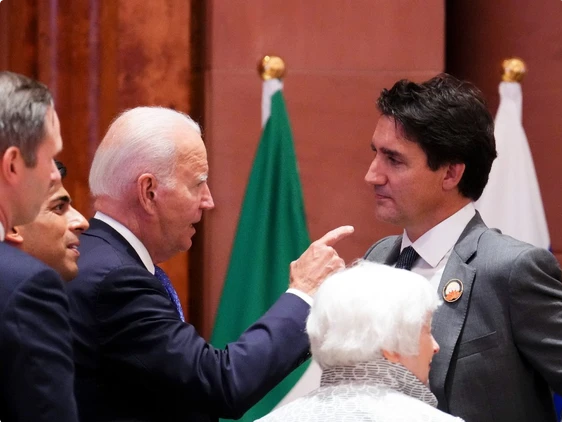
US President Joe Biden talks to Canadian Prime Minister Justin Trudeau, March 2023.

On the eve of Russia’s invasion of Ukraine, Mark Norman, the former vice-chief of defence, made a prediction that sounded overblown at the time.

“I really think the Americans are going to start ignoring us because they don’t think we are credible or reliable. They are not even putting pressure on us anymore,” he said in a January 2022 National Post interview, based on his conversations with contacts in Washington.

It turns out he was absolutely right.

Since then, leaked Pentagon documents have confirmed that sense, indicating that the U.S. believes “widespread defence shortfalls have hindered Canada’s capabilities, while straining partner relationships and alliance contributions”.

Canada left little room for doubt about its diminished capabilities when it took a pass on NATO’s largest-ever air exercise last summer, because its jets and pilots were involved in “modernization activities”. That absence left the impression that this country might not be able to show up in certain circumstances.

Even before the unfolding tragedy in the Middle East, America was letting it be known that it felt overstretched and needed regional allies to share the burden.

When President Joe Biden visited Ottawa in March, he asked Justin Trudeau to lead a mission to Haiti, which had descended into mob rule. Since the Liberals were elected on a peacekeeping ticket in 2015, it was a logical request. However, Trudeau demurred, presumably on the grounds that Canada’s security forces were stretched too thin by operations in Latvia and fighting wildfires at home. The upshot is that Kenya is set to send 1,000 security officers to the beleaguered island nation.

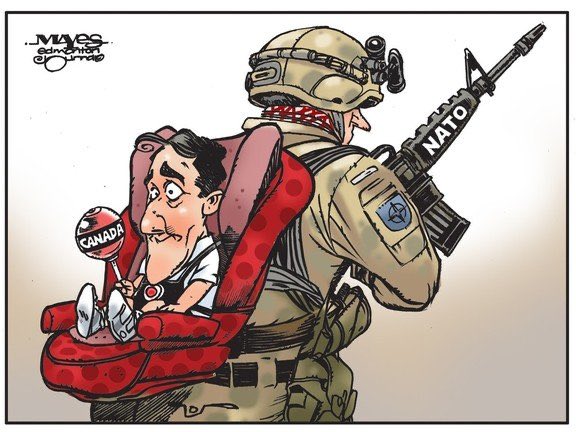
The recent news that Canada now plans to trim its defence budget by nearly $1 billion — a total of $17 billion over 20 years, if savings are recurring — has reinforced the image of a country with short arms and long pockets.

Against that background, it was no surprise that on Monday Biden hosted a call with the leaders of France, Germany, Italy and the U.K. to discuss the crisis in the Middle East — and didn’t include Canada.

A statement by the G7 minus Canada and Japan (which has a negligible Jewish population) was issued saying that the five countries would ensure Israel is able to defend itself.

Over at The Line, Matt Gurney discovered that the federal government was actively trying to hide the fact that Canadians in Israel were not able to access Canadian embassy services by pretending that the word “operational” meant “open and functional”:

On Sunday evening (hours after we published our dispatch), I received a reply from GAC. This was the reply:

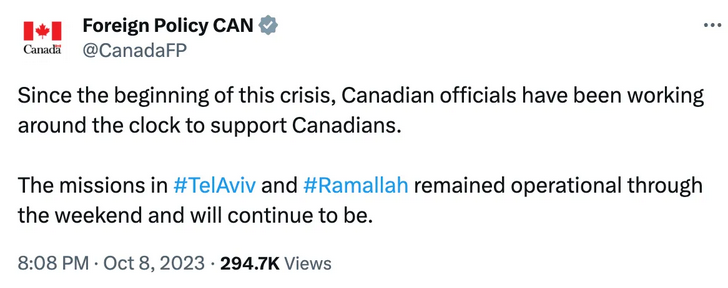
    Since the beginning of this crisis, Canadian officials have been working around the clock to support Canadians. The missions in Tel Aviv and Ramallah remained operational through the weekend and will continue to be. Our missions will open on Monday October 9th, unless security conditions do not allow for it. We will be assessing the security situation daily, in coordination with our allies.

Okay! That seemed fair. But not having been born yesterday, and being in a profession where people try to spin me all the time, I noticed something immediately. The distinction GAC was drawing between “operational” and “open” stood out to me. I replied at once seeking clarification, and heard nothing back. Not even an acknowledgement.

This word choice mattered. The government publicly used the “operational” messaging. Members of the government repeated it. This was what they were telling the Canadian people: all is well, ignore those nasty media people and members of the opposition. Of course the embassies were “operational”!

See that tweet? The one pasted above? I checked out who was retweeting it. Lots of people did! And that included a bunch of Liberal MPs, a bunch of Canadian diplomats, members of the media, and what I’ll politely refer to as a group of “usual suspects” I recognize from online as being proxies for the Liberal government’s messaging (or at least really devoted True Believer Liberal partisans).

On Monday morning, having heard nothing back about what “operational” meant as opposed to “open”, I asked for a specific clarification in the terminology. What was “operational” vs. “open”? I also asked for specifics on what services were available locally from Canadian diplomatic missions in Israel over the weekend in real time, and how that would change when the embassy “opened” on Monday. I asked about the staffing level at the embassy on the weekend, and how that would compare to a normal workday, and also to a normal weekend.

Rather than answer a simple question, our government would much rather obfuscate and prevaricate as a matter of policy. That, by itself, tells you everything you need to know about both our political leaders and the civil service organizations they control.

September 30, 2023

With the international situation so stable and peaceful, Canada intends to cut military spending by $1 billion or so

Filed under: Cancon, Government, Military — Tags: , — Nicholas @ 05:00

I didn’t think Justin Trudeau could possibly come up with another stunt to outrage our allies, but I stand corrected:

Canada’s top general revealed on Thursday that the armed forces is facing nearly $1 billion in cuts by the Liberal government, saying that military leaders are struggling to understand the change as the forces deal with more pressures in an unstable world.

Speaking to MPs Thursday during a meeting of the defence committee, Chief of Defence Staff Wayne Eyre was asked about proposals to cut $15 billion across the government, which the Liberals promised to do in the spring budget.

Eyre said the Defence Department’s piece of that cut will hurt.

“There’s no way that you can take almost $1 billion out of the defence budget and not have an impact, so this is something that we’re wrestling with now,” he told MPs.

Eyre said he had been discussing the cuts with military leaders and they’re struggling to understand the change.

“Our people see the degrading declining security situation around the world and so trying to explain this to them is very difficult,” he said.

Conservative Defence critic MP James Bezan said he hopes the military doesn’t weaken its readiness with these cuts.

“I sure hope we’re not going to hear stories that we can’t afford to put the fuel in the tanks and train guys in armour, we’re not going to put diesel in the ships and not have the Navy go out there and training, we can’t afford to do maintenance on our tanks,” he said. “We have to make sure we continue to move forward in training and operations.”

Deputy Minister of Defence Bill Matthews said the department is looking at ways to ensure the cuts don’t hurt the ability of the military to fight.

Not to be too cynical, but the Canadian Armed Forces are already well below the funding level we promised our allies we’d achieve, and it impacts pretty much everything the CAF needs to do. It’s quite possible that a budget cut of that size will end meaningful participation in NATO land operations in Estonia, Latvia, Poland, and other front-line allied nations.

August 31, 2023

Disaster response plans? I’m sure they’ve established terms of reference for the to-be-appointed blue-ribbon committees to look into that … eventually

In The Line Jen Gerson discovers once again that our federal government is much more interested in making dramatic announcements — usually repeated many, many times — than in actually doing anything. Their response to her inquiry about federal disaster response planning is anything but comforting to worriers among the citizenry:

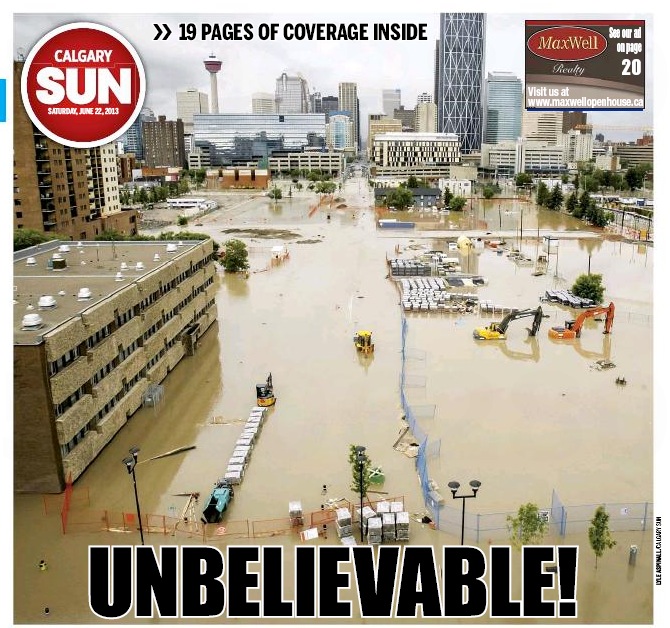
Front page of the Calgary Sun after major flooding hit downtown Calgary in June, 2013.

The clever and devoted readers of The Line will have already surmised that I am a touch neurotic, prone to catastrophize, and gifted with one of those imaginations that is perfectly capable of picturing in vivid detail every worst-case scenario playing out simultaneously.

And so, dear devotee, you will have no trouble picturing my mental state in recent months, in what will come be known as the Summer of Fire. Until next summer, anyway. Until then, it’s always fun to watch two cities burn (or come close to burning) over the course of a single weekend, eh?

Watching the long lines of cars fleeing Yellowknife, or the beachcombers lining the shores of Lake Okanagan as swathes of West Kelowna disappeared, I have to admit that my mind wandered into its darker wings.

Yellowknife and Kelowna are cities, yes, but relatively small ones: Yellowknife is remote and served by only one road, making it a particular logistical challenge to evacuate. But it’s still only a town of 20,000 people. This ought to be well within the capacity of a wealthy, organized G7 country.

What if wildfires threatened, say, Edmonton? A city of a million. How would we get everyone out? Where would they go? What would they eat?

And this line of internal paranoia brought me to the media landing page of the minister of Public Safety Canada. I have questions — to my mind, basic questions — about this country’s capacity to handle major catastrophes. They were as follows:

  • What are the transportation resources typically available to facilitate an evacuation: in an emergency, how many people could we move by air or land, and how quickly?
  • Does the federal government maintain stores of food or other basic goods? How much? How many people could we feed?
  • Do we have the capacity to establish temporary housing for evacuees displaced by an emergency situation? If so, how many people could it hold, and for how long?

I also had a few more general queries. I am aware that they may not have been fully answerable by the federal government, but I was curious about what the response would be. Specifically:

  • Are we going to rebuild everything that burns down, or do we have to accept that climate change will make some previously inhabited sections of Canada unlivable?
  • What kind of resources will the federal government marshal toward hardening infrastructure to prepare for more serious floods and fires in the future? Is this a priority?

To be clear, none of these questions are “gotchas”. I was not out to catch the federal government by surprise, nor to embarrass it in any way. I don’t think any of these questions is unreasonable; in fact, I expected some fairly stock answers. That is, I expected that a federal government would keep at least a basic running inventory of things like temporary housing or food supplies. Further, I would have been perfectly content with very general answers. Perhaps some of my questions were misguided, and I would have been happy to understand that as well.

What I got was, well, I’m going to show you exactly what I got, offer a little of my own running commentary, and allow you to come to your own conclusions.

August 6, 2023

QotD: Pierre Trudeau’s legacy

Filed under: Cancon, History, Military, Politics, Quotations — Tags: , , , — Nicholas @ 01:00

I have banged on and on and on, to the annoyance of some of my readers, about how Pierre Elliot Trudeau reshaped Canada, almost entirely, in my considered opinion, for the worse. I have singled out, frequently, his evident distaste for the Canadian military and his very real isolationism and reluctance to have armed forces, at all.

There is a lot of documentation about Pierre Trudeau and his views and attitudes, much of it laudatory, some of it critical. I make no secret of the fact that I assert that one Canadian prime minister (perhaps, in my opinion, Canada best-ever leader) the great Liberal Louis St. Laurent, gave Canada a coherent, principled, liberal, values-based grand strategy in the late 1940s and then, just 20 years later another Liberal, Pierre Trudeau, tore it all down, threw it all aside and imposed new, very illiberal, values on Canada ~ all because, I guess, he could not reconcile the facts that stared him in the face in the late 1940s with his own personal choice to have stood, firmly, on the wrong side of history in 1944 when he elected to continue to study (this time at Harvard) rather than to join in the fight to crush Hitler.

M. St. Laurent and M. Trudeau could not have been more different. Louis St. Laurent was an internationally respected lawyer, he was “a man of the world”, neither an anglophile, like Sir Wildred Laurier, nor an anglophobe like Trudeau, he was secure in being a Canadian. He came to politics reluctantly, as a duty, but he quickly became known to, respected by, and, indeed, often friends with Harry Truman, George Marshal, Dwight Eisenhower and Dean Acheson, with Anthony Eden, Ernest Bevin, Clement Atlee, Sir Winston Churchill and Harold Macmillan, and with Tage Erlander of Sweden, Jawaharlal Nehru and V.K. Krishna Menon in India, Sir Robert Menzies of Australia, Tunku Abdul Rahman in Malaysia and leaders, from the West, the East and the non-aligned states. Pierre Trudeau, on the other hand, was a small, very parochial man who did not, really, understand Canada, beyond French-speaking Québec. He became “famous” for opposing Maurice Duplessis ~ something, I have suggested, that would not be much beyond the intellectual capabilities of a somnolent house cat. He travelled the world but never seemed, to me, to have acquired the respect that was accorded to Louis St. Laurent or Mike Pearson … except, perhaps from Fidel Castro.

Ted Campbell, “Pierre Trudeau’s legacy”, Ted Campbell’s Point of View, 2019-08-02.

July 22, 2023

QotD: “Managing” your way to victory

Filed under: Bureaucracy, History, Military, Quotations, USA — Tags: , , , — Nicholas @ 01:00

Some of the greatest victories of all time were managed by ad hoc organization that, like Topsy, just “growed from 1939 to 1945, as Churchill and Roosevelt searched for ways to operate a grand, strategic alliance fighting against formidable enemies, while the postwar fascination with process, led in large part by US Defence Secretary (1961-68) Robert S. McNamara, contributed, I believe, in a major way to the strategic and military debacle that was the Vietnam War (1955-75) when data began to replace tactics, and management theory, coupled with complex organization charts, replaced military acumen and strategic vision.

There is nothing wrong with good, sound management and management theory and management science (and, yes, I believe there actually is a such a thing) have much to teach us all, including governments and the military, about how to get the most from one’s always limited resources, especially time. But, too often, in my opinion, management becomes an end in itself and process replaces critical thinking and analysis. When this happens in both the political/bureaucratic and in the military realms, as I believe it has in Canada (which has tended, since about 1970, to follow the USA almost slavishly) then I believe that our national defence is in peril.

It is common, amongst military people, to accept that there is a “master principle of war”: Selection and Maintenance of the Aim. That means that one MUST understand what one is trying to do and then focus all one’s efforts on getting that done. The corollary is that if you don’t know what you need to be doing then getting the results you want (need) is unlikely. I believe that the Canadian Armed Forces lack good strategic direction because the Government of Canada, the Trudeau government, is unconcerned with anything past the next election. I also believe that the military leadership, lacking strategic direction, simply follows whatever new process seems to be popular in the Pentagon. Canadians, therefore, are not getting value for money from either the government they elected nor from the military forces for which they pay.

Ted Campbell, “Following the blind leader (3)”, Ted Campbell’s Point of View, 2019-05-21.

July 17, 2023

Canada has been one of the biggest freeloaders in NATO for more than 40 years

From the weekend Dispatch from the editors of The Line, some indication that even the American legacy media are tired of Canada’s generations-long peace dividend freeloading at the expense of our allies:

American media doesn’t often notice Canada, and as much as Canadians like to whinge about being ignored, the lack of interest in our affairs from south of the border is usually a good thing. If you’re looking for a rule of thumb here, it’s this: attention from the Americans is almost always negative.

A case in point this week was an editorial published by the Wall Street Journal on Wednesday, headlined “Canada is a military free-rider in NATO”. The subhed was “Ottawa still spends only a pathetic 1.38% of GDP on defense”. The editorial makes a number of points almost all of which will be familiar to readers of the Line, which are all variations of: Canada shirks its NATO commitment to spend two per cent of GDP on defence, while engaging in relentless virtue signalling and moral preening, both domestically and to its allies. It treats national defence as social project, while doing little to nothing in the way of actually projecting the power that is needed to defend the values it purports to advance.

There are some absolutely killer lines in the editorial, beginning with the lede: “Canadian Prime Minister Justin Trudeau was in Lithuania this week for the annual NATO summit, but it’s too bad there wasn’t a junior table where he could sit.” A few paragraphs later: “Last week Ottawa put in its two cents against cluster munitions. But asking its citizens to meet their actual obligations to the cause of freedom is apparently too much to ask.” And then: “Nowadays Ottawa can be counted on to ‘fight’ for human rights, which is to say that it talks a lot about them.”

Again, for anyone paying attention here in Canada, these are not new arguments. But the editorial does add one twist at the end, suggesting that if Canada can’t be bothered keeping its NATO commitments, then perhaps it should be kicked out of the G7 and replaced by a country willing to play a leadership role. They suggest Poland as a possibility.

Reaction in Canada has been surprisingly muted. On our own social media feeds, we noted a lot of rather sad attempts at dismissing the editorial — the paper is a Rupert Murdoch owned rag; this is Trumpist nonsense; Europeans juice their defence spending through useless mandatory service requirements. But curiously, we didn’t see anyone try to pull a Julie Dzerowicz and argue that, despite all evidence to the contrary, Canada is actually punching above its weight in NATO.

Look, some of us here at The Line have been reading harsh editorials on Canada’s defence spending for decades. (We’ve written a few, too!) And we’ve never seen anything remotely this harsh from an American outlet. This is absolutely devastating stuff, and it can’t be simply shrugged off because of the source.

A bit of history: In 1995, the Wall Street Journal published an editorial calling Canada “an honorary member of the Third World” in an editorial that also referred to the Canadian dollar as the “northern peso”. This was in response to Canada’s national debt and tax rates hitting unsustainable levels. We were an economic basket case, and the Americans were starting to notice.

Lots of Canadian commentators dismissed the editorial on the grounds that the WSJ was just pushing the supposedly-discredited Reagan/Thatcher/Mulroney “neoliberal” agenda. But later that year the Chrétien government, with Paul Martin as finance minister, introduced one of the most significant budgets in Canadian history. They slashed federal spending in ways not seen since the end of the Second World War, slashed the public service, gutted the department of defence. But three years later they had balanced the budget, inaugurating an extended period of federal fiscal responsibility that lasted until the election of the Trudeau Liberals in 2015.

The point is not that there’s a cause and effect here — Jean Chrétien and Paul Martin didn’t sit down and go “oh shit, the Journal has weighed in, we have to do something”. It’s that when serious American media get around to noticing stuff about Canada, it is usually because the stuff they are noticing has become such a problem for other countries that our national Emperor’s New Clothes routine is no longer tenable. It is a sign that things have to change, and quickly.

Remember, the Liberal government doesn’t deny that Canada is a NATO laggard and a free rider on defence. Justin Trudeau has admitted as much, both publicly and privately. But up till now, his attitude has been to sort of smirk at the Americans, give his usually smarmy shrug, and say “what are you going to do about it?”

What the Wall Street Journal editorial does is suggest that there could be real consequences for our professed indigence. It is one thing to be left out of AUKUS, which the Liberals continue to falsely characterize as a submarine procurement deal. Getting kicked out of the G7 would something else entirely — it’s the sort of thing the sorts of people who vote Liberal tend to care about.

Canada’s current attitude to collective defence is not sustainable. Our allies have noticed. Either we change, or our allies will change things for us.

June 14, 2023

QotD: In hindsight, calling it “Operation HONOUR” was quite ironic

Filed under: Cancon, Military, Quotations — Tags: , , , , , , — Nicholas @ 01:00

I spent my subaltern years in the light of Operation HONOUR, the signature project of then-Chief of Defence Staff General Jonathan Vance. Operation HONOUR was a massive culture change effort intended to address the findings of the Deschamps Report, which had exposed the “underlying sexualized culture in the CAF that is hostile to women and LGTBQ members, and conducive to more serious incidents of sexual harassment and assault”. General Vance went to great lengths to emphasize that Operation HONOUR was, in fact, a military operation and not a mere policy. Slicing out the tumour of sexualized culture was our mission and the General’s words were our orders. During my first ever round of quarterly performance evaluations, I reported to the company commander that one of my NCOs was non-compliant with the principles of Operation HONOUR.

Loyalty up, remember?

As a young soldier, I had actually worked for this particular NCO. He was an artifact of the Old Army and had a reputation as a hardman. He liked to brag about picking Friday night fights in Native bars out on the Prairies (he wore weighted gloves for extra knock-out power). He described to us in detail what he would do to his wife after a training weekend. He told us she would never say no, followed up with a chuckle and “like she has a choice”. If you were weak in his eyes, he’d belittle you publicly as a “queer” or a “faggot”. The funny thing was that this guy was overweight and never showed up for ruck marches or PT tests. His annual conduct-after-capture briefing was basically forty minutes of “you’re gonna get raped but that doesn’t make you gay”. One of his favourite war stories was about stray dog duty in Bosnia. He’d lure in the strays with peanut butter on the end of shotgun then blow their brains out. Riveting stuff.

Overnight I had gone from from being this man’s subordinate to being his superior, so when the General said we had a duty to report, I did my duty. The next week I was in front of the Regimental Sergeant-Major being asked why I was interfering with a strong NCO’s career prospects. That’s when I learned that loyalty up meant loyalty to the Regiment, and that sensitive matters such as this were handled internally and off the record. That one-way conversation was a major push towards putting in my application for the Regular Force. I didn’t want to be around that type of nonsense (“oh my sweet summer child” says the peanut gallery). Not long after I left, my former supervisor sexually assaulted the mess steward.

[…]

In February 2021, an investigation was opened into General Jonathan Vance, who had just finished his tenure as Chief of Defence Staff. Major Kellie Brennan, a subordinate of Vance at various times, accused him of a preventing her from disclosing their long-running affair. Since their relationship began in 2001, Vance had been married twice. DNA testing confirmed that Vance was the father of one of Brennan’s children, but he had never acknowledged or taken responsibility for the child. Vance plead guilty to obstruction of justice in March 2022 and received a conditional discharge with twelve months of probation.

The heat and light generated by an investigation of the outgoing Chief of Defence Staff led to an unprecedente level of scrutiny on the CAF’s senior leadership. In 2021 alone, the Governor General of Canada, the Minister of National Defence, the incoming Chief of Defence Staff, the Vice Chief of Defence Staff, Commander Canadian Special Operations Command, and Commander Military Personnel Command, amongst others, would resign, retire, or be re-assigned amidst allegations of impropriety. Since 2021, recruiting and retention levels have continued to free fall and the federal government has set aside $900 million in class-action lawsuit compensation for current and former CAF members who experienced sexual harassment, assualt, or discrimination. The social trap has been sprung.

“Shady Maples”, “A Question of Loyalty”, The Powder Horn, 2023-03-12.

May 26, 2023

CH-124 Sea King; Legendary ASW helicopter and example of a deeply flawed defense procurement process

Filed under: Cancon, Government, History, Military, USA, Weapons — Tags: , , , , — Nicholas @ 04:00

Polyus
Published 21 May 2023

The Sea King was a legendary aircraft in the history of the Royal Canadian Navy. It filled the role of hunter and killer in the Cold War against Soviet submarines. By the mid-90s the situation had changed and their retirement seemed eminent. How naive. The process of finding a replacement for this workhorse would be an election promise by government after government for over 30 years. Its replacement, the CH-148 Cyclone, became operational in 2018. This allowed the 55 year old workhorses to finally retire.
(more…)

May 4, 2023

Despite all the evidence, Canada’s official motto doesn’t translate as “we broke it”

In The Line, Justin Ling adds more to the towering pile of evidence that “Canada is broken”:

If The Line has an editorial position, it is probably thus: Everything is broken.

This newsletter, of course, comes at the idea more earnestly than, say, the leader of the Conservative party. When my friend Matt Gurney advances that proposition, it is a lament. When Pierre Poilievre does: It’s wishful thinking.

While citizens of this country can’t always agree on what, exactly, is busted in our country, or why, or who is responsible — we can all agree, I hope, that things in this country could use a tune-up, at the very least. Canadians, after all, are imbued with a cloying optimism. An insufferable belief that things can be fixed. It’s a good thing.

Lucky for us, we have plenty of words written about how to fix much of what ails us. Because we, as a country, have a compulsive need to inquire about those problems. Our national pastime isn’t hockey, it’s the royal commission.

And we’ve got a government in office that loves to study the nature of the problem. There’s good work, these days, for the special rapporteurs and retired judges amongst us. And if you’re a Canadian that loves a good public consultation, you must be run ragged.

Yet we also have a government in office that has a pathological inability to take advice. And this problem may help explain why it feels like we’re sliding backwards.

[…]

When the government tapped an expert panel to study the use of solitary confinement in Canada’s prisons — literally torture — Correctional Services Canada blocked them from doing their job, and the public safety minister ignored their cries for help and then let their contracts lapse. Thanks to some scrutiny, the government renewed the study, then ignored it when the numbers showed they were still torturing people. Oops!

The National Security and Intelligence Committee of Parliamentarians — a body Trudeau created — warned in 2019 that Ottawa wasn’t taking foreign interference seriously, particularly when it came to China. “In short, government responses were piecemeal, responding to specific instances of foreign interference but leaving unaddressed the many other areas where Canadian institutions and fundamental rights and freedoms continue to be undermined by hostile states.” Prescient!

One of the most absurd examples is the sexual misconduct crisis in the Canadian Armed Forces. When Trudeau came into office in 2015, he had an external review on his desk from Marie Deschamps. One good external review deserves another, so the Liberals ordered one from Louise Arbour in 2022. What she found was harrowing: “We have been here before. Little seems to change.” Not only had the government failed to implement the Deschamps report, it was still failing to live up to the recommendations from the 1997 Somalia Inquiry. Fuck!

[…]

At the very centre of this tootsie-pop is, surprise, elitism. This Liberal government, armed with its paper-thin mandate, is convinced that they — and only they — are the verifiers of good ideas. And we should be grateful for whatever decision they deign to make.

If they farm out an idea to the public service, and the idea doesn’t come back in the form they envisioned, no matter: Send out the McKinsey signal. For just a few million dollars, their crack team of subject matter non-experts can prepare a PowerPoint presentation laying out the exact policy the political staff wanted in the first place.

The Liberals take a similar approach to consulting with the unwashed masses. When the government consulted the public on their plan to police “online harms,” they published a “what we heard” report that was broadly supportive of their plan.

Can we see the submissions? Journalists and academics asked. No. Came the reply.

April 27, 2023

Spending more on defence requires more than just turning on the financial taps

In The Line, Philippe Lagassé explains why just pouring more money into the Department of National Defence won’t automatically improve our defence capabilities:

Canadian defence spending is back in the news, thanks to an open letter urging the government to spend two per cent of GDP on the military and a leaked document suggesting Canada won’t hit that NATO target. Like ending the monarchy, defence spending is one of those issues that gets lots of attention once or twice a year, only to fade away before any serious discussion takes place. It’s unlikely that this time will be any different.

[…]

Even if the government wanted to greatly increase defence spending, though, it would have trouble spending that money effectively in the short term. While more money is needed over the long term, the Department of National Defence (DND) and Canadian Armed Forces (CAF) have to first build up their capacity to spend a much larger budget. As they do so, however, our historical tendency to reduce defence expenditures after pivotal moments should always be kept in mind.

The DND and CAF are already straining to implement the capital equipment and infrastructure programs that were announced in the 2017 defence policy, Strong, Secure, Engaged. This reflects the fact that department’s capacity to manage procurements has to be built back up after decades of anemic capital spending. There aren’t enough people to move the programs that are currently planned, let alone new ones that could be added. Additional money could be funneled to existing projects, but that wouldn’t be enough to cause an increase to two per cent of GDP in the coming years. The capabilities Canada is currently buying will probably be far more expensive to maintain in the future than the government realizes, which strongly suggests that we do need to gradually get to that number, but this reinforces the need for caution and for managing expectations. If ministers insist that new money be attached to still more new capabilities, DND/CAF will not only have trouble acquiring them, but will be unable to afford them.

One could argue that DND/CAF could get around its capacity challenges by simply buying more equipment “off the shelf”. Instead of getting more people to tackle complex procurements and infrastructure projects, the defence department should focus on simpler acquisitions that require less management. It is important to note, though, that “off the shelf” procurements aren’t an obvious solution either — DND and the CAF don’t specify requirements for the hell of it. Many project requirements reflect the need to integrate new capabilities into the existing force, which is no small feat when mixing new and old technologies and operating from installations across a massive country. Projects that gravitate toward “off the shelf” solutions, moreover, can be challenged by competitors who contend that they can develop a new capability that better meets Canada’s needs. Bombardier‘s response to the government’s plan to buy Boeing’s P-8 Poseidon aircraft to fulfil the Canadian Multi-mission Aircraft (CMMA) project is a recent example.

Canada also tends to favour platforms that can perform various missions, which further complicates “off the shelf” procurements, since the equipment sitting on the shelf may not do everything the CAF needs it to do. Unless we want the CAF to be less capable, the way to address this issue is to acquire more platforms that do specific things. The problem is that the CAF would need more people to acquire, operate, and maintain these additional fleets, still more money to sustain this extra equipment, and yet more infrastructure to store it. This approach promises to exacerbate the very problems it’s supposed to solve.

April 24, 2023

Canada won’t meet its defence spending targets, and Trudeau is totally fine saying this to our allies, if not to the public

Filed under: Cancon, Government, Military, Politics, USA — Tags: , , , , , — Nicholas @ 03:00

Canadian defence freeloading has been a hallmark of Canadian government policy since 1968, and as The Line confirms in their weekend dispatch, it should be no surprise that Justin Trudeau is okay continuing his father’s basic policies:

A story we’ve been watching in recent weeks was the remarkable leak of sensitive U.S. national security documents onto the dark web, and from there, widely across social media. A young member of the Air National Guard has been arrested and now faces serious charges. News reports suggest that he had access to classified material at work and began sharing it privately with a small group of online friends, apparently simply to impress and inform them, with no broader political agenda. Some of those friends, in turn, appear to have leaked the documents further afield. It took months before anyone noticed, but once picked up by several individuals with large followings — including some who are none-too-friendly to the U.S. and Western alliance — the story exploded and the full scope of the leak was finally discovered.

This is, for the U.S., a huge embarrassment and a diplomatic nightmare. For us, it was simply a fascinating story. This week, though, we suddenly had the coveted Canadian Angle: the Washington Post claims to have reviewed one of the leaked documents, apparently prepared for the American Joint Chiefs of Staff, that assesses Canada’s military serious military deficiencies, and also reports that Prime Minister Justin Trudeau has privately told fellow NATO leaders that Canada isn’t going to hit NATO’s two-per-cent-of-GDP spending target.

To wit:

    “Widespread defense shortfalls hinder Canadian capabilities,” the document says, “while straining partner relationships and alliance contributions.”

    The assessment, which bears the seal of the U.S. Joint Chiefs of Staff, says Germany is concerned about whether the Canadian Armed Forces can continue to aid Ukraine while meeting its NATO pledges. Turkey is “disappointed” by the Canadian military’s “refusal” to support the transport of humanitarian aid after February’s deadly earthquake there, the document says, and Haiti is “frustrated” by Ottawa’s reluctance to lead a multinational security mission to that crisis-racked nation.

Your Line editors just sort of sighed heavily and rubbed their temples when they read that. It was, to us, nothing we didn’t know already. It was actually almost some kind of a relief to know that the PM will at least say privately what he won’t admit publicly: we aren’t living up to our pledge, and don’t plan to.

The Post says that Trudeau told NATO that there won’t be much more military spending in this country until the political situation here changes. We aren’t sure if he meant the priorities of the voters or the composition of our parliament. It doesn’t matter — it’s true either way. We are disappointed, but again, in no way surprised, to see Trudeau seeing this as an issue that he’ll just accept as-is, as opposed to attempting the hard work of showing actual leadership. He’s always been more about the easy path of demonstrative gestures instead of working hard to achieve real change.

But hey. In this, he has a lot of company. The Tories under Harper were marginally better on defence, but not nearly good enough. We have little faith — next to none, really — that PM Poilievre would do any better on defence. What bums us out the most about this issue is that we recognize and even agree that the choice to neglect defence and shovel those dollars instead into other, more popular vote-buying files does indeed make political sense. It’s what the voters want. We wish it were otherwise. We’ve spent big chunks of our careers trying to change their minds. Our record to date is one of total, utter failure.

Still, never say die, right? So we’ll make this point: we understand and accept the criticism sometimes made by Canadian commentators, who argue that the two-per-cent-of-GDP target is arbitrary and somewhat meaningless. We don’t entirely agree — targets are useful, and two per cent seems reasonable. But we’d be open to an argument that Canada could still punch above its weight in the alliance, even while spending less, if we could deliver key capabilities.

But … we can’t. We probably could, once upon a time, but we can’t even do that now. The air force is a mess. The navy is a mess. The army is a disaster, and couldn’t even send Nova Scotia all the help it asked for after Hurricane Fiona. Sending a token plane or ship on a quick foreign jaunt is symbolism, not above-weight-punching. And the symbolism taps us out.

So we have to pick what we’re doing here, fellow Canucks. We can meet the two-per-cent target. We can find other ways to meaningfully contribute. Or we can do neither of those things, and admit it, but only in private. Right now, alas, we’ve chosen that third option. We see no sign that’ll be changing any time soon.

Pierre Trudeau discovered that Canadian voters are all too willing to accept “peace dividends” in the form of shorting defence spending to goose non-military spending, and few prime ministers since then have done much more than gesture vaguely at changing it. Worse, it’s also quite accepted practice for defence procurement to prioritize “regional economic benefits” over any actual military requirement, which often means Canada buys fewer items (ships, planes, helicopters, tanks, trucks, etc.) at significantly higher prices as long as there’s a shiny new plant in Quebec or New Brunswick that can be the backdrop for government ministers and party MPs to use as a backdrop during the next election campaign. Military capability barely scrapes into the bottom of the priority list on the few occasions that the government feels obligated to spend new money on the Canadian Armed Forces.

Worse, every penny of “new” spending on the military gets announced many times over before any actual cheques are issued, which helps to disguise the fact that it’s the same thing all over again — sometimes for periods stretching out into years. The Canadian military has a well-deserved reputation for keeping ancient equipment up and running for years (or decades) after all our peer nations have moved on to newer kit. It’s a tribute to the technical and maintenance skills of the units involved, but it probably absorbs far more resources to do it over replacing the stuff when it begins to wear out, and it reduces the number available to, and the combat effectiveness of, the front-line troops when they are needed.

April 10, 2023

It’s totally normal for a country to send troops overseas and neglect paying to feed them, right?

Filed under: Bureaucracy, Cancon, Military — Tags: , , , , , — Nicholas @ 06:00

This week’s Dispatch post from The Line includes some commentary on the story I linked to last week from the Ottawa Citizen, reporting that Canadian soldiers sent to Poland to train Ukrainian troops are being stiffed by the Department of National Defence on their food bills:

Operation Unifier shoulder patch for Canadian troops in Ukraine.
Detail from a photo in the Operation Unifier image gallery

Here’s a totally normal story from a well-functioning country that isn’t at all broken: it turns out that processing per diems for a hundred or so folks is now beyond the capability of the federal government.

This story came to us courtesy the Ottawa Citizen, where David Pugliese reported that the company sized unit of Canadian military personnel operating in Poland has seen months worth of expense filings go unpaid. In some situations, a military unit sent abroad would include its own logistical support team, including cooks. In other situations, a relatively small unit sent to a place with functioning civilian infrastructure is told to feed themselves and keep the receipts for reimbursement. For our troops in Poland, there to provide logistical and training support to Ukrainian forces since October, the government went the latter route.

And that’s fine. Really. Frankly, we’re sure the troops are happier eating out at local places and enjoying delicious Polish food — really, it’s amazing — than getting three servings of military slop a day. The problem, though, as these poor troops discovered, is that the military and national defence bureaucracy no longer has the ability to process the expense payments. So these balances are just sitting on their personal credit cards. For months.

[…]

The mission began in October.

It seems almost pointless to add much actual insight and analysis here. This kind of dysfunction speaks for itself. We’ll limit ourselves to two comments: operational deployments are incredible stressful on military personnel and their families on the homefront. That’s uncontroversial, and unavoidable. That’s why military service is recognized as a sacrifice even during peacetime deployments. The basic bargain we make with our servicemembers is while they are serving their country abroad, their country will take care of their families at home. Leaving these families with high-interest credit-card balances they can’t pay off because the Canadian government is too broken to reimburse soldiers for expenses they were told to incur is an on-the-nose failure of Canada to honour its debt to the the military parents, spouses and children who have been, in effect, ordered to advance the Canadian government money to subsidize military deployments.

The second comment we’ll make, is that this isn’t just further evidence in support of the Canada-is-broken thesis — it’s a very specific kind of break. We’ve all known that Canadian governments, at all levels, have struggled to turn new policies into new programs. That’s not new. But even granting that failure, we’ve generally been able to keep doing the things we already do. There seemed to be enough residual muscle memory in our governments. Can we do new things? No, not really. But we’ll keep doing the stuff we already do.

This military fiasco is alarming because it’s a sign that our state-capacity issues are now extending into areas that previously worked. Not only are we struggling to do new things, we’re forgetting how to do things we used to be able to do. This goes beyond what our typical gripes about state capacity. This is something else. This is state atrophy, or rot.

Now that the public is paying attention, we suspect we’ll see some reasonably rapid progress. The government will throw bureaucrats and maybe consultants at the problem until it goes away. This is how they have reacted to similar issues: we hurled ground staff at airport delays until they cleared, and bureaucrats at passport offices until the backlogs eased.

But we have to ask why we now require exceptional redeployments of staff to maintain typical levels of service. And we don’t like the answers we can come up with. Ottawa has added tens of thousands of civil servants, at an annual cost of tens of billions, in recent years. During that time Ottawa has also sharply ramped up spending on consultants; the annual cost now surpasses $20 billion.

And yet.

What the hell is going on?

I’ve been saying for literally years now, the more the government tries to do the less well it does everything, and this fiasco is a perfect example of that sclerosis spreading further.

April 6, 2023

Tikka T3x Arctic / Canadian Rangers C19 Rifle, 7.62 / .308 Win

Filed under: Cancon, Europe, Military, Weapons — Tags: , , , , — Nicholas @ 02:00

Bloke on the Range
Published 29 Mar 2019

Bloke unboxes and takes a first look at the Tikka T3x Arctic rifle, adopted as the C19 rifle for the Canadian Rangers in 7.62 NATO / .308 Winchester. Is the hype real? Oh yes! Yes, it really is!
(more…)

April 5, 2023

The modern Canadian Army – go on deployment to Poland, train Ukraine troops … and have to buy your own rations

Filed under: Bureaucracy, Cancon, Military — Tags: , , — Nicholas @ 05:00

Is it hard to figure out why the Canadian Armed Forces are having recruiting shortfalls when they can’t even manage to feed the troops they send overseas to train Ukrainian soldiers?

Operation Unifier shoulder patch for Canadian troops in Ukraine.
Detail from a photo in the Operation Unifier image gallery – https://www.canada.ca/en/department-national-defence/services/operations/military-operations/current-operations/operation-unifier.html

The Canadian soldiers are in Poland to train Ukrainian military personnel but since Canada did not send military cooks on the mission, the troops were told to eat at local restaurants.

But there is a massive backlog with the Canadian Forces reimbursing the soldiers for those costs, sending some of them thousands of dollars into debt. Their families contacted this newspaper to complain about the situation they say is causing financial stress at home.

After this newspaper [the Ottawa Citizen] inquired about the situation, the Canadian Forces confirmed Monday that there are problems with payments of per diems and the reimbursement of other expenses. The Canadian Forces is now promising to speed up the process.

“We apologize to the members and their families for the distress this has caused, and thank them for their patience,” said Capt. Nicolas Plourde-Fleury, spokesman for Canadian Joint Operations Command (CJOC). “We want them to know we have implemented measures to better support them moving forward.”

Approximately 100 Canadian military personnel are currently serving in Poland as part of a contingent to train Ukraine troops. The first arrived in October 2022 but the mission added more personnel in February and March.

As part of Operation Unifier, the Canadian soldiers are providing training in basic and advanced engineering skills, the use of explosives for demolition work, demining and skills relating to the use and operation of the Leopard 2 tanks in combat.

The Canadian Forces usually has its own cooks to provide troops with food. But in this situation, the Canadians initially received their meals from the Polish military. Later, the Canadian soldiers were told to eat in local restaurants and they would be reimbursed by the Canadian Forces.

« Newer PostsOlder Posts »

Powered by WordPress