Quotulatiousness

February 13, 2023

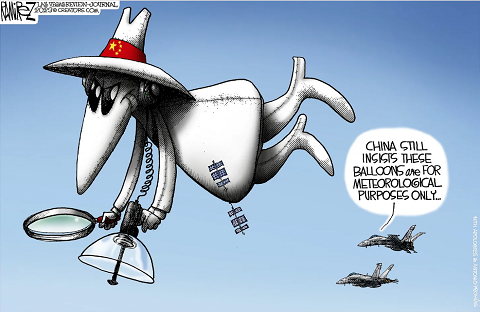
It’s open season for balloons over North America

Filed under: Cancon, Military, USA — Tags: , , , , , , — Nicholas @ 05:00

In The Line, yet another incursion into NORAD air space, and no, this isn’t a re-post from last week:

Holy jumpin’ Jeepers, folks, we’ve got more balloons!

On Friday, the Americans shot down another unidentified flying object — gulp — off the coast of Alaska. By Saturday, NORAD was reporting yet another one, this time over Canadian territory. NORAD jets scrambled, and an American F-22 destroyed the object over Yukon. Canadian military teams are now en route to recover the wreck and find out what the hell we are shooting at.

This was an exciting enough little pick-me-up on Saturday, but it wasn’t done. Later that night, another air defence emergency was declared over Montana, and American F-15 jets were scrambled out of Oregon to intercept an object that had been detected on radar. They were not able to find anything, and as of press time, NORAD has said only that they will continue to monitor the situation.

A few points we’d make about a truly bizarre series of stories.

The first is that there’s nothing wrong or particularly embarrassing about an American plane defending Canadian air space. NORAD is a joint bi-national command. Missions are tasked to the first available aircraft. That might sometimes mean a Canadian jet defending U.S. territory. It’s happened! On Saturday, the object was closer to American bases in Alaska than the nearest CF-18 base in Alberta. There probably is a conversation worth having about whether Canada should maintain a small alert force of jets further north, better able to respond in the future. That’s expensive and logistically complicated, but may still be worth considering. For now, the system functioned as intended. So we say, quite sincerely, thanks, America. We appreciate the help.

That being said, we do think this is a useful reminder that the long and repeated delays by Canada to both replace the aging CF-18 jets and modernize NORAD with new sensors and capabilities were reckless and dumb. It was obvious that the CF-18s needed replacing when Stephen Harper took office, but we only got that underway in recent months. NORAD, for its part, functions well as an institution but needs upgraded technology. That project also should have begun many years ago. In both cases, we delayed because we didn’t want to spend the money and because defence projects in this country are almost always politically fraught. The Russian invasion of Ukraine and now the weird series of aerial intruders is a useful reminder that neglecting your own defences is never a good idea. We are realists about Canada’s ability to field a massive military, but our geography, in so many ways a blessing, does impose a few costs back on us. It’s not easy to patrol and police such massive territories, especially with a relatively small and concentrated population. But we have to do it. It’s what being a country means. Too often, we haven’t. We hope that changes. With the NORAD modernization announced and the F-35s ordered, perhaps we’re finally making right some of these failures. We hope so. But we are jaded, friends. We admit that.

Our final point is an appeal to calm. We don’t really know what the hell is happening with all these aerial intruders either, but there could easily be a pretty mundane explanation. Radar sets have programmable software filters that are intended to avoid cluttering up the scopes with too much information. Without these filters, clouds, snow storms and birds can cause returns that may look like planes and missiles. One way of filtering out such clutter is by establishing a minimum speed for flagging an object. Balloons are likely normally below that minimum. Your Line editors suspect that part of what is happening right now is that we’ve adjusted those filters, and are suddenly seeing things that were already there all along.

Is that better, or worse? We don’t know. We can make that argument either way. In any case, that may be what’s happening.

Or hell, maybe it’s aliens, and Canada and the U.S. just declared war on a more sophisticated race that travelled across the vastness of the stars only to end their journey by being murdered by Justin Trudeau and Joe Biden. We doubt it, to be honest. But it’s been a weird few years already, no?

December 22, 2022

It may have taken most of the year, but Canada finally figured out its Ukraine position

In The Line, Andrew Potter theorizes that the Canadian government finally “got it right” on Ukraine, but only after having exhausted all the other possibilities:

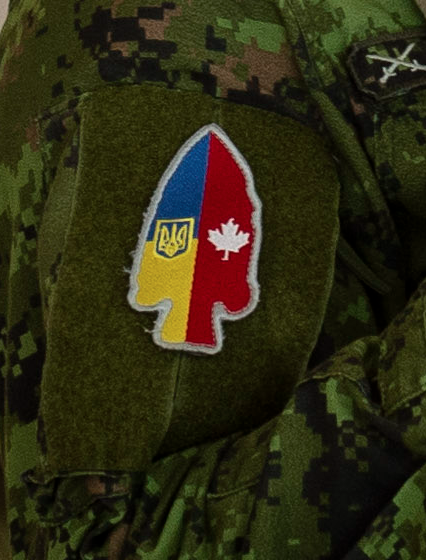
Operation Unifier shoulder patch for Canadian troops in Ukraine.
Detail from a photo in the Operation Unifier image gallery.

When Russia started massing troops on the border in Ukraine this time last year, Canada was one of the first Western countries to close its embassy in Kyiv, moving everyone to Lviv on February 12. Hours after Russia launched its illegal, insane, nihilistic, genocidal full invasion of Ukraine on February 24, all non-Ukrainian employees of our embassy scooted across the border into Poland. 

For months after the invasion, that highly risk-averse attitude infected every aspect of Canada’s approach to helping Ukraine. Whether it was diplomacy (hesitant), military aid (slow and limited), financial support (inadequate) or straight-up moral fortitude (lacking), the Trudeau government made it clear that it would do the least amount necessary, while taking the most credit possible, in supporting Ukraine. 

[…]

The weird thing about Canada’s foot-draggy-as-she-goes approach to helping Ukraine is how little sense it made politically, for both domestic and international audiences. Canada has one of the largest Ukrainian diaspora populations in the world. We were the first Western country to recognize Ukrainian independence in 1991. The deputy prime minister of Canada is half Ukrainian and has been a loud supporter of the country for years. Privately and publicly, our allies were pleading for us to do more. 

Who knows what it was that finally shook some sense into the Trudeau government. Maybe it was Freeland, maybe it was a call from Uncle Joe Biden, maybe it was just a sense in the PMO that, having exhausted all other options, the only thing left to do was the right thing. Whatever it was, over the last three or four months, Canada is finally punching its weight on the global stage on the Ukraine file. In particular, we seem to have finally figured out that the best way to help is to provide the sorts of support that draws on our strengths. 

So for example, while the handful of M777 howitzers we sent were certainly useful (and the ammunition we’re continuing to supply will be well spent) we’re never going to compete with the Americans or Brits when it comes to heavy arms supplies. That’s why, back in October, it was probably more helpful for us to send 400,000 pieces of winter gear and to provide a few million dollars worth of satellite communications to the Ukrainians through Telesat. And it was great to see Canada re-engage with its training commitments to the Ukrainian armed forces through the deployment of 40 combat engineers to train Ukrainian sappers in Poland, to complement our ongoing training of recruits in the U.K. 

December 17, 2022

Canada’s consciously anemic foreign and military policies

In The Line, Matt Gurney explains why Canada consistently fails to “punch above their weight” in foreign and military matters and that it’s not at all accidental:

Canadian politicians have an inputs problem. Maybe that’s actually the wrong way to describe it — the problem is with the outputs. But it’s the inputs they love talking about.

If that all sounds a little vague, maybe this sounds familiar: “Hey there, citizen. Alarmed about Troubling Issue X? Well, don’t worry. We’re pledging $300 million over the next six years to Troubling Issue X. Oh, and Annoying Irritant Y? We’re announcing a task force to report back on that.”

Does Troubling Issue X get solved? Does Annoying Irritant Y get less annoying and irritating? Eh. We probably don’t collect enough stats to even know. The purpose of the announcement isn’t to solve the problem. It’s to announce something and hope people stop paying attention.

Canadian politicians — especially the current federal government — are notorious for announcing the same “new thing” in as many ways and in as many different contexts as they can. They get several hundred dollars of positive press coverage for every actual dollar spent on whatever the announced spending is supposed to be devoted toward. If they can recycle announcements from months past into a new set of announcements, you’re pretty much guaranteed they’ll do it. Announcing spending is, one must assume, what gets people to cast their votes for the party announcing the spending.

A lot of what looks like policy failure in Canadian foreign and military affairs only looks like a failure when you forget that accomplishing something wasn’t the point. Being photographed and videotaped saying you’ll accomplish something was the point. And the announcement itself accomplishes that!

This was true even before the Trudeau government started handing out bushel baskets of money to various Canadian newspapers, TV networks, magazines, and other legacy media entities. What was once merely praise is now bought sychophancy from the (literally) paid media.

On the military side of things, the Canadian Armed Forces are an organization the government grudgingly funds, but only enough to look good for the self-same media:

It’s not that Canada accomplishes nothing on the world stage. We accomplish things. Sometimes we even play an outsized role — Canada did, for instance, perform well and above expectations in Kandahar. The odd exception aside, though, when it comes to foreign policy generally and especially with defence policy, successive Canadian governments have set a very clear target: we will do, technically, more than nothing. We won’t often do much more than that. But we’ll do enough to not get kicked out of the club of allied nations.

Why do we want to be in the club? Not because we feel any sense of duty or obligation to lead and take on any real burden. But because being in the club makes us safer, and it would, after all, be embarrassing to get kicked out.

It’s important to remember that Canada is, by any standard, a rich country. We could be an actual force for good and stability on the world stage if we wanted to. We could build a bigger fleet and patrol more places, more often — we’d be welcome! We could have a bigger army and lead more peacekeeping missions, or contribute more to NATO. A bigger air force, likewise, could contribute more to our allies, especially in Europe in these unsettled times. In a parallel universe where we did these things, we’d then be able to say with a straight face that the purpose of Canada’s navy was contributing to the safety and security of the seas, the purpose of our army was to assist allies and provide peacekeepers to help end international crises, and the purpose of our air force was to project power and bring support to threatened allies.

In the world we actually live in, though, the purpose of the navy is to technically have a navy that technically does things, the purpose of the army is to technically have an army that technically does things, and the purpose of the air force … you see where this is going, right?

Our navy does things! It shows up places, and patrols areas. But only as much as necessary to technically tick that box. The army is in much the same condition; with a growing number of domestic commitments sapping its strength and budget, even its ability to assist with disasters at home is largely maxed out, but we send a few hundred soldiers here and there, thereby allowing ourselves to proclaim that we’ve … sent soldiers somewhere. The air force, as was just reported this week, can’t even really do even that much this year. The exhausted force is skipping the very modest — a half-dozen fighter jets — annual mission to Europe. The air force is just too burnt out to sustain even that tiny mission.

This is a big and growing problem. Canada, again, is rich enough to make a difference in global security affairs, if we chose to make different choices with how we spend our money. We have made the opposite choice. We field just enough of a military to be able to make just enough difference to avoid being accused of being total deadbeats, and no more.

Can it fight? Eh, maybe a bit. Can it make a difference? Depends how you define “difference”, I guess. Does it make the world and our allies safer? In a way? Can it keep Canadians safe at home? Sort of.

This isn’t a failure of our policy. This is our policy. We show up with as little as possible for as brief a time as possible, but gosh, do we ever talk about the showing up. 

December 9, 2022

Canada’s “historic” shift toward the Indo-Pacific is … more marketing than strategy

Filed under: Asia, Cancon, Military, Pacific — Tags: , , , , , — Nicholas @ 05:00

In The Line, retired Canadian Lieutenant General Mike Day distills down all the airy phrases to see just what the Canadian government is actually going to do in the Indo-Pacific as opposed to merely talking about it:

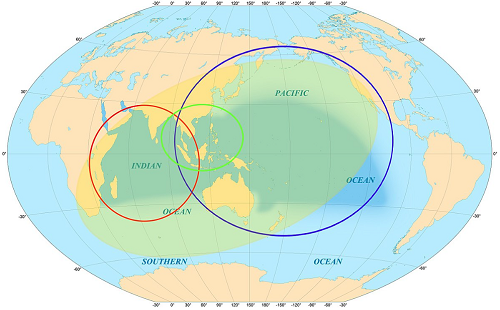
“Red circle/oval roughly depicts the Indian Ocean region. Blue circle/oval covers the Pacific region. Green oval covers ASEAN. Yellow overlay covers the Indo Pacific.”
Map annotation by Eric Gaba via Wikimedia Commons.

A formal public-policy statement from the Government of Canada is a rare thing. It is even rarer when it is not just a speech but a published written document. The rarest of these is undoubtedly when such a document focuses on foreign policy. When Foreign Affairs Minister Mélanie Joly recently pitched her “once-in-a-generation shift” toward the Indo-Pacific, much was made of why Canada was doing it and what it would achieve. No fewer than four cabinet ministers took part in the announcement. Canada will, they announced, step up naval patrols of the region, continue to expand trade with China while also tightening our protections of intellectual property and ownership rules for strategic industries, and use “Team Canada” trade missions to boost commercial links with other growing regional economic powers, including India. We seek also to expand our intelligence and cybersecurity links with allies and partners in the region. 

Now that the dust on the rhetoric has settled, closer examination reveals that this might simply be an exercise of branding separate activities into a marketing-friendly bundle, as opposed to a coherent plan focused on achieving specific outcomes. 

In examining the document two approaches are equally useful in assessing value: whether the content has some substance and whether the policy framework is sufficiently robust to hang various activities and plans on its body.

Three hints are provided as to why the new plan might not be the cornerstone of Canada’s foreign policy that it portends to be. Firstly, operating in the “National Interest”, a phrase used six separate times over the 26 pages, is given neither form nor function and lacks any definition. It is reminiscent of the Cheshire Cat talking to Alice asking her “where do you want to get to”. When Alice replies that “I don’t much care …” the Cheshire Cat wisely suggests that “Then it doesn’t matter which way you go.” With no definition of national interests pretty much anything can be hand waved as to being necessary and required, or not, for its achievement. 

This leads in turn to the second hint that the plan might be more posturing than substance. Lacking the single aimpoint of operating in the national interest, the “objectives” supposedly fill that gap by providing a set of specific achievements which in combination would be a sufficiently clear aimpoint. But normally objectives can, and should, be thought of as something specific and measurable, allowing plans to be developed to achieve them. “Save 100 dollars this month” or perhaps, in more relevant terms, “Increase our trade in the Indo-Pacific region by 100 per cent over the five years of this policy enactment.” Plans can then be developed to achieve those objectives. But reviewing those objectives reveals that they are themselves actions, not end-states. It appears that the policy is based on “doing, not achieving”. I am reminded of my sons many years ago. When asked if their rooms were clean, they would reply, “I’m cleaning it.” The process was enduring but we most certainly disagreed on the value of the activity as opposed to achieving a measurable result. Under this construct the government can claim that as long as Canada is doing stuff the policy should be considered a success. 

October 29, 2022

The Canadian government, despite committing billions to replace old equipment, is still not serious about the Canadian Armed Forces

Filed under: Cancon, Government, Military, Weapons — Tags: , , , , , , — Nicholas @ 03:00

In The Line, Matt Gurney explains why — despite big-ticket items getting a few headlines — the Canadian Armed Forces need far more than what any government has been willing to provide since the start of the Cold War:

Objectively speaking, there has been progress. Canada has committed billions to replacing the CF-18 fighter jets with F-35s — 88 of them. (That’s still way too small an air fleet for a country our literal size — it’s not a lot of planes for such a big place, folks — but it’s something.) Billions more have been committed to modernizing NORAD’s early warning systems. And, miracle of miracles, we finally got around to replacing the goddamned Second World War-era pistols!

These are real, tangible things. These things matter. They will leave the Canadian Armed Forces better off, our soldiers better protected and our continent more secure. This is good news.

It’s also the bare minimum.

Even these big spending announcements, and even the itty bitty pistol one, don’t actually add capabilities to the Canadian military. They replace existing ones. They maintain our capabilities. Sure, we can quibble about “maintain” or “replace” — the F-35 will give Canada a stealth capacity it has never had before, and all that jazz. Fine. Fair. But it isn’t really adding to the overall list of missions we are capable of conducting. It’s fleshing out capabilities that, due to advanced age and wear-and-tear for our critical equipment, were starting to exist only on paper. The government deserves credit for this, but only a really small amount of credit. Getting the urgently necessary basics done, many years after they should have been handled, is good, but it’s not worth a pat on the back. It is the bare minimum the country deserved and that the military needed to function, so that’s how far I’ll go in my praise: congratulations, Liberals, on responding to a massive change in our geopolitical order by accomplishing the bare minimum that was already overdue.

If that sounds scathing, here’s the worst part: that’s me being sincere. Thanks for the bare minimum! I wasn’t sure we’d get even that

So yeah. Good, but … you see the problem here, no? In a new era of global instability and geopolitical turmoil, the Canadian response, thus far, has been to get caught up to where we should have been 10 years ago. At the latest. And it’s far from clear that, if not for Russia kicking off the largest conflict we’ve seen in Europe since 1945, we’d have even bothered to do these necessary, long-overdue things.

And this is all shaping up to be just the latest iteration of a little game both Liberals and Conservatives like to play with the Canadian Armed Forces (and, come to think of it, most policy files). They’ll point to specific investments or particular accomplishments when defending their record. And the investment and accomplishment may well be excellent indeed! But they won’t speak to the full, broader picture. And the full, broader picture of the Canadian Armed Forces is grim, and some new F-35s and 9mm pistols isn’t going to change that.

There was a little story last month you might have seen. After Hurricane Fiona wrecked big parts of several Atlantic provinces, the feds sent in the military. This is right and proper. The troops would have made a welcome sight in those communities, of course. What you might not have noticed, though, was that Nova Scotia had to go public with its desire for more troops. It asked for a thousand. It got 500. It kept asking for more. It got the 500. And most of those 500 were troops already stationed in Nova Scotia; only about 200 were actually sent in from elsewhere. The government never really commented on this, but it’s not hard to suss out the problem: the military couldn’t scrape together any more troops.

October 25, 2022

Canadian Armed Forces recruiting crisis may be “more serious” than we’ve been told so far

Filed under: Cancon, Military — Tags: , — Nicholas @ 03:00

Rachel Gilmore on the state of recruiting for the Canadian Armed Forces:

As the Canadian Armed Forces grapples with how to boost recruitment amid growing global dangers, a former chief of the defence staff is warning that the situation might be even worse than the top brass are letting on.

Current Chief of the Defence Staff Gen. Wayne Eyre has warned in recent weeks that, due to recruitment issues, Canada does not have the military “that we need” to tackle future threats — and that readiness within the CAF is “going down”.

“In reality, I believe the case is much more serious than what Wayne has articulated,” said retired Gen. Rick Hillier, speaking in an interview with The West Block‘s Mercedes Stephenson.

The Canadian Armed Forces is supposed to be adding about 5,000 troops to regular and reserve forces, to meet a growing list of demands, but are instead short more than 10,000 trained members – meaning about one in 10 positions are currently vacant.

However, Hillier says the number that he’s hearing suggest the military is down “far greater than 10 per cent”.

“Instead of being at 70,000 people, the Canadian Forces are operating probably somewhere at about 45,000 people — and out of that, there are a significant percentage of them who are not operationally deployable or capable,” Hillier said.

“So the capability of the Canadian Forces, what we rely upon to look after us in Canada and then to represent us and protect our interests around the world and to take our values with them, that part that can do that is minuscule right now, and we need to change it.”

September 17, 2022

Maple Fury: Canada’s Mechanized Infantry Explained

Filed under: Cancon, Military, Weapons — Tags: , , , — Nicholas @ 02:00

Battle Order
Published 12 Nov 2020
(more…)

August 26, 2022

Bristol/Magellan CRV7 Ground Attack Rockets; Simply The Best

Filed under: Cancon, History, Military, Technology, Weapons — Tags: , , , , , — Nicholas @ 04:00

Polyus
Published 19 Aug 2022

Sometimes a weapon is produced that no one can ignore. Something so much better than anything else on the market that it becomes the de facto standard. Winnipeg, Manitoba’s Bristol Aerospace created such a weapon in the early 1970s. It combined high speed and long range with a powerful knockout punch. It was the CRV7 rocket and it would eventually become ubiquitous among western aligned armed forces.
(more…)

August 16, 2022

Nimble, Sleek, And Almost Useless In A Real Fight; the story of the Canadair CF-5 Freedom Fighter

Filed under: Cancon, History, Military, USA, Weapons — Tags: , , , , — Nicholas @ 02:00

Polyus Studios
Published 8 May 2021

Don’t forget to like the video and subscribe to my channel!
Support me on Patreon – https://www.patreon.com/polyusstudios

The multi-role CF-5 was intended to replace the nuclear-armed CF-104 Starfighter and CF-101 Voodoo squadrons with a conventional warfighter. However, as an air superiority fighter, it was useless against all but the oldest relics in the Warsaw Pact arsenal. It fared little better as a close air support tactical fighter, thanks to its short range, relatively small weapons load, lack of all-weather navigation, and its inability to survive in a sophisticated, integrated air defense environment. Despite this, 240 were built in Canada and served with the Canadian Armed Forces for 27 years, not as a replacement for the existing fleet, but as an addition to them no one in the military seemed to really want. So why did Canada operate the CF-5? As you might well have assumed, the story behind the acquisition and operation of the CF-5 is a complicated one.
(more…)

June 27, 2022

It’s not clear where the money will come from to fund the recently announced NORAD upgrades

Filed under: Cancon, Government, Military — Tags: , , — Nicholas @ 03:00

Aside from sticking knives in the backs of political critics, Justin Trudeau’s government loves announcing new programs and additional spending more than anything else. The boring, workaday details like actually implementing the newly announced programs … well, that sometimes gets forgotten in the rush to make new announcements. In this case, the recent announcement that Canada will be spending Cdn$4.9 billion to upgrade our contribution to NORAD for continental defence — and to no real surprise for anyone who’s been paying attention — it’s not clear even to the head of the Canadian Armed Forces just where that money is actually supposed to come from:

Canada’s defence chief says he doesn’t yet know where the money is coming from for $4.9 billion in promised upgrades to NORAD radar and surveillance systems.

In an interview with The West Block‘s Mercedes Stephenson, Gen. Wayne Eyre was asked about growing questions facing the government to detail their spending plan on NORAD upgrades.

Sources have told Global News the military is uncertain about where the funds are coming from, and that there are meetings happening at the department trying to determine how much of the money is new. Those sources say there are significant concerns that the money may not be new, and may need to be re-capitalized from within the existing defence budget.

“I haven’t completely figured out myself the source of funds for this,” Eyre said.

“So I can’t say definitively where it’s coming from. I will say, though, the announcement was welcome.”

Eyre was also asked whether the military is planning any departmental cuts in order to be able to allocate $4.9 billion to the NORAD upgrades.

“We haven’t looked at cutting. But as always, we have to look at rebalancing,” he said.

“The force that we have today is not the force that we need to support tomorrow. So we need to look at force structure. Do we have it in the right place? Do we need to look at rerolling of units so that they undertake roles that are more relevant for the future security environment? That is all important.”

Global News has asked for clarity on the question to Defence Minister Anita Anand’s office.

No answer has yet been received.

May 10, 2022

Canadian Armed Forces considering banning Islamic, Jewish, and Christian chaplains for their racist, misogynistic, and bigoted beliefs

Filed under: Cancon, Military, Religion — Tags: , , , , — Nicholas @ 05:00

When an organization goes woke, there’s no halfway measures … it’s all-woke, all the time. Recently the Canadian Armed Forces received a report that could result in current chaplains being forced to resign their commissions because their religious beliefs “are not aligned with those of the Defence Team”. One wonders how future recruiting efforts will go with believing members of those faith-based communities who are potentially going to be explicitly described as “racist, misogynistic, and bigoted”:

Calling other parties racist in the House of Commons is bad. Calling whole religions and their adherents racist, misogynist and bigoted is worse

And yet, this government is being called to support one of the most egregious examples of anti-religious sentiment I have ever seen in Canada, and it was published by the Minister of National Defence Advisory Panel on Systemic Racism and Discrimination. This document is supposed to advise the Canadian Armed Forces on racism and discrimination in the military and, if the government were to follow through on its recommendations, it would effectively disqualify chaplains from Canada’s largest faith groups.

In its final report, this panel recommends that the military should “not consider for employment as spiritual guides or multi-faith representatives Chaplaincy applicants affiliated with religious groups whose values are not aligned with those of the Defence Team.”

As you read the document, it quickly becomes clear that their understanding of “values” appear to be completely ignorant of the actual practice of the very religions they defame. Yet the report would disqualify clergy from — at the very least — the three major Abrahamic religions (Judaism, Islam, and Christianity) under the grounds that these faiths are inherently discriminatory.

Not content to deal with actual cases of misogyny, sexism and discrimination, the government’s panelists have taken a go at determining which beliefs and philosophies are acceptable in Canada’s new modern military.

“The Advisory Panel has observed that there are varying degrees of misogyny, sexism, and discrimination woven into the philosophies and beliefs of some mainstream religions currently represented in the cadre of chaplains in the CAF,” the report says.

Then it gets worse.

April 2, 2022

Lessons from Operation Unifier — Canada’s military training mission in Ukraine (2015-present)

Filed under: Cancon, Europe, Military — Tags: , , , — Nicholas @ 03:00

In The Line, Paul Wells talks to Lieutenant Colonel Melanie Lake, Royal Canadian Engineers, who commanded Operation Unifier from March to September, 2021:

Operation Unifier shoulder patch for Canadian troops in Ukraine.
Detail from a photo in the Operation Unifier image gallery – https://www.canada.ca/en/department-national-defence/services/operations/military-operations/current-operations/operation-unifier.html

Lake has had a hell of a career, as high-ranking soldiers usually have, though I cover soldiers rarely enough that I always manage to be surprised. She’s from Churchill Falls, Labrador and has a degree in chemical engineering from the Royal Military College. She served three tours in Afghanistan, including one collecting HUMINT, or human intelligence — interviewing Afghans in Kandahar for information on the insurgency. Later she led an explosives-clearance operation at Winisk, ON, way up north on Hudson Bay, where a DEW Line outpost had been shut down so quickly in the 1960s that large quantities of TNT had been left buried too close to the ground for comfort. This involved a lot of camping and trying to figure out how to explode only those parts of the landscape they wanted to explode, while trying not to explode one another. Canadian Forces Rangers worked with Lake’s team, keeping polar bears away. She really is a problem solver.

Lake confirmed both of my hunches about Op Unifier, at least in part. She sees a Ukrainian army that is performing well for specific important reasons, and a Russian army that is having serious trouble its commanders should have expected. She does think she and her colleagues in Op Unifier and other Western training missions — the United States, United Kingdom and Lithuania — can take some satisfaction in contributing to the substantial improvement of the Ukrainian defence effort since 2014. But she was careful to put a low ceiling over that effect.

“Certainly what the training missions provided have helped,” she said. “But I want to be really careful about taking credit for the performance that we’re seeing right now. We can’t teach courage. And [the Ukrainians] are showing that in spades.”

Where did training help? “The area where I think we had a really big influence is in helping them understand or institutionalize the idea of mission command. And decentralized decision-making — pushing authority and decision-making power down to lower levels. And helping them build a professional senior NCO corps. Those are things that, you know, when you look at the old Soviet system were certainly non-existent.”

Let’s unpack this. “Mission command” is a term of art in Western militaries. It holds commanders, down to quite junior levels, accountable for results while leaving them wide latitude to decide methods. How junior? “Senior NCO” refers to sergeants — career soldiers who’ve risen from the enlisted ranks and who are responsible for a section, which is between 6 and 20 soldiers. Canadian doctrine, American doctrine, NATO standards dictate that it should be routine for higher echelons to trust a section sergeant to figure out how to accomplish a task, and that’s something the Canadians have passed on to their Ukrainian colleagues.

The Russians haven’t built that trust into their system. This is an understatement. “A lot of what you’re seeing on the Russian side — you know, we keep talking about these general officers who are getting picked off, because they’re so far forward. They have no decentralized decision-making and their communication chain is breaking down. So you’ve got these generals going forward, way too far forward, trying to sort things out. And they’re just getting picked off left, right and centre. So training matters. Training matters an awful lot.”

To an Ottawa political reporter in the Trudeau era, there is a metaphor here as big as a billboard about what happens when too much decision-making is too centralized. But maybe just this once, I’ll resist the urge to jump in, more than I just did, and I’ll let Lake keep telling her story.

March 18, 2022

Jean Charest tries to position himself as the pro-military Conservative leadership candidate

Filed under: Cancon, Government, Military, Politics — Tags: , , , — Nicholas @ 03:00

Canadian politicians — generally speaking — are unwilling to tread too far into discussions of the Canadian Armed Forces and the utter disaster that is our federal government’s procurement “process”. There are lots of good, electoral reasons for this: Canadians have been propagandized over the last two generations to see Canada as a country with no real enemies and having no need of military force except for overseas peacekeeping and disaster relief. Any identified need for new equipment or even just updated replacements for existing capabilities is always a politically dangerous discussion, as it’s remarkably easy to get public support for almost any non-military spending instead of anything even vaguely warlike. Worse, on those few occasions when the government of the day bites the bullet to buy new ships/tanks/planes/helicopters/etc., the top priority isn’t military effectiveness or even lowest-price but where the money will be spent. Bidders for Canadian military contracts can’t just crank off a few extra units of the weapon or vehicle on existing production lines (which in almost every case would be both militarily better and economically cheaper): the government almost always demands new, expensive production facilities be constructed in Canada or for the foreign supplier to “partner” with an existing Canadian company to produce as much in Canada as possible.

This procurement charade usually means the Canadian Forces end up with far fewer weapons or vehicles because the increased costs of partial or complete production in Canada gobble up far more of the allocated budget. For example, back in 2017, we purchased a batch of new machineguns. It was the same model already in use with the Canadian army and with many of our NATO allies. If we’d just bought from one of the foreign manufacturers who already had production lines and tooling set up, each gun would have cost between US$6,000 and US$9,000 depending on configuration. But because we insisted on having Colt Canada set up a new production line, each weapon ended up costing C$28,000!

Multiply this across the entire range of equipment needed by the Canadian Army, the Royal Canadian Navy, and the Royal Canadian Air Force, and it’s quickly obvious that we’re running one of the least efficient military procurement systems in human history. And even on a domestic spin-off/job creation/vote buying spectrum, it’s insanely expensive and wasteful.

All of that out of the way, here’s Conservative leadership hopeful Jean Charest deliberately touching one of the “third rails” of Canadian politics by proposing an increase in funding for the military:

Our military procurement system is broken. For years experts have been warning about our incompetence at making major defence purchases. The past few weeks have shown us the price of our inaction.

While our allies, the United States, the United Kingdom and Australia, have entered into a new security pact to counter China in the Pacific, Canada wasn’t even invited to the table.

Germany, Sweden, and other NATO allies promise to increase their military spending to prepare for the uncertain times ahead. Canada has a moral responsibility to act. Now is the time.

If elected as the leader, my Conservative government will make significant changes and upgrades to our nation’s military capabilities. I will move quickly to ramp up Canadian defence spending to two percent of GDP, increase personnel to 100,000 and equip our forces for the challenging times ahead. I will modernize our cyber security infrastructure to prepare for future risks. And I will fix our embarrassing procurement system to ensure we get the equipment we desperately need.

The current conflict has also driven home the need to assert our sovereignty, especially in our North. As major sea lanes, essential to global trade and export of our natural resources, open within our arctic territory, we must be on high alert to Russian and Chinese encroachment. Neither recognizes our sovereignty there. In fact, no one really recognizes our sovereignty there and the imbalance in our military investments compared to our allies explains why that’s the case.

The war in Ukraine is a cruel reminder of why we cannot ignore these threats. Russia has a modern military base in the arctic — another area where indecision and delay could be extremely costly unless addressed.

A proud Canada must assert its sovereignty in the North and generate military support through major investments in equipment and coordination with our NATO allies. We need to get our act together.

The threats remain real and demand immediate attention from leaders willing to act in the best interests of their respective nations.

Canadians need experience and expertise overseeing our military. We need a government that supports our military.

March 17, 2022

The “Three-Block”, “Four-Block”, or “n-Block” war

Filed under: Cancon, History, Military, USA — Tags: , , , , — Nicholas @ 05:00

In The Line, Andrew Potter explains the genesis of the original “Three-Block War” idea and how a Canadian general tried to put theory into practice:

During General Rick Hillier’s first visit to Colorado Springs as Chief of Defence Staff, he takes a few minutes to talk with Tech. Sgt. Devin Fisher of NORAD and USNORTHCOM Public Affairs about Canada-U.S. Relations
Public domain image via Wikimedia Commons.

In 1999, a US Marine general named Charles Krulak wrote a piece in which he claimed that the future of combat for the Marines would be in urban environments in failed or failing states. In these situations, front line infantry might be doing humanitarian relief in one part of the city, performing peacekeeping duties in another, while doing intense urban combat in a third. He called this the “Three Block War“. Figuring out how to prepare and train for this scenario would be the central military challenge of the 21st century.

While the Three Block War was picked up and booted around as an interesting idea, it was never formalized into Marine doctrine. But one person who did take it seriously was Rick Hillier, the former head of the Canadian military who brought it into the Canadian forces when he took over as chief of the land staff in 2003, arguing that the Three Block War in failed and failing states was the future of warfare. He wanted a CAF that was trained and kitted out for this reality. When he became Chief of the Defence Staff in 2005, Hillier kept pushing this idea on Paul Martin and the Liberals, who loved his “vision” and firm sense of priority-setting.

In Hillier’s hands, the Three Block War concept was a disaster. Some American analysts blamed the strategy for Canada’s elevated casualty rates in Kandahar. The concept also came under considerable scrutiny from Canadian military analysts. In a highly critical paper, Walter Dorn and Michael Varey described the three block war idea as “fatally flawed“. While the Three Block War concept might have served as a useful description of a certain type of tactical reality (amplified maybe by a few too many viewings of Black Hawk Down), as a strategic concept it had a number of problems. For example, it wasn’t clear how it would apply to other armed services, or to theatres other than urban centres. It seemed to threaten the specificity of mandate and mission that is crucial to military operations. It clearly ran the risk of “block inflation” — why not throw governance, economic development, general nation building, and anything else you think you can get the military to do into the hopper? Indeed, in 2005 General James Mathis co-authored a piece proposing the concept of the four block war, which added psychological and information operations to the mix.

Ultimately, Dorn and Varey were concerned that crucial distinctions central to warfare were being elided. As they put it, the whole point of doctrine is to make a clear delineation between things that are “war” and things that are “not war”, and the Three Block War threatens to make everything into a type of war.

Two decades later the verdict is in, and it looks like everyone was right. When it comes to the tactical environment, people like Krulak, Hillier, and Mathis were more prescient than they might ever have imagined, at least if Ukraine is any template for how modern warfare is evolving. Yet at the same time, everything the critics of the Three Block War concept worried about has also come to pass: the confusion of mission and mandates, the endless proliferation of “blocks”, and most seriously, the assimilation of everything, and everyone, into “war”.

In his original article, Krulak argued that the reality of the Three Block War meant that any local engagement or interaction could have repercussions on the mission as a whole. For example, if a squad of Marines based in a “peacekeeping” block of the city gets jumpy and opens fire on a civilian truck carrying humanitarian aid (and not a truck bomb), that could have serious impacts for the entire strategic effort. And so he coined the notion of the “strategic corporal”, a front line soldier who would have the training, judgement, and moral fibre to do his or her job in a way that would always support strategic objectives.

March 15, 2022

For military procurement blunders, “no nation has mastered the ability to step on every bloody rake quite as well as Canada”

Germany has announced that they will be purchasing US F-35 stealth fighters as part of their re-armament program. My favourite headline on this was over at Blazing Cat Fur: “Germany To Buy 35 Lockheed F-35 Fighter Jets From U.S. Amid Ukraine Crisis … Canada Will Buy Cool ‘Fighter Jet Stickers’ With Eco-Friendly Adhesive”

On a more serious tone — but with sadly the same basic message — Mitch Heimpel looks at the multi-generational rolling catastrophe that is Canadian military procurement since the unification of the forces in 1968:

Browning High Power 9mm, the standard side-arm of the Canadian army since WW2. When I was in the reserves, we were told this was due for replacement in a few years. I was in the reserves from 1976-1980. It still hasn’t been replaced.

To say we have a checkered history with military procurement, fails to capture exactly how bad it is. Our political leadership has failed us continually over the course of half a century. No party has done it well. Some have done it better than others. But no one can claim any kind of bragging rights.

Fighter jet procurement in this country is so fraught it once caused the birth of a new political party. Trying to buy helicopters helped bring down a government. We only successfully bought those helicopters after they [the old helicopters] became a greater danger to the personnel manning them than they were to any potential adversary. We have been running a procurement for the next generation of fighter jets for an entire generation. Even Yes, Minister writers would have given up on something that absurd.

Our submarine fleet seems to be almost permanently in dry dock. Our most recent ship procurement resulted in the absolutely monstrous prosecution of one of the country’s most accomplished military leaders.

And we just issued a revised bid to finally replace our Second World War-era pistols … last week.

Just cataloguing that level of incompetence is exhausting. No leader or party looks good. The civil service, as the one constant through all these cartoonish blunders, surely has to wear some of this, too. The fact that we seem to repeat the same mistakes can, at least in part, be attributed to a significant institutional memory failure on the part of the people trusted with having the institutional memory.

Now, it is worth noting in fairness that no nation has an easy time with large scale military procurement. Ask the Americans about the development of the V-22 sometime. But, still, no nation has mastered the ability to step on every bloody rake quite as well as Canada.

I’m not a hardware expert. I can’t tell you which pistol we should buy. There’s also genuine policy questions here that need to be settled — I don’t know whether we should focus on the navy because we’re an Arctic nation, or the air force because it allows us to participate more readily in allied force projection exercises — like, say, no-fly zones? The necessary mix for Canada is no doubt some of both, and it’s fine to have disagreements between parties on what the right mix is.

But setting that aside, I want to talk about what it would take politically, to get us to start taking procurement seriously — just a few basic rules that any government would need to follow to procure anything that they chose was important for Canada to have.

« Newer PostsOlder Posts »

Powered by WordPress