
Years ago, when I was at university, I asked one of the older professors of history what he thought about the changes in the student body over his career. This gentleman, a word entirely applicable to him, said that when he started teaching in the early 1960s he would flunk between a quarter and a third of his first year classes. Faster forward to the early 2000s and he rarely flunked a student. I jokingly asked him if that was because young people are smarter now than they were forty years earlier. He found my little joke rather too funny.
He confided in me that in the late 1960s the president of the university did the rounds. He explained that he was receiving pressure from the provincial government. Too many students were going off to university and then failing to graduate. The logical inference would have been that the high schools had either failed to prepare these students, or that the students were not academically capable or inclined. Political logic, however, is not like ordinary logic. It works by different rules. A government minister couldn’t admit that many public high schools just weren’t good enough, or that little Johnny was a bit daft. That would have contravened the egalitarian ethos of the age. So if the high schools couldn’t be fixed, they’d fix the universities instead.
Now by fix they didn’t mean improve. Nope. They meant dumb down. Now this was at one of the most prestigious universities in the land. You can well imagine that dumbing down at such a place was bad enough, dumbing down at less academically selective schools would be the equivalent of destroying virtually all academic rigour. This dumbing down also had the added advantage of filling in all those empty spaces left when the Baby Boomers graduated.
Richard Anderson, “The Shadow of Truth”, The Gods of the Copybook Headings, 2014-03-28
September 22, 2014
QotD: Dumbing down the universities
August 27, 2014
Reason.tv – P.J. O’Rourke on Millennials and Baby Boomers
Published on 26 Aug 2014
“Just this whole process of going through the baby boom’s history, I began to realize what a nicer society — kinder, more decent society — that we live in today than the society when I was a kid,” says P.J. O’Rourke, best-selling author of Holidays in Hell, Parliament of Whores, and many other titles.
O’Rourke sat down with Reason‘s Nick Gillespie at Freedom Fest 2014 in Las Vegas to discuss his new book, The Baby Boom: How it Got That Way and It Wasn’t My Fault and I’ll Never Do it Again. As the father of three kids born between 1997 and 2004, he also lays down some thoughts about millennials, noting that they live in a much nicer, more tolerant world than the one in which he grew up. “I don’t think my 10-year old boy has ever been in a fist fight,” says O’Rourke, who was born in 1947. “I mean there might be a little scuffling but I don’t think he’s has ever had that kind of violent confrontation that was simply part of the package when I was a kid.”
He also feels that the internet “fragments information” in a way that destroys the sweep of history, at least at first. “You end up with mosaic information,” he says. “Now, I think over time the kids put these mosaics together but I don’t think the internet itself lends itself to the sweep of history.”
The interview also includes a tour of O’Rourke’s long and varied career in journalism, from his humble beginnings writing for an underground alt-weekly to his time as editor of National Lampoon and his incredible work as a foreign correspondent for Rolling Stone to his current position as columnist at the Daily Beast.
A prominent libertarian, O’Rourke also discusses the difficulties in selling a political philosophy devoted to taking power away from politicians.
“If libertarianism were easy to explain and if it weren’t so easy to exaggerate the effects of libertarianism — people walking around with ‘Legalize Heroin!’ buttons and so on — I think it would’ve been done already,” says O’Rourke. “But the problem is, of course, is that libertarianism isn’t political. It’s anti-political, really. It wants to take things out of the political arena.”
August 12, 2014
The very different American and British baby booms
In sp!ked, Jennie Bristow reviews P.J. O’Rourke’s latest book, The Baby Boom: How It Got That Way (And It Wasn’t My Fault) (And I’ll Never Do It Again).
For the British ‘Baby Boom’ was very different to its American sibling, in both respects of the word. Demographically, Britain – like many other Western countries immediately after the Second World War – experienced a spike in the birthrate, but this dropped back quickly until the mid-1950s, when there was a less dramatic, but more sustained, bulge over the next 10 years.
[…]
Size isn’t everything, however, and the other aspect of the Baby Boom label is the period of prosperity and growth that followed the war in the US. O’Rourke’s introduction to the UK edition of The Baby Boom points out another fact that tends to be ignored in the slating of the British Baby Boomers – that ‘postwar experience in America was very different from postwar experience in a place where war, in fact, occurred. That is, we had the “post-” and you had the war.’
[…]
Throughout the book, O’Rourke’s fond accounts of growing up during the Fifties, which are generally amusing and often stylistically annoying, hammer home the space, freedom, affluence and indulgence enjoyed by the American Baby Boomers as children. In Britain, accounts of the so-called ‘Golden Age’ of the Fifties tend to extend to children playing by the river and neighbours leaving their front doors unlocked, glossing over the more drab reality that kids did not have anything to play with inside, and that most homes were not worth burgling.
Given the divergence in experience between the British and American Baby Boomers, one might wonder how the American debate, about the problems of the Boomers’ size, wealth and health (which, many grumble, means they will live ‘too long’, robbing younger generations of their fair share of pensions and healthcare resources), became plonked on to Little Britain with scant regard for the differences.
The answer lies partly in what the US Boomers did share with their counterparts in the UK, and in parts of Europe, too. This was the experience of growing up in the tumultuous Sixties, when youth appeared to be in the vanguard of a cultural revolution that swept aside established norms and values, rejecting the authority of tradition and, above all, of adults.
Swiftly demolishing another great myth about the Sixties, O’Rourke points out that, in reality, ‘the Baby Boom was the tailgate party, not the team on the field’: ‘There was a lot of “talkin’ ‘bout my generation” (Pete Townshend, born 1945), but it wasn’t my generation that was causing “What’s Going On” (Marvin Gaye, born 1939) during the “Youthquake” (a coinage from Punch, edited by people born when mastodons roamed the earth).’
February 3, 2014
January 7, 2014
“Boomer Classic” and “Boomer Reboot”
Chronologically speaking, I’m a late Baby Boomer, but I’ve never felt I was a Boomer culturally. In the New York Times, Richard Pérez-Peña helps to explain why this is:
This year the youngest of the baby boomers — the youngest, mind you — turn 50. I hit that milestone a few months back. But we aren’t what people usually have in mind when they talk about boomers. They mean the early boomers, the postwar cohort, most of them now in their 60s — not us later boomers, labeled “Generation Jones” by the writer Jonathan Pontell.
The boom generation really has two distinct halves, which in my mind I call Boomer Classic and Boomer Reboot. (Take this quiz to see where you stand.) The differences between them have to do, not surprisingly, with sex, drugs and rock ‘n’ roll — and economics and war. For a wide-ranging set of attitudes and cultural references, it matters whether you were a child in the 1940s and ‘50s, or in the 1960s and ‘70s. And it probably matters even more whether you reached adulthood before or after the early ‘70s, a time of head-spinning changes with long-term consequences for families, careers and even survival.
[…]
Late boomers like me had none of that — no war, no draft, no defining political cause, and most of our fathers were too young for World War II. I remember, as a teenager, seeing old footage of the riots outside the 1968 Democratic convention in Chicago, and thinking, “People my age don’t feel that strongly about anything.”
People raised in the immediate postwar years had more faith in their government, and an idealistic view of America that curdled in the ‘60s and ‘70s. My childhood memories of the evening news, on the other hand, include the war, protests, Watergate and the dour faces of Johnson and Nixon, not the grins of Truman, Eisenhower and Kennedy.
In this way, I think we late boomers have more in common with the jaded Generation X that followed: we had less idealism to spoil. No, I don’t remember where I was when Kennedy was killed and innocence died (I was an infant), but I sure remember where I was when Nixon resigned and cynicism reigned. Older boomers may have wanted to change the world; most of my peers just wanted to change the channel.
H/T to Kathy Shaidle for the link.
January 5, 2014
In the dictionary, the word “narcissism” is defined as “baby boomer default mental state”
Okay, it isn’t really (but if you think it is, you’ve probably fallen for the “gullible isn’t in the dictionary” prank as well). In the Wall Street Journal, Terry Teachout discovers that every defining event of the Baby Boom era always comes back to being about the Baby Boomers themselves:
Most “Monty Python” fans are, of course, baby boomers, who have long been a nostalgic lot and are growing more so as they totter toward old age. Witness their tiresomely obsessive fascination with the popular television series of their youth. Likewise their undimmed passion for the rock music of the 1960s and ’70s, which they still love so much that they’ll buy expensive tickets to see wrinkled old codgers play it onstage.
As always with the boomers, this nostalgia contains more than a touch of narcissism. The same narcissism was on display in many of the countless gushy boomer-penned reminiscences occasioned by the 50th anniversary of the Kennedy assassination. An indisputably major historical event, to be sure, but there was also something decidedly creepy about the self-centered tone of those suddenly-my-world-changed pieces, which was deftly skewered by this Onion headline: “Area Man Can Remember Exactly Where He Was, What He Was Doing When He Assassinated John F. Kennedy.” Like everything else in the boomers’ world, Kennedy’s death turned out in the end to have been all about them.
[…]
Not surprisingly, my parents’ generation did everything they could to make life easier for their own children. Was that good for us? I wonder. It certainly didn’t do us any good from a cultural point of view. I’m struck by how few boomers have embraced adult culture in middle age. My impression is that they’d much rather watch sitcoms than read novels, go to the opera or listen to jazz. In large part they’re a cohort of Peter Pans, determined not to grow up any more than they can help. Indeed, not a few of them seem to take a perverse kind of pride in their adolescent enthusiasms. I read the other day that a “Fat Albert and the Cosby Kids” lunch box from 1973 now sells for $1,200 — and that the Smithsonian Institution’s National Museum of American History owns one. I’m not quite sure which of those facts makes me sadder.
If I live long enough, I’ll enjoy finding out how the millennials remember the world of their youth a quarter-century from now. Since they’re having a much harder time earning a living than did their baby-boom parents, I wouldn’t be at all surprised if their attitude ends up being much more like that of the wised-up kids of the Great Depression, especially as regards cultural matters. While I don’t know whether they’ll go in for late Beethoven by the time they reach their 50s, somehow I doubt that watching an ancient episode of “30 Rock” will cause them to recall with fondness the good old bad old days when they were living in crummy studio apartments — or their parents’ basements.
January 1, 2014
Newest apologist for the Baby Boomers – P.J. O’Rourke
Kathy Shaidle posted a Twitter update that should cause a few shudders:
PJ ORourke goes from writing for National Lampoon to pro-boomer dreck for AARP mag. Sigh. http://t.co/fJpAxAX5ox #DieFaster
— Kathy Shaidle (@kshaidle) January 1, 2014
The article at the AARP website is clearly written to buff up the self-esteem of Baby Boomers everywhere:
We’re the largest, richest, best-educated generation of Americans, the favored children of a strong, confident and prosperous country. Or, as other generations call us, spoiled brats. Born between 1946 and 1964, the 76 million boomers reaped all the benefits of the postwar period’s extraordinary economic growth.
We were dizzy with our aspirations. We’d be rock stars. We’d be spiritual avatars. We’d be social activists. We’d be billionaires. No, better yet, we’d be all those things at the same time. (Steve Jobs came close.)
Every time opportunity knocked, we let it in, even when it should have been locked out for decency’s sake. And behold the boomers’ remarkable experiments with prosperity — the dot-com bubble, the housing bubble, the enormous financial bubble that’s still got the nation trying to get fiduciary gum out of its hair.
And now the boomers run the world. The youngest members of the generation that decided to be young forever are turning 50. That’s the age of maximum privilege and power. We’re giving everybody orders. The oldest boomers are enrolled in Medicare, collecting Social Security and receiving tax-free Roth IRA disbursements. Plus, American life expectancy has increased by almost 12 years since the baby boom was born, so it doesn’t just seem like we’ll never go away. From President Obama, Rand Paul and Jeff Bezos at one end of our age cohort to Hillary Clinton, Rush Limbaugh and Cher at the other, we cannot be escaped or avoided (or shushed).
But running the world means taking responsibility for it. The boomers have been good at taking things: Mom’s car without permission, drugs, umbrage at the establishment, draft deferments, advantage of the sexual revolution, and credit for the civil rights and women’s liberation movements that rightly belongs to prior generations. The one thing that can be left in plain sight without us putting our sticky mitts on it is responsibility. Ask our therapists. Or the parents we haven’t visited at the extended-care facility.
November 19, 2013
Making Granny pay … full fare
In Maclean’s, a look at the feel-good but economically silly reasons for senior discounts:
The seniors discount has long been justified as a way to recognize the constraints faced by pensioners stuck on fixed incomes, and as a modest token of appreciation for a lifetime spent paying taxes and contributing to society. And for those truly in need, who would quibble? But with half a million Baby Boomers — a group not known for frugality or lack of financial resources — turning 65 every year for the next few decades, the seniors discount is in for much greater scrutiny.
[…]
There was a time when the seniors discount made a lot more sense. In the mid-1970s, nearly 30 per cent of all seniors were considered poor, as defined by Statistics Canada’s low-income cut-off. But today, this has fallen to a mere 5.2 per cent. The impact of this turnaround is hard to overstate. Seniors once faced the highest rates of poverty in Canada; now they enjoy the lowest level of any age group: The poverty rate among seniors is almost half that of working-age Canadians.
Thanks to a solid system of government support programs, the very poorest seniors receive more income in retirement than they did when they were of working age. The near-elimination of seniors’ poverty is widely considered to be Canada’s greatest social policy triumph of the past half-century.
This tremendous improvement in seniors’ financial security has dramatically changed the distribution of income across age categories, as well. In 1976, median income for senior households was 41 per cent of the national average. Today, it’s 67 per cent. Over the same period, median income for families where the oldest member is aged 25-34 has fallen in both absolute and relative terms.
Then there’s the vast wealth generated for the Boomer generation by the housing and stock markets (only some of which was lost during the great recession). The stock of wealth in housing, pensions and financial assets held by the average senior family is nearly double that of working-age households. Accounting for the financial benefits of home ownership and rising house values, Statistics Canada calculates the true net annual income of retired households rises to 87 per cent of a working-age household’s income. In other words, non-working seniors are making almost as much as folks in their prime earning years, but without all the expenses and stressors that go with a job, children at home, or middle age. Not only that, the current crop of seniors enjoys historically high rates of pension coverage. The much-publicized erosion of private-sector pensions will hit younger generations who are currently far from retirement.
February 18, 2013
November 27, 2012
The missing generation
Chris Myrick posted a link to a Wall Street Journal article on differences among the age cohorts regarding shopping habits, pointing out that his (and my) generation didn’t even show up in the graphic:
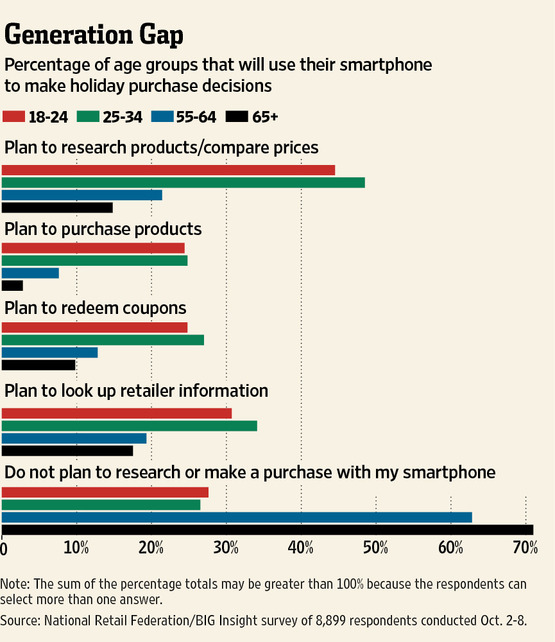
Hmmm. We can tell the shopping habits of folks from age 18 up to 34, then from 55 upwards. I wonder why the invisible folks aged 35-54 didn’t qualify? Perhaps because their behaviour would ruin the message the article is trying to push?
October 16, 2012
Early Baby Boomers had it much easier than those who followed
Depending on where you draw the demographic line, I’m either a (very) late Baby Boomer or an early arrival from the next generation. I “get” the anger that some younger folks feel about the BB’s, because I came along too late to benefit in the same way that the early boomers did:
But, have baby-boomers really enjoyed a cozy ride through life? The truly lucky were their parents, who worked in the post-Second World War “Golden Age” of low unemployment, rapidly rising real wages, rising house prices, and expanding public and private pension plans.
The postwar boom was petering out by the late 1970s and early 1980s, just as many baby boomers were entering the job market. The 1980s and 1990s were marked by two severe recessions, and by an increase in jobs which often did not provide steady wages or a decent pension.
The unemployment rate for the baby-boomers, then mainly in their early thirties (age 30-34), was more than 10 per cent from 1983 to 1985, and over 8 per cent for the boomers in their late thirties during the recession years of 1992 to 1994.
Many baby-boomers never managed to find the secure and well-paid jobs characteristic of the 1960s and 1970s that lay the basis for a decent retirement. A recent study by former Statscan assistant chief statistician Michael Wolfson found that one-in-four middle-income baby boomers face at least a 25 per cent fall in their standard of living in retirement. (He looked at persons born between 1945 and 1970, and earning between $35,000 and $80,000 per year.)
The proportion of all persons age 65 to 70 who are still working bottomed out at 11 per cent in 2000 and is now 24 per cent, and about one half of persons aged 60 to 65 are still working today.
In my entire career, I’ve worked for only one company that provided a pension plan — and I was laid off before my contributions vested anyway. I don’t expect to ever voluntarily retire: I won’t be able to afford it. And I’m far from alone in that.
October 2, 2012
The Baby Boomers are turning into the New Victorians
As usual, Gregg Easterbrook manages to squeeze in lots of non-football items into his weekly NFL column:
The entertaining aspect of the fizzled Newt Gingrich presidential campaign was that Gingrich still blames the 1960s for everything. The 1960s were half a century ago. In the year 2012, blaming the 1960s makes about as much sense as someone during the 1960s blaming events on the 1910 appearance of Halley’s Comet.
Since Gingrich put the 1960s into play, note that during that decade the mainstream media advocated what was then called “free love,” and looked down with scorn upon those who backed traditional views of marriage and lovemaking. Yet today when people engage in free love, graying Boomers who run the MSM get all squeamish.
Here, The New York Times treats as shocking that an unmarried yoga instructor had “a penchant for women” and liked “partying and fun.” Man likes women — arrest him! The unmarried instructor faces “accusations of sexual impropriety,” which means “yoga’s enlightened façade” is tainted by “scandal.” And the scandal is what? That unmarried adults are having consensual sex. This “penchant” must be stopped — it can lead to fun.
Worse, yoga can “promote sexual arousal” by causing “emotional closeness” that leads to “increased blood flow” which makes “pelvic regions more sensitive,” resulting in “debauchery.” Who wrote this, Queen Victoria?
All news organizations, including ESPN, sometimes publish ill-thought-through articles. What’s compelling about this one is the sociological change reflected. When they were young, the Baby Boomers who now run big news organizations extolled free love and mocked the older generation’s conventional expectations about sexuality. Now that the Boomers have aged and are not getting any themselves, they evince shock that younger people are fooling around.
August 22, 2012
Kicking the Baby Boomers while they’re down
P.J. O’Rourke laments the America that was, before the Baby Boomers came along and ruined everything:
The United States has set itself on a course of willful self-diminishment. Seventy-four years ago the perfect American was Superman, who happened to have been, like many of our forefathers, an undocumented alien. If Superman arrived today — assuming he could get past the INS and Homeland Security — he would be faster than the postal service, more powerful than a New York Times blogger, and able to ascend tall buildings in a single elevator.
[. . .]
America has had plenty of reasons to abdicate the crown of accomplishment and marry the Wallis Simpson of homely domestic concerns. Received wisdom tells us that, in the matter of great works and vast mechanisms, all is vanity. The Nurek Dam probably endangers some species of Nurek newt and will one day come crashing down in a manner that will make the aftermath of Japan’s Fukushima tsunami look like an overwatered lawn. And we have better things to spend our country’s money on, like putting a Starbucks on every city block. But I suspect there’s a sadder reason for America’s post-eminence in things tremendous, overwhelming, and awesome.
My sad generation of baby boomers can be blamed. We were born into an America where material needs were fulfilled to a degree unprecedented in history. We were a demographic benison, cherished and taught to be self-cherishing. We were cosseted by a lush economy and spoiled by a society grown permissive in its fatigue with the strictures of depression and war. The child being father to the man, and necessity being the mother of invention, we wound up as the orphans of effort and ingenuity. And pleased to be so. Sixty-six years of us would be enough to take the starch out of any nation.
The baby boom was skeptical about America’s inventive triumphalism. We took a lot of it for granted: light bulb, telephone, television, telegraph, phonograph, photographic film, skyscraper, airplane, air conditioning, movies. Many of our country’s creations seemed boring and square: cotton gin, combine harvester, cash register, electric stove, dishwasher, can opener, clothes hanger, paper bag, toilet paper roll, ear muffs, mass-produced automobiles. Some we regarded as sinister: revolver, repeating rifle, machine gun, atomic bomb, electric chair, assembly line. And, ouch, those Salk vaccine polio shots hurt.
The Soviet Union’s 1957 launch of Sputnik caused a blip in chauvinistic tech enthusiasm among those of us who were in grade school at the time. But then we learned that the math and science excellence being urged upon us meant more long division and multiplying fractions.
H/T to Jon, my former virtual landlord, for the link.
July 13, 2012
June 8, 2012
A Gen-X lament: “none of these “experts” … even agree on when we were born”
By any reckoning, I just missed being in Gen-X, as the earliest date anyone seems to use is 1961 (so my sister is a Gen X’er, but I’m a very-very-very-late boomer, apparently). In spite of that, most of my friends seem to identify much more with Gen X than the plutocratic fat cats of the early Baby Boom generation. Kathy Shaidle explains the three biggest myths about Generation X:
… the term “Generation X” was popularized by our contemporary Douglas Coupland’s titular 1991 novel. (And Coupland swiped his title from the name of Billy Idol’s old pop-punk band; my fellow ex-punk Kinsella should know that, too.)
There are lots of things “great minds” got wrong about Generation X since they started writing and worrying about them. (I mean, us.)
After Coupland’s novel — about over-educated, underemployed pop culture addicts who’ve formed an ad hoc “family” of friends – swept the planet, countless “consultants” (including, briefly, Coupland himself) started marketing themselves as experts on my demographic.
These consultants made a whole lot of money, keynote-speaking to job-for-life CEOs about why we Gen-Xer’s were all so broke and unemployed.
And the most irritating (and yeah, ironic) thing is, none of these “experts” (“X-perts”?) even agree on when we were born.
[. . .]
The takeaway for pundits and other “experts” is:
“Generation X” isn’t synonymous with “young people today.”
I’m gonna be 50 soon. Dammit.
[. . .]
Like the Y2K “experts” who came after them, all those demographic gurus and futurists who got rich theorizing about Generation X ended up looking pretty foolish. (But never had to give their money back.)
When we Gen-Xers were trying to get our first jobs out of college or high school, we did indeed contend with an economy burdened by a triple-feature of double digit horrors: inflation, unemployment and interest rates were all way over 10%.
We blamed those damn yuppie Baby Boomers. They’d beaten us to all the good jobs and were never gonna give them up.
(In the same way hippies had used up all the safe-ish drugs and free sex, and left us with crack and AIDS.)


