Quotulatiousness

June 25, 2020

What is the purpose of public art?

Filed under: History, Media, Politics — Tags: , , , — Nicholas @ 03:00

In his latest Age of Invention newsletter, Anton Howes engages with a topic that is in the headlines today as we find ourselves in the midst of an unexpected outbreak of iconoclasm:

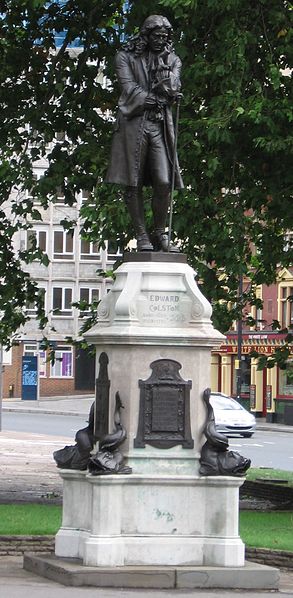
The John Cassidy (1860-1939) statue of Edward Colston, which stood in Bristol from 1895-2020 before being taken down and thrown into Bristol harbour during the protests after the death of George Floyd.
Photo by William Avery via Wikimedia Commons.

… public art in the eighteenth and nineteenth centuries used to be about inculcating virtue, which is something we seem to have forgotten. Public art was explicitly moralising, and not in the subversive way so often seen today, which leads us to question ourselves but rarely gives us answers. Back then, public art was instead meant to inspire. In painting, for example, the most prestigious and public-facing genre was history painting. History painting showed allegorical, mythological, and religious scenes, as well as those from actual history, in order to illustrate the exploits of the great and good, setting an example to us of integrity and public-spiritedness.

Importantly, the subjects of history paintings were taken from classical Greek or Roman history, or from mythology or religion, because such figures were generally uncontroversial — they could be upheld as paragons of virtue in a way that more recent and local historical figures could not. And the same went for statues, which became the main mediums of public art because the spaces available for history paintings were lacking. (The great room of the Society of Arts, by the way, has some of the few major history paintings in the country, all executed by the troubled self-proclaimed genius James Barry — the fastest riser in the Royal Academy’s history, and also, as far as I know, the only person to ever be expelled from it)

So, if some public statues have become controversial, that’s a clear sign of their failure. To the Victorians who put up the statue of slave trader Edward Colston in 1895, he must have seemed a distant and uncontroversial paragon of philanthropy. But today, he is mostly remembered for his murderous avarice. As such, he doesn’t deserve space on our streets or squares, for much the same reason that people in the eighteenth century avoided putting up statues of Oliver Cromwell — depending on your politics, he was either an ambitious and fanatical tyrant, or a selfless promoter of parliamentary liberties. Either way, it was the controversy itself that made him unsuitable: controversy got in the way of moral education. (Funnily enough, Cromwell seems to have got his public statues in the 1890s, too, just like Colston — maybe it was a low-point for the quality of history-teaching?)

I’m worried, however, that we’ve lost the self-confidence to replace them with statues that uncontroversially inculcate virtue (and in more than just a subversive or critical way). I suspect it take the delusions of grandeur of a James Barry to pull it off — someone who thought the history painter akin to a poet, like Shakespeare. But, as Tim Almond pointed out to me on twitter, perhaps we already do have such forms of virtue-promoting public art, and that all that has changed is the medium. Thus, rather than gazing upon statues or history paintings, we instead watch blockbuster superhero movies.

June 17, 2020

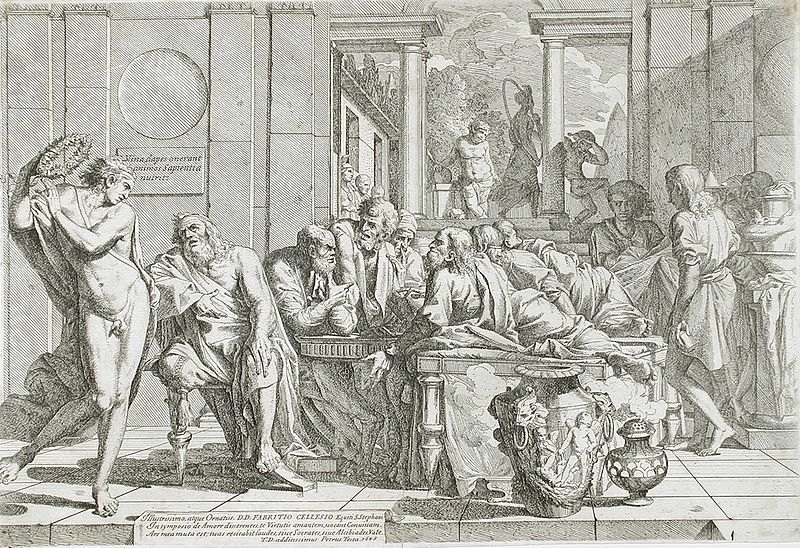
Alcibiades, the first recorded iconoclast, but far from the last

James Heartfield on the modern day resurgence of iconoclasm:

“Drunken Alcibiades interrupting the Symposium”, an engraving from 1648 by Pietro Testa (1611-1650)
Via Wikimedia Commons.

… far more often, the attacks on public symbols are indicative of a breakdown in social solidarity — often with alarming consequences. For activists seeking to win popular support, knocking down statues is a high-risk strategy that can provoke the opposite sentiments to those hoped for. The futurist Marinetti’s proposal to fill in the canals of Venice with concrete to make modern roads is a witty way to make a point, but not a sound policy.

Alcibiades was perhaps the first recorded statue vandal. One night in 415 BC he knocked all the stone cocks off the statues of Hermes in Athens. In 1497, the friar Girolamo Savonarola launched a Bonfire of the Vanities in which artworks, books and statues were destroyed out of a fear they would tempt people away from God. As any lover of old English churches knows, the furies of the Puritan revolution led to the destruction and defacing of Catholic saints’ statues and paintings.

In the modern era, the temptation to destroy monuments has been strong. In the First World War, Britain’s local authorities changed German-sounding names of streets like Bismarck Road — now Waterlow Road — while bully boys attacked German-owned shops. In 1933, Nazi students in Germany organised bonfires of subversive books, while the Reich organised an exhibition of “degenerate” modernist art. The burning of books only served as a trial run for the extermination of people, as the symbolic slaughter failed to yield the results of a “cleansed” Germany.

People often make the point that there are no statues of Hitler in Germany — though those were not taken down by Germans, but by the Allied occupiers. You can still see Albert Speer’s Zeppelinfeld and grandstand in Nuremberg, where many of Hitler’s rallies took place, though not much else of his Nazi architecture survives. Mussolini’s architects, Giuseppe Terragni and Marcello Piacentini, did better — much of their absurdly grandiose work survives. The model of an Allied-led “denazification” was in the minds of the US-led forces that overthrew Saddam Hussein in 2003. The destruction of his statue in Baghdad was largely staged by the allies.

Under the Maoist regimes in China and the Khmer Rouge in Cambodia, some of the worst atrocities after the Nazis were carried out. Mao’s “Cultural Revolution” against the “four olds” led to the destruction of books and artworks. Later, there were showtrials and the politically incorrect were battered by the mob. In the wreckage of Cambodia, Pol Pot led a terrifying war on alleged capitalist-roaders and even intellectuals — who could be handily identified by the fact they wore glasses — that led to millions being killed. Pol Pot declared a “year zero” — that all civilisation before the Khmer Rouge took power would be cancelled. Tragically, the wholesale wiping out of Cambodian culture was only a prelude to the extermination of much of its population. The sentiment of wiping out the wrong history was repeated in the war that al-Qaeda-inspired regimes in Afghanistan and Mali conducted against books and statues that did not match their own Islamist views.

In Soviet Russia, when the communist-allied artists of the Proletkult organisation argued that all Tsarist culture should be expunged, the Bolshevik leader Lenin took them to task for “rejecting the most valuable achievements of the bourgeois epoch”. Instead, he said, they should assimilate and re-work “everything of value in the more than 2,000 years of the development of human thought and culture”. Sadly, Lenin’s wise advice was lost on the Stalinist regimes that followed, during which the policy oscillated between futurist iconoclasm and maudlin Russian sentimentality. History got its revenge in eastern Europe when most of the ubiquitous Lenin and Marx statues came down in the 1990s.

June 5, 2020

QotD: Recognizing the work of famous painters

Filed under: History, Humour, Media, Quotations — Tags: , — Nicholas @ 01:00

#1 If Everyone – Including The Women – Looks Like Putin, Then It’s Van Eyck

#2 If Everyone Looks Like Hobos Illuminated Only By A Dim Streetlamp, It’s Rembrandt

#3 If It’s Something You Saw On Your Acid Trip Last Night, It’s Dali

#4 If The Paintings Have Lots Of Little People In Them But Also Have A Ton Of Crazy Bulls#%t, It’s Bosch

#5 If Everybody Has Some Sort Of Body Malfunction, Then It’s Picasso

#6 Lord Of The Rings Landscapes With Weird Blue Mist And The Same Wavy-Haired Aristocratic-Nose Madonna, It’s Da Vinci

#7 Dappled Light And Unhappy Party-Time People, Then It’s Manet

#8 If You See A Ballerina, It’s Degas

#9 Dappled Light But No Figures, It’s Monet

#10 If Everyone Is Beautiful, Naked, And Stacked, It’s Michelangelo

#11 Dappled Light And Happy Party-Time People, It’s Renoir

#12 If The Images Have A Dark Background And Everyone Has Tortured Expressions On Their Faces, It’s Titian

#13 Excel Sheet With Coloured Squares, It’s Mondrian

#14 If All The Men Look Like Cow-Eyed Curly-Haired Women, It’s Caravaggio

#15 If The Paintings Have Tons Of Little People In Them But Otherwise Seem Normal, It’s Bruegel

#16 If Everyone In The Paintings Has Enormous Asses, Then It’s Rubens

#17 If Every Painting Is The Face Of A Uni-Browed Woman, It’s Frida

#18 If Everything Is Highly-Contrasted And Sharp, Sort Of Bluish, And Everyone Has Gaunt Bearded Faces, It’s El Greco

#19 If The Painting Could Easily Have A Few Chubby Cupids Or Sheep Added (Or Already Has Them), It’s Boucher

Aušrys Uptas, “Someone Created A Funny Guide On How To Recognize Famous Painters And It’s Surprisingly Accurate (19 Pics)”, deMilked, 2019.

June 2, 2020

“Calling a modern ‘artist’ a poseur is like calling water wet — what could possibly be the point?”

Filed under: History, Media, Politics — Tags: , , , , — Nicholas @ 05:00

Severian on modern “art” and its practitioners:

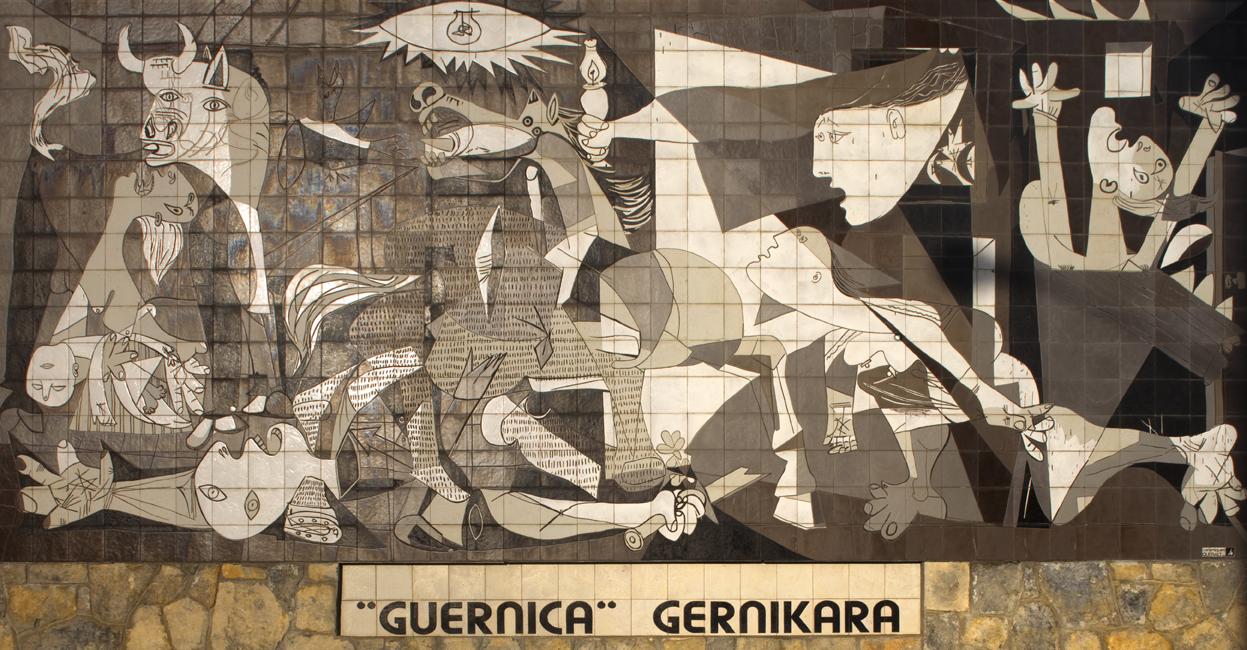
Picasso’s “Guernica” in mural form in the town of Guernica.
Photo by Papamanila via Wikimedia Commons.

Leszek Kolakowski, in his essay collection Is God Happy?, wrote several fascinating essays on Communism vs. other forms of Socialism, such as Fascism and generic Leftism. He notes that while Communism proper attracted lots of serious intellectuals and artists, who produced some works of real merit, generic “Leftism” had few, and Fascism almost none.

He also notes the degeneration of art on the Left. I don’t want / am not qualified to get deep into the weeds of art history, but let me use an example (mine, not Kolakowski’s): Pablo Picasso vs … oh, pick an artist, they’re all Lefties … let’s say Andy Warhol. Noting that “important” can be diametrically opposed to things like “good,” “aesthetically pleasing,” etc., we can all agree that both were important artists. Whatever else their differences, the most obvious one was:

Sincerity.

Picasso was a lifelong member of the Communist Party. He was also a sincere artist (which, again, can be miles away from “good;” I personally can’t stand Picasso’s art). Guernica is wildly overrated, and its sentiment jejune — we all agree that bombing civilians is bad, mmkay? — but at least it’s sincere. Warhol, on the other hand, never took a sincere breath in his life. Making your work superficial on purpose doesn’t absolve you from the sin of superficiality. Warhol (and Roy Lichtenstein, and the rest of the “Pop Art” crowd) gave wannabes permission to substitute “being ironic” for “having something to say,” and there’s your modern art in a nutshell. Calling a modern “artist” a poseur is like calling water wet — what could possibly be the point?

Which brings us back to Kolakowski. He notes that there are apostates aplenty from Communism, and they all seem compelled to write big long books full of critical self-examination. Cheering for the murder of millions would do that, one supposes… except that, as Kolakowski says, you can’t find one single ex-Leftist doing it. Hell, is there such a thing as an ex-Leftist, as opposed to an ex-Communist? Kolakowski couldn’t find one (as of 1995, I think), and I can’t think of one either. Every former radical I’m aware of was just that — a radical, a card-carrying Communist or at least a virulent fellow-traveler, e.g. David Horowitz. We probably all have heard of someone waking up one day (say, after 9/11) realizing that the Democratic Party they’d been knee-jerk voting for all their lives was out to lunch, but do you know of any True Believers seeing the light?

May 1, 2020

QotD: Cynicism

Filed under: Books, Media, Quotations — Tags: , , , , — Nicholas @ 01:00

Somewhere around that same eighth-grade mark where we all experimented with being mean, we get the idea that believing in things makes you a sucker — that good art is the stuff that reveals how shoddy and grasping people are, that good politics is cynical, that “realism” means accepting how rotten everything is to the core.

The cynics aren’t exactly wrong; there is a lot of shoddy, grasping, rottenness in the world. But cynicism is radically incomplete. Early modernist critics used to complain about the sanitized unreality of “nice” books with no bathrooms. The great modernist mistake was to decide that if books without sewers were unrealistic, “reality” must be the sewers. This was a greater error than the one it aimed to correct. In fact, human beings are often splendid, the world is often glorious, and nature, red in tooth and claw, also invented kindness, charity and love. Believe in that.

Megan McArdle, “After 45 Birthdays, Here Are ’12 Rules for Life'”, Bloomberg View, 2018-01-30.

March 30, 2020

Renaissance Antics – History Hijinks

Filed under: Architecture, Europe, History, Humour, Italy — Tags: , , , — Nicholas @ 04:00

Overly Sarcastic Productions
Published 27 Mar 2020

The Italian Renaissance is known for its fancy art and ginormous domes, but what about the visionaries behind it? In this ~~fancy new series~~ we’ll discuss the antics of the period’s most famous artists.

Sources & Further Reading: Brunelleschi’s Dome by King, Leonardo Da Vinci by Isaacson, Benvenuto Cellini’s autobiography, and Artemisia Gentileschi by Garrard.

Our content is intended for teenage audiences and up.
This video was edited by Sophia Ricciardi, AKA “Indigo” https://www.sophiakricci.com/

PATREON: https://www.Patreon.com/OSP

DISCORD: https://discord.gg/h3AqJPe

MERCH LINKS: https://www.redbubble.com/people/OSPY…

OUR WEBSITE: https://www.OverlySarcasticProductions.com
Find us on Twitter https://www.Twitter.com/OSPYouTube
Find us on Reddit https://www.Reddit.com/r/OSP/

December 8, 2019

History Summarized: Florence

Overly Sarcastic Productions
Published 6 Dec 2019

Get 3 months of Audible for just $6.95 a month. That’s more than half off the regular price. Visit http://www.audible.com/overlysarcastic or text overlysarcastic to 500 500.

Can’t start a Renaissance without building a few *Domes* — You’ve seen the memes, now learn the history behind the magnificent city of Florence!

It may sound like sacrilege, but many years ago, Florence was the first Italian city that little Blue had a cartoonishly-overblown obsession for — move over, Venice. In fact, Florentine history is basically THE reason I ever started caring about History in the first place. So I hope that you find this exquisite chapter in world history as enjoyable as I do.

SOURCES & Further Reading:
Death in Florence — Paul Strathern https://www.audible.com/pd/Death-in-F…
Florence: The Biography of A City — Christopher Hibbert
Be Like The Fox: Machiavelli In His World — Erica Benner

Our content is intended for teenage audiences and up.

DISCORD: https://discord.gg/sS5K4R3

PATREON: https://www.Patreon.com/OSP

MERCH LINKS: https://www.redbubble.com/people/OSPY…

OUR WEBSITE: https://www.OverlySarcasticProductions.com
Find us on Twitter https://www.Twitter.com/OSPYouTube
Find us on Reddit https://www.Reddit.com/r/OSP/

October 12, 2019

Göring, the Stoned Nazi Nut – Doped WW2 Leaders Part 1

Filed under: Germany, History, Military, WW2 — Tags: , , , , , , — Nicholas @ 04:00

World War Two
Published 10 Oct 2019

Hermann Göring was one of the most powerful leaders of the Third Reich. He was also a drug addict with some serious problems and a remarkable lifestyle.

Join us on Patreon: https://www.patreon.com/TimeGhostHistory
Or join The TimeGhost Army directly at: https://timeghost.tv

Follow WW2 day by day on Instagram @World_war_two_realtime https://www.instagram.com/world_war_t…
Join our Discord Server: https://discord.gg/D6D2aYN.
Between 2 Wars: https://www.youtube.com/playlist?list…
Source list: http://bit.ly/WW2sources

Hosted by: Indy Neidell
Written by: Joram Appel
Produced and Directed by: Spartacus Olsson and Astrid Deinhard
Executive Producers: Bodo Rittenauer, Astrid Deinhard, Indy Neidell, Spartacus Olsson
Creative Producer: Joram Appel
Research by: Joram Appel
Edited by: Iryna Dulka
Map animations: Eastory

Colorisations by Norman Stewart and Julius Jääskeläinen https://www.facebook.com/JJcolorization/

Eastory’s channel: https://www.youtube.com/channel/UCEly…
Archive by Screenocean/Reuters https://www.screenocean.com.

Sources:
Klimbim Colorizations – https://klimbim2014.wordpress.com/

A TimeGhost chronological documentary produced by OnLion Entertainment GmbH.

From the comments:

World War Two
31 minutes ago (edited)
Though this episode is mostly about the lifestyle of Hermann Göring, we will certainly get back to his more serious impact on the Nazi party, Germany and World War Two. For those of you who are new here, we are following World War Two Week by Week, in which we do pay a lot of attention to all those smaller but still significant events. If you would like to watch the series, make sure to subscribe and to click here to start watching from episode one: https://www.youtube.com/watch?v=3-A1gVm9T0A&list=PLsIk0qF0R1j4Y2QxGw33vYu3t70CAPV7X

Cheers,
The TimeGhost team.

August 27, 2019

QotD: Salvador Dali and the “benefit of clergy”

Filed under: Books, Europe, History, Quotations — Tags: , , , , — Nicholas @ 01:00

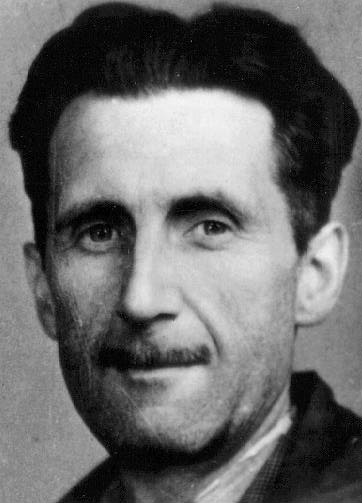
Orwell’s press card portrait, 1943

Now, if you showed this book, with its illustrations, to Lord Elton, to Mr. Alfred Noyes, to The Times leader writers who exult over the “eclipse of the highbrow” — in fact, to any “sensible” art-hating English person — it is easy to imagine what kind of response you would get. They would flatly refuse to see any merit in Dali whatever. Such people are not only unable to admit that what is morally degraded can be aesthetically right, but their real demand of every artist is that he shall pat them on the back and tell them that thought is unnecessary. And they can be especially dangerous at a time like the present, when the Ministry of Information and the British Council put power into their hands. For their impulse is not only to crush every new talent as it appears, but to castrate the past as well. Witness the renewed highbrow-baiting that is now going on in this country and America, with its outcry not only against Joyce, Proust and Lawrence, but even against T. S. Eliot.

But if you talk to the kind of person who can see Dali’s merits, the response that you get is not as a rule very much better. If you say that Dali, though a brilliant draughtsman, is a dirty little scoundrel, you are looked upon as a savage. If you say that you don’t like rotting corpses, and that people who do like rotting corpses are mentally diseased, it is assumed that you lack the aesthetic sense. Since Mannequin rotting in a taxicab is a good composition. And between these two fallacies there is no middle position, but we seldom hear much about it. On the one side Kulturbolschevismus: on the other (though the phrase itself is out of fashion) “Art for Art’s sake.” Obscenity is a very difficult question to discuss honestly. People are too frightened either of seeming to be shocked or of seeming not to be shocked, to be able to define the relationship between art and morals.

It will be seen that what the defenders of Dali are claiming is a kind of benefit of clergy. The artist is to be exempt from the moral laws that are binding on ordinary people. Just pronounce the magic word “Art”, and everything is O.K.: kicking little girls in the head is O.K.; even a film like L’Age d’Or* is O.K. It is also O.K. that Dali should batten on France for years and then scuttle off like rat as soon as France is in danger. So long as you can paint well enough to pass the test, all shall be forgiven you.

One can see how false this is if one extends it to cover ordinary crime. In an age like our own, when the artist is an altogether exceptional person, he must be allowed a certain amount of irresponsibility, just as a pregnant woman is. Still, no one would say that a pregnant woman should be allowed to commit murder, nor would anyone make such a claim for the artist, however gifted. If Shakespeare returned to the earth to-morrow, and if it were found that his favourite recreation was raping little girls in railway carriages, we should not tell him to go ahead with it on the ground that he might write another King Lear. And, after all, the worst crimes are not always the punishable ones. By encouraging necrophilic reveries one probably does quite as much harm as by, say, picking pockets at the races. One ought to be able to hold in one’s head simultaneously the two facts that Dali is a good draughtsman and a disgusting human being. The one does not invalidate or, in a sense, affect the other. The first thing that we demand of a wall is that it shall stand up. If it stands up, it is a good wall, and the question of what purpose it serves is separable from that. And yet even the best wall in the world deserves to be pulled down if it surrounds a concentration camp. In the same way it should be possible to say, “This is a good book or a good picture, and it ought to be burned by the public hangman.” Unless one can say that, at least in imagination, one is shirking the implications of the fact that an artist is also a citizen and a human being.

* Dali mentions L’Age d’Or and adds that its first public showing was broken up by hooligans, but he does not say in detail what it was about. According to Henry Miller’s account of it, it showed among other things some fairly detailed shots of a woman defecating.

George Orwell, “Benefit of Clergy: Some Notes on Salvador Dali”, Saturday Book for 1944, 1944.

August 23, 2019

QotD: The ego of Salvador Dali

Filed under: Books, Europe, History, Quotations — Tags: , , , , , — Nicholas @ 01:00

Orwell’s press card portrait, 1943

[Dali’s] aberrations are partly explicable. Perhaps they are a way of assuring himself that he is not commonplace. The two qualities that Dali unquestionably possesses are a gift for drawing and an atrocious egoism. “At seven”, he says in the first paragraph of his book, “I wanted to be Napoleon. And my ambition has been growing steadily ever since.” This is worded in a deliberately startling way, but no doubt it is substantially true. Such feelings are common enough. “I knew I was a genius”, somebody once said to me, “long before I knew what I was going to be a genius about.” And suppose that you have nothing in you except your egoism and a dexterity that goes no higher than the elbow; suppose that your real gift is for a detailed, academic, representational style of drawing, your real métier to be an illustrator of scientific textbooks. How then do you become Napoleon?

There is always one escape: into wickedness. Always do the thing that will shock and wound people. At five, throw a little boy off a bridge, strike an old doctor across the face with a whip and break his spectacles — or, at any rate, dream about doing such things. Twenty years later, gouge the eyes out of dead donkeys with a pair of scissors. Along those lines you can always feel yourself original. And after all, it pays! It is much less dangerous than crime. Making all allowance for the probable suppressions in Dali’s autobiography, it is clear that he had not had to suffer for his eccentricities as he would have done in an earlier age. He grew up into the corrupt world of the nineteen-twenties, when sophistication was immensely widespread and every European capital swarmed with aristocrats and rentiers who had given up sport and politics and taken to patronising the arts. If you threw dead donkeys at people, they threw money back. A phobia for grasshoppers — which a few decades back would merely have provoked a snigger — was now an interesting “complex” which could be profitably exploited. And when that particular world collapsed before the German Army, America was waiting. You could even top it all up with religious conversion, moving at one hop and without a shadow of repentance from the fashionable salons of Paris to Abraham’s bosom.

That, perhaps is the essential outline of Dali’s history. But why his aberrations should be the particular ones they were, and why it should be so easy to “sell” such horrors as rotting corpses to a sophisticated public — those are questions for the psychologist and the sociological critic. Marxist criticism has a short way with such phenomena as Surrealism. They are “bourgeois decadence” (much play is made with the phrases “corpse poisons” and “decaying rentiers class”), and that is that. But though this probably states a fact, it does not establish a connection. One would still like to know why Dali’s leaning was towards necrophilia (and not, say, homosexuality), and why the rentiers and the aristocrats would buy his pictures instead of hunting and making love like their grandfathers. Mere moral disapproval does not get one any further. But neither ought one to pretend, in the name of “detachment”, that such pictures as Mannequin rotting in a taxicab are morally neutral. They are diseased and disgusting, and any investigation ought to start out from that fact.

George Orwell, “Benefit of Clergy: Some Notes on Salvador Dali”, Saturday Book for 1944, 1944.

August 20, 2019

QotD: Autobiography

Filed under: Books, Europe, History, Quotations — Tags: , , , — Nicholas @ 01:00

Orwell’s press card portrait, 1943

Autobiography is only to be trusted when it reveals something disgraceful. A man who gives a good account of himself is probably lying, since any life when viewed from the inside is simply a series of defeats. However, even the most flagrantly dishonest book (Frank Harris‘s autobiographical writings are an example) can without intending it give a true picture of its author. Dali’s recently published [The Secret Life of Salvador Dali] comes under this heading. Some of the incidents in it are flatly incredible, others have been rearranged and romanticised, and not merely the humiliation but the persistent ordinariness of everyday life has been cut out. Dali is even by his own diagnosis narcissistic, and his autobiography is simply a strip-tease act conducted in pink limelight. But as a record of fantasy, of the perversion of instinct that has been made possible by the machine age, it has great value.

George Orwell, “Benefit of Clergy: Some Notes on Salvador Dali”, Saturday Book for 1944, 1944.

August 7, 2019

QotD: “Great” “Art”

Filed under: Books, History, Media, Quotations — Tags: , , — Nicholas @ 01:00

If you still don’t think the myth of the unappreciated writer, who labors in extreme poverty but creates True Art™, is nonsense, let me explain.

How do we know it’s true art? And before you start making gestures and sputtering, to finally come back with “knowledgeable people know that,” let me cut through the fog. The answer is, we don’t. No, not even experts. If everyone knew what great art was, investment in art wouldn’t be such a risky business. Great art, great literature, any form of “greatness” in creative expression is ultimately “What future generations think is great.” And, like all speculation about the future, it’s difficult, if not impossible. In visual art, what is often the acclaimed taste of an era is the laughable, ridiculous pastiche of a later era. In literature … Do me a favor, let your fingers do the walking through Gutenberg, then look up the biographies of some of those authors. Many of the people who make you say “who?” and who in fact would make anyone but an expert in the literature of their time go “who?” were literary lions in their times, acclaimed by all and pronounced “the next Shakespeare.” (Who, like “the next Heinlein,” used to rise every generation until people got tired of it.)

If the art is so great, how come no one is buying it? Besides the artist who is spending way too much time with absinthe and way too little time with quill and paper, or brushes and canvas, that is?

Oh. I see. Because the general public is too stupid to appreciate the greatness of the artist. Because the artist is “ahead” of the public.

Yeah, if you believe that you probably also think that history comes with an arrow since obviously art does. That is, art moves from “primitive” to “exquisite and advanced.” If you truly believe this, I invite you to go through any local art museum and move through it from, say, Roman times till now. And then I invite you to think. The Denver Museum of Art has an installation that consists of a bunch of twisted-together kitchen implements, something that often happens in my house due to the habit of overfilling drawers and my tendency – pre-coffee – to think there is no problem brute force can’t solve.

This is an “installation” worth 2 million and if you believe it is superior to Leonardo da Vinci’s Virgin of the Rocks, you should stop hitting the absinthe. No, wait. Have another cup. I have this installation …

Sarah Hoyt, “What Happens When the Artist Chides His Audience?”, PJ Media, 2017-07-13.

July 20, 2019

A Bankrupt Germany Didn’t Create the Nazis | Between 2 Wars | 1928 Part 1 of 1

Filed under: Europe, Germany, History, Media — Tags: , , , , , — Nicholas @ 06:00

TimeGhost History
Published on 18 Jul 2019

When the world goes into economic overdrive in the second half of the 1920s, contrary to popular belief Germany rises with the tide – it is the Goldener Zwanziger, the Golden Twenties.

Join us on Patreon: https://www.patreon.com/TimeGhostHistory

Hosted by: Indy Neidell
Written by Francis van Berkel and Spartacus Olsson
Directed and Produced by: Spartacus Olsson and Astrid Deinhard
Executive Producers: Bodo Rittenauer, Astrid Deinhard, Indy Neidell, Spartacus Olsson
Creative Producer: Joram Appel
Post-Production Director: Wieke Kapteijns
Edited By: Daniel Weiss
Research by: Francis van Berkel

Sources:
Bundesarchiv, Photos from the Jonatan Myhre Barlien photo collection.

Colorization by Daniel Weiss
Thumbnail motive by Olga Shirnina
https://klimbim2014.wordpress.com/201…

A TimeGhost chronological documentary produced by OnLion Entertainment GmbH

July 16, 2019

Totalitarian Temptations in Free Societies by Ryszard Legutko

Filed under: Books, Economics, Government, History, Politics — Tags: , , , , — Nicholas @ 05:00

Daniel Pipes reviews a recent translation (from Polish) by Teresa Adelson:

Legutko does not claim liberalism resembles communism in its monstrosity, much less that the two ideologies are identical; he fully acknowledges that the first is democratic and the second brutally tyrannical. After recognizing this contrast, however, he gets down to the more pungent topic of what the two have in common.

He first perceived those commonalities in the 1970s when visiting the West, where he saw how its liberals preferred communists to anti-communists; later, with the overthrow of the Soviet Bloc, he watched liberals warmly welcome communists, but not their anti-communist opponents. Why so?

Because, he argues, liberalism shares with communism a powerful faith in rational minds finding solutions which translates into a drive to improve the citizen, modernize him, and mold him into a superior being. Accordingly, both ideologies politicize, and thereby debase, every aspect of life, including sexuality, the family, religion, sports, entertainment, and the arts. (Here’s a mischievous but deadly serious question: which is the more awful art, the communist or the liberal, Stalin’s or the Venice Biennale’s?) [see below]

Both engage in social engineering to create a society whose members are “indistinguishable, in words, thoughts, and deeds ” from one another, aiming for a largely interchangeable population with no dissidents making trouble. Each sublimely assumes its specific vision constitutes the greatest hope for mankind and represents the end of history, the final stage of mankind’s evolution.

Trouble is, such grand schemes for improving mankind inevitably lead to severe disappointment; human beings, it turns out, are far more stubborn and less malleable then dreamers would like. When things go badly (say, food production for communists, unfettered immigration for liberals), two nasty consequences follow.

June 22, 2019

QotD: Militant Islam and the arts

Filed under: History, Media, Quotations, Religion — Tags: , , , , , — Nicholas @ 01:00

What I’ve learned since 9/11 is that the small pleasures — music, theatre, film — have to be earned. In the Muslim world, there is no music. In Libya they destroyed all the musical instruments — music was considered an abomination. When the demography changes, there will be no concert halls. Artists who take a multicultural view should be aware of this. Count the number of covered women in London’s West End. In Birmingham, where I went to high school, you have a provincial symphony orchestra in a Muslim city — I’m not sure it will survive. All art, all popular culture, is endangered by Islam, because there’s no room for it. It’s considered libertinism. And I’m not even talking about Miley Cyrus twerking at the music awards. What turned Sayyid Qutb against the morality of the West is that he attended a church dance in Greeley, Colorado, which was a dry town in 1948, and he heard the song “Baby, It’s Cold Outside”. He thought it was evil. And now things are getting a lot worse. Ugly things are happening.

Mark Steyn, interviewed by John Bloom, “Mark Steyn, Cole Porter and Free Speech”, Quadrant, 2017-05-11.

« Newer PostsOlder Posts »

Powered by WordPress