Matt Estlea
Published on 30 Apr 2019In this video, I begin by making a natural edged bowl but then kind of lose my mind and start adding metal, and fire, and more metal….. and more fire.
_________________________________________________________________Support what I do by becoming a Patron! This will help fund new tools, equipment and cover my overheads. Meaning I can continue to bring you regular, high quality, free content. Thank you so much for your support! https://www.patreon.com/mattestlea
_________________________________________________________________See what tools I use here: https://kit.com/MattEstlea
My Website: http://www.mattestlea.com
_________________________________________________________________My name is Matt Estlea, I’m a 23 year old Woodworker from Basingstoke in England and my aim is to make your woodworking less s***.
I come from 5 years tuition at Rycotewood Furniture Centre with a further 1 year working as an Artist in Residence at the Sylva Foundation. I now teach City and Guilds Furniture Making at Rycotewood as of September 2018.
I also had 5 years of experience working at Axminster Tools and Machinery where I helped customers with purchasing tools, demonstrated in stores and events, and gained extensive knowledge about a variety of tools and brands.
During the week, I film woodworking projects, tutorials, reviews and a viewer favourite ‘Tool Duel’ where I compare two competitive manufacturers tools against one another to find out which is best.
I like to have a laugh and my videos are quite fast paced BUT you will learn a lot, I assure you.
Lets go make a mess.
May 2, 2019
Natural Edged Bowl with Bronze Powder | Turning Tuesday #14
March 5, 2019
QotD: Modern architecture
Now that I think about it, he said, spitballing for no particular reason, having a lot of art books of a certain sort is a political statement: if people suspects that your choice of subjects implies a rejection or at least a lack of interest in modernism or other cultures, they infer things.
My architecture books would be a rebuke to some, since they’re focused on particular eras and styles. I don’t have any books about other styles or cultures because I am not interested in them. At all. I know it’s a sign of a robust and well-rounded mind to be utterly fascinated by everything, but I’d rather spend the time knowing more about what I’m interested in. I mean, there’s no way I could begin to pretend I care as much about Japanese art as I do about Western art. I know it has its own complexities and meanings I don’t understand or recognize, but I simply don’t care.
Then again, my books are rebuke to my own culture, since the architecture and art they contain are better than the tiresome products of the contemporary art establishment. This remarkable article in Forbes – not recent, but recently discovered – contains some gas-inducing quotes about the function and purpose of modern architecture, and it’s basically this: the brightest minds of the profession believe it is the duty of the architect to startle, confront, unnerve, dissolve, destroy, and also whip out the willie to irrigate the fusty bourgeoisie notions like beauty and tradition.
The article discusses a piece that took modern architecture to the woodshed, where it said “look at this woodshed. It’s more humane than anything you design.” Someone wrote a defense, but had to be honest with himself:
Yet Betsky then admitted, “All those critiques might be true.” They are irrelevant, he claims, since architecture must be about experimentation and the shock of the new. (Why this should be the case he does not say.) And sometimes designers must stretch technology to the breaking (or leaking) point: “The fact that buildings look strange to some people, and that roofs sometimes leak, is part and parcel of the research and development aspect of the design discipline.” Ever brave, he is willing to let others suffer for his art.
[…]
The ongoing project to unmoor Western Civ from its roots can only be enabled by people who believe the world has to be remade with its core memory wiped. I don’t share their hatred; why do I have to be forced to experience it, over and over again?
James Lileks, The Bleat, 2019-01-30.
January 1, 2019
Whither European fine art?
It’s apparently not just problematic because the vast majority of it was produced by dead white males, but it’s also now considered to be a totem of white supremacist beliefs:

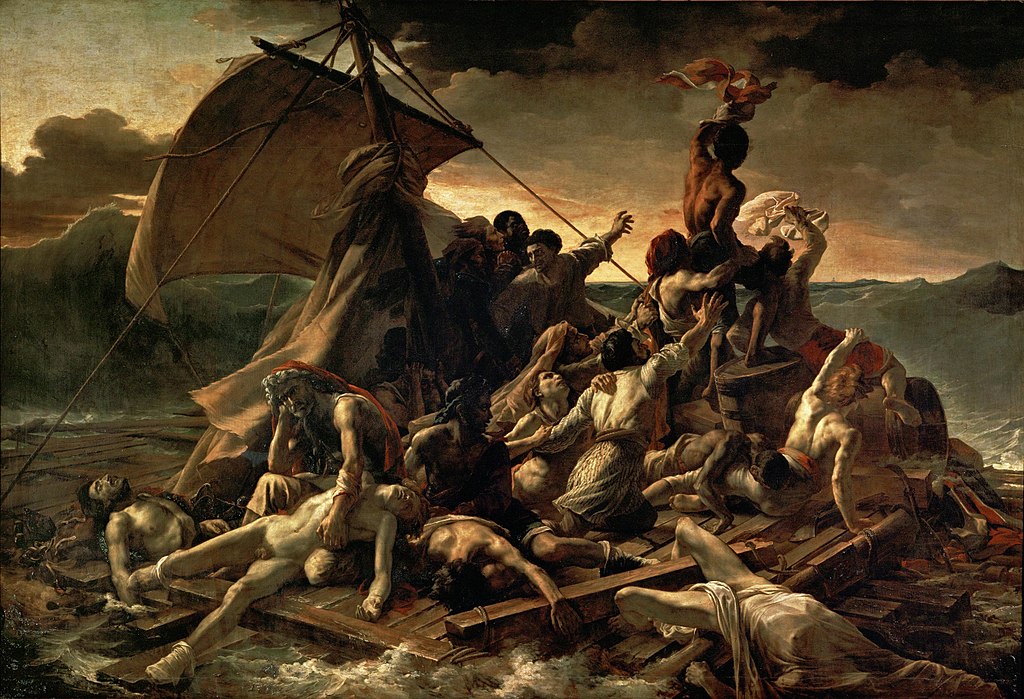
“The Raft of the Medusa” (French: Le Radeau de la Méduse) by Théodore Géricault 1818-19, an oil-on-canvas painting measuring 491 cm × 716 cm (16 ft 1 in × 23 ft 6 in)
Louvre, image via Wikimedia Commons.
A Philadelphia-based art historian and curator believes exhibitions of European art in American museums should be “reconsidered” in light of “a surge in white supremacist violence” across the country.
Alexander Kaufmann says that “[b]ecause the centering of Europe is baked into the architecture” of museums, and “usually inhabit the largest and most central galleries,” people might not notice a connection to white supremacy.
“But white supremacists do,” he adds ominously.
“Europe’s cultural prestige is their evidence for the racial superiority of white America,” Kaufmann writes in Hyperallergic. White supremacists and white nationalists gather at museums because that’s “where Europe’s cultural patrimony is most visibly singled out as exceptional.”
White supremacy notwithstanding, American museums’ original missions — “provid[ing] instruction for the industrial classes” and helping the country achieve the goal of becoming the “noblest development of humanity” — have long required a response, Kaufmann argues, and the activism of groups like the Black Emergency Cultural Coalition and the Guerrilla Girls can provide just that.
“After the violence in Charlottesville, Charleston, and Pittsburgh,” Kaufmann says, “our encyclopedic museums must take steps within their galleries of European Art to combat white supremacist ideology.” (But are women who run around in gorilla masks “to expose gender and ethnic bias [and] corruption in politics, art, film, and pop culture” really part of a serious solution?)
December 14, 2018
“Bohemian Rhapsody”
Colby Cosh on the media phenomenon of “Bohemian Rhapsody” … which, in his opinion, isn’t all that good as a song:
… Queen wasn’t really a four-piece; it was a pansexual mutant alien athlete-hero plus three ugly, highly talented Englishmen. And “Bohemian Rhapsody” almost isn’t a song so much as a captured moment. Considered as a song, there isn’t much to it except as a showcase for virtuosity: it’s not among Queen’s 20 best. And ordinary people can’t take a crack at “Bohemian Rhapsody” expecting to do it nicely and competently, in the way they might do “Blackbird” or “Wonderwall.” To be used for performance by the general public, “Bohemian Rhapsody” basically requires a roomful of drunks united in the ironic, non-judgmental spirit of karaoke.
Perhaps there is not much more to be said of “Bohemian Rhapsody” by way of explanation. Queen enjoyed trying on American hats from time to time (ah, if only Elvis had stayed around to receive the gift of “Crazy Little Thing Called Love”). But an American group could never have made anything that was weird in this particular way — wallowing in the pathos of a French gangster movie, then diving into a cryptic Dantean nightmare, piling up gestures and word-sounds into a unabashedly hokey panorama. There is no content at all to the thing, per se, except what the band members put into it as performers. In no way, I promise, will knowledge of Scaramouche’s place in the commedia dell’arte or the life of Galileo Galilei unlock some hidden layer of understanding.
“Bohemian Rhapsody” is an exquisitely made thing whose intricacy and beauty everybody can appreciate on more or less the same level. That is the special formula for mass popularity in all of the arts. They will tell you the Mona Lisa has a zillion layers of biographical or political meaning, but the painting really is what it is for everybody, and in roughly the same way. Every ordinary grownup can participate in the intimacy and the mystery of it, and it is not really a superior experience, as many great paintings might be, for somebody with a bundle of university degrees. As often happens I am reminded of Andy Warhol’s praise for Coca-Cola. “A Coke is a Coke and no amount of money can get you a better Coke than the one the bum on the corner is drinking. All the Cokes are the same and all the Cokes are good.”
October 25, 2018
The History of Australia
History With Hilbert
Published on 23 Aug 2017The entire history of Australia from the earliest humans until somewhere after World War II where I lost interest.
August 12, 2018
March 18, 2018
QotD: National flags
If you have never investigated or thought through this odd phenomenon of national anthems, it might not occur to you that it is not OK to tamper with the lyrics. There was a time not so long ago when national flag etiquette was fairly severe. Flags were seen as essentially military emblems, and their use was informed by military protocols. When flags started to be turned into clothing and ironic art in the 1960s, and were exposed to the demoralizing effects of marketed consumer kitsch in the 1970s, these developments were greeted with unease. Not so much in Canada, of course: our flag was invented as a marketing device in a time of consumerism, and it had not been used to soak up oceans of blood, so it lacks the sobering associations other flags have. It had a virgin birth. We are quite welcome to slap it onto a backpack or a truck bumper.
The point is that flags can now be visually remixed with near-total freedom by artists and designers and inserted into all sorts of contexts with relatively little discomfort. If you want to put Donald Trump in an editorial cartoon with a gore-oozing Stars and Stripes, no contemporary American will kick up too much fuss. Yet the taboos around anthems, as Remigio Pereira discovered, seem to have grown stronger. And even as someone who was instinctively furious with him, I am not quite sure how this happened, or why.
Colby Cosh, “Let’s talk about anthems”, National Post, 2016-07-14.
March 6, 2018
QotD: Baseball versus modern art
By now I hope the problems here are obvious. Hessenius notes at the linked essay that “The heart of the sports complex support over the past fifty years has been the farm team system,” and that the arts have lessons to learn from that fact. I can only speak for visual art, but there the continuity between the creative acts we engaged in as children and what goes on in the lofty regions of the professional world, by design, have little or nothing to do with each other. A painter I know in grad school — someone deeply thoughtful about materials and surfaces — was told by his department head a couple of months ago that she thought it was important to transcend the romantic idea of the artist working alone in his studio and contemplate how to become a better global citizen. Art that succeeds in doing this sort of thing, or appearing to do this sort of thing, wins praise for raising serious questions about this issue or that one.
Baseball hasn’t spent a hundred years smashing its own conventions. Baseball players don’t endeavor to turn hitting into a critique of late capitalism. Baseball doesn’t call upon fans to comprehend discussion full of coinages by PhD students trying to impress their dissertation committees, or implicitly punish them for having bourgeois values. Audiences instinctively and rightly hate this kind of pretentiousness.
Franklin Einspruch, “Why Sports Are Surging But the Arts Are Not”, Artblog.net, 2016-07-15.
February 3, 2018
QotD: Subsidising the arts
… the Luvvies justify tax subsidy of The Arts by saying, “We can’t call ourselves a civilized country without opera houses, ballet companies, etc., etc.”. Well, perhaps not. But can we call ourselves a civilized country when we have to be forced to pay for these things against our will? Does that not then make us an uncivilized country pretending to be civilized, aping true civilization, a sort of cargo-culture? It’s not our culture at all, spontaneously emerging through voluntary action, it’s someone else’s, laid on the top of our real civilization like fancy icing on (as they might have it) mud. Isn’t that worse?
Sam Duncan, commenting on David Thompson’s “Elsewhere (100)”, davidthompson.com, 2013-10-09.
November 25, 2017
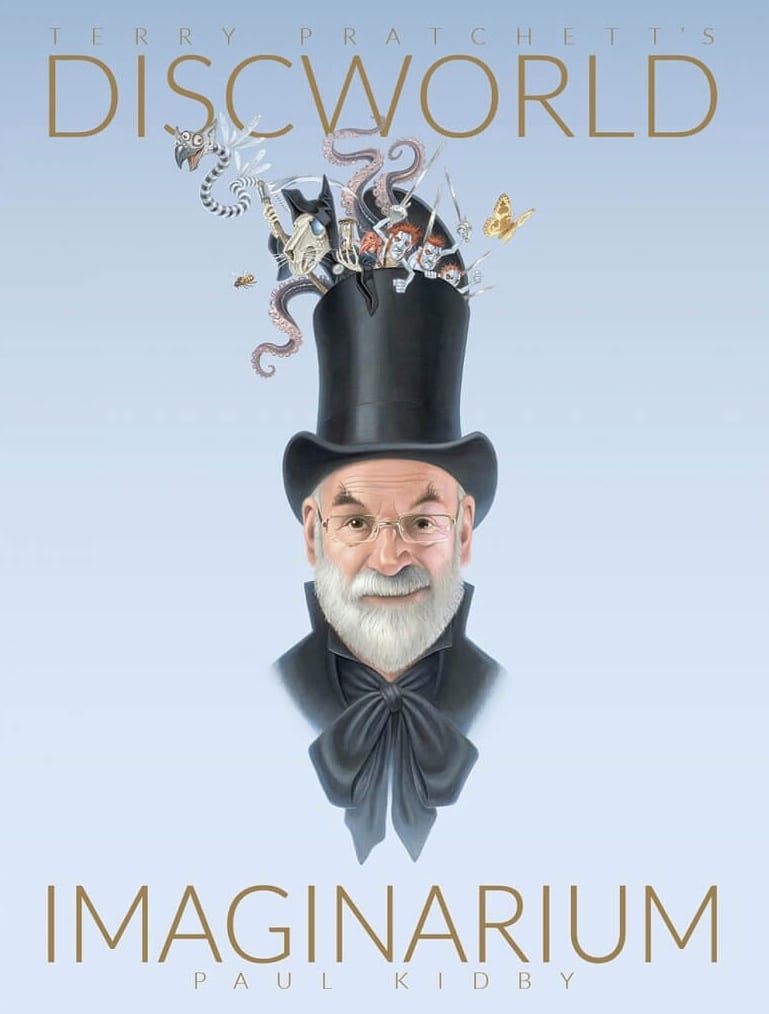
Paul Kidby’s Discworld Imaginarium
Jessica Brisbane linked to this Guardian overview of a new book by Paul Kidby, collecting his art to accompany Terry Pratchett’s Discworld series:
September 19, 2017
In praise of ancient Greece
In the latest Libertarian Enterprise, Sean Gabb explains why we owe so much today to ancient and classical Greek culture:
The Greeks gave us virtually all our philosophy, and the foundation of all our sciences. Their historians were the finest. Their poetry was second only to that of Homer – and it was they who put together all that we have of Homer, and Homer was himself an early Greek. They gave us ideals of beauty, the fading of which has always been a warning sign of decadence; and they gave us the technical means of recording that beauty. They had no examples to imitate. They did everything entirely by themselves. In a world that had always been at the midnight point of barbarism and superstition, they went off like a flashbulb; and everything good in our own world is part of their afterglow. Every renaissance and enlightenment we have had since then has begun with a rediscovery of the Ancient Greeks.
For the avoidance of doubt, I will not say that the Greeks were perfect. Though remarkable human beings – though the most remarkable human beings – they were still human beings, with all the vices and other failings that come with this. But, if you commit your life to staring into that flood of intense light that was Greece, you will not have lived in vain. And, though I do not despise translations, and would never discourage someone from approaching the Greeks only through translation, I will add that the light is most intense when seen directly, through the medium in which the Greeks themselves thought and spoke and wrote.
There are many reasons for learning Greek. A full discussion of them would amount to an advertisement for my services, and would take longer than I have available for this speech. But I will mention three.
The first is that Greek is inherently a beautiful language, and worth studying for itself alone. There is certainly a thrill to speaking it. Take this line from Homer:
τὸν δ’ ἀπαμειβόμενος προσέφη πολύμητις Ὀδυσσεύς
To him in answer spake the ever-resourceful OdysseusFor any number of reasons, my pronunciation is corrupt, and no Greek, ancient or modern, would think me other than a barbarian. But say these words, and you are making sounds that were first made when our own ancestors were tattooing their faces and smearing butter into their hair, before perhaps the building of Stonehenge, and when even Rome was no more than a collection of huts not far removed from the stone age.
The second main reason for learning Greek is that we know far less about the Greeks than we would like. So much has been carried away by the ravages of time. For the past six hundred years, a continuous line of scholars in Western Europe, and more recently in America, has laboured to gather and understand all that can be found about the Greeks. Every surviving Greek text has been pressed harder than olives for one of the supermarket chains to give up every possible meaning. Archaeology and all the natural sciences have been put to similar uses. In every century since the fourteenth, we have been able to say at its end that we knew more than at the beginning. But our knowledge remains imperfect. We look on the Greeks as we might on a landscape covered in mist. Here and there, the mist is absent or thinner, and we can be astonished by what we see; and we can hope to extrapolate from what we see to what remains covered.
If you come to the Greeks through translations, it is as if you are looking at that misty landscape though a sheet of coloured glass. Our word translate in Latin, and by extension in French, is traduco. This can mean translate. It can also mean dishonour, degrade or betray. Most translations, whether deliberately or by accident, do all these things to their original. Until very recently, English translators of the classics would labour to conceal the sexual tastes of the Ancients. Many translators labour still, though now to conceal the ancient taste for mood-altering substances. Even otherwise, a translation will not carry over the whole of the original meaning, but will impose on a reader the translator’s view of its meaning. Compare, if you like, my translation of Thucydides with other translations. The basic idea is the same: the choice of words and the balance and even the structure of the statement are different.
This brings me to my third main reason – and here I turn to Latin. If you take individual stories from Homer and put them into translation, they can sometimes work almost as well as they do in Greek. The story of Odysseus in the Cave of Polyphemus is wonderful in itself. So too the story of how Achilles tied the dead body of Hector to his chariot and dragged it about the walls of Troy, and how Priam came out to buy back the body. These stories thrilled me as a child, or moved me to tears. So they can in in any good retelling.
If we turn, however, to Vergil, any translation seems to involve a perceptible loss of impact. Last Easter, I taught some revision courses for A Level Classical Civilisation. One of the modules I covered was Vergil’s The Aeneid in several good English translations. Except for John Dryden’s version, this was my first experience of Vergil in translation. I have said that the translations used were good. They were made by men whose Latin was far better than mine. Compared with the original, however, they were disappointingly flat. Again and again, I would skim the text, looking for the equivalent of some line or phrase that had stamped itself into my memory. Again and again, I was disappointed by the mediocrity of what I made the students read aloud to me.

August 25, 2017
August 12, 2017
QotD: The decline and fall of art
It also turns out that when that sort of revolutionary who believes in tearing down for its own sake, gets power, all they can do is keep tearing down, until the product manages to be, objectively, both repulsive and boring to any sane person. […] In painting this is very obvious. The shock that doesn’t shock anyone does manage, nonetheless, to turn the normal, sane human being off the “art” being displayed. (Though even there most of it is just boring. Really, the Denver museum of art paid millions for a bunch of twisted together kitchen implements? Without the little card explaining what it is and how it relates to domestic dissatisfaction, that “art” evokes “my drawer got stuck again.”)
So this avant garde of the past aged without doing more than throwing continuous artistic tantrums at the world that refused to conform to their visions. Some of the early ones, when they still weren’t the establishment were magnificent and are probably art, just because, well, art includes tantrums too. BUT after they became the establishment all they could do was chase the thrill and shock that no longer existed ever further, off the plank of sanity and into the ocean of irrelevance.
When they realized this — when the museums emptied of the middle-brow and the print runs fell — they chased relevance by erecting ever more exacting rules saying “this you shall not do, that you shall not say, this thing you shall not even think.” This ranges from political correctness to the sort of stultifying mandates on style and manner that are the last gasp of any dying artistic movement. (I’m still sticking my middle finger up at the minimalists and the idiots who think first person is always bad. )
Which brings us to science fiction. Since science fiction in its heyday was not considered art or literature, it was just… what people wrote for fun. (Kind of like Shakespeare in his day.) There would be some reflexive classical references, which were the equivalent of Kit Marlowe putting his stage directions in Latin, just to prove his education wasn’t wasted. However, they weren’t exactly following any school.
Then came… the deluge. Or at least the “if we destroy all the rules and shock everyone, it will be literature and amazing.” And when they took over the establishment, the same thing followed as in the rest of the art.
Now… Now they — even those marginally younger than I — are the establishment. They are the authorities still vainly rebelling against an establishment that doesn’t exist, that probably never existed except in their heads. Which is probably why they attract so many people with issues with daddy or teacher or other authority figures who didn’t let them have their bugs and eat them too in childhood. (It also explains a certain fascination with the contents of their metaphorical diaper, now I think about it.) They must be FOREVER the first woman to write non-binary sex, even if it has been done for decades before they were born. They must be forever the most shocking thing Evah! even if what they’re doing was done better and more apropos by their grandparents’ generation. It’s all they have.
Sarah A. Hoyt, “Avant-Garde”, According to Hoyt, 2015-09-26.
July 24, 2017
QotD: Salvador Dali, in his own words
Here, then, are some of the episodes in Dali’s life, from his earliest years onward. Which of them are true and which are imaginary hardly matters: the point is that this is the kind of thing that Dali would have liked to do.
When he is six years old there is some excitement over the appearance of Halley’s comet:
Suddenly one of my father’s office clerks appeared in the drawing-room doorway and announced that the comet could be seen from the terrace… While crossing the hall I caught sight of my little three-year-old sister crawling unobtrusively through a doorway. I stopped, hesitated a second, then gave her a terrible kick in the head as though it had been a ball, and continued running, carried away with a ‘delirious joy’ induced by this savage act. But my father, who was behind me, caught me and led me down in to his office, where I remained as a punishment till dinner-time.
A year earlier than this Dali had ‘suddenly, as most of my ideas occur,’ flung another little boy off a suspension bridge. Several other incidents of the same kind are recorded, including (this was when he was twenty-nine years old) knocking down and trampling on a girl ‘until they had to tear her, bleeding, out of my reach.’
When he is about five he gets hold of a wounded bat which he puts into a tin pail. Next morning he finds that the bat is almost dead and is covered with ants which are devouring it. He puts it in his mouth, ants and all, and bites it almost in half.
When he is an adolescent a girl falls desperately in love with him. He kisses and caresses her so as to excite her as much as possible, but refuses to go further. He resolves to keep this up for five years (he calls it his ‘five-year plan’), enjoying her humiliation and the sense of power it gives him. He frequently tells her that at the end of the five years he will desert her, and when the time comes he does so.
Till well into adult life he keeps up the practice of masturbation, and likes to do this, apparently, in front of a looking-glass. For ordinary purposes he is impotent, it appears, till the age of thirty or so. When he first meets his future wife, Gala, he is greatly tempted to push her off a precipice. He is aware that there is something that she wants him to do to her, and after their first kiss the confession is made:
I threw back Gala’s head, pulling it by the hair, and trembling with complete hysteria, I commanded:
‘Now tell me what you want me to do with you! But tell me slowly, looking me in the eye, with the crudest, the most ferociously erotic words that can make both of us feel the greatest shame!’
Then Gala, transforming the last glimmer of her expression of pleasure into the hard light of her own tyranny, answered:
‘I want you to kill me!’He is somewhat disappointed by this demand, since it is merely what he wanted to do already. He contemplates throwing her off the bell-tower of the Cathedral of Toledo, but refrains from doing so.
During the Spanish Civil War he astutely avoids taking sides, and makes a trip to Italy. He feels himself more and more drawn towards the aristocracy, frequents smart salons, finds himself wealthy patrons, and is photographed with the plump Vicomte de Noailles, whom he describes as his ‘Maecenas.’ When the European War approaches he has one preoccupation only: how to find a place which has good cookery and from which he can make a quick bolt if danger comes too near. He fixes on Bordeaux, and duly flees to Spain during the Battle of France. He stays in Spain long enough to pick up a few anti-red atrocity stories, then makes for America. The story ends in a blaze of respectability. Dali, at thirty-seven, has become a devoted husband, is cured of his aberrations, or some of them, and is completely reconciled to the Catholic Church. He is also, one gathers, making a good deal of money.
George Orwell, “Benefit of Clergy: Some Notes on Salvador Dali”, Saturday Book for 1944, 1944.
May 18, 2017
If you subsidize art, you’ll get more [bad] art
I missed this when it got posted initially … Theodore Dalrymple on an Irish government initiative to actually audit the art they’re busy subsidizing:
Like most governments these days, the Irish government is a patron of the arts. The problem is that most governments know as much about the arts as I know about how to select camels for a camel race.
Naturally, therefore, governments rely on advisers to advise them on artistic matters, in effect delegating to them the disbursement of funds. Here the problem is that the art world is now so corrupt morally, intellectually, and aesthetically that the advice it gives is more likely to resemble Mr. Madoff’s advice to investors than Lord Duveen’s to Henry Clay Frick. There has always been bad art, of course, but rarely has it been so heavily subsidized; and when we see work of which we are inclined to ask, “But is it art?” we should perhaps be asking instead, “Is it government-funded?”
The Irish Arts Council, however, recently came up with a novel, even transgressive idea (“transgressive” is the highest term of praise in current art criticism, incidentally), namely that the artists they subsidize should show some sign of artistic endeavor. It is true that the council’s choice of word, audit, was an unfortunate one, as if artists were accountants having their accuracy checked; and the eminent Irish writer Colm Toibin said that the council’s terminology — for example, “working artists engaged in productive practice” — had a North Korean ring about it; an exaggeration, no doubt, given that the North Korean regime subjects its artists to something more severe than mere audit, but one knows what he means. These days it is increasingly difficult to distinguish, stylistically, between an official circular and a page from The Selected Works of Kim Il-sung. (The only one of those communist leaders worth reading, by the way, is Enver Hoxha, who had a wonderful natural gift for poisonous invective and insult. As by the end of his life he had fallen out with everyone, he also had a lot of practice at it; his principle was never to speak well of the dead, especially if he had killed them himself.)
But Mr. Toibin was exercised about the very idea of demanding of artists that they actually produce something in return for the money they receive. After all, many a great artist in the past has had a fallow patch in his life, sometimes lasting decades; you can’t just go to an artist and insist that he be inspired, any more than a photographer can insist that his subjects be natural in front of the lens. His logic appears to be:
Great artists a and b had fallow patches
Artist c is having a shallow patch
Therefore artist c is great and indefinitely worth subsidy
Now, I’m not against patronage as such; sometimes I even wish I had had a patron who had relieved me of the necessity to earn my daily bread (and jam). Then, surely, I would have written an imperishable masterpiece; I would have had time for le mot juste instead of having to make do with the le mot approximatif that mere journalism, as against literature, requires. But the government doesn’t have the taste or discrimination to act as patron. It can’t even choose its advisers well.