
Theory-of-mind is our intuitive model of how the mind works. It has no relation to intellectual theories about how the mind is made of cognitive algorithms or instantiated on neurons in the brain. Every schoolchild has a theory-of-mind. It usually goes like this: the mind is an imaginary space containing things like thoughts, emotions, and desires. I have mine and you have yours. I can see what’s inside my mind, but not what’s inside your mind, and vice versa. I mostly choose the things that are in my mind at any given time: I will thoughts to happen, and they happen; I will myself to make a decision, and it gets made. This needs a resource called willpower; if I don’t have enough willpower, sometimes the things that happen in my mind aren’t the ones I want. When important things happen, sometimes my mind gets strong emotions; this is natural, but I need to use lots of willpower to make sure I don’t get overwhelmed by them and make bad decisions.
All this seems so obvious to most people that it sounds like common sense rather than theory. It isn’t; it has to be learned. Very young children don’t start out with theory of mind. They can’t separate themselves from their emotions; it’s not natural for them to say “I’m really angry now, but that’s just a thing I’m feeling, I don’t actually hate you”. It’s not even clear to them that people’s minds contain different things; children are famously unable to figure out that a playmate who has different evidence than they do may draw different conclusions.
And the learning isn’t just a process of passively sitting back observing your own mind until you figure out how it works. You learn it from your parents. Parents are always telling their kids that “I think this” and “What do you think?” and “You look sad” and “It makes me feel sad when you do that”. Eventually it all sinks in. Kids learn their parent’s theory-of-mind the same way they learn their parents’ language or religion.
When in human history did theory-of-mind first arise? It couldn’t have been a single invention – more like a gradual process of refinement. “The unconscious” only really entered our theory-of-mind with Freud. Statements like “my abuse gave me a lot of baggage that I’m still working through” involves a theory-of-mind that would have been incomprehensible a few centuries ago. It’s like “I’m clicking on an icon with my mouse” – every individual word would have made sense, but the gestalt would be nonsensical.
Still, everyone always assumes that the absolute basics – mind as a metaphorical space containing beliefs and emotions, people having thoughts and making decisions – must go back so far that their origins are lost in the mists of time, attributable only to nameless ape-men.
Scott Alexander, “Book Review: Origin Of Consciousness In The Breakdown Of The Bicameral Mind”, Slate Star Codex, 2020-06-01.
June 2, 2021
QotD: The evolution of theory-of-mind
June 1, 2021
QotD: The evolutionary origin of male aggressiveness
Were we humans the entirely separate creations, quite unlike mere animals, that old-school Christians used to say we were, then for our minds to be entirely different from those of animals might make more sense. As it is, given that we are products of the same evolutionary process that made all the others animals, the “blank slate” notion of the human mind makes no sense at all.
One thing I did — not “learn” exactly — but hear for the first time from a scientist of human evolution, concerned the aggressiveness of the human male. Many human masculine characteristics have evolved not so much because human females like them, but more because other human males are intimidated by them. Males who defeat other males in competition achieve high status, and high status and the resources that accompany it are what human females especially like, rather than necessarily liking the particular characteristics that achieve that high status. Male aggressive characteristics are, metaphorically speaking, deer antlers more than they are peacock tails. They are at least as much for making human males into top dogs, so to speak, as they are for directly impressing the ladies. I can’t help noticing that some human females are impressed, directly, by male aggression. They like to watch men fighting, for instance. But others are very put off by such behaviour, and especially, of course, if it is ever directed against them.
Brian Micklethwait, “What Steve Stewart-Williams said”, Brian Micklethwait’s New Blog, 2021-02-26.
January 27, 2021
Australia’s aboriginal people
On Australia Day, which progressives want to rename as “Invasion Day”, a look at the aboriginal culture(s) who had inhabited the continent for thousands of years before contact with Europeans:
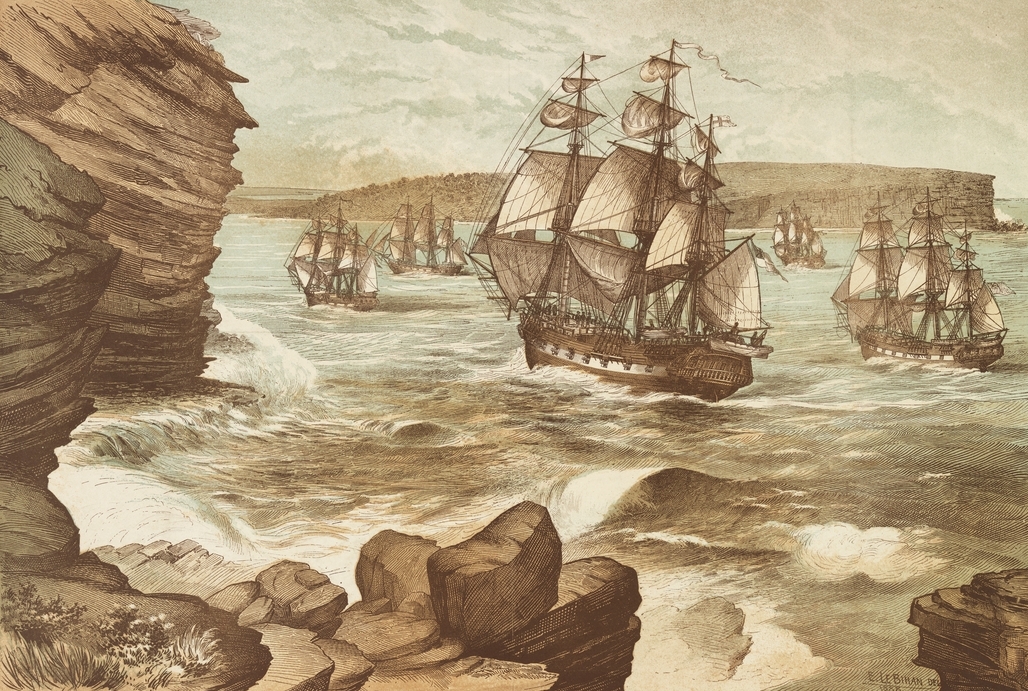
Colour lithograph of the First Fleet entering Port Jackson on January 26 1788, drawn in 1888.
Original by E. Le Bihan via Wikimedia Commons.
Liam Hemsworth and others are spruiking nonsense which is also being taught to school children as they protest against “invasion day”:
We are spiritually and culturally connected to this country.
This country was criss-crossed by generations of brilliant Nations.
Aboriginal and Torres Strait Islander people were Australia’s first explorers, first navigators, first engineers, first farmers, first botanists, first scientists, first diplomats, first astronomers and first artists.
Australia has the world’s oldest oral stories. The First Peoples engraved the world’s first maps, made the earliest paintings of ceremony and invented unique technologies. We built and engineered structures – structures on Earth – predating well-known sites such as the Egyptian Pyramids and Stonehenge.
Our adaptation and intimate knowledge of Country enabled us to endure climate change, catastrophic droughts and rising sea levels.
Always Was, Always Will Be. acknowledges that hundreds of Nations and our cultures covered this continent. All were managing the land – the biggest estate on earth – to sustainably provide for their future.This statement is a work of poorly written fiction. All humans are descended from ancestors that roamed Africa. At some stage – perhaps 50,000 to 60,000 years ago according to archaeological records – some Homo Sapiens (so far as we know, Homo Erectus do not appear to have migrated to the land mass now know as Australia) moved to this continent during the Pleistocene (ice age) when sea levels were much lower allowing transit without seafaring. Later the ice age abated, ice melted and the Australian continent became separate and its inhabitants isolated.
In Jared Diamond’s book Guns, Germs and Steel – the Fates of Human Societies, he argues that circumstances (pressure on resources etc) lead to innovations and changes to society. On Australia he wrote:
Australia is the sole continent where, in modern times, all native peoples still lived without any of the hallmarks of so-called civilization – without farming, herding, metal, bows and arrows, substantial buildings, settled villages, writing, chiefdoms or states. Instead Australian Aborigines were nomadic or semi-nomadic hunter-gatherers, organised into bands, living in temporary shelters or huts and still dependent on stone-tools. – (p. 297).
Compared with Native Australians, New Guineans rate as culturally “advanced” … most New Guineans … were farmers and swineherds. They lived in settled villages and were organised politically into tribes rather than as bands. All New Guineans had bows and arrows, and many used pottery. – (p. 297-8).
While New Guinea … developed both animal husbandry and agriculture, … Australia … developed neither. – (p. 308).
Isolated from other populations, and lacking little in the way of resources, Australia’s first inhabitants were not pressured into changing their ways of life and remained essentially hunter gatherers and nomadic societies. I make no judgement on whether this is good or bad, merely that despite the lack of competition over resources, life wasn’t always rosy and violence and skirmishes, murder and rape occurred as much among those humans as it did elsewhere.
It was inevitable that this isolation would not persist – it is perhaps surprising that it persisted as long as it did. But contact with other humans was inevitable and the outcome of that contact would be widely varying depending on whether the contact was made by the Portuguese, Spanish, Dutch, Chinese, British or others. The fact that Australia became a British colony is probably the best of the many alternatives that could have sprung from colonialisation. And we are all affected, mostly positively, by that contact – there would be few Aboriginal Australians (perhaps none) who today could say that they have no ancestry at all from settlers who arrived after 1787. We are all of mixed blood and we all descend from those original Homo Sapiens who evolved in Africa. It is time to talk about unity rather than division.
August 27, 2020
Margaret Murray’s highly influential The Witch-Cult in Western Europe
In First Things, Francis Young discusses the impact Murray’s work had when it was published in the 1920s:
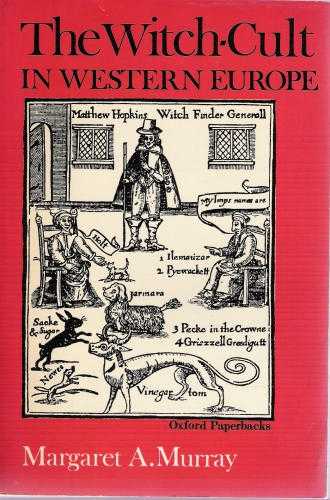
Just under a century ago, in 1921, one of the strangest books ever to be published by Oxford University Press appeared in print: The Witch-Cult in Western Europe by Margaret Alice Murray. By today’s academic standards — in fact, even by the standards of the 1920s — Murray’s book was filled with transparent flaws in methodology and research. Furthermore, the book’s author (a leading Egyptologist) was not qualified to write it. The few scholars then working on the history of European witchcraft dismissed Murray’s contribution. Yet in spite of this, The Witch-Cult in Western Europe became an instant hit and captured the imaginations of readers. Within three decades, the book had not only profoundly influenced cultural understandings of witchcraft, but also directly led to the rise of neopaganism and the foundation of a new religion, Wicca, that today has millions of adherents throughout the world.
Margaret Alice Murray (1863–1963) was born and brought up in British India — an upbringing that, as with so many Anglo-Indians of the nineteenth century, may have opened her mind to interests beyond Victorian culture. Determined to pursue a career of her own at a time when opportunities for women were limited, Murray tried out both nursing and social work before entering the progressive University College London in 1894, where she studied Egyptology under W. Flinders Petrie. Murray rapidly rose through the academic ranks, and by 1914, she was effectively running the Egyptology department. Her impressive achievements in advancing knowledge of ancient Egypt and higher education for women have, however, been largely overshadowed by her decision to take a detour into writing about European witchcraft.
In The Witch-Cult in Western Europe, Murray seized on some unusual testimonies in 16th-century Scottish witch trials to elaborate a radical theory: She claimed that what medieval and early modern people called witchcraft was, in fact, the last traces of a pagan fertility cult that originated in the Neolithic period. The witch trials of the 15th–17th centuries represented Christianity’s last attempt to stamp out this cult, which was practiced in secret covens (groups of thirteen people) who worshipped a horned god (who was mistaken for the devil). Knowledge of this cult was passed through families or, occasionally, to new initiates, but kept secret from the outside world.
Murray’s use of a single set of problematic sources from one country (Scotland) to argue that a previously unnoticed religion had existed since prehistory failed to meet basic historiographical and anthropological standards of research. She was given to making huge conceptual leaps on the basis of contentious interpretations of meager evidence. Using a small range of hostile trial records designed to discredit women accused of witchcraft (along with testimonies extracted under torture), Murray reconstructed what she believed were real religious practices lurking behind the demonological construct of the Witches’ Sabbath. In so doing, she brought together traditions of interpretation honed by the anthropologist Sir James Frazer (1854–1941), the author of The Golden Bough, and the French historian Jules Michelet (1798-1874). Murray followed Michelet in arguing that those accused of witchcraft were not the innocent victims of trumped-up charges, but were in fact adherents of a subversive cult; and she followed Frazer in her belief that prehistoric religious beliefs, associated with fertility, had survived into recent times.
August 18, 2020
QotD: Stigma
But in fact there is almost a law of conservation of stigma that operates in human societies, such that if it does not attach to one thing, it will attach to another. No doubt there is more stigma in shame societies than in guilt societies, but even in the latter everyone, except perhaps the most psychopathic of psychopaths, is afraid of being shown up in some respect or another.
Stigma begins early in life and children are much guided or influenced in their conduct by the fear of it. A teacher told me the following story. A child of about seven or eight came crying to her one day because another child had called him names.
“What did he say?” she asked.
“He called me a virgin.”
“What is a virgin?” asked the teacher,
“I don’t know,” said the boy. “But I know it’s something horrible.”
Stigma is a kind of shorthand to indicate what we detest. Anyone who pretends that he never stigmatises is probably lying, or perhaps I should say not telling the truth, since not every untruth that emerges from the human mouth is a lie. There are people who can contradict themselves without disbelieving in the law of non-contradiction, and therefore people who can genuinely despise people who pass moral judgment on others.
What would living completely without stigma and stigmatisation mean? Surely that there was nothing that we or anyone else could do to make people think badly of us. One of the reasons — I don’t say the only one — that I don’t steal is that I don’t want to be stigmatised as a thief. One sin doesn’t define a person’s character, however, so that when we stigmatise we must be careful to be just and proportionate. If we called everyone a liar who had told a lie, then we should all be liars (quite apart from the fact that it is sometimes virtuous to tell a lie). We call a liar someone who habitually lies, so that untruthfulness is a central part of his character.
Stigma is one of those many things that is neither good nor bad in itself, and depends for its social beneficence or maleficence on what it attaches to and how strongly. In the company of rogues or scoundrels, one can be stigmatised for honesty. Many a cruel act has been performed to avoid the stigma of being too cowardly to be cruel.
Theodore Dalrymple, “The Situational Nature of Scorn and Stigma”, New English Review, 2020-04-28.
July 7, 2020
QotD: The first invasion of Britain
Since then, 90 percent of subsequent skeletons in England reflect the DNA of the steppe invaders.
What happened to most of England’s earlier inhabitants? One of the less violent scenarios is that the steppe migrants introduced bubonic plague.
In general, “migration” and “mixture” tend in Reich’s book to serve as euphemisms for genocide of the native males and rape of the native females. Reich lists numerous examples from around the world where genetic data show that newcomers enslaved or murdered the local men and turned their women into concubines.
Fortunately, for the past 4,500 years, “ancient Britons harbored a blend of ancestries very similar to that of present-day Britons.” The Roman conquest didn’t leave much of a genetic mark, and the later Anglo-Saxon, Danish, and Norman invaders were genetically similar enough to earlier Britons that geneticists have only recently begun to disentangle them.
After 1066, the island race enjoyed a long halcyon era without new invaders raping and pillaging. But all good things evidently have to come to an end. As Benjamin Schwarz has pointed out, “In fact, Britain today receives more immigrants in a single year than it did in the entire period from 1066 to 1950.”
Steve Sailer, “Reich’s Laboratory”, Taki’s Magazine, 2018-03-28.
June 21, 2020
QotD: “[T]he fascinating modern science of high-tech grave robbing”
As Fitzgerald’s friend Hemingway ended The Sun Also Rises, “Isn’t it pretty to think so?”
But now the brilliant Harvard geneticist David Reich has published a bombshell scientific book, Who We Are and How We Got Here: Ancient DNA and the New Science of the Human Past, whose revelations would have been found congenial by a smarter version of Buchanan (such as Fitzgerald himself).
Despite Reich’s occasional need to stop his otherwise lucid narrative to spew irrational rage against his fellow race-science heretics such as James D. Watson, the genome expert conclusively demolishes the post-Boasian anthropologists’ conventional wisdom.
[…]
Reich learned the fascinating modern science of high-tech grave robbing from Svante Pääbo. This Swedish biologist invented the techniques for extracting from ancient skeletons their DNA. (Interestingly, the 1990 Native American Graves Protection and Repatriation Act makes it hard to get hold of ancient American Indian skeletons, but other races’ ancestors appear to be fair game.)
Reich applied to Pääbo’s breakthrough the traditional American knack for vast industrial scale. Assisted by English code-cracker Nick Patterson’s innovations in extracting meaning from bits and pieces of ancient genomes, Reich’s factory-like lab at the Broad Institute has been churning out a tsunami of papers on fascinating questions of prehistory.
Steve Sailer, “Reich’s Laboratory”, Taki’s Magazine, 2018-03-28.
May 19, 2020
QotD: Amour-propre
Really there is nothing new under the sun, and the concept comes much earlier from Saint Augustine of Hippo who in his City of God calls it in Latin, amor sui, and puts it about the centre of his review of human tawdriness. That, in turn, is how it came to Pascal: via the French Augustinians, with whom Pascal was in thick, about the time he was writing his Lettres provinciales. One might add, contre Rousseau (and perhaps with Joseph de Maistre) that it goes back farther, to Adam and Eve.
Ye devill appeals to Eve’s amour-propre. She then appeals to Adam’s. That’s how this whole wretched mess got started. Note that this couple predeceased all Rousseau’s noble savages, and that the field anthropologists have since discovered that the primitive tribal types are a lot like us. Which is to say, bad, in many colourful ways, and quite invariably self-regarding.
David Warren, “Amour-propre”, Essays in Idleness, 2016-06-01.
March 14, 2020
History Summarized: Ethiopia
Overly Sarcastic Productions
Published 13 Mar 2020Ethiopian History gets started early and just keeps on going. From the dawn of humanity itself through the medieval period and into the modern day, the history of the kingdom at the end of the Blue Nile is full of surprises.
SOURCES & Further Reading: Harold Marcus A History of Ethiopia and John Jackson’s Ethiopia and the Origins of Civilization, see also Kenneth Vickery’s lecture “Ethiopia: Outpost of Christianity” and William Cook’s lecture “The Rock-Hewn Churches of Ethiopia” via The Great Courses.
This video was edited by Sophia Ricciardi AKA “Indigo”. https://www.sophiakricci.com/
Our content is intended for teenage audiences and up.
PATREON: https://www.Patreon.com/OSP
DISCORD: https://discord.gg/h3AqJPe
MERCH LINKS: https://www.redbubble.com/people/OSPY…
OUR WEBSITE: https://www.OverlySarcasticProductions.com
Find us on Twitter https://www.Twitter.com/OSPYouTube
Find us on Reddit https://www.Reddit.com/r/OSP/

June 29, 2019
Determining who the “original” inhabitants were
It’s become quite common in some countries to pay formal lip service to the “original” peoples who inhabited the land before being dispossessed of that territory by various Europeans. Actually determining who were the first human inhabitants, however, is much more fraught … you can’t exactly expiate some residual guilt of your culture by acknowledging the previous culture if the previous culture in their turn dispossessed an even earlier group, can you? How far down the rabbit hole do you need to go? Tim Worstall explains:
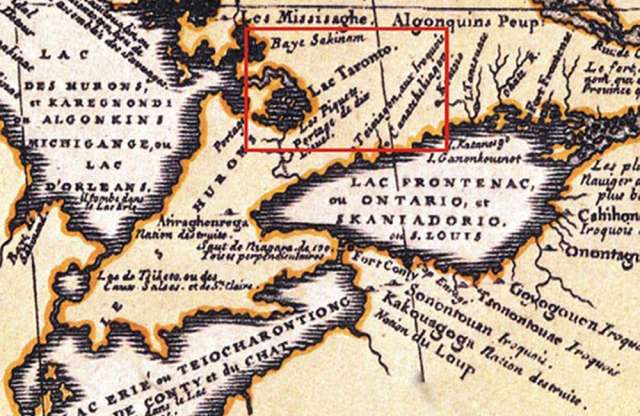
Detail from a 1688 map of western New France by Vincenzo Coronelli that locates “Lac Taronto” at Lake Simcoe.
City of Toronto Culture Division/Library and Archives Canada via the National Post
… within all that the accurate answer to “Whose land are we on?” is the land of the latest bunch of murderous bastards who killed all the previous inhabitants. Perhaps moderated to say the peeps who killed all the previous men then dated the remaining womenfolk. Because once we’ve got past that nullius stage that’s the way it has been. The Moriori are in short supply these days on the Chatham Islands given that the Maori decided to eat them.
The original inhabitants of the British Isles, the Beaker Folk, were entirely replaced by the next lot, the Iron Age Celts and similar. The Angles displaced to the west the Romano Celts in their turn, detailed DNA studies showing rather more of the female side of the R-C’s bred into the new population than the male. The Franks weren’t indigenous to France, the Allemani to Germany, the Turks to Turkey.
In fact, we’ve between little and no proof that the varied Amerinds were the original inhabitants of the lands where the White Europeans found then from 1492 onwards. In the case of both the Incas and Aztecs as political powers, proof they weren’t. And horses and Plains Indians simply weren’t a thing until the Eurasian horse was introduced post 1492.
Basically, this is indeed true. Anywhere is the possession of simply the last group of people to have slaughtered, or outbred, the previous group.
An interesting observation – if we apply the oft stated Americas example elsewhere, that Whitey stole it all and should give it back, then the Bantu should be back in Nigeria and Central Africa returned to the Pygmies, Southern to the Khoi San. We don’t say that and for the life of me I can’t work out why.
March 22, 2019
The rise of the neo-barbarians and modern tribalism
Sarah Hoyt isn’t a fan of civilization being replaced by the prehistoric landscape of tribe versus tribe, forever:
Tribalism seems to be the default setting of the human race.
Maybe it’s because we’re built on the frame of Great (or at least pretty good) Apes. Band seems to be the default unit of a Great Ape.
The people who do those cute and vapid studies on how your toddler is racist — by which they mean he prefers people who look like mommy and daddy, or their surrogates in his life — don’t seem to understand that. They don’t seem to understand that for most of human existence, (prehistory is much longer than history) for a toddler to stray outside his tribe meant at best he was raised as a slave, and at worst he became lunch.
I wonder if it’s this uncritical, sort of history-and-genetics free view of the world that causes the left to think that tribes are awesome.
Might just be their usual — and honestly, isn’t it tiresome by now? — view of the world which thinks everything “natural” by which they mean pre-civilized is better. This leads to nostalgie de la boue and therefore elevates primitive/non civilized cultures over western culture.
Or perhaps it is simply the fact that Marxism was “rescued” by Gramsci. Marxism was bad enough in its inability to see individuals, and ascribing everyone to economic tribes.
[…]
Anyway, back to our point: one of the great advances of humanity, possibly as momentous as the discovery of fire, was the overcoming of tribalism.
Forging tribe-like bonds based on “we share this land” and in fact, being able to tell ourselves stories about how “everyone in this land is one people” gave rise to the city state, the country, and eventually the “community of civilized men.”
Of course, yes, Christianity had a lot to do with this, but there was some of that going on already in the Roman Empire, where Persian and Greek could both declare (after the appropriate formalities and acculturation) “Civis Romanum sum.”
As bad as the super-states of the twentieth century got — because there’s nothing as a large nation with a good dose of crazy-making philosophical theory — it allowed commerce and industry, which are miles and miles better at creating and keeping wealth than hunting-gathering.
The problem is that the left, led by Gramsci, has re-invented tribalism. And no, I don’t just mean tribalism of place of origin or color — though they include that — I mean tribalism of EVERYTHING.
Being unable to see individuals (has anyone done studies of their brain? Maybe there’s something missing) they instead keep sorting people into increasingly smaller groups based on things that have bloody nothing to do with what the person IS capable of, or thinks or believes: Color, who people sleep with, what people have between their legs, who people like to sleep with, what people call their deity, etc. etc. ad very definitely nauseum.
[…]
The other side effect of this is that everyone who isn’t a member of the tribe is potentially the enemy. This is what leads to the internecine fights within the left, and why if they should win (forbid) we’ll be stuck in civil war after civil war forever. Adapting the Arab proverb: Me and my Marxist classmates against the world; Me and my black Marxist classmates against our white Marxist classmates; Me and my black Marxist female classmates against our black Marxist male classmates; Me and my black lesbian Marxist female classmates against our black straight Marxist female classmates… and so on ad infinitum, until the tribe of one is at war with everyone else, and worse stuck in a pit of anger and resentment because he/she isn’t given all the recognition and compensation he/she should have from the rest of the world at large.
At the same time anyone outside it is viewed as less than human. This is why they think they can tell everyone to shut up because “white privilege” or “male privilege” or whatever, and they honestly think there will be no resistance and no backlash.
Debunking Stephen Jay Gould
Several years back, I linked to a David Friedman post on a study that contradicted a key argument in Stephen Jay Gould’s book The Mismeasure of Man. While I’ve read a few of his books, it’s been nearly 15 years since I last read anything by him … by now I only have a vague recollection of what he wrote, but his works were quite popular at the time. Much more recently Russell T. Warne looked at different problems in Gould’s work that are much more damaging to his reputation:
Stephen Jay Gould, the famous 20th century paleontologist, published his most celebrated work, The Mismeasure of Man, in 1981. Gould’s thesis is that throughout the history of science, prejudiced scientists studying human beings allowed their social beliefs to color their data collection and analysis. Gould believed that this confirmation bias was particularly powerful when a scientists’ beliefs were socially important to them. […] The Mismeasure of Man provides a great deal of evidence that scientists’ pre-existing beliefs color their judgment — but not in the way he intended. Rather, the book is a perfect example of the sin it purports to expose in others. Gould’s Marxist political beliefs made him attack intelligence research because he saw it as a threat to his egalitarian social goals. Ironically, it was this allegiance to ideology over data that made Gould himself a classic examplar of a biased scientist.
[…]
Most criticism of The Mismeasure of Man was confined to the recherché world of psychologists who study intelligence. However, a new debate opened up in 2011 when a team of anthropologists argued that Gould’s analysis of the data on cranium measurements from 19th century scientist Samuel George Morton was flawed. Gould cast Morton as a racist who fudged his data to match his beliefs about white racial superiority because of a supposed larger skull capacity. Instead, the anthropologists argued, it was Gould who manipulated the data to support his biases.
This ignited a series of follow-up articles in the scholarly literature by authors taking a variety of positions regarding Morton’s data and Gould’s interpretations. Weisberg believed that the re-analysis was flawed and Gould was mostly correct. Kaplan and his colleagues claimed that Morton’s interpretations were flawed, but that Gould was incorrect in believing that he could discern Morton’s actions and motivations. Finally, Mitchell believed that Morton’s data were accurate and that the interpretations were colored by the racism of the era, but the claim that Morton subtly manipulated the data was a fiction created by Gould.
Though still unresolved, the debate shows that a critical analysis of specific sections of The Mismeasure of Man is warranted. After writing an article about Lewis Terman, an important developer of early intelligence tests, I decided that a 23-page section of The Mismeasure of Man would be a valuable section of the book to analyze. This section is Gould’s description and analysis of the Army Beta test, one of the tests that Terman helped create. The Army Beta was used in World War I to screen illiterate recruits for military service.
Having read some of the primary scholarly work about the Army Beta, I knew that some of Gould’s claims were inaccurate. However, I was unprepared for the level of pervasive deception that I encountered when I carefully checked Gould’s claims against the historical record. Moreover, I discovered overwhelming evidence that any pretense of Gould being “objective” — even if defined as “fair treatment of data” — is a farce. In The Mismeasure of Man, Gould elevates his biases to the status of uncontestable facts and to great lengths to hide the truth from his readers.
February 5, 2019
Mythology Matters – Extra Mythology – #1
Extra Credits
Published on 4 Feb 2019Join the Patreon community! http://bit.ly/EMPatreon
We’ll periodically, in-between series, do a Mythology Matters video, where we talk about some of the writing and research choices we made and topics we didn’t really get to cover in the full illustrated episodes. Let’s talk about plot holes and discrepancies in the myths we’ve covered so far, and the parallels we see between myths from completely different cultures!
November 2, 2018
QotD: Modern men are “the sorriest cohort of masculine Homo sapiens to ever walk the planet”
A new book claims even modern athletes could not run as fast, jump as high, or have been nearly as strong as our predecessors.
The book, Manthropology: The Science of the Inadequate Modern Male, by Australian anthropologist Peter McAllister, describes many examples of the inadequacy of the modern male, calling them as a class, “the sorriest cohort of masculine Homo sapiens to ever walk the planet.”
Given spiked running shoes, Indigenous Australians of 20,000 years ago could have beaten today’s world record for running 100 and 200 meters. As recently as last century, some Tutsi males in Rwanda could have easily beaten the current high jump world record, and bodybuilders such as Arnold Schwarzenegger would have been no match in an arm wrestle with a Neanderthal woman.
Twenty thousand years ago six male Australian Aborigines chasing prey left footprints in a muddy lake shore that became fossilized. Analysis of the footprints shows one of them was running at 37 kph (23 mph), only 5 kph slower than Usain Bolt was traveling at when he ran the 100 meters in world record time of 9.69 seconds in Beijing last year. But Bolt had been the recipient of modern training, and had the benefits of spiked running shoes and a rubberized track, whereas the Aboriginal man was running barefoot in soft mud. Given the modern conditions, the man, dubbed T8, could have reached speeds of 45 kph, according to McAllister.
McAllister also presents as evidence of his thesis photographs taken by a German anthropologist early in the twentieth century. The photographs showed Tutsi initiation ceremonies in which young men had to jump their own height in order to be accepted as men. Some of them jumped as high as 2.52 meters, which is higher than the current world record of 2.45 meters.
Lin Edwards, “Modern men are wimps, according to new book”, Phys.org, 2009-10-21.
October 25, 2018
The History of Australia
History With Hilbert
Published on 23 Aug 2017The entire history of Australia from the earliest humans until somewhere after World War II where I lost interest.


