Quotulatiousness

July 5, 2020

With Christianity on its last legs, westerners seem to be looking for secular replacement beliefs

In Reason, John McWhorter discusses the pseudo-religious trappings of modern day Social Justice devotions:

Over the past several years, a social justice philosophy has arisen that is less a political program than a religion in all but name. Where Christianity calls for people to display their moral worth through faith in Jesus, modern Third-Wave Antiracism (henceforth TWA) calls for people to display their moral worth through opposition to racism. In the wake of the murder of George Floyd, this vision has increasingly been expressed through procedures, routines, and phraseology directly patterned on Abrahamic religion.

America certainly has work to do on race. For one, while racism does not explain why cops kill more black than white people — poverty makes all people more likely to be killed by the cops, hundreds of poor whites are killed annually, but more black people are poor — they harass and abuse black people more than white people, and the real-life impact of this is in its way just as pernicious as the disparity in killings would be. If the tension between black people and the cops were resolved, America’s race problem would quickly begin dissolving faster than it ever has. But making this happen will require work, as will ending the war on drugs, improving educational opportunities for all disadvantaged black children, and other efforts such as steering more black teenagers to vocational programs training them for solid careers without four years of college.

These are real things, upon which we must behold scenes like in Bethesda, where protesters kneeled on the pavement in droves, chanting allegiance with upraised hands to a series of anti-white privilege tenets incanted by what a naïve anthropologist would recognize as a flock’s pastor. On a similar occasion, white protesters bowed down in front of black people standing in attendance. In Cary, North Carolina, whites washed black protesters’ feet as a symbol of subservience and sympathy. Elsewhere, when a group of white activists painted whip scars upon themselves in sympathy with black America’s past, many black protesters found it a bit much.

Such rituals of subservience and self-mortification parallel devout Christianity in an especially graphic way, but other episodes tell the same story. Many conventional religious institutions are now rejecting actual Christianity where it conflicts with TWA teachings. At the Massachusetts Institute of Technology, a chaplain was forced to resign after writing a note exploring the contradiction between roasting the police as racist and the Christian call for love of all souls. Unitarianism has been all but taken over in many places by modern antiracist theology, forcing the resignation of various ministers and other figures.

The new faith also manifests itself in objections to what its adherents process as dissent. A friend wrote on Facebook that they agreed with Black Lives Matter, only to have another person — a white one, for the record — post this reply: “Wait a minute! You ‘agree’ with them? That implies you get to disagree with them! That’s like saying you ‘agree’ with the law of gravity! You as a white person don’t get to ‘agree’ OR ‘disagree’ when black people assert something! Saying you ‘agree’ with them is every bit as arrogant as disputing them! This isn’t an intellectual exercise! This is their lives on the line!”

This objection seems studiously hostile until we compare it to how a devout Christian might feel about someone opining that he “agrees” with Jesus’ teachings, as if the custom were to think one’s way through the liturgy in logical fashion and decide what parts of it makes sense, rather than to suspend logic and have faith.

The religious analogies pile higher by the week.

Light, Mobile, and Deadly: the French Mle 1937 25mm Puteaux AT Gun

Filed under: France, History, Military, Weapons, WW2 — Tags: , , , , — Nicholas @ 02:00

Forgotten Weapons
Published 20 Mar 2020

http://www.patreon.com/ForgottenWeapons

https://www.floatplane.com/channel/Fo…

Cool Forgotten Weapons merch! http://shop.bbtv.com/collections/forg…

After World War One, the French military set up a program to modernize all of its weaponry, and that included a replacement for the Mle 1916 light infantry cannon. An anti-tank gun had not been necessary during the Great War, as Germany never fielded tanks in substantial numbers — but as a pioneer of the modern tank, the French recognized the need for a good AT gun. Taking a lesson from World War One, they wanted a light gun that was flexible and mobile, easily moved around the battlefield and easily concealed from enemy fire. A 25mm cartridge was specified, and both the Hotchkiss company and the Puteaux arsenal created guns to use it. Both were adopted into service, with the Hotchkiss Mle 1934 being a bit heavier and the Puteaux Mle 1937 being a bit lighter, at only about 600 pounds. The Puteaux gun was quite small, easily moved by a horse or virtually any motorized vehicle. It had a long barrel and the 25mm AP projectile had a muzzle velocity of about 3150 fps, making it quite effective on the light and medium tanks of the 1930s. It was also remarkably accurate, and the long barrel and flash hider gave it a very small firing signature. Aiming was done with either a 4x magnified optic or a set of backup iron sights.

A total of 1285 of these guns were made before the armistice of June 1940, and they served ably in the Battle of France. A few were also used by the British before Dunkirk, and after the armistice they were used by German forces in limited numbers, and also supplied to Spain and Finland as military aid (this particular one has a Finnish property tag on it).

Thanks to DriveTanks.com in Uvalde Texas for giving me access to film this Puteaux cannon for you!

Contact:
Forgotten Weapons
6281 N. Oracle #36270
Tucson, AZ 85740

QotD: Gandhi and sanitation

Filed under: Health, History, India, Quotations — Tags: , , , — Nicholas @ 01:00

It should be plain by now that there is much in the Hindu culture that is distasteful to the Western mind, and consequently is largely unknown in the West — not because Hindus do not go on and on about these subjects, but because a Western squeamishness usually prevents these preoccupations from reaching print (not to mention film). When Gandhi attended his first Indian National Congress he was most distressed at seeing the Hindus — not laborers but high-caste Hindus, civic leaders — defecating all over the place, as if to pay attention to where the feces fell was somehow unclean. (For, as V.S. Naipaul puts it, in a twisted Hindu way it is unclean to clean. It is unclean even to notice. “It was the business of the sweepers to remove excrement, and until the sweepers came, people were content to live in the midst of their own excrement.”) Gandhi exhorted Indians endlessly on the subject, saying that sanitation was the first need of India, but he retained an obvious obsession with excreta, gleefully designing latrines and latrine drills for all hands at the ashram, and, all in all, what with giving and taking enemas, and his public bowel movements, and his deep concern with everyone else’s bowel movements (much correspondence), and endless dietary experiments as a function of bowel movements, he devoted a rather large share of his life to the matter. Despite his constant campaigning for sanitation, it is hard to believe that Gandhi was not permanently marked by what Arthur Koestler terms the Hindu “morbid infatuation with filth,” and what V.S. Naipaul goes as far as to call the Indian “deification of filth.”

Richard Grenier, “The Gandhi Nobody Knows”, Commentary, 1983-03-01.

July 4, 2020

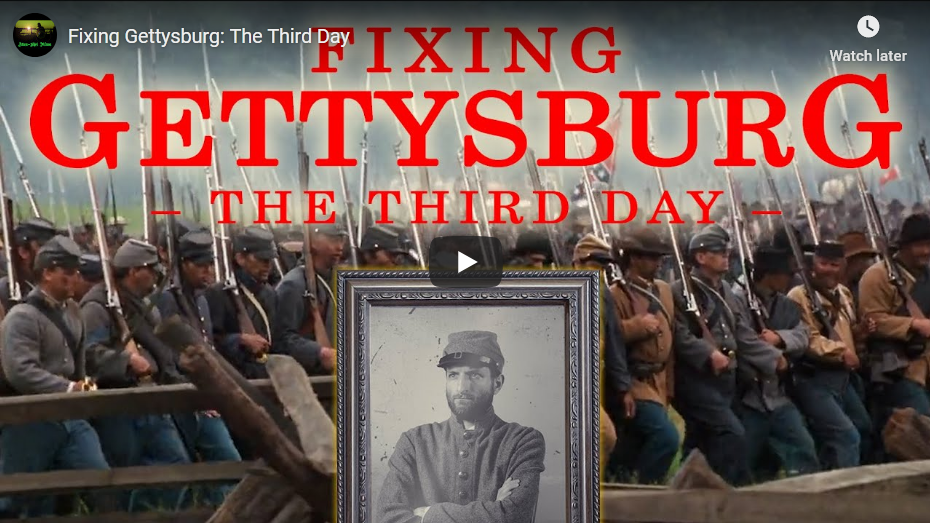
Fixing Gettysburg: The Third Day

Filed under: Books, History, Humour, Media, Military, USA — Tags: , , , — Nicholas @ 06:00

Atun-Shei Films
Published 3 Jul 2020

In this three-part series, I review a classic Ron Maxwell film about a little known historical event that no one talks about called the Battle of Gettysburg. I also present an abbreviated and oversimplified history of the battle, while simultaneously criticizing the movie for presenting an abbreviated and oversimplified history of the battle.

In the third episode, I discuss the third day of fighting on July 3, 1863 – including the morning scrap on Culp’s Hill, East Cavalry Field, and Pickett’s Charge.

Support Atun-Shei Films on Patreon ► https://www.patreon.com/atunsheifilms

Leave a Tip via Paypal ► https://www.paypal.me/atunsheifilms (Between now and October, all donations made here will go toward the production of The Sudbury Devil, our historical feature film)

#Gettysburg #CivilWar #VideoEssay

Watch our film ALIEN, BABY! free with Prime ► http://a.co/d/3QjqOWv
Reddit ► https://www.reddit.com/r/atunsheifilms
Twitter ► https://twitter.com/atun_shei
Instagram ► https://www.instagram.com/atunsheifilms
Merch ► https://atun-sheifilms.bandcamp.com

~REFERENCES~

[1] Frederick Tilberg, Scott Hartwig, John Heiser: Gettysburg National Military Park Handbook (2013). Historic Map and Print Company, Page 49

[2] James Longstreet: From Manassas to Appomattox, Da Capo Edition (1992). Da Capo Press, Page 392

[3] “Haskell’s Account of the Battle of Gettysburg”. Bartleby: Great Books Online https://www.bartleby.com/43/3504.html

[4] “East Cavalry Battlefield – Ranger John Nicholas” (2014). GettysburgNPS https://youtu.be/AfwBOOFFlXQ

Australian defence expansion – “We’re not talking about Canada”

Filed under: Australia, China, Government, Military — Tags: , , , — Nicholas @ 05:00

The Australian government has embarked on a ten-year military expansion program that is clearly directed against recent Chinese bullying in the region:

HMAS Adelaide (LHD 01) and HMAS Canberra (LHD 02), based on the Spanish navy’s Juan Carlos I landing helicopter dock built by Navantia, and commissioned in November 2014 (Canberra) and December 2015 (Adelaide).
Photo by Tony Hisgett via Wikimedia Commons.

[Australian PM] Scott Morrison has unveiled a more aggressive defence strategy aimed at countering the rise of China, while warning that Australia faces regional challenges on a scale not seen since World War II.

The strategy increases the focus on the Indo-Pacific region, with the Prime Minister warning that Australia needs to prepare for a post-COVID-19 world that is “poorer, more dangerous and more disorderly”.

Australia will build a larger military that is focused on its immediate backyard, including new long-range anti-ship missiles, signalling a major shift in the nation’s defence strategy.

“We have not seen the conflation of global economic and strategic uncertainty now being experienced here in Australia in our region since the existential threat we faced when the global and regional order collapsed in the 1930s and 1940s,” the Prime Minister warned.

Mr Morrison also announced a commitment to spend $270 billion over the next decade on defence capabilities, including more potent strike weapons, cyber capabilities and a high-tech underwater surveillance system.

Over the four years, the Australian Defence Force (ADF) is expected to grow by 800 people, comprising 650 extra personnel for the Navy, 100 for the Air Force, and 50 for the Army.

According to Defence’s 2019-20 Budget Statement, the ADF was estimated to grow to 60,090 by this year, with 16,272 full-time public service staff.

Its budget was expected to grow to 2 per cent of Australia’s gross domestic product by 2020-21, “equating to approximately $200 billion in Australia’s defence capability over 10 years”, making the new announcement an increase of $70 billion to the department.

In a speech at the Australian Defence Force Academy Mr Morrison argued the Indo-Pacific is the “epicentre” of rising strategic competition and “the risk of miscalculation — and even conflict — is heightening”.

Make your own paint FROM SCRATCH! // Hand tool woodworking

Filed under: Tools, Woodworking — Tags: , — Nicholas @ 04:00

Rex Krueger
Published 1 Jul 2020

Make your own paint to put that special final touch on your woodworking projects!

More video and exclusive content: http://www.patreon.com/rexkrueger
(more…)

The birth of the steam age

Filed under: Britain, Economics, History, Science, Technology — Tags: , , , , — Nicholas @ 03:00

In the latest installment of his Age of Invention newsletter, Anton Howes explores the very early steam age in England:

Why was the steam engine invented in England? An awful lot hinges on this question, because the answer often depends on our broader theories of what caused the British Industrial Revolution as a whole. And while I never tire of saying that Britain’s acceleration of innovation was about much, much more than just the “poster boy” industries of cotton, iron, and coal, the economy’s transition to burning fossil fuels was still an unprecedented and remarkable event. Before the rise of coal, land traditionally had to be devoted to either fuel, food, or clothing: typically forest for firewood, fields for grain, and pastures for wool-bearing sheep. By 1800, however, English coal was providing fuel each year equivalent to 11 million acres of forest — an area that would have taken up a third of the country’s entire surface area, and which was many times larger than its actual forest. By digging downward for coal, Britain effectively increased its breadth.

And coal found new uses, too. It had traditionally just been one among many different fuels that could be used to heat homes, alongside turf, gorse, firewood, charcoal, and even cow dung. When such fuels were used for industry, they were generally confined to the direct application of heat, such as in baking bricks, evaporating seawater to extract salt, firing the forges for blacksmiths, and heating the furnaces for glass-makers. Over the course of the seventeenth century, however, coal had increasingly become the fuel of choice for both heating homes and for industry. Despite its drawbacks — it was sooty, smelly, and unhealthy — in places like London it remained cheap while the price of other fuels like firewood steadily increased. More and more industries were adapted to burning it. It took decades of tinkering and experimentation, for example, to reliable use coal in the smelting of iron.

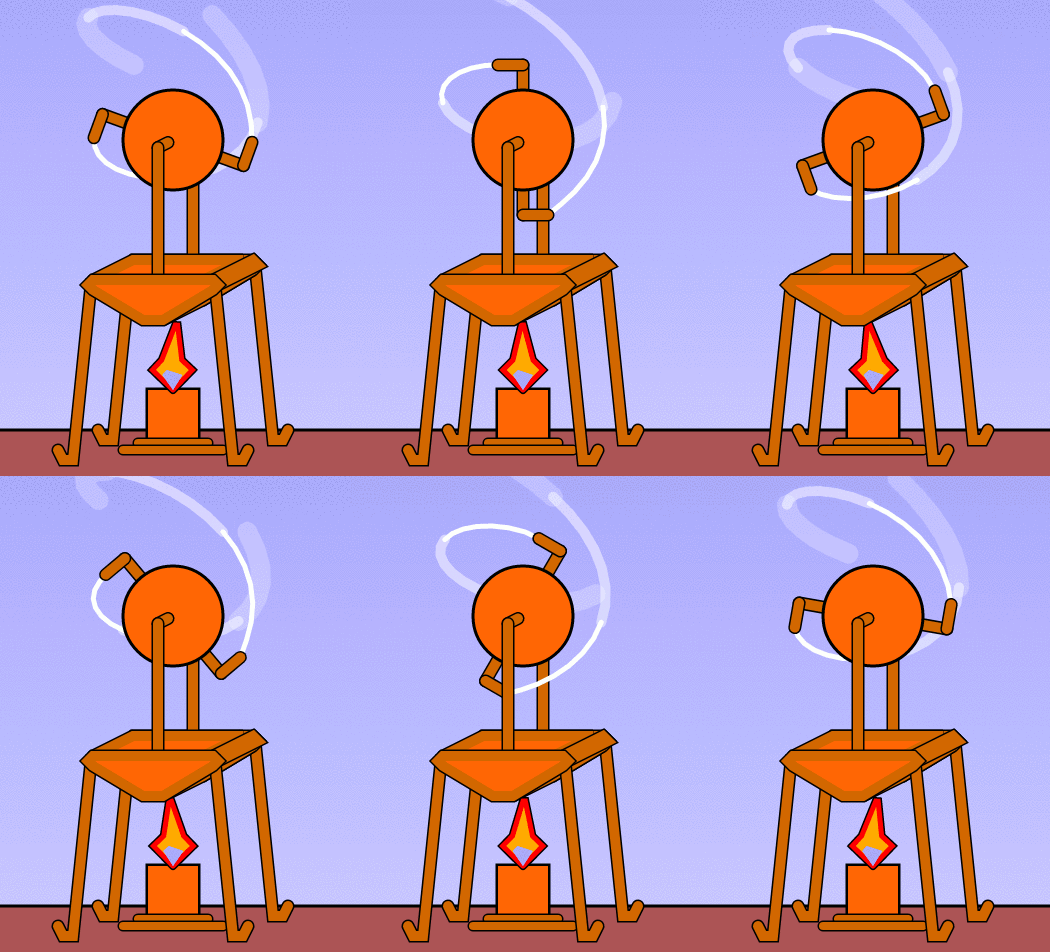
3D animation of an aeolipile or Hero’s engine.
Animation by Michael Frey via Wikimedia Commons.

Yet with the invention of the steam engine, the industrial uses of coal multiplied further. Although the earliest steam engines generally just sucked the water out of flooded mines, by the 1780s they were turning machinery too. By the 1830s, steam engines were having a noticeable impact on British economic growth, and had been applied to locomotion. Steam boats, steam carriages, steam trains, and steam ships proliferated and began to shrink the world. Rather than just a source of heat, coal became a substitute for the motive power of water, wind, and muscle.

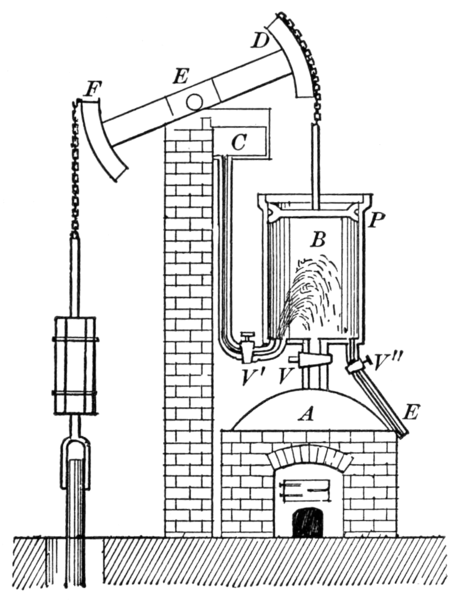
So where did this revolutionary invention come from? There were, of course, ancient forms of steam-powered devices, such as the “aeolipile”. Described by Hero of Alexandria in the 1st century, the aeolipile consisted of a hollow ball with nozzles, configured in such a way that the steam passing into the ball and exiting through the nozzles would cause the ball to spin. But this was more like a steam turbine than a steam engine. It could not do a whole lot of lifting. The key breakthroughs came later, in the late seventeenth and early eighteenth centuries, and instead exploited vacuums. In a steam engine the main force was applied, not by the steam itself pushing a piston, but by the steam within the cylinder being doused in cold water, causing it to rapidly condense. The resulting partial vacuum meant that the weight of the air — the atmospheric pressure — did the real lifting work. The steam was not there to push, but to be condensed and thus pull. It saw its first practical applications in the 1700s thanks to the work of a Devon ironmonger, Thomas Newcomen.

Science was important here. Newcomen’s engine could never have been conceived had it not been for the basic and not at all obvious observation that the air weighed something. It then required decades of experimentation with air pumps, barometers, and even gunpowder, before it was realised that a vacuum could rapidly be created through the condensation of steam rather than by trying to suck the air out with a pump. And it was still more decades before this observation was reliably applied to exerting force. An important factor in the creation of the steam engine was thus that there was a sufficiently large and well-organised group of people experimenting with the very nature of air, sharing their observations with one another and publishing — a group of people who, in England, formalised their socialising and correspondence in the early 1660s with the creation of the Royal Society.

Newcomen’s Atmospheric Steam Engine. The steam was generated in the boiler A. The piston P moved in a cylinder B. When the valve V was opened, the steam pushed up the piston. At the top of the stroke, the valve was closed, the valve V’ was opened, and a jet of cold water from the tank C was injected into the cylinder, thus condensing the steam and reducing the pressure under the piston. The atmospheric pressure above then pushed the piston down again.
Original illustration from Practical Physics for Secondary Schools. Fundamental principles and applications to daily life, by Newton Henry Black and Harvey Nathaniel Davis, 1913, via Wikimedia Commons.

Crusader helmets

Filed under: Europe, History, Middle East, Military — Tags: , , , , — Nicholas @ 02:00

Lindybeige
Published 4 Sep 2014

Here I show you three common styles of crusader helmet, and I comment upon them.

Thanks to Dr David Tetard for the loan of his helmets. These particular ones were bought here:

www.getdressedforbattle.co.uk
http://www.kovexars.cz/index.php (HL 007 and 103)

Lindybeige: a channel of archaeology, ancient and medieval warfare, rants, swing dance, travelogues, evolution, and whatever else occurs to me to make.

▼ Follow me…

Twitter: https://twitter.com/Lindybeige I may have some drivel to contribute to the Twittersphere, plus you get notice of uploads.

website: www.LloydianAspects.co.uk

QotD: Interpreting what men say

Filed under: Humour, Quotations — Tags: , , — Nicholas @ 01:00

Here is what male speech means.

1. “Exactly what I said” — 75% of the time.

2. “Apparently I have not said the right thing yet, because your panties are still on” — 15%.

3. “My God, you’re still talking. You make me wish I had a tranquilizer gun. Doesn’t it ever stop? Jesus, I hope you didn’t say anything important, because all I hear is a buzzing sound. Did I say ‘okay’ or ‘mm-hmm’ or just grunt last time? I better mix it up, or you’ll realize I’m watching the game” — 10%

That covers it.

Steve H., “Traitor in Your Midst: She Must be Dealt With”, Hog On Ice, 2005-02-17.

July 3, 2020

Fixing Gettysburg: The Second Day

Filed under: Books, History, Humour, Media, Military, USA — Tags: , , , — Nicholas @ 06:00

Atun-Shei Films
Published 2 Jul 2020

In this three-part series, I review a classic Ron Maxwell film about a little known historical event that no one talks about called the Battle of Gettysburg. I also present an abbreviated and oversimplified history of the battle, while simultaneously criticizing the movie for presenting an abbreviated and oversimplified history of the battle.

In the second episode, I discuss the first day of fighting on July 2, 1863 – including Dan Sickles’ shenanigans on the left, the 20th Maine on Little Round Top, the 1st Minnesota, and the night battle on Culp’s Hill.

Support Atun-Shei Films on Patreon ► https://www.patreon.com/atunsheifilms

Leave a Tip via Paypal ► https://www.paypal.me/atunsheifilms (Between now and October, all donations made here will go toward the production of The Sudbury Devil, our historical feature film)

#Gettysburg #CivilWar #VideoEssay

Watch our film ALIEN, BABY! free with Prime ► http://a.co/d/3QjqOWv
Reddit ► https://www.reddit.com/r/atunsheifilms
Twitter ► https://twitter.com/atun_shei
Instagram ► https://www.instagram.com/atunsheifilms
Merch ► https://atun-sheifilms.bandcamp.com

~REFERENCES~

[1] Stephen W. Sears: “General Longstreet and the Lost Cause” (2005). American Heritage Magazine https://www.americanheritage.com/gene…

[2] W.C. Storrick: The Battle of Gettysburg (1931). J Horace McFarland Company, Page 26

[3] Frederick Tilberg, Scott Hartwig, John Heiser: Gettysburg National Military Park Handbook (2013). Historic Map and Print Company, Page 31-32

[4] Storrick, Page 27

[5] William B. Styple: Generals in Bronze (2005). Belle Grove Publishing Company, Page 222

[6] “The 1st Minnesota Infantry at Gettysburg” (2014). Iron Brigader https://ironbrigader.com/2014/01/03/1…

[7] Storrick, Page 29-30

[8] Tilberg, Hartwig, Heiser, Page 45

Back to the Future Middle Ages

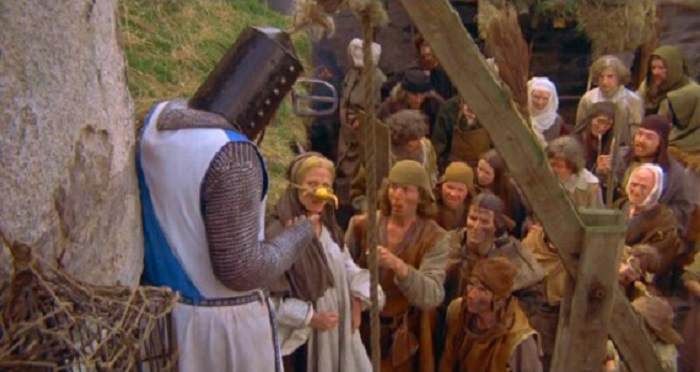
At Spiked, Dominic Frisby takes us back to a time when today’s progressive temper tantrums would fit in perfectly with accepted behaviours of the age … the Middle Ages:

A social media heretic faces trial

How much of what went on in the Middle Ages and early-modern periods do we look back on with abhorrence and a certain amount of perplexity? Burning witches at the stake, lynch mobs, self-flagellation – what possessed people to do such things, we wonder.

But take a step back, look about and you see many of these practices are still flourishing today, though they go by different names.

Here are just some of them.

Let’s start with excommunication. Excommunication meant so much more than being banned from taking communion. It involved you being shunned, shamed, spiritually condemned, even banished. Only through some kind of heavy penance – often a very public, lengthy and humiliating contrition – could you and your reputation be redeemed.

Excommunication became a powerful political weapon. It was dished out to enemies of the faith to destroy their legitimacy. Often it was used as a punishment for sins as minor as uttering the wrong opinion.

What are No Platforming and cancel culture if not a modern form of excommunication? Qualified, competent professionals are hounded out of their jobs and publicly shamed just for uttering the wrong opinion, often simply for a misjudged choice of words. Even just the wrong pronouns.

As often as not, their employer wants a quiet life, so he bows to activist pressure and sacks the target of the witch hunt. Cancel culture is excommunication.

Today’s religions, however, are not the many sects of Christianity that once perforated Europe, but climate change, education, the NHS, gay rights, trans rights, the European Union and multiculturalism. Even coronavirus and the lockdown have become sacrosanct.

Intellectuals of the right and left, from Polly Toynbee to Nigel Lawson, have described the NHS as Britain’s religion. It has replaced the Virgin Mary as the divine matriarch. Why this worship? I suggest it goes back to the late 19th and early 20th centuries, when the state began to replace the church as the main provider of education, welfare and healthcare. After 1945, it was just a matter of time before the welfare state achieved altar status.

“Nuclear Attack” – Atomic Bombings – Sabaton History 074 [Official]

Sabaton History
Published 2 Jul 2020

At 0815 on 6 August 1945, the first atomic bomb, nicknamed “Little Boy”, was dropped out of the B-29 Enola Gay and descended towards the Japanese city of Hiroshima. 43 seconds later, the city was engulfed in a flashing bright light and a shockwave of unimaginable heat and deadly pressure. From the hypocenter of the resulting mushroom-cloud, a blue-green fireball burned and blinded the city and its inhabitants with unprecedented power. 140,000 people were killed in the first few moments. Tens of thousands would die from wounds and radiation. The age of atomic warfare had begun.

Support Sabaton History on Patreon: https://www.patreon.com/sabatonhistory

Listen to “Nuclear Attack” on the album Attero Dominatus
CD: http://bit.ly/AtteroDominatusStore
Spotify: http://bit.ly/AtteroDominatusSpotify
Apple Music: http://bit.ly/AtteroDominatusAppleMusic
iTunes: http://bit.ly/AtteroDominatusiTunes
Amazon: http://bit.ly/AtteroDominatusAmzn
Google Play: http://bit.ly/AtteroDominatusGooglePlay

Listen to Sabaton on Spotify: http://smarturl.it/SabatonSpotify
Official Sabaton Merchandise Shop: http://bit.ly/SabatonOfficialShop

Hosted by: Indy Neidell
Written by: Markus Linke and Indy Neidell
Directed by: Astrid Deinhard and Wieke Kapteijns
Produced by: Pär Sundström, Astrid Deinhard and Spartacus Olsson
Creative Producer: Joram Appel
Community Manager: Maria Kyhle
Executive Producers: Pär Sundström, Joakim Broden, Tomas Sunmo, Indy Neidell, Astrid Deinhard, and Spartacus Olsson
Post-Production Director: Wieke Kapteijns
Edited by: Iryna Dulka
Sound Editing by: Marek Kaminski
Maps by: Eastory – https://www.youtube.com/c/eastory

Archive by: Reuters/Screenocean https://www.screenocean.com
Music by Sabaton.

Colorizations:
– Dememorabilia – https://www.instagram.com/dememorabilia/

Sources:
– U.S. Department of Energy
– Bomb icon by P Thanga Vignesh from the Noun Project
– bockelsound from freesound.org
– Vilna Gaon State Jewish Museum

An OnLion Entertainment GmbH and Raging Beaver Publishing AB co-Production.

© Raging Beaver Publishing AB, 2019 – all rights reserved.

From the comments:

Sabaton History
2 days ago

August 6, 1945. On this fateful Monday morning our world changed forever.

Nuclear weapons were now a reality, destruction on a whole new level a possibility. International power dynamics, foreign politics and conflict handling would never be the same once this new kind of weapon of mass destruction had entered the scene. The threat of potentially world-ending nuclear war, the fear that the men in power would push “the red button”, would hang over people like a dark cloud from this day on. The Nuclear Age had begun.

If you’re interested in how politics developed during The Nuclear Age, you can explore that in the day-by-day coverage of The Cuban Missile Crisis over on TimeGhost History. The first introduction, “USA Starts the Atomic Arms Race”, is already up and you can watch it right here: https://youtu.be/zEXjoBe5ZdI

Birth, rapid growth, profitable stasis, bureausclerosis, decline, death – typical tech firm lifecycle

Filed under: Bureaucracy, Business, Technology — Tags: , , , — Nicholas @ 03:00

In the Continental Telegraph, what looks to be a pretty solid characterization of the corporate life-cycle for technology firms:

There are generally, 6 stages in the life of a tech company:

  1. Inception. A couple of smart kids start something in a garage. Massive innovation.
  2. Fast growth. The business moves to some good offices, number of staff increases. They take on smart, fast moving people who are innovating big. A few people know them.
  3. Steady growth. The business is now something of a household name. They get their own small head office. Staff are more like normal business. Innovation continues, but the bureaucracy starts to grow.
  4. Bureaucracy. The business is a household name. They have multiple offices, or something designed by a smart-ass architect. There’s still staff coming in, but they’re mostly seeing it as a nice warm place to sit and be bureaucrats. The innovators start leaving as it’s just not interesting. They might even be making lots of money, but it’s mostly just living off what was built in earlier phases, or large dumb wasteful projects that go nowhere for years.
  5. Decline. A new disruptor arrives on the scene. They innovate in a field you’re involved in. You can’t keep up because in the previous phase, you replaced the innovators with bureaucrats. You’re outsmarted.
  6. Terminal decline and death. You slowly or quickly disappear, maybe holding onto a few customers who habitually use you.

I think there might also be something about when government starts taking an interest in you, and I think it’s quite some time into stage 4. Google are already there. Firing James Damore is very much bureaucracy state behaviour. They wouldn’t have cared when it was a tiny number of staff in an office. And how much have they really innovated in the last decade?

The History of: The British 1942 Battle Jerkin & Skeleton Battle Jerkin | Uniform History

Filed under: Britain, Cancon, History, Military, WW2 — Tags: , , , , , — Nicholas @ 02:00

Uniform History
Published 24 Mar 2020

The start of another two parter, in this one we cover the British Battle Jerkin family as it helped inspire the US Normandy Assault Vest’s creation.

Music by: https://www.juliancrowhurst.com/

QotD: Pop music

Filed under: Economics, Media, Quotations — Tags: , , , — Nicholas @ 01:00

The thing I always hated hearing from my grandfather was how modern music was terrible and not fit for civilized people. He was a man of his age and class, so he used colorful euphemisms to describe popular music. Even as a kid, I understood that every generation has their soundtrack. Maybe never having known anything but a world where pop culture dominated, this came naturally to me, while my grandfather still recalled an age before everyone had a radio and television. Maybe he knew things I couldn’t know.

Either way, I’ve always just assumed that once I passed my mid-20’s, pop music was no longer for me. Some stuff would be appealing, but most would be aimed at kids and strike me as simplistic and repetitive. There were some good bands in the 90’s that I liked, but most of it was not my thing. By the 2000’s, I was unable to name popular groups or the songs at the top of the charts. Today, I have not heard a single note from any song on the current top-40. On the other hand, I’m sure I’ve heard some version of all of it.

That may be why music sales have collapsed. A 15-year old can go on YouTube or Spotify and find fifty versions of the current pop hits, going back before their parents were born. They can also find stuff from previous eras that was remarkably well done and performed by people with real talent. Justin Timberlake may be very talented as a singer, but no one is confusing him with Frank Sinatra. It’s simply a lot easier for young people to see that pop music is just manufactured pap from Acme Global Corp.

“The Z Man”, “The Soundtrack Of This Age”, The Z Blog, 2018-03-15.

« Newer PostsOlder Posts »

Powered by WordPress