Lindybeige
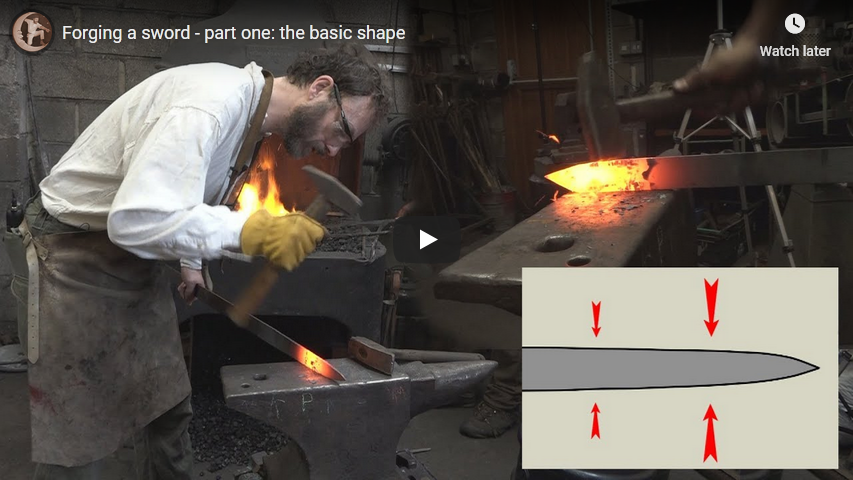
Published 8 Feb 2018Hammering hot metal into shape is quite a satisfying task, when it goes well. Here you see me shaping out my sword.
Support me on Patreon: https://www.patreon.com/Lindybeige
I was invited by the Cut and Thrust Collective to go to Glastonbury and make my own sword. In an earlier video, you saw my training (forging a nail), and immediately after that we started on the sword. Thom Leworthy was the bladesmith showing me how it is done.
The Cut and Thrust Collective:
glastonburysmith@gmail.comBuy the music – the music played at the end of my videos is now available here: https://lindybeige.bandcamp.com/track…
Lindybeige: a channel of archaeology, ancient and medieval warfare, rants, swing dance, travelogues, evolution, and whatever else occurs to me to make.
▼ Follow me…
Twitter: https://twitter.com/Lindybeige I may have some drivel to contribute to the Twittersphere, plus you get notice of uploads.
website: http://www.LloydianAspects.co.uk
August 22, 2020
QotD: Sex-differentiated status hierarchies
Jordan Peterson had this to say about sex-differentiated status hierarchies:
Girls can win by winning in their own hierarchy — by being good at what girls value, as girls. They can add to this victory by winning in the boys’ hierarchy. Boys, however, can only win by winning in the male hierarchy. They will lose status, among girls and boys, by being good at what girls value. It costs them in reputation among the boys, and in attractiveness among the girls. Girls aren’t attracted to boys who are their friends, even though they might like them, whatever that means. They are attracted to boys who win status contests with other boys.
“whatever that means”. Heh. Shivvy way to say, “which means nothing”.
When JP discusses sex differences, he could be reading CH posts. Whatever one thinks of the criticisms leveled against him (some are valid), he does have a decent grasp of the sexual market and how men and women navigate divergent routes through an ocean of mate prospects to get what they want.
However, this is one of the rare instances when I disagree with his premise. He’s generally correct that, at least within the bounds of our current cultural arrangement, women have two status hierarchies available to them while men only have one. Our gynarcho-tyranny not only encourages but aggressively impresses upon women the urgency and even moral duty of succeeding in male domains (leaning in), while simultaneously encouraging men to sacrifice their status within their own male domains to make way for more women (and consequently rendering themselves less sexually attractive to women who are now their equal or higher in social status).
Women who do succeed in the man’s world can expect to ascend the intrafemale status ladder (more precisely, the intra-feminist status ladder), but where JP is wrong is assuming these women don’t also suffer an SMV status loss the near-equivalent of the SMV status loss suffered by men who succeed at girlie games of one-uppance.
Just as girls aren’t attracted to effeminate males, and other men are repulsed by nancyboys, the inverse is as true: men aren’t attracted to masculine, status-striving girls, and other women don’t subconsciously look up to mouthy careerist shrikes with the same mix of envy and admiration that they look up to physically beautiful women.
CH, “Sex-Based Status”, Chateau Heartiste, 2018-06-04.
August 21, 2020
British Deserters, Sword Fights, and Poison Gas – WW2 – OOTF 016
World War Two
Published 20 Aug 2020What happened to deserters in the British Army? Did Chinese and Japanese troops ever engage in sword to sword combat? Why didn’t Germany use poison gas on the battlefield? Find out the answers to all these questions in today’s Out of the Foxholes!
Join us on Patreon: https://www.patreon.com/TimeGhostHistory
Or join The TimeGhost Army directly at: https://timeghost.tvFollow WW2 day by day on Instagram @World_war_two_realtime https://www.instagram.com/world_war_two_realtime
Between 2 Wars: https://www.youtube.com/playlist?list…
Source list: http://bit.ly/WW2sourcesHosted by: Indy Neidell
Written by: Rune Væver Hartvig
Director: Astrid Deinhard
Producers: Astrid Deinhard and Spartacus Olsson
Executive Producers: Astrid Deinhard, Indy Neidell, Spartacus Olsson, Bodo Rittenauer
Creative Producer: Joram Appel
Post-Production Director: Wieke Kapteijns
Research by: Rune Væver Hartvig
Edited by: Jakub Janiec
Sound design: Marek KamińskiColorizations:
Mikołaj UchmanVisual Sources:
Imperial War Museums: HU 762498, Q 79508, El Alamein 1942, E 18542, B5114, MH 26392, F2845,
Library of Congress
Antoine from Flickr.com
National Archives NARA
Bundesarchive
Narodowe Archiwum Cyfrowe
The icons from Noun Project by: Milinda Courey, Arthur Shlain, Delwar Hossain, ahmad, Muhamad Ulum, Rooty, Simon Child, carlotta zampini, Wonmo Kang, Vectors Point, EucalypMusic:
“Break Free” – Fabien Tell
“Ancient Saga” – Max Anson
“Defeated” – Wendel SchererArchive by Screenocean/Reuters https://www.screenocean.com.
A TimeGhost chronological documentary produced by OnLion Entertainment GmbH.
Geography works against CANZUK ever happening
Ted Campbell is a big fan of the CANZUK scheme (Canada-Australia-New Zealand-United Kingdom) to create an “anglosphere” power alongside the current economic big-hitters on the world stage like the United States, China and the European Union. I agree it has historical, nostalgic appeal, but as Aris Roussinos points out, geography is a big stumbling block to it ever being much more than an idea:
Since losing the empire, Britain has notoriously struggled to find a role on the world stage. Initial attempts to piggyback on the power of our successor as global hegemon, the United States, by acting as a guiding force — a Greece to America’s Rome, in Harold Macmillan’s phrase — faltered due to the total absence of interest ever shown in this arrangement by any American administration.
The subsequent attempt to remould Britain as a European power acting in concert with its continental neighbours through the European Union was an unhappy marriage, and has ended in a rancorous divorce whose final settlement is still to be determined. Adrift on the world stage, we are in need of good ideas.
Instead, we are offered CANZUK, a reheated Edwardian fantasy of a globe-spanning Anglosphere acting as a world power which excites the enthusiasm of a small coterie of neoliberal and neoconservative ideologues, if no one else.
In a recent piece for the Wall Street Journal, the historian and Churchill biographer Andrew Roberts argued that the CANZUK nations — Canada, Australia, New Zealand and the UK — ought to establish “some form of federation among them” as a “second Anglospheric superpower” combining “free trade, free movement of people, a mutual defense organization and combined military capabilities” , which would “create a new global superpower and ally of the U.S., the great anchor of the Anglosphere”.
One cannot fault Roberts for the grandeur of his vision, even if the details of how this would actually work are left to others to fill in. Instead, we are reassured, this would not be a centralising project like the hated EU; rather, “its program for a loose confederal state linking the Westminster democracies would be clearly enunciated right from the start.” Already, we see the harsh hand of reality ready to crush this initially appealing vision. On the one hand, CANZUK is a globe-spanning superpower ready to be born; on the other, it is merely a loose grouping of separate national governments, which would, like all national governments, act according to their own interests above all.
By totting up the different GDP figures of the various CANZUK nations, Roberts claims that his proposed Empire 2.0 “would have a combined GDP of more than $6 trillion, placing it behind only the U.S., China and the EU,” while “with a combined defense expenditure of over $100 billion, it would also be able to punch above its weight”.
Yet the flaws of this argument are obvious. As other critics have noted, only a minuscule proportion of the CANZUK nations’ trade is with each other, save New Zealand, an economic satellite of Australia. Australia is a great East Asian trading power, and will remain so. Canada is enmeshed in the greater North American trading sphere, as are we with Europe, whatever Brexiteers may wish. As always, the simple matter of geography trumps the affective bonds between far-flung kith and kin, whatever their emotional appeal.
“Uprising” Pt. 2 – The Liberation of Paris 1944 – Sabaton History 081 [Official]
Sabaton History
Posted 20 Aug 2020Mid-August 1944. The battle for France enters its decisive phase. With the Allied spearheads just 100 km away from Paris, the Résistance prepares for its long-awaited uprising. While collaborators and fascist officials flee the city in panic, many insurgents are eager to immediately rise up against the occupation and fight the Germans in the streets. But there is need for caution. The Germans are still there in force, and they have tanks and machine guns. The fear that this might turn into “another Warsaw” if the Allies don’t show up in time is very real.
Support Sabaton History on Patreon: https://www.patreon.com/sabatonhistory
Listen to “Uprising” on the album Coat Of Arms:
https://music.sabaton.net/CoatOfArmsWatch the Official Music Video of “Uprising”:
https://www.youtube.com/watch?v=01IaK…Listen to Sabaton on Spotify: http://smarturl.it/SabatonSpotify
Official Sabaton Merchandise Shop: http://bit.ly/SabatonOfficialShopHosted by: Indy Neidell
Written by: Markus Linke and Indy Neidell
Directed by: Astrid Deinhard and Wieke Kapteijns
Produced by: Pär Sundström, Astrid Deinhard, and Spartacus Olsson
Creative Producer: Maria Kyhle
Executive Producers: Pär Sundström, Joakim Broden, Tomas Sunmo, Indy Neidell, Astrid Deinhard, and Spartacus Olsson
Post-Production Director: Wieke Kapteijns
Editor: Iryna Dulka
Sound Editor: Marek Kaminski
Archive by: Reuters/Screenocean https://www.screenocean.com
Community Manager: Maria Kyhle
All music by SabatonSources:
– Imperial War Museum: B 9298
– Bundesarchiv, CC-BY-SA 3.0: Bild_101I-027-1477-16, Bild_183-2008-0710-500, Bild_183-2003-1112-500
– lubini from freesound.orgAn OnLion Entertainment GmbH and Raging Beaver Publishing AB co-Production.
© Raging Beaver Publishing AB, 2019 – all rights reserved.
Virtuesplaining Blazing Saddles
Paul du Quenoy says that Mel Brooks is cancelled after all:
It seems like only yesterday that HBO Max, the financially troubled American cable television network’s new film streaming service, signalled its virtue by removing Gone With The Wind from viewing so that the classic film could be properly “contextualised” as what presenter and University of Chicago film professor Jacqueline Stewart calls “a prime text for examining expressions of white supremacy in popular culture”. She believes this is useful for the “re-education” of audiences who might otherwise stray into thoughtcrime.
Mel Brooks’s smash hit 1974 comedy Blazing Saddles, which seems to have been added to HBO Max since the Gone With The Wind dust up and is known for its liberal use of the feared and loathed “n-word”, arrived with a similarly patronising disclaimer already installed. In a three-minute introduction that apparently cannot be skipped over, Stewart is there again, this time to inform viewers that “racist language and attitudes pervade the film”, while instructing them that “those attitudes are espoused by characters who are portrayed here as explicitly small-minded, ignorant bigots … The real, and much more enlightened, perspective is provided by the main characters played by Cleavon Little and Gene Wilder”.
Thanks, Aunt Jacqueline. If you have not seen Blazing Saddles – and if you are under the age of forty there is an excellent chance some prudish authority figure sanitised it out of your cosseted millennial existence – it stands as one of the greatest, and the certainly the funniest, anti-racist films of all time. Based on a story by Andrew Bergman, Brooks conceived it as a scathing send-up of racism and the hypocrisy that still enabled it after the great civil rights victories of the 1960s. Brooks’s idiom was a parody of the classic Western, by then an exhausted genre that had, among other flaws, become inanely predictable and was much criticised for leaving out minorities. A landmark of American film, Blazing Saddles was selected in 2006 for inclusion in the US National Film Registry, which recognises “culturally, historically, or aesthetically significant films” worthy of preservation.
Drenched in hilarity – and by my count using the “n-word” 17 times in its 93-minute run – the plot involves a conspiracy by an avaricious U.S. state attorney general who wants to drive white settlers off land he needs to complete a profitable railroad project. After having outlaws wreak mayhem on the townspeople, he recommends that the governor appoint a black sheriff to restore law and order, cynically assuming that their racism will cause them to reject the new lawman and give up. Despite a rough initial reception, the sheriff outwits attempts to get rid of him and, with the help of a washed up but sympathetic alcoholic gunslinger, leads the townspeople to victory, winning their love and respect before moving on to other brave deeds.
While HBO no longer wants to risk having its paying customers think for themselves (and what stale corporate outfit uneasily transitioning to a crowded new market wouldn’t?), it could rightly be said that anyone dumb enough to miss the film’s message might be a recent product of Anglo-American higher education. I do not mean this at all facetiously. Decaying and run by a self-important clerisy whose demands to be taken seriously only become shriller as it declines in reach and vitality – and from which any participant can be dismissed for even the slightest speech or behavioural infraction – academia naturally discourages humour. Jokes, which can almost always cause some kind of offence, are simply too risky to be told or laughed at, even in private. Finding the wrong thing funny can invite career-hobbling accusations that one has demeaned a student or colleague and thereby made them feel unacceptably “uncomfortable” or even physically “unsafe”. Perceived flippancy bruises sanctified “professional seriousness” in a way tantamount to sacrilege. The only tolerated exceptions are a kind of solemn irony that offers comfort in coping with academia’s increasing irrelevance and a resigned gallows humor about its ever more limited prospects.
Don’t Use Pallet Wood!! USE THIS INSTEAD…(Cull Wood Vs. Pallet Wood)
The Honest Carpenter
Published 2 May 2020Pallet wood projects have been all the craze for a while now. But, in general pallets are very SUB-PAR lumber, and they have other problems associated with them as well! There is a much better option out there: CULL WOOD. This short video from The Honest Carpenter will compare the two: pallet wood vs. cull wood.
DON’T USE PALLET WOOD!
Pallets are typically pine or oak, but they’re inferior grades of that lumber. They’re shaggy and the end grain splits. Not to mention that they’re full of nails!
To work with pallets, you often have to break them down. But, the spiral shank nails don’t come out easily. Then, you might have nail fragments in your lumber, which can damage your saw blades, or harm you.
Also, pallet wood is not as thick as most dimensional lumber (it’s usually only 1/2″ to 5/8″ thick). And, pieces are typically only 3′ to 4′ long. So, you have to work around these dimensional limitations from the beginning of a project.
Also, pallet wood sometimes contains dangerous insecticides, such as METHYL BROMIDE!
AVOID PALLETS MARKED WITH THE LETTERS “MB” OR “EUR.” THEY’VE BEEN FUMIGATED.
Even non-fumigated pallets may have had chemicals spilled on them during shipping. And, pallet wood is never actually “treated” (with a fungicide), so they will eventually rot outside.
CULL WOOD IS THE SUPERIOR OPTION!
Cull wood is wood that has been pulled off the shelves at lumberyards because it isn’t quite up to salable standards. In many cases, it will contain only minor defects.
This wood is often marked down 70%! In some cases, you can even get it for free…
Also, cull wood comes in all varieties and dimensions. It is actual lumber–the same kind you would typically use for projects. And, it won’t have contain nails or spilt chemicals.
Thanks for watching the video!
Be sure to visit us at The Honest Carpenter Website:
www.thehonestcarpenter.comDon’t Use Pallet Wood!! USE THIS INSTEAD…(Cull Wood Vs. Pallet Wood)
QotD: Our overprotective culture
Our society has become an overprotective mother. If you protect people, you reduce their competence.
There’s a rule of thumb for dealing with elderly people in old age homes: Never do anything for anyone that they can do for themselves. It sounds cruel, but it’s not cruel.
This is one of the pathologies of our culture. A major pathology, and this is associated with a kind of immaturity and a kind of fear and this Oedipal mother problem, which is, “I don’t want you to suffer any distress right now.” Fine, but what about tomorrow and next week and next month? You might have to suffer a lot of distress right now so that you’re better next week and next month.
Jordan Peterson, “Christie Blatchford Sits Down With ‘Warrior For Common Sense’ Jordan Peterson”, National Post, 2018-02-07.
August 20, 2020
Will a premium plane really cut “out of the box”?
Rex Krueger
Published 19 Aug 2020Find out if this premium plane delivers everything that it promises. Test and setup.
More video and exclusive content: http://www.patreon.com/rexkrueger
Watch my FREEHAND Sharpening Tutorial: https://www.youtube.com/watch?v=EmyW8…
(more…)
Thomas Becket, Archbishop of Canterbury 1162-1170
Reverend Steve Morris tries to show why St. Thomas of Canterbury needs a “reboot” for modern eyes:

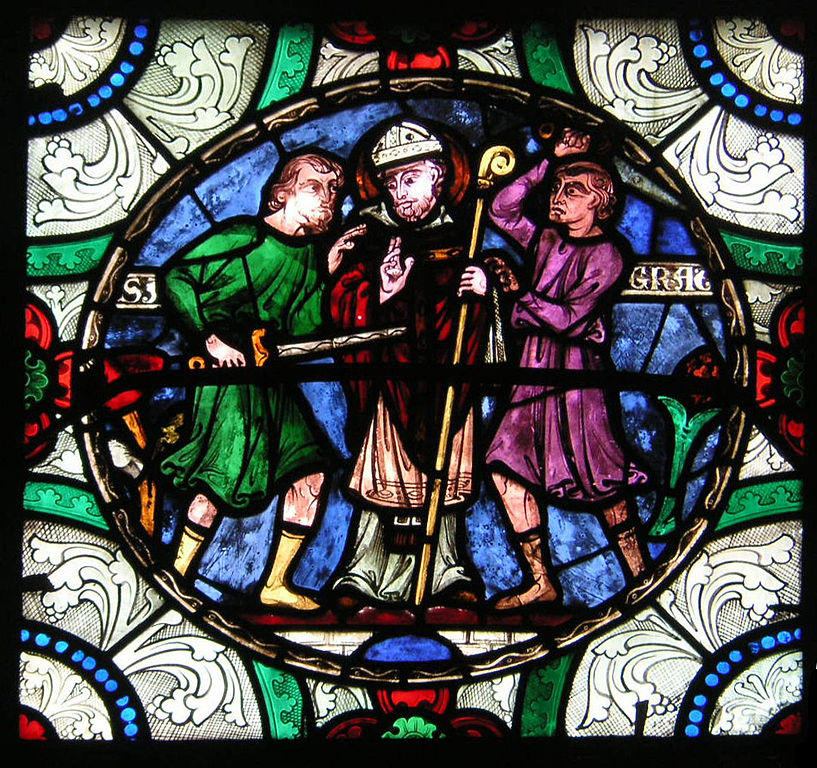
Stained glass showing the murder of St. Thomas at Canterbury on 29 December, 1170.
Wikimedia Commons.
It’s 850 years since that night when four knights murdered the Archbishop of Canterbury. It’s been a rocky old road for Thomas Becket despite hundreds of years as the poster-boy of the cult of saints which swept medieval England. His reputation, his legacy and his conduct have been filleted over the last few centuries and we are left with just a ghost of the man who, once upon a time, stood for all that was good.
It is a cautionary tale of historical revisionism, measuring yesterdays’ saints by today’s “standards” and assembling a set of half-truths to trash the reputation of England’s great, perhaps greatest, saint. It is high time he made a comeback – especially in these political times. After all, Becket was perhaps the greatest political martyr we have. Of course, there is always truth in just about any criticism. And Becket lays himself open. He was, to say the least, stubborn. He was a contrarian and he was reckless with his own safety. In an age of kingly power, it doesn’t do to embarrass the monarch.
The charge sheet does quickly stack up. Becket was a canny careerist (although you’d be hard pushed to find anyone of influence at the time who wasn’t). He seemed to have a death wish, or at least refused to listen to perfectly sensible advice on taking a more circumspect path. And his cause, seen through a certain lens, seems off-beam for modern times. He has been painted as standing for the ancient legal power of the church against a reforming king who began to kick-start Common Law. But of course, it’s never as simple as this.
But none of this was the real problem and none of it was what caused our great saint to be consigned to the historical dustbin. As is often the way, the problem comes down to background and class. Becket was born to only modestly well-off parents in London (he has always been London’s saint). His father was middle-class, and a merchant. Becket was “trade” by background and it was something he couldn’t shake off. But his rise was an astounding feat of defying gravity.
In an era of complex geopolitics and conflicts between pope and state Thomas rose through the ranks and became Archbishop of Canterbury. At first, he seemed like the king’s man, but relations soured. Becket and the king were entangled in a fight to the death, with the archbishop excommunicating various opponents and generally throwing his weight around.
His death was gruesome. Four knights ambushed him. He could have run or barricaded himself in the cathedral, but he told his followers that God’s house should not be made a fortress. He pushed one of his attackers. What followed was a flurry of sword-strokes to the head – one of which took his tonsured skull right off. The contemporaneous reports paint a ghastly picture of brain fluid and blood mixing freely on the cathedral floor. But it didn’t end there.
Britain, France, and Israel’s War Collusion | The Suez Crisis | Prelude 2
TimeGhost History
Published 19 Aug 2020Britain and France are becoming increasingly worried about the growing threat of Egypt to the Middle East and Africa — they are not alone — Israel is also worried. Israel’s close proximity to Egypt makes them a valuable secret accomplice in finding justification for a war that will seek to remove Gamal Abdel Nasser.
Join us on Patreon: https://www.patreon.com/TimeGhostHistory
Hosted by: Indy Neidell
Written by: Joram Appel and Francis van Berkel
Director: Astrid Deinhard
Producers: Astrid Deinhard and Spartacus Olsson
Executive Producers: Astrid Deinhard, Indy Neidell, Spartacus Olsson, Bodo Rittenauer
Creative Producer: Joram Appel
Post-Production Director: Wieke Kapteijns
Research by: Joram Appel
Image Research: Ian Irungu, Shaun Harrison & Daniel Weiss
Edited by: Daniel Weiss
Sound design: Marek Kamiński
Maps: Ryan WeatherbyColorizations:
– Mikolaj Uchman
– Daniel Weiss
– Carlos Ortega Pereira (BlauColorizations) – https://www.instagram.com/blaucoloriz…
– Norman Stewart – https://oldtimesincolor.blogspot.com/Sources:
National Archives NARA
Library of Congress Geography and Maps Department
Munich_conference – Mareček2000From the Noun Project:
– Paris – Vonn WeisenbergerSoundtracks from Epidemic Sound:
– “Devil’s Disgrace” – Deskant
– “Dreamless Nights” – The New Fools
– “Where Kings Walk” – Jon Sumner
– “Invocation” – Deskant
– “Call of Muezzin” – Sight of Wonders
– “Crying Winds” – Deskant
– “Divine Serpent” – Deskant
– “Pepper Seeds” – Rune Dale
– “Searching Through Sand” – Deskant
– “Scented Nectar” – Rune Dale
– “As the Rivers Collapse” – DeskantArchive by Screenocean/Reuters https://www.screenocean.com.
A TimeGhost chronological documentary produced by OnLion Entertainment GmbH.
From the comments:
TimeGhost History
2 days ago
“And now for our second prologue episode on the Suez Crisis. This one is all about a conspiracy where three countries believe they can fool the US, USSR, and entire UN all at the same time. Hindsight is of course 20/20, but it really is astounding that Britain, France, and Israel thought they could start a war with another member of the UN with a completedly engineered casus belli. This isn’t the first or last time something like this has happened in the history of international relations. Still, the pure audacity of Britain and France in their plans here really does seem quite unique. Can you guys think of any other examples of this kind of thing?”Cheers,
Francis.
Nock 6 Barrel Flintlock
Forgotten Weapons
Published 16 Nov 2016Sold for $40,250.
Cool Forgotten Weapons Merch! http://shop.bbtv.com/collections/forg…
Henry Nock was a highly respected and very talented British gunsmith, who manufactured a wide variety of arms including military muskets for the British Army. He is probably best known on the internet for his 7-barreled volley gun (which fires all seven charges simultaneously), intended for naval ship boarding operations. This particular gun resembled that volley gun design, but is actually a self-priming flintlock pepperbox. Its cluster of 6 barrels is manually rotated, allowing the used to fire six separate shots before needing to reload. The priming mechanism and lock bear a remarkable similarity to the Collier repeating flintlocks, and it is suspected that this system was developed by Artemis Wheeler of the United States.
QotD: Manipulating minimum wage laws to harm your competitors
I would be very surprised if careful research of the history of this Oregon statute did not reveal a producer group — or producer groups — who benefitted materially from the minimum-wage-induced stifling of competition.
The logic of such rent-creating legislation is plain: producer group A competes for many of the same customers against producer group B. Producer group A, however, uses for its production a mix of inputs (most importantly, capital and labor) that differs from the mix used by producer group B. Also, producer group B might compete most effectively against producer group A not by producing outputs as nearly identical as possible to that of A but, instead, by producing “substitute” goods or services that sell at prices lower than those charged by producer group A.
For example, producer group A might consist of locally owned restaurants with tablecloths and serving food freshly prepared by skilled chefs, while producer group B consists of chain restaurants serving food less exquisite but priced much lower. Members of producer group A are upset that producer group B is competing successfully for some diners who would likely otherwise eat more frequently at the restaurants of producer group A. What are the members of producer group A to do?
They could accept the fact that competition is not tortious — indeed, that economic competition is healthy for the economy at large — and do nothing other than compete harder to win more consumer patronage. That’d be the honest and honorable path to take. But government is in the picture, standing ready to escort those with little interest in honesty and honor down the rent-seeking path.
“So just pass legislation outlawing chain restaurants in our state,” suggests the leader of producer group A.
“Wish I could,” responds Sen. Slimey, “but that’s too blatant. Plus, it might not pass muster with the courts. But I’ve got an alternative plan that’s just as good.”
“Do tell!” exclaims the leader of producer group A.
“Well, I understand,” replies Sen. Slimey, “that the restaurants run by producer group B use many more low-skilled workers in their kitchens than your restaurants use.”
“That’s correct. We serve only fine food, so we hire experienced, high-skilled chefs, whose market wages are high.”
“So,” observes Sen. Slimey, “let’s enact a statute that raises the minimum wage above the average wage now paid to the average worker in producer group B’s restaurants, but lower than the average wage paid to workers in your — producer group A’s — restaurants.”
“Brilliant!” declares the leader of producer group A, who sees immediately that, while the minimum-wage legislation will on its face — de jure — apply to all restaurants, it will in fact have a differentially harsh effect on the restaurants in producer group B. The minimum wage will artificially raise producer group B’s costs of operation, causing them to reduce their outputs. One consequence of producer group B’s reduced outputs will be artificially increased demand for meals served at producer group A’s restaurants.
Sen. Slimey smiles, knowing that the news media, as well as most of the intellectuals in town, will applaud him for his apparent humanity and “Progressive” values. It’s a win-win for Sen. Slimey and for members of producer group A. And too few people will pay close-enough attention to the members, workers, and customers of producer group B to suspect that Sen. Slimey is anything other than a socially conscious public servant.
Don Boudreaux, “Doing Bad By Pretending to Do Good”, Café Hayek, 2018-05-13.