
The Armourer’s Bench
Published 22 Mar 2026The Canadian Armed Forces are set to adopt variants of Colt Canada’s MRR as the Canadian Modular Assault Rifle (CMAR). The announcement stated that more than 65,000 rifles will be procured over the next 5 years to replace the Colt Canada C7 rifles and C8 carbines currently in Canadian service.
Be sure to check out our accompanying article for this video here – https://armourersbench.com/2026/03/22/canada-adopts-new-rifle/
March 23, 2026
Canada’s NEW Rifle – the CMAR
Comments Off on Canada’s NEW Rifle – the CMAR
Mapping the “Manosphere”
Janice Fiamengo says — and a lot will agree with here — that we can’t hate gender studies enough:

As Leo Kearse posted on Substack Notes – “When’s Louis Theroux doing a documentary on THIS manosphere? When’s he going to expose the idiocy of its leading proponents, such as Stella Creasy and Hannah Spencer?”
Nothing beats a threat narrative for a gender studies academic in search of relevance, and what more urgent than the dark corners of the internet where men (and the women who love them) allegedly spread misogyny and male supremacism.
Many academics now claim expertise in this area of gender studies, probing the volatile fragility and violent anxieties of manosphere men, and calling to repentance all who resist the feminist future. Many of these academics are women, making a sweet living warning about male “hate”, but there are plenty of male feminists as well, crusaders against others’ toxicity.
In “Mapping the Neo-Manosphere(s): New Directions for Research“, four scholars of masculinity survey the latest research on digital media and violent extremism. Vivian Gerrand, Debbie Ging, Joshua Roose, and Michael Flood claim to have read hundreds of studies of the manosphere, which they call an “online ecosystem of anti-women actors”.
According to them, the manosphere is brimming over with grievance-mongering, grift, and gynocidal fantasy. Nothing in it is good or sincere or well-intentioned. Various sub-genres of online content, including fitness advice, stoicism, and the tradwife lifestyle, are presented as outgrowths of misogynistic extremism from which millions of men and boys require rescue, by force if necessary.
A Roll Call of Buzzwords
The researchers make no distinction between manosphere content generally and what they call male supremacy — or, indeed, between those terms and a host of others, all pejorative. Their introductory paragraph alone provides a roll call of buzzwords that link any dissent from Marxist-feminist orthodoxy to misogynistic violence.
The manosphere, we’re told, is “bound by the belief that mainstream society is a misandrist conspiracy that disadvantages men”. Manosphere groups “frame contemporary gender politics as a ‘war against men'”. These groups also “frequently engage in misogynistic abuse as well as inciting violence against women”, thus creating an “online environment of accelerating harms”.
None of these statements is ever supported with evidence, but it is likely too much to expect evidence: the direct equation between male-positive advocacy and murderous misogyny is no longer a subject of academic debate, if it ever was. It is an axiom.
In one short paragraph, then, we move from non-feminist perspectives to “misandrist conspiracies”, and from belief in a “war against men” to “inciting violence” and “accelerating harms”. Anyone with even a passing acquaintance with anti-feminist content will recognize the definitional sleights of hand. Are any of these academics genuinely familiar with the subject they are writing about? It seems more likely that they have taken a shortcut to a politically-approved position.
What about the mass of anti-feminist and male-positive content creators — Rick Bradford at The Illustrated Empathy Gap, Tom Golden at Men Are Good, Alison Tieman and company at Honey Badger Radio, Bettina Arndt at Bettina Arndt, Hannah Spier at Psychobabble, just to name a few — who come nowhere near “inciting violence against women”? On the contrary, they pursue a vision of mutual cooperation and accountability between the sexes by rejecting female privilege and paranoia. Is this manosphere content, or not?
Many men’s rights advocates — researchers like Stephen Baskerville, Paul Nathanson, James Nuzzo, David Shackleton, Gerard Casey, Helen Smith, and Grant Brown, just to name those I’ve been consulting most recently — simply document male disadvantage with evidence. They do not assert conspiracies or stoke grievance.
As for the “war against men”, have our researchers read any of the voluminous feminist writings that celebrate male death and openly advocate a world without them? When feminist leaders — many of them university professors — are not only allowed but actually celebrated for declaring their anti-male hatred and calling for a “decontamination of the earth“, what are sensible people to conclude about anti-male animus?
Comments Off on Mapping the “Manosphere”
The REAL History of Worcestershire Sauce (and a few others …)
Tweedy Misc
Published 20 Nov 2025A look into the history of Worcestershire Sauce, and some other related sauces and condiments originating in the 18th and 19th centuries.
In doing so I try to understand whether Lea and Perrins created something brand new in their Worcestershire Sauce of the 1830s, or whether it was more an evolution of other similar styles of sauce which already existed at that time like Harvey’s Sauce, and Reading Sauce … and in turn do both of those owe something to an even earlier condiment — Quin’s Sauce …?
I also debunk an oft retold (particularly here in YouTube) story about Baron Sandys returning from a post as the Governor of Bengal being the inspiration for Lea and Perrins’ Worcestershire Sauce — it’s almost certainly not true.
0:00 Introduction
0:55 What is Worcestershire Sauce?
1:22 Ingredients and Recipes
3:01 History of Worcestershire Sauce
6:33 Food in Georgian England
7:51 Hare Soup!
8:22 Harvey’s Sauce
11:00 Reading Sauce
13:21 Quin’s Sauce
14:49 Yorkshire Relish
16:04 Henderson’s Relish
17:02 Conclusion
He also posted an addendum to this video.
Comments Off on The REAL History of Worcestershire Sauce (and a few others …)
QotD: Grading coffee
Coffee comes in five descending stages: Coffee, Java, Jamoke, Joe, and Carbon Remover. This stuff was no better than grade four.
Robert A. Heinlein, Glory Road, 1963.
Comments Off on QotD: Grading coffee
March 22, 2026
Four million books published in North America during 2024
In the latest SHuSH newsletter, Ken Whyte considers the size of the North American book market at most recent count:
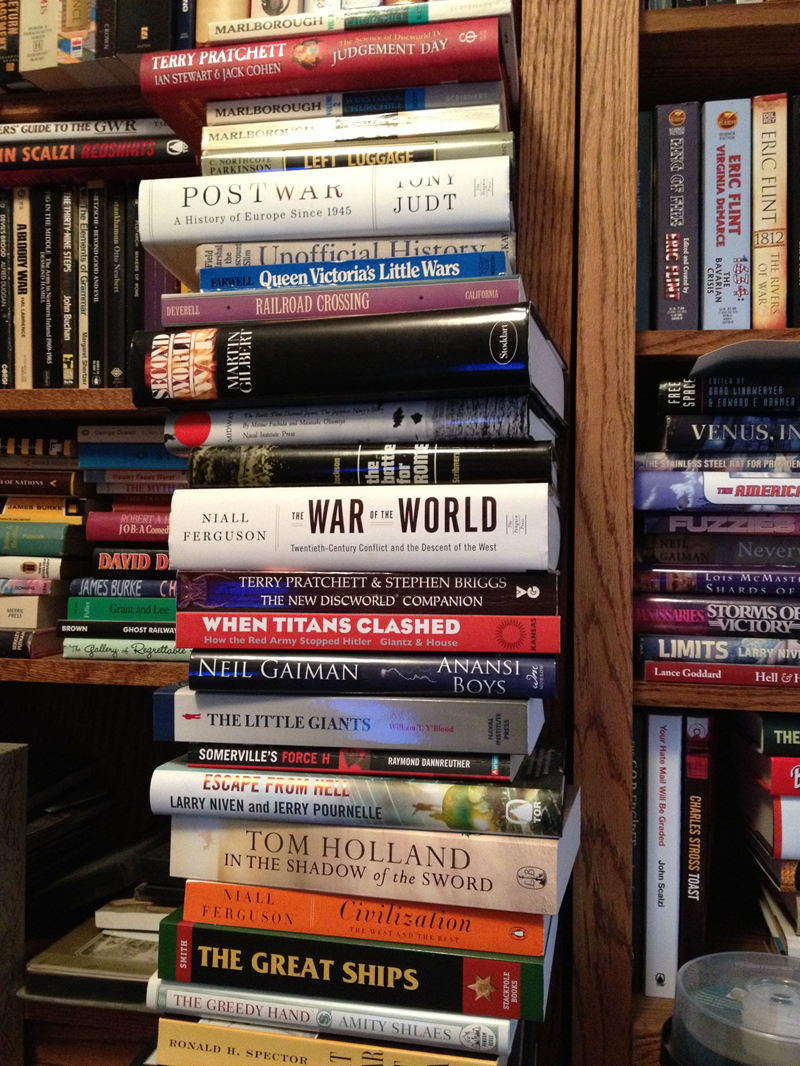
Random photo of books stacked in my office about 15 years ago.
I’m often asked by writers about the prospects of a particular book. I try to be encouraging. If it’s a good book, there’s undoubtedly an audience for it. At the same time, I try to be realistic. It’s a crowded market and it’s often difficult even for a good book to find its audience.
If asked to explain just how crowded the market for books is today, I usually say something like, there are about two million books published in North America every year. I’m not sure where I got that figure from. Probably from some research I read five years ago.
Turns out it’s wrong. “The total number of books published in the US in 2025 with ISBN numbers jumped 32.5% over 2024 to more than four million books,” announced Publishers Weekly on March 17.
I can’t get over that number. Four million books.
An average reader might get through about 2,000 books in a lifetime. A long-lived super-reader churning through 70 or 80 a year may exceed 5,000. Gladstone’s reading logs suggest that he engaged with more than 20,000 books, but it’s not clear he read them all.
A large independent bookstore might carry between 10,000 and 30,000 books. A suburban chain store, 60,000 to 120,000. The Barnes & flagship at Union Square in Manhattan has hundreds of thousands of books on four massive floors. Powell’s City of Books in Portland, occupying an entire city block—you need a map to get from room to room—has at least a half million books, and by some counts a million. New York’s The Strand, which boasts 18 miles of books, new and used, is probably the world’s biggest bricks-and-mortar retailer: it has 2.5 million books on incredibly dense shelving. You’d need a Powell’s, a Strand, and a couple of B&N Union Squares to hold four million titles.
Four million books is equivalent in volume to the holdings of a good-sized university library system, or a large public library system—collections built over a century. And these are published in a single year.
In 1939, the year Margaret Atwood was born, The Library of Congress, widely recognized as the largest library in the world, home to a civilization’s worth of books, boasted about six million titles, including pamphlets. It’s now holding about 25 million, and the US alone is on pace to produce that many titles between now and the end of the decade.
Four million books. That’s 11,000 books a day. Four hundred and fifty books an hour.
A year ago, there were “only” 3.15 million books, traditional and self-published, released. So 2025 represents an increase of 32.5 percent. Self-publishing was up just under 39 percent. Traditional publishing about 6.6 percent. Publishers Weekly doesn’t offer much of an explanation for the explosion of new titles. AI has to be a major factor (see this week’s publishing sensation in The New York Times.)
Of course, most of the four million books are not worth your time. Only 642,242 of the titles were released by traditional publishers. A traditional publisher doesn’t guarantee quality, but it suggests a minimum of vetting. The search for merit among self-published books is easily frustrated.
Bowker, the service that counts the ISBNs (the unique thirteen-digit identifiers attached to each book), does not distinguish among formats. Many of the four million were published only as ebooks. And some books published as print, ebook, and audiobook are triple-counted. There may only be about 2.5 million distinct works in that total.
If one were to take the colouring books, planners, puzzle books, and AI-generated garbage out of the equation, we might be down to 1.5 million meaningfully distinct books. And of all those, maybe 1 to 3 percent, or 20,000 to 50,000, will sell over 1,000 copies. That puts some perspective on the four million.
Comments Off on Four million books published in North America during 2024
How To Indoctrinate the Children – Death of Democracy 08 – Q4 1934
World War Two and Spartacus Olsson
Published 21 Mar 2026In this episode of Death of Democracy, we examine Germany in the final quarter of 1934, as Adolf Hitler tightens his grip on power after Hindenburg’s death and prepares the Reich for the next stage of Nazi rule. Behind a façade of order, the regime accelerates secret rearmament, deepens propaganda and youth indoctrination, pushes Jews further out of public life, and turns universities, schools, and culture into instruments of ideological control.
This documentary explores Nazi Germany in late 1934 through the looming Saar plebiscite, the growth of the Hitler myth, rising public frustration with local Nazi officials, and the regime’s deeper preparation for dictatorship, expansion, and war. If you are interested in Hitler, Nazi propaganda, rearmament, antisemitism, the Saar vote, and the collapse of democracy in Germany, this episode provides the critical context.
(more…)
Comments Off on How To Indoctrinate the Children – Death of Democracy 08 – Q4 1934
“In 1800, most people worked the land. By 1900, most didn’t. … That’s a psychological earthquake”
On the social media site formerly known as Twitter, L. Wayne Mathison points out just how vast the disruption of normal, traditional lives over less than a century has torn most of us from our historical moorings:

Image generated with AI
The Great Collision: When Reality Stopped Making Sense
For most of human history, life wasn’t confusing. It was hard, yes. Brutal, often. But simple.
You were born into a pattern. You followed it. You died in it.
Then the 20th century showed up like a wrecking ball.
What people call “progress” was really a mass psychological dislocation. We didn’t just move from farms to cities. We lost the structure that told us who we were.
We solved survival. Then immediately created a meaning crisis.
That’s the trade nobody advertises.
1. The Shock: When Life Broke Its Own Pattern
People think industrialization was about better tools. It wasn’t. It was about ripping people out of identity.
In 1800, most people worked the land. By 1900, most didn’t. That’s not a statistic. That’s a psychological earthquake.
Tradition vanished faster than people could adapt. So the state stepped in and did what states always do. Standardize. Educate. Normalize.
Mass schooling didn’t just teach reading. It replaced lost culture with manufactured culture.
Useful? Yes.
Neutral? Not even close.
You don’t remove a thousand-year identity system and expect people to just “figure it out”.
They don’t. They drift.
2. The Lie We Tell Ourselves: “People Want the Truth”
No, they don’t. They want to feel right.
Semmelweis proved it. Doctors were killing women by not washing their hands. When he showed them, they didn’t thank him. They rejected him. Destroyed him.
Why?
Because truth wasn’t the problem. Identity was.
If the facts say “you’re causing harm”, and your identity says “I’m a healer”, most people will reject the facts. Not update the identity.
That’s the Is vs Ought gap in plain terms:
The world is what it is
You believe what should be
When they collide, you protect the beliefNot truth. Belief.
That’s not stupidity. That’s self-preservation.
3. The Split: Are You a Person or a Machine?
Here’s the quiet tension nobody resolves.
You experience yourself as a decision-maker. You choose. You judge. You act.
But science describes you as chemistry and electrical signals.
Both are true. And they don’t fit together cleanly.
The old world said: you are a moral agent.
The modern world says: you are a biological system.
So which one is responsible when something goes wrong?
If you lean too far into “machine”, responsibility disappears.
If you lean too far into “agent”, you ignore constraints.
Most people bounce between the two depending on what excuses them fastest.
4. The Dangerous Shortcut: Let Someone Else Decide
Freedom sounds nice until it demands something from you.
Dostoevsky nailed this. People don’t just want freedom. They want relief from it.
So they trade it. Quietly.
Security, comfort, certainty. Those become the new gods.
And then comes the predictable move. Someone steps in and says:
“I’ll decide what’s good for everyone.”
History has a word for those people. It’s not flattering.
Once you remove any higher standard, the only thing left is preference backed by power.
That’s when things get ugly fast.
5. When “Good Intentions” Go Off the Rails
This is where it usually collapses.
When there’s no fixed standard, people start building their own. Then enforcing it.
George Bernard Shaw is a perfect example. Smart. Influential. Completely untethered.
Once you decide some people are “in the way”, the logic gets dark very quickly.
Not because people are monsters.
Because they think they’re right.
That’s always the justification.
Final Reframe: You Don’t Get Meaning for Free
Here’s the uncomfortable truth.
The old systems that gave people meaning are gone or weakened. They’re not coming back in their original form.
So now you’re left with a choice most people avoid:
Drift and absorb whatever narrative is loudest
Or build your own framework and take responsibility for itThere is no neutral ground.
You’re either shaping your values, or inheriting someone else’s without noticing.
Most people think they’re thinking.
They’re not. They’re echoing.
Simple Stoic Move
Strip it down.
Ask one question:
“What do I actually control here?”
Then act there. Only there.
Everything else is noise.
And right now, there’s a lot of noise.
[NR] – minor formatting added.
Comments Off on “In 1800, most people worked the land. By 1900, most didn’t. … That’s a psychological earthquake”
The Original AR-15: Serial Number 6 in Original Configuration
Forgotten Weapons
Published 1 Nov 2025The very first AR15 rifles submitted to US government trials were extremely lightweight, with an assortment of interesting features that did not last long. They had top-mounted charging handles, one-piece hand guards, very thin barrels with plain muzzles, and a different safety selector configuration than became normal later one. Updates and modifications were made to virtually all of the original rifles, but today we have a chance to look at serial number 6 in the Springfield Armory collection — which is still in completely original configuration.
Thanks to the Springfield Armory National Historic Site for giving me access to this truly unique specimen from their reference collection to film for you! Don’t miss the chance to visit the museum there if you have a day free in Springfield, Massachusetts: https://www.nps.gov/spar/index.htm
(more…)
Comments Off on The Original AR-15: Serial Number 6 in Original Configuration
QotD: The treason of the scientists
Luca Barbato @lu_zero_
Research is not taking money and then creative-write whatever fits the political faction you align with.And that’s why there are at least some people, that value science a lot, that consider burning down or starve “institutions” the correct first step to amend course.
One of those people is me.
I can still keenly remember my first feelings of crushing disappointment back in the 1980s when I started reading the “scientific” literature on gun policy and realized how utterly fraudulent much of it was.
I had grown up loving The Science, thinking of research scientists as the best of humanity, carrying us forward into a better future with honesty and courage. Discovering that there were people who would violate this sacred trust to push a political agenda hurt me.
But it only started with the gun policy literature. Sociology, psychology, political “science”, climatology. Learning how far the rot had spread was deeply dispiriting to me.
And the worst of it wasn’t even the hacks and partisans. The worst was noticing the cowardice of the people who failed to oppose them. Because that part isn’t just an indictment of the successful activists and manipulators, it’s an indictment of almost all scientists, everywhere.
Which is why I now contemplate rude, ignorant populists proposing to burn down large swathes of research funding and find myself rooting for the populists, not the scientists.
Because the lesson needs to be learned. It’s not just about driving out the hacks and partisans. Scientists, as a culture, need to learn the hard way that cowardice has a price — that if you don’t call out politicization when it’s happening, you don’t deserve the trust of the rest of our society, or the funding and privileges that come with it.
ESR, The social media site formerly known as Twitter, 2025-12-21.
Update, 23 March: Welcome, Instapundit readers! Have a look around at some of my other posts you may find of interest. I send out a daily summary of posts here through my Substack – https://substack.com/@nicholasrusson that you can subscribe to if you’d like to be informed of new posts in the future.
March 21, 2026
The second naval battle of Narvik
On his Substack, James Holland recounts the events of April, 1940 when British and German ships fought savagely for the port of Narvik in the north of Norway. The first battle had resulted in the loss of several destroyers on each side and the deaths of the commanders as well. A couple of days later, the Royal Navy sent in a more powerful force to eliminate the surviving ships of the Kriegsmarine and secure the port for landing allied troops:
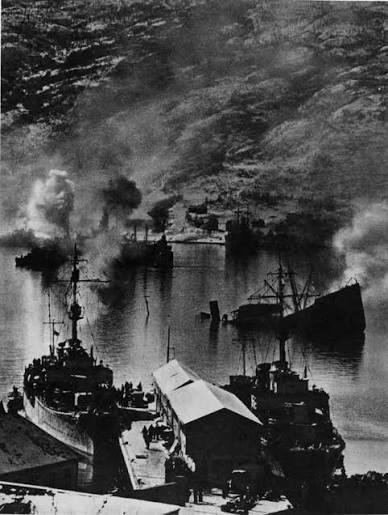
Narvik harbour after the first battle, April 1940.
The next few days were marked by caution and ponderousness by both sides. Now commanding the German flotilla was Kapitän Erich Bey. His remaining ships were trapped unless he moved them swiftly. This meant refuelling as soon as possible from the surviving oiler, making the damaged ships seaworthy, then using bad weather, darkness and supporting U-boats to sneak out past the British in the Vestfjord beyond the Ofotfjord. Although the ships were all refuelled and engines repaired, he then suffered a further calamity when the Zenke damaged her propellers manouevring around the wrecks in Narvik harbour, and the Köllner also caused debilitating damage while refuelling and made herself unseaworthy. Difficult though it was to manoeuvre in the narrow confines of Narvik, these were entirely avoidable and self-inflicted own goals. The British, meanwhile, reeling from the rapid German advances through southern Norway and uncertain what plan to now pursue, dithered from a lack of clear, unified and determined decision-making, so that it was not until the morning of 13th April that they returned, this time with four larger tribal-class destroyers, five further destroyers and the mighty battleship, HMS Warspite, all under the command of Admiral Whitworth.
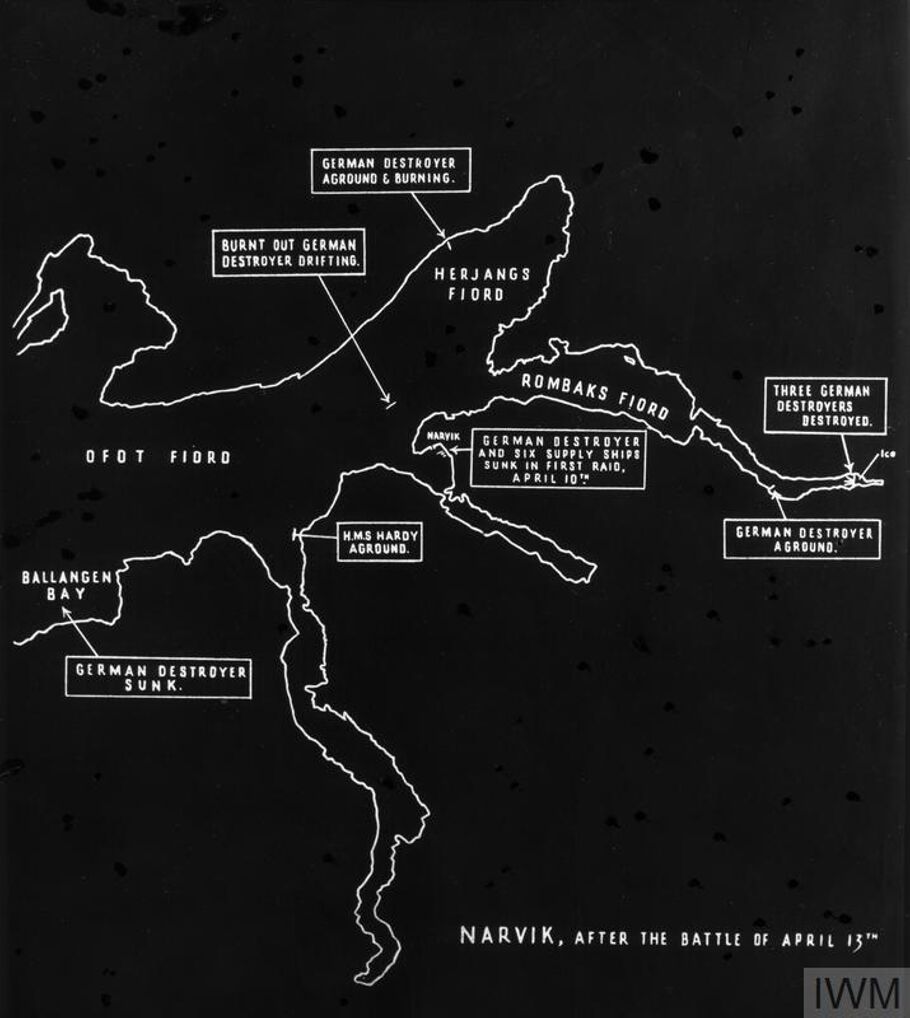
Kapitän Bey had known the Royal Navy were coming, partly because German cryptanalysts had deciphered British naval codes, but also because it was blindingly obvious they would do. He tried to deploy his ships as well as he might but knew in his heart the situation was hopeless. The crippled Köllner was towed to Taarstadt, an inlet beyond Ballangen, where it was to lie in wait, unseen, for the arrival of the British then fire her torpedoes and guns and hope for the best. She had only reached the inlet at Djupvik, some 20 miles west from Narvik, when she was spotted by the Warspite‘s Swordfish floatplane late in the morning of 13th April. As the leading British ships, Bedouin and Eskimo, turned the headland, their guns and torpedoes were trained and ready. Köllner‘s bow was ripped off by the first torpedo and the rest of her sunk soon after. That was three of the ten now at the bottom of the fjord. The remaining seven had barely begun moving before the rest of the British force were bearing down upon them through the mist, frost and snow. First, though, ten Swordfish, flown from the aircraft carrier, HMS Furious, swooped down. Their orders were to dive-bomb the German ships, a role for which they were not suited; Swordfish, slow, ungainly biplanes, were designed to fly in low and drop torpedoes, a role to which they were, in fact, very well suited. As dive-bombers, however, they hit nothing but lost two of their own in an entirely fruitless attack.
It was also completely unnecessary as Whitworth’s force had the matter firmly in hand. The German destroyers, still nursing the damage of four days earlier, swiftly fired all their remaining ammunition and were now effectively sitting ducks. Bey ordered them into the narrow Rombaksfjord, east and to the north of Narvik, where they were hotly pursued by Eskimo, Bedouin and even Warspite. Here the fjord narrowed to a few hundred yards before widening to half a mile but with the high mountain sides looming over this gloomily dark and slender channel, there was nowhere for the surviving German destroyers to go. The Künne was dispatched by Bedouin, and although the Georg Thiele fired one last torpedo that blew off the bow of Eskimo, her captain then ran her aground like the Hardy, while the surviving three, the Zenke, Von Armin and Lüdemann, steamed to the head of the fjord where they, too, deliberately ran themselves aground. The crews all then made good their escape into the mountains to join the Gebirgsjäger [mountain troops] that had disembarked five days earlier and who were still holding a shallow bridgehead around Narvik.
The second British naval action off Narvik. A diagram of the battle of 13 April 1940.
Imperial War MuseumAmazingly, Eskimo remained afloat, sailing stern-first back out of the fjord and to safety. She was repaired and would fight again, not least against the Bismarck in May 1941. But here in the waters around Narvik, the naval battle was now over, with half the Kriegsmarine‘s destroyer fleet sunk and lost — a disaster from which it could not hope to recover. A golden opportunity to send in decisive numbers of Allied troops to fight and defeat the beleaguered German troops in Narvik was now laid out on a plate. Southern Norway might have already been lost but the north — and, crucially, the iron-ore railway line and port — lay there for the taking — on paper, at any rate. British, French and Polish troops were eventually landed but this was not a part of the world where landing and maintaining supplies was at all straightforward. Britain had only a few basic landing craft at this early stage of the war, there were few beaches and its geographical remoteness and weather made a difficult task even harder. As it happened, by early June, the Allies did have victory there within their grasp, but by then, France was being overrun and facing defeat and the Allies decided the better part of valour was to pull out while they had the chance and consolidate in Britain instead. The Allied expedition to Norway was over.
The ramifications of the naval battle were significant, however. The Kriegsmarine not only lost half their destroyer fleet, but also one of two heavy cruisers, two of six light cruisers and six U-boats, leaving their navy woefully depleted. It also meant their plans for a successful surface fleet marauding in the Atlantic had been left in tatters. The U-boats, withdrawn from the Atlantic for the campaign, hit not a single vessel, largely due to problems with the magnetic ignition pistols on their torpedoes. For the three months they were tied up in the waters around Norway, they were not in the Atlantic, giving Britain a vital free pass as convoys sailed unimpeded. During the critical summer months of 1940, this was to prove a hugely important lifeline. Norway had been clinically subdued by Germany but it would cost Hitler more than half a million troops, all told, as well the costly construction of the Atlantic Wall in the years to come — a series of bunkers, coastal gun batteries and barracks in some of the remotest outposts of Europe and at an untold cost in men, resources and money. Norway would become an albatross around Nazi Germany’s neck, while its value to the Kriegsmarine was negligible.
The grave of Captain Bernard Warburton-Lee, VC, RN, in Narvik.
Photo by James Holland

Comments Off on The second naval battle of Narvik
The Complete Chieftain Tank
The Tank Museum
Published 20 Mar 2026Chieftain. The world’s first main battle tank. An icon of the Cold War, it served the British Army for more than 30 years. Yet, it had something of a Jekyll and Hyde reputation. It was prized for having the best gun in the world but, for the British, it never fired a shot in anger. Loved by gunners. Loathed by mechanics. The Chieftain was often referred to as the best tank in the world as long as it broke down in the right place.
But was the gun truly as good as the stats make it out to be? And was the engine really that bad? It’s time to take a dive into the heart of the Iron Triangle to find out.
00:00 | Introduction
00:36 | Gun
03:44 | Engine
06:19 | Armour
11:07 | Just Deserts
13:53 | A Tragic HeroIn this film, join James Donaldson as he delves into the good, the bad, and the ugly sides of the Chieftain tank. With a great gun, revolutionary armour, and a misunderstood engine, Chieftain’s service with the British ensured the Cold War never turned hot. And hear from Chieftain veterans, Bob and Steve, as they share their experiences with this iconic tank.
(more…)
Comments Off on The Complete Chieftain Tank
“None of the artistic -isms lasted very long. Today’s -ism soon becomes yesterday’s was-ism”
Ted Gioia on “the shock of the old”:
During the 15th century, the leading critics all agreed that the greatest works of art came from an unusual place. No, not a museum or church or palace — they were found, instead, underground and amid ruins, literally covered in dirt.
Before you could see them, you first had to dig them up.
Can we even imagine this attitude today? Our whole hierarchy of aesthetics would need to be reversed. Just consider the shame of admitting that our most cherished cultural legacy had been buried and forgotten by our ancestors. Art appreciation gets turned into some kind of exhumation.
But the reaction to this rediscovered art was just as interesting as the sculptures themselves. How do you feel when you look at these works?
You probably aren’t shocked by the nudity. You’ve seen more salacious stuff on Netflix. In fact, you probably aren’t shocked by anything here — these statues feel very old fashioned and antiquated.
That’s an interesting word, antiquated. It means “old, and no longer useful”. If the plumbing in your house is antiquated, you’re in big trouble. And it’s even worse if you are antiquated.
The word comes from the same root as antiquities — a term applied to arts and artifacts from the past. And most observers today would put the two ideas together, and say that these old statues might be charming to see in a museum, but have little or no relevance to us today.
But that’s not how Michelangelo, Raphael, and other Renaissance artists saw them.
These works were more than a thousand years old, but the leading 16th century artists believed they were worthy of study and imitation. Even more shocking, the great minds of the Renaissance believed that such works represented timeless standards of artistic excellence that could not be erased by the passing centuries.
In other words, evaluating art was like pursuing the good life. After you discovered the pathway to do that, you kept to the course. It didn’t go stale like a loaf of bread. It wasn’t a fad or a trend, but something enduring. The same thing is true of good health or a good marriage — you want them to endure, not get replaced by the next new thing.
Five hundred years later, leading critics believed the exact opposite. Standards were not timeless, but constantly in flux. During the 20th century, art was supposed to disrupt the standards from the past. If a work made you uncomfortable, all the better — you needed a kick in the ass. If the Venus de Milo hadn’t already lost her arms, some witty critic would probably suggest that we cut them off. That would give you a jolt, huh?
This notion of disruption was already prevalent a hundred years ago. And the kicks aimed at your posterior came from all directions. Critic Robert Hughes called this the “Shock of the New”.
The individual asskicks were the -isms.
There’s surrealism, dadaism, cubism, futurism, brutalism, fauvism, abstract expressionism, deconstructionism, postmodernism, serialism, minimalism, and so forth and so on. You could make a patter song from all of them.
Critics placed wagers on them, as if they were horses at the track. If they made a smart bet, they could reap a windfall. Their reputation was enhanced, and also their wallet. I’m reminded of the elite art critic who launched the careers of painters, and sent the market price of their works skyrocketing — but only after he had accumulated some choice specimens for his own collection. In the finance world, this is called insider trading.
The suffix -ism originally denoted a doctrine, theory, or worldview. Or even a religion, such as Judaism or Buddhism. These aesthetic -isms were also a bit like religions, inspiring fervent loyalty.
But there was a big difference. Religions like Judaism or Buddhism last for thousands of years. But aesthetic theories come and go. None of the artistic -isms lasted very long. Today’s -ism soon becomes yesterday’s was-ism.
That’s a little strange, because the advocates of the -isms all promised that they were delivering the blueprint for the future. And then we finally get to the future — and what do we see?

Colt LE-901 Modular Multi-Caliber AR: A Well-Designed Failure
Forgotten Weapons
Published 29 Oct 2025Colt originally developed the 901 as part of the US Army SCAR program, with the intention being to create a 7.62x51mm rifle that could also use unmodified 5.56x45mm upper assemblies. This would allow special operations units to customize a single weapon to a variety of different configurations for different mission profiles. Mechanically, the system Colt devised to do this was quite clever, and very effective. However, the rifle ultimately failed to win a military contract.
Moved to civilian sales, the system was unsuccessful fundamentally because the modular concept is just not very desirable. A single modular rifle like this inevitably sacrifices some capability in every specific configuration in exchange for the modular capability and most people would rather have two dedicated rifles in different configurations than one swappable one. It sounds appealing on paper, but almost always fails economically in practice.
(more…)
Comments Off on Colt LE-901 Modular Multi-Caliber AR: A Well-Designed Failure
QotD: Rejectionism
Amazon works the same way. If you have to plan your trips to the grocery store, you have to ask yourself: Do I really need this? There are many fewer chances for impulse buys. When the store’s right there, you just run down and satisfy whatever momentary craving you happen to have. Same with Amazon — if you had to make a special store to get that piece of Chinese junk, you wouldn’t. But Amazon is right there, on the phone …
Haste. Impulsiveness. The instant, unexamined gratification of each and every urge. Those are the things the Left encourages. That’s what all that stuff is fundamentally for — Amazon, Twitter, smartphones, the whole deal.
That, therefore, is what we must reject. Call it “Rejectionism” if you want to make it into a sales pitch (or something better; I suck at titles). The Left’s “morality” is to treat everything — health, beauty, pleasure, the Economy, politics, people — as means to one and only one end: The instant, unthinking gratification of each and every momentary impulse.
We reject it. We reject the Internet. It’s a tool, nothing more, and remember what they say about hammers: When a hammer’s all you’ve got, everything looks like a nail. Reject it. Reject it all, for your soul’s sake.
Severian, “Rejectionism”, Founding Questions, 2022-05-24.
Comments Off on QotD: Rejectionism
March 20, 2026
When pursuit of knowledge shifts to sharing of feelings instead
Institutes of higher learning were once places where academic careers involved research, analysis, and logical pursuits to advance human knowledge (in theory, at least, and mostly in practice). Today’s groves of academe are apparently much more about “the feels” than the facts:

An expected and obvious consequence of the Great Effeminization of the Academy is that a great deal of academic output is now about the feelings of academics.
From the peer-reviewed paper “What’s Racial About Matter? A Conversation on Race and ‘New’ Materialism Past, Present, and Future” in Catalyst: feminism, theory, technoscience. (They mean matter in the same sense as a physicist, only they are much vaguer.) My emphasis:
What follows is an informal, at times undisciplined, conversation about Asian American racial matters between interlocutors who have been in generative dialogue for several years now. This roundtable is the constellation of many other discussions from conference panels to shared meals, reflecting the relational nature of our inquiry. We hope this roundtable can open entry points for those exploring intersections of feminist new materialisms, STS, and studies of race — from its genealogies to its animating new directions. How did we get here, and where do we go from here?
The text itself reads like it was produced by one of those postmodern text generators that were passed around as jokes in the late 1990s.
From the Abstract of “After Hybridity: The Biological Life of the Mixed Race Child” (same journal):
I argue that renderings of the mixed race child as a metaphor for assimilation and multicultural progress obscure how racial science continues to shape the very definition of mixed raceness. Instead, I frame the mixed race Asian American child as hybrid matter to explore the slippages between their figuration and other abnormally reproduced objects: the genetically modified food organism and cancer.
From the Abstract of “Racial Atmospherics: Greenhouses, Terrariums, and Empire’s Pneumatics” (same journal):
What happens when we understand air as racial matter? This paper takes up this question by tracking the political, architectural, and artistic genealogies of Cold War phytotrons, or computer-controlled climatic laboratories.
From the Abstract of “Disrupting the Whitened Lemur: Reading Black Trans* Considerations in Feminist Primatology” (same journal):
In this article, I trace the evolution of female dominance studies in lemurs to explore how logics of cis-heterosexuality and whiteness are embedded in the study of the nonhuman … Following recent theories of trans* and the nonhuman, this essay argues that such critiques illustrate the trans* potential of the nonhuman, which was prefigured by decades of critique in feminist primatology. However, by engaging with recent Black trans scholarship, this essay suggests that such trans* critiques of the nonhuman have stopped short by ignoring the racialized nature of the dyad as a social unit. I thus propose a feminist science studies that attends to Black trans* theory to work against colonial taxonomies and the forced assimilation of the nonhuman world into rigid ontologies for material gain — or what I refer to as whitening processes.
The punchline is that not only are these all from the same journal, but they are all from the same issue of that organ. And that this is only one of many such diaries (the proper word) — funded largely by you via our great benevolent government.
Comments Off on When pursuit of knowledge shifts to sharing of feelings instead


