Quotulatiousness

July 25, 2021

The Line editors clearly loved crafting their “Dicks in space!” headline

Filed under: Business, Space, Technology, USA — Tags: , , , , , , — Nicholas @ 05:00

As a fellow space nerd, I welcome the editors of The Line to our number:

You’ve probably noticed by now that your Line editors are space enthusiasts. It’s been an interesting few weeks on that front. Sir Richard Branson flew out of the atmosphere, into free-fall (not zero-G, you scientific illiterates!), on a Virgin Galactic space plane. That said, he didn’t get high enough to cross the Kármán line, which, in the absence of any real international agreement on where the Earth ends and space begins, is as close as we come to a functional definition of the edge of space. (It’s an altitude of 100 km, for those wondering.) Jeff Bezos, of Amazon wealth and fame, did cross that line this week, along with three passengers, including Wally Funk, which was cool, if you’re into that sort of thing. (We are.) Bezos was riding a Blue Origin New Shepard rocket; Blue Origin is a company he founded and funded with his own gigantic wealth.

Look, let’s face facts — your Line editors are into space. We just are. But yeah, we agree that space policy is important enough and complicated enough to warrant debate. Reasonable people can have different views on this stuff. And we also agree that there are important debates to have about the accumulated wealth of billionaires, and the distorting effects that wealth can have on politics and society.

But unlike a bunch of ya’ll, we don’t get confused about a debate over income inequality and a debate over space travel. You can despise Bezos, Amazon and everything he’s done there, and still recognize that what he is doing on the space front is important. Everyone rolling their eyes at Bezos matching space flight capabilities that the Soviets and Americans achieved literally 60 years ago is allowing their desire to rack up some sweet Twitter likes with a snarky dunk blind themselves to the fact that Bezos (and Elon Musk’s SpaceX, which is way ahead of Blue Origin) aren’t just recreating earlier capabilities, they are massively improving on them.

So yeah, Blue Origin can now do what the Soviets and U.S. could do 60 years ago, but they’re doing it more safely, more efficiently and much, much more sustainably than national space agencies did. Reusability isn’t a frill, it’s a massive game-changer. And as much fun as it is to snort when these private-sector companies recreate an existing capability, do you really think they’re going to stop there?

Branson’s company could be written off as a tourism play for the affluent. Fair enough. Except that making space flight economically viable is the first step to ensuring that capability is both sustainable and more broadly accessible in the long run. Further, Bezos and especially Musk are inventing new and transformative space-flight capabilities. They are materially pushing back against the final frontier in ways that we simply have not before. It won’t matter unless we choose to do anything with these new capabilities, and your guess is as good as ours as to whether or not we will. But we could. That’s huge.

As huge as the gigantic dick-shaped rocket Bezos rode up. Yeah, yeah. We snorted, too. But, like, seriously, folks — making penis jokes about the shape of an object dictated by aerodynamic considerations isn’t quite as witty as you think: the rockets are shaped like penises because they literally have to be in order to work. Having a giggle is fine, but if you actually think you’re making a real point about misogyny and fragile male egos when you get snippy (ahem) about a schlong-shaped rocket, well, we’d love to see what happens when your very emotionally vigorous and feminist vagina-shaped space vehicle hits max Q. So long as we aren’t aboard it or in the landing area for its hurtling debris.

Our main point still stands: don’t let your cynicism and even revulsion at these guys blind you to what they’re doing. Bezos isn’t gonna stop at Yuri Gagarin-vintage accomplishments. Musk sure hasn’t. This’ll matter. It’s time to get serious. They are.


Wehrmacht Conquers 250 Miles of Nothing – WW2 – 152a – July 24, 1942

World War Two
Published 24 Jul 2021

The Soviets keep withdrawing from the advancing Axis forces, and Hitler keeps issuing contrary orders to try and stop that, with the results that logistics are getting screwed up and the mobile units are bogged down in huge traffic jams. The Allies have decided not to open a second front in Europe in 1942, but do choose another spot to begin the long counter offensive.
(more…)

The plight of the Uyghurs in China

Filed under: China, Government, Religion — Tags: , , , , — Nicholas @ 03:00

In this week’s excerpt from his full Weekly Dish, Andrew Sullivan considers the Chinese government’s ongoing suppression of the Uyghur minority:

There’s a story in a recent Atlantic memoir by a Uyghur refugee that lingers in the mind. The Chinese authorities in Xinjiang Province now regard the possession of any religious literature, including the Koran, as prima facie evidence of terroristic activities. Terrified Uyghurs in Urumqi, the regional capital, have learned these past few years to quickly dispose of any such items — some throwing out books into the streets overnight so they could not be traced to their households. But one old man in his seventies forgot about a Koran he had possessed, and, coming upon it late, was too scared to hand it over, so threw it into a river. Alas,

    the authorities had installed wire mesh under all bridges, and when the mesh was cleaned, the Quran was found and turned over to the police. When officers opened it, they found a copy of the old man’s ID card: In Xinjiang, the elderly have a habit of keeping important documents in frequently read books, so that they are easily found when needed. The police tracked down the old man and detained him on charges of engaging in illegal religious activities. He was sentenced to seven years in prison.

The “prisons” this elderly, devout Muslim was shipped off to now have a capacity of around one million people. They have been built at breakneck speed. Buzzfeed News has found “more than 260 structures built since 2017 and bearing the hallmarks of fortified detention compounds.” The more recent building suggests they are going to become permanent parts of a bid to wipe Uyghur culture from the face of the earth.

The Atlantic story helps you understand how eerily reminiscent this campaign is to the early Nazi-era treatment of Jews, all the way down to the initial disbelief that the genocidal campaign was beginning, to the slow creeping oppression, the sudden new checkpoints and security procedures, the separation of Han and Uyghurs, knocks on the door at night, the attempts of some to escape without detection, and the sudden disappearances of friends, relatives, co-workers — never to be heard of again.

We cannot know for sure what happens inside the camps, but reports from survivors include torture, starvation, force-feeding, solitary confinement, and brainwashing. And in some ways, the entire region is now an open-air prison: security cameras are everywhere, the imprisoned are pressured to incriminate others, police go house to house searching for illicit materials, mosques and neighborhoods are razed, Uyghur language is banned, phones monitored, face recognition technology is ubiquitous. Family members, waiting for their turn to be arrested, leave notes like this one from a husband to his wife:

    If they arrest me, don’t lose yourself. Don’t make inquiries about me, don’t go looking for help, don’t spend money trying to get me out. This time isn’t like any time before. They are planning something dark. There is no notifying families or inquiring at police stations this time … I’m not afraid of prison. I am afraid of you and the girls struggling and hurting when I’m gone. So I want you to remember what I’m saying.

It’s important to note that the concentration camps for Muslims in China are not extermination camps. (At least not yet. “They are planning something dark” is not a sentence one ever wants to read.) But it is the greatest, systematic detention of a religious minority since the Second World War, championed by a newly emerged dictator-for-life, Chinese President Xi. And it is not going to stop any time soon.

Russian Type 2 AK: Introducing the Milled Receiver

Filed under: History, Military, Russia, Weapons — Tags: , , , — Nicholas @ 02:00

Forgotten Weapons
Published 8 Jul 2018

http://www.patreon.com/ForgottenWeapons​

Cool Forgotten Weapons merch! http://shop.bbtv.com/collections/forg…​

Updated to fix errors in nomenclature and production dates.

With recognition of the production problems of the original Type 1 AK, an alternative was needed. Russian engineer Valeriy Kharkov led a team of engineers who designed a replacement drop-forged and machined receiver for the AK. This new receiver was not a technical challenge for Izhevsk to produce, and it added durability and potentially accuracy to the weapon, at the cost of an additional pound (half kilo) of weight and more manufacturing time/expense.

The Type 2 AK is distinctive for its rear socket used to attach the buttstock, which was done to simplify the receiver profile and to allow the same receiver to be used for both fixed and underfolding stocks. The Type 2 receiver also has a weight reduction scalloped cut on the right side which is parallel to the top surface of the receiver (on the later Type 3, this cut would be made parallel to the bottom of the receiver instead) as well as a few other smaller features.

While the Type 2 receiver solved the immediate problem for Kalashnikov’s team, it would only be in production for a short time. Introduced in 1951, production ceased in 1957, being replaced by an improved iteration of milled receiver, the Type 3, in 1955. The Type 3 would remain in production until the stamped receiver was finally perfected as the AKM in 1959, and the Type 3 would be produced by a significant number of nations outside the Soviet Union.

Today, the second pattern AK is an very rare weapon, and I am grateful to the private collector who allowed me to video this one for you!

If you enjoy Forgotten Weapons, check out its sister channel, InRangeTV! http://www.youtube.com/InRangeTVShow

Contact:
Forgotten Weapons
6281 N Oracle #36270​
Tucson, AZ 85704

QotD: The Two Rules of Modern Journalism

Filed under: Humour, Media, Politics, Quotations — Tags: , , , , — Nicholas @ 01:00

RULE # 1: Because journalists are required to be open-minded, exercise independence of spirit, and display a healthy amount of skepticism, the words and deeds of politicians, leaders, and the powerful — as well as those of regular citizens being interviewed — must constantly be questioned, second-guessed, doubted, fact-checked, challenged, and, more often than not, interrupted (more or less politely).

RULE # 2: Rule # 1 only applies to Republicans.

(And to anybody leaning conservative.)

For Democrats and leftists, the typical query is more along the lines of “pray enlighten us to your glorious plans for fundamentally transforming the United States of America (we will be quiet now).” (Close second: “kindly tell us how much people have suffered, and are still suffering, in this dreadful country of ours.”)

Erik, “The Two Rules of Modern Journalism”, ¡No Pasarán!, 2021-04-16.

July 24, 2021

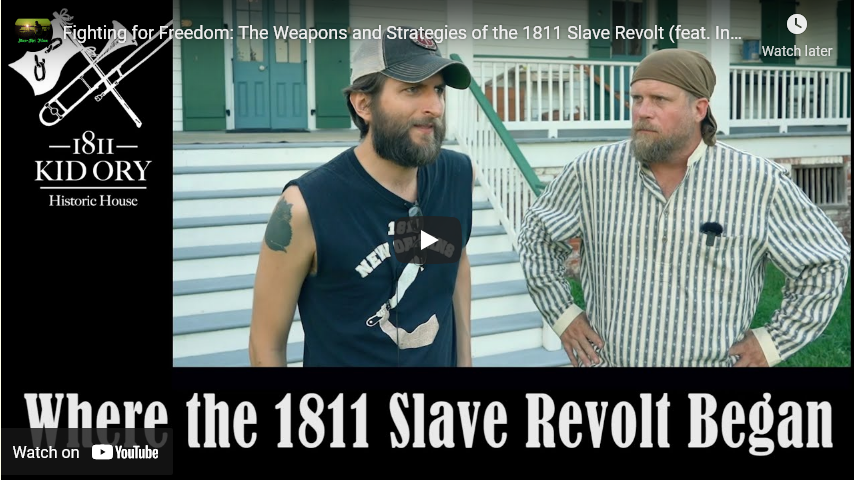
Fighting for Freedom: The Weapons and Strategies of the 1811 Slave Revolt (feat. InRangeTV)

Filed under: Americas, History, USA — Tags: , , , , — Nicholas @ 06:00

Atun-Shei Films
Published 22 Jul 2021

I highly recommend visiting the 1811 Kid Ory Historic House during your next trip to the New Orleans area! https://www.1811kidoryhistorichouse.com/

Karl from @InRangeTV was recently in town, and we visited the plantation house where the 1811 Slave Revolt began. In this video, we examine the uprising primarily from a military perspective, discussing the weaponry the enslaved army used, the tactics they employed, and the likelihood of the rebels’ long-term success if their battle with the local planter militia had gone a little bit differently.

The 1811 Revolt, despite being the largest rebellion of enslaved people in American history, has not been the subject of much scholarship, and in many ways is still poorly understood. Regardless, we were surprised how much our visit forced us to rethink the conventional historical narrative. In Karl’s companion video, we discuss alternative perspectives of the revolt and speculate about what truths may have been lost to history. Watch Karl’s video [embedded below].

Support Atun-Shei Films on Patreon ► https://www.patreon.com/atunsheifilms

Leave a Tip via Paypal ► https://www.paypal.me/atunsheifilms

Buy Merch ► teespring.com/stores/atun-shei-films

#GermanCoast #Louisiana #AmericanHistory

Original Music by Dillon DeRosa ► http://dillonderosa.com/
Reddit ► https://www.reddit.com/r/atunsheifilms
Twitter ► https://twitter.com/atun_shei

~FURTHER READING/VIEWING~

Daniel Rasmussen. American Uprising: The Untold Story of America’s Largest Slave Revolt (2011). Harper Perennial

“Freedom or Death: The Louisiana Slave Revolt of 1811” (2019). Atun-Shei Films https://youtu.be/1zUPNtP3Yn0

“Creoles, Kaintucks, and the Culture War of Early New Orleans” (2020). Atun-Shei Films https://youtu.be/i0mDwK47Qq0

1811 Slave Revolt – An Alternative Perspective (feat. Atun-Shei)

InRangeTV
Published 22 Jul 2021

InRange is entirely viewer supported:
https://www.patreon.com/inrangetv

First off, I must give very special thanks to John McCusker for his gracious hospitality for allowing us to film, as well as for his research and candid approach to the history, and the social ramifications of this topic that resonate still to this day.

If you’re in New Orleans, or visiting, make sure you take time to go see the 1811 Kid Ory House and say hi to John from InRange & Atun-Shei:
https://www.1811kidoryhistorichouse.com/

On one of my more recent trips to New Orleans, I got together with Atun-Shei and we visited the Andry plantation house where the 1811 Slave Revolt began. In this video, we re-examine the uprising with fresh perspectives on what actually may have happened and contrast it to the relatively tiny amount of academic research done in relation to the actual significance of this important American revolt for freedom.

The 1811 Revolt, despite being the largest rebellion of enslaved people in American history, has not been the source of much scholarship, and in many ways is still poorly understood. Regardless, we were surprised how much our visit forced us to rethink the conventional historical narrative. In Atun-Shei’s companion video, we examine the uprising primarily from a military perspective, discussing the weaponry the rebels used, the tactics they employed, and the likelihood of the rebels’ long-term success if their battle with the local planter militia had gone a little bit differently.

~FURTHER READING/VIEWING~

Daniel Rasmussen.
American Uprising: The Untold Story of America’s Largest Slave Revolt (2011). Harper Perennial

A new history of Anglo-Saxon England

Filed under: Britain, History, Religion — Tags: , , , — Nicholas @ 05:00

At First Things, Francis Young reviews The Anglo-Saxons: A History of the Beginnings of England by Marc Morris:

The art of telling stories will always be closely associated with the Anglo-Saxons. Beowulf, the era’s best-known epic poem, begins with a word that is difficult to translate, summoning an audience to attention: “Hwæt!” The same word opens another great poem of early medieval England, The Dream of the Rood, in which the wood of the Cross speaks and narrates a uniquely Anglo-Saxon Passion — a reminder that it was the Anglo-Saxons who built Christian England.

These people, as Marc Morris observes, were tellers of tales; and yet, until now, there has been no modern narrative history that weaves together the insights of archaeologists, historians, and literary scholars. Morris has risen to the task, tracing the journey of the English-speaking inhabitants of the island of Britain from tribal warbands to a highly sophisticated medieval kingdom on the eve of the Norman Conquest.

This is a triumph of historical storytelling, woven together from the scattered evidence of archaeology, numismatics, chronicles, charters, and many other sources. The narrative that emerges from these difficult sources is, of course, contentious; after all, even the use of the term “Anglo-Saxon” is now debated by scholars. But the narrative is also compelling, rooted in the primary sources, iconoclastic of received interpretations, and — most importantly — the product of a commanding historical imagination. This is an account of the Anglo-Saxons that will inform our perception of them for years to come.

It would be perfectly possible to challenge virtually every one of the author’s interpretations: As Morris notes, “The less evidence, the more contention,” especially when it comes to the chaotic documentary void of the fifth and sixth centuries. (By comparison, by the mid-eleventh century there is a comparative richness of documentary sources.) The first question is about the nature of Germanic immigration after the departure of the Roman legions at the beginning of the fifth century. Morris leans toward a more traditional “replacement” model in which Germanic settlers took the place of the Britons in the landscape. Morris places a great deal of weight on the linguistic evidence, which shows that Brittonic (the language of the Britons) had little influence on Old English. If the Anglo-Saxons had largely assimilated the Britons, rather than replacing them, we might expect many more Brittonic loanwords.

According to Morris, “The broken Britain that the Saxons found … had no allure.” Post-Roman Britain was “in every sense a degraded society, sifting through the detritus of an earlier civilisation.” Morris follows in the tradition of Bede by viewing the Britons as decadent, but this is by no means the only possible view of post-Roman society. Recent scholarship by Miles Russell and Stuart Laycock has drawn attention to Britain’s failure to become Romanized in the first place, raising the question of whether the abandonment of urban life in the early fifth century should be seen as a sign of decline, and Susan Oosthuizen has argued that rural Britain continued to prosper in the absence of urban settlement; it simply thrived on its own terms as a non-urban society.

History Hijinks: Rome’s Crisis of the Third Century

Overly Sarcastic Productions
Published 23 Jul 2021

Local Empire Too Stubborn To Die — Field Historian Blue is here at the scene of Ancient Rome with more on the Crisis of the Third Century.

SOURCES & Further Reading
https://www.britannica.com/place/anci… + Aurelian, Postumus, Zenobia
The Great Courses The Roman Empire: From Augustus to The Fall of Rome lectures 13 14 and 15, “From Commodus to Caracalla”, “The Crisis of the Third Century” and “Diocletian and Late Third-Century Reforms”, by Gregory Aldrete
The Enemies of Rome Chapter 20 “Parthia, Persia, Palmyra” by Stephen Kershaw

Partial Tracklist: “Scheming Weasel”, Sneaky Snitch”, “Marty Gots A Plan” Kevin MacLeod (incompetech.com)Licensed under Creative Commons: By Attribution 4.0 License
http://creativecommons.org/licenses/b…

Content is intended for teenage audiences and up.

PATREON: https://www.Patreon.com/OSP

PODCAST: https://overlysarcasticpodcast.transi…

DISCORD: https://discord.gg/osp

MERCH LINKS: http://rdbl.co/osp

OUR WEBSITE: https://www.OverlySarcasticProductions.com
Find us on Twitter https://www.Twitter.com/OSPYouTube
Find us on Reddit https://www.Reddit.com/r/OSP/

From the comments:

Facundo Cadaa
2 hours ago
Thumbnail: “Rome’s big crisis”

Do you have any idea how little that narrows it down?

Boris Johnson as a character-brought-to-life from Evelyn Waugh’s Scoop

Filed under: Books, Britain, Media, Politics — Tags: , — Nicholas @ 03:00

In The Critic, Robert Hutton explains why so many members of the British press find Waugh’s satire of their trade so compelling:

Boris Johnson, Secretary of State for Foreign and Commonwealth Affairs at an informal meeting of the Foreign Affairs Council on 15 February 2018.
Photo by Velislav Nikolov via Wikimedia Commons.

For a British reporter, Scoop is the holy text of the job. One of the enduring mysteries of journalism is that a trade which employs large numbers of skilled writers, and puts them into interesting situations every day, has been the subject of so few really good novels. Scoop was written as satire, but eight decades after it was published, and after the industry has gone through two technological revolutions, it remains the best description of UK journalistic life.

While parts of the job have changed — copy is no longer filed in an abbreviated telegramese to reduce transmission costs — much remains the same. Anxious newspaper executives still live in terror of capricious proprietors. Reporters still enjoy a strange fellowship of simultaneous competition and cooperation. Entertaining readers remains as important as informing them.

So how does the current British PM fit into all of this? Well, Boris had been a journalist:

Which brings us to Boris Johnson. As well as being Britain’s most successful politician, the prime minister has long been one of the country’s highest-paid journalists, a job he did entirely in the Scoop mould. His sympathetic biographer, Andrew Gimson, describes how, posted to Brussels, Johnson delighted in producing stories that were more entertaining than accurate. It was not that he was opposed to writing accurate stories, but he didn’t see it as in any way essential.

The Scoop character Johnson most resembles isn’t the hero — Boot is too naïve, his reports too close to reality. Nor is the press corps regulars, Corker, Shumble, Whelper and Pigge, who huddle in the same hotel, lest they will be beaten on a story. Johnson, both as journalist and politician, has generally preferred to hunt alone. We must look to the man Boot replaced at the Beast, foreign correspondent Sir Jocelyn Hitchcock.

Like Johnson, who was hazy on the outcome of the Battle of Stalingrad, Sir Jocelyn is more confident than he should be about history (“He was wrong about the Battle of Hastings,” says Lord Copper. “It was 1066. I looked it up”). He hides in his hotel room before filing an entirely imaginary interview — something else for which Johnson has form. Sir Jocelyn was, pleasingly, modelled on Sir Percival Phillips, a correspondent for the Daily Telegraph, which would later employ Johnson.

Sir Jocelyn’s fabrications didn’t hold him back, and Johnson’s propelled him to the front rank of journalism, then into politics, where he exhibits the same behaviour: the pursuit of a higher “truth” unburdened by facts, the deadline mentality, the reluctance to correct mistakes, the assumption that someone else should pick up the bill. Johnson was neither the kind of journalist nor a prime minister who would read a study on, say, pandemic preparedness. A leaked document from his first months in the job showed him describing Cameron as a “girly swot” for wanting to show that MPs were hard at work.

How to Set a Cap Iron | Paul Sellers

Filed under: Tools, Woodworking — Tags: , , — Nicholas @ 02:00

Paul Sellers
Published 22 Apr 2021

You can 20 expert woodworkers about what distance to set the cap iron (chip-breaker in the USA) fore-edge to the cutting edge and get 20 different suggestions. Why? Because generally speaking, it is undefined. I personally find that 1/32″ (1mm) works well but watch this video and you will see that you can set it anywhere between 1/32″ and 1/8″ and it will still cut nicely. Myth and mysteries often have no real substance to them so, this is done to bust them.
——————–

Want to learn more about woodworking?

Go to Woodworking Masterclasses for weekly project episodes: http://bit.ly/2JeH3a9​

Go to Common Woodworking for step-by-step beginner guides and courses: http://bit.ly/35VQV2o

http://bit.ly/2BXmuei​ for Paul’s latest ventures on his blog

——————–

Instagram: http://bit.ly/2oWpy7W​

Twitter: http://bit.ly/33S7RFa​

Pinterest: http://bit.ly/35X5uTf

QotD: Demolishing the Tim Hortons myth

Filed under: Business, Cancon, Food, Humour, Quotations — Tags: , — Nicholas @ 01:00

I’m here to help. This is a safe place, Canada. I want to see you get through this. Which is why I need you to listen to me closely. These words will be painful, but it’s important you hear them:

Tim Hortons is not a defining national institution. Rather, it is a chain of thousands of doughnut shops, several of which have working toilets.

Tim Hortons is not an indispensable part of the Canadian experience. Rather, it is a place that sells a breakfast sandwich that tastes like a dishcloth soaked in egg yolk and left out overnight on top of a radiator.

Tim Hortons is not an anti-Starbucks choice that makes you a more relatable politician or a more authentic Canadian. Rather, it is a great place to buy a muffin if you’ve always wondered what it would be like to eat blueberry air.

There is no shame in having been caught up in the Hortons hype. It happens. Just last week, a columnist in the Toronto Star likened Tim Hortons to a precious vase that’s about to be juggled by its new owner, a monkey. (I was so irate at this irresponsible journalism that I wrote a letter demanding the Star issue a retraction. Everyone knows monkeys juggle only coconuts.)

Meanwhile, the NDP’s Peggy Nash — who, by all accounts, is an actual person and not a fictional construct of The Onion — gravely warned of the potential consequences of the Tim Hortons brand “falling into foreign hands.”

Yes, imagine the consequences. Maybe these madcap foreign owners will go so far as to alter the sandwiches so they taste like … something. Preferably like sandwich, but, at this point, most of us have stopped being picky.

Am I getting through to you, Canada? While we’re on the topic of hard truths, there is something else that needs to be said.

Canada, you sure do like your double-double — or, as it is by law referred to in news reports, the “beloved double-double.” But here’s a newsflash for you: If you drink your coffee with two creams and two sugars, the quality of the coffee itself is of little consequence. You might as well pour a mug of instant coffee or sip the urine of a house cat mixed with a clump of dirt from your golf spikes. It’s all basically the same thing once you bombard it with sweet and dairy. You’re really just wasting your …

I see from your reaction that I’ve crossed a line. I hereby withdraw my defamatory comments about the double-double and kindly ask that you return that handful of my chest hair.

Scott Feschuk, “Okay, Canada: It’s time for the hard truth about Tim Hortons”, Macleans, 2014-09-14.

July 23, 2021

FDR Knew about Pearl Harbor?! – WW2 – Reading Comments

Filed under: Germany, History, Japan, Military, Pacific, USA, WW2 — Tags: , , , , — Nicholas @ 04:00

World War Two
Published 22 Jul 2021

Here is another installment of Across the Airwaves where Indy and Sparty take the opportunity to directly address some of the comments left by our community. In this episode, we take a look at some of the more controversial comments left on our videos.
(more…)

Panic is infectious, and the dying media are a primary vector

In City Journal, John Tierney looks at the two lethal waves of contagion the world has suffered since 2019, the Wuhan Coronavirus itself and the media-driven panic that almost certainly resulted in far more deaths than the disease that triggered it:

Wuhan Institute of Virology.
Wikimedia Commons.

Instead of keeping calm and carrying on, the American elite flouted the norms of governance, journalism, academic freedom — and, worst of all, science. They misled the public about the origins of the virus and the true risk that it posed. Ignoring their own carefully prepared plans for a pandemic, they claimed unprecedented powers to impose untested strategies, with terrible collateral damage. As evidence of their mistakes mounted, they stifled debate by vilifying dissenters, censoring criticism, and suppressing scientific research.

If, as seems increasingly plausible, the coronavirus that causes Covid-19 leaked out of a laboratory in Wuhan, it is the costliest blunder ever committed by scientists. Whatever the pandemic’s origin, the response to it is the worst mistake in the history of the public-health profession. We still have no convincing evidence that the lockdowns saved lives, but lots of evidence that they have already cost lives and will prove deadlier in the long run than the virus itself.

One in three people worldwide lost a job or a business during the lockdowns, and half saw their earnings drop, according to a Gallup poll. Children, never at risk from the virus, in many places essentially lost a year of school. The economic and health consequences were felt most acutely among the less affluent in America and in the rest of the world, where the World Bank estimates that more than 100 million have been pushed into extreme poverty.

The leaders responsible for these disasters continue to pretend that their policies worked and assume that they can keep fooling the public. They’ve promised to deploy these strategies again in the future, and they might even succeed in doing so — unless we begin to understand what went wrong.

The panic was started, as usual, by journalists. As the virus spread early last year, they highlighted the most alarming statistics and the scariest images: the estimates of a fatality rate ten to 50 times higher than the flu, the chaotic scenes at hospitals in Italy and New York City, the predictions that national health-care systems were about to collapse. The full-scale panic was set off by the release in March 2020 of a computer model at the Imperial College in London, which projected that — unless drastic measures were taken — intensive-care units would have 30 Covid patients for every available bed and that America would see 2.2 million deaths by the end of the summer. The British researchers announced that the “only viable strategy” was to impose draconian restrictions on businesses, schools, and social gatherings until a vaccine arrived.

This extraordinary project was swiftly declared the “consensus” among public-health officials, politicians, journalists, and academics. Anthony Fauci, director of the National Institute of Allergy and Infectious Diseases, endorsed it and became the unassailable authority for those purporting to “follow the science”. What had originally been a limited lockdown — “15 days to slow the spread” — became long-term policy across much of the United States and the world. A few scientists and public-health experts objected, noting that an extended lockdown was a novel strategy of unknown effectiveness that had been rejected in previous plans for a pandemic. It was a dangerous experiment being conducted without knowing the answer to the most basic question: Just how lethal is this virus?

The most prominent early critic was John Ioannidis, an epidemiologist at Stanford, who published an essay for STAT headlined “A Fiasco in the Making? As the Coronavirus Pandemic Takes Hold, We Are Making Decisions Without Reliable Data.” While a short-term lockdown made sense, he argued, an extended lockdown could prove worse than the disease, and scientists needed to do more intensive testing to determine the risk. The article offered common-sense advice from one of the world’s most frequently cited authorities on the credibility of medical research, but it provoked a furious backlash on Twitter from scientists and journalists.

‘Armoured’ and ‘Unarmoured’ Carriers – Survivability vs Strike Power

Filed under: Britain, History, Military, Pacific, USA, WW2 — Tags: , , , , — Nicholas @ 02:00

Drachinifel
Published 2 Jan 2019

In which we try to unpick the somewhat thorny issue of armoured vs unarmoured flight decks in WW2 carrier design.

Want to support the channel? – https://www.patreon.com/Drachinifel​

Want to talk about ships? https://discord.gg/TYu88mt​

Music – https://www.youtube.com/c/NCMEpicMusic

QotD: Cultural Marxism includes a form of reverse Nazism

Filed under: Germany, History, Politics, Quotations — Tags: , , , , — Nicholas @ 01:00

While the neo-Marxism (or cultural Marxism, as some call it) is same shit, different assholes, it also represents a sort of a reverse Nazism. Where under the original Nazism, the Aryans were the master race of supermen, with all the other races inferior, and some (like Jews) not only inferior but positively dangerous and evil, now it’s the “whiteness” that is irredeemably tainted and the source of everything that is wrong with the world. If that sort of a Manichean world-view filled with hateful racialist (and increasingly eliminationist) rhetoric worries you, there is no need to – after all, the people who hold such opinions are “anti-fascists”.

There is nothing new under the sun, just the same old zombie ideas that refuse to die. Whether the old or new Marxism, the activists have the same simplistic, blinkered view of life and the same radical solutions. The irony in both cases is that their ideology reaches its peak popularity after the genuine grievances that gave rise to it in the first place have by and large been confronted and addressed. No matter. In the twentieth century, Marxists failed to replace liberal capitalist democracy with their utopia; in the twenty-first, they are trying their luck again. This time it will be “real” socialism, rainbows and unicorns and happily ever after. This time it will be different.

Arthur Chrenkoff, “Why everything is racist”, Daily Chrenk, 2021-04-13.

« Newer PostsOlder Posts »

Powered by WordPress