
Imperial War Museums
Published 7 Jan 2026This video take an in depth look at the Sea Harrier. We cover its development, the air battle for the Falklands in 1982 and renowned Sea Harrier pilot Nigel “Sharkey” Ward.
0:00 Introducing Sea Harrier ZA175
0:57 Why the Sea Harrier?
2:00 Harrier Development
2:40 GR.3 vs Sea Harrier
3:30 Nigel “Sharkey” Ward
4:35 The Falklands Conflict
5:39 Preparing for Battle
7:12 The Air War
9:11 The AIM-9L Sindewinder
9:54 Sharkey’s Kill
11:41 The Sea Harrier’s Record
12:17 What happened to Sharkey and ZA 175?
(more…)
May 22, 2026
The Real-Life British Top Gun
Comments Off on The Real-Life British Top Gun
QotD: The cargo cults of New Guinea
When I was twelve years old, my grandfather gave me a copy of Jared Diamond’s Guns, Germs, and Steel. This single fact probably goes farther than any other in explaining How I Got This Way: the book blew my mind and kicked off a lifelong fascination with big-picture, multidisciplinary investigations of how the world, well, Got This Way. (Or, if you’re a hereditarian: roughly 25% of my genes come from a guy who thought this was a good book to buy for a twelve-year-old girl.)
You may remember that Guns, Germs, and Steel is framed as a reply to a man named Yali, a “remarkable local politician” whom Diamond encountered while walking on the beach in New Guinea in July of 1972. (Back before Diamond’s second career as a pop-science public intellectual, he was an ornithologist focusing on the birds of northern Melanesia.)1 They chatted for a while about the prospects for New Guinean independence, and local birds, and then Yali asked a question that Diamond spends a couple of paragraphs boiling down to something like, “Why did human development proceed at such different rates on different continents?” (Which is of course what Guns, Germs, and Steel tries to answer.) But that’s not actually the way Yali put it, and his real question — indeed, his whole story, which is fascinating in its own right — suggests a whole ‘nother set of answers
Yali should be better-known.2 He may have been from a backwards backwater, but he’s one of the true Player Characters of history. If we lived in a better world, he would be the subject of a prestige cable drama3 — or maybe a Robert Eggers film, because the values and assumptions of his society are incredibly foreign to a Western audience. And so to really understand and appreciate Yali’s story (and the question he asked an American ornithologist on the beach one day) you need some background about the tribal cultures of the New Guinea coast and their reaction to contact with Europeans. Which is to say, you need to understand cargo cults! Because what Yali actually asked (per Diamond’s recollection twenty-odd years later) was: “Why is it that you white people developed so much cargo and brought it to New Guinea, but we black people had little cargo of our own?”
“Cargo” is the catchall word for Western material culture in Pidgin English,4 the lingua franca of New Guinea’s many language isolates, and New Guineans were understandably obsessed: before European contact, they were living in the literal Stone Age. It would be an exaggeration to say that they hadn’t made any technological progress since their ancestors settled the island 50,000 years earlier, since they domesticated several local plants (taro, yams, and the cooking banana) and got pigs plus a little admixture from some passing Austronesians about 1500 BC, but they were solidly Neolithic and had been since time immemorial. So of course as soon as they encountered cargo — especially steel tools, tinned meat and dried rice, and cotton cloth — they wanted it desperately. And they almost universally believed they could get it by ritual activity.
The prescribed rituals varied. One set, recorded in secret by an American Lutheran missionary in the late 1930s, involved the locals setting up tables in front of the local cemetery and decorating them with flowers, food, and tobacco. Then they danced wildly until dawn in twitching, trembling fits so uncontrolled that some devotees continued to sway and shake for days or weeks afterward. Those lucky people were believed to have a special connection to the ancestors that would let them receive dream messages about the cargo shipments their tables and dancing would surely bring. A different cult was led by a man who had a long piece of iron he claimed brought him messages from the future. He told his followers that if they set out all their food in cemeteries as offerings to their ancestors, handed all their Western goods and money to him for safekeeping, and renamed Tuesday to Sunday, they could expect a god to send them airplanes full of cargo flown by the spirits of the dead disguised as Japanese servicemen. These spirits would bring them rifles, tanks, and other materiel and help them drive out the white people, and then the god would change the natives’ skin from black to white. Oh, and also there would be storms and earthquakes of unimaginable violence.
Forget everything you think you know about cargo cults. (Especially forget those pictures you may have seen of “decoy” airplanes or satellite dishes made out of straw and wood: one popular airplane photo is from a Japanese straw festival, another is a Soviet wind tunnel model, and the radio telescope is just one advertisement from a British ice cream company.)5 Nowadays we use “cargo cult” as a lazy shorthand for “copying what someone successful seems to be doing without really knowing why and hoping you get the same result,” but that’s not what was happening at all. If the New Guinea natives built airstrips, it wasn’t out of a belief that airstrips attract cargo planes like planting milkweed brings Monarch butterflies — that would be seem silly but basically understandable from our frame of reference. No, it’s much weirder than that. They built airstrips for exactly the same reason anyone else does: because they thought cargo planes were coming. They just thought the planes were coming because of the dancing.
This is a story about epistemology. And also about Jesus sending you a case of Spam in the mail.
Jane Psmith, “REVIEW: Road Belong Cargo, by Peter Lawrence”, Mr. and Mrs. Psmith’s Bookshelf, 2025-04-21.
- Okay, fine, it’s actually his third career — he was a specialist in cell membrane biophysics before he started publishing on birds.
- Kudos to commenter Gary Mar, who did his part in this project by alerting me to this book in the first place.
- Just in case anyone reading this has contacts in showbiz, my other idea for a cable drama is the story of Charles V, Philip II, and William of Orange. The emperor of half the known world, the son and heir raised far away, the beloved ward who betrayed him… It would win twelve Emmys.
- Which is not actually a pidgin but a creole! Nowadays it’s more often called Tok Pisin (etymologically, obviously, from “talk pidgin”). Most Tok Pisin vocabulary comes from English, but the grammar and pronunciation are very different and the orthography makes it hard to read. Still, if you try saying it out loud you can sometimes get the gist: “Wetman noken haitim samting moa” pretty easily becomes “white man no can hide’em something more”, and actually means something like “the white man will not keep anything secret from us any longer”.
- Credit for tracking down the sources of those images goes to Ken Shirriff in this blog post, which Gwern kindly sent me when I started talking about this book review.
Comments Off on QotD: The cargo cults of New Guinea
May 21, 2026
Evaluating the Boomers’ complaints from the Zoomers’ point of view
As a dirt-poor boomer (or Generation Jones-er as some term us extra-late boomers), I don’t have a lot of sympathy for others in my age cohort who complain about their kids and grandkids not getting ahead when they’re occasionally back in Canada from their second or third extended exotic foreign vacation since before the snow fell last fall. (It’s been more than a decade since the last time we were able to take any kind of vacation … and that was just a week’s driving holiday to South Carolina.) The Zoomers (and Millennials, and even some of the Gen X’ers) have valid complaints that the boomers generally are not capable of understanding, as John Carter explains:
I’m going to have a little rant, here, so I’ll start by emphasizing: Not All Boomers. Look, my mother is a boomer, and I love her dearly, in large part because she represents the opposite of so many boomer stereotypes. Many of you reading this are boomers; I know this because you’re in the comments, writing some of the best comments, you can ask anyone, the very best comments, everyone says it, it’s true. I know full well that much of what follows doesn’t apply to you, because you’re the good ones, the exceptional ones, the few, the proud So, please, do not take any of this personally.
With that said.
The shouting match broke down along the expected lines. Boomers – including spiritual boomers – loudly agreed with O’Leary’s remarks. If you only spend $2 a day on lunch, they insisted, the resulting $26 a day that you save adds up to $9490 a year; after 5 years, you’ve got the down payment for a $250,000 house. Checkmate, you financially illiterate layabouts!
Zoomers, millennials, and Gen-X replied that $250,000 will get you a leaky shack in rural Arkansas with black mold in the unfinished basement; that by the time you save up the money for the down-payment, that shack will be going for $500,000; that recent immigrants receive government assistance to get onto the property ladder (along with preferential employment) and so do not have to spend years of their lives saving up at all. Disaffected youth (and these days, that is just ‘the youth’) generally heaped scorn on the idea that it’s even possible to save in this economy, or that there’s anything worth saving. “If you live on instant noodles and margarine sandwiches for twenty years, you too, my son, can one day afford a van down by the river.”
As an aside, isn’t it incredible how fashion has barely changed since Chris Farley did this skit on SNL back in 1993? Stuck culture is everywhere.
Image and caption from Postcards from BarsoomI can see both sides of this. I tend to live frugally myself, not so much because I consider it virtuous but out of simple necessity. Throughout my 20s and 30s I was a career student living paycheck-to-paycheck, as a result of which I became very accustomed to cooking my meals and buying only what’s necessary. I’ve never once used DoorDash or Uber Eats. I buy my clothing at thrift stores, only purchase a new laptop once every decade or so, and have somehow managed to avoid racking up much in the way of debt … and by ‘somehow’ I mean that I’ve never owned a house or a car, partly because I changed continents too regularly to make such big-ticket purchases practical or necessary, but mostly because I couldn’t afford them. Even finishing my doctorate did not really bring anything you could call prosperity in its wake: my first position was for the princely some of just over USD30,000 per year. By the time I reached the median national income in my late 30s, I’d gotten so accustomed to frugal living that money started piling up in my account just because I had no idea what to do with it, and little inclination to spend it because I was honestly just happy to not have to worry about budgeting to make rent. That turned out to be very helpful when DEI came for my career track; I lived on those savings for a couple of years after.
[…]
There was a famous Stanford experiment called the Marshmallow Test which measured time preference in young children. A child would be left in a room with a single marshmallow on the table. They were of course free to eat the marshmallow, the experimenter would tell them, but if they didn’t, then later on they would get a second marshmallow. Children with high time preference – meaning that they strongly prefer the immediate reward to the hypothetical future reward – would cram the marshmallow into their candy-holes without a second thought. Children with low time preference – meaning that they value the future at a similar or even higher level to the present – would patiently wait, and be rewarded with a second marshmallow. These children were then followed, and it was demonstrated that the children with low time preference demonstrated better life outcomes: they maintained higher grades, were less likely to fall into debt, were less likely to develop drug addictions, were less likely to get pregnant before marriage, were less likely to get fat, and so on. All of which makes sense. The capacity to endure present pain – by studying, dieting, working out, what have you – in order to obtain a better future outcome is obviously going to be linked to better outcomes.
How would a smart kid react if the experimenter failed the marshmallow test?
For instance, say the experimenter simply lied. There was no second marshmallow; the child waited for nothing. Or, even worse, the first marshmallow was snatched away, and replaced with two marshmallows, each one half the size of the original? Or a third the size? Here are your two marshmallows, sucker, joke’s on you. What would the results be if, after this experience, the children were tested a second time? I don’t know if such an experiment has ever been conducted, but the outcome is not hard to guess. Every single one of the children, whether they’d passed the marshmallow test the first time or not, would scarf down the marshmallow the moment it was in front of them.
The capacity for low time preference may be largely innate, but whether it expresses or not is entirely a function of social trust. In order to defer gratification for a greater future reward, one must believe that there is a reasonably high chance of that reward manifesting. The less likely the future reward becomes, the more steeply a rational actor will discount the future.
I don’t want to minimize the hardships that boomers endured when they were young. Boomers worked hard, and they didn’t enjoy the same conveniences that we enjoy now. They fought in the Vietnam War (well, about 3% of them), they spent most of their lives under a nuclear sword of Damocles, they suffered through the oil shock and stagflation in the 70s, they were punished by double-digit interest rates in the early 80s, and they spent their working lives trying desperately to stay one step ahead of the skyrocketing inflation that was unleashed when Bretton-Woods fell apart and the last vestigial support of the gold standard was kicked out from under the brrrring money printer.
But, despite all of that drama, the one thing boomers could generally rely upon was that – so long as thermonuclear annihilation was averted – things would generally get better. Technology would advance. Working conditions would get safer. The special effects in movies would become more convincing. Houses would get larger. Cars would get nicer. Air conditioning would get quieter. The environment would get cleaner. Society would become more just. The world would become freer and safer for democracy. And so on and so forth. Baby boomers have enjoyed a charmed life such as no other generation has known: free of major wars, full of technical wonders, in which whatever difficulties you might endure now, you could generally count on the future being a better place. For the boomer, deferred gratification always had a payoff.
For the zoomer – and the millennial, and generation X – this has simply not been the case. After 9/11 a police state panopticon settled over society. The 2008 real estate crash pulled the rug out from under the millennials, after which real-estate got ZIRPed to the Moon. Mass immigration pumped real estate demand further, while undercutting wages and rendering public spaces steadily more alienating, unpleasant, and dangerous. Black Lives Matter immolated quaint notions of racial harmony. DEI threw young white men, their careers, their futures, and their unborn children to the wolves. COVID stole two years from young people’s lives so that old people could feel safe from the coof. Now, AI^2 (Artificial Intelligence + Actual Indians) means that the only thing the young expect in their future is gig work in the sex trade industry (until robots take that, too).

Comments Off on Evaluating the Boomers’ complaints from the Zoomers’ point of view
The RCAF Snowbirds
The RCAF’s aerobatic flight demonstration team, the Snowbirds (431 Air Demonstration Squadron), have been needing new aircraft for a couple of decades, but there was never the political will to purchase new jets just for the PR benefits the Snowbirds provided. This year, the government announced they’d be “pausing” the Snowbirds until sometime — perhaps in the 2030s — when new aircraft could be provided. Paul Wells argues that, should the team survive this operational pause, they will be just as effective flying turboprops as the CT-114 Tutor jets they’ve been flying since 1963:

I’m just catching up to this story now, after a long weekend away. I won’t keep you long. I just want to make a few points. These are:
- Airplanes get old. Eventually it becomes harder to fly them safely, and harder to be proud of owning them when they do fly.
- Concern about the Snowbirds is almost as old as the Snowbirds. The Tutor jet is a sturdy beast, as are many things that first saw light in 1960 — the Twist, Hitchcock’s Psycho, televised presidential debates — but it’s always been fair to wonder whether a barnstorming team is the best use of scarce military resources, and people have wondered.
- Other countries have, on occasion, grounded their aerobatic teams; replaced old fleets with newer fleets for those teams; even occasionally replaced older jet-propelled fleets with newer prop-driven fleets. There seem to be countries that have viewed this sort of decision as routine and easy. Canada hasn’t been one of them. It would be good if we got better at making simple decisions that obviously have to be made.
A CT-114 Tutor of the Snowbirds team in St. Catharines, Ontario on 26 August, 2006.
Photo by Balcer-commonswiki via Wikimedia Commons.
[…]In August 2003 the Defence Department’s director of major service delivery procurement wrote that the Snowbirds Tutors might last until 2010, or if heroic measures were used, perhaps as far as 2020. “With each passing year, the technical, safety and financial risk associated with extending the Tutor into its fifth decade and beyond, will escalate,” the review said. Emphasis, as always, added.
The Defence department should proceed “immediately” with Snowbirds fleet replacement, the report said.
It didn’t.
[…]
We’re supposed to get weepy over the beloved Snowbirds, but with great respect to the flight crews that have flown the Tutors with durable proficiency and the ground crews that have kept them airborne, surely it wouldn’t be a big deal if they never came back? Other countries sometimes ground their aerobatics teams — the Asas de Portugal in 2010, the Philippine Blue Diamonds in 2005, Sweden’s Team 60 in 2024. The old newspaper stories I just quoted all called the Snowbirds an unbeatable recruitment tool for the Canadian Armed Forces, but I suspect the Afghanistan war was a bigger boost to recruitment and morale, and Donald Trump might yet give it a run for its money. Also useful: the internet, which the Tutors predate.
I have enjoyed many fun hours at air shows, and in my high-school days was a bit of a fighter geek. But it’s always been strange to idolize a particular model of vintage trainer rather than the whole portfolio of work a competent military performs. Perhaps a parliamentary committee or, I don’t know, a parliament could have discussed such matters, at some point in my lifetime. Perhaps a government could make a decision. “Air shows are fine, but participating in them is not a priority of government policy,” one might say. And even: “We’re taking the sign out of the window.”
Committees, parliaments and governments having proven reluctant to grasp the nettle, perhaps we could farm it out to some arms-length body. An equivalent of the Parliamentary Budget Officer could make decisions, rather than simply costing them. Call her or him the Parliamentary Finding Some Stones Officer. Her or his office would make actual decisions, with funding attached, about official residences, flight-show equipment, and supply management. Parliamentarians could flutter their hands over their brows and exclaim, “I had nothing to do with it!” Everybody wins. Sorry that it’s come to this, but we tried it the other way and it went poorly.

Enoch Powell, from would-be Viceroy to “Little Englander”
Niccolo Soldo discusses the early career of Enoch Powell and an earlier speech than the famous “Rivers of Blood” speech that took his own party to task for failings in the Imperial decline after World War 2:

AI-generated image from Fisted by Foucault
I’ve been on a bit of an Enoch Powell kick lately, and I’m not exactly sure as to why. Best known for his “Rivers of Blood” speech, in which he warned the UK about the dangers of mass migration, Powell was both an iconoclast and an eccentric, something that the British used to produce in spades.
Think about it; as a boy of the age of six, he would finish books and then collect his parents and give them a presentation on what he learned. His teen years were focused on the Classics, and translating(!) them into English. So adept was he at this that by the time he got to Trinity College at Cambridge, he entered into every Classics competition that existed at the time, and won each and every single one during his first year. When the University’s Dean and his wife invited him for a private supper, he had the temerity to politely refuse their offer, insisting that he had work to do (more translations). He became a Professor of Greek at the ripe old age of 25.
A devoted Nietzschean, Powell dreamed of becoming Viceroy of India, and he took the first opportunity to volunteer to serve his country in the war. His rise through the ranks was nothing short of incredible: Lieutenant-Colonel by 1942, and Brigadier (One-Star General) by the end of WW2. The man was the living embodiment of a 19th century German Romantic, albeit an English one at that. So thoroughly English was he that he could barely conceal his anti-Americanism, a trait that would surface from time to time over the course of decades. And yes, English, not British. Although today feted by immigration-restrictionists across the UK, his nationalism was what is known as “Little Englander”. Adding to the eccentricity, the turn away from Empire by the UK shortly after WW2 saw Powell do much the same: from golden dreams of being appointed Viceroy of India, to transforming into a Little Englander, adamant that it protect and retain all of what he felt were its best traits and characteristics, rejecting that which did not conform to this modus operandi.
It’s this overnight transformation that most piques my interest in his character because it is somewhat unique for a person of a very conservative nature to immediately accept such a dramatic shift in conditions and insist that the best must be made of it. “Empire is over. Let’s put it to bed, and let’s get on with it”, are words that are far, far beneath Powell’s level of erudition, but they do accurately describe his course correction.
Comments Off on Enoch Powell, from would-be Viceroy to “Little Englander”
Explaining why more men are “opting out”
On Substack, Bettina Arndt shows some of the reasons why men are less and less willing to commit — not just to relationships, but to huge swathes of what we used to call “adult life”:
The warning signs have been there for decades. Back in 1983, American author Barbara Ehrenreich wrote a powerful book — The Hearts of Men: American Dreams and the Flight from Commitment — arguing that a male revolt was underway. Since the 1950s, she suggested, men had begun rebelling against the breadwinner ethic — inspired by Playboy culture, the counterculture, and a desire for personal freedom. They were rejecting the cultural ideology that had shamed them into tying the knot and becoming a good provider, lest they be seen as immature, irresponsible, and less than a real man.
Ehrenreich understood that marriage was the mechanism by which society harnessed male productivity. Remove the shame, and the yoke comes off.
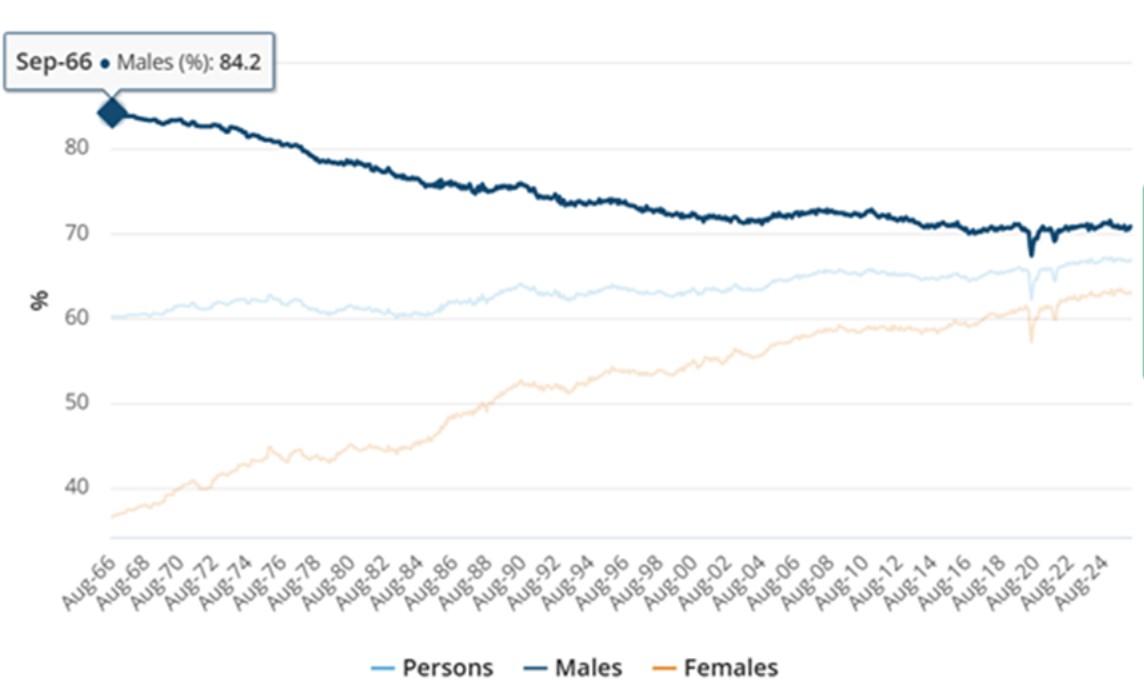
Forty years on, the yoke has disappeared. In April 2026, the American male labour force participation rate hit its lowest level since records began in the 1940s, according to the US Bureau of Labor Statistics. One in three American men — roughly 33% — were not working or actively looking for work. The overall male participation rate for men aged 16 and over stood at just 67%, down from 73.5% two decades ago and from 87% in the postwar years when Ehrenreich’s story begins.
The trend is not confined to America. Australian men’s workforce participation has fallen from around 79% in 1978 to approximately 71% today (see below), while similar declines — though less dramatic than in the United States — have occurred in the UK and Canada.
[…]
If you want to understand why men are voting with their feet, you need to look not just at what marriage now costs them — and the costs are severe — but at what it delivers. Increasingly, what it delivers is a pretty dud deal.
The modern woman: a prospectus.
- They are the most miserable, anxious, and insecure cohort in living memory — hardly great marriage material.
- Most married women go off sex — and the husband who objects is seen as the problem.
- Many women don’t actually like men very much. The more educated she is, the higher the contempt.
- They’ve gone full throttle left — and three quarters of college-educated women won’t even date a man who votes differently.
- They’ve rigged the education system and colonised corporate and institutional life, turning universities and workplaces into man-repellent factories.
- Yet their hypergamy (desire to marry up) is still running hot. Despite outnumbering men in education and careers, they demand a tall, equally high-status unicorn.
- The modern female threat-detection system is hyperactive. Almost any male behaviour — silence, opinions, jokes, breathing — gets flagged as a red flag.
- They’re extremely well-versed in the lucrative economics of divorce, including a well-timed false allegation to eliminate tedious shared parenting.
What rational man reads this list and thinks: yes, that’s exactly what’s been missing from my life?
Comments Off on Explaining why more men are “opting out”
The Ancient Greeks: 01 – What Made Them Special? (c) Why Greece Still Matters
seangabb
Published 31 Jan 2026Given the brutality and inequality of Greek society, a fundamental question arises: why do the Greeks matter at all?
This section answers that question by examining Greek self-awareness and historical reflection. It contrasts Greek civilisation with Near Eastern empires such as Assyria, and focuses on the writings of Thucydides and John Stuart Mill to explain why Greek history had consequences far beyond its own time.
The Greeks were not morally superior, but they developed habits of analysis and criticism that allowed their ideas to outlive their political power.
This section forms the intellectual turning point of the lecture.
Comments Off on The Ancient Greeks: 01 – What Made Them Special? (c) Why Greece Still Matters
QotD: “Theory” in film interpretation
[Camille Paglia] What has been called “theory” since the arrival of deconstruction in elite U.S. universities in the 1970s is in my view one of the most pointless and pretentious movements in modern cultural history. The catastrophic results should be obvious by now: the humanities are in ruin and have lost public respect and even internal support in academe, where budget reduction has come to the fore. I would refer those seeking greater specifics to my long attack on poststructuralism, Junk Bonds and Corporate Raiders: Academe in the Hour of the Wolf, published by Arion in 1991. Seven years ago, I did a follow-up assessment of current “theory” when the Chronicle of Higher Education asked me to review three new academic books by women about the bondage and domination trend. My unhappy response was “Scholars in Bondage”, which laments the damage done to promising young professors by a tyrannical academic establishment still chained to the bleached-out corpse of “theory”.
My approach to art is grounded in the sensory. Art is not philosophy. Art by definition refracts meaning through some medium of the material world. Hence my interpretation of art is grounded in the five senses. Perhaps the only theorist who fully grasped this issue was Gaston Bachelard in his 1957 book, The Poetics of Space, animated by a phenomenology that partly aligns with my own practice. It is no coincidence that I have spent most of my teaching career at art schools, where the body remains front and center in most art forms. Digital genres are certainly spreading and flourishing, but dance, music, and theater remain grounded in physicality — which is partly why art schools are finding it so difficult to adapt to the harsh, distancing realities of the virus crisis.
Comments Off on QotD: “Theory” in film interpretation
May 20, 2026
The seax as an English ethno-national equivalent to the kirpan
As most will know, the UK government has been steadily working to prevent UK citizens from carrying weapons of any time … except the religious exception for Sikhs to carry the kirpan, which is part of their faith. John Carter claims that the case for the Saxons to carry the seax is at least as strong:

Infamously, as one of its many assaults upon British tradition – the latest of which is the end of jury trials, a right Englishmen have enjoyed since the Magna Carta – the decline’s managers disarmed the British people. The right of (Protestant) Englishmen to keep and bear arms was enshrined in the Glorious Revolution’s 1689 Bill of Rights. The Second Amendment of the American Constitution’s Bill of Rights is essentially a reiteration of this ancient right of Englishmen; indeed, one of the complaints of the revolutionary colonists was that their rights as Englishmen were not being respected by the English crown. The right to bear arms was first expressed in the 1689 Bill of Rights, but its origin is much older, in the ancient Germanic understanding that a free man is an armed man, and that only slaves are prohibited the means of assuring their personal security. Britain’s managerial regime spent the twentieth century patiently gnawing away at the right to bear arms. It began its assault with licensing requirements in 1920, finally escalating to absolute bans following the 1988 Hungerford massacre and the 1996 Dunblane massacre.
As with all of its petty oppressions, the excuse for banning firearms has always been public safety, which the Yookish regime claims to prize much more highly than public liberty, which it does not claim to prize at all, that being the only honest thing about it. The sincerity of these invocations of safety is rendered dubious by the simultaneous premium Westminster, Whitehall, Number 10 Downing, and Buckingham Palace place upon the uninterrupted mass importation of humanoid dross from the most violently dysfunctional countries on the planet, which (notably) started in earnest at almost exactly the same time that the British people were disarmed.
It was not enough to take away the tools of self-defence. The principle of self-defence was also effectively eliminated: if a private citizen injures or kills a criminal in the course of defending himself against criminal predation, he will be charged as a criminal himself. The British people are expected to outsource their personal defence to police who refuse to defend them, in a country to which their government deliberately imports as many dangerous men as it can. Notably, defence against dangerous men of diversity is particularly frowned upon, because this is racist; indeed, even to complain about diversity danger is treated as a worse crime than rape, robbery, assault, or murder. The Yookay arrests more people for speechcrime than any other country on the planet.
Since firearms are banned, Britain’s criminal element has turned to knives, leading to a long-standing hysteria over knife crime. “Zombie-style knives” and “ninja swords” were banned in 2024 and 2025, while online knife sales now require 2-step age verification. There have even been calls to ban knives with sharp points, which would present certain challenges to the culinary arts. Meanwhile the stop-and-search policies intended to control knife crime on the streets are routinely derided as racist, as it is (surprise!) overwhelmingly young black men who are caught with concealed knives, which of course they conceal because their intent is to use them in the commission of robbery, assault, and murder. Which the British people are not permitted to defend themselves from, and which the Yookish police refuse to do anything about.
All of this raises the question of why, precisely, Digwa was walking around with a big knife.
The answer to this is that Digwa is a Sikh, and Sikhs have a special carve-out for the kirpan, a ceremonial knife which their religion mandates they carry with them at all times, as (if I understand correctly) a symbol of resistance to oppression and their readiness to always be prepared to defend the weak from injustice. Symbolic or not, the kirpan is a very real knife, with a very real edge.
The special religious dispensation granted Britain’s Sikhs is merely the most visible double-standard when it comes to keeping weapons. We saw another example during the Southport riots, when large numbers of Muslims turned out on the streets with machetes. Rather than arresting the lot of them (which the Yookish authorities couldn’t do, as they were busy filling the prisons with British protesters), the law enforcement officers on the scene advised them to hide their weapons in their mosque, which out of respect for the delicate sensibilities of the vibrant Islamic community the police would certainly never even dream of searching. One wonders just how many mosques are hiding caches of weapons.
Unlike the benevolently blind eye the Yookish authorities cast upon their treasured Muslims, however, the Sikh exemption is actually written into law.
As the Nowak case broke across social media a few days ago, a lot of people called for an end to this double standard. If whites are disarmed, then everyone else should be as well. There should be no special treatment on account of their heathen gods.
This is an understandable position, but I think it’s the wrong one. It is the thought pattern of The Raped.
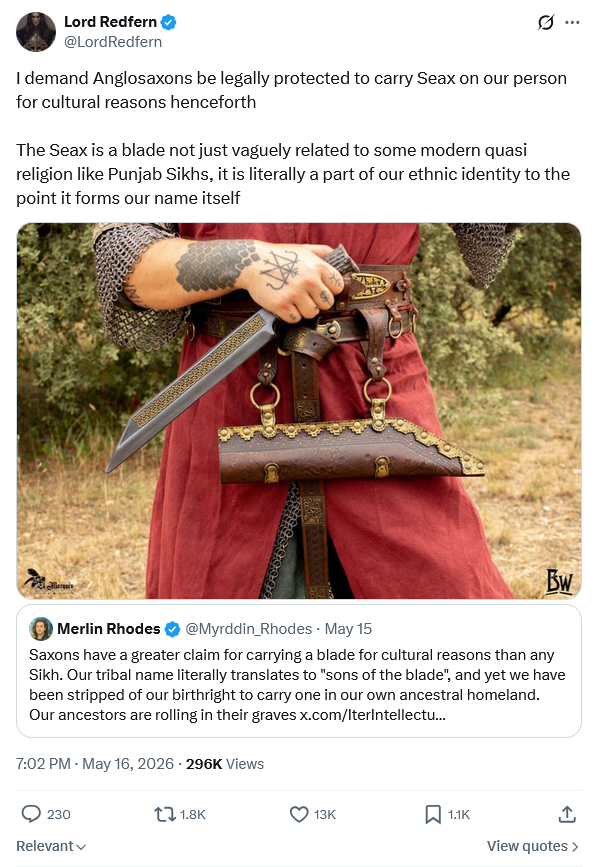
Rather than wanting to drag Sikhs down to the subbasement of slavish cuckery into which they’ve been pressed, Anglo-Saxons should instead demand that they, too, be allowed to arm themselves.
The Sikh argument is that their faith requires that they be armed at all time.
The Saxon argument is similar to the Sikh, but if anything it is even more fundamental.
The name Saxon derives from the seax, the characteristic short sword carried by the Germanic invaders who made England their home in the 5th century. “Saxon” literally means “the sons of the knife”, “the people of the blade”, or “the swordsmen”.
The very identity of our tribe is intertwined with privately held armaments. This is pre-political; it’s pre-religious; for the Saxon, armaments are an identitarian symbol that goes to the very core of what a Saxon is. To remove the seax from the Saxon is to strip him of his identity. Which, of course, is the avowed goal of the Fabian social engineers who have laboured for generations to reconstitute the definite form of the Anglo-Saxon into a pliable mush of generic, vaguely-defined, ahistorical, and universally extensible “values” that no Anglo-Saxon had even heard of until five minutes ago.
The same principle obviously applies to knife crime. Criminals are opportunistic predators. They avoid hard prey. There’s profit in jacking up easy meat to get a free iPhone, but not so much in getting stabbed into fresh meat yourself. If every Saxon wore a seax, street crime would very rapidly become a non-issue.
Of course, from the perspective of the Yookish governing apparat, the powerlessness of its subjects against criminal predation is quite an insignificant price to pay in exchange for ensuring the powerlessness of the autochthonous helotry against the apparat itself. If anything it’s a bonus. The regular humiliation of being forced to endure low-level criminality encourages a feeling of helplessness. The rainbow communists will therefore never “allow” the Saxon to rearm himself.
But what if the Saxon wore the seax without permission?
Comments Off on The seax as an English ethno-national equivalent to the kirpan
The Korean War Week 100: Mark Clark in Command – May 19, 1952
The Korean War by Indy Neidell
Published 19 May 2026Mark Clark is the new UN Commander and will run the war in Korea, replacing Matt Ridgway, who leaves for Europe to take over NATO Command. The Koje-Do POW camp situation is resolved, but is a black eye for the UN, as are the allegations that the US has been practicing germ warfare in Korea and Manchuria, backed up by “confessions” from captured American airmen.
00:00 Intro
01:13 Recap
01:29 Demand and Response
05:35 What Went Wrong at Koje-Do?
12:06 Germ Warfare?
13:55 Mark Clark
15:45 ROK and Ammunition
19:53 Philippine Raids
21:16 Summary
21:28 Conclusion
22:09 Call to Action
Comments Off on The Korean War Week 100: Mark Clark in Command – May 19, 1952
Canadian politics can be bad for your mental health
As a rule of thumb, the more you pay attention to Canada’s political circus, the worse your state of mental health becomes, IMO anyway. On a more serious note, David Clinton got curious about a recent Manhattan Institute project tracing American mental health trends:

Image from The Audit
The Manhattan Institute’s research into the confluence of mental health trends and political leanings in the U.S. generated buzz a while back. Among other things, they discovered that, as of the 2021-22 school year, liberal students were 13-17 percent more likely to seek mental health treatment than their conservative peers. That’s a frightening gap.
I was curious to know if there’s anything like that going on here in Canada. And it turns out that there’s excellent public-facing data waiting for us to drop by and help ourselves. The most recent published version of the Canadian Election Study (CES) dates back to the period around the 2021 federal election — the full dataset from 2025 isn’t yet available.
There were 20,968 respondents in total in the CES survey data from 2021. Having now spent a couple of happy hours with the results, this looks like an excellent representation of Canadian society. The questions go both deep and wide.1
I was able to directly address the political angle to all this using responses to one core question. Participants were asked to situate themselves on a political “scale where 0 means the left and 10 means the right”.
I classified anyone who responded with a number higher than 6 as “far right”, and responses less than 4 were tagged “far left”. The far left cohort had 4,927 members, while there were just 3,891 people in the far right. Those numbers are easily large enough to make distinctions potentially statistically meaningful.
Anxiety
I explored both far right and far left cohorts for how accurately the words “anxious” and “easily upset” applied to them. A response of seven indicates a self-assessment of extreme anxiety, while zero would be Big-Lebowski-level calm.
The average for the right-coded group was 3.47, while those on the left rated themselves 3.88.
Overall Mental Health
Respondents were asked to rate their mental health in relation to their peers where “1” indicates excellent mental health and “5” indicates poor mental health. A total of 3,878 from the far right responded and 3,263 from the far left. The average of all responses on the right was 2.02 (standard deviation: 0.876859) and from the left, 2.32 (0.926268).
- In fact, the average survey took two hours and twenty five minutes to complete! I’m definitely glad they didn’t ask me.
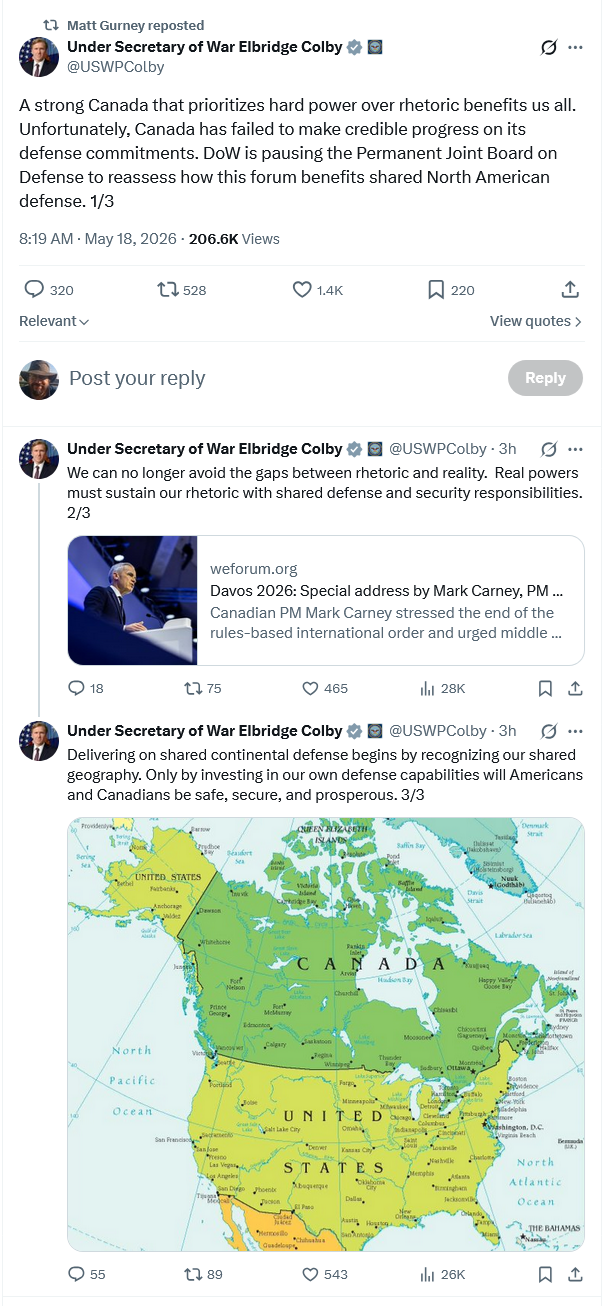
I mentioned the other day that the US was fully justified in “pausing” their participation in the Permanent Joint Board on Defence due to the Canadian government’s continued delinquence on military matters (and Prime Minister Carney’s blatant desire to tweak American noses while neglecting joint interests with the United States. At The Line, Matt Gurney says this won’t be the only tangible sign of American impatience with our ongoing fecklessness:
As I posted on social media when sharing this: “This is another gentle reminder to the f*ckwits in the Canadian government that they are playing with existential fire when they work to actively piss off our American allies.”
First of all, and this will annoy the Elbows Uppers to no end, the undersecretary’s comments are, fundamentally, accurate. Canada has indeed massively underinvested in defence and has also prioritized rhetoric over reality. I completely understand why Canadians hate admitting this — I hate admitting this. Having your flaws pointed out to you by someone you dislike is always a mortifying experience. But I’ve spent almost two decades writing about the very things Colby is pointing out — Canada has allowed its military capability to atrophy to a point, as I noted just a week ago in an episode of On The Line, where we’ll need many years and untold billions of dollars just to rehabilitate the armed forces. Expanding them and adding capabilities will be a whole other level of investment. This is why Canada’s recent major announcements on defence, though good and welcome, are also not enough — it will take a long time and even more money to actually repair what we have allowed to rot.
The other half of what Colby identified is also, alas, accurate. While we were massively underfunding defence and allowing core capabilities to wither and die, or while just totally missing the bus on transformational military developments (hello, drones!), Canada did indeed talk a lot about the rules-based international order and the role of middle powers and punching above our weight and all the rest. Canada focusing on rhetoric instead of reality is, alas, a fair criticism.
Many U.S. administrations called us out on this. We ignored them. Donald Trump is unique in how viciously he is prepared to exploit our weakness, but he’s hardly the first to have noticed it and called us out on it. I carry no water for MAGA or Trump, but they’ve got us dead to rights on this one. The bad orange man didn’t let the navy rust out, repeatedly defer the fighter jet replacement and hobble the army with non-serviceable equipment and recruiting and procurement systems that were actually quite awful at both those things.
We did those things. We did it to ourselves. Colby is simply possessed of the gall to bluntly call us out on our failures, in a way that Canadians aren’t accustomed to and aren’t going to enjoy.
So that’s part of it. But it’s also worth asking why the U.S. is doing this, and especially why they’re doing it now.
Part of it, probably, is just sincere frustration with us. As noted above, Colby’s remarks are accurate. But the timing is interesting. The CUSMA renegotiation deadline looms in early July And in Colby’s remarks, do I detect a whiff of the art of the deal?
The Carney government has made, and continues to make, plenty of announcements about plans, and potential deals, and future capabilities, and so on … but the Americans can’t help but notice that little is actually being done despite all the sound and fury on the PR side. Canada belatedly reached the long-agreed-upon 2% of GDP target for military spending, but most of it was a bookkeeping exercise of moving existing costs onto the Department of National Defence budget (the Canadian Coast Guard and parts of Veterans Affairs) but not much improved in Canada’s actual defence capabilities.
Comments Off on Canadian politics can be bad for your mental health
LMG-25: The Swiss Toggle-Locked Light Machine Gun
Forgotten Weapons
Published 29 Dec 2025The LMG-25 was designed by Adolph Furrer at Waffenfabrik Bern in the 1920s. Furrer was a devoted fan of the toggle locking system, and also designed a toggle-locked submachine gun that Switzerland (unwisely) adopted in 1941. The LMG-25 was first produced in 1924, adopted in 1925, and remained in production until 1946 with a total of 23,045 standard models and 1,742 optics-equipped fortress models made.
It is chambered for the standard 7.5x55mm Swiss cartridge with a 30-round side-mounted magazine (interchangeable with the later Stgw 57 magazine, incidentally). It is an effective design, if expensive to produce, and served Switzerland well for several decades.
(more…)
Comments Off on LMG-25: The Swiss Toggle-Locked Light Machine Gun
QotD: “Gilded Age” Robber Barons didn’t have access to what even working-class Americans have now
… but the robber baron knew he needed the serfs. Their relationship was purely dialectical. Without his factory hands, no robber baron. And in a strange but very real way, the higher up the food chain your Gilded Age robber baron went, the more he was dependent on his serfs for his lifestyle. J.P. Morgan is usually credited as being the first guy to become a Robber Baron purely through finance. Carnegie, Rockefeller, all those guys had most of their wealth in financial instruments, of course, but those financial instruments rested on control of a physical product — Carnegie Steel, Standard Oil.
I’m probably being unfair to Jay Cooke, the Michael Milken of his day, but since more people have heard of J.P. Morgan let’s roll with it. Even though Morgan’s wealth was entirely on paper — he was nothing but a securities trader — his lifestyle utterly depended on a battalion of servants. In a very real way, you yourself, right now, live much better than J.P. Morgan did in his heyday. And not just because you have aspirin, antibiotics, and air conditioning, three taken-for-granted things ol’ J.P. would’ve given half his kingdom for. But because you have more time. If you’re hungry, you can open the fridge or the microwave and have all the food you need in a matter of minutes.
J.P. couldn’t. J.P. had to deploy an army of servants every time he wanted a snack, and those servants were constrained by things like “availability of ice” and “when is the fishmonger at his stall”. You’re hungry at 2am, you jump in your car and get some Taco Bell. It takes ten minutes. J.P.’s hungry at 2am and it’s tough titty, J.P., your ass is going hungry. Because even though you’re the richest man in the world and have legions of manservants at your beck and call, Taco Bell just isn’t there. Even if someone had had the brilliant idea to create a Gilded Age Taco Bell, it still would’ve taken hours:
Wake up the manservant. Wake up the groom and stableboy. Hell, wake up the horse, then saddle the horse, ride to the drive thru window … which in this case means “the house of the guy who runs Gilded Age Taco Bell”. At which point he has to fire up the oven, start pounding the tortillas, send his own legion of valets and stableboys and whatnot out to get the refried beans …
And that’s the other thing, J.P. — you’d best not pull that shit too often, because those people know where you live. Not only do they know where you live, they live with you. Literally under the same roof. You want to sleep easy? You’d best not beat the servants too often, buddy.
There’s only so much “class consciousness” one can develop in that world. Oh yeah, J.P. thought of himself as one of the Masters of the Universe, there’s no denying that. But J.P. lived in what was still a brutally physical world, in a way we PoMo people really can’t grasp. If you can’t imagine what it would take to get some Gilded Age Taco Bell, maybe geography will do the trick. Ever seen Gangs of New York? Even if you haven’t, you’ve probably heard the name “Five Points”. The worst slum in America in the 19th century, and 19th century American slums were world class …
That was right down the street from Wall Street. Literally. I am not in any way joking, and if I’m exaggerating a little for effect when I say “J.P. could’ve hit Five Points with a five iron from his swanky digs on Central Park West”, I promise you I’m not exaggerating much. You can look it up for yourself. The main reason the Union rushed troops straight from the Gettysburg battlefield, and no-shit shelled parts of the city with gunboats, during the Draft Riots was because Five Points (et al) was right fucking there, and they might’ve gotten it into their heads to lynch a few Masters of the Universe. Rich man’s war, poor man’s fight, right? Let’s see how you like it, you bankster bastards …
The PoMo “information economy” removes all that. The other day I joked about colleges like Bennington and Goucher. I cracked some jokes, yeah, but I wasn’t really joking. Those places aren’t for us. Wall Street is still a physical location, but it might as well be on the dark side of the moon for all any of us have access to it. J.P. couldn’t beat the servants too hard, or too often. The modern equivalent of J.P. isn’t even aware that he has servants. He just clicks on a website, and stuff appears at his door. Like magic. Hell, it IS magic for all he knows, and he surely doesn’t care, because all that shit is his by right. He went to Bennington, after all. He has achieved full class consciousness.
All of which suggests, of course, that while Marx was wrong about the end state — the State will not, in fact, wither away — he might well have been right about the solution to the “contradictions of capitalism”, if you follow me. And if that makes me some kind of godless pinko Commie subversive, well … I’ve been called worse by better.
Anybody got the lyrics to La Marseillaise in English?
Severian, “On Losing the Cold War”, Founding Questions, 2022-07-02.
Update, 21 May: Welcome, Instapundit readers! Have a look around at some of my other posts you may find of interest. I send out a daily summary of posts here through my Substack – https://substack.com/@nicholasrusson that you can subscribe to if you’d like to be informed of new posts in the future.
May 19, 2026
The War People by Lucian Staiano-Daniels
At Dead Carl and You, Kiran Pfitzner reviews The War People: A Social History of Common Soldiers during the Era of the Thirty Years War and finds it has value in bringing to life some of the ordinary people involved in that bloody, interconnected series of wars that we group together as the Thirty Years’ War:
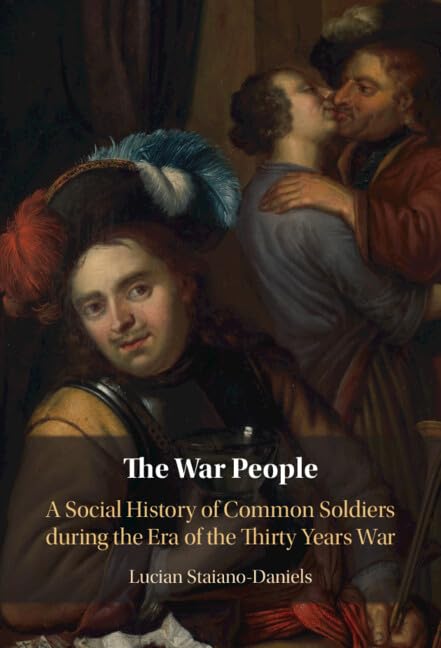
“Their word for themselves was People. Early seventeenth-century common soldiers were Die Leute, Das Volk, les gens, or la gente. They were Das Kriegsvolk, Die Kriegsleute, les gens de guerre, the War People.” So begins Lucian Staiano-Daniels’s aptly titled The War People: A Social History of Common Soldiers during the Era of the Thirty Years War. Using the technique of micro-history, Staiano-Daniels follows the Mansfeld regiment from its raising in 1625 to its unhappy dissolution in 1627. This unexceptional regiment is notable because of the primary source documentation that survives, specifically its original internal legal records — investigations, debts, trials, and last testaments. Through this unusually immediate resource, we gain glimpses of the reality of the 17th century common soldier and so a clearer view of the social conditions he lived within.
One way Staiano-Daniels situates this investigation is in terms of the relationship between military organization and state-building. Describing the existing historiography, he writes: “In this argument, early-modern states increased their control over their civilian populations in part to raise tax money for larger armies that were inhabited by soldiers who were themselves increasingly well-disciplined”. He instead finds, “neither an intensification of military discipline nor unadulterated thuggishness. The military community was made up of systems of relationships that were subtle, intricate, and disorganized.” (7). These findings are well evidenced, and significant, as earlier literature (drawing on more normative sources like manuals and regulations) asserted the intensification of discipline as part of the emergence of the modern state. Instead, we see states forced to engage in the paradoxically complexly and loosely organized world of the mercenary, unable in this time of crisis and state-emergence to fully subordinate the armed forces they employed.
The 17th century and the Thirty Years’ War serve as an important benchmark in understanding the development of war. In witnessing the lives of the kind of men with which wars of the 17th century were fought, we gain a greater understanding of the society that they moved in. In so doing, we can more easily conceptualize the forces that both constrained and enabled war in the 17th century, producing its particular form. This conception provides the opportunity to more easily understand war in other places and times and what conditions reduced or intensified its violence.
Reading this work as a Clausewitz scholar, I could also not help but see a connection between the culture of the war people and Clausewitz’s support for a national militia or Landwehr as a step towards more inclusive governance. There is, of course, a great distance between the unruly mercenaries of the Thirty Years’ War and the “nation in arms” envisioned by Clausewitz and the other Prussian reformers, but at its core we find a common phenomenon: the connection between military service and rights, personal and political.
This book demonstrates well the value of microhistory; in looking closely at the practices and prevalent attitudes of these soldiers of the 17th century, we gain a more concrete view of the prevailing social conditions. This is not just of interest for its own sake (as social history), but because social conditions greatly shape the practice of war, as Clausewitz tells us. This is so because social conditions both reflect and affect the political conditions that create war, as well as the political purpose that exercises a continuous influence upon it.
Comments Off on The War People by Lucian Staiano-Daniels
“That is not diplomacy. That is national self-harm wearing a lanyard.”
On the social media site formerly known as Twitter, L. Wayne Mathison responds to a post about the Canadian government’s amazing nonchalance about protecting Canada’s sovereignty:
Canadians voted in a federal election, not in a referendum to turn the country into a Davos policy lab with a maple leaf sticker slapped on the front.
The line “we will never be the 51st state” is easy politics. Most Canadians agree. But then the same elbozos turns around and flirts with every other form of sovereignty dilution they can find.
Join the EU? Canada is not in Europe. Geography still matters, apparently. Joining the EU would mean importing another layer of bureaucracy, regulation, courts, trade rules, and political obligations from people Canadians cannot remove from office. That is not independence. That is outsourcing control with better stationery.
Give China influence over resources? That is even worse. A serious country protects strategic assets: energy, minerals, food, ports, telecom, data, and critical infrastructure. You do not hand leverage over your future to an authoritarian state and then call yourself sophisticated. That is not diplomacy. That is national self-harm wearing a lanyard.
The real issue is this:
Canada’s elites love sovereignty when it means rejecting America.
They seem much less interested in sovereignty when it means resisting Brussels, Beijing, the UN, global finance, or climate bureaucrats.
So the question is fair:
Who voted for Canada to stop acting like a country?
Not Canadians. Not directly.
This is elite mission creep. They run on patriotism, then govern like national borders are an administrative inconvenience.

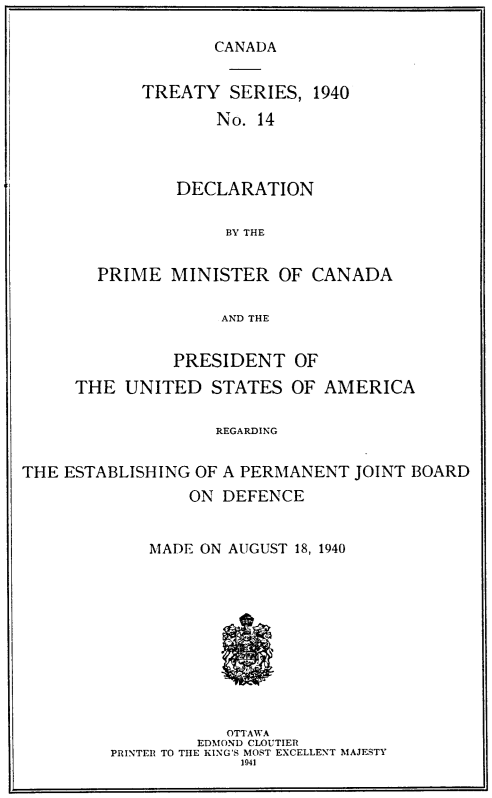
Other items that popped up in the news over the weekend included the United States Department of War announcing that they will be “pausing” their participation in the Permanent Joint Board on Defence, a US-Canadian body that has been continuously operating since 1940 when US President Franklin Delano Roosevelt and Canadian Prime Minister William Lyon Mackenzie King established it in a meeting in Ogdensburg, New York. Is this a big deal? Some people certainly think so:
In a bit of a sudden, surprise move, Under Secretary of War Elbridge “The Biggest Cheese” Colby has announced on X of all places that the Unites States would be pausing participation in the Permanent Joint Board on Defence, the Oldest and most Foundational node of the Canada-US security partnership.
[…]
As we all know, on August 17, 1940, U.S. President Franklin D. Roosevelt and Canadian Prime Minister William Lyon Mackenzie King met in a railway car in Ogdensburg, New York. They issued the Ogdensburg Declaration, an agreement to create a joint board to study sea, land, and air defense problems.
For over 80 years the PJBD has serves as one of the major intersects of the Canada-US relationship. It has been the forum where we have been able to engage and work collaboratively on matters of National Security, Continental Defence, and Critical Infrastructure.
Obviously, given how late it is for me, I sadly can’t dive head first into things. However, I did wanna get something out there. It’s no doubt a very petty move to make, part of a long line of petty moves between everyone in the last year. The pressure is obviously there to push Canada along, and the inclusion of the Prime Ministers Davos speech by Colby should go as a sign to one of the areas that is troubling the current administration.
Trying to apply pressure through such acts though isn’t something that I think will be successful. Granted, being a bit of a dick and doing petty shit in hopes of manipulating opinions, only for it to backfire due to a general miscalculation, is something this Administration does on the regular, and so I can’t be surprised to see it done here.
Nor is it surprising for the performative PM and his government to be utterly blindsided when one of their petty performances triggers a strong negative reaction from the United States.
Another issue that the Liberals in Ottawa seem to think both uncontroversial and straightforward is one of their batch of anti-civil-liberties bills before Parliament, in this case Bill C-22, which the US Congress considers to be a dangerous attempt to control US companies who do business in Canada:
The government’s plans for lawful access have gone off the rails. In recent days, Signal has warned it would pull out of the Canadian market rather than comply with Bill C-22. Windscribe, the Toronto-headquartered VPN provider, has said it would relocate its headquarters out of Canada and NordVPN has warned it would consider following suit. Apple and Meta have both raised public concerns about the bill’s effect on encryption and cybersecurity. The Canadian Chamber of Commerce, the Cybersecurity Advisors Network, civil liberties groups, and a long line of legal and security experts have all called for changes. The chairs of the U.S. House Judiciary and Foreign Affairs Committees have written to Public Safety Minister Gary Anandasangaree warning that the bill threatens U.S. national security and the integrity of cross-border data flows. Even the bill’s own oversight body, the National Security and Intelligence Review Agency, has told the SECU committee it does not have the access it needs for effective oversight. If the government thought it could push through the bill largely unnoticed, it has been proven painfully wrong as there are now trade frictions with the U.S., the prospect of leading companies exiting the Canadian market, and weaker cybersecurity protections for ordinary users.
[…]
The bill nominally protects against the worst outcome through a systemic vulnerability safeguard, which says that core providers are not required to comply with a regulation if compliance would require the introduction or maintenance of a systemic vulnerability. But the safeguard falls apart on careful reading. First, the term “systemic vulnerability” lacks specificity in the statute, which means the government could define encryption and vulnerability narrowly enough to hollow out the protection. Second, Sections 5(5) and 7(5) state that providers are not required to comply where doing so would result in a systemic vulnerability, but Sections 12 and 13 unconditionally require compliance with orders and provide that orders prevail over inconsistent regulations. The net effect is that providers are stuck with contradictory provisions in a system shrouded in secrecy and which could lead to the weakening of security systems. That is why Signal, Windscribe, NordVPN, Apple, Meta, the Canadian Chamber of Commerce, the Cybersecurity Advisors Network, and the U.S. Congress are raising the alarm.
The best approach to address these risks is to go back to the drawing board on Part 2 of the bill. Committee hearings should be extended to ensure that the long list of expert witnesses, industry voices, and international counterparts who have asked for changes receive a full hearing. Further, real amendments should be on the table that better balance law enforcement needs with Canadians’ privacy rights. Failure to do so will result in some of the world’s most privacy-protective services exiting the market, leaving behind a law that is vulnerable to constitutional challenge with millions of Canadians facing genuine privacy and cybersecurity risks.
Comments Off on “That is not diplomacy. That is national self-harm wearing a lanyard.”


