
World War Two
Published 14 Jun 2022Neutral Turkey appears to be an island of peace in a sea of war. But if you look a little closer though and there’s another story. Assassins ply their deadly trade. Spies slip in and out of occupied Europe. The Allies and Axis battle for influence. The secret war is in full swing.
(more…)
June 15, 2022
Istanbul: City of Spies – WW2 – Spies & Ties 18
Comments Off on Istanbul: City of Spies – WW2 – Spies & Ties 18
“Privacy” seems to be an archaic concept that doesn’t matter to the Canadian government
Michael Geist wonders why the Canadian government doesn’t seem to care at all about the privacy of Canadians:



Over the past several weeks, there have been several important privacy developments in Canada including troubling privacy practices at well-known organizations such as the CBC and Tim Hortons, a call from business organizations for privacy reform, the nomination of a new privacy commissioner with little privacy experience, and a decision by a Senate committee to effectively overrule the government on border privacy rules. These developments raise the puzzling question of why the federal government – led by Innovation, Science and Industry Minister François-Philippe Champagne, Public Safety Minister Marco Mendicino, and Canadian Heritage Minister Pablo Rodriguez – are so indifferent to privacy, at best treating it as a low priority issue and at worst proposing dangerous measures or seemingly hoping to cash in on weak privacy laws in order to fund other policy priorities.
The privacy alarm bells have been ringing for weeks. For example, the Globe and Mail recently featured an important story on children’s privacy, working with Human Rights Watch and other media organizations to examine the privacy practices of dozens of online education platforms. The preliminary data suggests some major concerns in Canada, most notably with the CBC, whose CBC Kids platform is said to be “one of the most egregious cases in Canada and really all around the world”. The CBC responded that it “complies with relevant Canadian laws and regulations with regard to online privacy, and follows industry practices in audience analytics and privacy protection”. Yet that is the problem: Canada’s privacy laws are universally regarded as outdated and weak, thereby enabling privacy invasive practices with no consequences. Soon after, the Privacy Commissioner of Canada released findings in an investigation involving the Tim Hortons app tracking location data. First identified by then-National Post reporter James McLeod, the commissioner found privacy violations, yet Canadian privacy law does not include penalties for these violations.
Despite the obvious need for privacy reform – outgoing Privacy Commissioner of Canada Daniel Therrien reiterated the necessity for reform in his final speech as commissioner and business groups have made a similar call for privacy reform – the government seems indifferent to the issue. The nomination of Philippe Dufresne as the new privacy commissioner is a case in point. I don’t know Mr. Dufresne and I’m hoping that he proves to be a great commissioner. He certainly said many of the right things in his appearance before committee yesterday. However, the government’s choice is instructive. In choosing someone with no obvious privacy experience, the government sided instead with government managerial experience. Good managerial experience is valuable, but a career spent within government is not a training ground for pushing the policy envelope, pressuring governments to reform the law, and demanding that the private sector comply with it. The Dufresne choice signals that the government may be more comfortable with a well-managed agent of Parliament than with an agent of change.
Comments Off on “Privacy” seems to be an archaic concept that doesn’t matter to the Canadian government
Model 1892 Berthier Artillery Musketoon
Forgotten Weapons
Published 19 Jul 2017http://www.patreon.com/ForgottenWeapons
The original 1890 Berthier carbine was designed for cavalry, but a slightly modified version was produced (in small numbers) with a bayonet lug, for use by the Gendarmerie. In 1892, the French military would adopt that same carbine for use by an assortment of troops who were better suited with a carbine than a full size Lebel rifle. These included primarily artillery crews, but also engineers, messengers, drivers, and others.
The Modele 1892 Mousqueton d’Artillerie was basically identical to the 1890 cavalry carbine, including the same 3-round Mannlicher-type clip. It was put into production at both the St Etienne and Chatellerault factories, and by August of 1914 384,000 were in French inventory. By the time the improved 1916 model was put into production, a total of 675,000 of these carbines would be built.
If you enjoy Forgotten Weapons, check out its sister channel, InRangeTV! http://www.youtube.com/InRangeTVShow

Comments Off on Model 1892 Berthier Artillery Musketoon
QotD: The gobsmacking magnitude of “The Great Enrichment”
Serious growth happened only after 1800, at first in northwestern Europe, 2% per capita in PPP [purchasing power parity] conventionally adjusted for inflation, as in the USA 1800–present, and now the world. Its magnitude is enormous, the Great Enrichment. It was a rise from $2 or $3 a day to over $100, a factor of 30. (I recently had to explain to a justly famous anthropologist that [(30–1) / 1] x 100 is 2,900%, or about 3,000%. He said that he could believe a factor of 30 … but not 3,000%.)
The exactitude, of course, is inessential. In Japan and Finland it was roughly the factor of 30. But it could be the worldwide factor since 1800 of 10 only, about $2 or $3 to $30 a day (to $10,000 a year, the level of Brazil now, to fix ideas), and still be utterly novel. As a Brit might say, the Great Enrichment was gobsmacking.
The enrichment was actually much greater than the factor of 30, because price indices, especially recently, do not adequately reflect improvements in quality, as was determined in the early 1990s by the Boskin Commission … Consider your cell phone, your auto tires, your medical treatment — all greatly better, recently. Even economic facts and analyses are better. (Well, sometimes.) The downward bias from inadequately deflating money prices for improved quality is not far from 2% per year, which would double recent growth rates in the rich countries.
Its magnitude, novelty, recency, and location are all crucial to explaining the Great Enrichment, because together they strongly suggest that there was something deeply peculiar about Britain in the 18th century, and that afterwards the peculiarity spread to the rest of the world. Such facts make “run-up” theories such as in Stephen Broadberry et alii look implausible, because they depend on a metaphor of an airplane taking off, with little else by way of explanation for why the Industrial Revolution (a factor of 2) happened or, especially, its follow-on the Great Enrichment (a factor of 20 or 30). Likewise, it is dubious to attach the Great Enrichment to remote causes within Europe, such as the Black Death — which originated in China, with similar terrors, and yet yielded no Great Enrichment there. Also dubious is the Eurocentric belief, prominent in conservative circles, of some ancient superiority of melanin-challenged Volk back in the Black Forest. (Did you know, for example, that all European countries had common law in the Middle Ages, that is, judge-found-and-made, not legislated or codified?)
The Great Enrichment is the second most important secular event in human history, second only to the domestication of plants and animals making for cities and literacy.
Dierdre McCloskey, “How Growth Happens: Liberalism, Innovism, and the Great Enrichment (Preliminary version)” [PDF], 2018-11-29.
Comments Off on QotD: The gobsmacking magnitude of “The Great Enrichment”
June 14, 2022
The Early Roman Emperors – Part 2: An Empire of Peoples
seangabb
Published 4 Oct 2021The Roman Empire was the last and the greatest of the ancient empires. It is the origin from which springs the history of Western Europe and those nations that descend from the Western Roman Empire. It is the political entity within which the Christian faith was born, and the growth of the Church within the Empire, and its eventual establishment as the sole faith of the Empire, have left an indelible impression on all modern denominations. Its history, together with that of the ancient Greeks and the Jews, is our history. To understand how the Empire emerged from a great though finally dysfunctional republic, and how it was consolidated by its early rulers, is partly how we understand ourselves.
Here is a series of lectures given by Sean Gabb in late 2021, in which he discusses and tries to explain the achievement of the early Emperors. For reasons of politeness and data protection, all student contributions have been removed.
More by Sean Gabb on the Ancient World: https://www.classicstuition.co.uk/
Learn Latin or Greek or both with him: https://www.udemy.com/user/sean-gabb/
His historical novels (under the pen name “Richard Blake”): https://www.amazon.co.uk/Richard-Blake/e/B005I2B5PO
Comments Off on The Early Roman Emperors – Part 2: An Empire of Peoples
Gender dysphoria and body dysmorphia
Once upon a time, in the dark recesses of ancient history (say, 2015 or so), most of the people expressing dissatisfaction with their birth gender were male. Shortly after that, the numbers inverted significantly and today it’s predominantly females demanding “gender affirming” treatment:
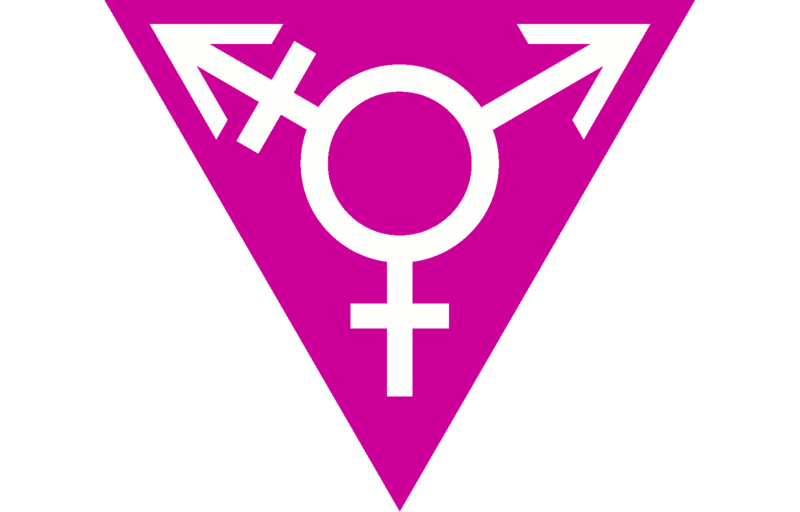
Girls who reject femininity or self identify as male or “non-binary” actually have a form of body dysmorphia. Rejecting their feminine body parts, for instance by flattening their chests, shows repulsion toward the areas they feel are not fit for acceptance. The trend of “binding” to produce a flat, androgynous body is dangerous, cutting off the air supply and possibly causing permanent damage, but it is encouraged as a precursor to transitioning from female to male.
In fact, transgendered people who were born women tend to suffer from eating disorders in an “extremely high proportion”, according to the Duke University Health System.
Make no mistake, a young woman who is dieting obsessively does not wish to look feminine or capable of having children. Many women who achieve their desired weight by extreme dieting cease to have periods and even grow downy hair on the face which resembles the incoming beard of a pre-pubescent man.
So is gender dysphoria essentially interchangeable with body dysmorphia? The woke people working at the NHS and gender reassignment clinics would never admit it, and would deny any correlation despite the statistics. But they are seeing more gender dysphoric young women than ever.
According to this article, entitled “Why Are So Many Females Coming out as Trans/Non-Binary?” in recent years the proportion of young women coming out as trans as opposed to men has increased dramatically. This shows a reversal from the previous trend years ago of more men wishing to become the opposite sex. But the incidence of actual transitions carried out does not show a corresponding rise for women, and that should prove many young women eventually grow out of identifying as trans, or “desist” from the desire to become male. “Desistance” refers to the situation where a young person who experiences gender dysphoria eventually “grows out of it” and decides not to go through with a sex change.
The occurrence of desistance among youngsters supports the position that they should not be allowed to undergo irreversible operations such as mastectomy or be pumped full of hormones (including puberty blocking “treatments”) which they are likely later to regret. Sadly, many medical “experts” don’t believe the figures cited for desistance among young people and discount them as flawed due to the looser criteria for diagnosing gender dysphoria used in the past. In other words, young boys who liked to wear dresses and would have been diagnosed as transgendered in previous years would not so qualify today, but young girls who hate their bodies and want to mutilate their breasts would be eligible for such “treatments”. The reasoning goes on that a whole raft subsisted of boys who were merely “gay boys who may have been experimenting with different ways of expressing gender but who were never really transgender in the first place”.
Such conclusions defy common sense or any logic or human decency. This article cites the findings of one Thomas Steensma, a clinician and researcher at the Centre of Expertise on Gender Dysphoria at the VU University Medical Centre in Amsterdam. He conveniently found in a study that desistance rates were lower in older, female children than in young boys.
H/T to Blazing Cat Fur for the link.
Comments Off on Gender dysphoria and body dysmorphia
History of Rome in 15 Buildings 13. San Pietro in Vincoli
toldinstone
Published 2 Oct 2018Speech stands at the threshold of the compressed lips. Righteous indignation is written in the lines of the set jaw. The presence of God blazes forth from the eyes. As a work of art, Michelangelo’s Moses is nothing short of awe-inspiring. It sits, however, in the cramped central niche of a rather underwhelming wall tomb, ringed by smaller statues ranging in quality from mediocre to incompetent. This thirteenth episode in our History of Rome discusses the creation of the Moses, and the circumstances that brought it to the church of San Pietro in Vincoli.
To see the story and photo essay associated with this video, go to:
https://toldinstone.com/san-pietro-in…

Comments Off on History of Rome in 15 Buildings 13. San Pietro in Vincoli
QotD: Generation snowflake
So no, no surprises here. Their collective personality makes the Millennials unusually suited for the flirtation with socialism. They are a great match; if this was Tinder, Marx would be getting super liked all the time.
Socialism is the response of a spoiled child when faced with the world that does not genuflect to its every wish the way their parents did – the world as it is must therefore be evil and has to be changed to something radically different. Gen Y, of course, did not just magically became the way they are – they were brought up like that, so we all bear the blame and the responsibility for a generation who resents not being managers in their 20s and not being recognised as special anymore by all their elders. Clearly, the capitalism has failed when I’m not showered down with money after I graduate from my double in media and gender studies.
Arthur Chrenkoff, “Socialism as a Millennial religion”, The Daily Chrenk, 2019-02-19.
Comments Off on QotD: Generation snowflake
June 13, 2022
The idealized EU that British “Remainers” still long for
The Brexit debate was at least as much a cultural as it was an economic or political struggle. Many of the people who wanted the UK to remain within the European Union would be instantly comfortable as members of Canada’s Liberal or New Democratic parties, as our “Laurentian elite” are culturally much more attuned to their European elite counterparts than they are to ordinary Canadians. British “Remainers” similarly have much more in common with their Euro counterparts than with ordinary Brits:

For many in the British cultural establishment, Brexit was (and still is) an incomprehensible, foolish rejection of the unqualified benefits of the European Union. The creative industries, according to one noted poll in the lead-up to the 2016 referendum, were 96 per cent in favour of staying in the EU, and many working in the arts and culture have been raging ever since. Britain’s contemporary artists are some of the most outspoken about Britain leaving the EU, to the point that some of them would rather leave Britain. Last week, speaking at an exhibition opening in the Netherlands, famed sculptor Antony Gormley announced that such were his strong feelings over Brexit that he had applied for German citizenship. “I’m embarrassed about Brexit”, he lamented, “it’s a practical disaster, a betrayal of my parents’ and grandparents’ sacrifice to make a Europe that was not going to be divided again”.
[…]
None of our parents and grandparents who experienced the war, and the postwar reconstruction, would have envisioned the EU in its current form. It is a backroom technocracy of elites, making decisions beyond the reach of popular accountability, increasingly hostile to democracy and the aspirations of its millions of citizens. As many of us have always maintained, it’s possible to be for Europe, for fellow Europeans and for European culture – but against the EU.
The “little Englander” slur is one of the more ingrained prejudices of cultured Remainers. It has always been a way of expressing their contempt for those stuck with the consequences of the European project, those people unable or unwilling to shift from their “little”, provincial world and attitudes. These are the people, moreover, who the cultural establishment spent two decades up until the referendum patronising and cajoling. Arts policies and newbuild art galleries imagined that culture would rehabilitate the left-behind provincials of post-industrial Britain. Until, that is, post-industrial Britain voted the “wrong” way. (Gormley, with haughty disdain, has previously described Brexit as “a stupid moment of collective fibrillation” and “a disease”.)
Prominent Remainers profess their love for EU free movement, but studiously look the other way when it comes to its less romantic reality. Its only real achievement has been to facilitate the flow of cheap labour from poorer to richer EU states. This is the dominant economic reality of the free movement of labour, not the individualist idyll of foot-loose, self-determining bohemianism, or the career mobility of the well-paid creative. The latest Home Office figures for applications to the EU settled-status scheme reveal the stark trends in where Europeans, settling in Britain post-Brexit, are from: while the table is headed by poorer Eastern European Romania and Poland, these are followed by Italy, Portugal and Spain – southern Eurozone countries which were battered by the consequences of the EU’s stubborn and heedless imposition of the single currency.
While Remainers crow about insularity and “little Englanders”, it turns out that Britain is actually becoming more cosmopolitan, not less, since Brexit – just not in the way they mean it. Not only are 3.2million European citizens now fully settled and 2.6million “pre-settled” (meaning they’ll be fully settled after five years of residence), but also the British population is becoming more international. Recent ONS figures show that the number of workers not born in the UK has increased as a share of the labour force, from 17 per cent in June 2016 to 19 per cent in March 2022, with the increase made up of non-EU workers.
Update: Added the link to J.J. Charlesworth’s article at Spiked.
Comments Off on The idealized EU that British “Remainers” still long for
Nazis in a Balkan Mess – WAH 064 – June 12, 1943
World War Two
Published 12 Jun 2022In the Balkans, the Axis powers fail to rout Yugoslav and Greek Partisans. In Bengal, British India starvation is spreading, and in the Netherlands, the Nazis send 1,296 children and infants from the Vught Camp to the gas chambers at Sobibor.
(more…)
Comments Off on Nazis in a Balkan Mess – WAH 064 – June 12, 1943
Justin Trudeau’s sadism is visible at Toronto’s Pearson International Airport
It’s been more than a decade since the last time I had to travel by air … and even then it was still a far worse experience than it was before 9/11. Canada is among the last few countries to loosen Wuhan Coronavirus restrictions on international travel — along with two of Justin Trudeau’s favourite nations, the cuddly North Korean sole proprietorship and the “admirable” “basic dictatorship” in China. In the free-to-cheapskates weekly round-up of The Line, the editors have recent travel experiences at Canadian airports to discuss:

CBC News report on delays at Pearson International Airport in Toronto, 9 June, 2022.
Screencap from https://www.youtube.com/watch?v=pkgmWWY2SDc
… Why couldn’t your Line editor browse the aisle? Well, because duty free is only for international travellers, and hanging around was forbidden due to “COVID protocols,” the clerk explained.
Now, was your Line editor going to stand around and pick a fight with some underpaid store clerk who was just following the rules? Absolutely not.
But she thought about it.
Look, we understand that not being able to browse is, on the list of first-world problems, really far down, but we had to admit that this stupid little non-incident made us angry. Just stupid, irrationally, bug-eyed angry for a solid minute or two.
Why? Because our entire lives have been eaten by a compounding collection of nonsensical COVID rules and restrictions that have added up to make everybody crazy and miserable, and this was just another. Everyone we know now has a story of peaking on COVID hysteria; experiencing a moment so surreal, inhumane and paranoid that it had the effect of fundamentally breaking trust in the judgement of public health and in broader institutional authority. Whether it was the moment they covered the outdoor playgrounds with police tape; the librarian who refused to let the potty-training toddler use the bathroom; the umpteenth school closure; the triple-masked mom screaming hysterically at her ward for touching other kids; to stories of being trapped for hours on end in airplanes or terminals. There was a moment when nearly all of us broke and took someone else’s head off. When we stopped clapping for health-care workers and instead grew quietly resentful, or found ways to silently flout COVID protocols — or abandoned the mainstream altogether and lost ourselves to fringe politics and conspiracy theories.
Upon arrival at one airport, one of your Line editors spotted a kids’ play area containing nothing more than a cartoonish carpet depicting a fun little airport runway. It was still closed. It is, apparently, still too dangerous to let kids burn off steam by pretending to be airplanes for a few minutes.
Even the Liberal backbench has been reported to be demanding that Justin Trudeau make some vague gestures to reduce the arbitrary and unscientific civil liberty restrictions we’ve been living under for what seems like forever … but he seems to like making Canadians miserable where and when he can.
Keeping up unnecessary mandates is not a cost-free political solution. You are teaching your population to distrust you. Yeah, we mean that quite literally: you, Liberals, are also responsible for the declining social cohesion and failing institutional trust that is fuelling populist movements across the country.
We realize that the mandates are small potatoes. But in a way, they’re also really not. Keeping up historic restrictions on Canadians movement, slowing a desperately desired return to normal, purely for political reasons, is only further corroding the social contract between electorate and government. Further, you’re falling into exactly the same trap as the Conservatives — you’re riding the dragon that will eat you, allowing your loudest, fringiest members to dictate policy.
The Liberals seem to be getting this, at least a little bit. Probably because they perceive the political threat this presents to them. On Friday, they announced that random COVID-19 testing of certain arrivals would be suspended, temporarily, until the end of the month. This is intended to reduce backlogs and crowding at our arrival gates, particularly in Toronto. We’ll see how much it helps, but as a political decision, it’s revealing: the Liberals are now alarmed enough to do something, but not to actually just scrap the screening, at least not yet. For now, it’s just a pause.
Comments Off on Justin Trudeau’s sadism is visible at Toronto’s Pearson International Airport
Lightning fast interceptor turned nuclear strike bomber: the Canadair CF-104 Starfighter
Polyus Studios
Published 29 Sep 2020Don’t forget to like the video and subscribe to my channel!
Support me on Patreon – https://www.patreon.com/polyusstudiosThis is an UPDATED version of the video. It includes many changes and corrections to the original video. Many thanks to Gary Watson for all his contributions!
Starting in 1959 Canadair began building Canada’s fastest jet at their plant in Montreal. It was designed as a sleek high altitude and high speed interceptor, but was adapted for low level ground strike missions with conventional and nuclear weapons. It was the Canadair CF-104 Starfighter, Canada’s missile with a man in it.
0:00 Introduction
0:33 Historical Context
2:01 Design Choice
4:15 Canadair’s Production Run
6:50 Configuration and Specifications
11:04 Nuclear Strike Role
12:13 Operational History
16:06 Conventional Role
17:53 Retirement and Replacement
19:28 Accidents, Controversy and Legacy
22:56 ConclusionMusic:
“Denmark” – Portland Cello ProjectResearch Sources:
Canadair CF-104 Starfighter by Harold A. Skaarup (http://silverhawkauthor.com/canadian-…)
Canadair CF-104 Starfighter by Canadian Starfighter Association (http://canadianstarfighterassociation…)
CF-104 Flight Operations by Air Force Museum of Alberta (https://www.rcaf.museum/history/rcaf-…)
Story of the F-104 Starfighter in Norwegian Service by Bjorn Hafsten (http://starfighter.no/hist-en3.html)
Starfighters with Turkey by Joe Baugher (http://www.joebaugher.com/usaf_fighte…)
ASN Aviation Safety Database by Aviation Safety Network (http://aviation-safety.net/wikibase/d…)
Starfighter by David L. Bashow (Fortress Publication, 1990, ISBN: 0-919195-12-1)
Photography credit 6mins10sec: Gary WatsonFootage Sources:
Personal Footage – Gary Watson
Cold War Fighter Pilot – Ken Castle, CD, Flight-Lieutenant (ret’d) – Canada Aviation and Space Museum (https://youtu.be/sEUOFyPLL94)
CF 104 Baden Soellingen 1965 – Gordon Price (https://youtu.be/4UZ9PE58Eq0)
CF104 Germany 1983/4 441 Squadron CAF – Tom Hammond (https://youtu.be/xrqjAKHflCo)
Great Planes Lockheed F-104 Starfighter – Discovery Channel (1996)
Avro Canada CF 100 Canuck – Avro (1956)#Starfighter #CanadianAerospace #PolyusStudios

Comments Off on Lightning fast interceptor turned nuclear strike bomber: the Canadair CF-104 Starfighter
QotD: Helot women in Sparta
And I want to stress the importance of this question, because there are more helot women in Sparta than there are free humans in Sparta (as from last time, around 15% of Sparta is free – men and women both included – but 42.5% of Sparta consists of enslaved helot women). If we want to say absolutely anything about the condition of life in Sparta, we simply cannot ignore such a large group of human beings living in Sparta.
And our sources here let us down catastrophically. There are, to my knowledge, no passages anywhere in the corpus of ancient literature which are actually about helot women, and every passage that mentions them could be included on a single typed page with space to spare. But that is no excuse to pretend they do not exist, and we are going to talk about them.
As far as we can tell, family structure and labor roles among the helots approximated what we see in the rest of Greece. Once freed, the Messenian helots establish a fairly normal polis in Messenia, so it hardly seems like they had some radically different social makeup. That gives us the beginnings of sketching out what life might have been like for a helot woman: we can then take the handful of things we know that are peculiar about their circumstances and combine them with what we know about the normal structure of life for ancient Greek peasant families.
The primary economic occupation of helot women was probably in food preparation and textile production. And if I know my students, I know that the moment I start talking about the economic role of women in ancient households, a very specific half of the class dozes off. Wake Up. There is an awful tendency to see this “women’s work” as somehow lesser or optional. These tasks I just listed are not economically marginal, they are not unimportant. Yes, our ancient sources devalue them, but we should not.
First: let’s be clear – women in ancient households (or early modern households, or modern households) were not idle. They had important jobs every bit as important as the farming, which had to get done for the family to survive. I’ve estimated elsewhere that it probably takes a minimum of something like 2,220 hours per year to produce the minimum necessary textile goods for a household of five (that’s 42 hours a week spinning and weaving, every week). Most of that time is spent spinning raw fibers (either plant fibers from flax to make linen, or animal fibers from sheep to make wool). The next step after that is weaving those threads into fabric. Both weaving and spinning are slow, careful and painstaking exercises.
Food preparation is similarly essential, as you might imagine. As late as 1900, food preparation and cleanup consumed some 44 hours per week on average in American households, plus another 14 hours dedicated to laundry and cleaning (Lebergott, Pursuing Happiness (1993)). So even without child rearing – and ask any parent, there is a TON of work in that – a small peasant household (again, five members) is going to require something like 100 hours per week of “woman’s work” merely to sustain itself.
Now, in a normal peasant household, that work will get split up between the women of the house at all ages. Girls will typically learn to spin and weave at very young ages, at first helping out with the simpler tasks before becoming fully proficient (but of course, now add “training time” as a job requirement for their mothers). But at the same time (see Erdkamp, The Grain Market in the Roman Empire (2005) on this) women often also had to engage in agricultural labor during peak demand – sowing, harvesting, etc. That’s a lot of work to go around. Remember, we’re positing a roughly five-individual household, so those 100 hours may well be split between only two people (one of whom may be either quite old or quite young and thus not as productive).
In short: these tasks, when combined with all of the other demands, is very much a full time job and then some. It’s also a job that someone very much needs to do if the family is to survive.
We can assume that these demands, along with marriage, the bearing and raising children, and religious rituals and festivals, likely shaped the contours of the lives of helot women, much as they would have for many poor women in the Greek (or Roman) countryside. But the Spartan system also shapes these contours and it does so in almost entirely negative ways.
Let’s start [with] textiles. Spartiate women do not engage in textile manufacture (Xen. Lac. 1.4) as noted previously, nor do they seem (though the evidence here is weaker) to engage in food preparation. In the syssitia, at least, the meals are cooked and catered by helot slaves (Plut. Lyc. 12.5, 12.7). In the former case, we are told explicitly by Xenophon that it is slave labor (he uses the word doule, “female slave”, which clearly here must mean helot women) which does this. So helot women now have an additional demand on their time and energy: not only the 2,200 hours for clothing their own household, but even more clothing the spartiate household they are forced to serve. If we want to throw numbers at this, we might idly suppose something like five helot households serving one spartiate household, suggesting something like a 20% increase in the amount of textile work. We are not told, but it seems a safe bet that they were also forced to serve as “domestics” in spartiate households. That’s actually a fairly heavy and onerous imposition of additional labor on these helot women who already have their hands full.
We also know […] that helot households were forced to turn over a significant portion of their produce, perhaps as high as half. I won’t drag you all through the details now – I love agricultural modeling precisely because it lets us peek into the lives of folks who don’t make it into our sources – but I know of no model of ancient agriculture which can tolerate that kind of extraction without bad consequences. And I hear the retort already coming: well, of course it couldn’t have been that bad, because there were still helots, right? Not quite, because that’s not how poor farming populations work. It can be very bad and still leave you with a stable – but miserable – population.
Bret Devereaux, “Collections: This. Isn’t. Sparta. Part III: Spartan Women”, A Collection of Unmitigated Pedantry, 2019-08-29.
Comments Off on QotD: Helot women in Sparta
June 12, 2022
The “w-word” is no longer allowed, please update your Newspeak Dictionary, citizens
Brendan O’Neill on how the dreaded “w-word” is being actively erased from woke vocabulary [Note — to avoid being prosecuted under some progressive British law, I’m protecting the innocent eyes of my readers by substituting [the “w-word”] in this article to avoid offence]:
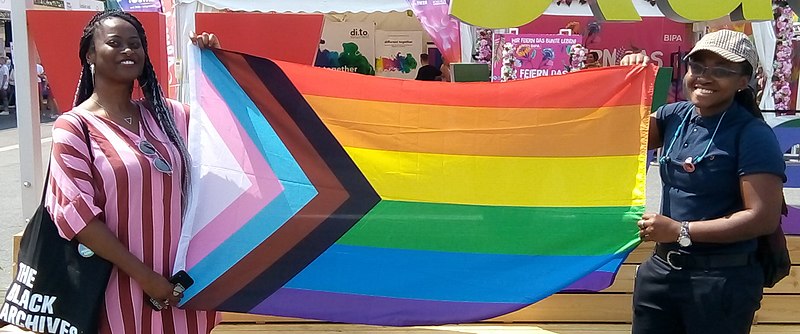
Two people at EuroPride 2019 in Vienna holding an LGBTQ+ pride rainbow flag featuring a design by Daniel Quasar; this variation of the rainbow flag was initially promoted as “Progress” a PRIDE Flag Reboot.
Photo by Bojan Cvetanović via Wikimedia Commons.
Over the past week we have witnessed two biological males – or men, as we used to call them – winning first and second place in a [the “w-word”]‘s cycling race. We’ve watched as the Crown Prosecution Service has hired a diversity consultant who is trans and who has previously suggested that [the “w-word”] could be replaced with “womxn”. We’ve heard that civil servants have received equality training telling them that the phrase “adult human female” – which is the dictionary definition of [the “w-word”] – is a transphobic dogwhistle. We’ve seen the publication of a new study by King’s College London which suggests that one way around sex / gender controversies might be to change the wording of questions in official documents like the census. For example, you could ask respondents “Do you menstruate?” rather than “Are you a [the “w-word”]?”.
Anyone who doubts that the word [the “w-word”], and the entire idea of [the “w-word”]hood, is being erased, sacrificed at the altar of the ideology of transgenderism, will surely have had a rude awakening these past few days. When men can claim [the “w-word”]‘s sporting prizes, it is clear that [the “w-word”]‘s sport risks becoming a thing of the past. When powerful institutions like the CPS and the civil service flirt with the idea that it is sinful to utter the words “adult human female”, it is obvious that even talking about [the “w-word”] has become a risky business. When even someone as globally influential as Michelle Obama uses the unpronounceable word “womxn”, as she did in a story shared to her Instagram page, you know that it’s not just time-rich, purple-haired campus crazies who have tumbled down the rabbit hole of genderfluidity. No, from the sporting world to the political world, from the justice system to the state bureaucracy, the idea that sex can be changed, and that language must be changed to avoid offending the trans minority, is orthodox now.
Strikingly, Mrs Obama’s use of the word “womxn” was related to the Roe v Wade controversy. She shared on Instagram a series of slides created by the nonprofit campaign group When We All Vote. One of them said: “State lawmakers will have the power to strip womxn of the right to make decisions about their bodies and their healthcare.” There is a dark irony to this comment, and one that exposes just how messed up the war on [the “w-word”]hood has become. That Obama-endorsed IG slide frets about [the “w-word”] being stripped of the right to control their bodies and yet it implicitly strips [the “w-word”] of the right to use certain words when they talk about themselves and what they need. “Womxn” is a reprimanding word, used to remind the female masses that their kind includes men now too. As Dictionary.com said of “womxn” when it added it in 2019, it is designed to be “inclusive of trans and non-binary” people. That is, blokes. In stripping out the old, supposedly problematic word “[the “w-word”]“, even as it wrings its hands over [the “w-word”] – sorry, womxn – being stripped of their bodily autonomy, When We All Vote unwittingly highlights the profound confusions and deep illiberalism behind today’s erasure of [the “w-word”]hood.
Barely a day passes without fresh reports about the linguistic war on [the “w-word”]kind. So the recent civil-service story involves a group called A:gender, which supports trans and intersex people who work in government departments. The Times got hold of some training videos A:gender has produced, which are shown to thousands of civil servants every year, one of which claims that it is impossible to define [the “w-word”] and that saying “adult human female” can be “transphobic”. Beware, these woke educators warn the civil service, of “transphobia [that] is increasingly presented as feminism”. To reiterate, this is civil servants we’re talking about, the people responsible for the smooth functioning of the nation. And they’re being told that if you say out loud what the dictionary says [the “w-word”] is, then you are a bigot. They’re being told that the likes of JK Rowling, whose great thoughtcrime is to understand biology, promote hatred dressed up as feminism.
Eisenhower Lays Out His Plans for Sicily – WW2 – 198 – June 11, 1943
World War Two
Published 11 Jun 2022The Allies bomb Mediterranean islands in preparation for their invasion of Sicily next month; they also prepare a lot of deceptions to mislead the enemy as to where they will attack. The German plans for the summer offensive against the Kursk salient are ever more concrete, and in the field this week, the Chinese stop the Japanese offensive cold.
(more…)
Comments Off on Eisenhower Lays Out His Plans for Sicily – WW2 – 198 – June 11, 1943


