seangabb
Published 22 Oct 2021The Roman Empire was the last and the greatest of the ancient empires. It is the origin from which springs the history of Western Europe and those nations that descend from the Western Roman Empire. It is the political entity within which the Christian faith was born, and the growth of the Church within the Empire, and its eventual establishment as the sole faith of the Empire, have left an indelible impression on all modern denominations. Its history, together with that of the ancient Greeks and the Jews, is our history. To understand how the Empire emerged from a great though finally dysfunctional republic, and how it was consolidated by its early rulers, is partly how we understand ourselves.
Here is a series of lectures given by Sean Gabb in late 2021, in which he discusses and tries to explain the achievement of the early Emperors. For reasons of politeness and data protection, all student contributions have been removed.
More by Sean Gabb on the Ancient World: https://www.classicstuition.co.uk/
Learn Latin or Greek or both with him: https://www.udemy.com/user/sean-gabb/
His historical novels (under the pen name “Richard Blake”): https://www.amazon.co.uk/Richard-Blak…
June 18, 2022
The Early Emperors – Part 3: Tiberius, A Safe Pair of Hands
M60: Its Purpose, Mechanics, and Development
Forgotten Weapons
Published 25 Feb 2022https://utreon.com/c/forgottenweapons/
http://www.patreon.com/ForgottenWeapons
Cool Forgotten Weapons merch! http://shop.forgottenweapons.com
Contact:
Forgotten Weapons
6281 N. Oracle 36270
Tucson, AZ 85740
June 17, 2022
Oikophobia run rampant
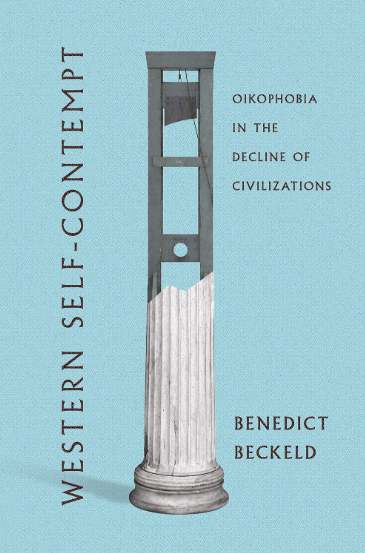
In the New English Review, Theodore Dalrymple considers the prevalence of oikophobia in western culture:
In an article for the American Mind, Daniel Mahoney draws our attention to a recent book on the phenomenon of oikophobia, the dislike or even hatred of one’s own country or culture, which now seems so prevalent in western academic and intellectual circles as to be almost an orthodoxy or requirement for acceptance into the intellectual class. Of course, no social trend or phenomenon is entirely new or has an indisputable starting point: for example, George Orwell drew attention to English self-hatred many years ago. But the spread of oikophobia has been of epidemic proportion in late years.
It seems to me that Mr. Mahoney’s analysis can be extended. The first question to ask is why oikophobia should now be so prevalent. To this, I should tentatively reply that it is because of the mass intellectualization of society consequent upon the spread of tertiary education. Intellectuals have an inherent tendency to be oppositional to all received opinion or feeling, for there is no point in going to the trouble of being an intellectual if one ends up thinking and feeling what the great mass of the people around one think and feel. Love of country and inherited custom is so commonplace as to appear almost normal or natural, and much of it, of course, is unreflecting.
But intellectuals are supposed to reflect. That is their function, and they are inclined to reject received opinion, not because it is wrong but because it is received. It goes without saying that received opinion can be wrong and even wicked or evil, in which case the strictures of intellectuals are necessary and salutary; but intellectuals themselves may promote wrong or even wicked opinions, partly from the a priori need to distinguish themselves from the run of mankind.
The phobia in oikophobia is the fear of being taken for one of the common run of mankind.
The second question about oikophobia is the old one of cui bono? Again, one must not confuse the psychological or social origin or function of an opinion with its justification or correctness in the abstract, but once one has decided that an opinion is mistaken or deleterious in its effect, it is natural to ask where it comes from and what interests it serves.
In my opinion, oikophobia is generally bogus, that is to say insincere, as is its cognate, multiculturalism. The oikophobe and the multiculturalist are not really interested in other cultures, except as instruments with which to beat their fellow citizens. The reason for their lack of real interest in other countries is not difficult to find and is of very common application. The fact is that it is very difficult genuinely to enter into a culture, or subculture, other than one’s own, even when that culture or subculture is close to or adjacent to one’s own.
Napoleon’s Retreat from Moscow – Why He Failed in Russia
Real Time History
Published 16 Jun 2022Sign up for the CuriosityStream + Nebula Bundle: https://curiositystream.com/realtimeh…
Napoleon’s retreat from Moscow and from Russia as a whole is one of the most dramatic scenes in history. Starving and freezing, the French Grande Armée is desperately trying to reach the Berezina River. The revitalized Russian Army is on their heels and almost catches their prey in the 2nd Battle of Krasny. But it wasn’t just “General Winter” that defeated Napoleon in Russia.
» SUPPORT US ON PATREON
https://patreon.com/realtimehistory» THANK YOU TO OUR CO-PRODUCERS
John Ozment, James Darcangelo, Jacob Carter Landt, Thomas Brendan, Kurt Gillies, Scott Deederly, John Belland, Adam Smith, Taylor Allen, Rustem Sharipov, Christoph Wolf, Simen Røste, Marcus Bondura, Ramon Rijkhoek, Theodore Patrick Shannon, Philip Schoffman, Avi Woolf, Emile Bouffard, William Kincade, Daniel L Garza, Stefan Weiß, Matt Barnes, Chris Daley, Marco Kuhnert, Simdoom» SOURCES
Boudon, Jacques-Olivier. Napoléon et la campagne de Russie en 1812 (2021).
Chandler, David. The Campaigns of Napoleon, Volume 1 (New York 1966).
Lieven, Dominic. Russia Against Napoleon (2010).
Mikaberidze A. The Battle of the Berezina: Napoleon’s Great Escape (Pen&Sword Military, 2010)
Rey, Marie-Pierre. L’effroyable tragédie: une nouvelle histoire de la campagne de Russie. (2012).
Zamoyski, Adam. 1812: Napoleon’s Fatal March on Moscow. (2005).
Отечественная война 1812 года. Энциклопедия (Москва: РОССПЭН, 2004)
Безотосный В. М. Россия в наполеоновских войнах 1805–1815 гг. (Москва: Политическая энциклопедия, 2014)
Троицкий Н.А. 1812. Великий год России (Москва: Омега, 2007)
(Прибавление к «Санкт-Петербургским ведомостям» №87 от 29 октября 1812 / http://www.museum.ru/museum/1812/War/…)» OUR STORE
Website: https://realtimehistory.net»CREDITS
Presented by: Jesse Alexander
Written by: Jesse Alexander
Director: Toni Steller & Florian Wittig
Director of Photography: Toni Steller
Sound: Above Zero
Editing: Toni Steller
Motion Design: Toni Steller
Mixing, Mastering & Sound Design: http://above-zero.com
Digital Maps: Canadian Research and Mapping Association (CRMA)
Research by: Jesse Alexander, Sofia Shirogorova
Fact checking: Florian WittigChannel Design: Simon Buckmaster
Contains licensed material by getty images
Maps: MapTiler/OpenStreetMap Contributors & GEOlayers3
All rights reserved – Real Time History GmbH 2022
Tank Chat #149 Cut in Half Centurion | The Tank Museum
The Tank Museum
Published 25 Feb 2022► JOIN OUR PATREON: Our Patreons have already enjoyed Early Access and AD free viewing of our weekly YouTube video! Consider becoming a Patreon Supporter today: https://www.patreon.com/tankmuseum
► TIMESTAMP:
00:00 – INTRO
00:31 – FEATURES
(more…)
June 16, 2022
Among GenZ adults, LGBT identification tracks far higher than LGBT behaviour
In conversation on social media the other day, I speculated that in years gone by, some possibly significant proportion of self-identified lesbians would probably identify as asexuals today. Coming of age long before more relaxed modern attitudes toward non-heterosexual relationships, women who were not attracted to men would probably assume that this lack of attraction meant they must be lesbians. Similarly, Eric Kaufmann discusses a recent survey that shows some interesting divergence among GenZ adults between their declared sexual orientation and their actual behaviour:
A granular look at survey data on same-sex behaviour and LGBT identity shows that identification is increasingly diverging from behaviour. More importantly, those who adopt an LGBT identity but display conventionally heterosexual behaviour are a growing and distinct group, who lean strongly to the left politically and experience considerably greater mental health problems than the rest of the population.
By contrast, those who engage in same-sex behaviour are more politically moderate and psychologically stable. These facts sit awkwardly with the progressive view that the rise in LGBT identity, like left-handedness, is explained by people increasingly feeling that they can come out of the closet because society is more liberal. My analysis of these data raise another interesting question: Has some of the increase in anxiety and depression among young people, like the LGBT identity surge, arisen from a culture that values divergence and boundary-transgression over conformity to traditional norms and roles?
[…]
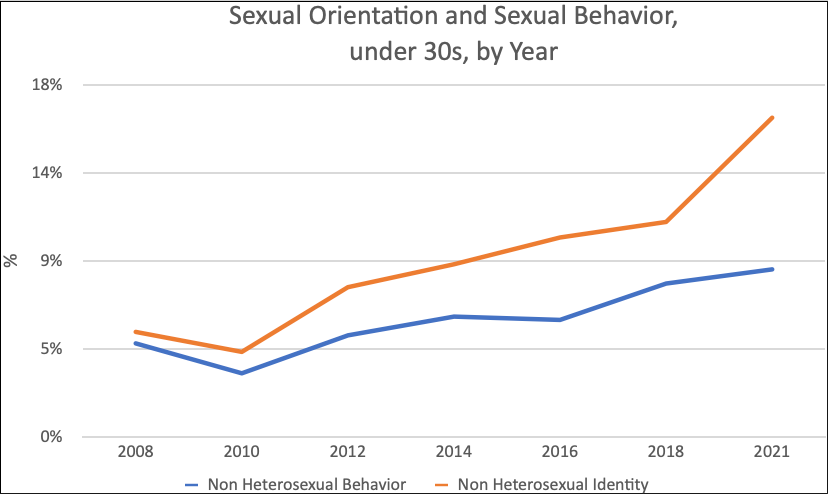
But has the LGBT share of young people really tripled in a decade? It has not. First, a growing share of LGBT identifiers engage in purely heterosexual behaviour. Figure 1, drawn from the General Social Survey (GSS), shows that, in 2008, about five percent of Americans under the age of 30 identified as LGBT and a similar number had a same-sex partnership in that year. By 2021, the proportion identifying as LGBT had increased 11 points to 16.3 percent but the share reporting same-sex relations had only risen four points, to 8.6 percent. LGBT identity had become twice as prevalent as LGBT behaviour. We must also bear in mind that 20 percent of young people now report no sex in the previous year, which means the four-point rise in same-sex partnering since 2008 is actually closer to a three-point rise: not nothing, but hardly a sexual revolution.
The trend towards greater LGBT identification has been particularly pronounced for young women, among whom there are three bisexuals for every lesbian in the 2018–21 period. Among young men, on the other hand, gays outnumber bisexuals and the LGBT total is only half as large as it is for women. Other large major surveys conducted by the Foundation for Individual Rights in Education (FIRE) and by Cooperative Congressional Election Study (CCES) find a similar pattern.
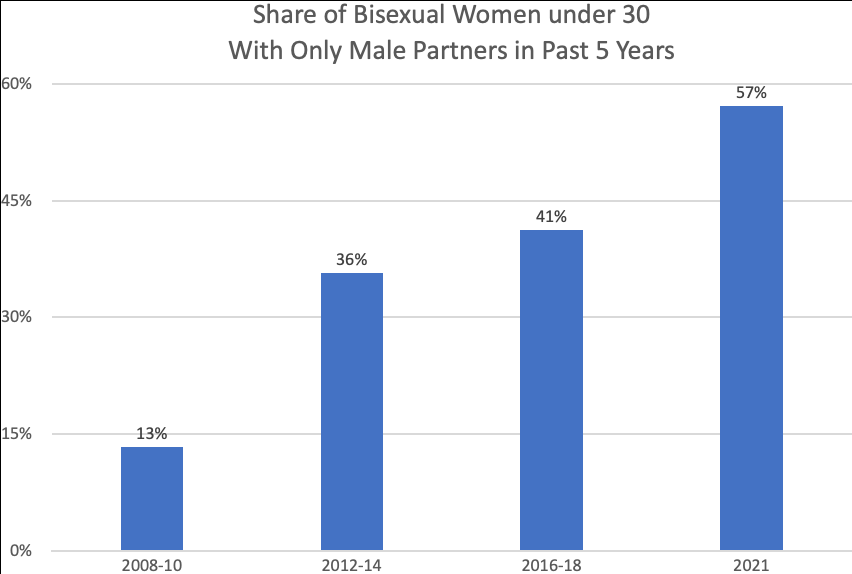
Furthermore, the GSS data show that bisexual women are the fastest-growing category, accounting for a disproportionate share of the post-2010 rise. A closer look at trends among female bisexuals in figure 2 shows that an increasing share of them display conventional sexual behaviour. In 2008–10, just 13 percent of female bisexuals said they only had male partners during the past five years. By 2018 this was up to 53 percent, rising to 57 percent in 2021. Most young female bisexuals today are arguably LGBT in name only.
Mussolini’s Pope? – The Geopolitics of the Vatican
World War Two
Published 14 Jun 2022Pope Pius XI is the first Pope to guide the Catholic Church through the age of fascism. How has his Vatican responded to Fascists Italy and Nazi Germany, and what is the geopolitical position of the Papacy on the eve of war of World War Two?
(more…)
Paul Wells takes in a current movie … and likes it
I’ve never been much of a movie-goer, even before the neverending pandemic lockdown theatre landed on us in 2020, so the chances of me going to see something like Top Gun: Maverick were pretty low (especially as I never bothered to watch the original, back in the day). Paul Wells is in the middle of a European trip, so he did what every travelling North American would do somewhere on the continent of history and culture: he watched a current-release American movie:
The mystery of Maverick is why, by next weekend, it will pass Doctor Strange in the Convolution of Fan Service as the year’s biggest movie, why it is the biggest film of Tom Cruise’s charmed life — why it strikes such a chord in this moment, even though its premises, visual vocabulary and soundtrack are 36 years old. In terms of chronological distance from the original Top Gun, it’s as though the top-grossing movie of 1986 had been a sequel to 1950’s Annie Get Your Gun. (“And there has never been a star as sensational as Betty Hutton!” Annie‘s trailer proclaims. Switch Tom Cruise in for poor Betty and suddenly the claim may actually be true.)
The simplest hypothesis is that Maverick is just big and loud, so you can leave your brain at home and enjoy the spectacle. But lots of lousy movies nobody watched were big and loud, including Matrix: Resolutions and Ghostbusters: Afterlife, so there must be some fuller explanation.
This being a Substack newsletter, I suspect I’m contractually encouraged to argue that Maverick wins because it isn’t woke. I’m afraid I can’t oblige. I mean, the movie definitely makes only the barest acknowledgment of taking place in the 21st century. None of the hotshot young recruits pauses from the action to specify their pronouns. None decorates their flight helmets with empty square brackets to acknowledge their privilege. The film’s few concessions to cultural change since the MTV era have the effect, not of engaging today’s fights on provocatively old-fashioned terms, but of declining to engage. Joseph Kosinski, the journeyman special-effects technician brought in to direct this film in note-perfect homage to the style of the original Top Gun director Tony Scott, doesn’t even bother to make the film’s racial politics as minimally complex as Scott did in 1995’s Crimson Tide. Maverick‘s young recruits, diverse in gender and ethnicity, are awesomely interchangeable in every other way. One smirks, one has a moustache; the others have no identifying characteristics. (When half the recruits get cut from the big mission at the 90-minute mark, there is no dramatic payoff because it’s impossible to tell these people apart. “Sorry, Component A, I’ve decided to go with Component B.”) Nobody under 30 in this film has sex for either pleasure or procreation. Yearning for intimate touch is plainly something only old people do, like writing in cursive script or owning books.
As a cultural argument, Maverick is so close to being tabula rasa that there’s no real point interrogating it. But on another front, it succeeds resoundingly in popular art’s primary function of tantalizing simplification. It started to make sense when I realized that Cruise’s character, despite the denial inherent in his call sign, is a career civil servant.
This is a movie about the action of a large modern state. It’s a film about public policy. Its central claim is a cathartic feat of Avengers-level denial. Just as the superhero movies offer us a made-up universe in which we have any hope of telling the good characters and the evil characters apart, Maverick posits a world in which modern governments can get anything done at all.
I may be influenced in this reading by the fact that I work in contemporary Ottawa. I’ve been writing variations on a simple question — Can Justin Trudeau get big things built? — since 2017. I’m hardly alone. And it’s hardly just a question about Trudeau, Ottawa or Canada. It’s been fun reading about chaos at Toronto’s Pearson airport, but last week the Financial Times ran a “big read” feature story about global airport chaos that didn’t even mention Pearson, Toronto or Canada. Joe Biden promised to Build Back Better. It’s not going great. Here in France, Emmanuel Macron is the first president to be re-elected in 20 years, a genuine feat, but it’s not going great. Brexit? Don’t ask.
A generic term for the ability of governments to do stuff is “state capacity”, and there’s a vague sense in the quasi-academic literature that it’s in decline, although, the real world being the real world, every element of this claim — that state capacity is declining, that it can be measured, that it even exists in any measurable form — is open to dispute. Still, it feels true, don’t it? The world was never great. In important ways it was worse than today. But it used to feel like it was possible to improve the thing, and now it just feels like everyone’s just firing blind and hoping for the best. COVID is a dynamite demonstration of this. Three successive Canadian federal health ministers were told, by a prime minister who prides himself on his ability to read the room, to get cracking on plain-paper packaging for tobacco products. And then the biggest public-health disaster of our lifetimes opened up its jumbo can of whup-ass, and it wasn’t even in the mandate letters. And it’s hard to blame anyone involved. All the chaos that has ensued had its roots in the original chaos. Real life doesn’t have a plot. As Homer Simpson said, it’s just a bunch of stuff that happens.
Secret Foods of the Spanish Inquisition
Tasting History with Max Miller
Published 15 Feb 2022Support the Channel with Patreon ► https://www.patreon.com/tastinghistory
Merch ► crowdmade.com/collections/tastinghistory
Instagram ► https://www.instagram.com/tastinghist…
Twitter ► https://twitter.com/TastingHistory1
Tiktok ► TastingHistory
Reddit ► r/TastingHistory
Discord ► https://discord.gg/d7nbEpy
Amazon Wish List ► https://amzn.to/3i0mwGt
Send mail to:
Tasting History
PO Box 766
Burbank, CA 91503LINKS TO SOURCES**
A Drizzle of Honey by David M. Gitlitz and Linda Kay Davidson: https://amzn.to/3gyf0CY
The Spanish Inquisition by Henry Kamen: https://amzn.to/3B9EbVXRECIPE
1 cup (160g) dried fava beans
1 cup (180g) dried chickpeas
2 1/2 lbs or 1kg beef
¼ cup (60ml) Olive oil
1 tablespoon salt
1 large onion diced
1 quart (1L) beef broth or water
2 teaspoon ground coriander
1 1/2 tsp ground cumin
2 teaspoon ground caraway
2 teaspoon fresh ground pepper
2 Eggplant, peeled and chopped
A large handful of chard leaves1. Coat the eggplant in salt, cover, and set aside for several hours.
2. Boil the fava beans and chickpeas in a large pot for 2 minutes, then drain and set aside. In the same pot, heat half of the olive oil over medium heat then, add the onions and half of the salt and cook until lightly brown, about 8 minutes. Remove the onions and add the beef to the empty pot with the rest of the oil and salt. Cook until lightly brown, about 5 minutes. Add the onions back in as well as the beef broth/water. Bring to a simmer and cover, letting the stew simmer for 1 hour.
3. Drain and rinse the eggplant, then add it into the pot along with the fava bean, chickpeas, and spices. Cover and let cook for another 2 hours.
4. Chop the chard, then pound it flat with a rolling pin, and add it into the pot. Set the pot into the oven at 200°F and cook overnight (or at least 6 hours). Alternately, you can transfer the adafina to a slow cooker overnight. Serve alone or over rice.**Some of the links and other products that appear on this video are from companies which Tasting History will earn an affiliate commission or referral bonus. Each purchase made from these links will help to support this channel with no additional cost to you. The content in this video is accurate as of the posting date. Some of the offers mentioned may no longer be available.
Subtitles: Jose Mendoza | IG @ worldagainstjose
#tastinghistory #jewishcooking #spanishinquisition
QotD: The Guardian and “capitalism”
The displacement of responsibility is a Guardian staple, with society or capitalism (or “late capitalism”, or “neoliberalism” or whatever) being blamed for the columnist’s own hang-ups and incontinence. Tanya Gold did it two or three times during her time at the paper, as did Madeleine Bunting, Oliver James, VJD Smith and God knows how many others. Diane Abbott once claimed that capitalism is the reason she got fat, and still is.
It’s practically a rule. If a Guardian contributor drinks too much, eats too much, buys too many shoes … well, obviously, they’re the victim because consumerist peer pressure somehow made them do it against their will, such as it is. The premise is generally “capitalism made me fat”, followed by “capitalism made me anxious about being fat”, followed by “tax such-and-such to buggery, or ban it altogether, and then I’ll be thin”.
David Thompson, from the comments to “Reheated (55)”, DavidThompson.com, 2019-04-01.
June 15, 2022
When adult responsibilities become overwhelming, the retreat into childish things beckons … hence the cultural dominance of “British Twee”
Ed West isn’t a fan of Britain’s universal adoption of “British Twee” as an escape from the burdens of “adulting” (as the Millenials call it):
James Marriott wrote about the phenomenon in the Times last week; noting the strangeness of seeing a drone corgi in the sky at the Jubilee, he felt “awe at this almost imperial triumph of twee”.
“Once culturally marginal — a series of aesthetic mannerisms associated with greetings cards and downmarket children’s books — twee is now the establishment style”, he wrote: “When the Queen was presented to her subjects at the coronation 70 years ago, the emphasis was on dignity and mystery: uniformed soldiers, a naval review, the BBC’s cameras forbidden from capturing the sovereign’s face in close-up. In the 1950s, this was still the language of power: formal, pompous, sternly detached. Parading for the Queen in 2022 were Teletubbies, a man in a Shaun the Sheep costume, women dressed as afternoon tea, a towering motorised cake.
“Twee is now a cultural default; the distinctive style of our age. Our emojis, gifs and memes will mark us as surely to the generations of the future as the wing collars, tailcoats and elaborate ceremonies of social deference marked our ancestors. Grown-up men and women love Disney and Harry Potter.”
Twee is egalitarian, anti-highbrow and obsessed with childhood, he says. “A love of childish things is a mark of democratic taste and an aversion to pomposity. Britain, with its long (often admirable) tradition of anti-intellectualism is especially vulnerable.”
Marriott concludes that “I can’t bring myself to hate Paddington and corgis but twee can be as oppressive as the formal, serious culture that preceded it. If our ancestors denied themselves the silly, child-like side of human nature, we now ourselves deny its solemn and difficult aspects. Twee is an aesthetic for an age uninterested in ethical complexity, which prefers good and bad as neatly separated as they are at Hogwarts. It fits the childish behaviour of social media’s most active users who swing between condemnatory temper tantrums and cooing over anthropomorphised animal.”
He also notes how twee has been “appropriated by powerful corporations” because “it’s easier to rip someone off with a smiling wide-eyed chatbot.” In my experience, the more informal and “I’m yer mate” a service provider is, the worse it treats its customers.
And that applies to social classes, too; the more informal a ruling elite behaves, the less they care about boring old customs, the less they can be trusted to do the right thing for the people they’re supposed to lead.
Tweeness is terrible, but there’s a particular indefinable, British kind of twee, which is infuriating but hard to articulate. British Twee, or British Cringe, is not so much a definable illness as more like a cluster of symptoms.
Cockwomble, as explained by Ben Sixsmith, is British Twee. Needless posh swearing is very British Twee; used sparsely, swearing is very effective, especially by people with RP accents; used liberally, it’s cringeworthy, especially when discussing politics. The post-referendum anti-Brexit campaign was filled with British Twee, mixing both a loathing of the country with an assumption of cultural superiority, all done in a self-consciously frivolous way.
This kind of Twee British Cringe, because it’s at once both self-hating and also uniquely self-obsessed, seems to suppose that certain British things are uniquely terrible — the awfulness of our government, or the prejudice of our great unwashed — but certain British things are uniquely brilliant and envied, such as the BBC and NHS, not to mention our famous sense of humour.
British Twee is the patriotism of the soft-left. While consciously anti-nationalist, this kind of tweeness is obsessed with defining British national character and values. This reaches its peak with pride about Britain’s universal healthcare, something enjoyed by literally every developed country except the United States.