
My own feelings about George Bernard Shaw are equivocal. He was a high-profile, publicity-seeking crank who espoused many bad causes, and in general preferred a bon mot or notoriety to the truth. He called Louis Pasteur and Joseph Lister frauds, and to the end of his life did not believe in the germ theory of disease. He likened marriage to legalized prostitution and said many other destructive things to draw attention to himself. How far he believed in his worst pronouncements and expected anyone to be influenced by them is moot.
On the other hand, he was one of the few playwrights in English whose plays can still be performed for the pleasure of an audience a century later. One or two of them might even, without absurdity, be called great. He was undoubtedly very witty, and if he was unbearably opinionated, his prose was always vigorous and quite often elegant. I learned to write from him. Many of his bons mots are still nearly as funny as those of Oscar Wilde.
It was as a playwright — one whose fame stretched around the world — not as a thinker or guide to policy that he is commemorated in the name of the theatre [at Britain’s Royal Academy of Dramatic Art]. His plays have been in print ever since they were written. His achievements in the theatre can hardly be denied. He is virtually the founder of the modern drama in English. I can extract at least 20 of his plays from the vaults of my mind.
Theodore Dalrymple, “Man and Underman at RADA”, City Journal, 2020-09-17.
June 12, 2026
QotD: George Bernard Shaw
June 11, 2026
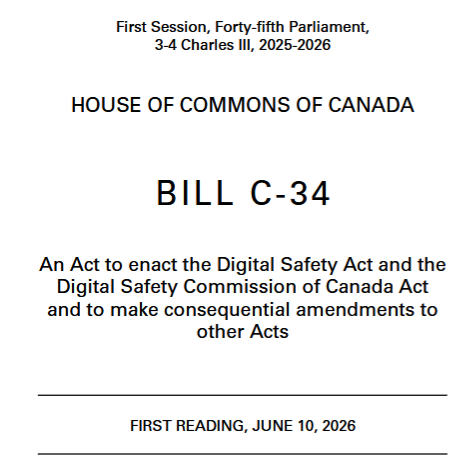
Bill C-34, the Safe Social Media Act
As promised/threatened, the Liberal government introduced a new bill to address ongoing concerns about “online harms”: Bill C-34, the Safe Social Media Act. The ever-informative Michael Geist provides an overview:
The government tabled Bill C-34, the Safe Social Media Act, earlier today, marking its third attempt at online harms legislation after the failed 2021 consultation and Bill C-63, the Online Harms Act that died on the order paper when Parliament was prorogued ahead of the 2025 election. As I wrote on the day Bill C-63 was introduced, that bill was effectively three bills in one: a defensible set of platform regulation provisions built around a duty to act responsibly and a clear list of identifiable harms, contentious Criminal Code and Canada Human Rights Act reforms, and a powerful new Digital Safety Commission with considerable regulatory discretion. My view at the time was that the contentious provisions should be removed and addressed separately, since they were certain to dominate the debate at the expense of what really mattered, namely the platform regulation piece. That is precisely how it played out as the speech provisions undermined the bill for months, and by the time the government conceded and agreed to split the bill, time ran out.
Bill C-34 suggests the government absorbed only part of the lesson. The Criminal Code and Human Rights Act provisions are gone, but in their place the government has thrown in everything else: the original Online Harms Act platform duties, an under-16 social media ban backed by mandated age verification, Bill S-209’s pornography age verification requirements, a new AI chatbot regulatory regime, and sweeping powers for a Digital Safety Commission that will write the rules, enforce them, and decide which platforms escape the ban restriction. It is an everything-all-at-once approach in which nearly every key component, including which services face the restriction, how age gets verified, which AI systems are covered, and what standards govern exemptions, is left to regulations that do not yet exist.
I’ve been working on this piece since before the bill was introduced with the expectation that many provisions from the prior proposal would resurface. This post is long, but seeks to provide a very initial review of key elements in the bill. For those looking for the key takeaways, there are five. First, the platform regulation elements with a duty to act responsibly once again offers a good starting point for working through regulation. Second, the inclusion of a social media ban for those under 16 is bad policy that will take considerable time to implement and raises serious privacy concerns that will affect tens of millions of Canadians. Third, the AI chatbot regulations are consistent with emerging standards, but the uncertainty of who it covers is not. Fourth, the government is creating a bureaucracy comparable to the CRTC in the Digital Safety Commission as it will wield serious power and be tasked with fleshing out much of the detail of how the law will work. Fifth, the uncertainty of this bill has the hallmarks of a government wanting to do something quickly, but the “trust us” approach likely means years of implementation work and potential court challenges.
The Foundation: A Duty to Act Responsibly
The aspect that attracted the broadest support in Bill C-63, namely the platform regulation rules, survived largely intact. The bill features the same seven categories of harmful content (intimate content communicated without consent, content that sexually victimizes a child or revictimizes a survivor, content that induces a child to harm themselves, content used to bully a child, content that foments hatred, content that incites violence, and terrorism or violent extremism content) and revives the duty to act responsibly that requires platforms to assess and mitigate the risk of exposure to that content. There is also a duty to make certain categories of content inaccessible within 24 hours backed by a complaint path to the new Digital Safety Commission, and a duty to be transparent through public digital safety plans, record-keeping, and researcher access to data. These measures target how platforms actually operate and provide a credible starting point.
[…]
The Social Media Ban for Under 16’s
The headline measure, widely reported as a “temporary” ban on social media for those under 16, leaves many questions unanswered since the application of the ban, age verification methods, and exemption rules are all left to future regulation. The word “temporary” appears nowhere in the bill. […]
The AI Chatbot Regime: Mainstream Duties, Unbounded Definition
The government wisely took the duty path rather than the ban path on AI chatbots, an approach I argued last month would be even worse than the social media ban. There is no chatbot ban and no under-16 account restriction for chatbot services. Instead, the bill creates duties that track the emerging international mainstream found in California’s SB 243 and New York’s AI companion law. […]
The Commission: More Power, Fewer Limits, Smaller Penalties
The third concern is the one the government never resolved the first time. My day-one assessment of Bill C-63 flagged the Digital Safety Commission’s regulatory power as a serious concern. The answer two years later is an even more powerful Commission with more undefined limits. Bill C-63’s three-pronged approach of the Commission, a Digital Safety Office, and a Digital Safety Ombudsperson has been consolidated into a single Digital Safety Commission of Canada that develops the regulations and guidance, assesses compliance, manages complaints, conducts audits, issues compliance orders, levies administrative monetary penalties, and decides the exemption applications that determine which platforms escape the under-16 restriction. Once again, the amount of uncertainty is the real story since the design features at the heart of the duty to protect children are simply those “set out in the regulations”, and the user thresholds that determine which services are covered at all are to be determined.
“Thoughts and prayers” in a Two-Tier Keir accent
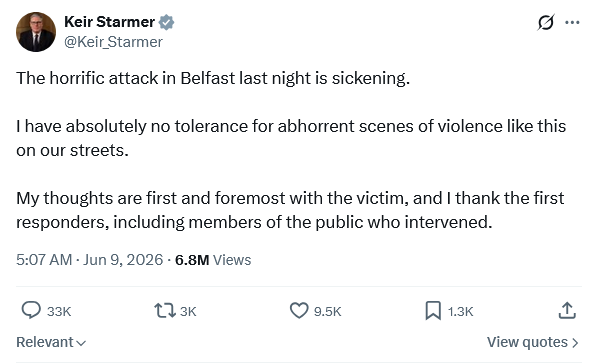
Sir Keir Starmer posted to X in response to the attempted beheading of a Belfast man a few days ago:
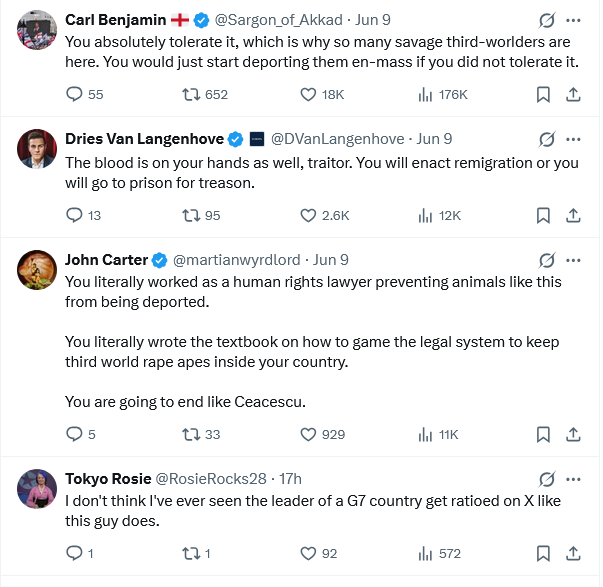
It drew some angry responses like this:
And a longer response from Jim Chimirie:
.@Keir_Starmer, your statement says you have absolutely no tolerance for abhorrent scenes of violence like this on our streets.
With respect, tolerance is not the issue. Nobody tolerates a near beheading on a residential street in Belfast. The question your statement carefully avoids is prevention. And prevention requires honesty about a pattern your government has consistently refused to name.
A man in his thirties, a Somali national, pinned a man to the ground on a residential street and stabbed him repeatedly in the face and neck. Members of the public intervened with a hurling stick. A woman required hospital treatment for the stress of witnessing it. This happened in Northern Ireland, a place that has known more than its share of violence, and even there residents said they had never seen anything like it.
Your government has presided over record small boat crossings. It has failed to proscribe the IRGC despite repeated promises. It has blocked the grooming gang inquiry for a year before being forced to concede it. It has spent £10 billion on asylum accommodation contracts. It has actively resisted measures that would have reduced the number of unvetted individuals entering and remaining in this country.
The victims of these attacks are not statistics. They are British people, going about their lives on their own streets, who were failed before the attack happened. Failed at the border. Failed by a system that prioritises the rights of those who arrive illegally over the safety of those who were already here.
Your thoughts are with the victim. So are ours. The difference is that thoughts are not policy. Thoughts do not secure borders. Thoughts do not remove individuals with no right to be here. Thoughts do not protect the next victim, whose name we do not yet know, on a street we cannot yet identify, from an attack that has not yet happened.
How many more before the thoughts become action?

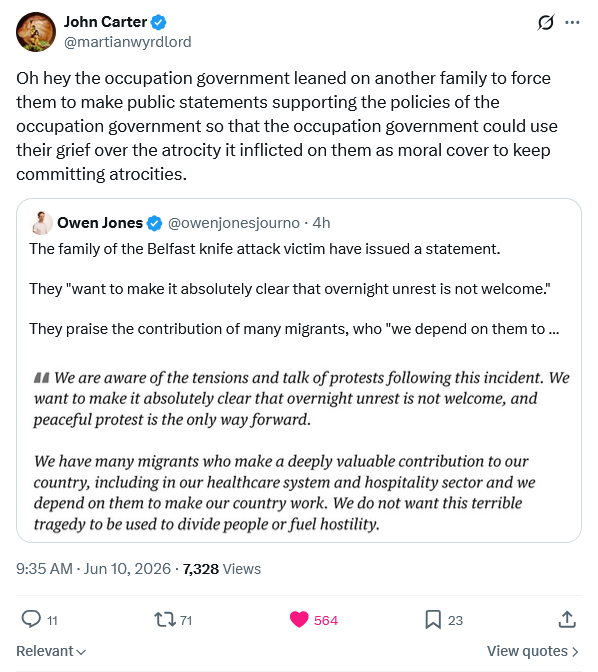
The family of the victim talked to the media and it in no way seems to have been pre-scripted by the government and was clearly uncoerced and of their free will and is in no way any kind of hostage statement:
Northern Ireland has seen a lot over the last few decades, but I doubt anybody expected to see the two opposing sides of “The Troubles” joining forces:

Between them, the Ulster Protestant paramilitaries and the IRA operatives have a lot of hard-won skills at avoiding the authorities and committing direct violence. At The Bugscuffle Gazette, Ian notes that he predicted this earlier:
In June of last year I penned an essay titled “Popular Misconceptions” in which I opined that if the “good men and true” of an area get “fed up with lawlessness” they tend to take matters into their own hands.
We are now seeing this play out in real time in Northern Ireland.
For those of you not paying attention to the news, a refugee from the Sudan attempted to saw off the head of an Irish man in Belfast on Monday, 08 JUN 26. He was on a public street when he did so, and several locals rushed to stop his assault. His victim has lost an eye from the attack, and is in critical care at a local hospital.
If you read my previous essay, I postulated that when the vigilance committees show up, a lot of collateral damage come with them — so nobody should be shocked to understand that a whole bunch of immigrant homes and businesses are currently on fire in Northern Ireland.
I will now expound upon that previous essay. I will even go so far as to issue a warning that the people who should heed said warning are going to ignore:
If the “good men and true” get the perception that the government and officialdom are not only facilitating what has them all riled up, but just might be a source of what has them all riled up … well, history has shown that the “good men and true” have very little problem with expanding the “extra-judicial punishments” to include Minions of the Law and Government.
And for those folks who pish-tosh any sort of threat from the British “subjects” — this is Northern-bloody-Ireland. The time and area where the locals refined the “Vehicle-Borne Improved Explosive Device” to the point a popular cocktail was named after the practice.
This is the area where there are more SLRs, Sterlings, and Browning Hi-Powers buried around that little island than any three countries in Africa.
Hell, the Irish made the AR-18 famous.
I speak to the government and officials of Northern Ireland, Ireland, and the United Kingdom: Listen to me — you won’t, but listen to me … You’d better — at the very least — pay some sort of lip service towards a credible perception that you give a tinker’s damn about what has the people all lathered up, and make the people believe that you’re doing something about it.
If you don’t — and you won’t — don’t come whinging to me when your dance card abruptly becomes filled with such exhilarating numbers as: the Hemp Fandango, the Beatdown Boogie, and the Arson Waltz.
You have failed the people. You have failed them utterly, completely, and totally. They’re about to rectify that situation. You might want to get ahead of that power curve before you find yourself watching folks get loaded onto cattle cars alongside you.
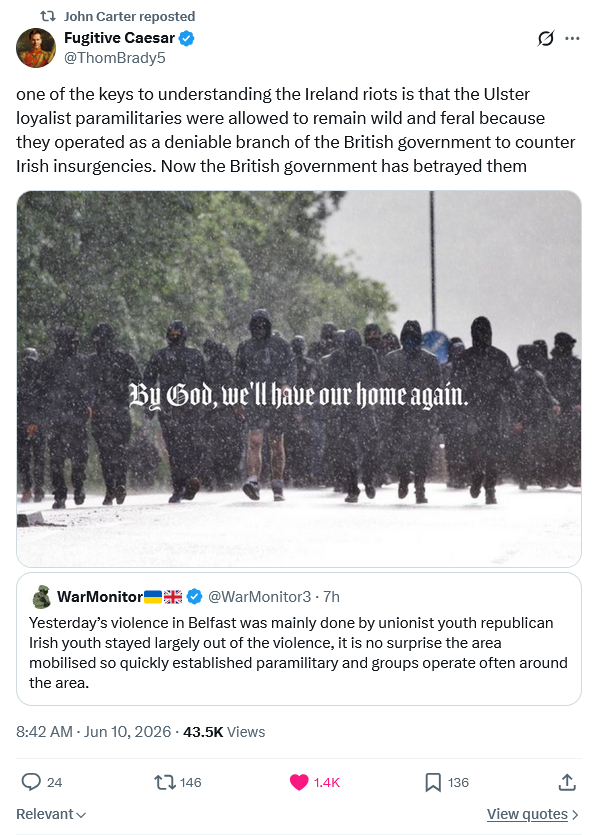
John Ringo on X:
One more post on the subject of the Irish getting their dander up.
The Irish Troubles (a continuous low level insurgency) lasted from the 1960s to 1998. But they were the continuation of “Troubles” stretching back to the 1800s.
1998, that’s a bit over 25 years ago.
Both sides in the Troubles, the Catholics and the Protestants, are one generation away from a civil war that lasted for TWO GENERATIONS.
The Gen Z men of today were raised on the stories of the heroism and patriotism of their fathers and grandfathers and THEY HAVE HAD NO SIMILAR OUTLET.
The IRA did not invent the vehicle borne IED. The Vietnamese used it before them.
They just invented a cocktail from their name as well as a drinking song.
“Former” IRA weapons dealers are still some of the top illegal weapons dealers in the world.
1/10th of “British” SAS come from Ulster. A significant fraction of the British infantry as well.
Many of them served in GWOT so they have a recent master’s class in insurgency.
And now Keir Bloody Starmer and the Irish Government have given BOTH SIDES a reason to start again, but this time UNITED.
We may be about to get a glimpse of what a civil war in the US looks like up against a massive surveillance state.
Take notes.
Update, 12 June: Welcome, Instapundit readers! Have a look around at some of my other posts you may find of interest. I send out a daily summary of posts here through my Substack – https://substack.com/@nicholasrusson that you can subscribe to if you’d like to be informed of new posts in the future.
“That’s the fun thing about the fall of the West; everybody gets a swing of the sledgehammer”
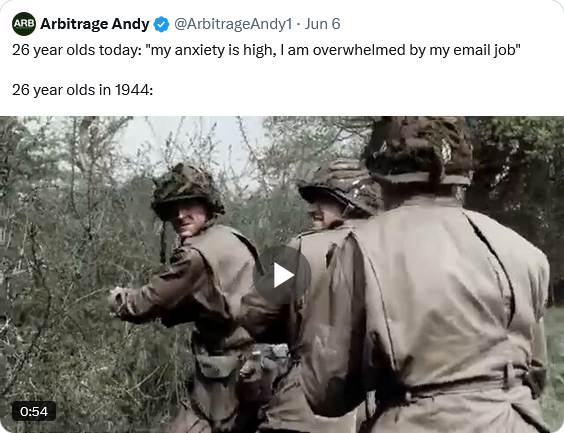
Devon Eriksen responds to a fairly common boomer-ish post:
I don’t know if @ArbitrageAndy1 is a Boomer, but here he gives us a mashup of two classics from the Boomers’ greatest hits, “Younger Generations Suck”, and “The Television Never Lies to Me”.
It’s a jaunty little tune, and you can sing in it the shower, but the lyrics don’t actually make much sense.
Back in the real world, which younger generations actually have to live in, and where the television seldom tells the truth, WW2 was fought, on both sides, by guys even younger than 26.
And they were terrified.
The stress of combat against a peer adversary is overwhelming. It’s unendurable. But you endure anyway, because there you are, it’s happening to you, and you’re not getting out of it.
So you actually do have those little moments that Boomers would describe as stress meltdowns if they happened at work. You have them, and you do what you need to do anyway. Sometimes at the very same moment while you are melting down.
When you’re in this kind of war, there’s something terrible in front of you. In reality, that terrible thing is just as young and scared and overwhelmed as you are, but it sure doesn’t feel that way to you.
However, you also have something behind you, and something around you.
Behind you, you have a tribe that accepts and appreciates you. They know they sent you to hell, but they did it because hell was necessary, not because hell was fine. No one is gaslighting you pretending that everything is okay and that any problems you have are personal character flaws.
Around you, you have bros. They’re exactly where you are, doing exactly what you are doing, and they know how much it sucks. You’ve entrusted your lives to each other, and carried each other through things you don’t wanna talk about in your letters home.
Under intense stress and fear and exhaustion, your horizons shrink. You might have signed up for duty and patriotism and high ideals, but when you’re fighting, you fight to save the man next to you. And he fights to save you.
This is a very different experience than being isolated in a society that’s turned against young people, especially young men, especially young White men.
I won’t pretend it’s as difficult as fighting the Waffen SS. But young men fought the Waffen SS together.
They have to face the dissolution of the West alone.
That’s why they are anxious. Everything around them is not just going to shit.
It’s being systematically and deliberately turned into shit by powerful people who want them dead and replaced by someone else who will work cheaper and doesn’t expect to have a share of political power and a nice house and a retirement pension.
But I suppose Andy can still go ahead and dunk on them for clicks and a twenty-three dollar check from Twitter. That’s the fun thing about the fall of the West. Everybody gets a swing of the sledgehammer.
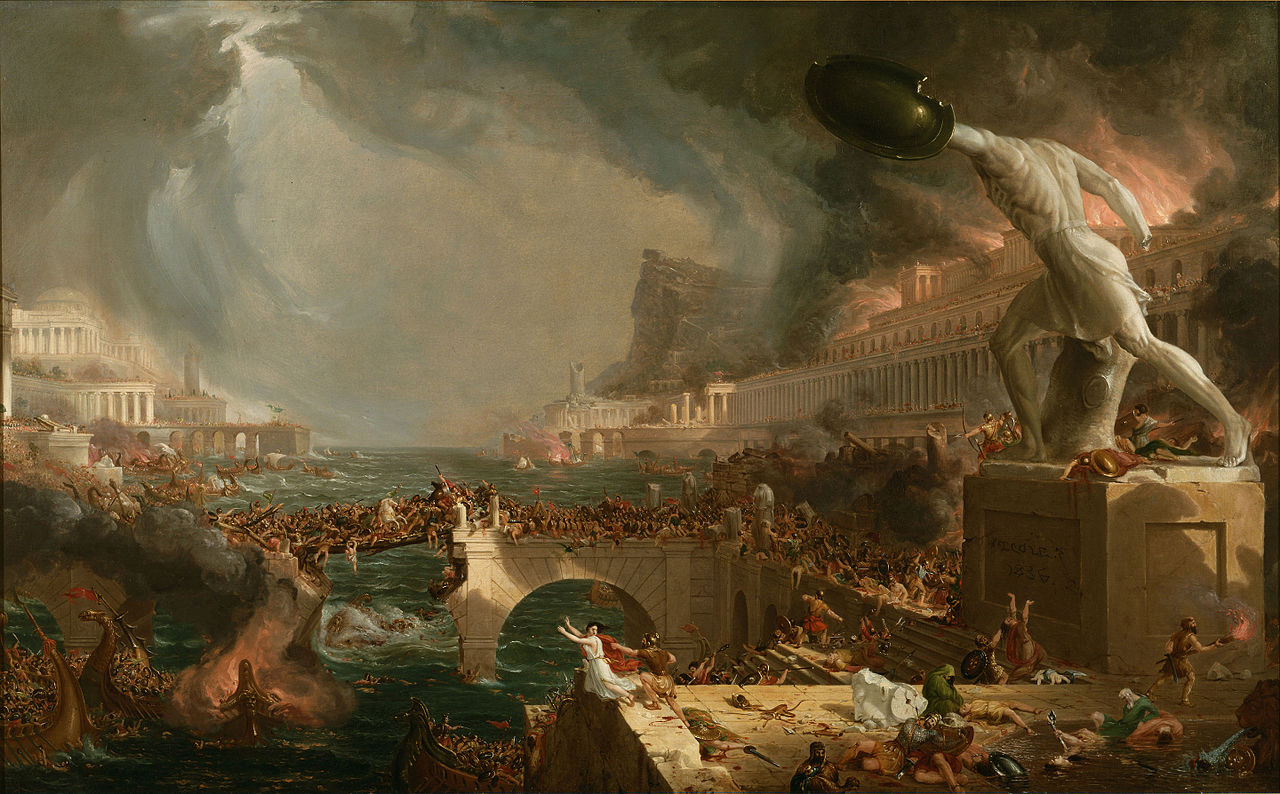
The Course of Empire – Destruction by Thomas Cole, 1836.
From the New York Historical Society collection via Wikimedia Commons.
The First Red Dot Sights: Aimpoint Electronic, MkIII, and Aimpoint 1000
Forgotten Weapons
Published 17 Jan 2026Today we are looking at the first commercial red dot optic, and its successors. In 1975, Aimpoint released the Aimpoint Electronic, a collimating optic using an LED as a light source. It was intended for the hunting market, where an unmagnified optic that could be used with both eyes open offered a significant improvement over traditional magnified optics for short-range moving targets. The sight proved popular, and led to a second generation in 1978 with an improved mount. In 1983, a third generation (the MkIII) was introduced. This model was zeroed by moving the collimating lens inside the optic, instead of moving the whole optic on its base as on the previous models.
In 1985 Aimpoint released their first optic that mounted in standard scope rings, the Aimpoint 2000. However, they continued to market and develop the initial family of optics as well, releasing the Aimpoint 1000 in 1987. This pattern was still very popular with hunters, and offered a lower mounting position than possible with scope rings. Ultimately the ring-style models became much more popular and the Aimpoint 1000 was the last of its type offered by the company.
How Red Dot Sights Work: • How Red Dot Sights Work (What is a Collima…
(more…)
QotD: Barbarism
Sometimes I worry that I’m turning into that guy but for barbarians. One of the very first reviews I wrote here was of James Scott’s The Art of Not Being Governed. That book is about the peoples who inhabit the rugged and hilly region of Southeast Asia known as Zomia, centered around the border between China and Laos. Scott is interested in the practices employed by the “barbarians” — the hill people — to resist domination by the much more numerous and organized “civilized” people living around them. He argues that many of the negative associations we have with barbarism — illiteracy, itinerancy, cousin marriage, religious messianism, and so on — are actually either deliberately adopted or emerge out of a process of cultural evolution that’s optimizing for ungovernability.
Zomia was an effective refuge from the state (in fact it still is — Dan Wang has a beautiful essay about fleeing to the exact same area to escape China’s zero-COVID policies). But what really stuck in my head from Scott’s book was the idea that barbarism is mostly a state of mind and a set of social practices and habits that could be employed anywhere. To be a barbarian is just to recognize that the world is full of forces vastly more powerful than you and coldly indifferent to your survival, be they criminal gangs, nation states, multinational corporations, fanatical social movements, artificial intelligences, or plain old egregores. When one of these entities turns its baleful gaze upon you, your options are to submit and be consumed, or go down fighting in a pointless last stand. But the barbarian chooses a different path — he hides in plain sight, adopts protective coloration, stays on the move, becomes an extremophile clinging to the marginal biomes and the “debatable lands”: a minnow living in crevices too poor and too narrow to interest the leviathans. And if worst comes to worst and he finds himself facing one of those monsters, then he makes himself as indigestible and unappealing a meal as he can manage.
That all sounds great, so why doesn’t everybody do it? The reason is that to be a barbarian carries serious costs. Some of those costs are material: the leviathans of the state, the corporation, etc., aren’t interested in your barbarian biome for a reason (probably because it kind of sucks). Other costs are intellectual and cultural: to be a barbarian is often to have no history or education (it can be used against you), and barbarian societies are often crippled and debased as a result. And some of the costs are psychological and spiritual: to live as a barbarian is to live as a hunted prey animal, always with a wariness verging on paranoia, building a protective shell around you that can make normal human relations even with close family impossible. Last year I read and reviewed the memoir of a modern American barbarian that makes all three of these forms of poverty all too apparent.
John Psmith, “REVIEW: Imperial China, by F.W. Mote”, Mr. and Mrs. Psmith’s Bookshelf, 2025-02-24.
- It isn’t actually ducks.
June 10, 2026
To protect under-16s from harmful content, everyone will now need to show their ID online
Australia’s attempt to ban under-16s from accessing social media and other online sites blew up rather quickly. Britain and Canada, seeing what happened down under, chorused “Hold our beers!“:

“Automotive Social Media Marketing” by socialautomotive is licensed under CC BY 2.0

The government is expected to table the Digital Safety Act on Wednesday with reports that it will include a ban on social media for those under 16, framed as a “temporary” measure that platforms can exit once a new digital regulator certifies their safety standards. I have been writing about these issues, from the original Online Harms Act to mandated age verification and website blocking and now the kids’ ban, for several years. This FAQ gathers the analysis in one place, with links throughout to the longer pieces for anyone who wants to go deeper. The key takeaway is that a kids’ social media ban is an ineffective and harmful policy that raises privacy concerns for tens of millions of Canadians through mandated age verification requirements. The policy fails to address the underlying concerns with social media and the prospect of a “temporary” ban makes little sense since the requirement might be reversible, but the data collection and regulatory infrastructure are permanent.
What is the government reportedly about to introduce?
According to the Globe and Mail, the forthcoming bill would bar anyone under 16 from social media. The government will indicate that this is a temporary safeguard with an opt-back-in once a regulator certifies safety standards. The government will frame this as “temporary” measure, but I argue that once established, there is no putting the toothpaste back in the tube given that the policy will require a regulator and proof of age from everyone.
Didn’t this start with Bill C-63, the Online Harms Act? What happened to it?
Bill C-63 was the government’s 2024 online harms bill, and from my first-day take I described it as effectively three bills in one: a defensible set of provisions focused on platforms that featured a duty to act responsibly, more contentious Criminal Code and Canada Human Rights Act provisions, and a powerful new Digital Safety Commission modelled on the CRTC to be funded by the tech companies. My view was that the Criminal Code and Human Rights Act provisions should have been dropped or incorporated into a separate piece of legislation. Bill C-63 itself died on the order paper when Parliament was prorogued ahead of the 2025 election, but the duty-to-act-responsibly model is likely to survive as part of the forthcoming bill.
Why is a kids’ social media ban bad policy?
I set out at least six reasons in this post on the issue. The most important is the first: the harms people associate with social media, such as algorithmic manipulation, addictive engagement design, weak content moderation, inconsistent enforcement, inadequate transparency, and privacy risks, affect users of every age. Treating them as a children’s problem misidentifies both the source of the harm and the right target of regulation. By focusing legislative attention on who is permitted to use social media rather than on how the platforms operate, an age-based ban lets legislators and the companies off the hook from more effective broad-based regulation. The other reasons identified in the post include the absence of evidence that bans work, the privacy harms they create, and the constitutional rights of the children they claim to protect.
Does the ban actually work?
The evidence to date says no. Australia’s under-16 ban took effect in December 2025, and the eSafety Commissioner’s first compliance report found that roughly 70 per cent of children who had accounts before the ban retained access to at least one platform three months later, with no discernible reduction in cyberbullying or image-based abuse complaints from under-16 users. Children route around age gates through VPNs, borrowed accounts, and false birthdates, and the most at-risk users are the most likely to circumvent them. Professor Lisa Given laid out much of this on a Law Bytes episode before most of the data was even in. Canadian politicians now citing the Australian approach with approval are pointing to a model whose own regulator’s data suggests has thus far proven ineffective. At a recent Canada 2020 event in Ottawa, Australian professor Amanda Third confirmed that kids are actively circumventing the ban and indicated that parents are concerned that their children are now less safe.
Doesn’t polling show overwhelming public support for a ban?
The headline number is real but misleading. The March 2026 Angus Reid Institute survey found that three-quarters of respondents support a full ban on social media for those under 16, and politicians have cited it repeatedly. But as McGill’s Sara Grimes documented on this Law Bytes podcast episode, the less-quoted numbers in the same survey complicate the picture: 72 per cent said parents, not governments, should be primarily responsible for regulating teens’ social media use, only 32 per cent picked 16 as the right threshold, and the survey did not ask respondents anything about the mechanism any ban would actually require. Simply put, public support for “protect kids from harm” is not the same as public support for “every Canadian must submit ID to a third-party provider in order to use the internet”.
Hasn’t social media been proven harmful to kids?
The data on social media harms to kids is far more mixed than is often portrayed in the media and in Jonathan Haidt’s Anxious Generation book that has fuelled much of the legislative panic. Grimes has produced a very accessible explainer on the issue that walks through the science. As she notes in Panic First, Evidence Later, “there is a serious problem. Researchers who have spent their entire careers studying adolescent mental health, children’s digital media, developmental science, and media psychology – the people who actually built the evidence base Haidt draws on – have raised sustained, substantive objections to his core claims.”
Read all of Michael Geist’s FAQ here.
The Korean War Week 103 – The Outpost War – June 9, 1952
The Korean War by Indy Neidell
Published 9 Jun 2026The US 45th Division launches Operation Counter in the field this week, to take some enemy outposts, Bull Boatner finishes his plans for his operation to take total control at Koje-Do POW Camp, and in the US, the Presidential primary season finishes, though it’s still anybody’s guess who the actual Democratic and Republican candidates will be.
00:00 Intro
01:21 Recap
01:52 Primary Season
05:18 Operation Counter
09:20 Communist Artillery
12:09 Boatner
20:10 Summary
20:20 Conclusion
“Don’t talk to the police”
On the social media site formerly known as Twitter, Canadian lawyer Ian Runkle (aka “Runkle of the Bailey”) jokingly suggested that he needed to make a change to his normal billing practice:
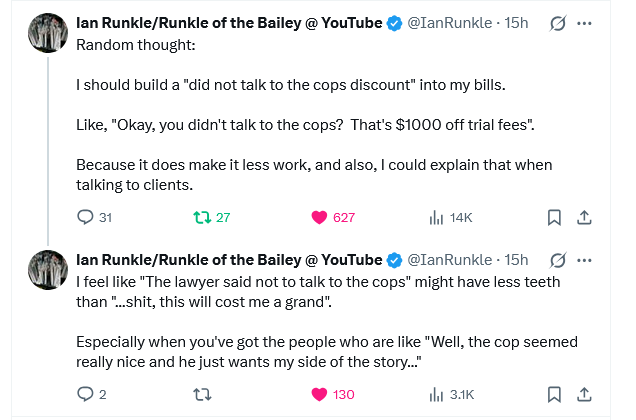
This rustled the jimmies of Jake Sun:
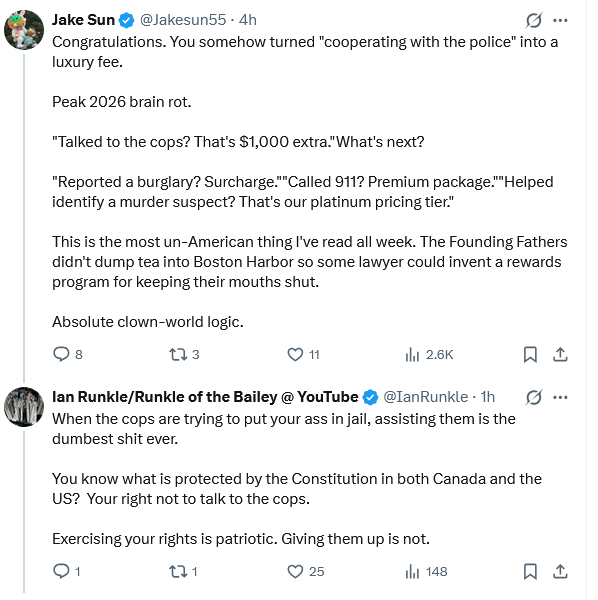
Which led to a more extended discussion from Ian:
Okay, ignoring the whole Canadian vs. American thing, let’s talk about this notion that it is somehow un-American to advise people not to speak to the cops.
Cause holy shit that’s funny.
First, when the cops want to put you in jail, cooperating with them and making that easier for them is a real dumb move. If you’re sitting in the interrogation room it’s not because the cops are looking to help you find a burglar or because you’re calling 911. It’s because they want to put you in jail, potentially for years. Wanting to help them at that point is as dumb as it gets.
Second, your right not to talk to the cops is enshrined in the Constitution in both Canada and the U.S. In other countries, likely not as much, which means that being able to tell the cops “Fuck you, no” is absolutely American, both because it is a thing in America and because exercising your Constitutional rights is an American and patriotic thing to do.
Third, if we’re talking about the United States specifically, we’re not talking about a country founded on respect for and obeisance to authority. The slogan was never “Give me Liberty, if the government allows it”. No one asked for a permit to throw tea in the harbour. The U.S. was not founded on the principles of obedience and deference to authority, but instead the rights of the individual against authorities are fundamental to the American experience.
America is not and never was about “Yes, sir.” It’s far more about “Fuck you, I won’t do what you tell me.”
World War 2 Mincemeat Pie for the Battle of the Bulge
Tasting History with Max Miller
Published 16 Dec 2025Raisin-forward army mincemeat pie made in a quarter sheet pan
City/Region: United States of America
Time Period: 1945During World War II, and really any war, soldiers far from home longed for a taste of home, especially during the holidays. Field kitchens would go to great lengths to break the monotonous menus and bring a little holiday cheer to the troops with things like turkey, stuffing, and pies.
This mincemeat pie is not bad, but it does lack the spices and citrus that really say “Christmas” to me. The corned beef and bouillon cubes add more of a savory note than a real meaty flavor, and raisins are the star of this pie.
No. 822. MINCEMEAT FORMULA NO. 1
Yield: 100 servings, 2 sheet pans, 16 1/2″ x 24″ x 1 1/2″.
Bouillon cubes……36 cubes
Water, boiling……9 quarts (9 No. 56 dippers)
Corned beef, canned……4 pounds
Fat……2 pounds (1 No. 56 dipper)
Apple nuggets, dehydrated……2 1/2 pounds (3 1/4 No. 56 dippers)
Sugar, granulated……3 pounds (1 1/2 No. 56 dippers)
Raisins……7 pounds (5 1/3 No. 56 dippers)
Cinnamon…… 3/4 ounce (3 mess kit spoons)
Pepper……(1/3 mess kit spoon)
Nutmeg……1/4 ounce (1 mess kit spoon)
Salt……(1/3 mess kit spoon)
Dissolve bouillon cubes in boiling water.
Add remaining ingredients. Simmer on a slow fire for approximately 45 minutes or until apples and raisins are tender. The addition of gravy coloring or caramelized sugar will improve the appearance. Remove from fire and cool. Pour into pastry-lined sheet pans.
Cover with a top crust and make in hot oven 40 to 45 minutes or until crust is golden brown.
Note. This mix should be prepared just prior to using.
— TM 10-412 US Army Technical Manual. Army Recipes by the U.S. War Department, 1945
QotD: Tiberius Gracchus, Tribune of the Plebs
And here it is worth noting that kind of government the Romans had to understand the response. The Roman Republic had written laws but no written constitution – instead, the rules for office holding, for conducting the business of the Senate, for running the assemblies and so on were all customary: the Romans governed themselves in accordance with what they called the mos maiorum, “the custom of the ancestors”. In a sense then, certain practices, if practiced long enough, became a sort of law-of-tradition to themselves and of course one of those customs – practiced at this point for, at minimum around 150 years – was the continual leasing of large amounts of ager publicus to the point that the leases were treated as a form of ownership: people used that land as security for loans, they built houses on it, they buried their parents on it and so on. Because the leases were presumptively renewable and had been for decades if not centuries, under the mos maiorum, the holders of ager publicus had long considered the land theirs. And of course the upset parties are rich and powerful, so their opposition was significant and meaningful, politically.
In brief, the way this plays out is that while Tiberius Gracchus does have significant popular support for his motion (Plut. Ti. Gracch. 9.1), much of the elite are opposed. He draws up a quite conciliatory version of the law, which proposes to compensate the holders of large amounts of ager publicus for their lost leasing rights and to then give them the remainder of their leased land (so they needn’t fear a second lex agraria and a third and a fourth and so on), but according to Plutarch in the face of continued elite opposition, shifts back to a less conciliatory version of the law (Plut. Ti. Gracch. 10.3). The resistance to his law centers on another tribune, Marcus Octavius, himself a large holder of public lands, who plans to veto the law and uses his own powers as a tribune to disrupt the process (along with some fairly clear shenanigans by some of the wealthy, like trying to hide the voting urns to prevent a vote on the law and so on).
Now there are a few things to note at this juncture in the story. First, there being ten tribunes, it must never have been very hard to find a tribute willing to gum up the passage of a given law, but that, traditionally, this was a tactic of delay, rather than a hard-stop the way Octavius is using it. At the same time, with real public momentum to make this law happen, one could easily imagine simply waiting Octavius out – he only has one year in office. Except. Except that, remember, Tiberius Gracchus needs a big victory in his tribunate to get his political career [back] on track, a consideration that was clearly significant (thus the reason we’re informed of his quaestorship; we usually don’t know much about even very significant figures’ time in junior offices!). That consideration, I think, serves as important context for Tiberius’ decision to escalate every time he encounters resistance: he cannot afford to simply be the prelude to someone else passing this law: he needs to pass it himself.
The normal method for “deconflicting” two magistrates with opposing vetoes like this was to go to the Senate, which Tiberius Gracchus, hoping his influential supporters would carry the day, did. Instead, according to Plutarch (Ti. Gracch. 11.2) the Senate was merely no help, whereas Appian (BCiv 1.12) describes the Senate as openly upbraiding Tiberius, a strong negative response. Now under the mos maiorum, that would be the end of it: the authority of the Senate (the auctoritas senatus) ought to be so intense that when the Senate speaks in one voice and says, “not right now” then you desist. Remember that in the Roman conception, the Republic is a partnership of sorts between the Senate and the People (the S and the P in SPQR), rather than a situation in which the Senate is purely subordinate to the popular will: if the Senate is strongly opposed, that is supposed to be a veto point that is respected.
But remember: Tiberius Gracchus cannot, politically, desist. He must push through because his political career requires a victory this year. Note that the cause does not require a victory in 133; there is nothing to stop another tribune in 132 from trying to advance the same bill or a more limited or different version of it. But Tiberius Gracchus’ career absolutely requires success in 133. So instead of desisting, he escalates.
He now breaks clearly with the mos maiorum and plans to take his law directly to the people against the advice of the Senate. Octavius is obviously a problem – he’ll veto anything Tiberius Gracchus tries to do – so Tiberius Gracchus introduces a law to depose Octavius from office. The Roman Republic doesn’t have anything like impeachment, there is no framework to remove someone from office. Instead, the way the Republic works is that all of the offices are held for short duration (one year) and while tribunes and office holders with imperium are immune from prosecution while in office, they can be prosecuted the moment they leave office for any crimes they committed. There is no framework for booting out a tribune like this; the remedy in the customary Roman system is to make sure the next year you elect tribunes who support the idea and try to pass it then. But that remedy doesn’t work for Tiberius Gracchus.
So Tiberius Gracchus passes the law deposing Octavius and then has him dragged from the speaker’s platform (the rostra) and now we have a problem. Because of course Octavius’ supporters are going to view this law itself as illegal and invalid: tribunes are, you will recall sacrosanct, so it’s not clear they can be deposed and it is very clear they cannot be assaulted or dragged. Violating the sacrosanctity of a tribune is, at least notionally, a capital offense and a severe violation of religion and if you think that Tiberius Gracchus’ legal basis for all of this is rubbish, you think he just did it twice. Of course, Tiberius is also a tribune, so you can’t attack him now, but once his year is done, you are probably planning to haul him in to court and let a jury decide if what he did was legal or not.2
In any case, with Octavius removed, Tiberius passes his land reform bill. The law provided for a three-man commission to handle the assessment of what public land was held in excess and then to hand it out. Tiberius Gracchus names as those commissioners himself, his brother and his father-in-law (Appius Claudius Pulcher (cos. 143)). Needless to say, that is a set of commissioners which does not inspire a lot of confidence that the commission will be uncorrupted by politics, a point we’ll get back to in just a moment.
In the meantime, the Senate looked to exert its traditional prerogative over state funds (as it advised the quaestors who superintended the treasury) to hamstring the new commission, but Tiberius Gracchus took advantage of the recent death of Attalus III, King of Pergamum. Attalus had notionally willed his kingdom “to the Roman people” – he had no clear heirs and so perhaps thought by this act to get the Romans to pick one of his relatives to run the kingdom, thus avoiding a damaging civil war – but instead Tiberius, getting the news early, rushed to pass a law annexing the kingdom and using the windfall to fund his commission. The law passes, but this is a breach both of the Senate’s traditional power over state finances, but also its very important role managing Roman foreign policy.
What I want to note in this sequence which is important for understanding what comes next is that Tiberius Gracchus has just demonstrated that, so long as he remained popular, he could use the powers of the tribunate to essentially run the Roman state from the tribune’s chair. Tiberius has now forced not merely a domestic land issue, but also a finance issue and a foreign policy issue over the objection of the Senate and another elected tribune, essentially running roughshod over all of the customary limits intended to keep any one Roman politician from coming to dominate the Roman political system.
Of course if you were an opponent of Tiberius Gracchus, you could at least tell yourself that this is all bad, but at the very least, Tiberius Gracchus will be out of office next year, as it was contrary to custom to run for any office immediately after holding it. Indeed, it was unusual to hold basically any office more than once, save for the consulship (and even then, only for very successful consuls and never multiple years in a row). Those limits are customary but everything about the Roman Republic is customary; if you discounted the mos maiorum, there wouldn’t be any republic left. You’d instead expect that Tiberius would go back to being a senator for a few years while planning his shot at the praetorship – during which he’ll have to survive a series of court battles over the legality of his actions.
So even if he is doing potentially outrageous, dangerous things, at least he’ll be gone in a year, right?
Bret Devereaux, “Collections: On the Gracchi, Part I: Tiberius Gracchus”, A Collection of Unmitigated Pedantry, 2025-01-17.
- Which, again, noting the complications above, probably means applying that limit for the first time to at least some classifications of land it had not applied to before and also applying it against the socii.
- The Roman court system leaves questions of law – which in most modern courts would be decided by a judge – to the jury itself.
June 9, 2026
Confucian deference to authority and tradition lead to autocracy and rebellion, time after time
Chinese history is not one of my areas of interest, so I have not read deeply in any specific area. Lorenzo Warby, on the other hand, has a much better grasp of the sweep of historical events in China and some of the philosophical and cultural elements that persist through the centuries:

All political and social philosophies rest, implicitly or explicitly, on some claims or claims about the nature of humans.
Consider the thought of Kong Qiu (c.551 BC – c. 479 BC), known as Kǒngfūzǐ (孔夫子) (Great Master or Wise Teacher Kong), hence Confucius. He held that human nature is naturally good and that it is therefore a reasonable aspiration to create a society of harmony, a society without conflict, if everyone just behaves with the propriety appropriate to their place in society — in particular, according to their placement in the web of social connections. His constant concern for the rites (li 禮) is for people to show the correct forms of, and orientation towards, those socially embedded interactions.
This leads very naturally to a very authoritarian, hierarchical view of politics as enforcing social harmony, particularly as people vary in their willingness and capacity to cultivate such virtuous propriety. The notion that politics is legitimately an arena for bargaining between competing interests — the Western idea of “normal politics” — becomes not a natural way to do politics, but a failure to achieve proper harmony.
Master Kong developed his ideas — that were further developed by disciples and commentators — in a civilisation with no tradition of warrior assemblies, self-governing cities, or deliberative assemblies of any kind. A ruler’s court is a place where officials report, and may even debate, but the ruler decides. You can see this narrow view of politics in comments by Master Kong in the Analects such as:
8.14 The Master said, “If you don’t have a particular [government] position, then don’t meddle with any of its business.”
14.26 The Master said, “If you don’t have a particular [government] position, then don’t meddle with any of its business.” Master Zeng [Zengzi] commented, “The gentleman does not allow his thoughts to go beyond what his position calls for.”
In such a political culture, judicious quotes based on mastery of a shared literature become a way of communicating to superiors while giving minimum offence. Conversely, political rhetoric has little or no value, because there are not the deliberative assemblies to be swayed by argument. Master Kong deprecated glib persuasiveness, on the grounds that it tended to hide one’s real character (or lack thereof).
Where command-and-control hierarchy is the dominant method of political action, hoping for propriety to pervade the hierarchy has obvious resonance. Putting such propriety as a mechanism for social harmony is a way to, ironically enough, be persuasive — which requires a positive view of human nature. But it also hugely elevates the moral claims of governorship. Hence comments such as:
2.1 The Master said, “To rule by virtue is like the way the North Star rules, standing in its place with all the other stars revolving around it and paying court to it.”
12.17 Ji Kangzi asked about the way of governing [zheng]. Confucius replied, “To govern [zheng] is to correct [zheng]. When you set an example by correcting your mistakes, who will dare not to correct his mistakes?”
This concern for harmonious propriety is not a world away from ibn Khaldun‘s concern for asabiyya. Nor is it so far from recognising the importance of a coherent civic culture in order to maintain robust institutions, which rest on norms and rules. This is a factor that much of mainstream Economics fails to seriously grapple with, leading to incompetent analysis of immigration.
The problem is that this cultural and institutional framework turns the thought of Master Kong, his disciples and commentators, into what is, in effect, one-trick moral propriety politics, however sophisticated other aspects of this tradition may be. The choices of governance are narrowed down to punishment and example:
2.3 The Master said, “If you guide the people with ordinances and statutes and keep them in line with [threats of] punishment, they will try to stay out of trouble but will have no sense of shame. If you guide them with exemplary virtue [de] and keep them in line with the practice of the rites [li], they will have a sense of shame and will know to reform themselves.”
They are reduced to trying to make autocratic command-and-control politics work as a successful long-term project: as the repeated dynastic collapses in Chinese history show, they did not succeed. Indeed, the recurring pattern of Chinese political reformers and reform programs ending badly reflects that such fail to break out of that autocratic command-and-control pattern, so end up being swallowed by its incentive structures — including the long-term pathologies of bureaucracy and the inherent fears of autocrats.
The most thorough attempt to implement ideas based on rú (儒) classicism (“Confucianism”) in Chinese history was the disastrous reign of Wang Meng (r.9-23), who provides an object lesson in overweening Theory leading to disastrous policies. Ironically, Master Kong himself was against such grand theorising:
9.4 The Master stayed away from four things: he did not put forth theories or conjectures; he did not think that he must be right; he was not obdurate; he was not self-centered.
The episode is a particularly disastrous example of Etienne Gilson‘s principle that the conclusions of the master are the premises of the disciple, thereby all too readily reducing struggles with complexity to a simplifying dogmatism: a trap that scholarly commentary on The Analects often tried to avoid.
The thought of Master Kong also wanders very close to someone is morally better, not only because learned, but because smart and learned. For instance:
5.9 The Master said to Zigong, “Who is the better man, you or Hui [Yan Hui]?” Zigong replied, “How dare I compare myself with Hui? Having learned one thing, he gives play to ten, while I go only as far as two.” The Master said, “You are not as good as he is. Neither of us is as good as he is.”
This arrogance of the appropriately credentialed periodically led to mass outbreaks of infuriated peasants removing educated heads from elite bodies. The most recent manifestations of this were the Cultural Revolution in China and the megacidal Cambodian horrors under Pol Pot but you can see versions of this reaching back into Chinese history — for example, the massacres by Huang Chao’s rebellion (874-884) towards the end of the Tang dynasty (618-907) and the earlier peasant revolts that brought down Wang Meng.
We can also see the same self-righteous exploitive arrogance of those credentialed with “morally proper knowledge” afflicting contemporary Western societies along with bureaucratic pathologies that have also been a feature of Chinese history — remembering that we Westerners copied the Chinese pattern of bureaucratic selection through examination without considering the long-term patterns of Chinese history. Fortunately, national populism generates a less violent outlet for popular frustrations than Chinese peasant revolts.
Update, 10 June: Welcome, Instapundit readers! Have a look around at some of my other posts you may find of interest. I send out a daily summary of posts here through my Substack – https://substack.com/@nicholasrusson that you can subscribe to if you’d like to be informed of new posts in the future.
Road to Rangoon, Ep. 1 – Slim’s Hammer and Anvil
HardThrasher
Published 8 Jun 2026The Road to Rangoon Ep1: Hammer & A Hard Place — The Battle for Burma Begins By the start of the monsoon rains in 1944, British and Indian forces of General Sir William “Bill” Slim’s XIVth Army had been pegged back inside India. Five months later, after the battles of Imphal and Kohima, the Fourteenth Army had not only retaken the ground it had lost, but inflicted catastrophic losses on the Imperial Japanese Army.
The question was: what now? There would be no more forces coming from Europe, no additional fire power or support, and apparently no belief in the men by the Imperial General Staff in London or the US Army high command in Washington. Could the DUKE forces push into Burma through monsoon rains, jungle, mountains, disease, impossible supply lines and against an enemy willing to die for each yard of ground? Could Slim, Mountbatten, Oliver Leese, the US-led Northern Combat Area Command — NCAC — turn victory in India into the reconquest of Burma?
In this opening episode of “The Road to Rangoon”, we begin the story of the epic advance that would throw the Imperial Japanese Army out of Burma (modern day Myanmar) and become familiar with some of the places, names and concepts that will shape our story.
We look at the geography of Burma and eastern India, the aftermath of Imphal and Kohima, the state of the Japanese Burma Area Army under General Kimura Heitarō, the role of XIVth Army, XV Corps and NCAC, and the Allied plans that became Operation ROMULUS, Operation CAPITAL, Operation DRACULA and EXTENDED CAPITAL. This is the story of how the Burma Campaign moved from defence to attack — and how Slim planned one of the most ambitious offensives of the Second World War.
(more…)
“… prior opportunities for mental health evaluations were missed”
So shocking a crime, yet the reaction of the elites really does seem to boil down to “black on white violence is just something we have to put up with” or, even worse, “it’s the fault of systemic racism, homophobia, transphobia, etc., etc. …”. This was originally posted last year, but nothing significant has changed:

In the 6 weeks since the gruesome murder of Iryna Zarutska, we’ve had time to learn what politicians and the courts and the media think her death means.
And that’s this: Nobody is responsible. Brutal black-on-white violence is either a depersonalized fact of nature, like bad weather, or it’s a sort of just retribution by the oppressed against a racist society. We’re to avert our eyes, to forget the psychotic mumbling “I got that white girl! I got that white girl!” He’s just crazy. The mumbles don’t mean anything, and if they mean something it means that white people deserved it.
But it does mean something very definite. It means that white girls like Iryna can no longer trust that society will make any systematic effort to deter Black psychotics from murdering them.
An LLM, asked to summarize, says “prior opportunities for mental health evaluations were missed”. That agentless, passive language is perfect; no one did anything. No one is responsible, and no one, not even the murderer, can be held accountable.
The purpose of a system is what it does. The purpose of our justice system is to allow grisly murders to happen, as long as the victim sorts into an oppressor class and the perpetrator to sort into an oppressed one. If Iryna’s death hadn’t been caught live on video all our institutions would have colluded to make us forget it.
Institutions like the Community Relations Service. Which for 60 years until President Trump just defunded it, strongarmed white victims of racial hate crimes into keeping silent or uttering anodyne denials that race hatred could be a factor.
Blacks, 13% of the population, commit at least 60% of serious index crimes, murder and rape and felony assault. The actual percentage is probably higher, since there’s increasing evidence that Black crime is underreported by police and officials as a way of managing racial tensions downwards. In a fair system, this would predict that a solid majority of the state and federal prison population is Black. The actual percentage is about 33%
Blacks are privileged. They’re under-arrested, under-indicted, under-imprisoned, and (despite popular mythology) less likely to be killed during a police stop than a white person is.
It’s exactly by treating Blacks as a privileged class, licensed to act from racial hatred and mumble “I got that white girl!”, that we got to the point where. Iryna Zarutka bled to death on live video.
The grimmest fact about her murder other than the horrific death itself is that six weeks later, nobody is talking about black privilege.
It’s time to start having that conversation, and it’s time to start using the term “black privilege” for the combination of systematic averaion and viciousness that led to Iryna Zarutska dying, innocent and alone and abandoned by the system that should have protected her.
Stop buying stadiums for billionaires!
ReasonTV
Published 6 Feb 2026Sports subsidies suck.
If sports is a trillion dollar industry, with billionaire team owners and millionaire players, and hundreds of thousands of enthusiastic fans, and weird pervert mascot creatures, why is the government giving them your money?


