
In 1977, the French essayist, Jean-François Revel, published a tract with the title The Totalitarian Temptation. In it, he condemned the western intelligentsia’s faiblesse, which was at the same time dishonest, posturing, stupid, and evil, for Stalinist-style dictatorships.
One might have thought — I certainly thought — that with the downfall of the Soviet Union, the totalitarian temptation had been exorcised once and for all. This, of course, was a very superficial view. Instead of disappearing, the temptation balkanised, so to speak, and was also repatriated. Totalitarianism had been shown almost as conclusively as anything in the sphere of human affairs to be inherently absurd, intellectually nugatory, and catastrophic in practice. This fact was not sufficient, however, to destroy its attractions — at least for those who desire a complete solution to all of life’s little problems such as how to live and what to live for. A solution in the mind is worth a thousand disasters in the world.
Naturally, it takes a certain level of education to feel the temptations of totalitarianism: they do not occur to the illiterate, for example, but only to the intelligentsia. The latter has increased in size almost exponentially with the expansion of tertiary education, or at least with attendance at institutions of tertiary instruction. In retrospect, it is not surprising that totalitarianism should continue to exert its siren-song in previously liberal societies, particularly when the young, always tempted by radical ideas, face genuine if intractable problems, seemingly worse than those of the previous generation.
Theodore Dalrymple, “The Temptations of Power”, The Iconoclast, 2020-09-06.
June 9, 2026
QotD: The temptations of totalitarianism
June 8, 2026
Milton Friedman – accessory to Grand Theft Taxation
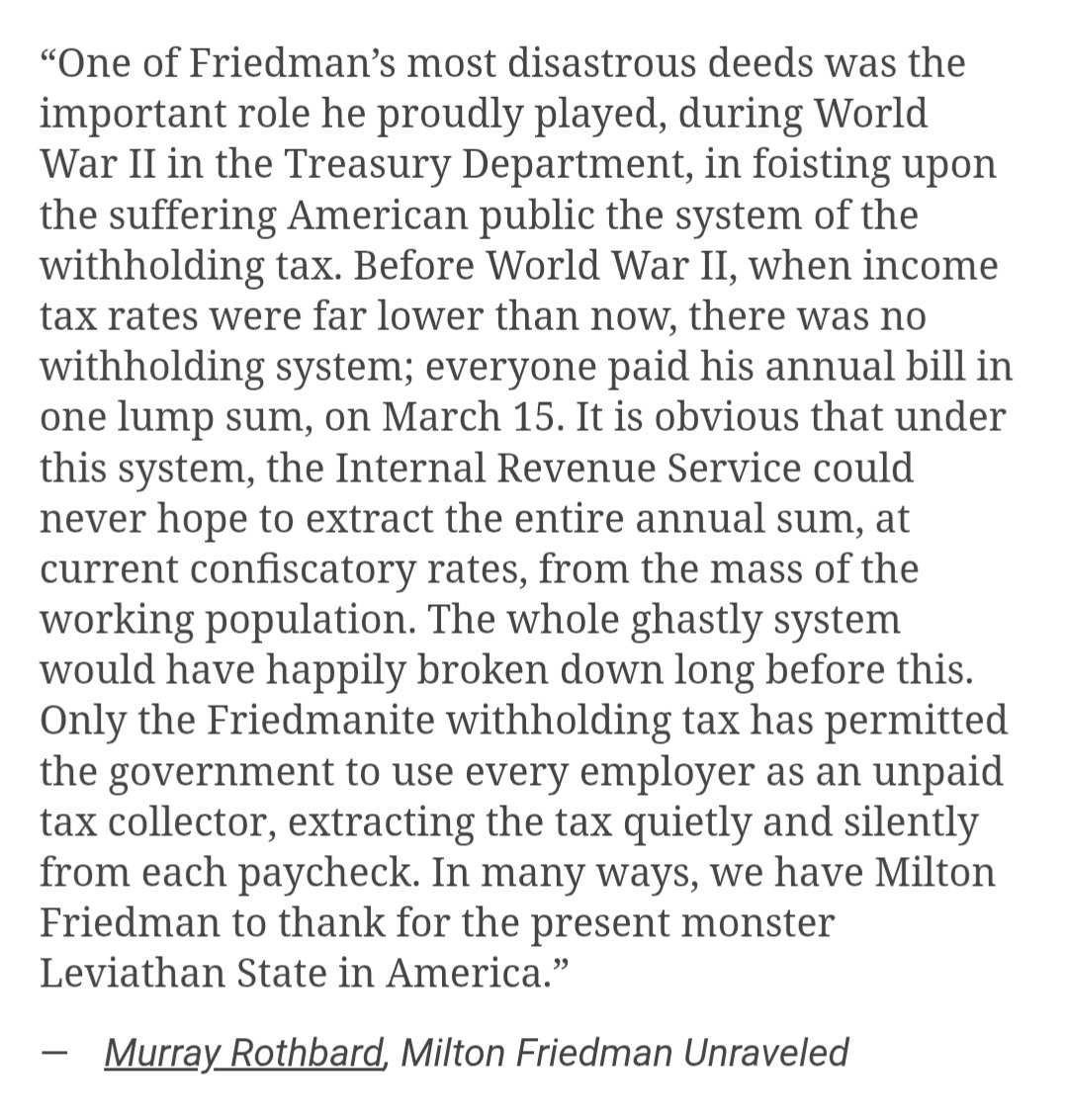
I’ve only read a small part of Milton Friedman’s work, but I have great respect for him and think that overall, he was a very strong proponent for smaller, less intrusive government. But there’s one terrible thing that he was instrumental in implementing that almost outweighs everything else:

Milton Friedman’s greatest regret.
The federal government discovered the perfect crime in 1943: make employers collect taxes before workers ever see their paychecks. You think you earn $60,000 per year, but you actually earn $75,000 and hand over $15,000 to politicians without ever touching it. The psychological difference is enormous.
Before payroll withholding, Americans wrote quarterly checks directly to the Treasury. Picture yourself sitting at your kitchen table, writing a $3,750 check to the IRS every three months. The pain was immediate and visceral. Politicians faced constant pressure to justify every dollar because citizens felt the extraction in real time.
Withholding transforms this concrete loss into an abstract accounting entry. Your employer becomes an unpaid tax collector, and you never experience the actual cost of government. Worse, most people celebrate their tax refunds as government generosity rather than recognizing them as interest-free loans they provided to politicians. The Treasury collects your money throughout the year, spends it immediately, then returns your own cash and receives gratitude.
This system enables the explosion in government spending you witness today. Defense contractors billing $640 for toilet seats, agricultural subsidies for corn syrup, and congressional salaries for 535 people who rarely show up to work. When taxation feels painless, voters stop demanding accountability for how their money gets spent.
Milton Friedman helped design withholding as a wartime emergency measure and later called it his greatest regret. Free market economists recognized that the psychological pain of direct taxation creates political pressure for fiscal restraint. The temporary always becomes permanent in government hands, and the emergency justification disappears while the extraction mechanism remains forever.
Libertarian economist Murray Rothbard was far more scathing about Friedman:
A Brief History of Nuclear Weapons in Canada
Polyus
Published 6 Jun 2026 #aviationlovers #canadianaerospace #PolyusStudiosCanadians themselves were largely opposed to nuclear weapons but their utility in a full out conflict was impossible to ignore. And so up until fairly recently the Canadian government’s position on the matter was deliberately ambiguous. Promoting peace while supplying the means of war. Now with the luxury of hindsight we can see the true extent to which these weapons played a central role in the defense of this country during the Cold War.
Like it or not, Canada was a threatening and potent nuclear-armed force during a 9 year period between 1963 and 1972. The posturing was offensive in Europe, and defensive on Canadian soil. The last defensive weapons were relinquished in 1984. Nuclear weapons were adopted as part of its network of alliances, when it became obvious that the Soviet missile threat could only be defeated by deterrence. Politically the nuclear question was a hot potato, John Diefenbaker tried to keep the weapons out, Lester Pearson let them in, and Pierre Trudeau kicked them back out again.
This video was made without the use of Artificial Intelligence (No AI). Long live people power!
0:00 Introduction
1:20 Uranium mining in the North
2:31 Tube Alloys and the Manhattan Project
4:10 Post war fears of Soviet army and Canadian build up in Europe
6:04 Air threat from Soviet bombers
8:05 The case for nuclear weapons
9:28 Cancellation of the Arrow in favour of nuclear weapons
10:55 Defensive nukes
13:39 Offensive nukes
16:15 Nuclear capable platforms
16:59 Types and numbers of deployed weapons
18:30 Legacy and impact of these weapons
19:55 ConclusionSupport me on Patreon – / polyusstudios
Music:
Denmark – Portland Cello Project
Your Suggestions – Unicorn Heads
“Friedrich Nietzsche predicted our culture more than a century ago”
On the social media site formerly known as Twitter, Creative Deduction give Nietzsche credit for predicting how western cultures would change to the state we find ourselves in today:
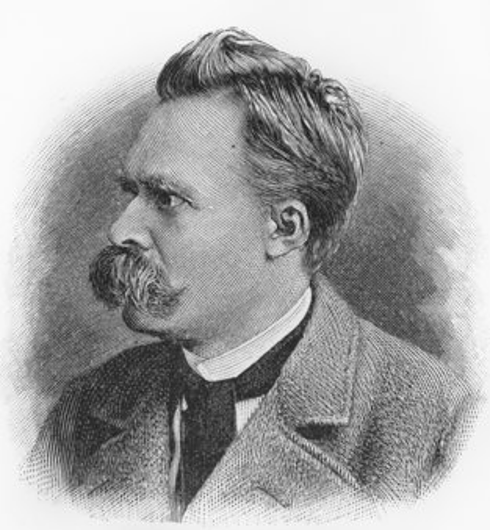
Friedrich Nietzsche predicted our culture more than a century ago.
A society where victimhood confers status; where weakness is celebrated as virtue; where grievance brings moral authority; and where the highest aspiration is not greatness, but comfort.
He regarded it as a symptom of civilisational decline. In place of the old aristocratic values of strength, courage and self-overcoming, Nietzsche saw the rise of what he called “slave morality” — a worldview that elevates weakness, suffering and resentment into virtues. The modern celebration of victimhood, where people compete to present themselves as the most oppressed, is this mentality. Rather than striving to overcome hardship, many now seek status and moral authority through claims of injury and grievance.
Nietzsche was deeply contemptuous of those who pursue safety and comfort above all else. He mocked the “last man”, the small-souled creature who wants nothing more than a warm bed, entertainment and protection from anything difficult or dangerous. For Nietzsche, struggle was not an unfortunate condition to be eliminated, but the very source of meaning, growth and greatness. Without resistance, there is no self-creation.
The modern welfare state would have horrified Nietzsche. By shielding people from the consequences of their actions and removing the necessity of struggle, it does not liberate — it enfeebles. It creates populations that are materially secure but existentially empty, dependent on the state rather than on their own strength and initiative. Nietzsche believed that genuine human flourishing requires the willingness to endure hardship and take responsibility for one’s life. A society that makes comfort its highest value and victimhood its highest status inevitably produces weak, resentful people who have forgotten how to live.
How Red Dot Sights Work (What is a Collimator?)
Forgotten Weapons
Published 16 Jan 2026A whole lot of people have used red dot sights, but how many actually understand how they work? Let’s see if we can fix that today …
(more…)
QotD: Re-use, recycle, and contaminate
This “common cup” was the ultimate reusable product — much to the horror of public-health experts, who blamed it for spreading tuberculosis, pneumonia, diphtheria, meningitis, and other diseases. Alvin Davison, a biologist at Lafayette College in Pennsylvania, analyzed cups from public schools and reported in 1908 that a single sip from a student left a residue of 100 dead skin cells and 75,000 bacteria. He used the scrapings from one school cup to induce fatal cases of pneumonia and tuberculosis in guinea pigs.
His article “Death in School Drinking Cups” provided support to “Ban the Cup” campaigns around the country. The first successful one was led in Kansas by Samuel Crumbine, a colorful doctor who had started his career in Dodge City (he was the model for Doc Adams in the long-running Gunsmoke television series) and went on to lead various public-hygiene crusades. The term “flyswatter” comes from a slogan he popularized, “Swat the fly” (which came to him while listening to the crowd at a baseball game urging a hitter to swat a sacrifice fly ball). After watching train passengers with tuberculosis and other diseases drinking water from a common cup, Crumbine got so upset that he threw the cup out the train’s window, and proceeded to persuade his colleagues on the state board of health to ban the common cup in trains, schools, and other public places in Kansas in 1909.
The ban left Kansans with a new problem: What were they supposed to use at a public fountain? Fortunately, as Crumbine later recalled, “Necessity proved to be the mother of invention.” Shortly after banning the cup, Crumbine was visited by a former Kansan named Hugh Moore, who brought with him samples of a product that his brother-in-law had invented: round paper cups that could be stacked in a dispenser next to a fountain. Crumbine’s endorsement provided crucial help to Moore in selling his product, originally called Health Kups and later renamed Dixie Cups.
John Tierney, “Let’s Hold On to the Throwaway Society”, City Journal, 2020-09-13.
June 7, 2026
Are “Dad books” in trouble?
In the latest SHuSH newsletter, Ken Whyte views with (mild) alarm a recent Wall Street Journal article claiming that “Dad books” — the kind of books thoughtful kids give their fathers as gifts — are in steep decline:
The Wall Street Journal ran a piece last month on the death of Dad books, the Father’s Day specials — books about “some little-known chapter of World War II, the sweeping narrative of a shipwreck, perhaps the latest presidential biography”.
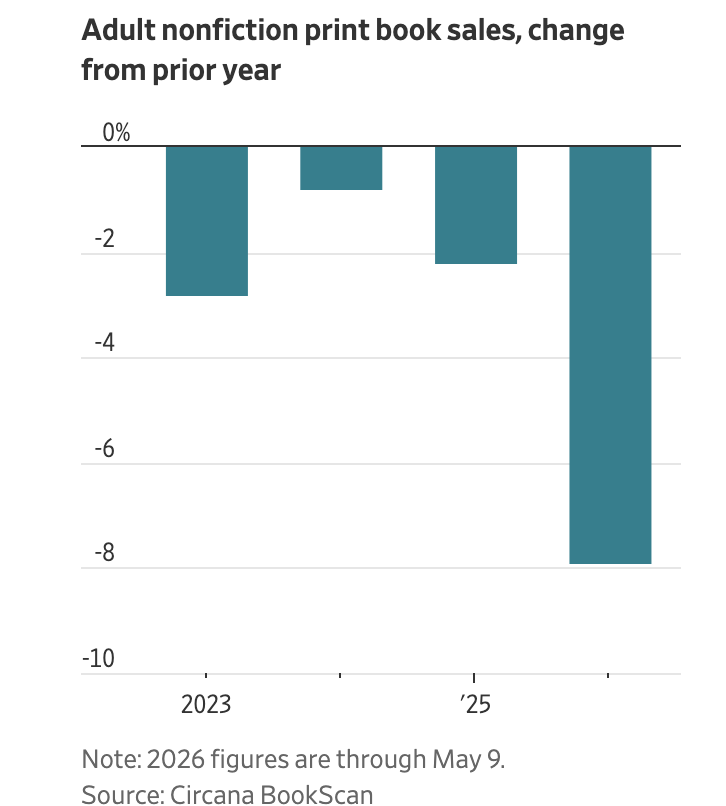
Here’s what it gave for evidence. Nonfiction book sales have declined for four years, including an 8 percent drop this year up to May 9.
Sales of Books about politics and current affairs are down 19 percent in those same four months and nine days in 2026. The article quotes, among others, former Simon & Schuster publisher Jonathan Karp saying that “this is a sea change and people should wake up and realize we’re living in a new world”.
The new world is one with “an endless supply of Substack newsletters, Netflix documentaries, YouTube videos and podcasts that offer the kind of fresh reporting, sharp analysis and historical perspective once limited doorstop-size books”.
Jonathan Burnham of Harper Group adds that all these alternatives to books make “the idea of sitting down with a 700-page Ron Chernow book less appealing. You’ve scratched that itch.”
The WSJ noted that Chernow’s recent biography of Mark Twain, published last spring, is underperforming his 2017 biography of Ulysses S. Grant.
There was an obligatory quote from Barnes & Noble CEO James Daunt, who attributed the decline in serious nonfiction sales to the fact that everyday events are all-consuming: “The world is exceptionally interesting right now and when that happens the nonfiction reader is reading the news instead.”
As someone who publishes a lot of Dad books, i.e., serious researched nonfiction, histories and biographies, that sort of thing, I read the article with concern. In fact, I read it twice.
I felt much better after the second reading.
Let’s start with the chart. The first four months and 9 days of 2026 are doing all the work here. A decline of 1 to 2 percent in the years 2023 to 2025 is statistical noise. Circana BookScan numbers don’t include audiobooks, which have been rising steadily in popularity. The very slight decline in sales for the first three years might be entirely attributable to format shifting, hardcopy to digital audio. The 8 percent decline in the first four months of 2026 looks more ominous, but book sales figures are always lumpy, never a straight line. A four-month sample tells you nothing.
The greater problem with the chart is that it is counting adult nonfiction book sales, not Dad books. There are any number of ways to cut Circana BookScan data, but the broad adult nonfiction category contains a vast array of books. Books for men, books for women, books for everybody. Not only serious researched nonfiction, but self-help, how-to, study guides, business and personal finance, psychology and religion books, health and fitness books, parenting books, food and travel books, true crime, sports, military, essays, crafts and hobbies, memoirs, etc. There is no data cut for Dad books. So the story is backing its thesis for the death of apples with stats about oranges.
The report of a 19 percent drop in the narrower category of politics and current affairs also looks ominous, but this is one of the most notoriously cyclical genres in existence. And, again, we’re discussing a short period of four months and nine days. The new Trump era was less than a year old at the start of that period. It generally takes longer than a year to get new books from commission to sale. Ten days after the end of the period under discussion, Andrew Weissmann released Liar’s Kingdom: How to Stop Trump’s Deceit and Save America. It was an instant number-one New York Times bestseller. In so specialized a category as this, Liar’s Kingdom alone might have been sufficient to right the ship.
The only other evidence presented to support the decline in Dad books is poor Ron Chernow’s journey. His Mark Twain, with 119,259 hardcover sales, is underperforming his Ulysses S. Grant, with 381,604 sales.
I don’t know where to start. The Grant book has been out for almost a decade, Twain for a year. Not surprising that it has sold less. Also, you can’t compare major political biographies to major cultural biographies. David McCullough’s biographies of Truman and Adams far outsold his book about American artists and writers in Paris. And while I’m a fan of Chernow, his Twain book isn’t his best work. He received polite and generally positive reviews, but they noted that the book is overly long — the word “exhaustive” surfaces repeatedly — and that he doesn’t entirely succeed in bringing Twain to life. Grant is a superior book, and the more enjoyable read, too, if customer reviews are anything to go by. The Twain sales prove nothing.
So we don’t really have any evidence at all that Dad books are in trouble, that they’re getting swamped by podcasts or current events, and certainly not that there’s been “a sea change” and that we’re living “in a new world”.
Amusingly, the literary world was flooded with hot new Dad books coincident with the WSJ‘s declaration of their death.
Those “decorations” or “doodles” on medieval manuscripts
In this week’s Substack Post of links they included this gem from weird medieval guys providing lots of illuminated explanations of the visual additions to pages of handwritten text generated in monasteries all over Europe during the Middle Ages:
After perhaps my 9,000th time seeing someone describe medieval marginalia as “doodles” or the product of “boredom”, I thought it might be nice to put together a brief guide to some of the themes and ideas that recur in the margins of manuscripts, hopefully helping to showcase the fact that these drawings were usually anything but “random”! In fact, far more interestingly, these little characters and scenes were part of a complex and visually dense world rooted in religion, pop culture, humour, and folklore. This is just a whistle-stop tour, but I’d love to add a second part soon.
Context matters
Illuminated manuscripts were essentially always written first and illustrated second in the late Middle Ages. The scribes would add their writing to unbound, empty pages, working carefully around blank fields where painted miniatures and initials would later be added by a separate artist or artists. We do not know exactly what sort of education these artists would have obtained. However, they almost certainly would have had a degree of literacy in their native tongue and a familiarity with the scriptures they were illustrating, even if this did not extend to a firm grasp of written Latin.
Understanding this is crucial for pushing back on the idea of medieval marginalia as “random”, since it opens up the possibility of considering marginal drawings in relation to the rest of the page and manuscript as a whole — crucial context that is often neglected when we encounter marginalia as isolated snippets online. Artists were not simply filling in blank voids but adding adornment to a canvas already rich with meaning imparted by the scribe. Thus, the first step to understanding a piece of marginalia should always be to trace it back to its source, if possible. Have a look through the entire work and see what themes and images recur.
Works like the 13th century English prayerbook known as the Rutland Psalter show extensive evidence of the marginal artists playing on specific words and lines from the scriptures featured on the same page. I highly recommend Betsy Chunko Dominguez’ fantastic paper “Playing on Timbrels: The Margins of the Rutland Psalter” for a more complete exposition, but I will go over a couple examples here.
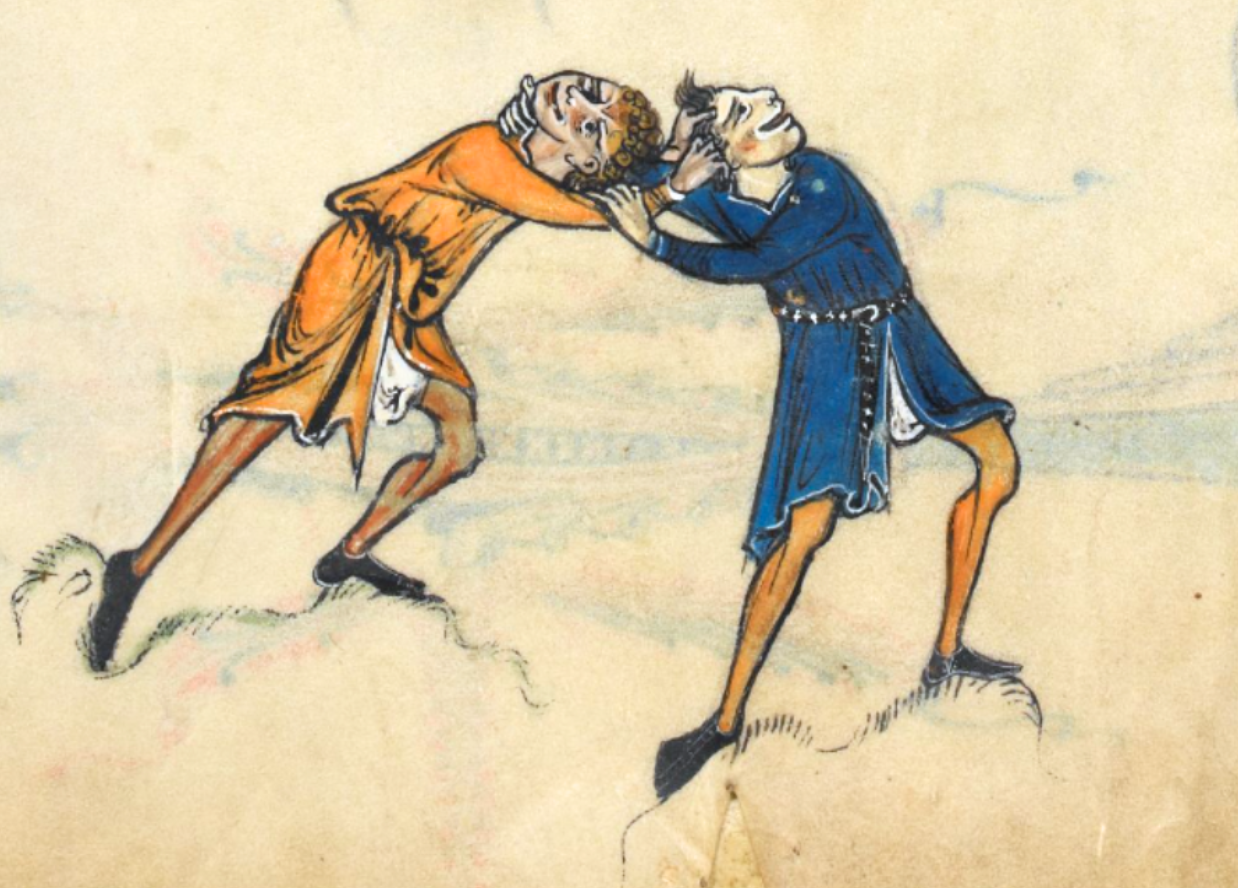
In the lower margin of folio 11r of the Psalter, two men seem to be engaged in a fierce struggle, with one of them apparently trying to rip off the other’s ear. Moving their eyes back up to the start of the opposite page, a reader would have been greeted by the following line from Psalm 5:
Verba mea auribus percipe Domine intellege clamorem meum.
Give ear, O Lord, to my words, understand my cry.
Thus, our marginal brawl becomes a clever pun on the notion of “giving ear” — perhaps a way of making the text more engaging and memorable for its reader.
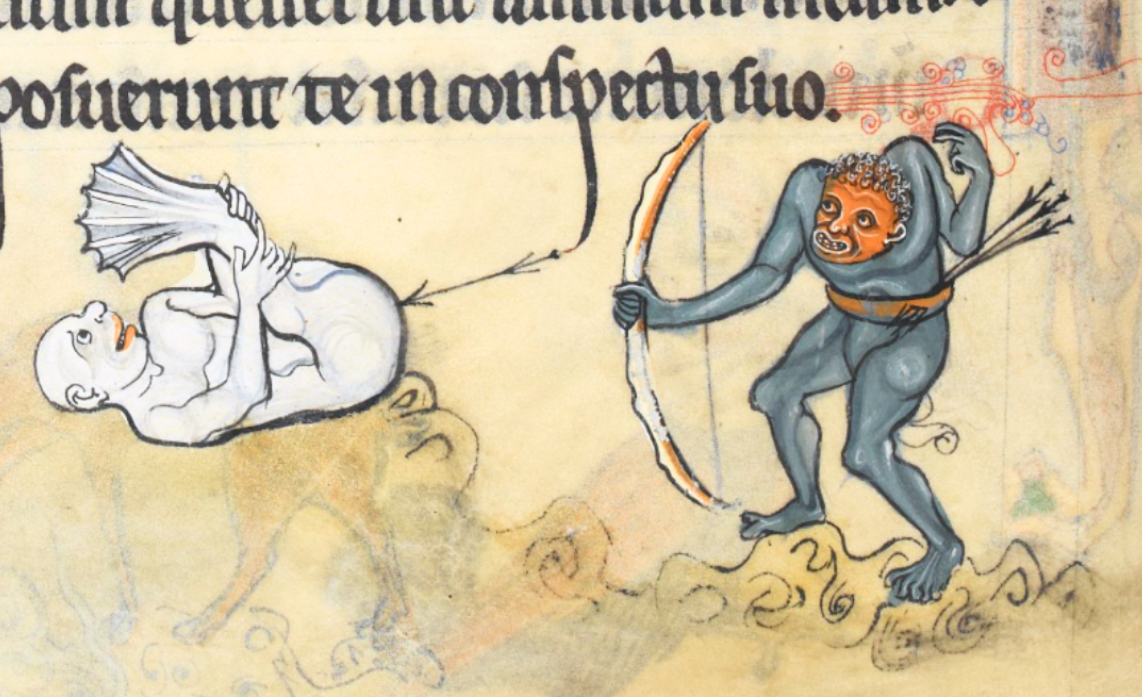
On folio 87v, the artist has extended the letter p from the word conspectu in Psalm 86 (85 in the Vulgate) into an arrow fired from the bow of one monster into the rear end of another.
Conspectu means “to behold” or “to consider”, and the famous medieval scholar Michael Camille connected the arrow’s placement to the notion of gaze as a type of visual penetration. One might also consider the entire verse from the Psalm, which reads:
Deus, iniqui insurrexerunt super me, et synagoga potentium quaesierunt animam meam: et non proposuerunt te in conspectu suo.
Arrogant men are rising up against me, O God; a violent mob seeks my life; they do not keep you before their eyes.
In redirecting the word for “gaze” into the supine creature’s rear end, the artist has perhaps emphasised the evils of turning one’s eyes away from God, connecting the two monsters with the violent mob evoked in the text above.
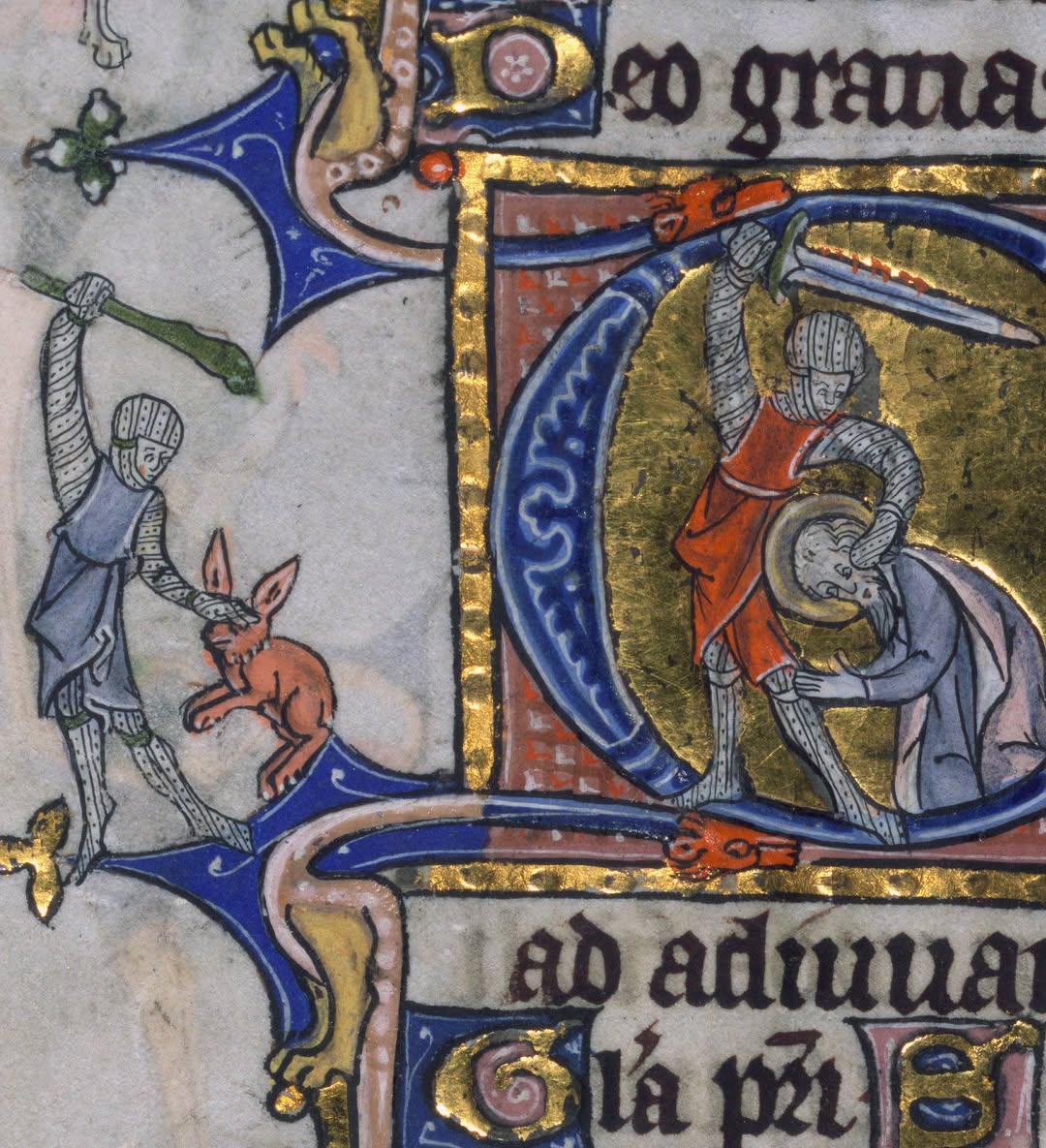
For those who lack an education in Latin, this type of wordplay can be tricky to identify. What may be easier to find are visual parallels between different drawings in a manuscript: the margins could function as a sort of antithesis to the “orthodox” miniatures and initials in the centre of the page. In one 14th century French book of hours, the martyrdom of St Paul in an initial D is reenacted directly to the left by a soldier about to club a rabbit — a humorous elevation of lapine suffering that perhaps emphasises Paul’s innocence.
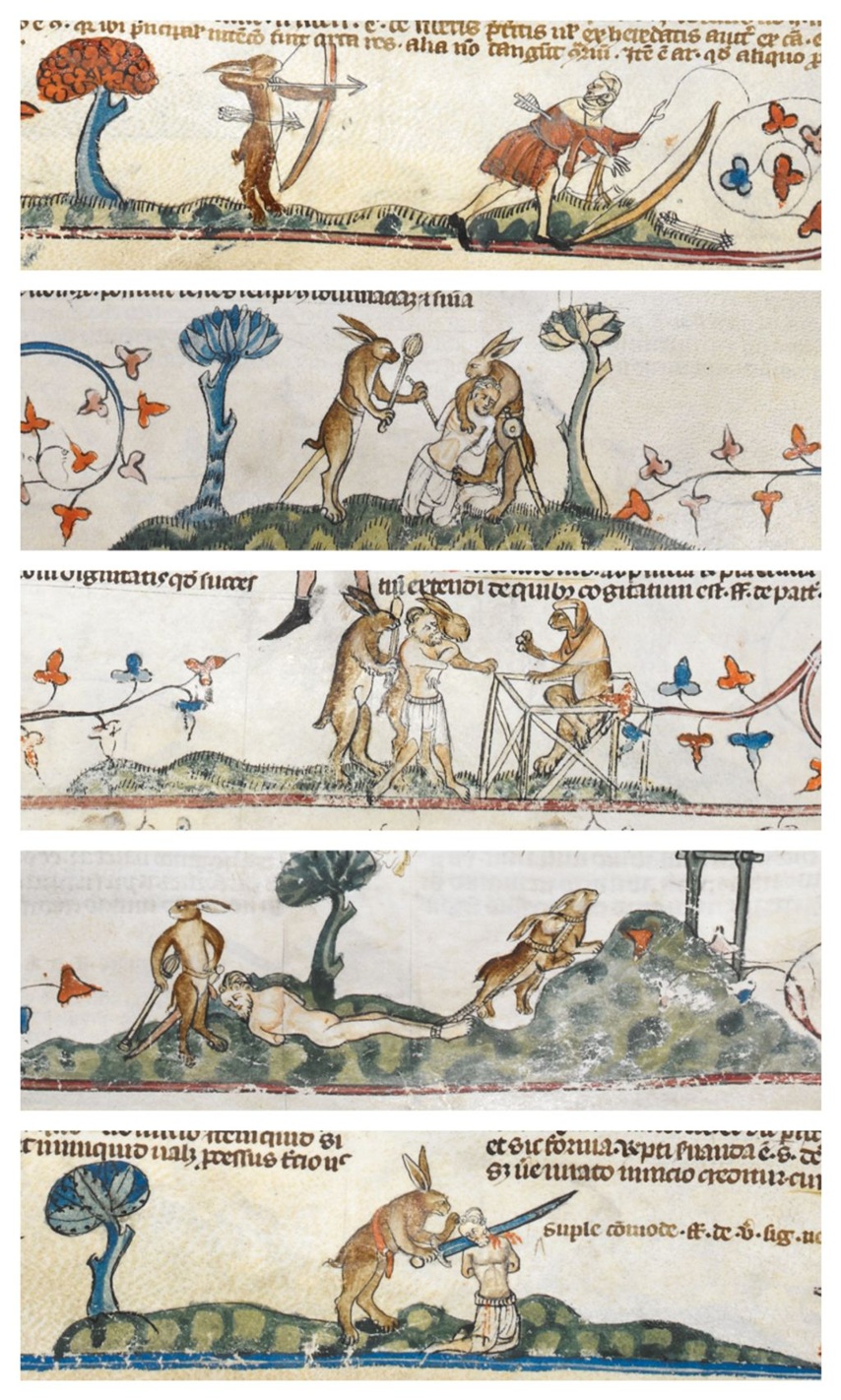
Other manuscripts show narratives playing out in the margins across multiple pages in a comic-book fashion. The 14th century Smithfield Decretals contains more than a dozen multi-page stories, including those of several saints, naughty priests, henpecked husbands, and a group of rabbits who capture, try, convict, and execute a hunter for his crimes against their kind.
British Library, Royal MS 10 E IV
How Hitler Tested His Next War in Spain – Death of Democracy 18 – Q2 1937
World War Two and Spartacus Olsson
Published 6 Jun 2026Berlin, June 30, 1937. Hitler has not staged a major diplomatic shock this quarter — but beneath the surface, Nazi Germany is preparing for war.
In Spain, the Condor Legion helps Franco’s Nationalists and the bombing of Guernica gives the world a terrifying preview of modern aerial terror. At home, the regime escalates its assault on the Catholic Church, begins the purge of “degenerate art”, tightens the link between courts and concentration camps, and hides rearmament behind spectacles of economic success.
This episode of Death of Democracy looks at Q2 1937: the quarter when Nazi Germany normalized aggression abroad while deepening tyranny at home.
00:00 Berlin, June 30, 1937
00:05 No Hitler Surprise — But War Preparations Continue
00:51 The Hindenburg and the Shadow of Modern War
01:50 The “Give Me Four Years” Exhibition
02:25 Guernica and the Condor Legion
02:55 The Bombardment of Almería
03:11 Case Green and Case Otto
03:54 Degenerate Art and Cultural Cleansing
04:22 The Judiciary and the Concentration Camps
05:13 The Nazi Assault on the Catholic Church
06:07 Goebbels, Propaganda, and the Morality Trials
07:45 Autarky, Rearmament, and Hidden Austerity
08:52 Mood Inside the Nazi Leadership
09:48 Ordinary Germans and Apathy
12:15 Analysis: War Abroad, Tyranny at Home
14:19 Conclusion: Nazi Double-Talk
Morality and humour
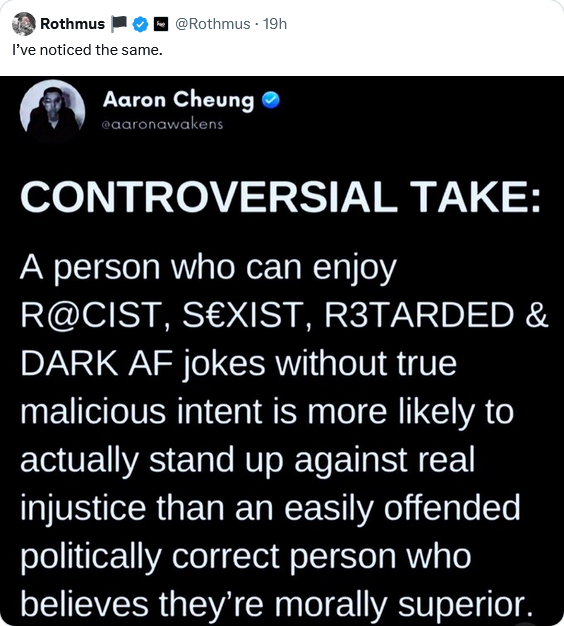
Devon Eriksen suggests that there’s a correlation between a person’s morality and their sense of humour (or lack thereof):
There is probably a correlation between morality and sense of humor.
Larry Niven once theorized that humor is associated with an interrupted defense mechanism.
The idea is that you have a situation presented to you which would normally trigger a defensive response, but when you realize it is actually harmless, the response that you experience as laughter or amusement is your brain’s way of derailing that inappropriate defense mechanism.
Because it isn’t appropriate to fight or run away from harmless things.
This mechanism become easy to see when you look at very simple or developing senses of humor. To a baby, unexpected + safe = comedy gold.
And my cat Dante’s favorite joke is “I BITE your toes! … but actually, I don’t bite them! I just lick them by surprise, watch you jump, then run away mewing and looking pleased with myself!”
Humor can become quite sophisticated, but I’ve never yet seen anything funny that couldn’t be understood this way.
But there’s a certain type of evil person who is evil precisely because they don’t interrupt defense mechanisms.
They fight harmless things. Even beneficial ones. And they give you long lectures about how the harmless or even the wonderful thing is ackshually super-problematic.
This is the visible symptom of a form of neurotic hypervigilance which can, and often does, progress to the point of simply lashing out, figuratively or even literally, at random parts of the environment, because the brain has constructed some narrative whereby it’s a threat.
The humor response is our natural way of not doing this.
The Ancient Greeks: 01 – What Made Them Special? (e) Science, Art, and the Limits of Greek Freedom
seangabb
Published 31 Jan 2026Greece: A Brief History, c.700 BC – 500 AD
This final section examines what the Greeks achieved with the intellectual tools they developed — and where those tools fell short.
It discusses Greek science through figures such as Archimedes and the Antikythera Mechanism, highlighting both technical brilliance and flawed cosmology. It then turns to Greek art, explaining why Greek sculpture represents a decisive shift towards realism, embodiment, and the truthful representation of the human body.
The section concludes with an assessment of Greek democracy: its radical nature, its severe limits, and its enduring influence.
The lecture ends by drawing together the central argument: the Greeks were not morally exemplary, but they were intellectually revolutionary.
QotD: Undergrad writing
I would always tell students who genuinely wanted to improve that nobody is ever going to fail your term paper for style. Unless you really want to be a novelist — and you don’t; we wouldn’t be having this conversation if you did — pretty much all the writing you’re ever going to do is about efficient communication. Fuck literature, fuck all the tropes of rhetoric. Just lay it out there. Who cares if it’s not a page-turner?
But the few things students are taught about writing in grade school are not just useless, they’re counterproductive, because they focus – for some unfathomable reason — on style. So you end up with crap like this:
This article was very thought provoking and caused me to thoroughly evaluate the idea of gender and the role it plays in our society.
Duuuuuuude … far out!!! It’s not quite as “cosmic” as some of the intro sentences I’ve gotten over the years (one kid said something like “Throughout history, there have been many historic events”), but it’s just filler, very obvious filler, and that’s the very first thing your reader sees. Give me Militarese any day: “At 0500 hours, patrolling near Checkpoint Bravo, 1st platoon encountered an enemy force of approximately platoon strength …” But back in sophomore English, Teacher said that all papers must have a Thesis Statement, and since xzhey never bothered to define “Thesis Statement” I keep getting stuff like this.
Same way with the other crap they teach. There’s the one about never using the same word twice, so I’d get papers with half the thesaurus cut-and-pasted. There’s stuff about alliteration and parallelism and metaphors and passive voice, oh God, the passive voice. I swear, I’ve seen things you people wouldn’t believe. Passive voice on fire off the shoulder of Orion. Botched alliteration glittering in the dark near the Tannhäuser Gate. All these moments will be lost in time, like tears in the rain, after I’ve had enough beers to endure grading another batch of midterms …
Yeah, you see what I did there. It’s all so, so unnecessary. The point of writing is communication, and in this instance what you are trying to communicate, above all else, is that you have read and understood the assignment. Every sentence I have to read about how deeply thought provoking you found the article is another moment of my life gone, like tears in the rain. The funny thing is, except for the far-out intro, this girl mostly doesn’t have the “style” problem. Her sentences are short and to the point, and most of them are in that nice subject-verb-object pattern that makes me suspect AI, especially coming from a Current Year undergrad.
In my experience, the Kids These Days either give you tweets — often literal bullet points, to the point where some colleagues actually had to specify complete sentences in their essay prompts — or these long, byzantine things that look like really bad parodies of Alexander Pope. If she really does write like that, good! I can work with that. Outline your response next time, making sure that each paragraph contains at least one direct citation from the assignment, and you’ll be fine.
Severian, “Friday Mailbag”, Founding Questions, 2025-12-05.
June 6, 2026
Lies “in a good cause” are still frickin’ lies
This was posted in late May, but only came to my attention today, so apologies if you’ve already waded through the details here:

The problem with this meme is … well, just read the article.
This meme keeps entering my feed and it bugs me every time I see it. For search engines and the visually impaired: it shows, on the left, a large McDonald’s French fry priced at $1.99. On the right, it shows a delectable fruit cup, including mixed berries, cubed melon, and prominent slices of starfruit priced at $5.99. The caption above both declares, “The Problem With Our Food System”.
Invariably, this meme is met with earnest rejoinders, often in thread 🧵 form, explaining the complexities of food distribution. One particularly clever one that I just saw introduces the concept of “Malicious Design” as a sort of secular creationism where the limitations imposed by nature are imagined as human systems intentionally engineered to harm the masses. Threads like these usually go on to describe how potatoes are cheap, hardy, and practically preserve themselves, while berries are delicate, seasonal, and expensive to ship. They argue that the price difference is simply the natural consequence of supply chains, not the machinations of a capitalist oligarchy trying to keep the proletariat down.
All of that might be true.
But it doesn’t matter.
Because the entire discussion rests on a premise that is demonstrably false.
Not the stuff about potatoes or berries or supply chains. Not even the stuff about the oligarchs insofar as, if they are trying to poison us, they are doing a middling job at best. The problem is that everyone accepts the meme’s starting point as if it were genuine. They never check the most basic fact: the prices themselves!!!
Let’s start with the French fries, because they are on the left and because I have the McDonald’s app on my phone. I can tell you without looking that $1.99 is the wrong price for a large fry because I am a fast-food proletarian myself.
Behold: in my market — Omaha — the price is $4.39. According to the Interwebs, this is a pretty representative price nationwide outside of larger cities. The reason we are considering a large fry instead of a small, which still comes in at a whopping $3.99, is because the meme uses a picture of a large.
Already, the price of the fruit cup and the French fries are much more comparable. Ah, but those crafty capitalists know that the stupid masses will steer toward the cheaper option, regardless of the health risks, even if it is only to save a penny. That’s how the fast-food-to-pharma pipeline gets you! By tricking you into passing on the much healthier and obviously more delicious fruit cup. (Never mind last week’s newsletter about all the poisonous chemicals they’re spraying on the fruit.)
So, I will check on the fruit cup now. The first wrinkle is that the image of the fruit cup does not come from the McDonald’s app. That’s because McDonald’s doesn’t sell a fruit cup in most — if any — markets. If they did, it would arrive to the store frozen and the kid who was supposed to move it from the freezer to the refrigerator last night will have forgotten to do so, meaning that what you will receive is a cup of brightly colored ice cubes that you can pretend to enjoy in a couple of hours. (source: 5+ years personally serving in the McTrenches coinciding with the deployment of the Fruit ‘n Yogurt Parfait™.) In other word, you will not see these two items side-by-side on the menu.
And this is where it gets tricky. Because I can’t actually find that particular fruit cup. Reverse image search turns up a big fat nada. Not on any fast food site, online grocery store, stock photo outlet, food blog, or news page.

Read the whole thing, I believe is the term d’art for this. H/T to Kim du Toit for the link.
Civil forfeiture is legalized theft where the process is part of the punishment
J.D. Tuccille points out that most victims of civil forfeiture actions in the United States never get a day in court to fight against the theft:

Two years ago, the Netflix film Rebel Ridge turned a common law enforcement tactic into a cinematic study of injustice. In fictionalized form, the movie brought home to audiences the reality that civil asset forfeiture is nothing more than legalized theft. Unfortunately, as documented in a recent Institute for Justice (I.J.) report, while several states have sought to reform the use of civil forfeiture, it remains a source of profit for many law enforcement agencies and a cause of grief to unlucky victims who rarely get to argue their cases in a courtroom.
Forfeiture “Clearly Has Been Abused”
Civil asset forfeiture is “a legal process enabling law enforcement agencies to seize property which is suspected of having connections to criminal activity,” Northeastern University criminology professor Nikos Passas explained when Rebel Ridge spurred Americans to wonder whether cops could really take money and property without convicting anybody of a crime. “The difference between criminal and civil forfeiture is that the criminal one requires a conviction. A civil forfeiture targets the property itself, and often it is done without charging the owner with wrongdoing.”
The problem, he added, “is that by giving a profit motive, a financial motive, to law enforcement it introduces a bias. … It clearly has been abused.”
I.J. has long tracked and battled those abuses. In the fourth edition of Policing for Profit: The Abuse of Civil Asset Forfeiture, authors Lisa Knepper, Jason Tiezzi, Matthew P. West, Elyse Pohl, and Mindy Menjou document legal changes that have reformed or even abolished civil asset forfeiture in some states, and the work that remains to rein in abuses. Change has been slow because stealing under color of law is a huge moneymaker for government agencies against which people have little recourse.
Seizures by Default, With No Courtroom Proceedings
“Most forfeitures never reach a courtroom, available data show. For example, in a large sample of Indiana cases, just 4% were decided by a judge. Instead, forfeiture typically happens by default,” the recent report notes.
Why is that? It’s often because in their seizures, police departments take enough money or property to be lucrative, but not at a value that would justify a legal fight.
“Very few owners who contest forfeiture have legal representation — just 6% in Arizona and 7% in Oregon — likely because it is prohibitively expensive,” according to the report. “A straightforward state-court forfeiture case costs an estimated $3,300, nearly twice the median cash forfeiture of $1,678 across 24 states.”
Since it’s a civil process and not a criminal one, people on the receiving end of civil forfeiture aren’t entitled to public defenders. Many find the cost of hiring attorneys to be much higher than the value of what is stolen from them by authorities. The money winds up in government coffers without a fight. Those who do fight end up running a gauntlet.
“Even owners who successfully reach a judge typically wait months. Adding together statutory deadlines, the median forfeiture process takes more than six months on paper just to reach a courtroom. … In practice, cases frequently take far longer. In Virginia, for example, half of successful challenges lasted more than nine months, and a quarter stretched beyond 16 months.”
Brave browser users and X’s latest algorithm changes
While I use the Brave web browser, I don’t access the social media site formerly known as Twitter with it, so I haven’t seen the described behaviour, thank goodness:

Recent algorithm changes on X may be unfairly hammering Brave users. And there’s a larger issue here about bad interactions between robots and privacy measures.
@nikitabier
@braveMy friend Jay Maynard, who some of you may know as Tron Guy, just got permabanned off X for “inauthentic behavior”. His appeal was swiftly denied.
Jay is not a spammer, scammer or engagement farmer; he is, in fact, exactly the kind of good citizen X says it wants. Jay asked Gemini for analysis, and now thinks he knows what happened.
Brave, as a privacy measure, randomly changes the identity presented to sites in order to avoid tracking by the ad vampires. Gemini suggested that some code at X interpreted this as spammy behavior using multiple browsers. If so – and this does seem plausible – everybody trying to protect their privacy with Brave is at risk.
This is a general problem, not just an X glitch or a Brave issue. Social media sites are increasingly relying for security on forms of heuristic AI that are prone to unacceptably high false-positive rates.
More specifically, platforms are increasingly treating a user’s refusal to be tracked, fingerprinted, and categorized as a hostile act. When a site makes it impossible to connect via a privacy-focused user agent without getting flagged as a malicious bot, it stops being “security” and effectively becomes a retaliatory lockout for protecting oneself.
Worse yet, such system architecture provides no circuit breaker – humans are only rarely and exceptionally asked review for errors. Jay’s appeal denial came back so fast that it was obvious no meat-brain ever saw it. He has filed complaints within the Minnesota Attorney General and the Better Business Bureau, because what else can he do? The robots have locked him out.
Badly designed robots and zeal to squeeze human oversight out of the system forces regular citizens to rely on state law enforcement or consumer protection bureaus.
Allow me to gently suggest to the people running X that unless you want politicians poking their noses into your business and imposing constraints on you that you are not going to like, you need to fix your security and appeal processes so running to the law isn’t necessary.


