
Imperial War Museums
Published 5 Jun 2020On 6 June 1944, Sergeant Ian Grant was among the thousands of men landing on Sword Beach in Normandy on D Day, armed only with a revolver and a cine camera. He was part of the Army Film and Photographic Unit (AFPU) and captured this incredible mute footage of the landings. Fewer than a dozen men filmed the D Day landings and this extraordinary record is now held exclusively by the Imperial War Museum. Film curator Michelle Kirby introduces us to this film.
(more…)
June 6, 2026
D-Day landings on Sword, Gold, and Juno Beaches
Comments Off on D-Day landings on Sword, Gold, and Juno Beaches
QotD: Richard Nixon – more sinned against than sinning?
Fifty yards from Richard Nixon’s grave, which sits not quite in the shadow of the modest home where he was born, a series of exhibits at his presidential library describe him as a psychologically unbalanced fool.
The Nixon White House, museum display panels announce, was consumed by “a climate of deep suspicion”. The infamous Plumbers took action against “perceived political opponents within the Federal Government”. A video display allows visitors to choose clips on the theme of Nixon’s “Conspiracy Thinking”. Paranoid, the president mindlessly lashed out at enemies that he hallucinated. This is still the official history, in museum exhibits curated by the National Archives and Records Administration.
On Friday morning, the consistently pro-Nixon docents hadn’t heard about the important Feb. 8 story in The New York Times that describes a plot within the government to spy on the Nixon White House, with Navy Yeoman Charles Radford stealing documents and sending them to the Pentagon as insurance against budget and policy meddling from the person serving as the president of the United States.
The revelation from a newly declassified document, longtime journalist James Rosen concluded, “bears directly on allegations by President Trump and his supporters about the existence of what was once called the permanent bureaucracy, better known today as the ‘deep state’. … Nixon proved to a team of federal prosecutors and grand jurors not only that such a beast existed but also that he, guilty as he was in Watergate, had been its victim.”
Chris Bray, “The Nixon Library Is Wrong About Nixon And The Deep State”, The Federalist, 2026-02-13.
Comments Off on QotD: Richard Nixon – more sinned against than sinning?
June 5, 2026
Canada’s AI “strategy”
I’m at the point where I honestly can’t tell whether this is parody or actual Canadian government policy:

AI in Canada lost before it even got started.
They literally are trying to get AI to give a Land acknowledgement before any session.
Here are 6 statements that show how Canada already blew AI like we all knew it would.
1. “The Government of Canada commits to applying Gender-Based Analysis Plus in a meaningful way across policy design, skills development, innovation, and governance to ensure that AI reflects our values, protects those most impacted, and leads to outcomes that are safe, inclusive, and beneficial for all Canadians.”
2. “Canadian AI must support, reflect, and project Canadian culture, which includes our customs, our history, and our heritage. Canadian voices, languages, communities, and knowledge must also be represented in how AI systems are designed, built, and used.”
3. “support Indigenous self-determination over how AI is built and used in Indigenous contexts, and build domestic capacity to address the specific harms Indigenous Peoples face”.
4. “promote the world’s first AI equity-based national standard on accessible AI to drive inclusive and accessible AI and remove accessibility barriers from AI systems, and ensure Canadian AI reflects the Accessible Canada Act principles.”
5. Repeated framing around “disproportionate exposure and impacts of AI harms to equity-seeking groups” and the need to “address the systemic barriers experienced by racialized communities, persons living with disabilities, and others who too often fall on the wrong side of the digital divide”.
6. “Canada will support and amplify Indigenous-led AI initiatives that reinforce cultural expression and linguistic vitality in Canada and around the world, building on existing efforts …”
The Canadian economy, RIP
On the social media site formerly known as Twitter, James E. Thorne writes an obituary for the Canadian economy:

For the record.
In Canada, It Matters How the Economy Dies.
The Canadian economy is dead. It just didn’t die with a crash big enough to satisfy the models. No Lehman moment, no Covid-style cliff, just two negative quarters of GDP, years of falling output per person, negative productivity, and a private sector slowly strangled by rates and regulation while the establishment insists the patient is “resting”.
On the facts, this isn’t ambiguous. Real GDP has contracted for two consecutive quarters on an annualized basis. Labour productivity has been flat or negative since 2021. Real GDP per capita is below its pre-pandemic level. Ontario has logged its worst non-pandemic quarterly job losses since the mid-1970s. The only consistent growth is in government payrolls and compliance, not in private enterprise and investment. If that isn’t recessionary, the word is meaningless.
And yes Macklem threatens rate hikes through all of this insanity.
Yet Canada’s official guardians insist nothing fundamental has broken. The C.D. Howe recession-dating committee says the downturn is not “pronounced, persistent, and pervasive” enough. The central bank warns against overreacting to “technical” weakness. Bay Street talks about “soft landings” and “resilience”. In some quarters, the answer to this slow-motion collapse is not relief, but further rate hikes. Ignore the body on the table, we are told, the vital signs aren’t quite bad enough yet to fill out the certificate.
Their rulebook was built for heart attacks, not cancers. It excels at spotting sudden collapses in aggregate GDP and jobs. It barely registers slow organ failure: a few tenths off real GDP per capita each year, productivity edging down, ugly quarters for private-sector employment and capex offset by public hiring. None of that triggers the old alarms until the damage is permanent.
Meanwhile, Canada has been busy throwing away the advantages that once justified its prosperity. Energy and resource projects are stalled or strangled. Business investment per worker trails peers. A country rich in capital, talent, and geography behaves as if it can live forever off inherited endowments while making it harder to build anything new. That is not “resilience”. It is delusion.
Canada’s economic establishment needs to wake up.
Two negative quarters of GDP, negative productivity, falling GDP per person, historic job losses in the core province, a suffocated private sector and calls for more tightening on top, are not signs of an economy “cooling toward trend”. They are signs of an economy that has already crossed the line from stagnation into decay.
The Canadian economy is dead in the way that matters: as an engine of rising living standards and a place where private capital is rewarded for building the future. It just didn’t die loudly enough for the old definitions. The real question now is not what we call it, but how long our institutions will keep pretending the corpse is “resilient”.
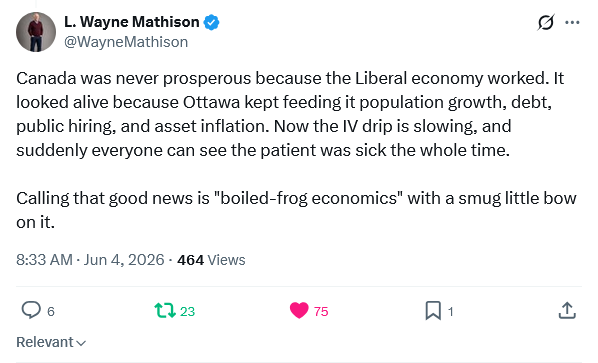
As the propagandists of the mainstream media do everything they can to deflect any hint of blame from their Liberal paymasters, we can still see that things are getting worse, not better:
The federal Liberals are getting fantastic return on their investment … giving our money to the presstitutes of the legacy media in return for kid-glove treatment of the government and attack-dog tactics against the opposition:
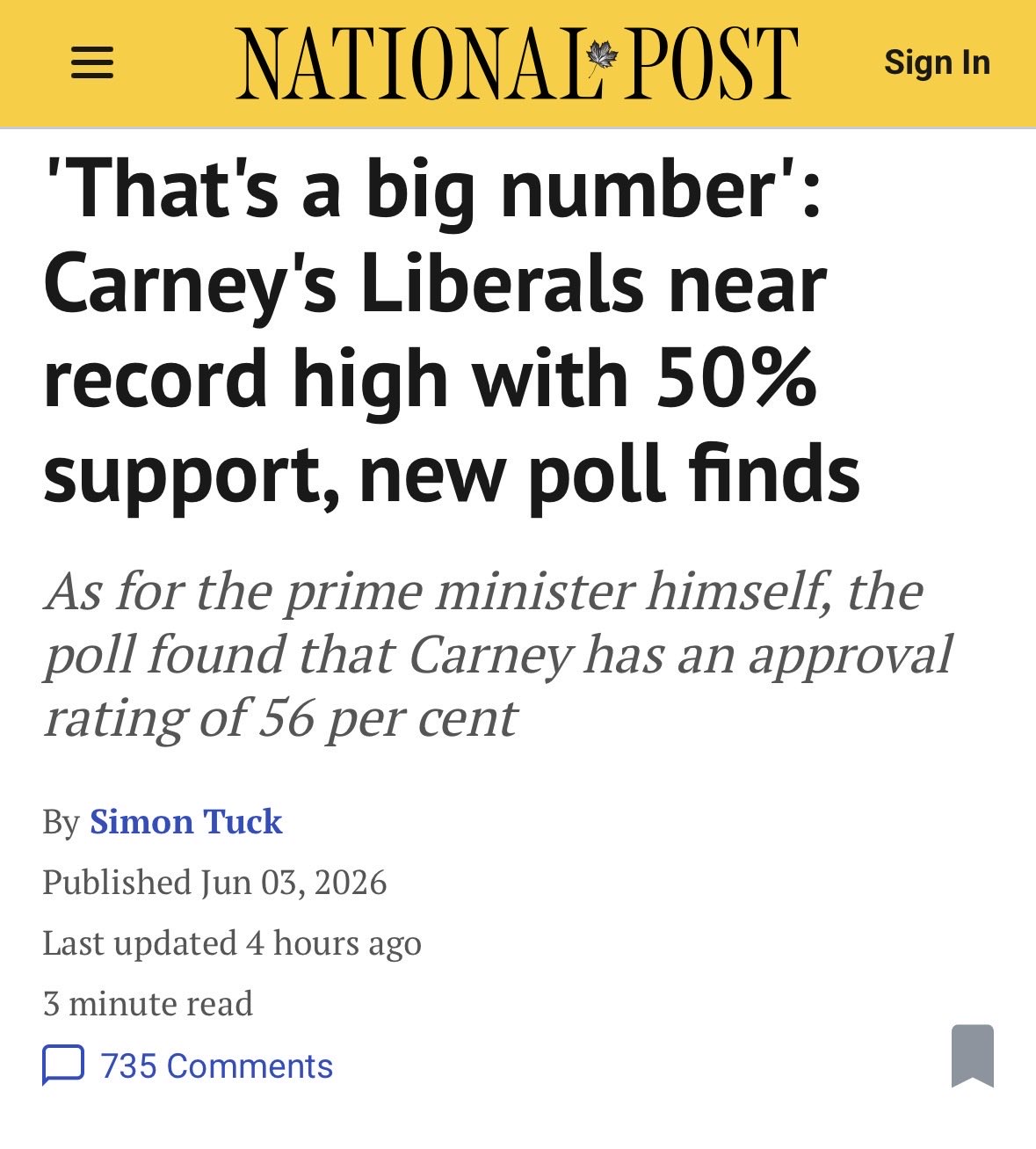
Why Do 50% Still Support Carney? My long-winded response.
That is a question we need to take seriously.
Leger’s latest federal polling has the Liberals at 50% support among decided voters, their highest level in that firm’s tracking since the Liberals first formed government in 2015. Abacus also found the political environment still favourable for Carney and the Liberal government. So this is not imaginary. This is not just CBC fairy dust sprinkled over Ottawa. The support is real. The harder question is whether it is rational.
My answer is simple: many Canadians are not voting for results. They are voting for the illusion of relief.
Even though Carney was in the economic background since 2020 he appeared to arrive after the Trudeau years like a man in a clean suit walking into a room after the dog crapped on the floor. Trump threatened 51st State. Carney looked calm. Unlike Trudeau. He spoke in complete sentences. He had the central banker aura. For exhausted voters, that was enough. They did not examine the wiring. They just saw someone who did not seem to be setting the curtains on fire.
Carney’s appeal is not built mainly on performance. It is built on contrast. Compared with Trudeau’s theatre-kid government of slogans, selfies, and moral lectures, Carney looks serious. But “serious” is not the same as right. A surgeon can look serious while operating on the wrong leg.
Canada’s economy is now weak enough that Carney himself has had to acknowledge ugly economic data. Reuters reported him addressing Canada’s technical recession and warning that some data will be “uneven” “ah ah ah” as the government pushes through policy changes. The Wall Street Journal reported GDP weakness, including two consecutive quarterly contractions, while Carney framed the pain as part of a broader economic rebuild.
That is where the sales pitch gets slippery.
When the economy weakens under Conservatives, it is called failure. When it weakens under Liberals, it becomes “transition”, “restructuring”, or “long-term transformation”. Same corpse, nicer label on the toe tag.
The deeper problem is that Canadians were never really asked whether they wanted Carney’s ideology. They were sold competence, not doctrine. They were sold expertise, not a governing philosophy that puts the state, regulators, climate finance, and elite managerial planning at the centre of national life.
Nobody knocked on doors saying, “Would you like a prime minister who believes markets should be bent around elite-defined social and environmental values?” No. They said, “He is smart. He ran banks. He knows Trump. He will steady things.”
That is not a mandate. That is a branding exercise.
And this is why the Conservative attack has to get sharper. Not louder. Sharper.
Calling voters stupid is a dead end. Many Carney supporters are not stupid. They are terrified of Trump. They are tired. They are anxious. They are looking at housing, debt, food prices, crime, productivity, health care, and a country that feels smaller than it used to, and they want someone who looks like an adult. Carney gives them the visual. He gives them the voice. He gives them the vibe.
But vibes do not build houses. Vibes do not raise productivity. Vibes do not lower debt. Vibes do not attract investment. Vibes do not make young Canadians believe they have a future.
The Carney government’s strongest weapon is not success. It is emotional permission. It lets Liberal voters tell themselves they have moved on from Trudeau without admitting the Liberal machine remains fundamentally intact. Same operating system, cleaner looking wallpaper.
That is why 50% still support him.
They are not endorsing the results. They are postponing the verdict.
Canada does not need a better-spoken manager of decline. It needs a government willing to reverse the policies that caused the decline in the first place.
Because a tight ship headed toward the rocks is still headed toward the rocks.
The Lord of the Flies was just a novel
We often use The Lord of the Flies as a shorthand way to illustrate the darkness in the hearts of men, and that, absent civilizations, men descend into a hellscape of violence, hatred, and all-against-all destructive competition. Yet the real-life case of a group of boys isolated for an extended time didn’t go at all the way the novel did:

More and more I’m learning that the nihilistic claptrap we were all told was genius was just Leftist demoralization propaganda.
Situations like this have occurred, and the children didn’t turn into little monsters. In fact they survived quite well.
In June 1965, six boys named, aged 13 to 16 “borrowed” a fisherman’s boat hoping to reach Fiji or New Zealand. After a storm damaged the sail and rudder, they drifted for eight days surviving on fish and rainwater collected in coconut shells, before washing up on the rocky uninhabited island of ‘Ata.
Rather than descending into chaos during their months there the boys created a mini society. They planted vegetables, collected and stored rainwater, and maintained a permanent fire. They even built a gymnasium with homemade weights, a badminton court, and chicken pens.
They divided daily chores using rosters, resolved conflicts with time-outs instead of fighting, began and ended each day with songs and prayers. One boy, Gilligan’s Isle style, constructed a guitar from driftwood and coconut shell to boost morale. When one of the children broke his leg falling off a cliff the others set it with sticks and leaves and took over his work. They ate fish, coconuts, eggs, wild taro, bananas, and later chickens they had discovered in an ancient volcanic crater.
They endured this for for fifteen months, and never once turned into murderous thugs. A far cry from what we were told would happen.
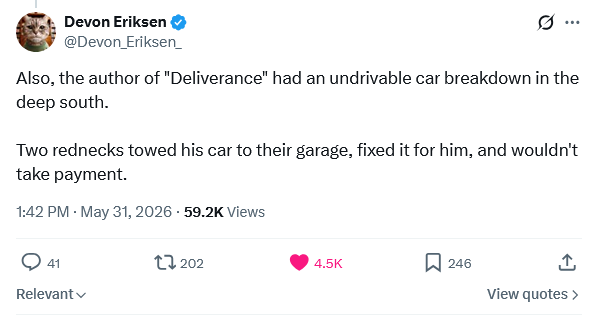
It wasn’t just William Golding manufacturing dark stories, of course:
Comments Off on The Lord of the Flies was just a novel
The First Ever British SLR: Serial Number One L1A1 Explained
Royal Armouries
Published Jan 14, 2026The L1A1 Self-Loading Rifle is one of the most iconic service rifles in British military history and on this week’s episode we have the very first one ever produced.
Next week: an original Royal Small Arms Factory archive film found by our archive team showing how the L1A1 was made.
0:00 Intro
0:46 Serial Number One Explained (UE57 Alpha 1)
1:40 Factory Plaque, Proof Marks & Enfield Details
4:26 Condition, Finish & Standard Configuration
5:17 Distinctive British L1A1 Features
7:08 Controls, Ergonomics & Fire Selector Choices
10:35 Why the L1A1 Won & Closing ThoughtsThis week’s object’s collections online page: https://royalarmouries.org/collection…
(more…)
Comments Off on The First Ever British SLR: Serial Number One L1A1 Explained
QotD: Modern men and the need for male spaces
Internet men believe that some kind of man-space is essential. A place for men to be men, mentor other men, and tell younger men the secret wisdom to get their lives on track. That if only we had these spaces, everything would be great for men because we’d all know the secret wisdom that doesn’t actually exist.
Internet women believe that male spaces are dens of misogyny. Places where trollish men want to gather, away from the eyes and ears of right-thinking people, so they can poison other men with hate and bigotry.
Which is silly. Men don’t hate women because other men told them to. They see women being women, and that does the trick just fine. In fact, if a man is getting hourly blowjobs from every woman whose path he crosses, then some group of troll men try to tell him women suck, he’d be confused at how uninformed these men are when women are clearly awesome.
Women’s behavior is the number-one driver of misogyny. Not men telling other men women suck.
And that’s the point of male spaces. Not secret manly-man wisdom, not chattering about woman-hate. A space where men can just be. Without women there.
Women are … a certain way.
This is especially true of middle-class and richer women, and even a little more true of white women than other kinds. But true of all women to some extent.
Women have this way about them — everything they do, say, everything about how they behave — that just subtly communicates that they do not have a lot of experience with consequences. That they are just not that used to considering consequences seriously before doing something.
I’m usually hesitant to use political buzz-words in a non-ironic way, but I think the term “privileged” is pretty perfect for this situation.
A woman’s reality — her experience — is a world where consequences just aren’t quite as big of a deal for her as they are for others. She’s never really had to consider consequences with quite the same intensity.
It’s important to note that this isn’t some kind of overt, intentional flaunting as women stride around, consequence-free, thumbing their noses at us. Women don’t even know this is a thing. They’ll deny it fiercely if you tell them. They don’t feel privileged, and their feelings are always real. They’ll even tell you that you’re the privileged one, not them. Because that feels right to them.
It’s not something they do on purpose, and it’s not even that frontal and pronounced. It’s very subtle. Just this subtle way that women are. When they talk, act, make decisions.
This makes them very irritating. Even women find each other irritating.
Archwinger, “Male spaces are because women are irritating”, Archwinger’s Substack, 2026-02-25.
Comments Off on QotD: Modern men and the need for male spaces
June 4, 2026
The murder of Henry Nowak and the failure of British policing
Andrew Doyle notes that the very first mention of Henry Nowak’s murder in Spain’s El País (approximately Spain’s equivalent of the Toronto Star, The Guardian, or the New York Times) frames the story as “evil extremely extreme extreme-right-wing Führers pounce”:
While the country is still reeling from the horrific murder of eighteen-year-old student Henry Nowak, an astonishing article has appeared in El País, Spain’s largest national newspaper. Rather than focus on the failures of the police officers, or the institutional bias within the force, the headline steers its readers away from the case and towards the outlet’s own obsessions. The headline translates as “Farage’s far right stirs up hatred in the UK after a young man is stabbed to death by a Sikh man”.
As Alejo Schapire (an Argentine journalist based in France) has pointed out, this is the first and only article produced by El País on the subject of the Nowak killing. Instead of an image of the victim, the newspaper has opted for a photograph of Nigel Farage. The Guardian was similarly histrionic and detached from reality in its coverage: “As ethnonationalist far right drives racist agenda, Reform UK leader felt need to weigh in on murder of Henry Nowak”.
It is one thing to take issue with those who seek to weaponise human tragedies for their own political gain, and quite another to dismiss legitimate criticism of a failed system. Reform UK is by no means a “far right” party, but of course the term has been so promiscuously misused in the press that at this point it might be best to dispense with it altogether. But of course, this is not really about Farage or his response to the murder at all. It is a cynical means of deflecting from the fate of Nowak and what it reveals about the state of policing in the UK.
So what exactly did Farage say to have the Guardian fulminate about his “racist agenda” and for El País to make him the focus of the story rather than the victim? During a live broadcast, Farage praised the Nowak family for their “extraordinarily dignified” response following the conviction of their son’s killer, and went on to say: “I suggest the rest of us respond to this with pure cold rage”.
And why not indeed? Let’s not forget the shocking details of what happened in this case. Nowak was stabbed multiple times by Vickrum Digwa using a Sikh ceremonial dagger. His mother hid the murder weapon, and his brother called 999 claiming that Nowak had been racially abusive. When police arrived, Digwa repeated this lie. And when Nowak repeatedly told the officers he had been stabbed, one replied “I don’t think you have, mate” and handcuffed him as he lay dying.

At Always the Horizon, Copernican shares his thoughts on the political response to the murder:
Riots have been growing over the last few years in the UK when incidents like this occur. Nigel Farage addressed the incident in a youtube video here. Referring it as a “moment to take a long hard look at ourselves and the country that we’ve become”. He proceeds to say, “All the values and standards of living in a free country, where everyone is judged equally before the law, have been trashed and thrown away”. Nigel Farage demands that “the police complaints operation, the IOPC, needs to get to the bottom of this and produce a report very very quickly.” He also states that the sentencing is unacceptable, as the sentencing of the Sikh was less severe than the minimum recommended for a sustained, aggressive, murderous assault.
Nigel knows how to fix this: file some more reports. Maybe even reprimand a judge for being too lenient. That will surely bring back the murdered man, make whole his family, and un-rape and un-murder the children that have been attacked over the years by numerous violent psychos imported from the third world by domestic traitors. What a British solution: file another report about it.
Keir Starmer took another position. He condemned Nigel Farage for “Whipping up” division against the wishes of Nowak’s family. He believes “Nigel Farage’s Reaction” is the “wrong reaction”. We wouldn’t want division at a time like this. What we really need to do is respect the wishes of the cucked cowards whose son was killed and who took no flesh or blood from the offending Sikh as recompense. Who were cowed by government processes and report filing. Those are the people whose feelings we should be worried about. We would hate for the Sikh community to feel threatened.
To be honest, I agree with Keir Starmer. Nigel Farage’s reaction is the wrong reaction
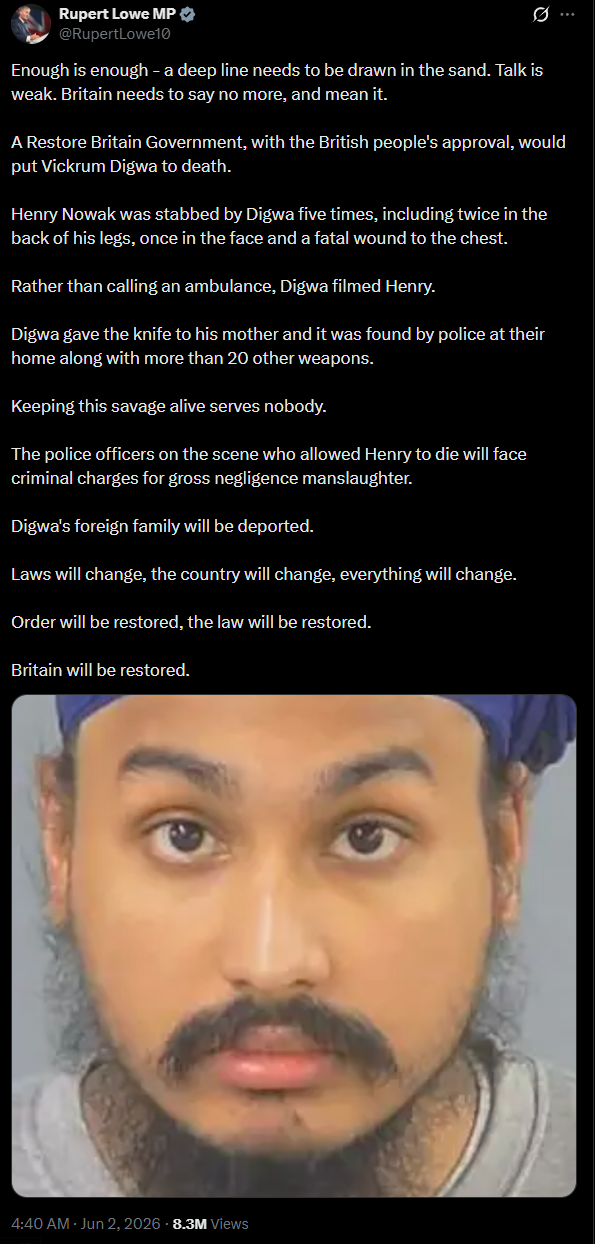
Rupert Lowe, an MP of the “far-right” British Reform party [correction: Lowe is the leader of the Restore Britain party], is getting closer to the correct reaction when it comes to this murderous Sikh, his community, and the managerial bureaucracy that brought them here and protected them.
That said, I think Rupert Lowe is also heavily couching his language for fear of public backlash, or getting arrested for “inflaming racial tensions”.
Update, 5 June: Welcome, Instapundit readers! Have a look around at some of my other posts you may find of interest. I send out a daily summary of posts here through my Substack – https://substack.com/@nicholasrusson that you can subscribe to if you’d like to be informed of new posts in the future.
Bill C-9 is “what happens when the Frankfurt School gets a government badge, a pension, and a corner office in Ottawa”
L. Wayne Mathison explains how the Canadian government persuaded itself to push a “hate speech” bill that will upend centuries of free speech practice and criminalize good-faith arguments. Like many such brainfarts, they cannot imagine what consciously evil people will do with these legal tools in hand:
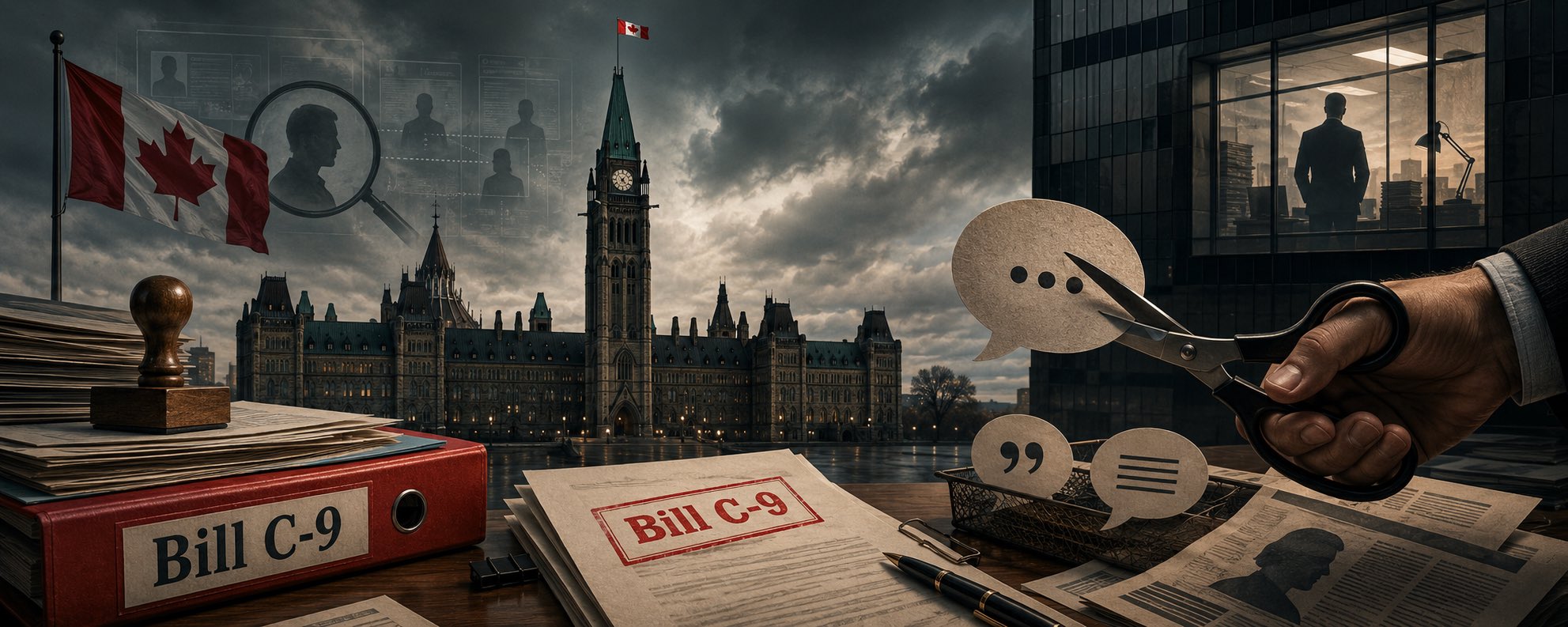
AI-generated image by L. Wayne Mathison
If you want to see what happens when the Frankfurt School gets a government badge, a pension, and a corner office in Ottawa, look at Bill C-9.
This is not just another “hate speech” bill. It is a sign of a much bigger shift.
The old political arguments were about wages, factories, class, ownership, and the economy. That was the old Marxist world. Today’s politics is about language, symbols, identity, emotion, culture, and who gets to decide what “harm” means.
Parliament has stopped arguing about who owns the factory.
Now it wants to control the dictionary.
Bill C-9 reads like a critical theory seminar that escaped campus, found a suit, and got hired by the Department of Justice.
Under the older liberal model, the law punished actions. Assault someone? Crime. Vandalize property? Crime. Block access to a building? Crime. The state dealt with what you actually did.
But C-9 moves the centre of gravity from action to meaning.
What did your words mean?
What did your symbol represent?
What was your motive?
What cultural message did your expression create?
That is not law as a neutral referee. That is law as a cultural therapist with police powers.
The most revealing part is the proposed removal of the long-standing “good faith” religious defence for hate propaganda. That defence existed for a reason. It protected freedom of conscience. It recognized that in a free country, people may express religious beliefs that others find offensive, outdated, or wrong, as long as they are not wilfully promoting hatred or violence.
That was not a loophole.
It was a guardrail.
But to the modern ideological mind, an ancient religious text is not treated as a source of conscience. It is treated as an artifact of power. A legal protection for religious speech is no longer seen as freedom. It is seen as oppression wearing a church hat.
So the guardrail has to go.
And what does government offer instead?
Trust us.
Trust that prosecutors will be reasonable. Trust that judges will interpret the law narrowly. Trust that ordinary Canadians will not get dragged through the process for saying something unpopular, traditional, religious, or politically unfashionable.
Sorry, but that is not how liberty works.
Rights are not protected by hoping the state behaves itself. Rights are protected by limiting what the state is allowed to do in the first place.
That is what makes the Senate debate so revealing. The Senate was supposed to be sober second thought. The old establishment airbag. The place where bad laws were supposed to slow down before hitting the public at full speed.
But now even the Senate is wrestling with a bill built from an intellectual toolkit designed to dismantle the very traditions the Senate was created to preserve.
Bill C-9 does not build social cohesion. It does not repair trust. It does not ask why people are angry, alienated, or radicalized in the first place.
It does what modern bureaucratic progressivism always does.
It manages symptoms by expanding state power.
It turns culture into a compliance file. It treats offensive expression less like a social problem to be answered with argument, courage, and moral confidence, and more like a hazardous substance to be regulated by experts.
The Frankfurt School wrote in dense, foggy jargon to expose hidden systems of power.
The joke is on everyone.
The modern state did not reject those tools. It absorbed them, stripped out the revolutionary romance, bolted them onto the Criminal Code, and called it public safety.
Bill C-9 is what happens when cultural theory becomes administrative power.
It is what happens when the state stops protecting public order and starts managing public meaning.
And that should worry anyone who still thinks freedom means more than government-approved speech.
Comments Off on Bill C-9 is “what happens when the Frankfurt School gets a government badge, a pension, and a corner office in Ottawa”
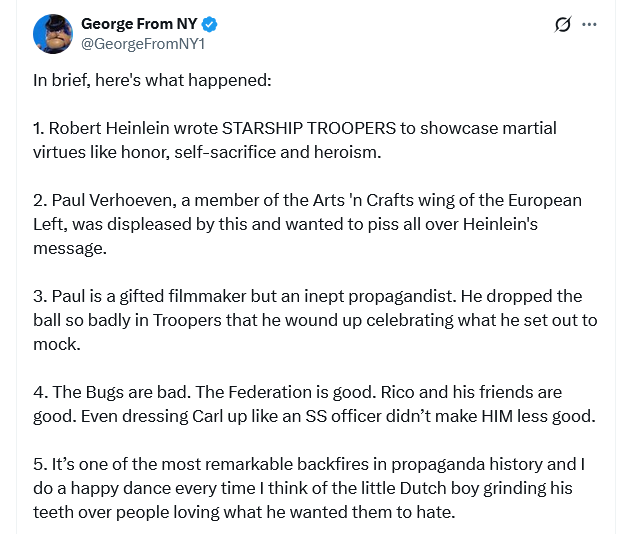
“It’s called Starship Troopers, not The Big War with the Bugs“
On the social media site formerly known as Twitter, Devon Eriksen explains why filmgoers still identify with the humans in Verhoeven’s unfaithful-to-the-story film of Robert A. Heinlein’s Starship Troopers:
Here’s a hint:
It’s called Starship Troopers. Not The Big War with the Bugs.
There’s a reason for that. Heinlein was one of the 20th century’s greatest authors, if not THE greatest, and he was also the 20th century’s greatest philosopher and it’s not even close.
So he didn’t name things by accident.
Starship Troopers isn’t about the war. It isn’t even about war. And it’s certainly not about the fucking bugs.
All that shit is just stage dressing for the story is really about. That’s why the book doesn’t end with defeating the enemy. It ends with Rico meeting his father again, facing future fights together.
Starship Troopers is about the military life, the relationship between armies and the civilizations they serve, and what it means to be a soldier and a man.
Eurotrash communists failed to get the point, not merely because they have the “media literacy” of a sack of wet hammers, but also because they don’t understand soldiering, civilization, or manhood.
So, yes, Verhoeven tried to make fun of Heinlein and failed miserably because Heinlein was a better storyteller, a better man, and a better human being by a margin so great that the Earth can barely encompass it.
But even though his failed satire makes humanity clearly the good guys, the war clearly righteous, and soldiers clearly cool and heroic, it still doesn’t recapture the actual meaning of Starship Troopers.
Because the real themes were so invisible, so incomprehensible, to Verhoeven that he couldn’t even see them to disagree with.
So enjoy the film for what it turned out to be … a fun, campy, morally unambiguous story of heroes squashing disgusting bugs. Suitable for popcorn consumption.
Then, read more Heinlein.

Update, 6 June: Welcome, Instapundit readers! Have a look around at some of my other posts you may find of interest. I send out a daily summary of posts here through my Substack – https://substack.com/@nicholasrusson that you can subscribe to if you’d like to be informed of new posts in the future.
Sci-Fi and the WWII Mythos Part II : The Political Element
Feral Historian
Published 16 Jan 2026Last time I was focused on cultural aspects, but what about the direct political manifestations today? Is there a resurgence of neo-nazi attitudes or is just an artifact of the ubiquity of digital media preserving everything? Why might those ideas resonate with the young, and how does it fit with my argument that the old myths are breaking down?
00:00 Intro
01:42 Right, Left, and Gen-Z
02:56 Patterns of Force
04:25 Rambling about Economics
05:48 Efficient? No.
06:39 Bifurcation
08:00 Loss of PerspectiveThis one is a direct result of a conversation on the Talking History program on KSMU (I’ll link the episode when goes up) and covers something that came up but wasn’t really addressed well.
(more…)
Comments Off on Sci-Fi and the WWII Mythos Part II : The Political Element
QotD: Demographic decline in the late western Roman Empire
It’s a plausible theory and the only problem with it is that it doesn’t appear to have actually happened.
Here the key archaeological method is what is called “field survey“. While readers are probably more familiar with the intensive excavation work done at famous sites like Pompeii or Vindolanda, one tool archaeologists have to study the past is to survey large areas, sometimes by air, sometimes by on foot, sometimes with ground penetrating radar, in an effort to map out larger scale settlement patterns in the past than would be possible by labor-intensive single-site excavation work. Dateable remains (pottery most often) allow for archaeologists to get a rough sense of the dates in which sites were inhabited and in some cases building remains and the like can give some sense of what kind of settlement was present. The “error-bars” on some of this data can of course be large, but they offer a tool for tracking long-term changes in land use patterns. On the flip side, these sorts of studies really become valuable only when you have a lot of them to create a robust data-set over a fairly large area that lets you adjust for purely local patterns and distortions. Fortunately in much of the former Western Roman Empire and especially in Roman Italy (where these studies are very important for the study of Roman demography and agriculture) we’ve hit the tipping point where there is enough archaeological data to begin reaching for conclusions.
Now there is an immediate difficulty with using this kind of evidence, which is that for reasons we’ll get to in a moment (though they are reasons that tend to also be bad for the “change and continuity” argument), we have a major confounding variable here: site visibility. Our ability to see a site, archaeologically, is heavily dependent on factors like building material and the quantity of imperishable goods (especially pottery) that people are using. For reasons we’ll get to, compared to, say, second century AD communities, sixth century AD communities tended to build their buildings in far more perishable (and thus less visible) materials (like wood) and also tended to use a lot less imperishable household goods. Consequently, it is substantially harder to see a sixth century village than it is to see a second century villa.
Nevertheless, the decline is so marked and so consistent as to strongly suggest there is something real here. R.P. Duncan Jones (in “Economic Change and the Transition to Late Antiquity” in Swain and Edwards (eds) Approaching Late Antiquity (2006)) assembles some of the site data from around the empire; there is unsurprisingly a lot of regional variation (with some regions, like Syria, actually moving against trend), but in the western Empire (except N. Africa; decline there comes later) the trend is fairly clear, with site numbers declining (often drastically by half or more) beginning in the late third or fourth centuries. Bryan Ward-Perkins in The Fall of Rome notes a field study outside of Rome in which the number of sites declines by three quarters. Site data accumulated like this isn’t often very chronologically precise, so we’re dealing with centuries, not decades, but the clear trend suggests rural population decline, not an urban population ruralizing. To be visible to us in this way, the decline must have been quite severe.
To give a sense of the scale of the decline, here is an abbreviated version of a chart from Bruce Friar’s “Demography” chapter in the second edition of the Cambridge Ancient History, which breaks down the estimated population of the Roman Empire by region and adds the dates when each of those regions got back to their Roman-era population:
Chart from Frier, “Demography” CAH2 XI (2000), 814. Some of these figures would likely see some revision today, mostly downward revisions of growth combined with upward revisions in population reflecting a somewhat (but generally not massively) higher estimated pre-Roman population.
Note that the decline in the East was, as noted last time, both later and generally slower. The reason for the later times to reattain Roman population here in many cases is that the major medieval Islamic population centers were further East (e.g. Baghdad under the Abbasids) placing them outside the traditional bounds of the Roman Empire, but also that the Roman East was much more urbanized and densely populated compared to its land area than the Roman West in the second century (or at any time during the Roman Period) so the “population to attain” bar on the East was much higher. After all, the cities of places like Syria or Egypt were in many cases centuries or even millennia old when the Romans showed up.Now the long times there to regain the Roman population can be a bit deceiving (and are very approximate). For reasons we’ll get into shortly, population growth from 600 to 900 or so in Europe was very low, so the issue here isn’t that the decline was so steep that it took many centuries to recover from, but rather that the decline was from a high population equilibrium to a low population equilibrium, both of which were, under their own conditions, stable (if that is confusing, don’t worry, we’ll delve more into it in a moment). Second, the apparent gap between places that “caught up” before 1300 and those that “caught up” after it is smaller than it looks, because of course the mid-1300s represent a massive population discontinuity over the entire broader Mediterranean world due to the Black Death such that a lot of those places “catching up” in the 1200s probably fell behind again due to the plague and then caught up again in the 1400s or early 1500s.
But this now raises two related questions: first, why did population decline so sharply and second, what was the impact on quality of life that resulted? The old answer to the first question was of course “the barbarians killed everyone” but as we’ve seen, while the fifth century was a violent time, the violent discontinuities were not that extreme. Surely the violence of the period has something to do with some of this declining population, but as noted, the underlying population (with their language and religion) didn’t much change (and the raw number of “barbarians” coming over the frontier was, in demographic terms, fairly small). Most of those Roman cities decayed, rather than being burned. But if the “barbarians” didn’t kill everyone, what did and why did that somehow have a negative impact on the survivors? The answers to these two questions are actually linked in that they depend on the same evidence, so that is where we will go next.
Bret Devereaux, “Collections: Rome: Decline and Fall? Part III: Things”, A Collection of Unmitigated Pedantry, 2022-02-11.

Comments Off on QotD: Demographic decline in the late western Roman Empire
June 3, 2026
China’s pirate fishing fleets
John Carter was really impressed with a recent self-published novel by Frank Kidd, and takes the time to set up the real-life situation the novel imagines being kinetically addressed:
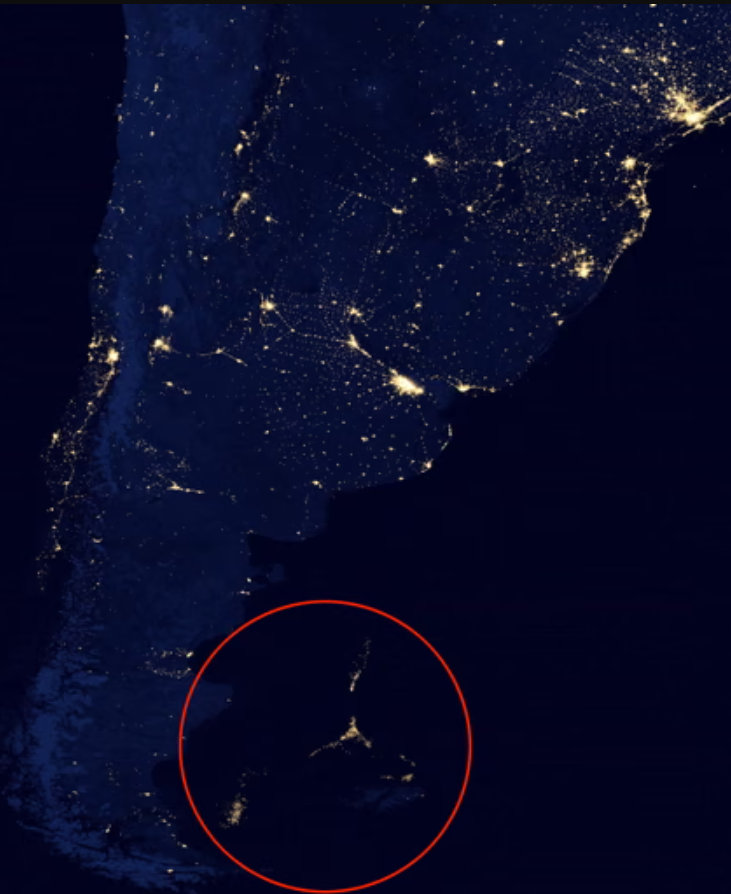
A few years ago a photograph taken by a pilot over the Pacific went viral. It showed a mysterious red glow spreading ominously out over the water.
Initially people thought it was aliens, and to be fair, they weren’t far off. The glow belonged to the closest thing humanity has yet invented to a Tyranid hive fleet: a Chinese fishing fleet raping the seas in search of seafood. The glow is from huge banks of LEDs, which the ships use to draw marine life to the surface, where they trawl it up with nets. Much, maybe even most of the indiscriminate catch is discarded.
China has over half a million fishing vessels. Their vast fleets comprise thousands of ships, and can often be seen from orbit.
The triangular lights inside the red circle are a Chinese fishing fleet.
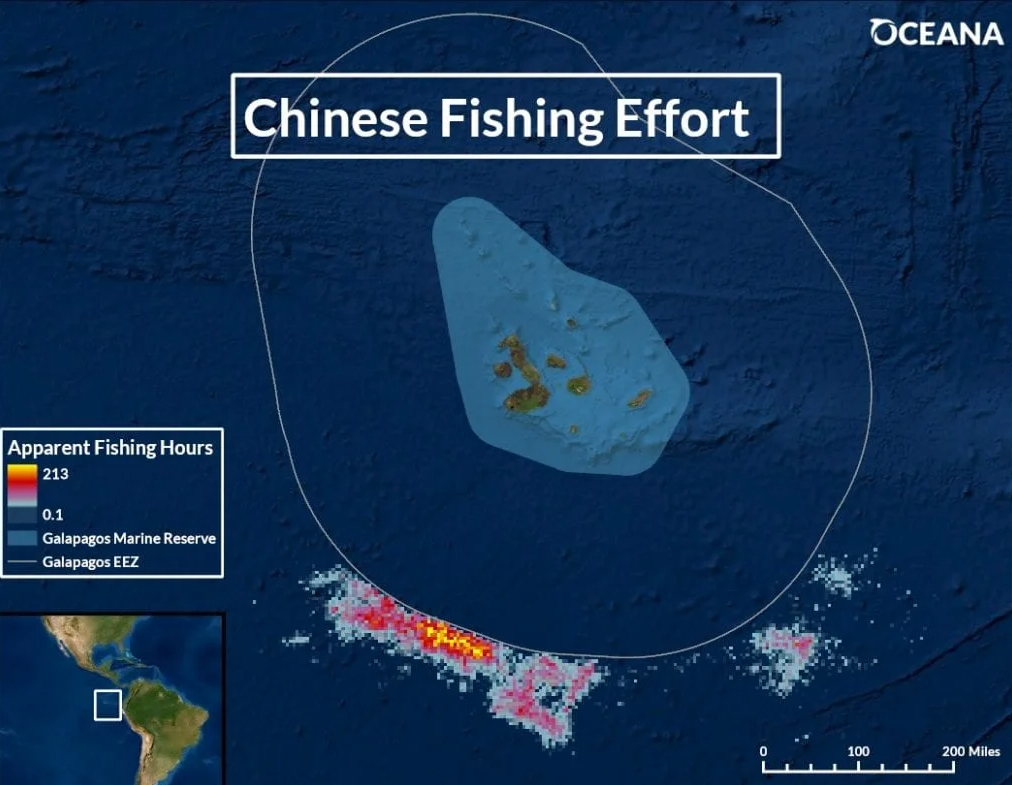
China has long since eaten its way through its own territorial waters, and therefore sends its fleets out into the rest of the world’s oceans. As a rule marine life is much more abundant close to the shore, since this is where most of the nutrients are. Fishing in another country’s territorial waters is illegal under international law. The Chinese do not care. Their fleets park just on the edge of a country’s Economic Exclusion Zone, and then turn off their Automatic Identification System transponders so that they can sneak inside and poach. Turning off an AIS transponder is also illegal: maritime law requires these to be activated at all times, for collision avoidance and search and rescue. Organizations which track this regularly observe Chinese ships on EEZ borders disappearing from the AIS network, and reappearing a few hours later on the right side of the border.
Here we see the scum pillaging the ocean around the Galapagos. Yeah. I know. Billions must die.
The consequences for local fishermen are disastrous: the Chinese scoop up all the fish, and lead the local fisheries towards ecosystem collapse. When they’re done pillaging they just move on, leaving an oceanic wasteland in their wake.
Environmental groups generally don’t seem very bothered about this, perhaps because the ocean is a CO2 sink whether or not there are fish in it, and the only thing that matters about the environment is how much carbon is in the air. National governments are reluctant to take action, because they are often dependent upon Chinese investment for their economic growth. The only people who really seem to care are fishermen and Internet racists.
This is the set-up for Frank Kidd‘s immensely satisfying debut mercenary novel, Once Upon A Time In Argentina.


Comments Off on China’s pirate fishing fleets
“… basically it’s a plan to make power more expensive while campaigning on affordability”
John Robson examines a few of the ways the Ontario government (and other provincial and state governments) frames what they call “affordability”, yet somehow it always seems to cost more afterwards and nobody is ever held responsible:
In many areas of life, the devil is famously in the details. And it presents both an opportunity and a frustration because there is so much out there deserving readers’ attention that you can’t even follow it all let alone cram it into a newsletter. Including former banking executive Parker Gallant‘s vigilance about the absurdities of the power system in the Canadian province of Ontario that the aspiring Conservative premier Doug Ford promised to fix in the 2018 campaign and then has smugly done nothing about. These things might seem uninteresting if you do not live in Ontario … until you realize it’s just as bad wherever you live. And when we say bad we mean both the cost and the deviousness with which it is presented to, or hidden from, the public. On this very point we like to quote the late great P.J. O’Rourke that “Beyond a certain point complexity is fraud … when someone creates a system in which you can’t tell whether or not you’re being fooled, you’re being fooled.” Which brings us to the shiny new buzzword “affordability” which refers to policies that make everything more expensive and the beneficiaries hide the fraud in tangles of complex bureaucracy.
If you want to get a headache, stay with us while we explain what it is that Gallant tracks. Ontario has what they call the “Independent Electricity System Operator” so politicians can claim whatever disaster is unfolding isn’t their fault. Sure, they make the laws and oversee the creation of the regulations. But heck, these things are “arms’ length” and “impartial” and independent and expert and wise and wonderful so shut up.
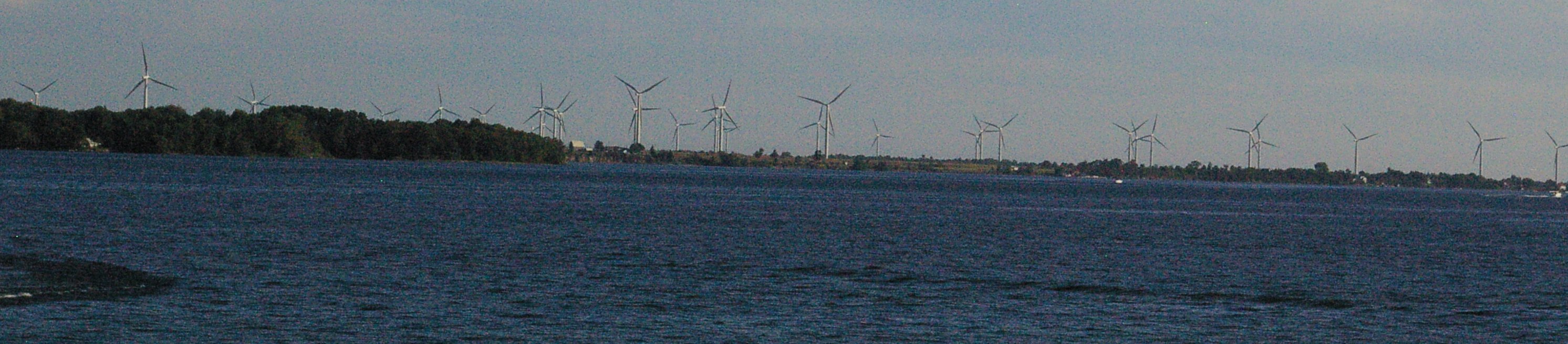
Including this nutty system where the province buys power we don’t need at grossly inflated rates from wind and solar virtue-signallers and then sells the surplus at deep losses to the neighbouring province of Quebec and some American states including New York and Michigan. So he looked in depth (we promised a headache) at just half a day, May 19, 2026, because a post by another of the people who keeps an eye on this stuff for the benefit of an indifferent or baffled populace alerted him to something fishy in the IESO forecast of generation by Industrial Wind Turbine operators. But it seems to be hard to find out exactly how much the taxpayers, via this wonderful “Independent” system with its hand in their pockets via the arm of the state, actually paid these IWTs not to produce power.
Paid them what? Yup. It’s how it works. And the idea is that if they didn’t produce the original forecast rather than the revised one we’d have had to pay them even more for what they didn’t do. Weird even by the standards of government. And expensive. As Gallant sums it up:
The net result is that those IWT cost us Ontario ratepayers almost $2.6 million for NOTHING over just the first 12 hours but we should rest assured the IWT owners loved it!
You read that right. The citizens of Ontario paid $2.6 million to the energy producers of the future not to produce energy in the present in just half of one day. If it were typical, it would be over $5 million a day times 365 days in the year so yes indeedy folks nearly $2 billion a year.
[…]
He then looks at various efforts to try to figure out the cost to consumers, including one by “my friend Roger Caiazza (the Pragmatic Environmentalist of New York)” based on the auction price of “allowances” in March 2025:
Roger’s conclusion at that time was that the RGGI auctions were adding about $8-11/MWh to the wholesale cost of electricity, for electricity produced by natural gas. That would mean an addition of about 1 cent/kWh on a consumer’s bill. A penny may not seem like much, except when you realize that the average price in the country is less than 18 cents/kWh, so the penny is about 6%.
Imagine if people knew. As he concludes:
remember that the structure of the program is that the amount of allowances goes down every year and the price is intentionally driven up. And data centers are going in all over the place. And the Northeastern states have refused to build new power plants for a couple of decades now in the midst of the climate hysteria. So the 10-15% extra cost being experienced now is only the beginning of much worse to come. The worst part of the RGGI ‘cap and invest’ scheme is that the consumers get absolutely nothing for the increased cost. It is just a gratuitously inflicted injury brought about by completely artificial scarcity. Keep this in mid when you hear a politician from an RGGI state talking about how they care about energy ‘affordability’.
Or, we add, transparency. Or accountability.
Comments Off on “… basically it’s a plan to make power more expensive while campaigning on affordability”
The Korean War Week 102 – American Bioweapons on Korean Soil? – June 2, 1952
The Korean War by Indy Neidell
Published 2 Jun 2026The Chinese continue their campaign of accusing the US of practicing germ warfare in North Korea and Manchuria. Meanwhile in South Korea, Syngman Rhee has declared martial law in Pusan as part of his campaign to remain in power.
00:00 Intro
00:50 Recap
01:23 Germ Warfare Charges
11:17 Bull Boatner
15:34 Holding POWs
17:58 Summary
18:13 Conclusion
19:21 Call to Action
Comments Off on The Korean War Week 102 – American Bioweapons on Korean Soil? – June 2, 1952


