
Feral Historian
Published 23 Jan 2026Elysium is one of those films I like more for the world it presents than the story it tells. It’s a tale of two worlds, a wealthy break-away civilization in orbit and a slowly dying civilization on Earth. On the surface it’s simplistic, preachy even, but underneath it posits some important questions both by what it tries to do and what it doesn’t even attempt to address.
00:00 Intro
01:18 Healing Magic and Healthcare Access
03:22 Overpopulation and Automation
04:18 Technology in Layers
07:50 Easy Answers to Hard Problems🔹 Patreon | patreon.com/FeralHistorian
🔹 Ko-Fi | ko-fi.com/feralhistorian
🔹 and Merch! | feral-shop.fourthwall.com
Ninti’s Gate – the prologue to Stellar Drift, coming later this year.
🔹 amazon.com/dp/B0CYXH9BWD
June 15, 2026
Elysium: Greed and the Crab Trap
QotD: “… shall not be infringed”
The United States Constitution is the highest law of the land. Its Amendments, it therefore follows, are the highest of the high. Read the Second Amendment for yourself. It forbids the government from infringing on the individual right to own and carry weapons. Now look up the word “infringe” in a decent dictionary. Not a single federal, state, or local gun law of any kind, from 1917 until today, is Constitutional.
L. Neil Smith, “Ballistic Exceptionalism”, Libertarian Enterprise, 2020-09-20.
June 14, 2026
The “Dissolution of the Universities” draws ever closer
On the social media site formerly known as Twitter, Steve McGuire reacts to more news about the conscious dumbing-down of modern university programs:
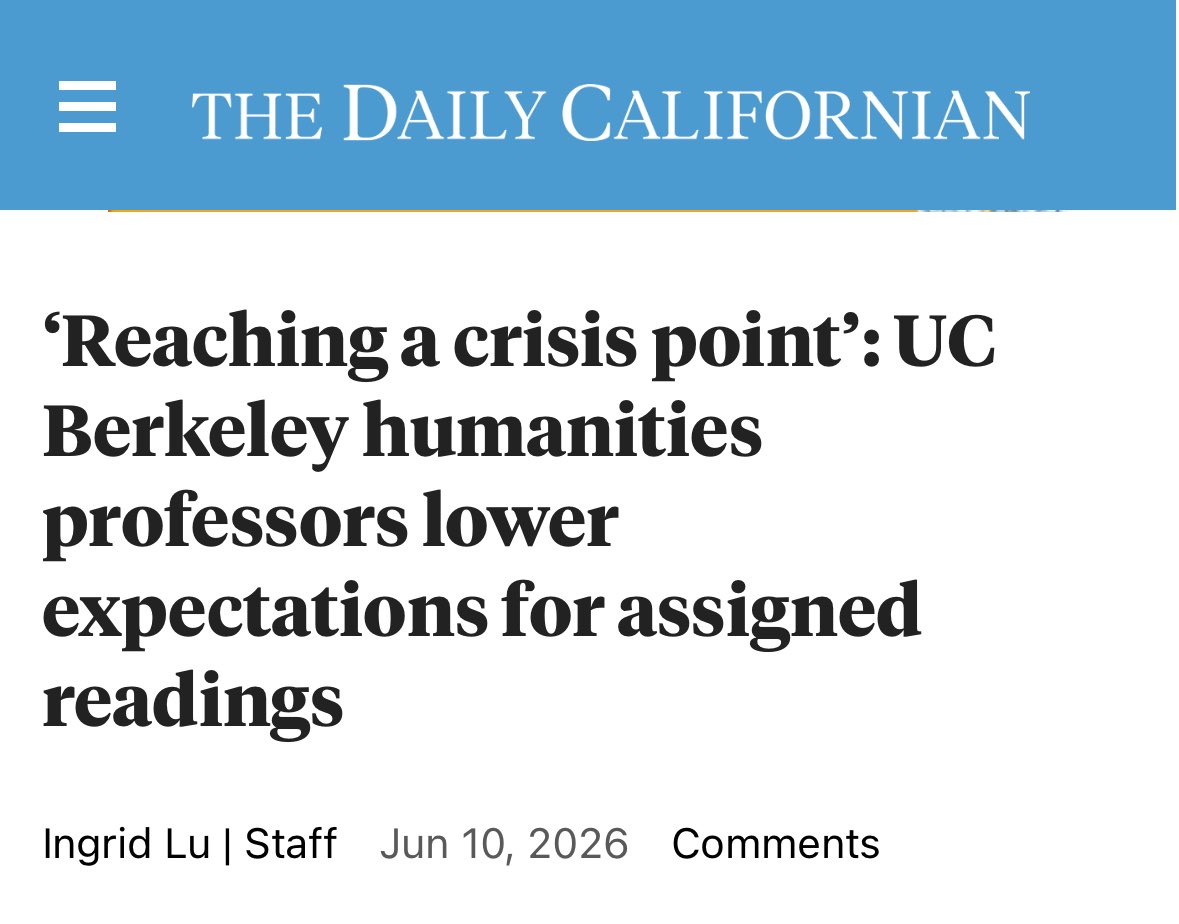
A Berkeley history professor said he’s gone from assigning 100 pages of reading per week to 35.
Another “said the earliest version of the … course he taught required seven full books, while his most recent iteration exclusively consisted of excerpts”.
“We are now reaching a crisis point where if the number (of pages) goes down further, it’s unclear to me whether my discipline of history can really be taught”, the first one said.
To which John Carter responds:
The academic death spiral is something to behold.
Demographics are steadily reducing the size of the student body, squeezing finances and driving bankruptcies.
At the same time, standards collapse is destroying the quality of the students the universities admit.
We’re already at the point where it’s common knowledge that a degree signals essentially nothing about intellectual ability. AI is exacerbating this, since cheating is so easy now.
Kids are already starting to forgo university, since they don’t think the cost of the credential is justified. That cuts even more deeply into the number of students universities can attract.
Universities respond by reducing standards even further (thereby accelerating brand destruction), by reducing tuition (which cuts even more deeply into budgets), and by firing professors in low-enrollment majors (reducing program variety, especially in the small seminars that are generally the most rewarding experiences for students).
[…]
“How can this be reversed?”
It can’t. There are pathways for individual institutions to revive themselves, even to prosper, but the sector as a whole is cooked. The death spiral is driven by prestige collapse as well as the demographic cliff, and intellectual prestige is inversely correlated to the size of the student body. More students means lower standards. That is especially true with a demographic cliff.
The only way to survive this crisis is ruthless elitism. Stop trying to edutain the fat middle of the bell curve, and refocus on the right tail. Become a place where the smartest people gather, and from which anyone who isn’t a 2-sigma outlier is excluded. This makes the school an arena in which intellectual iron can sharpen against iron. Elitism restored, prestige follows.
Next, eliminate the 500 person intro lectures. Admin loves these, since the high student:teacher ratio makes them cash cows. But they’re functionally no better than watching YouTube videos. Refocus on small seminars. This offers value that the Internet can’t.
Schools that take this path will restore or build reputations that will enable them to survive. However, they won’t be large. There is no future in which huge institutions keep tens of thousands of professors and administrators on payroll.
Update, 15 June: Welcome, Instapundit readers! Have a look around at some of my other posts you may find of interest. I send out a daily summary of posts here through my Substack – https://substack.com/@nicholasrusson that you can subscribe to if you’d like to be informed of new posts in the future.
How to Make Dissent Disappear – Death of Democracy 19 – Q3 1937
World War Two and Spartacus Olsson
Published 13 Jun 2026In 1937, Nazi Germany moved from controlling politics to controlling thought itself. Churches, artists, workers, and dissenters all came under attack.
Berlin, September 1937. From the outside, Germany can seem strangely quiet while the rest of the world slides deeper into war, civil conflict, and authoritarianism. But inside the Reich, the Nazi state is tightening its grip on the last spaces where dissent can still exist.
This quarter, the Gestapo arrests Pastor Martin Niemöller and intensifies the attack on the Confessing Church. The regime opens the House of German Art in Munich, then stages the infamous “Degenerate Art” exhibition to mock, vilify, and destroy modernist culture. The SS establishes Buchenwald near Weimar, forcing prisoners to build their own prison. Meanwhile, Göring’s new state industrial empire and the Nuremberg “Rally of Work” reveal a society being reorganized for war.
This is Step 19 in the death of democracy: when the authoritarian state stops merely silencing opposition and begins fighting the inner freedom to believe, imagine, worship, create, and think.
“99% of Canadians are decent, law-abiding people”
John Konrad explains why, despite agreeing that the vast majority of Canadians are “decent, law-abiding people”, he wants to see the US/Canadian border closed:
Yes. 99% of Canadians are decent, law-abiding people. Friendly neighbors. Good trading partners. Nobody serious disputes that.
I DO NOT CARE
CLOSE THE BORDER
Public safety is not built around the 99%.
We do not have laws, police, and prisons because most people are good. We have them because a small minority can inflict enormous harm on everyone else.
The argument for border enforcement is not that Canadians are bad people. It is that even a small failure rate matters when the consequences are catastrophic.
Free and open borders are a wonderful thing provided both countries are willing and able to identify, remove, and deter the small percentage of dangerous actors who exploit them.
If one side stops filtering effectively, the burden shifts to the other.
And yes, that creates unfairness. When enforcement breaks down, restrictions fall hardest on the innocent majority: families, commuters, truckers, tourists, and businesses. No one should pretend otherwise.
But there is also unfairness in asking another country to absorb preventable risks because difficult enforcement has become politically inconvenient.
A secure border is not an insult to a neighboring nation. It is a hedge against failure.
That is their sovereign choice.
But the United States also has a sovereign responsibility: to reduce risks to its own citizens.
If a partner cannot or will not reliably filter threats, then verification at the border becomes the default. Not because the majority deserves punishment, but because governments exist to manage tail risk, not assume it away.
Open borders require mutual trust.
Trust requires performance.
But the real threat is not the 1% of evil bad actors. The real threat is the 1% of far left lunatics in your government who are facilitating and funding the 1% of criminals.
YOU. The ninety nine percent are the only ones who can demand election reform. YOU are the only check left on their power.
So I absolutely endorse punishing YOU as incentive to demand change now.
A full and total stop of VISAs, temporary and permanent, will cause real stress to your economy, it will make international and domestic travel more difficult, will unfairly hurt Canadians studying in USA, it will hurt many Americans too.
But it’s worth temporary extreme pain is a small price to pay for long term stability.
You are a frog slowly boiling in water. We have asked you to jump out of them pot but you refuse. You just croak “elbows up”
So our choice as Americans is to watch you die slowly or remove you from the pot and chop a leg off so you don’t jump back in.
I believe the latter is the only option. And I believe it’s the lore humane option knowing that the leg will grow back just fine.

Mauser M80SA: Actually a High Power and Actually Hungarian
Forgotten Weapons
Published 21 Jan 2026In the 1980s, the Mauser company was completely adrift, without any real plans or goals or good leadership. They had been trying to get by on relaunched old designs, and not been very successful. By the late 80s they move on to just buying guns from other companies (like Renato Gamba) and relabelling them as Mauser. One of these partnerships was with FEG in Hungary.
In 1990, Mauser contracted with FEG to buy Browning High Power copies. FEG had actually licensed the high Power design from FN back in the 1970s, and was already tooled up for production, so they just added a Mauser roll mark and called the gun the M80. It was a straight copy of the High Power, except for the omission of the magazine safety. Production ran from 1990 until 1995, with only 3,200 made. The gun did not sell well, which should [not] be very surprising — this was a very outdated design by the 1990s and the Mauser name just wasn’t worth much as a value-add.
(more…)
QotD: Some of H.G. Wells’ more awkward views
This was, of course, before the genocidal policies of the Nazis were implemented, and while many of these grand men and women of the left had died before the camps were liberated and the horrors known, others certainly lived on. Some were contrite, others not. Either way, it hardly forgives them their ideology and influence – naiveté and ignorance simply isn’t a viable defence in such circumstances.
Michael Coren, “Eugenics and the intellectual left”, The Critic, 2020-09-16.
Update, 15 June: Welcome, Instapundit readers! Have a look around at some of my other posts you may find of interest. I send out a daily summary of posts here through my Substack – https://substack.com/@nicholasrusson that you can subscribe to if you’d like to be informed of new posts in the future.
June 13, 2026
The intellectual dangers of “nostalgia economics”
Mani Basharzad explains that although resurgent socialist beliefs are a bad sign, there’s actually a worse danger to modern economies that isn’t a coherent ideology but all the more potent because of it:
Custom image by FEE
If someone asked me what the most dangerous economic ideology is, many would expect an Austrian to give a typical answer: Marxism, socialism, or Modern Monetary Theory. Yet I believe there is another way of thinking that is even more pervasive. It is not a coherent body of ideas like those ideologies. Rather, it is a sentiment so widespread and socially accepted that it threatens not merely economic freedom, but our very understanding of progress itself. I call it “nostalgia economics”.
Recently, the singer Sting suggested that the rise of toxic masculinity is partly the result of the “loss of manual jobs”, claiming that because many men no longer use their hands and physical strength in their daily work, unhealthy masculine traits are on the rise. Like many commentators on the political left, he also blamed Margaret Thatcher for Britain’s economic transformation. “Britain’s wealth was created in the coalfields and the steel towns and the mill towns and the shipyards”, Sting said. “All of those skill sets were thrown on the scrapheap … for Thatcher’s dream of a service economy.”
This is nostalgia economics in action. A global celebrity whose music can be streamed instantly on another continent, who earns income through digital platforms, and whose career depends on modern communications and services, criticizes the very service economy that makes his success possible.
A person in thrall to nostalgia economics will take the blessings of progress for granted while romanticizing a past that never truly existed. Imagine living in the world of Charles Dickens: you would not have had access to a typewriter for much of your life, if at all, since it was only commercialized in the late 19th century. More importantly, you would not have had access to electricity. The conveniences we now consider basic would have been unimaginable luxuries.
The economic historian Norman Stone illustrated the extraordinary pace of modern progress through the experience of the novelist Henry James:
In 1895 the novelist Henry James acquired electric lighting; in 1896 he rode a bicycle; in 1897 he wrote on a typewriter; in 1898 he saw a cinematograph. Within very few years, he could have had a Freudian analysis, travelled in an aircraft, understood the principles of the jet-engine or even of space-travel.
Had Sting been alive in 1890, a world tour would have looked very different. A journey from London to New York would have taken more than a week rather than a few hours. International audiences, instant communication, and global entertainment markets would have been beyond imagination.
The glorification of manual labor is one of the most overrated ideas in modern political discourse. This tendency is not confined to the left. Ambitions to revive manufacturing employment through government policy often draw on the same nostalgic impulse. But what exactly are we trying to return to?
Perhaps literature offers a more honest answer than politics. Oscar Wilde observed that “all unintellectual labour, all monotonous, dull labour” involved unpleasant conditions. He went even further, commenting that “there is nothing necessarily dignified about manual labour at all, and most of it is absolutely degrading”.
The reality of industrial labor was far harsher than many modern observers imagine. In Britain, workplace fatalities have fallen dramatically over the last century: fatal injuries to employees dropped from around 4,400 a year early in the 20th century to around 200 a year by the end of the century. Coal mining, one of the occupations most frequently romanticized today and the first industry Sting evoked, exposed workers to constant danger and disease. Throughout the 1950s and 1960s, coal workers’ pneumoconiosis (“black lung”) claimed well over a thousand lives annually. What would a laborer enduring dangerous conditions, long hours, and chronic health risks have given for an air-conditioned office job?
One thing Sting did identify is that men generally do need more physical activity in their lives both for general physical health but also for mental health.
Hating on Elon Musk, the world’s first trillionaire
It shouldn’t be surprising that so many people are doing what they can to raise resentment against the very rich in general, and Elon Musk in particular. Stoking resentment of the better off has always been a viable short-term political play, and it’s not every day we see wealth of this scale:

Reddit meme
For all these dumbasses claiming if they had Elon’s money they’d end world hunger, cause world peace, educate everyone, or whatever, blah blah blah … No you wouldn’t. You’re full of shit and everyone knows it, because that’s not how the world works.
Throwing money at a problem doesn’t fix it. The entire history of government demonstrates that. Saying vapid nonsense just makes weak, unimaginative people with a childlike grasp on reality feel better about themselves for caring harder, while accomplishing nothing.
Meanwhile, the guy you hate revolutionized EVs and self driving cars, brought affordable reliable internet to every corner of the Earth, and is making the dream of colonizing space real. And the process of doing all that has given hundreds of thousands of people jobs.
While you posture about how you’d give everybody an imaginary unicorn, he’s done stuff that’s actually changed the world for the better.
And you don’t get it. You can’t get it. Because you’re just too fucking small.
And even the Globe and Mail, which used to consider itself the most respectable and influential newspaper in Canada goes for the “hate the rich” market:

But some people just can’t help themselves and ginning up the hate and envy is all they can do:
For the left, it’s important that you do more than view billionaires with skepticism. You have to actually hate them. You have to blame them for every ill that befalls you, and you must actively resent their wealth.
One way that the left accomplishes this is by framing their gains as somehow your losses.
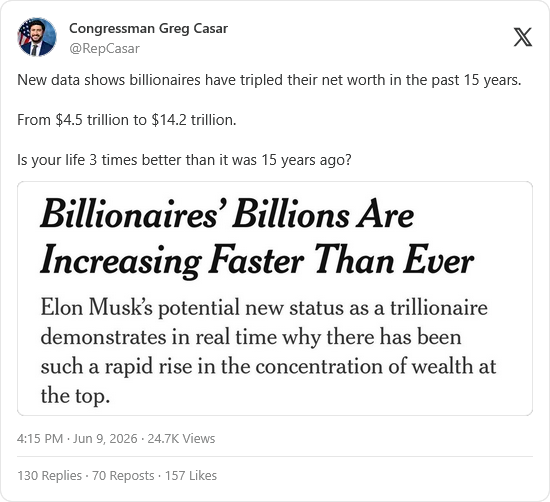
Congressman Greg Cesar (D-TX) decided to try that on X Tuesday with this banger.
Now, it’s interesting that he talks about their wealth being three times what it was 15 years ago, but doesn’t account for what the rest of us are dealing with. Instead, he engages in an apples-and-oranges comparison.
For starters, the increase in net worth for billionaires has nothing at all to do with whether your life is three times better than it was back then. There are too many variables. Someone who was unemployed and homeless and got a job, built a life back up, and then started a successful business is a lot more than three times better off, right?
Plus, it doesn’t account for differences in the cost of living or anything else.
Instead, a better metric is whether the median household net worth in America has increased a similar amount. So, I went to Google, then got its AI to generate a graph for me showing what’s happened over that timeframe.
While that’s not three times, it is 2.5 times the median net worth 15 years ago, and since this caps at 2022, it may well have increased even more.
In other words, the net worth of ordinary Americans seems to be mostly keeping up with that of the billionaires.
Cesar’s question, though, is disengenuous because the cost of living has gone up about 53 percent over that timeframe. So while net worth has increased, so has the cost of living. Not enough to completely drain away the gains in net worth, but enough that people aren’t living three times better than they were.
But that’s the point, isn’t it?
It’s not enough that, on average, Americans are much richer than they were 15 years ago, and by about the same amount as the billionaires, because that won’t foster the necessary resentment the left needs to push through their policies. You have to resent their wealth, and that’s less likely if you realize you’ve gained as much as they have by percentages. You have to feel like their wealth has been taken from yours, otherwise you’re less likely to look at wealth redistribution as a good thing.
And wealth redistribution is what it’s always about.

The Laurentian Elite
The people who actually rule Canada — including but not limited to Liberal Party members — don’t mind “populists” who want to “spread awareness”, because it’s about as ineffective as can be and dissipates some of the energy that might otherwise be used to oppose the Laurentian Elite’s preferred outcomes:

Homesteaders, agrarians, and populists relying on “spreading awareness”, protesting, or Americanisms like “we the people” and “the silent majority” aren’t nearly as effective or influential as people think they are.
A deeply unpopular Laurentian liberal elite minority, one that increasingly LARPs as blue-state Americans and takes its cues from them, managed to transform the country against the popular will.
Over a roughly twenty-year period between the 1940s and 1960s, they spent decades scheming behind the scenes. They changed the flag, lured French Canadians into supporting them through the Royal Commission on Biculturalism and Bilingualism by promising greater national recognition of Canada’s French heritage, then dropped the whole thing almost immediately. They pulled the rug out from under them and basically said, “SYKE, you thought. Here’s infinite immigrants instead.”
In 1971 they pushed multiculturalism and the cultural mosaic, abolished assimilation while polling showed around 80% of Canadians opposed increased immigration. They later entrenched their ideology through the Charter of Rights and Freedoms, stacked and empowered a judiciary that would future-proof it, formalized the project through the 1988 Multiculturalism Act, and gradually consolidated influence over the media, education system, and cultural institutions.
The result was a decades-long effort to indoctrinate Canadians into viewing their country as a post-national economic zone built on stolen land called Turtle Island, where Canadians don’t exist, but foreigners are just as Canadian as you and me, borders are morally questionable, and none is illegal on stolen land.
This isn’t going to be reversed through awareness campaigns, symbolic protests, or endlessly posting facts online. Political systems are ultimately shaped by elites and counter-elites. The only way this order gets replaced is if a rival elite, or a political force capable of becoming one, displaces the existing ruling class and takes its place.
That process will almost certainly involve some degree of populism, but populism by itself is not enough. You need people who can actually build institutions, wield power, and replace the current establishment rather than just complain about it or bug off into the woods, or try to balkanize the country.
Sing, Muse, of A Complicated Man: Why the Narrative Structure of The Odyssey is VITAL
MoAn Inc.
Published 2 Jan 2026
(more…)
QotD: Ecce BCG
Of course BCG stands for “Basic College Girl”, and thus she can be found at any institution of “higher” “learning”, but the most Basic ones of all go to colleges you’ve never heard of. Jonah Goldberg is a good example, and while I know he’s technically male, his act is classic BCG. He famously — or infamously — went to Goucher College, which is the kind of school that likes to pretend it’s a mini-Ivy, when in fact it’s the kind of school bright-enough but directionless young nouveau riche kids go to when they just can’t kick that drug habit.
[…]
Achieving shockingly high rank right out of the gate is another tell, and I know what you’re thinking, because of course I thought it too: Mark Meadows is 63 years old, and in the world we grew up in, there’s only one way for a straight-out-of-college girl to become a “close confidante” of a 63 year old man. In my experience, though, BCGs aren’t socially savvy enough to figure that out.
Yeah yeah, I know, but y’all, as primal as that is, these BCGs are just weird. They have no social skills whatsoever. Two data points. First, from Hutchinson’s wiki page:
Identified as a “White House legislative aide”, Hutchinson was the subject of a nationally-syndicated AP photograph in which she was shown dancing to the song “Y.M.C.A.” alongside White House press secretary Kayleigh McEnany at the end of Trump’s September 21, 2020, campaign rally in Swanton, Ohio.
That is not grownup behavior. No woman who ever hoped to be taken seriously in politics would be caught dead doing that, as recently as 15 years ago. They have absolutely zero idea how they come off to other people.
Second data point: I once taught a night class in one of my Flyover State tours. I had this girl there who was just dying to get to Capitol Hill. She was involved in every possible Poli Sci club, the pre-law club, the Young Legislators (or whatever FNG shit it was), and so on. She emailed me once to say she’d be coming to class late, because she was representing Student Senate (or whatever) in some big to-do the college was hosting for the Governor.
When she shows up to my class, she’s wearing this tight red cocktail dress that would’ve looked trashy on a Vegas waitress. It was slit at the sides and back. and at the midriff. It had sequins, I shit you not. It was all I could do not to bust out laughing. You went to a reception. With the Governor. Wearing that.
They have no savvy at all, y’all. None whatsoever. The invitation she got read “formal attire”, so she wore what she wore to the sorority formal. You could practically still see Chad Thundercock’s handprints on her ass.
And that’s the fourth and most diagnostic criterion: utter, complete, hilarious fucking cluelessness. About everything.
Severian, “Alt Thread: Diagnosing the BCG”, Founding Questions, 2022-06-30.
June 12, 2026
The mystical powers of climate change, is there anything it can’t do?
In Canada, all problems are now blamed on US President Donald Trump. It’s a fantastic get-out-of-trouble move for politicans like Prime Minister Mark Carney, Ontario Premier Doug Ford, and even mayors of towns and cities across the Demented Dominion. But even the malign powers of the Bad Orange Man seem puny in comparison to the amazing powers of — gasp! — CLIMATE CHANGE:

Every now and then I suspect there is a game played by bored elites to see which of them can get away with the most asinine “climate change” claim. There have been some doozies: lack of UFOs, “climate change” anxiety, increased sugar consumption, engineering short people. On and on and on ad infinitum.
Today we meet what could be the winner in the contest. Experts are claiming World Cup matches could be slower. Now instead of ninety-plus minutes running around ending in zero-zero ties and dramatic shootouts, we’ll get ninety-plus minutes of somewhat slower running around ending in zero-zero ties and dramatic shootouts. Because “climate change”.
Seems to me, though, that if we really wanted to save time, we could have all matches begin at the shootouts. The whole tournament could be over in a day. Take that, “climate change”!
Here’s the claim, appropriately announced on a PR site, a site whose specialty is juicing dull and dubious headlines: “Climate Central finds climate change has increased the likelihood of heat that could slow players for 97 of the 104 matches, threatening game speed and fan safety.”
What will happen to the other 7 matches they don’t say. Probably they will end in shootouts.
Details:
Previous research shows temperatures above 82.4°F can reduce sprint frequency, total distance covered, and recovery time, impacting not only player performance and safety, but also match tempo, tactics, and overall style of play.
Previous researchers discovered — and stay with me, here — that when it’s hot outside people outside in the heat act like people act when it’s hot out.
Where would we be without previous researchers?
[…]
As you have surmised, we don’t have to believe any of this: the scenarios are all silly, proving that the stunning new research is purely performative, a way to signal the vices and predilections of the researchers. As proof, we oblige the PR site which asks us to quote this:
As global temperatures continue to rise, driven by the burning of fossil fuels, the 2026 World Cup could become another example of how climate change can disrupt sports and traditions people cherish, forcing a reevaluation of how the game is played.
This is all ridiculous, and only saved by the charge of falsity by adding that “could.” Meaning might, which also means might not.
They also provide this quote they ask us to re-quote:
Alex Jacobs, professional player formerly with the Jamaican Premier League:
Heat is not new. But extreme heat — made more likely by heat-trapping pollution driving climate change — might just be a difference maker in this summer’s edition of the biggest sporting event on the planet.Way these quotes work is that either the PR firm, or the organization employing the PR firm, write them for victims, who are sought out and asked to sign on. The people allowing their names to be used are, of course, fully responsible for the words used, and even often believe them. But there’s no mistaking that stilted prose of the manufactured quote. Nobody talks like this. This prose is not conclusive, but whenever you see it, it’s a darn good reason to dismiss the claims made.
Of course, using a highly visible public event to advance the climate change agenda is nothing new, they’ve literally been doing it for decades now. Media outlets have always had a bias toward the most dramatic outcome, if only for marketing purposes — “if it bleeds, it leads” — but even the more skeptical outlets have drifted in the climate hysteria direction over time:
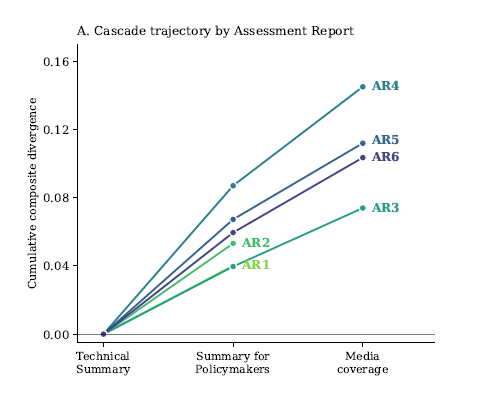
We have complained many times that the public is presented with a picture of climate science systematically biased towards alarmism. And it’s not just our anecdotal impression. We have data, in the form of a new study from the US National Bureau of Economic Research saying the government delegates who write the IPCC Summary for Policy Makers (SPM) overstate the science in the underlying report, and then the media further overstates what’s in the SPM. The study authors used multiple AI systems to extract key scientific statements in every IPCC Assessment Report since 1990, track how they were summarized and what the accompanying media coverage said. Using a statistical model they measured the way the statements get changed or twisted at each stage. There were some surprising results and some unsurprising. Unsurprisingly the data showed the UK Guardian has by far the most climate coverage of all major media outlets and is also the most biased. Another unsurprising result is that the overall media bias regarding the severity of climate change has been consistent over time. A surprising result (to many, but not to us) is that the only major media outlet exhibiting precisely zero bias was Fox News. Otherwise most right-leaning outlets adopted the left-leaning outlets’ alarmist bias as of 2007, again unsurprising to us. And there’s much more.
The authors identified three forms of bias: severity, in which a summary picks the upper end of a range of claims, uncertainty, in which a summary downplays caveats and qualifiers, and scenario in which worst-case scenarios get foregrounded. They used a numerical scale from -2 to +2 that captured bias in either direction: a positive number indicated that the summary was biased towards alarmism and a negative number indicated a bias in the opposite direction. Then they averaged the bias measures together and measured them at two stages in the game of telephone. The “TS-to-SPM” stage compared statements in the author-written Technical Summary to how they were worded in the government-written Summary for Policymakers. The “SPM-to-media” stage looked at how statements in the SPM were then reported in the press. The authors examined the TS-to-SPM stage for every IPCC Assessment Report from 1990 to 2023. They only looked at the SPM-to-media stage from the 2001 Third Assessment Report (AR3) because that’s as far back as their media library went.
[…]
That’s right, folks. Even the right-leaning outlets have also gone in for alarmist bias, at least since 2007. Indeed, the media’s bias converged in size and direction over time, as shown in this chart:
For the AR3 in 2001, right-leaning outlets on average understated the climate findings while left-leaning outlets overstated them. But thereafter both sides shared the alarmist bias. Which reflects the success of alarmist activists in the post-An Inconvenient Truth era (2006) driving skeptical voices out of the media. That campaign didn’t eliminate bias, it only replaced one form by another, with the result that the overall media landscape became entirely one-sided.
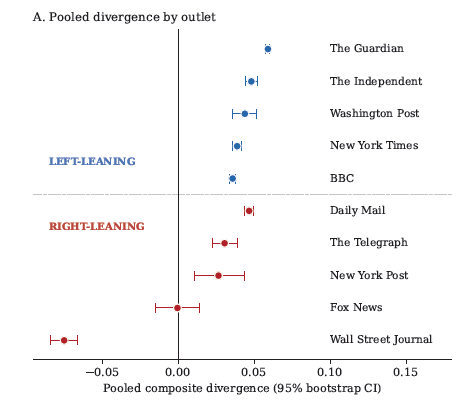
The uniformity of the bias can also be seen in this chart:
The right-leaning outlets in red are about as bad as the lefties in blue, except for Fox News which is the only outlet with no measurable bias and the Wall Street Journal which had an overall negative (anti-alarmist) bias.
Protests and riots send different messages to the PTB
While this is specifically related to the situation in Belfast, it applies to protests and riots generally:
The message of a protest is “we don’t like this”.
The message of a riot is “we don’t like this, and we’re able to do something about it”.
People who unconditionally call for peace and calm, regardless of the provocation, don’t fundamentally understand how politics works in the real world.
They do understand that the purpose of politics is to provide an alternative to violence, but that’s as far as their understanding goes. They don’t think through the implications, usually because they are quite comfortable with things as they are.
If politics is an alternative to violence, then politics is a proxy for violence.
And that means you have to dole out power in proportion to capacity for violence. Or someone’s going to figure out they can do better by flipping the table.
Monarchy wasn’t replaced by democracy because of fine-sounding philosophical ideals and eloquent documents declaring this or that.
Democracy happened because if you added rifling to the flintlock firearm, suddenly a individual farmer with a tube was the pinnacle of military technology, and now you had to keep all the farmers with tubes happy by giving them political power.
(Ancient Greek democracy had a similar relationship with the hoplite warrior.)
When political systems work well, for a while, the violence they represent becomes further and further from people’s minds, and those who can’t effectively commit or direct violence worm their way into power, and begin to take it away from those who can.
And they’ll defend their position by saying that violence is unthinkable, barbaric, always bad, must be disavowed at all costs, etc.
This isn’t some sort of high-minded principle on their part. It simply means one of two things. Either “the status quo works for me, so I don’t want you to upset it”, or “I suck at violence, and I don’t want to have to fight”.
They want young men demoralized, so that their artificial meritocracy of spreadsheets, or their non-meritocracy of patronage networks, can be protected from the natural meritocracy of conflict.
This means that riots aren’t actually for achieving any specific material aim. They are for reminding the comfortable that judges and bureaucrats and policemen have home addresses and families. And that violence is always on the table.
A protest would only send the message that the Irish don’t want to be ethnically cleansed. But the bureaucrats and judges and lawyers already know that. They just don’t care.
A riot reminds them that they have to care, because the Irish have a long tradition of doing something about it.

How one German soldier survived WW1
The Great War
Published 12 Dec 2025Order Alexander’s Diary in The Other Trench in English and Der andere Graben in German: https://www.theothertrench.com
More than 13 million men served in the German army during the First World War. Most wrote letters home, some kept diaries, and some wrote memoirs if they survived. But over a century later, it’s rare to have a window into the everyday thoughts and feelings of one man, a time capsule of the experience of one of those 13 million.
(more…)


