
Forgotten Weapons
Published 9 Nov 2022The US Army spent nearly 16 years languidly testing the Maxim gun, but was never willing to actually make a decision until a final trial in 1903 finally settled the matter. The Maxim was deemed the best available machine gun and a contract was signed with Vickers, Sons, & Maxim to purchase 50 (later increased to 90). Eventually a total of 287 were procured; 90 from VSM and a further 197 made by Colt in the US. The first British guns were chambered for .30-03, with the Colts all made for the later .30-06 (and the VSM guns updated to that standard).
The Model 1904 was the heaviest Maxim gun ever made, weighing in at 62 pounds for the gun and another 80 for its tripod. Despite excellent reliability and durability, it was so heavy and unwieldy that it was pretty universally hated by American soldiers. The final order for 1904 Maxims was placed in 1908 and just the following year the M1909 Benet Mercie light Hotchkiss pattern was was adopted. By the time World War One arrived, half the Maxims had already been relegated to long-term storage. They were pulled out of the warehouses for training troops prior to their deployment to Europe, but they never saw any more significant military use.
(more…)
March 18, 2023
The US Adopts A Maxim: The Colt Model 1904
QotD: Experts outside their field of expertise
… just because someone is really smart and successful at A does not necessarily mean their opinion on B is worth squat. As always, as a consumer of opinions, caveat emptor should always be the watchwords.
The first time I really encountered this phenomenon (outside of obvious examples such as the political and economic opinions of Hollywood celebrities) was related to climate change. I don’t see them as often today, but for a while it used to be very common for letters to circulate in support of climate change science signed by hundreds or thousands of scientists.
The list of signatures was always impressive, but when you looked into it, there was a problem: few if any of the folks who signed had spent any time really looking at the details of climate science — they were busy happily studying subatomic particles or looking for dark energy in space. It turned out most of them had fallen for the climate alarmist marketing ploy that opposition to catastrophic man-made global warming theory was by people who were anti-science. And thus by signing the letter they weren’t saying they had looked into it all and confirmed the science looked good to them, they were merely saying they supported science.
When some of them looked into the details of climate science later, they were appalled. Many have reached the same general conclusions that I have, that CO2 is certainly causing some warming but the magnitude of that warming or in particular the magnitude and direction of its knock on effects like floods or droughts or tornadoes, is far from settled science.
So it is often the case that people who show strong support for ideas or people outside of their domain do so for reasons other than having made use of their expertise and experience to take a deep dive into the issues. Theranos is a great example from the business world. Elizabeth Holmes convinced a bunch of men (and they were mostly all men — women seemed to have more immunity to her BS) who were extraordinarily successful in their own domains (George Schultz, the Murdochs, Henry Kissinger, Larry Ellison) to become passionate believers in her vision. Which is fine, it was a lovely vision. But they spent zero time testing whether she could really do it, and worse, refused to countenance any reality checks about problems Theranos was facing because Holmes convinced them that critics were just bad-intentioned people representing nefarious interests who wanted her vision to fail.
Warren Meyer, “People Who Express Opinions Outside of their Domain Seldom Have Really Looked into it Much”, Coyote Blog, 2019-05-28.
March 17, 2023
Ukrainian, Yugoslav and Baltic Nazis? – ϟϟ Foreign Fighters Part 2
World War Two
Published 16 Mar 2023Across Europe, non-Germans are filling the ranks of Heinrich Himmler’s forces. These foreign fighters certainly don’t meet the racial standards of the SS but times are tough and the Reichsführer-SS needs warm bodies. So, does that mean Himmler’s given up on the idea of a Germanic master race? Not at all. And he uses all sorts of twisted esoteric logic to justify his latest moves.
(more…)
Beef & Guinness Stew – St. Patrick’s Day Special – Beef Stewed in Guinness Beer
Food Wishes
Published 15 Mar 2013Learn how to make a Beef & Guinness Stew! Go to http://foodwishes.blogspot.com/2013/0… for the ingredient amounts, more information, and many, many more video recipes! I hope you enjoy this St. Patrick’s Day Special Beef Stewed in Guinness Beer recipe!
From the comments:
Food Wishes
2 years ago
Check out the recipe: https://www.allrecipes.com/Recipe/234534/Beef-and-Guinness-Stew/
QotD: The unique nature of Roman Egypt
[…]
… what makes Roman Egypt’s uniqueness so important is one of the unique things about it: Roman Egypt preserves a much larger slice of our evidence than any other place in the ancient world. This comes down to climate (as do most things); Egypt is a climatically extreme place. On the one hand, most of the country is desert and here I mean hard desert, with absolutely minuscule amounts of precipitation. On the other hand, the Nile River creates a fertile, at points almost lush, band cutting through the country running to the coast. The change between these two environments is extremely stark; it is, I have been told (I haven’t yet been to Egypt), entirely possible in many places to stand with one foot in the “green” and another foot in the hard desert.
That in turn matters because while Egypt was hardly the only arid region Rome controlled, it was the only place you were likely to find very many large settlements and lots of people living in such close proximity to such extremely arid environments (other large North African settlements tend to be coastal). And that in turn matters for preservation. When objects are deposited – lost, thrown away, carefully placed in a sanctuary, whatever – they begin to degrade. Organic objects (textile, leather, paper, wood) rot as microorganisms use them as food, while metal objects oxidize (that is, rust). Aridity arrests (at least somewhat) both processes. Consequently things survive from the Roman period (or indeed, from even more ancient periods) in Egypt that simply wouldn’t survive almost anywhere else.
By far the most important of those things is paper, particularly papyrus paper. The Romans actually had a number of writing solutions. For short-term documents, they used wax writing tablets, an ancient sort of “dry erase board” which could be scraped smooth to write a new text when needed; these only survive under very unusual circumstances. For more permanent documents, wood and papyrus were used. Wood tablets, such as those famously recovered from the Roman fort at Vindolanda, are fairly simple: thin wooden slats are smoothed so they can be written on with ink and a pen, creating a rigid but workable and cheap writing surface; when we find these tablets they have tended to be short documents like letters or temporary lists, presumably in part because storing lots of wood tablets would be hard so more serious records would go on the easier to store papyrus paper.
Papyrus paper was lighter, more portable, more storeable option. Papyrus paper is produced by taking the pith of the papyrus plant, which is sticky, and placing it in two layers at right angles to each other, before compressing (or crushing) those layers together to produce a single sheet, which is then dried, creating a sheet of paper (albeit a very fibery sort of paper). Papyrus paper originated in Egypt and the papyrus plant is native to Egypt, but by the Roman period we generally suppose papyrus paper to have been used widely over much of the Roman Empire; it is sometimes supposed that papyrus was cheaper and more commonly used in Egypt than elsewhere, but it is hard to be sure.
Now within the typical European and Mediterranean humidity, papyrus doesn’t last forever (unlike the parchment paper produced in the Middle Ages which was far more expensive but also lasts much longer); papyrus paper will degrade over anything from a few decades to a couple hundred years – the more humidity, the faster decay. Of course wood tablets and wax tablets fare no better. What that means is that in most parts of the Roman Empire, very little casual writing survives; what does survive were the sorts of important official documents which might be inscribed on stone (along with the literary works that were worth painstakingly copying over and over again by hand through the Middle Ages). But letters, receipts, tax returns, census records, shopping lists, school assignments – these sorts of documents were all written on less durable materials which don’t survive except in a few exceptional sites like Vindolanda.
Or Egypt. Not individual places in Egypt; pretty much the whole province.
In the extremely dry conditions of the Egyptian desert, papyrus can survive (albeit typically in damaged scraps rather than complete scrolls) from antiquity to the present. Now the coverage of these surviving papyri is not even. The Roman period is far better represented in the surviving papyri than the Ptolemaic period (much less the proceeding “late” period or the New Kingdom before that). It’s also not evenly distributed geographically; the Arsinoite nome (what is today el-Fayyum, an oasis basin to the West of the Nile) and the Oxyrhynchus nome (roughly in the middle of Egypt, on the Nile) are both substantially overrepresented, while the Nile Delta itself has fewer (but by no means zero) finds. Consequently, we need to be worried not only about the degree to which Egypt might be representative of the larger Roman world, but also the degree to which these two nomes (a nome is an administrative district within Egypt, we’ll talk about them more in a bit) are representative of Egypt. That’s complicated in turn by the fact that the Arsinoite nome is not a normal nome; extensive cultivation there only really begins under Ptolemaic rule, which raises questions about how typical it was. It also means we lack a really good trove of papyri from a nome in Lower Egypt proper (the northern part of the country, covering the delta of the Nile) which, because of its different terrain, we might imagine was in some ways different.
Nevertheless, it is difficult to overstate the value of the papyri we do recover from Egypt. Documents containing census and tax information can give us important clues about the structure of ancient households (revealing, for instance, a lot of complex composite households). Tax receipts (particularly for customs taxes) can illuminate a lot about how Roman customs taxes (portoria) were assessed and conducted. Military pay stubs from Roman Egypt also provide the foundation for our understanding of how Roman soldiers were paid, recording for instance, pay deductions for rations, clothes and gear. We also occasionally recover fragments of literary works that we know existed but which otherwise did not survive to the present. And there is so much of this material. Whereas new additions to the corpus of ancient literary texts are extremely infrequent (the last very long such text was the recovery of the Athenaion Polteia or Constitution of the Athenians, from a papyrus discovered in the Fayyum (of course), published in 1891), the quantity of unpublished papyri from Egypt remains vast and there is frankly a real shortage of trained Egyptologists who can work through and publish this material (to the point that the vast troves of unpublished material has created deeply unfortunate opportunities for theft and fraud).
And so that is the first way in which Egypt is unusual: we know a lot more about daily life in Roman Egypt, especially when it comes to affairs below the upper-tier of society. Recovered papyrological evidence makes petty government officials, regular soldiers, small farming households, affluent “middle class” families and so on much more visible to us. But of course that immediately raises debates over how typical those people we can see are, because we’d like to be able to generalize information we learn about small farmers or petty government officials more broadly around the empire, to use that information to “fill in” regions where the evidence just does not survive. But of course the rejoinder is natural to point out the ways in which Egypt may be unusual beyond merely the survival of evidence (to include the possibility that cheaper papyrus in Egypt may have meant that more things were committed to paper here than elsewhere).
Consequently the debate about how strange a place Roman Egypt was is also a fairly important and active area of scholarship. We can divide those arguments into two large categories: the way in which Roman rule itself in Egypt was unusual and the ways in which Egypt was a potentially unusual place in comparison to the rest of Roman world already.
Bret Devereaux, “Collections: Why Roman Egypt Was Such a Strange Province”, A Collection of Unmitigated Pedantry, 2022-12-02.
March 16, 2023
Once it was possible to be a fully fledged techno-optimist … but things have changed for the worse
Glenn Reynolds on how he “lost his religion” about the bright, shiny techno-future so many of us looked forward to:

Okay, there’s optimism and then there’s totally unrealistic techno-utopianism…
Listening to that song reminded me of how much more overtly optimistic I was about technology and the future at the turn of the millennium. I realized that I’m somewhat less so now. But why? In truth, I think my more negative attitude has to do with people more than with the machines that Embrace the Machine characterizes as “children of our minds”. (I stole that line from Hans Moravec. Er, I mean it’s a “homage”.) But maybe there’s a connection there, between creators and creations.
It was easy to be optimistic in the 90s and at the turn of the millennium. The Soviet Union lost the Cold War, the Berlin Wall fell, and freedom and democracy and prosperity were on the march almost everywhere. Personal technology was booming, and its dark sides were not yet very apparent. (And the darker sides, like social media and smartphones, basically didn’t exist.)
And the tech companies, then, were run by people who looked very different from the people who run them now – even when, as in the case of Bill Gates, they were the same people. It’s easy to forget that Gates was once a rather libertarian figure, who boasted that Microsoft didn’t even have an office in Washington, DC. The Justice Department, via its Antitrust Division, punished him for that, and he has long since lost any libertarian inclinations, to put it mildly.
It’s a different world now. In the 1990s it seemed plausible that the work force of tech companies would rise up in revolt if their products were used for repression. In the 2020s, they rise up in revolt if they aren’t. Commercial tech products spy on you, censor you, and even stop you from doing things they disapprove of. Apple nowadays looks more like Big Brother than like a tool to smash Big Brother as presented in its famous 1984 commercial.
Silicon Valley itself is now a bastion of privilege, full of second- and third-generation tech people, rich Stanford alumni, and VC scions. It’s not a place that strives to open up society, but a place that wants to lock in the hierarchy, with itself on top. They’re pulling up the ladders just as fast as they can.

Wooden marking gauges are NOT what you think
Rex Krueger
Published 15 Mar 2023Can an old tool teach us a few new tricks?
(more…)
Field Marshal Slim’s one and only demotion … from lance-corporal back down to private
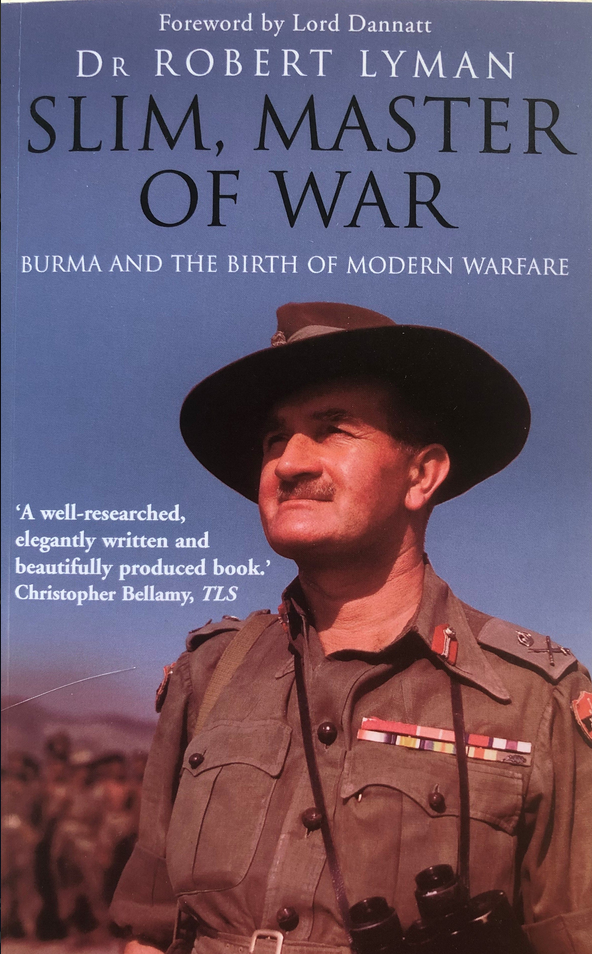
William Slim, arguably the best British general of the Second World War, didn’t have the fastest start to his military career, as recounted in an article by Frank Owen, the editor of the WW2 South East Asia theatre publication Phoenix. This and many others appear in Dr. Robert Lyman’s upcoming book Slim, Master of War:
The General stood on an ammunition box. Facing him in a green amphitheatre of the low hills that ring the Palel Plain, sat or squatted the British officers and sergeants of the 11th East African Division. They were then new to the Burma Front and were moving into the line the next day. The General removed his battered slouch hat, which the Gurkhas wear and which has become the headgear of the 14th Army. “Take a good look at my mug”, he advised. “Not that I consider it to be an oil painting. But I am the Army Commander and you had better be able to recognize me — if only to say “Look out, the old b…. is coming round”.
Lieutenant-General Sir William Slim, KCB, CB, DSO, MC (“Bill”) is 53, burly, grey and going a bit bald. His mug is large and weather beaten, with a broad nose, jutting jaw, and twinkling hazel eyes. He looks like a well-to-do West Country farmer, and could be one. For he has energy and patience and, above all, the man has common sense. However, so far Slim has not farmed. He started life as a junior clerk, once he was a school teacher, and then he became the foreman of a testing gang in a Midland engineering works. For the next 30 years Slim was a soldier.
He began at the bottom of the ladder as a Territorial private. August 4, 1914, found him at Summer camp with his regiment. The Territorials were at once embodied in the Regular Army, and Slim got his first stripe as lance-corporal. A few weeks later he was a private again, the only demotion that this Lieutenant-General has suffered.
It was a sweltering, dusty day and the regiment plodded on its twenty-mile route march down an endless Yorkshire lane. At that time British troops still marched in fours, so that Lance-Corporal Slim, as he swung along by the side of his men, made the fifth in the file, which brought him very close to the roadside. There were cottages there and an old lady stood at the garden gate.
“I can see her yet”, Slim reminisces. “she was a beautiful old lady with her hair neatly parted in the middle and wearing a black print dress. In her hand she held a beautiful jug, and on the top of that jug was a beautiful foam, indicating that it contained beer. She was offering it to the soldier boys.”
The Lance-Corporal took one pace to the side and grasped the jug. As he did, the column was halted with a roar. The Colonel, who rode a horse at its head, had glanced back. Slim was hailed before him and “busted” on the spot. The Colonel bellowed “Had we been in France you would have been shot.” Slim confides, “I thought he was a damned old fool – and he was. I lost my stripe, but he lost his army.” In truth he did, in France in March 1918. Bill soon got his stripe back.
Now in this corner of Palel Plain, one of India’s bloodiest battlefields and the scene of one of his greatest victories, Slim tells the officers and men of the 11th Division, “I have commanded every kind of formation from a section upwards to this army, which happens to be the largest single one in the world.” (At that time, Slim had under his command half a million troops.) “I tell you this simply that you shall realize I know what I am talking about. I understand the British soldier because I have been one, and I have learned about the Japanese soldier because I have been beaten by him. I have been kicked by this enemy in the place where it hurts, and all the way from Rangoon to India where I had to dust-off my pants. Now, gentlemen, we are kicking our Japanese neighbours back to Rangoon.”
Slim commanded the rear guard of the army that retreated from Burma in 1942. He is proud of that. His men marched and fought for a hundred days and nights and across a thousand miles. But this retreat was no Dunkirk. Says Slim “We brought our weapons out with us, and we carried our wounded, too. Dog-tired soldiers, hardly able to put one foot in front of another, would stagger along for hours carrying or holding up a wounded comrade. When at last they reached India over those terrible jungle mountains they did not go back to an island fortress and to their own people where they could rest and refit. The Army of Burma sank down on the frontier of India, dead beat and in rags. But, they fought here all through the downpour of the monsoon, and they saved India until a great new Army – which is this one – could be built up to take the offensive once again. In those days, if anyone had gone to me with a single piece of good news I would have burst out crying. Nobody ever did.”
He tells another story. One day he entered a jungle glade in a tank. In front of him stood a group of soldiers, in their midst the eternal Tommy. Assuming an optimism which he did not feel, Slim jumped out of the tank and approached them. “Gentlemen!” he said (which is the nice way that British generals sometimes address their troops) “Things might be worse!”
“‘Ow could they be worse?” inquired the Tommy.
“Well, it could rain” said Slim, lightly. He adds “And within quarter of an hour it did.”
History of the Royal Navy – Wooden Walls (1600-1805)
Ryan Doyle
Published 3 Mar 2013
(more…)
QotD: “In the tattoo parlour, the customer is always wrong”
One day, I arrived on the ward to discover an enthusiastic self-expresser in the first bed. Her two-inch-long nails were painted lime green, and looked as if they gave off the kind of radiation that meant instant leukaemia. That, however, was the least of it.
She was lying in the bed, décolleté, to reveal breasts pierced with many metal bars ending in steel balls to keep them in place, and for what is known round here as decoration. I couldn’t look at them without wincing; ex-President Clinton would no doubt have felt her pain. As for her face, it was the modern equivalent of the martyrdom of Saint Sebastian. It was also the refutation of the doctrine that the customer is always the right. In the tattoo parlour, the customer is always wrong.
She had a ring through the septum of her nose, and a ring through her upper lip, so that the two clacked when she spoke. She had a stud in her tongue, and two studs through her lower lip. She had so many rings through her ears that they looked like solenoids. She had a metal bar through the bridge of her nose and rings at the outer edges of her eyebrows. If she were to die, she could probably be sold to a scrap metal merchant.
Theodore Dalrymple, “Lady of the Rings”, Asian Age, 2005-12-27.
March 15, 2023
Not only is the science “settled” … it’s already in the school textbooks
David Friedman on his attempts to follow up on claims made in a textbook on climate change already in use in US public schools:
Introduction to Modern Climate Change by Andrew Dessler is an elementary climate science textbook, now in its third edition. In Chapter 9, “Impacts of Climate Change”, it has:
Scientists predict that sea level will rise 47 to 73 cm (19 to 29 inches) above 1995–2014 levels by 2100. This may not sound like a significant challenge, but it is much larger than the 18 cm of sea level experienced over the twentieth century, which is already challenging for many who live near sea level. Like temperature, these predictions of sea-level rise might sound small but, also like temperature, they are not. In Florida, for example, a sea-level rise in the middle of the projected range would inundate 9 percent of Florida’s current land area at high tide. This includes virtually all of the Florida Keys as well as 70 percent of Miami-Dade County. Almost one-tenth of Florida’s current population, or nearly 2 million people, live in this vulnerable zone, and it includes residential real estate valued at hundreds of billions of dollars. It also includes important infrastructure, such as two nuclear reactors, three prisons, and 68 hospitals.
That struck me as implausible, given what else I had seen on the effect of sea level rise. The footnote for the claim was to Stanton and Ackerman (2007), which turned out to be not a peer reviewed journal article but a report commissioned by the Environmental Defense fund, an environmentalist group. It includes the same claims, but for 27 inches of sea-level rise not the 24 inches that is Dessler’s “middle of the projected range”. It refers the reader to Appendix C for “detailed sources and methodology”. Going there, I found:
To estimate the impact of sea-level rise on land area, populations, and public and private assets and infrastructure, we began with a 1:250,000 Digital Elevation Model (DEM) map of the State of Florida, and divided the state into “vulnerable” and “not vulnerable” zones demarcated by 1.5 meters of elevation and other factors described by Titus and Richman (2000) as corresponding to 27 inches of sea-level rise.
So what they are showing as the vulnerable area is not the 27 inch or 24 inch contour but the 1.5 meter (5 feet) contour. The explanation, from Titus, J.G. and C. Richman (2001). “Maps of lands vulnerable to sea level rise: modeled elevations along the US Atlantic and Gulf coasts“. Climate Research 18: 205–228, a journal article written by two EPA people and presumably peer reviewed:
Thus, at a typical site, the 1.5-meter contour would be flooded by spring high tides (i.e., high tides during new and full moons) when sea level rises 80 cm
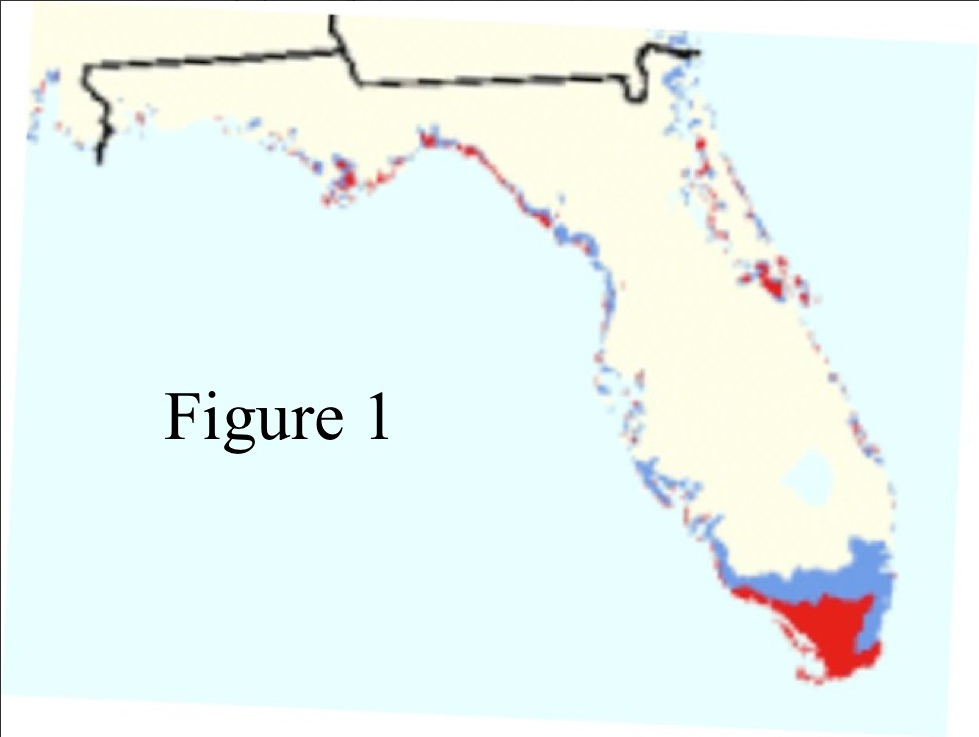
Figure 1 below (Titus and Richman Figure 4) is a map of Florida with the region within the 1.5 meter contour colored red, the region between 1.5 and 3.5 blue. Dessler’s middle of the projected range is 60 cm. Stanton and Ackerman’s 27 inches is 68.6 cm. The map shows what its authors claim would be flooded at 80cm.
Figure 2 below is a population density map of Florida from Wikipedia to which I have added the 1.5m contours from Figure 1. The large flooded area on the southern tip of Florida includes none of the densely populated area around Miami; only one of the tiny areas farther north appears to be in part on a populated area. That is not surprising — areas very close to sea level are likely to be marsh, in this case the everglades, and poor places to build on.
Stanton and Ackerman claim that their own calculations, using data bases of elevation and population, produce a total population in the at-risk area of 1.5 million. That was the figure Dessler gave in his first edition, presumably increased to almost 2 million in the third edition to reflect the increase in Florida’s population. Figure 2 shows why I don’t believe it. The flooded areas are in places almost all of which have very low population density, making it hard to see how flooding nine percent of the land area, most of it in the everglades, can flood almost ten percent of the population. Even if all of the Florida Keys are flooded, their total population is only about 80,000.
That problem is in addition to the fact that Dessler’s claim is for 60 cm of sea level rise, Stanton and Ackerman’s, from which Dessler got his figure for how many people are flooded, is for 68.6 cm (27 inches), and Titus and Richman get the 1.5 m contour that Stanton and Ackerman say they are using by assuming 80cm of sea level rise. Further reasons for suspicion are that Stanton and Ackerman gave figures for sea level rise substantially higher than either the IPCC figure at the time or the current IPCC figure, which suggests that they were trying to make the consequences of climate change look as scary as possible, and that they write “1.5 meters of elevation and other factors described by Titus and Richman (2000) as corresponding to 27 inches of sea-level rise” when Titus and Richman actually describe 1.5 meters as corresponding to 80 cm (31.5 inches) of sea level rise.

Irish Soda Bread from 1836
Tasting History with Max Miller
Published 14 Mar 2023
(more…)
Mining the moon would be “harmful” to indigenous people, say activists
Among the many, many things that are said to be harmful to indigenous culture we’re now told to include any kind of Lunar exploitation as modern colonialism:
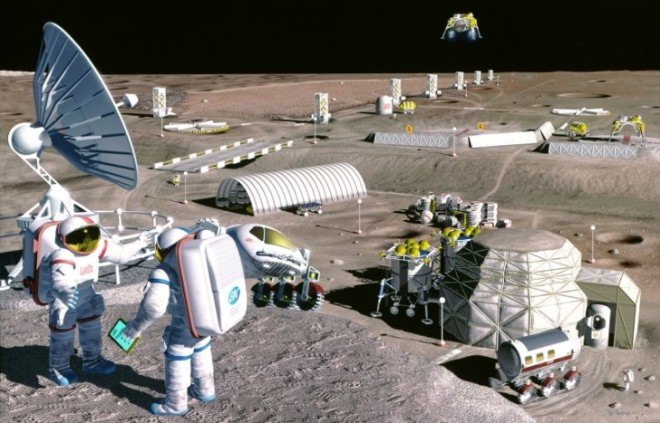
Artist’s conception of Helium-3 mining on the surface of the Moon.
Image from Inhabitat.com
Humans have boldly ventured beyond the Earth into space for more than half a century now. It’s a testament to the ambition of the modern world.
And today, humanity is still more ambitious. A new space race is underway between the US and China to mine the Moon for rare metals. NASA is even hoping to establish a long-term presence on the Moon and eventually send humans to Mars.
But it seems that some scientists-cum-activists, in hock to identity politics, want to rein in that ambition. Speaking ahead of a US conference on the ethics of space exploration, held by the American Association for the Advancement of Science (AAAS) last week, astrobiologist Dr Pamela Conrad told the Guardian that space exploration, particularly efforts to mine the Moon, is in danger of becoming an exercise in “colonialism” and “exploitation”. Conrad warned that “if something that’s not here [on Earth] is seen as a resource, just ripe to be exploited, then that [perpetuates] colonialism”.
Conrad’s fellow panellist at the conference, Dr Hilding Neilson, went even further. According to Neilson, a member of the Native American Mi’kmaq people, indigenous people have a deep connection with celestial bodies like the Moon. They therefore have a more profound and, by implication, superior “way of knowing” the Moon compared with those advocating space exploration. The latter merely see the Moon “as a dead object to be conquered”, Neilson says – meaning that those advocating space exploration are “essentially cheering on the history of colonialism”.
There are so many problems with this argument it’s difficult to know where to start. Both Conrad and Neilson appear to be using the specific and brutal practice of “colonialism” to describe – and demonise – humanity’s attempt to master nature in general. That’s a flawed enough approach to take to the history of our growing mastery of nature on Earth. But it’s even more flawed in the context of space.
After all, there’s one big difference between laying claim to the resources of other countries under colonialism and attempting to mine the Moon – nobody lives on the Moon! So no one would be “exploited” or “colonised” if humans were to mine it. Space exploration is therefore not the same as colonialism.
An Aircraft Carrier Without A Deck? | The Remarkable Brodie Landing System
Rex’s Hangar
Published 21 Sept 2022Today we’re taking a look at the remarkable Brodie Launch System. This device could be used on land or aboard ships, and it was designed to provide accessibility for light aircraft in extremely remote locations during WW2.
(more…)
QotD: The coming generation isn’t the Millennials … it’s Gen X
That’s your next layer of political and social control. The youngest of us are in their late 30s (again, using the broadest definition); most of us are well into middle age, and some of us are plunging headfirst into late middle age. The chiefs of police, the military’s senior staff officers (including, by now, some general and flag officers), the CEOs and CFOs … they’re not Millennials, they’re Xers.
Admittedly we’re a forgettable bunch. We didn’t get a chance at natural, healthy teenage rebellion, because our parents, the goddamn Boomers, claimed a monopoly on rebellion, so we had to be all, you know, like, whatever about it. The Boomers thought Andy Warhol was a serious artist and Bob Dylan a talented musician; is it any wonder that Kurt Cobain’s godawful caterwauling was the best we could do?
All of that is water under the bridge, of course. But here’s where it gets really, really meta: This great social upheaval is, for us, a copy of a copy. It’s people who were actually alive in the 1960s cosplaying The Sixties™ — just like they did the entire time we were growing up. Just as we had no template for teenage rebellion, we don’t really have a template for riots and whatnot either. Some of us have decided to crank it up to eleven — all of the most obnoxious Karens are Gen Xers — but lots of us … haven’t. I really have no idea just what the majority of my generational cohort is doing right now while our most vocal idiots are out Karening, in much the same way I have no idea what the majority of Silents were doing while the Chicago Seven were out doing their thing.
All I know is, there’s an entire layer of political power between AOC and Pelosi. We haven’t really seen it up until now, but it’s there. Is Gen X finally, at long last, going to get its shit together? I suspect that the real drama is still waiting in the wings.
Severian, “Talkin’ ’bout My Generation!”, Rotten Chestnuts, 2020-06-11.


