
The pop-culture image of elephants in battle is an awe-inspiring one: massive animals smashing forward through infantry, while men on elephant-back rain missiles down on the hapless enemy. And for once I can surprise you by saying: this isn’t an entirely inaccurate picture. But, as always, we’re also going to introduce some complications into this picture.
Elephants are – all on their own – dangerous animals. Elephants account for several hundred fatalities per year in India even today and even captured elephants are never quite as domesticated as, say, dogs or horses. Whereas a horse is mostly a conveyance in battle (although medieval European knights greatly valued the combativeness of certain breeds of destrier warhorses), a war elephant is a combatant in his own right. When enraged, elephants will gore with tusks and crush with feet, along with using their trunks as weapons to smash, throw or even rip opponents apart (by pinning with the feet). Against other elephants, they will generally lock tusks and attempt to topple their opponent over, with the winner of the contest fatally goring the loser in the exposed belly (Polybius actually describes this behavior, Plb. 5.84.3-4). Dumbo, it turns out, can do some serious damage if prompted.
Elephants were selected for combativeness, which typically meant that the ideal war elephant was an adult male, around 40 years of age (we’ll come back to that). Male elephants enter a state called “musth” once a year, where they show heightened aggressiveness and increases interest in mating. Trautmann (2015) notes a combination of diet, straight up intoxication and training used by war elephant handlers to induce musth in war elephants about to go into battle, because that aggression was prized (given that the signs of musth are observable from the outside, it seems likely to me that these methods worked).
(Note: In the ancient Mediterranean, female elephants seem to have also been used, but it is unclear how often. Cassius Dio (Dio 10.6.48) seems to think some of Pyrrhus’s elephants were female, and my elephant plate shows a mother elephant with her cub, apparently on campaign. It is possible that the difficulty of getting large numbers of elephants outside of India caused the use of female elephants in battle; it’s also possible that our sources and artists – far less familiar with the animals than Indian sources – are themselves confused.)
Thus, whereas I have stressed before that horses are not battering rams, in some sense a good war elephant is. Indeed, sometimes in a very literal sense – as Trautmann notes, “tearing down fortifications” was one of the key functions of Indian war elephants, spelled out in contemporary (to the war elephants) military literature there. A mature Asian elephant male is around 2.75m tall, masses around 4 tons and is much more sturdily built than any horse. Against poorly prepared infantry, a charge of war elephants could simply shock them out of position a lot of the time – though we will deal with some of the psychological aspects there in a moment.
A word on size: film and video-game portrayals often oversize their elephants – sometimes, like the Mumakil of Lord of the Rings, this is clearly a fantasy creature, but often that distinction isn’t made. As notes, male Asian (Indian) elephants are around 2.75m (9ft) tall; modern African bush elephants are larger (c. 10-13ft) but were not used for war. The African elephant which was trained for war was probably either an extinct North African species or the African forest elephant (c. 8ft tall normally) – in either case, ancient sources are clear that African war elephants were smaller than Asian ones.
Thus realistic war elephants should be about 1.5 times the size of an infantryman at the shoulders (assuming an average male height in the premodern world of around 5’6?), but are often shown to be around twice as tall if not even larger. I think this leads into a somewhat unrealistic assumption of how the creatures might function in battle, for people not familiar with how large actual elephants really are.
The elephant as firing platform is also a staple of the pop-culture depiction – often more strongly emphasized because it is easier to film. This is true to their use, but seems to have always been a secondary role from a tactical standpoint – the elephant itself was always more dangerous than anything someone riding it could carry.
There is a social status issue at play here which we’ll come back to […] The driver of the elephant, called a mahout, seems to have typically been a lower-status individual and is left out of a lot of heroic descriptions of elephant-riding (but not driving) aristocrats (much like Egyptian pharaohs tend to erase their chariot drivers when they recount their great victories). Of course, the mahout is the fellow who actually knows how to control the elephant, and was a highly skilled specialist. The elephant is controlled via iron hooks called ankusa. These are no joke – often with a sharp hook and a spear-like point – because elephants selected for combativeness are, unsurprisingly, hard to control. That said, they were not permanent ear-piercings or anything of the sort – the sort of setup in Lord of the Rings is rather unlike the hooks used.
In terms of the riders, we reach a critical distinction. In western media, war elephants almost always appear with great towers on their backs – often very elaborate towers, like those in Lord of the Rings or the film Alexander (2004). Alexander, at least, has it wrong. The howdah – the rigid seat or tower on an elephant’s back – was not an Indian innovation and doesn’t appear in India until the twelfth century (Trautmann supposes, based on the etymology of howdah (originally an Arabic word) that this may have been carried back into India by Islamic armies). Instead, the tower was a Hellenistic idea (called a thorkion in Greek) which post-dates Alexander (but probably not by much).
This is relevant because while the bowmen riding atop elephants in the armies of Alexander’s successors seem to be lower-status military professionals, in India this is where the military aristocrat fights. […] this is a big distinction, so keep it in mind. It also illustrates neatly how the elephant itself was the primary weapon – the society that used these animals the most never really got around to creating a protected firing position on their back because that just wasn’t very important.
In all cases, elephants needed to be supported by infantry (something Alexander (2004) gets right!) Cavalry typically cannot effectively support elephants for reasons we’ll get to in a moment. The standard deployment position for war elephants was directly in front of an infantry force (heavy or light) – when heavy infantry was used, the gap between the two was generally larger, so that the elephants didn’t foul the infantry’s formation.
Infantry support covers for some of the main weaknesses elephants face, keeping the elephants from being isolated and taken down one by one. It also places an effective exploitation force which can take advantage of the havoc the elephants wreck on opposing forces. The “elephants advancing alone and unsupported” formation from Peter Jackson’s Return of the King, by contrast, allows the elephants to be isolated and annihilated (as they subsequently are in the film).
Bret Devereaux, “Collections: War Elephants, Part I: Battle Pachyderms”, A Collection of Unmitigated Pedantry, 2019-07-26.
March 21, 2023
QotD: The elephant as a weapon of war
March 20, 2023
“It amounts to nothing less than a declaration of all-out war between the government and the Big Tech companies”
The editors of The Line have strong opinions on the federal government’s decision to batter Google, Facebook, and other online “giants” over their opposition to the proposed internet legislation in bills C-11 and C-18:
As a result of C-18, both Google and Meta have considered dropping news distribution from their platforms, or have outright promised to do so. To which we have responded: “Well, no shit, Sherlocks.” We have, in fact, warned all of the parties involved with this misguided bill that that’s exactly what was going to happen.
Nonetheless, the dim-witted government officials and corporate media barons who have pinned their hopes of survival to the apparent money spigot of Big Tech didn’t believe us. So when Meta came right out and said it would drop news last week, the ashen-faced Minister of Heritage accused them of using “intimidation and subversion” tactics. And, thus, these demands for private correspondence appear to have been drafted.
It amounts to nothing less than a declaration of all-out war between the government and the Big Tech companies — and, by extension, the many independent media creators like ourselves.
Well. Okey Dokey then.
*cracks knuckles*
Let’s start with two very obvious points: firstly, we at The Line don’t object to forcing these tech companies to disclose funding to third parties for the purpose of opposing C-18 et al. That is perfectly reasonable, in our minds. Further, if these companies are being accused of anything illegal, by all means, investigate away — after you get a warrant.
The rest of these demands are nothing short of banana crackers; it’s an extraordinary interpretation of the committee’s mandate. It’s the kind of overbroad dragnet that will necessarily create privacy breaches for the unknown numbers of ordinary citizens, dissidents and journalists who have corresponded with these companies about these bills.
We will remind the government that private citizens and private companies do not owe the government a full accounting of their private business or communications. The government is subject to this kind of transparency and disclosure because the government works for us. Not the other way around.
We will also point out the irony. The government is demanding years worth of correspondence from private entities within a very short time frame: this is a level of transparency that no government department would subject itself to. Don’t believe us? Just try to draft a similar ATIP request to any ministry; it would take years to get such a request fulfilled, and half if it would come back redacted.
McKinsey, in the backrooms, with a masterplan
Elizabeth Nickson suggests that the vast disruption of life in western societies, the transformation of governments from barely competent to actively tyrannical, and the economic undermining of middle class prosperity may all be linked to one management consulting firm:

The brutalism of government during the last three years was anomalous in western democracies. First of all, it was irrational, it contravened common sense, which almost everyone possesses, and it destroyed millions of household economies and small businesses. It impoverished and starved a billion people in the developing world. It killed the old, brutally, refusing them affection in their last days. It divided us and is still dividing us. The virus was engineered by the government and paid for by the people it was unleashed upon. And then the fiends forced injections upon anyone with a job and a family to feed, via relentless propaganda, where it too contravened basic reason (acquired immunity, tiny effect on people under 70), and then the shot started to kill. And the deaths were ignored, records hidden, and the press was quiescent.
Who did this? This wasn’t normal government behavior. Government is usually just incompetent. At the very least it pretends compassion, is generally well-meaning, its check the voting booth. But now, it’s full-on Satanic. And the voting booth is essentially gone, corrupted by cartels, the CCP, the international left, the profiting UniParty.
But this niggled at me. Who drew up the plan, instituted it in every country, bullied every citizenry, devised the advertising, instituted the protocols? What operation has that level of power, of discipline?
Only one answer: McKinsey. McKinsey innovated and executed the whole damned thing. Mr Google is quite clear. In France, in Canada, in the U.S., in Australia and New Zealand. The cruelty, the ruthless crushing of millions, it was all them. In Canada alone they made $100 million “transitioning” government’s duty of care into a brutal suppression of anyone without elite status.
McKinsey is the international consultancy that lands everywhere that owners want to maximize their income. It is profoundly efficient. It privileges the predator class and institutes a brutal Darwinian system for everyone else.
“We don’t do policy,” said Richard Elder, DC Mckinsey chief. “We do execution.” Sure, buddy, you aren’t at the meeting where they tabletop ICE budgets, game the Chicago Health bureaucracy by Kaiser or how to sell more opioids to teens?
Trudeau had to have taken McKinsey advice when he set planeloads of anonymous black Kevlar-clad mercenaries on Canadian truckers and their supporters. He simply doesn’t have the nerve to do it alone. That action was unprecedented in Canadian history. Even the poodle press thinks McKinsey runs Canada. It has contracts across ministries, its former CEO, Dominic Barton, is Trudeau’s ambassador to China, and he is likely guiding some of the election theft that has been taking place under Trudeau. Whether McKinsey games immigrant ballot harvesting remains to be seen, but it bears its fingerprint.
“The New American Empire lasted, at most, twenty years, if one counts the two falls of Kabul as brackets”
Ed West on the brief — and largely unacknowledged by Americans — high-water mark of the 21st century’s biggest empire:
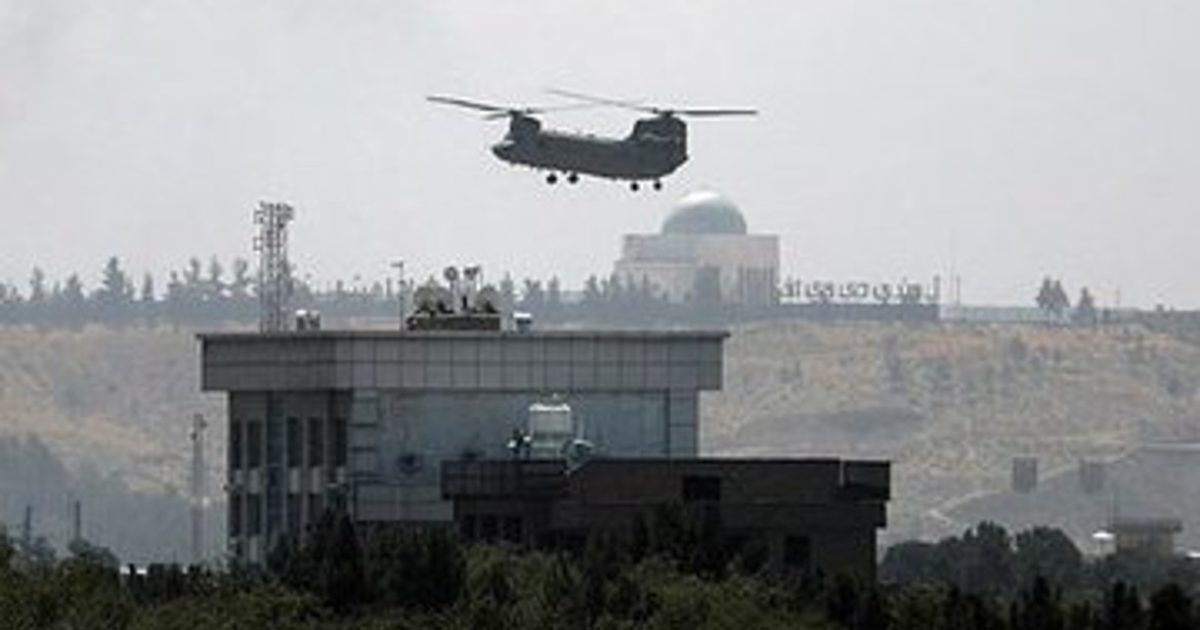
A Boeing CH-47 Chinook transport helicopter appears over the U.S. embassy compound in Kabul, 15 Aug 2021. Image from Twitter via libertyunyielding.com
This century has already seen its fair share of great delusions, society-changing disasters built on wishful thinking: you can loan mortgages to people who obviously can’t pay them back; you can cure pain with an opiate that won’t make people addicted; and now the unstoppable idea of equality of outcomes between races, a project doomed to failure and tragedy.
But none was perhaps so spectacularly disastrous as liberal imperialism. Twenty years ago, George W Bush sent the most powerful military the world had ever seen into the birthplace of Abraham to overthrow Saddam Hussein, and as Niall Ferguson wrote in the Wall Street Journal at the time: “the greatest empire of the modern times has come into existence without the American people even noticing”.
The New American Empire lasted, at most, twenty years, if one counts the two falls of Kabul as brackets. This was despite enormous technological supremacy, and genuine goodwill and benevolence among many of the state-builders.
The United States was “born liberal”, as historian Louis Hartz said, even if the crime wave of the late 20th century made that a dirty word, and the “New American Empire” would spread the benefits of liberalism to grateful beneficiaries around the world.
Yet what is so striking about the imperialists of the 21st century, compared to their forebears in the 19th, was just how little interest they seemed to show in the subject people. Their naivety about human nature, and their utopian belief that people around the world just wanted “freedom”, chimed with a lack of curiosity about humanity.
To think that people around the world might not be the same, that they might not want “freedom” nor have the social structure or culture that suited democracy, might be to venture into dangerous territory. To suggest that Iraq was incapable of democracy was insulting to Iraqis, since as the US president said ahead of the war: “There was a time when many said that the cultures of Japan and Germany were incapable of sustaining democratic values. Well, they were wrong. Some say the same of Iraq today. They are mistaken.”
Yet the defeated nations in 1945 had very old, well-established institutions and very strong national identities, something Iraq did not. The latter was extremely clannish, something no one seemed to consider. Sovereignty and strong institutions take generations to build, and cannot just be imposed by foreigners working on abstract principles like “democracy”.
Bush was not alone. That same year, John McCain had said: “There is not a history of clashes that are violent between Sunnis and Shias, so I think they can probably get along”. And on March 1, 2003, two weeks before the war started, Bill Kristol, editor of the Weekly Standard, had dismissed warnings about sectarian conflict: “We talk here about Shiites and Sunnis as if they’ve never lived together. Most Arab countries have Shiites and Sunnis, and a lot of them live perfectly well together.” On top of that, “Very few wars in American history were prepared better or more thoroughly than this one by this president.” He was totally wrong, while in contrast the American Conservative‘s pessimistic warnings about Iraq’s social fabric proved correct.
When 1 Ship Saved 30 others – The Sacrifice of Jervis Bay
Historigraph
Published 25 Nov 2022On the morning of November 5th 1940, the British merchant convoy HX84 was spotted and attacked by a German pocket battleship. Faced with the destruction of 37 merchant ships and a heavy blow against Britain’s survival, it fell to HMS Jervis Bay, the convoy’s only escort, to charge the enemy ship head on and at all costs buy some time for the merchant ships to escape.
(more…)
QotD: The world of “Plum”
The maestro also knew a thing or two about politics. This is strange, for few of his nearly one hundred novels, short stories or plays betray more than a nodding acquaintanceship with the great upheavals of the 20th century. Enquiring deeper, the connoisseur will find that his eternal creation, Jeeves — the discreet, silent, valet-cum-butler extraordinaire — was named in honour of a popular English cricketer who died on the Somme in 1916. The subject himself, in a post-1945 volume, admitted to his employer Bertie Wooster that he had “dabbled somewhat in the Commandos” during the Second World Conflagration.
War and turmoil are there, lurking in the background, if successfully banished from much of his writing. Sadly, Pelham Grenville (forenames he hated, so adopted the moniker “Plum” instead) was naïve. Loafing professionally in France when the Wehrmacht knocked on his door for tea and crumpets in 1940, he and his wife were interned as enemy aliens. In 1941, Plum agreed to record five broadcasts to the USA, then neutral. Entitled How to be an Internee without previous Training, they comprised playful anecdotes about his experiences as a prisoner of the folk in field grey. I’ve read them. They are rib-tickling and harmless, and his American readers lapped them up. Alas, his British fan club took a different view.
The devotees of Bertie Wooster, Reginald Jeeves, the Earl of Emsworth, Sir Roderick Glossop and Co. were at first stunned, then vexed and finally branded the poor author a traitor. Although a post-war MI5 investigation exonerated him, a hurt Wodehouse thereafter lived in exile on Long Island. Fortunately for us, the flow of humour continued unabated, but Plum’s hard-earned Knighthood for conjuring up the essence of Bottled Englishness was long delayed until the New Year’s Honours of 1975. He died soon after, on St Valentine’s Day, aged ninety-three.
This lapse of judgement was all the more extraordinary given his ability to spot a scoundrel at one hundred paces. Threats to the serene, ordered nature of English society in which he resided — indeed helped to create — were few. In Wodehouse’s Garden of Eden, there is a definite hierarchy of earls and aunts, bishops, baronets and young blades, stationmasters and policemen.
The majority of his tales are set in country houses, replete with conservatories, libraries, gun rooms, stables and butler’s pantries. Letters arrive by several posts a day, telegrams by the hour. Trains run on time from village stations. Other than the pinching of policemens’ helmets, there is order and serenity. Necklaces are filched, silverware is purloined, butlers snaffle port, chums are impersonated, romances develop in rose gardens, but nothing lurks to fundamentally reorder society.
Peter Caddick-Adams, “Coups and coronets”, The Critic, 2022-12-13.
March 19, 2023
Ron DeSantis as an American Neville Chamberlain
Andrew Sullivan points out the inanity of comparing Florida Governor and potential presidential candidate to former British PM Neville Chamberlain over DeSantis not including the idea of increasing support to Ukraine as “a new Munich”:

Governor Ron DeSantis speaking with attendees at the 2021 Student Action Summit hosted by Turning Point USA at the Tampa Convention Center in Tampa, Florida on 18 July, 2021.
Photo by Gage Skidmore via Wikimedia Commons.
For a written statement on foreign policy from a potential presidential candidate, it was, I suppose, a big deal. The salient sentence from Governor Ron DeSantis:
While the U.S. has many vital national interests — securing our borders, addressing the crisis of readiness with our military, achieving energy security and independence, and checking the economic, cultural and military power of the Chinese Communist Party — becoming further entangled in a territorial dispute between Ukraine and Russia is not one of them.
It’s open to some interpretation. DeSantis says the Ukraine war is not in the “vital national interests” of the US, but is it maybe still in our general interests? Not clear. And he commits to no further entanglement, which could mean sticking with where we are now, but no more. Sure: no F-16s. But that’s also Biden’s position.
“Territorial dispute?” That set a lot of people off. But of course it’s undeniably, at some level, a border dispute. The entire post-Soviet settlement was a redrawing of national borders — and marked an extraordinarily rapid advance of Western arms and allies to the edge of Russia itself. In any kind of perspective, the current war has come at the end of that now-disputed settlement, and is indeed a debate over where Russia ends and Ukraine — which literally means “borderland” — begins. DeSantis didn’t blame Ukraine for its self-defense. He didn’t defend Putin. He merely proffered a different view of vital US national interests in the medium-term.
The gall!
The Blob declared another “Munich!” — an ancient neocon ritual — and declared the DeSantis candidacy all-but-over. Chris Christie called DeSantis “Neville Chamberlain“; Chuck Schumer asked, “I have to wonder what [DeSantis] would’ve thought if he was around in the 1930s”; Jenn Rubin called DeSantis “pro-Putin“; and the WSJ warned of a return to “isolationism in the 1930s”. This morning, the WaPo dusted down and wheeled out their perennial “appeasement!” editorial. And we got a French-Brooks double-whammy direct from 1983. Churchill envy never dies.
And I’m sorry. But I don’t get it. It is surely perfectly fine for a country to have two political parties that differ on foreign policy. In fact, it’s a critical advantage that democracies have over more rigid regimes: it helps us correct mistakes in time (and sometimes not), change personnel, and adjust to an always changing reality.
And in the 21st century, after the collapse of the imperial ideologies of the 20th, the role and reach of the United States is legitimately open to debate. It makes sense that one party would be more interventionist and one would be less so; it makes even more sense for the conservative party to be the one more skeptical of wars, small and large, and the unintended consequences they invariably entail.
That’s what’s happening — partly in reaction to the catastrophic, and bipartisan, hyper-interventionism of the first two decades of this century, and partly because of the rise of China. And it’s a good, normalizing thing. It will keep pressure on Biden not to escalate any further; and force us to think through the ugly compromises that will almost certainly confront us in the future. DeSantis’ position is pretty much where Obama was on Ukraine — and Obama was not some far-right fanatic. Money quote:
The fact is that Ukraine, which is a non-NATO country, is going to be vulnerable to military domination by Russia no matter what we do. … We have to be very clear about what our core interests are and what we are willing to go to war for. And at the end of the day, there’s always going to be some ambiguity.
Replace “core” with “vital” and it’s DeSantis’ outrageous position. Yes, Putin miscalculated badly and invaded Ukraine, which means a new situation, and defense of Ukraine. But the core reality of America’s and Russia’s interests is unchanged. And Putin is not in command of a huge war economy and occupying the Sudetenland. He’s stuck in Eastern Ukraine, for Pete’s sake, and can barely move. China is maneuvering to counter and exploit our escalation. We need flexibility. What we absolutely do not need is some kind of shrill, bipartisan consensus on yet another war — and the usual McCarthyite smears of critics.
The Japanese Invade India! – WW2 – Week 238 – March 18, 1944
World War Two
Published 18 Mar 2023Operation U-Go, Renya Mutaguchi’s invasion of India, is in full swing this week, as his men aim at Imphal and Kohima; three Soviets Fronts batter their way through the Axis positions all over Ukraine; and there is a huge Allied bombing campaign at Cassino in Italy, which mistakenly kills a lot of Allied soldiers. That’s one busy week.
(more…)
Disagree with the Canadian government’s attempt to take over significant parts of the internet? Get ready for administrative punishment, citizens!
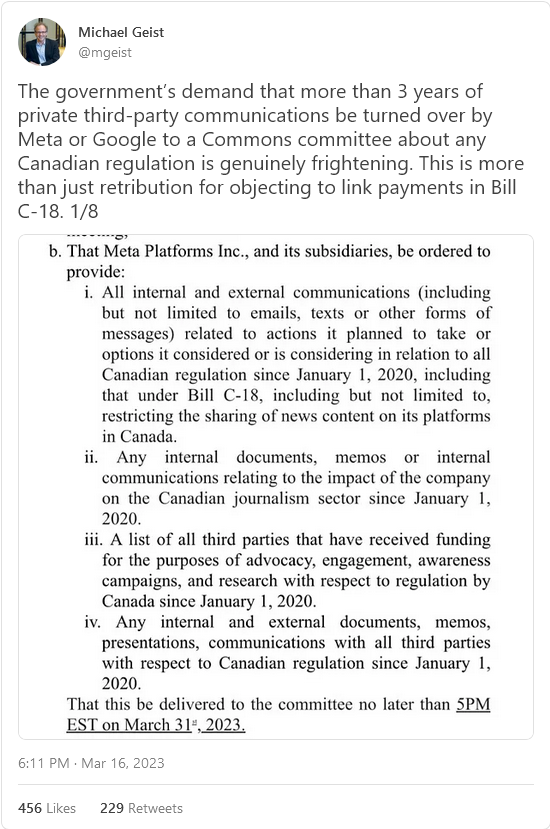
Michael Geist, who often seems like the only person paying close attention to the Canadian government’s growing authoritarian attitudes to Canadians’ internet usage, shows the utter hypocrisy of the feds demanding access to a vast array of private and corporate information on a two-week deadline, when it can take literally years for them to respond to a request for access to government information:

Senator Joe McCarthy would be in awe of the Canadian government’s audacious power grab.
Library of Congress photo via Wikimedia Commons.
The government plans to introduce a motion next week requiring Google and Facebook to turn over years of private third-party communication involving any Canadian regulation. The move represents more than just a remarkable escalation of its battle against the two tech companies for opposing Bill C-18 and considering blocking news sharing or linking in light of demands for hundreds of millions in payments. The motion – to be introduced by the Parliamentary Secretary to the Minister of Canadian Heritage (yes, that guy) – calls for a series of hearings on what it describes as “current and ongoing use of intimidation and subversion tactics to avoid regulation in Canada”. In the context of Bill C-18, those tactics amount to little more than making the business choice that Heritage Minister Pablo Rodriguez made clear was a function of his bill: if you link to content, you fall within the scope of the law and must pay. If you don’t link, you are out of scope.
While the same committee initially blocked Facebook from even appearing on Bill C-18 (Liberal MP Anthony Housefather said he was ready for clause-by-clause review after just four hearings and no Facebook invitation), bringing the companies to committee to investigate the implications of their plans is a reasonable approach. But the motion isn’t just about calling executives before committee to answer questions from what will no doubt be a hostile group of MPs. The same motion sweeps in the private communications of thousands of Canadians, which is a stunning disregard for privacy and which could have a dangerous chilling effect on public participation. Indeed, the intent seems fairly clear: guilt by association for anyone who dares to communicate with these companies with an attempt to undermine critics by casting doubt on their motivations. Note that this approach is only aimed at those that criticize government legislation. There has been a painfully obvious lobbying campaign in support of the bill within some Canadian media outlets, but there are no efforts to uncover potential bias or funding for those that speak out in favour of Bill C-18, Bill C-11, or other digital policy initiatives.
It is hard to overstate the broad scope of the disclosure demands. Canadian digital creators concerned with Bill C-11 who wrote to Youtube would find their correspondence disclosed to the committee. So would researchers who sought access to data from Google or Facebook on issues such as police access to social media records or anti-hate groups who contacted Facebook regarding the government’s online harms proposal for automated reports to law enforcement. Privacy advocates focused on how Google administers the right to be forgotten in Canada would ironically find their correspondence disclosed as would independent media sites that wrote to Facebook about the implications of Bill C-18.
Inside An M4 Sherman Tank With Historian James Holland
History Hit
Published 21 Nov 2022‘Inside An M4 Sherman Tank With Historian James Holland’
In this video, military historian James Holland gets inside the most iconic tank of the Second World War — the ubiquitous US M4 Sherman Tank.
With over 50,000 having produced between 1942 and 1945, the Sherman was the most widely used medium tank by the United States and Western Allies in World War II.
Easily produced, maintained and equipped with a 75mm gun as well as a single hatch-mounted .50 caliber machine gun (plus two lighter .30 cals positioned in the turret and forward hull), the Sherman proved extremely effective against soft targets. It still lacked the range and firepower of the German Panther and Tiger tanks, but its speed, manoeuvrability and fast rate of fire made it ideal wartime workhorse.
More recently, the M4 Sherman has risen to stardom with the release of Hollywood blockbuster Fury (2014), starring Brad Pitt and Shia LaBeouf.
(more…)
QotD: Are we re-enacting the “Crisis of the Third Century” or “Fall of the Roman Empire” this time?
Again, my knowledge of the topic is pretty weak, but y’all know that in general I believe inertia is one of the strongest forces in human affairs (just behind accident and error). What can’t continue, won’t … eventually, but there’s a lot of give in “can’t”. The “collapse” of the 5th century looked an awful lot like the “crisis” of the 3rd century, and not only did the Empire survive the third century crisis, in many ways it came back stronger than ever (one wonders what golden age might’ve been born had Aurelian lived).
It certainly does seem like we’re heading into a major crisis (yeah yeah, I know, thanks Nostradamus). Is it The End, or “merely” the Third Century Crisis? One wonders how it’s going down there in Brazil, and if there are any cagey young officers in the AINO Imperial Garrisons taking notes. The guys who grabbed the purple in the Third Century Crisis were called “the barracks emperors” for a reason, and we know (from the comments yesterday) that there are cabals of perverts alive and well in the officer corps.
2023 is shaping up to be really interesting. Ace of Grillers has done some reporting on the fossil fuel-intensive “Green” private jet flights of our beloved Transportation Secretary, Anal Pete. AOG thinks this is pretty obviously the butt bandit announcing his 2024 presidential run, and it’s hard to argue against it. Frankly I’m amazed Brandon has survived this long — is Dr. Jill that canny a political infighter, or is it just dumb luck that no one has felt the need to finish him off? — but it’s hard to see him making it too far into 2024. Veep Throat is of course running; we have yet to see Z Man’s predicted replacement of her with Gavin Hairgel, but I’m sure he’s in, too …
Frankly, I’m rooting for the Russians. You really want the wheels to come off, then start cheering for a big winter offensive from Ivan. Provided AINO doesn’t start cracking off nukes — a big, big IF — nothing would force the crisis like our “victory or death!” Juggalos getting their asses handed to them in the Donbas. The Z Man thinks they’ll pull a Ngo Dinh Diem on the Jewish Comedian here before too long; I wonder if they’ll even get the chance, or if it would matter if they did. I’m pretty sure Vlad’s done talking, if for no other reason than that he knows whatever faction of Juggalos he cuts a deal with will be betrayed by some other Juggalo faction. Unless the AINO peace proposals come written in the still-hot blood of a shitload of Kagans, he has zero reason to negotiate. And since The Media is still all in on their “total Ukrainian victory is just around the corner!” narrative …
Severian, “Friday Mailbag”, Founding Questions, 2022-12-16.
March 18, 2023
Tales of the Metaverse
Ted Gioia wonders if Metaverse is doing badly enough to seriously harm Facebook itself:

When Facebook changed it’s name to Meta back in 2021, I made a gloomy prediction:
“Meta is for losers,” I announced. “Mark Zuckerberg is betting his company on a new idea — but this is a wager he will almost certainly regret.”
I revisited the situation in December, and pointed out all the ways Meta wasn’t just dying in the metaverse. It was also ruining its base business, the Facebook platform.
The company kept making the same mistake as so many other aging websites — instead of serving users they want to control them. The end result is a seeming paradox: the more money the company spends, the worse the user experience becomes.
In the article, I gave a dozen examples — and after it was published many readers shared their own horror stories.
Here’s just one anecdote, out of many:
Try to sign up for Facebook Dating and then try to leave. They won’t let you. A friend of mine recently used it, and now is unable to remove herself totally from the feature. She was allowed to remove all of her pictures, however, she was not permitted to remove her dating profile and picture, which really distressed her. She didn’t want any record of it.
What a great concept. You can meet somebody special, fall in love, get married, and raise a family — but years later you’re still on the Facebook dating app.
It seems ridiculous. But Meta really, really doesn’t like you to opt out of features. Their dream is to operate a virtual Hotel California, where — as the lyrics warn, “you can check out any time you want, but you can never leave”.
Hey, maybe that’s why Mark Zuckerberg won’t let you have legs in his metaverse.
Why isn’t this bold new strategy working? It certainly isn’t for lack of investment. Meta is reportedly spending one billion dollars per month on the project.
But sometimes you can fail even with the right concept — simply because the technology just isn’t ready for the mass market.
[…]
A year-and-a-half after his corporate makeover, the situation at Meta is more dire than ever. Back in October 2021, Facebook shares were trading above $340, but now they are below $200 — that’s a loss of around $300 billion in market value.
But here again, the real problem is the user experience.
“On my initial visits, the metaverse seems sort of desolate, like an abandoned mall,” writes Paul Murray in New York magazine.
[…]
Mark Zuckerberg seems hellbent on pursuing an even more embarrassing fate. His bet on the metaverse may turn into the biggest cash sinkhole in the history of capitalism. Already the Edsel and New Coke look like tiny peccadilloes by comparison.
Even if he keeps his job, he may want to go hide. Fortunately, he has a huge metaverse at his disposal where that has become surprising easy to do.
“Strongmen” all run the same basic “playbook” says scholar
Chris Bray considers the arguments made by Ruth Ben-Ghiat that ropes every “strongman” together into a single, coherent strategy that applies at all times and under all circumstances:
Holocaust scholars have always argued from every possible perspective, and will always argue from every possible perspective, about causation. There’s a school gathered around “No Hitler, no Holocaust”, and there’s Zygmunt Bauman, who barely mentions the man in an argument about the inherently dehumanizing tendencies of the modern bureaucratic state. Christopher Browning depicts a battalion of Order Police participating in state-organized mass killing because of cowardice, habitual obedience, and social compliance; Daniel Goldhagen replies that no, Germans killed Jews because Germans hated Jews, full stop. But in this extraordinary diversity of voices, there is argument. If you ask, why did this happen?, many answers follow — growing out of questions about the operation of power, the limits of moral agency, the basic human willingness to comply, and so on, that aren’t easy to answer.
Then comes 21st century American political scholarship.
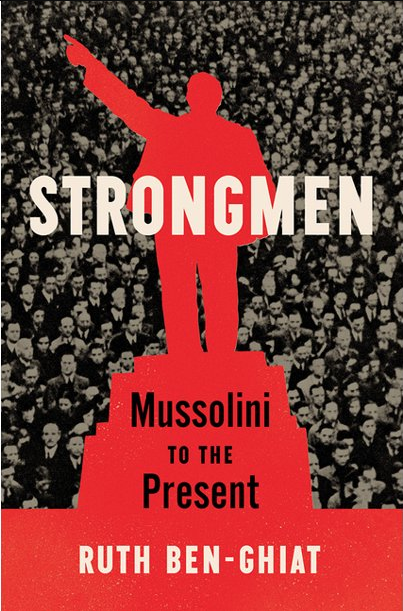
Here’s how the publisher explains this book:
Ruth Ben-Ghiat is the expert on the “strongman” playbook employed by authoritarian demagogues from Mussolini to Putin—enabling her to predict with uncanny accuracy the recent experience in America and Europe. In Strongmen, she lays bare the blueprint these leaders have followed over the past 100 years, and empowers us to recognize, resist, and prevent their disastrous rule in the future …
Vladimir Putin and Mobutu Sese Seko’s kleptocracies, Augusto Pinochet’s torture sites, Benito Mussolini and Muammar Gaddafi’s systems of sexual exploitation, and Silvio Berlusconi and Donald Trump’s relentless misinformation: all show how authoritarian rule, far from ensuring stability, is marked by destructive chaos.
All that stuff is the same, see, “from Mussolini to Putin”. Pinochet and Berlusconi are the same, Russia and Italy are the same, new postcolonial nations and old reborn nations are the same, resource economies and service economies are the same, 1922 is 2016, modern culture is postmodern culture, mass media is social media — all in a blended mass of social reality and cultural factors, turning the March on Rome and mean tweets into the same “playbook”, which is also the same “blueprint”.
What caused the Bolshevik revolution? Lenin said so. What caused the Holocaust? Hitler said so. Why was there political violence in Chile? Pinochet said so. You can see the richness and complexity of single-actor history with blueprints and playbooks.
Turning the urgent precision of this analysis to the task of understanding contemporary politics, scholars know that Trump’s personality is very bad, but is DeSantis more badderer in the badness of his mean and bad personality? Does he use the playbook, exactly like Lenin and Mobutu Sese Seko? Is he running Florida just like the Congo? (Is Kristi Noem precisely identical to Joe Stalin, Idi Amin, and Tiberius? Depends on how she does in the primaries.)
It’s politics without politics, stripped of systems, processes, principles, historical uniqueness, geographic and economic factors, and competing forces in culture and society. Political power is a weight falling off a table onto a lever; the leader acts, his instruments are acted upon, and the machine of society moves according to the force and direction applied by the leader. Is it significant that our particular political moment is postindustrial, urbanizing, and increasingly made up of social and economic interactions mediated through an electronic screen? No, Trump is using Lenin’s playbook. Politics is all the same, and entirely about names and personalities.
If not “woke”, then what should we call it?
Freddie deBoer devoutly hopes for a proper term to use instead of the by-now highly pejorative term “woke”:
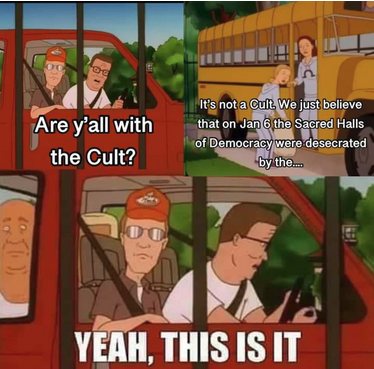
As I have said many times, I don’t like using the term “woke” myself, not without qualification or quotation marks. It’s too much of a culture war pinball and now deemed too pejorative to be useful. I much, much prefer the term “social justice politics” to refer to the school of politics that is typically referred to as woke, out of a desire to be neutral in terminology. However: there is such a school of politics, it’s absurd that so many people pretend not to know what woke means, and the problem could be easily solved if people who support woke politics would adopt a name for others to use. No to woke, no to identity politics, no to political correctness, fine: PICK SOMETHING. The fact that they steadfastly refuse to do so is a function of their feeling that they shouldn’t have to do politics like everyone else. But they do. And their resistance to doing politics is why, three years after a supposed “reckoning”, nothing has really changed. (If there’s no such thing as the social justice politics movement, who made the protests and unrest of 2020 happen? The fucking Democrats?)
The conceit is that “woke” has even shaggier or vaguer boundaries than “liberal”, “fascist”, “conservative”, or “moderate”. And I just don’t think that’s true.
“Woke” or “wokeness” refers to a school of social and cultural liberalism that has become the dominant discourse in left-of-center spaces in American intellectual life. It reflects trends and fashions that emerged over time from left activist and academic spaces and became mainstream, indeed hegemonic, among American progressives in the 2010s. “Wokeness” centers “the personal is political” at the heart of all politics and treats political action as inherently a matter of personal moral hygiene — woke isn’t something you do, it’s something you are. Correspondingly all of politics can be decomposed down to the right thoughts and right utterances of enlightened people. Persuasion and compromise are contrary to this vision of moral hygiene and thus are deprecated. Correct thoughts are enforced through a system of mutual surveillance, one which takes advantage of the affordances of internet technology to surveil and then punish. Since politics is not a matter of arriving at the least-bad alternative through an adversarial process but rather a matter of understanding and inhabiting an elevated moral station, there are no crises of conscience or necessary evils.
The US Adopts A Maxim: The Colt Model 1904
Forgotten Weapons
Published 9 Nov 2022The US Army spent nearly 16 years languidly testing the Maxim gun, but was never willing to actually make a decision until a final trial in 1903 finally settled the matter. The Maxim was deemed the best available machine gun and a contract was signed with Vickers, Sons, & Maxim to purchase 50 (later increased to 90). Eventually a total of 287 were procured; 90 from VSM and a further 197 made by Colt in the US. The first British guns were chambered for .30-03, with the Colts all made for the later .30-06 (and the VSM guns updated to that standard).
The Model 1904 was the heaviest Maxim gun ever made, weighing in at 62 pounds for the gun and another 80 for its tripod. Despite excellent reliability and durability, it was so heavy and unwieldy that it was pretty universally hated by American soldiers. The final order for 1904 Maxims was placed in 1908 and just the following year the M1909 Benet Mercie light Hotchkiss pattern was was adopted. By the time World War One arrived, half the Maxims had already been relegated to long-term storage. They were pulled out of the warehouses for training troops prior to their deployment to Europe, but they never saw any more significant military use.
(more…)


