
The reason this matters is: The whole thing now — St. George Floyd, the Kung Flu, the Seattle “autonomous zone”, all of it — is being portrayed as the revolt of the New New Left against the Old Left. It’s Alexandria Ocasio-Cortez vs. Nancy Pelosi (born 1940) … but lost in all of this is the fact that the next generation to take power won’t be the Millennials, it’ll be the Gen Xers. Those people born between 1965 and 1980(-ish)? You know, the “Slackers”? Did we all just kinda, umm, forget about them?
That’s your next layer of political and social control. The youngest of us are in their late 30s (again, using the broadest definition); most of us are well into middle age, and some of us are plunging headfirst into late middle age. The chiefs of police, the military’s senior staff officers (including, by now, some general and flag officers), the CEOs and CFOs … they’re not Millennials, they’re Xers.
Admittedly we’re a forgettable bunch. We didn’t get a chance at natural, healthy teenage rebellion, because our parents, the goddamn Boomers, claimed a monopoly on rebellion, so we had to be all, you know, like, whatever about it. The Boomers thought Andy Warhol was a serious artist and Bob Dylan a talented musician; is it any wonder that Kurt Cobain’s godawful caterwauling was the best we could do?
All of that is water under the bridge, of course. But here’s where it gets really, really meta: This great social upheaval is, for us, a copy of a copy. It’s people who were actually alive in the 1960s cosplaying The Sixties™ — just like they did the entire time we were growing up. Just as we had no template for teenage rebellion, we don’t really have a template for riots and whatnot either. Some of us have decided to crank it up to eleven — all of the most obnoxious Karens are Gen Xers — but lots of us … haven’t. I really have no idea just what the majority of my generational cohort is doing right now while our most vocal idiots are out Karening, in much the same way I have no idea what the majority of Silents were doing while the Chicago Seven were out doing their thing.
All I know is, there’s an entire layer of political power between AOC and Pelosi. We haven’t really seen it up until now, but it’s there. Is Gen X finally, at long last, going to get its shit together? I suspect that the real drama is still waiting in the wings.
Severian, “Talkin’ ’bout My Generation!”, Rotten Chestnuts, 2020-06-11.
March 15, 2023
QotD: The coming generation isn’t the Millennials … it’s Gen X
March 14, 2023
“Strangely, my friends have a more negative view of the feminist movement than I do”
Bryan Caplan explains why he chooses to write the books he writes:

Almost by definition, writing controversial books tends to provoke negative emotional reactions. Anger above all. Anger which, in turn, inspires fear. And not without just cause; the sad story of Salman Rushdie sends shivers down the spine of almost any writer. If you write controversial books — or care about someone who does — you should be at least a little afraid of the anger your writing inspires.
[…]
In contrast, when I announced the imminent publication of Don’t Be a Feminist, the fear went through the roof. Several folks warned me of “career suicide”. Others told me that I had no idea what horrors awaited me. Friends staged mini-interventions on my behalf.
The underlying premise, naturally, was that the feminist movement is at once terribly powerful and horribly bad-tempered.
My best guess is that the warnings are overblown. Strangely, my friends have a more negative view of the feminist movement than I do. Whether my guess is right or wrong, though, all this intense, widespread fear really ought to trouble the feminist conscience.
If I said, “Hi” to one of my kids’ friends, and they responded by fleeing in terror, my reaction would be, “Did I do something to scare him?” I would ask my kids, “Why was he so afraid of me?” If such incidents started to repeat, I would be severely troubled. “I thought I came off as a friendly dad, but I guess I’m seen as an ogre.”
The same applies if I were a feminist, and I discovered that critics are literally afraid to criticize feminism. If only a few critics feared feminism, my question would be, “What did we do to scare them?” If I discovered that fear of feminism was widespread, a full soul-search would be in order. “I thought we came off as a friendly movement, but I guess we’re seen as ogres.”
And guess what? Fear of feminism plainly is widespread.
What, then, are feminists doing wrong? Above all, cultivating and expressing vastly too much anger. Sharing your angry feelings is an effective way to dominate the social world, but a terrible way to discover the truth or sincerely convince others. Maybe you don’t mean to scare others; maybe you’re just acting impulsively. Yet either way, the fear feminists inspire is all too real.
Social media, selfies, and depression
In The Free Press, Jonathan Haidt notes the inflection point at which young liberal women started to become depressed at a much higher rate than the rest of the population — a trend that has continued for over a decade:
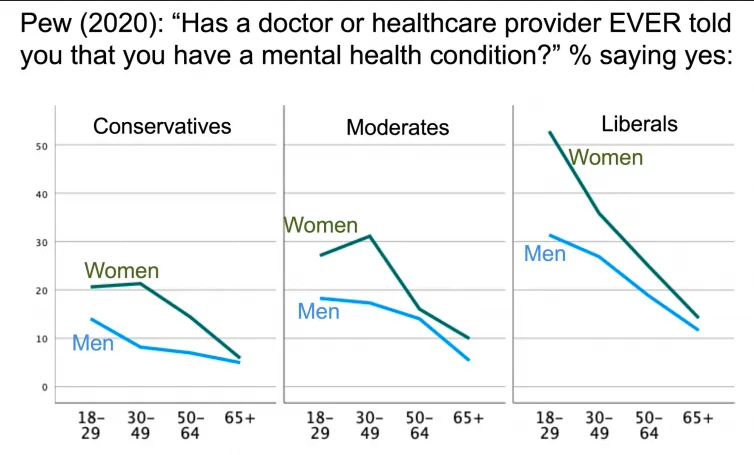
In September 2020, Zach Goldberg, who was then a graduate student at Georgia State University, discovered something interesting in a dataset made public by Pew Research. Pew surveyed about 12,000 people in March 2020, during the first month of the COVID shutdowns. The survey included this item: “Has a doctor or other healthcare provider EVER told you that you have a mental health condition?” Goldberg graphed the percentage of respondents who said “yes” to that item as a function of their self-placement on the liberal-conservative 5-point scale and found that white liberals were much more likely to say yes than white moderates and conservatives. (His analyses for non-white groups generally found small or inconsistent relationships with politics.)
I wrote to Goldberg and asked him to redo it for men and women separately, and for young vs. old separately. He did, and he found that the relationship to politics was much stronger for young (white) women. You can see Goldberg’s graph here, but I find it hard to interpret a three-way interaction using bar charts, so I downloaded the Pew dataset and created line graphs, which make it easier to interpret.
Here’s the same data, showing three main effects: gender (women higher), age (youngest groups higher), and politics (liberals higher). The graphs also show three two-way interactions (young women higher, liberal women higher, young liberals higher). And there’s an important three-way interaction: it is the young liberal women who are highest. They are so high that a majority of them said yes, they had been told that they have a mental health condition.
Data from Pew Research, American Trends Panel Wave 64. The survey was fielded March 19–24, 2020.
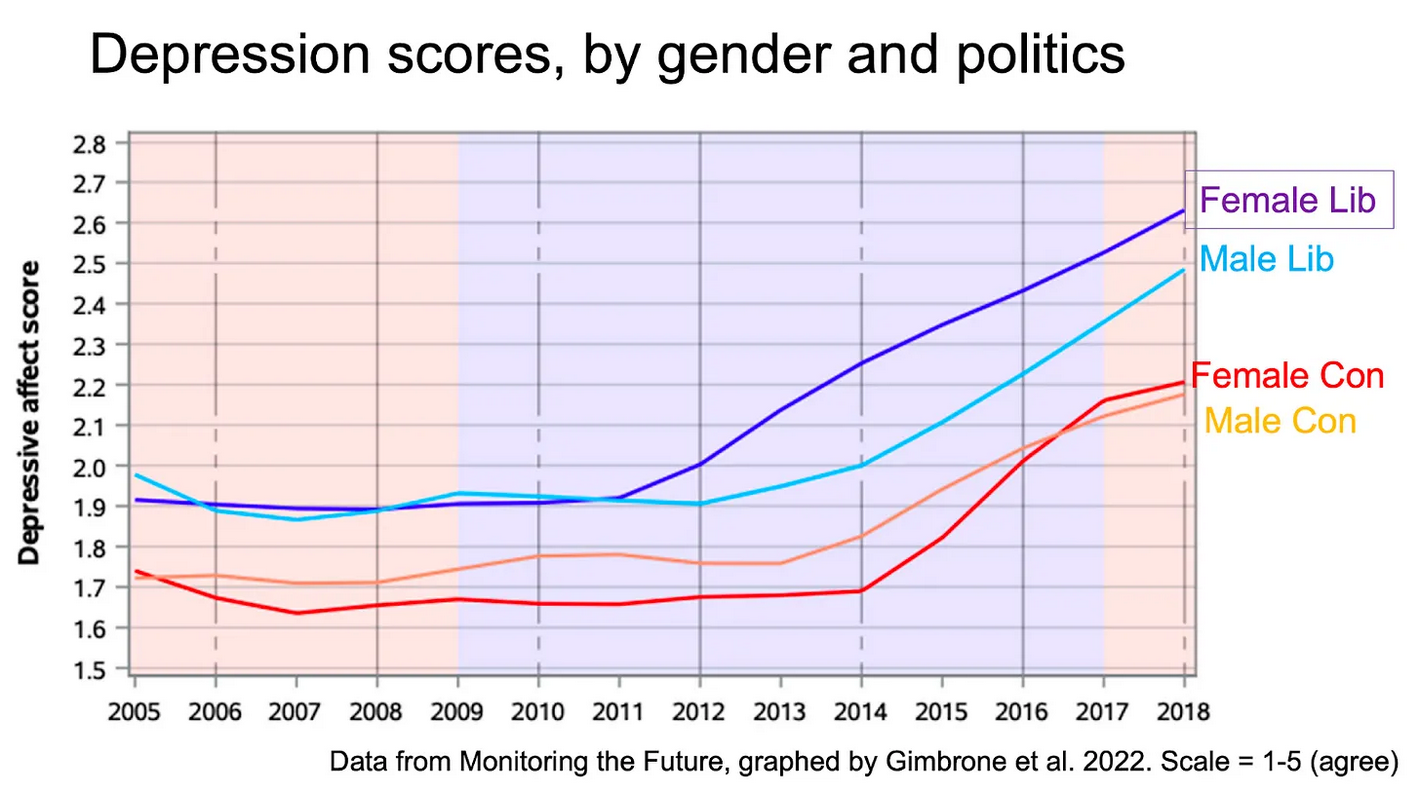
Graphed by Jon Haidt.In recent weeks — since the publication of the CDC’s report on the high and rising rates of depression and anxiety among teens — there has been a lot of attention to a different study that shows the gender-by-politics interaction — Gimbrone, Bates, Prins & Keyes (2022), titled: “The politics of depression: Diverging trends in internalizing symptoms among US adolescents by political beliefs”. Gimbrone et al. examined trends in the Monitoring the Future dataset, which is the only major U.S. survey of adolescents that asks high school students (seniors) to self-identify as liberal or conservative (using a 5-point scale). The survey asks four items about mood/depression. Gimbrone et al. found that prior to 2012 there were no sex differences and only a small difference between liberals and conservatives. But beginning in 2012, the liberal girls began to rise, and they rose the most. The other three groups followed suit, although none rose as much, in absolute terms, as did the liberal girls (who rose .73 points since 2010, on a 5-point scale where the standard deviation is .89).
Data from Monitoring the Future, graphed by Gimbrone et al. (2022). The scale runs from 1 (minimum) to 5 (maximum).
The authors of the study try to explain the fact that liberals rise first and most in terms of the terrible things that conservatives were doing during Obama’s second term, e.g.,
Liberal adolescents may have therefore experienced alienation within a growing conservative political climate such that their mental health suffered in comparison to that of their conservative peers whose hegemonic views were flourishing.
The progressive New York Times columnist Michelle Goldberg took up the question and wrote a superb essay making the argument that teen mental health is not and must not become a partisan issue. She dismissed Gimbrone et al.’s explanation as having a poor fit with their own data:
Barack Obama was re-elected in 2012. In 2013, the Supreme Court extended gay marriage rights. It was hard to draw a direct link between that period’s political events and teenage depression, which in 2012 started an increase that has continued, unabated, until today.
After examining the evidence, including the fact that the same trends happened at the same time in Britain, Canada, and Australia, Goldberg concluded that “Technology, not politics, was what changed in all these countries around 2012. That was the year that Facebook bought Instagram and the word ‘selfie’ entered the popular lexicon.”
Turkey has always been the awkward ally in NATO, but for how much longer?
In Strategika, Zafiris Rossidis examines the shift of Turkish sentiment away from its longstanding role in the NATO alliance and toward a more Russian-friendly and more independent stance in international affairs:

Turkish flag.
Photo by Burak Su via Wikimedia Commons.
A poll conducted in December 2022 by the Turkish company Gezici found that 72.8% of Turkish citizens polled were in favor of good relations with Russia. By comparison, nearly 90% perceive the United States as a hostile country. It also revealed that 24.2% of citizens believe that Russia is hostile, while 62.6% believe that Russia is a friendly country. Similarly, more than 60% of respondents said that Russia contributes positively to the Turkish economy.
Turkey began to distance itself from the United States as early as 2003, when it refused the passage of American troops to Iraq. In 2010, it destroyed the U.S.–Israel–Turkey triangle, breaking up with Israel. In 2011, Turkey implemented a policy in Syria that was hardly in line with U.S. interests. The final distancing took place in 2016, with the July coup, for which Turkey blamed the United States.
Turkey considers itself very important to the United States but declares that Ankara can live without Washington. This concept has become the point of departure for Turkey in its quest to reconstitute the Ottoman Empire. Minister of the Interior Süleyman Soylu declares that the Turkish government will design the new world order with the help of Allah, and Western powers will eat the dust behind almighty Turkey (December 8, 2022).
According to a RAND Corporation volume on Turkey, there are four scenarios for the future of Turkish strategic orientation: 1) Turkey will remain a difficult partner for the United States; 2) Turkey will become democratic and unite with the West; 3) Turkey will be between East and West, but have better relations with powers such as China, Iran, and Russia, than with the U.S. and the EU; and 4) Turkey will completely abandon the West.
From the evidence in the case of the Russian–Ukrainian war, Russia, China, Turkey, and Iran justify the Russian invasion since NATO and the EU have designs on their neighborhood. Above all, they are united by a common hatred for the West. They are frenemies and they know it: on the contrary, the U.S. tends to invest in frenemies as if they were true friends.
The U.S. observed the rapprochement of Turkey and Russia without renouncing the traditional alliance with Turkey, which today has no longer such importance. Turkey was useful when it was an “enemy” of the USSR and the U.S. made far too many concessions for the sake of this useful enmity. In short, there is some inertia in the modification of the principle “the enemy of my enemy is my friend”, as of course “the friend of a friend is my friend”. Turkey’s role in NATO worries the U.S., as Ankara–Moscow relations have acquired some shared strategic characteristics.
?he attraction between the two countries lies in their equally authoritarian governance models and the fact that their strategic culture and operational codes bear similarities: Both countries are revisionist, aggressive, and assertive in their regions; both countries claim to be encircled, which they use as a pretext for their unilateral actions; and both countries have militarized their foreign policy, waging hybrid warfare, resorting to proxy warfare, and blackmailing countries that offer resistance. Russia and Turkey cooperate on natural gas and oil pipelines; Russia has sold weapons such as the S-400 missile system to Turkey; Russia has provided technical assistance in the construction of Turkey’s nuclear plants; the two nations have collaborated in Central Asia (i.e., Azerbaijan); they import and export each other’s commodities; and Turkey has illegally transported Russian fuel to China and Iran, thereby bypassing sanctions on Russia, to mention only a few.
But the big issue for U.S.–Turkey relations against the backdrop of the Russian–Ukrainian war has four strands: First, the issue of the important role Turkey plays in the grain export agreement, which if cancelled will create a food crisis in Africa. Second, Turkey’s blackmailing of the NATO candidacies of Sweden and Finland. Third, the Turkish application to purchase the F-16 and the possible conflict between Congress and the Biden administration over the administration’s request to grant Turkey the license to do so. Finally, Turkey’s non-adoption of NATO sanctions against Russia. The possibility of Erdoğan using a strategy of tensions with Greece (e.g., multiple violations of Greek airspace, aggressiveness in the Aegean, weaponization of immigration, threats of bombing Athens with the new “Tayfun” short-range ballistic missile) to rally the electorate around his party and detach it from any opposition — all recent polls have AKP trailing the opposition — prior to the June election is one explanation for Turkey’s behavior that is being considered by the U.S., which nonetheless is angered that Turkey is the only NATO country that has not adopted the sanctions against Russia.
German Troop Trials “Push-Button” Gewehr 41(W)
Forgotten Weapons
Published 8 Nov 2022When the German army wanted a new semiauto service rifle in 1941, it received submissions from two companies; Walther and Mauser. Walther’s design didn’t strictly meet the criteria set forth, but it was clearly the better rifle and would eventually win the competition. This involved conducting troop trials, and Walther got an initial contract for 5,000 rifles for those trials. That first batch of rifles differed in several ways from the version that was ultimately put into mass production. Most substantially, the first version of the G41(W) had a push-button bolt release on the left side of the stock. After loading two stripper clips, one would push the button to close the bolt. Of course, one could also simply pull the bolt handle back slightly and release to do the same thing — and so the bolt release button was removed to simplify production. In addition, the bolt guide rail on the receiver would be lengthened on production, optics mounting rails were added (although never really used), and the serrations on the spring guide rod were dropped.
(more…)
QotD: Facebook’s entire structure is designed to prevent information “going viral”
You might think that social media is where to go to share this very cool thing, and watch it go viral. And, in fact, that happens on Twitter and a few other platforms. I’m not always right in forecasting which things I post will go viral, but a few times every year I will share something on Twitter that grabs people’s attention so much that it gets tens of thousands of retweets and likes. Millions of people might see it.
That’s what going viral is all about.
Now here’s the kicker. I put up that same item on my Facebook author’s page, and the company will actively work to prevent people from seeing it. And adding insult (a company specialty), they will send me an alert telling me: This post could go viral if you pay us money for promoting it.
At first glance, this just seems another way to maximize profits. And who can blame Mark Zuckerberg for wanting to get a few more dollars in his bank account? Let’s feel some pity for a guy who just lost $100 billion.
But the real devastating part of this story is that Facebook is actually preventing users from sharing the funniest joke in the world. Facebook actually hates seeing some videos go viral, even if they are the most amusing things on the web. Every day they work to prevent folks from seeing a mind-blowing photo — and many other things that can’t be monetized.
This can’t be good for the user experience. This can’t be what users want, or what they would tell the company in a focus group or via market research.
And it certainly can’t be good for business.
So I’m amused when I hear how Facebook is envious of TikTok, which has much superior user engagement. Well, duh. Of course TikTok has greater engagement — that’s because Facebook has put systems in place to prevent entertaining things from going viral. They are now scrambling to work around this tiny detail, but they won’t succeed.
I’ve reduced my Facebook posts by at least 70%, and this was the main reason. I can’t be the only person who has responded in this way.
It’s not in the company’s DNA to promote interesting things on its platform. That’s why I wasn’t surprised when Facebook’s recent attempt to imitate Substack collapsed in total failure. I knew that would happen on day one — because Facebook will never let writers go viral on the platform. Mr. Z. wants to get paid before anything goes viral, and that’s the exact opposite of Substack’s successful formula — which rewards the creator more than the platform.
When Facebook initially launched this touted publishing platform, somebody asked me what I thought about it. “Facebook has the power to give a writer access to millions of readers,” I replied, “but they will never let it happen. The entire internal structure of the company is designed to prevent this.”
The speed of the collapse, however, was surprising. Facebook announced the launch of Bulletin on June 29, 2021. Facebook announced the termination of Bulletin on October 4, 2022.
Even King Henry VIII’s wives lasted longer than that.
Ted Gioia, “How Web Platforms Collapse”, The Honest Broker, 2022-12-05.
March 13, 2023
People in high places like “Pryam Farll”
Elizabeth Nickson on the kakistocratic “elites” of the west and the dangerous policies they’ve been pushing:

How our leaders are seen by the people, their prey.
Around early Trump, a character calling himself Pryam Farll acquired a host of “friends” on Facebook among the most influential intellectual activist/writers on the right. He claimed to be a member of the Danish Royal Family, related to Prince Phillip, who spent Christmas at Sandringham, mentored Prince Harry and who read Putin’s email. He hated Putin with all his strength, claimed to be a General in US Intelligence, had worked in Reagan White House, and spent his time dropping into NATO, the EU, and Defence Departments in countries adjacent to Russia in the service of marshalling power against Putin, surrounding him with armies and bases and, as it turns out, bioweapons labs. He was also, tongue-in-cheek, “6’8″, devastatingly handsome and mind-blowingly rich”. He posted a dozen times a day, hilarious, way too bright, and substantive. Around the time that the first lie emerged about the Russia Hoax, which he claimed to have helped invent, he said he was in at the War Office in Romania, and to “start no trouble whilst he worked”.
Then he vanished.
And whether he was a genius kid in the basement or a mock-up by MI6 counter-intelligence meant to influence the influential, he serves as a type, the type that got us into this mess, where we are ghost-walking into nuclear conflict. The British since McKinder have had it out for the Russians and Russia-hate is baked into their intellectual class. Did the U.S. blow up Nordstream? Maybe, maybe not, but we very probably paid for it. More like MI6 and General Farll did the deed, and theirs is the ghastly world we now inhabit.
The early neo-cons promoted war as a way to get the “common” people “exhilarated and unified”. Get them off rock and roll, sex and shopping onto a spiritual crusade for “democracy”, they thought, demonstrating one of the aspects of this type: they didn’t have much fun in high school.
Iraq 1 and 2 were a result of this thinking. And now Ukraine. This crowd has spent almost a decade since Trump’s throwaway remark that maybe we should ally with Russia, stirring up hate. This entirely, entirely to cover for their thefts and crimes. And now they present us with another opportunity to be exhilarated and unified. Aren’t we just blessed?
If the Ukraine had signed and executed Minsk 2, we wouldn’t be in this mess. This was created by slender boy-men like Antony Blinken and little-girl-women like Samantha Power and Victoria Nuland, playing the Great Game without any notion of the actual effect of their ambitions on those they see as servile nothings, good for tax dollars like us, or foreign meatsuits to bomb to death. They have killed or wounded 500,000 Ukrainians in the last two years. Britain alone has issued 190,000 visas to terrified Ukrainians. Soros’s 2014 Color Revolution, where they installed a puppet over an actually elected Russian-friendly President, started the rush and ever since it’s all Pryam Farll angling for nuclear conflict.
[…]
Of course this is all centered around the intellectual fatuity of the Davos plan to enslave humanity in a technocratic prison because “climate change”. Russia under Putin is rapidly reclaiming its thousand year old culture, reintegrating the church, refusing the revolting ambi-sexual garbage of our culture. Davos couldn’t tolerate that. Plus Davos Man wants Russian resources, the vast wealth locked up in the steppes and Siberian wastes can power unimaginable wealth. So, they are willing to destroy the culture that created Tolstoy. No other literature approaches Russia’s in its prime, nor is there a more transcendent music. This is what Big Money and Davos want to bend to the west’s corrupt values? Imagine the arrogance it takes to decide to destroy a 1000 year old culture. And one that is nuclear-armed. And to do it with the bodies of Ukrainians.
They will spend eternity experiencing the pain of those families they ruined in service of their vanity. The sooner we get rid of them, the better.
Good “peacetime” generals versus good “wartime” generals
“Shady Maples“, a serving Canadian Army officer, explains why the skills and talents that allow an officer to rise to general rank in peacetime have no direct relationship with how that officer will perform in a shooting war:
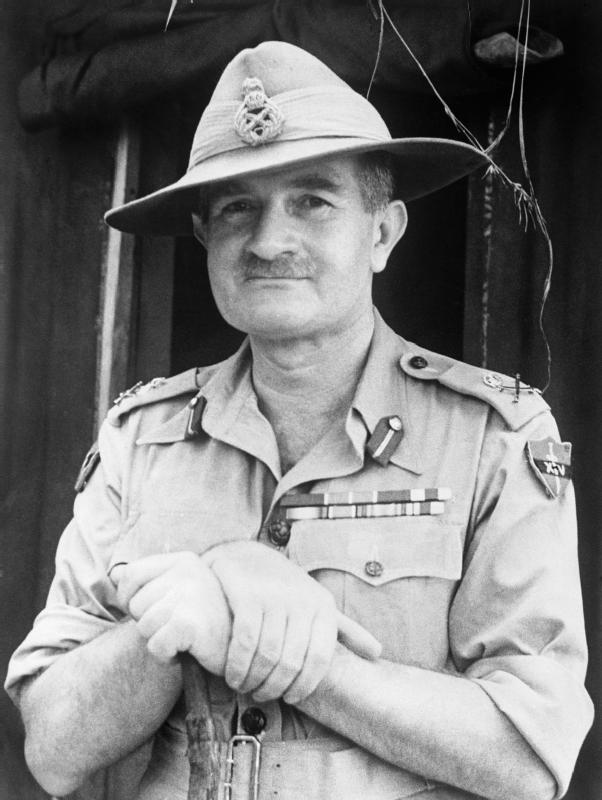
Field Marshal Sir William Slim (1891-1970), during his time as GOC XIVth Army in Burma.
Portrait by No. 9 Army Film & Photographic Unit via Wikimedia Commons.
I am not the first person to make these kinds of observations. Jim Storr has written about peacetime promotion culture in the British Army and Thomas E. Ricks did the same with U.S. Army. Here is an excerpt from Storr:
It appears that many of those whom the British Army promoted in peacetime during the twentieth century were found wanting on the outbreak of war. Promotion to high command in peacetime very much reflects the values of existing senior commanders, themselves largely the products of a peacetime promotion system. To that extent it reflects deeply held values, and has an obvious impact on operational effectiveness in war.
Roughly two-thirds of those who commanded formations in the BEF [British Expeditionary Force] of 1940 were either sacked, retired immediately, or were never given another formation to command in the field.
Ricks describes a similar phenomenon occurring in the U.S. Army during the Second World War. Many senior leaders who had risen during peacetime couldn’t perform under real-world conditions. Under the stern hand of George C. Marshall, then Chief of Staff of the U.S. Army, generals were removed from command at a rate that is unheard of today. Many of those who were fired had glowing records and some went on to redeem their reputations in later commands, which suggests that they had been promoted too soon or too high above their level of competence.
More recently, Russia has been churning through general officers in Ukraine, seemingly desperate to find someone who can achieve Putin’s war aims. If an army systematically promotes its officers above their level of competence in peacetime, then clearly their selection and assessment criteria are not aligned with the actual job requirements.
To illustrate the point, Storr compares careers of Second World War British Field Marshals. The first, Field Marshal John Verreker a.k.a. Lord Gort, was Commander-in-Chief (C.-in-C.) of the BEF during its disastrous efforts in France in 1940.
[Gort] was the epitome of the system: young, highly decorated, charismatic, promoted through and entirely within the system. He was only 51 when appointed CIGS [Chief of Imperial General Staff] … As C.-in-C. of the BEF, he “fussed over details and things of comparatively little consequence” and had a “constant preoccupation with things of small detail”.
After he oversaw the evacuation of British troops from Dunkirk, Gort was removed from command and served out the rest of the war in non-combatant posts. It should be noted that Gort was not a bad soldier. During the First World War, he rose from the rank of captain to acting lieutenant-colonel and in the process earned the Distinguished Service Order (with bar) and the Victoria Cross. It was during the interwar years that Gort ascended from the substantive rank of Major to Field Marshal. Battles may be won with good-enough tactics and a lot of chutzpah, but Gort was unprepared for the complexities of wartime command at the strategic level. He did, however, excel at playing politics.
For contrast, here is Storr’s description of Field Marshal William “Bill” Slim:
[The] 47-year-old Bill Slim was promoted to lieutenant-colonel in 1938, perhaps at the last possible opportunity. Slim had not been to Sandhurst; he had gained his commission “through the back door” and had come from a modest background. The outbreak of the Second World War saw him commanding a brigade in East Africa. Within four years he was commanding the Fourteenth Army in Burma … Slim was obviously not the product of a stable heirarchy in peacetime. His rise to fame came entirely during wartime. He was arguably one of the greatest British generals of the twentieth century. The contrast with Gort could not be more marked.
For his part, Ricks has a takes a wider view of how the post-war U.S. Army made some officers too big to fail:
Korea, Vietnam, and Iraq were all small, ambiguous, increasingly unpopular wars, and in each, success was harder to define than it was in World War II. Firing generals seemed to send a signal to the public that the war was going poorly.
But that is only a partial explanation. Changes in our broader society are also to blame. During the 1950s, the military, like much of the nation, became more “corporate” — less tolerant of the maverick and more likely to favor conformist “organization men”. As a large, bureaucratized national-security establishment developed to wage the Cold War, the nation’s generals also began acting less like stewards of a profession, responsible to the public at large, and more like members of a guild, looking out primarily for their own interests.
It seems like loyalty up became more important than loyalty out.
When did the “elites” of the West become so bumbling and incompetent?
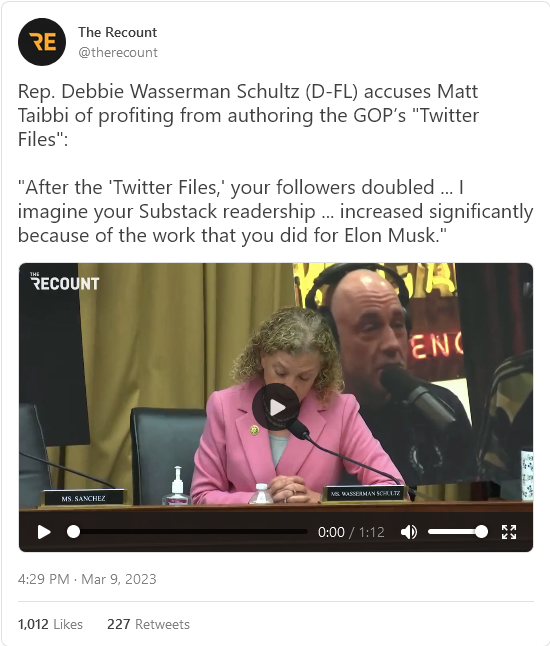
Chris Bray on the blatant decay of western political leadership on display at the #Twitterfiles hearing in Washington D.C.:
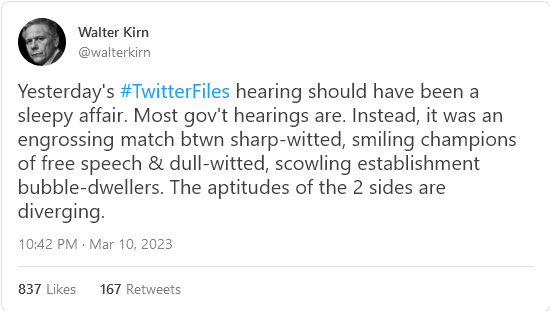
I should probably just go back to sleep for a decade, because Walter Kirn always has it covered:
I was trying to be clever about this yesterday, but it should be said plainly for the space aliens who eventually find the ruins of our former civilization and have to use the surviving digital evidence to report to their superiors on the collapse of the earth losers.
The most striking thing about the average member of the contemporary political class — the “elite”, and yes, I know — isn’t that they’re almost invariably wrong, or that they’re never interesting, or that they have no wisdom of any kind that ever shines through anything they do, ever. Instead, the most striking thing about the contemporary political class is that most of them can’t actually speak, in the sense that you ask them something and then they think and then words come out. Here, watch:
Even in the screenshot, her face is pointed downward at a piece of paper. She’s only ever reading. She’s looking at prepared questions and giving voice to a script, like a much dumber Anne Hathaway. And, yes, what the script says is idiotic — Matt Taibbi gets paid for his journalismz!!!!! (unlike members of Congress, who take a vow of poverty and work for free) — but the more interesting thing to me is that this person, in her fifty-trillionth term in Congress, can’t say what she thinks without reading it. Mr. Taibbi, it says on this piece of paper that you are a very bad person.
They don’t know anything. They don’t think anything. They have no ability, no insight, no value to offer. So they make our laws.
1949: HMS Implacable‘s Last Voyage | BBC Television Newsreel | Retro Transport | BBC Archive
BBC Archive
Published 19 Nov 2022HMS Implacable, a 149 year-old ship of the line — which survived the Battle of Trafalgar — embarks on her final, solemn voyage.
The figurehead, deck and stern cabin of this captured French ship are to be kept at the National Maritime Museum in Greenwich, but her hulk is to be towed out from Portsmouth dockyard and scuttled.
Originally broadcast 5 December, 1949.
(more…)
QotD: The components of an oath in pre-modern cultures
So when thinking about oaths, we want to think about them the way people in the past did: as things that work – that is they do something. In particular, we should understand these oaths as effective – by which I mean that the oath itself actually does something more than just the words alone. They trigger some actual, functional supernatural mechanisms. In essence, we want to treat these oaths as real in order to understand them.
So what is an oath? To borrow Richard Janko’s (The Iliad: A Commentary (1992), in turn quoted by Sommerstein [in Horkos: The Oath in Greek Society (2007)]) formulation, “to take an oath is in effect to invoke powers greater than oneself to uphold the truth of a declaration, by putting a curse upon oneself if it is false”. Following Sommerstein, an oath has three key components:
First: A declaration, which may be either something about the present or past or a promise for the future.
Second: The specific powers greater than oneself who are invoked as witnesses and who will enforce the penalty if the oath is false. In Christian oaths, this is typically God, although it can also include saints. For the Greeks, Zeus Horkios (Zeus the Oath-Keeper) is the most common witness for oaths. This is almost never omitted, even when it is obvious.
Third: A curse, by the swearers, called down on themselves, should they be false. This third part is often omitted or left implied, where the cultural context makes it clear what the curse ought to be. Particularly, in Christian contexts, the curse is theologically obvious (damnation, delivered at judgment) and so is often omitted.
While some of these components (especially the last) may be implied in the form of an oath, all three are necessary for the oath to be effective – that is, for the oath to work.
A fantastic example of the basic formula comes from Anglo-Saxon Chronicles (656 – that’s a section, not a date), where the promise in question is the construction of a new monastery, which runs thusly (Anne Savage’s translation):
These are the witnesses that were there, who signed on Christ’s cross with their fingers and agreed with their tongues … “I, king Wulfhere, with these king’s eorls, war-leaders and thanes, witness of my gift, before archbishop Deusdedit, confirm with Christ’s cross” … they laid God’s curse, and the curse of all the saints and all God’s people on anyone who undid anything of what was done, so be it, say we all. Amen.” [Emphasis mine]
So we have the promise (building a monastery and respecting the donation of land to it), the specific power invoked as witness, both by name and through the connection to a specific object (the cross – I’ve omitted the oaths of all of Wulfhere’s subordinates, but each and every one of them assented “with Christ’s cross”, which they are touching) and then the curse to be laid on anyone who should break the oath.
Of the Medieval oaths I’ve seen, this one is somewhat odd in that the penalty is spelled out. That’s much more common in ancient oaths where the range of possible penalties and curses was much wider. The Dikask‘s oath (the oath sworn by Athenian jurors), as reconstructed by Max Frankel, also provides an example of the whole formula from the ancient world:
I will vote according to the laws and the votes of the Demos of the Athenians and the Council of the Five Hundred … I swear these things by Zeus, Apollo and Demeter, and may I have many good things if I swear well, but destruction for me and my family if I forswear.
Again, each of the three working components are clear: the promise being made (to judge fairly – I have shortened this part, it goes on a bit), the enforcing entity (Zeus, Apollo and Demeter) and the penalty for forswearing (in this case, a curse of destruction). The penalty here is appropriately ruinous, given that the jurors have themselves the power to ruin others (they might be judging cases with very serious crimes, after all).
Bret Devereaux, “Collections: Oaths! How do they Work?”, A Collection of Unmitigated Pedantry, 2019-06-28.
March 12, 2023
“Indigo is no longer a bookseller but a general merchandiser with a sideline in books”
In the latest edition of the SHuSH newsletter, Ken Whyte looks at the dismal financial (and technological) picture for Indigo in the Canadian market:

“Indigo Books and Music” by Open Grid Scheduler / Grid Engine is licensed under CC0 1.0

As you’ve heard, the bookselling chain was hacked, its employment records held for ransom. Indigo (rightly) refused to pay and the hackers are now expected to release the employees’ personal data on the dark web.
This all started a month ago. The company’s website went down along with its in-store credit and debit systems. The payment systems came back after about ten days. A new website was built and launched at the beginning of March. It is a much-reduced site with a much reduced catalog of books.
The repercussions will be enormous for both Indigo and the publishing community.
One of the things overshadowed by the hacks was the release of Indigo’s third-quarter results, covering the crucial holiday season. As we’ve noted before, the company’s finances are unsettling. It lost $37 million in 2019, $185 million in 2020, and $57 million in 2021. Things looked somewhat better in 2022 with a $3 million profit, but the first two quarters of 2023 (Indigo has a March 28 year-end) showed a loss of $41.3 million, about $10 million worse than in the first two quarters of the previous year.
The hope was that a blockbuster holiday season would get Indigo’s year back on track.
It didn’t happen. Revenue for Q3 2022 came in at $423 million, down $8 million from last year, with pre-tax profits of $36 million, down from $45 million last year.
After three quarters, Indigo now stands at an $8 million loss. The company’s fourth quarter, covering the first three months of the calendar year, is usually terrible (all retail suffers in the deep of winter). If this fourth quarter goes like the last, Indigo will be looking at a $30 million loss for its full year. But this fourth won’t go like the last because of the hack. I have no idea what it will cost in terms of lost sales and unexpected expenditures (or what will be covered by insurance). It’s hard to imagine the company not doing worse than $30 million after such a catastrophic event.
Most of Canada’s mid-size to large publishers sell somewhere between 25 percent and 60 percent of their books through the chain. The outage will hurt revenue for both publishers and authors. If there’s a silver lining here, it’s that it occurred in a dead season. But the knock-on effects will be substantial. I’m told Indigo has no visibility into its store sales or current stock levels across the chain. It’s being very cautious about bringing in new books apart from the most in-demand titles. Publishers I’ve spoken to say sales to Indigo are down and they expect returns to be large and late. (Booksellers send unsold inventory back to publishers for full refunds and the bulk of these come in the months after the holidays).
By the way, the latest results showed that Indigo is no longer a bookseller but a general merchandiser with a sideline in books. Blankets and cheeseboards accounted for more than 50 percent of the company’s total revenue over the holidays. Print was 46 percent, down from 54 percent earlier in 2022 and 67.4 percent eight years ago. The movement away from bookselling is picking up steam. I hope you like Amazon because it and the few independent bookstores Chapters/Indigo hasn’t manage to kill will be all that’s left of Canadian bookselling before very long.
Zhukov hits the Ground Running – WW2 – Week 237 – March 11, 1944
World War Two
Published 11 Mar 2023The Soviets launch not one, not two, but three offensives in Ukraine this week, designed to destroy the entire southern wing of the German forces. The Japanese counterattack against the Americans on Bougainville finally begins after months of preparations, but there are more Japanese attacks elsewhere that get going: the operation to invade India.
(more…)
The young British officer’s attitude toward his men
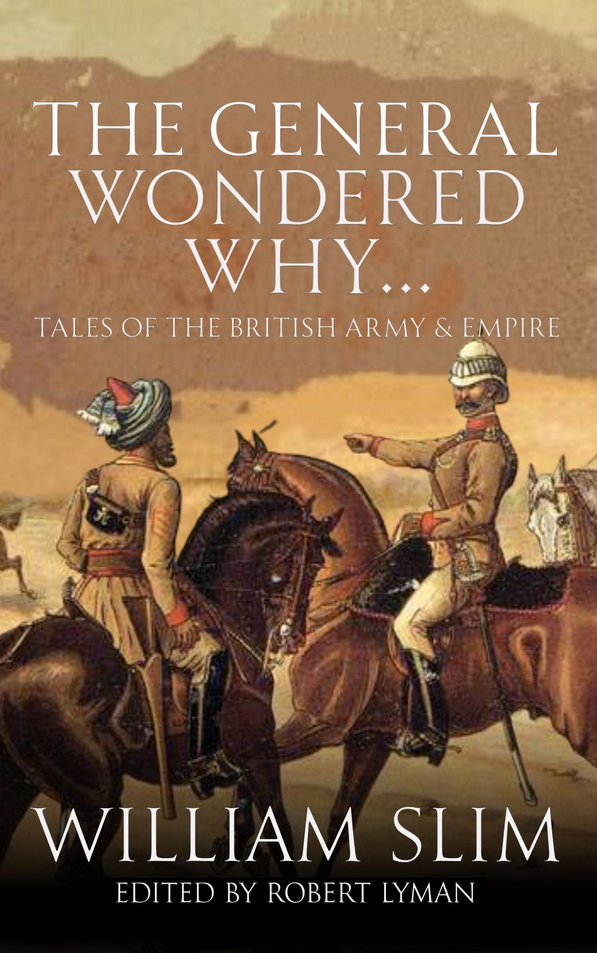
Dr. Robert Lyman has been working on pulling together various newspaper and magazine articles written by Field Marshal William Slim before the Second World War, to be published later this year. I believe this will include everything he included (in shorter form in some cases) in his 1959 book Unofficial History plus many others. In this excerpt from “Private Richard Chuck, aka The Incorrigible Rogue”, Slim recounts taking command of a company of recent conscripts while recuperating from wounds received earlier in WW1:
“Light duty of a clerical nature,” announced the President of the Medical Board. Not too bad, I thought, as I struggled back into my shirt. “Light duty of a clerical nature” had a nice leisurely sound about it. I remembered a visit I had paid to a friend in one of the new government departments that were springing up all over London at the end of 1915. He had sat at a large desk dictating letters to an attractive young lady. When she got tired of taking down letters, she poured out tea for us. She did it very charmingly. Decidedly, light duty of a clerical nature might prove an agreeable change after a hectic year as a platoon commander and a rather grim six months in hospital. Alas, after a month in charge of the officers’ mess accounts of a reserve battalion, with no more assistant than an adenoidal “C” Class clerk, I had revised my opinion. My one idea was to escape from “light duty of a clerical nature” into something more active. Reserve battalions were like those reservoirs that haunted the arithmetic of our youth — the sort that were filled by two streams and emptied by one. Flowing in came the recovered men from hospitals and convalescent homes and the new enlistments; out went the drafts to battalions overseas. When the stream of voluntary recruits was reduced to a trickle the only way to restore the intake was by conscription, and this was my chance.
It had been decided to segregate the conscripts into a separate company as they arrived. I happened to be the senior subaltern at the moment and I applied for command of the new company. Rather to my surprise, for I was still nominally on light duty, I got it. The conscripts, about a hundred and twenty of them, duly arrived. They looked very much like any other civilians suddenly pushed into uniform, awkward, bewildered, and slightly sheepish, and I regarded them with some misgiving. After all, they were conscripts; I wondered if I should like them.
The young British officer commanding native troops is often asked if he likes his men. An absurd question, for there is only one answer. They are his men. Whether they are jet-black, brown, yellow, or café-au-lait, the young officer will tell you that his particular fellows possess a combination of military virtues denied to any other race. Good soldiers! He is prepared to back them against the Brigade of Guards itself! And not only does the young officer say this, but he most firmly believes it, and that is why, on a thousand battlefields, his men have justified his faith.
In a week I felt like that about my conscripts. I was a certain rise to any remark about one volunteer being worth three pressed men. Slackers? Not a bit of it! They all had good reasons for not joining up. How did I know? I would ask them. And I did. I had them, one by one, into the company office, without even an N.C.O. to see whether military etiquette was observed. They were quite frank. Most of them did have reasons — dependants who would suffer when they went, one-man businesses that would have to shut down. Underlying all the reasons of those who were husbands and fathers was the feeling that the young single men who had escaped into well-paid munitions jobs might have been combed out first.
[…]
We had now advanced far enough in our training to introduce the company to the mysteries of the Mills bomb. There is something about a bomb which is foreign to an Englishman’s nature. Some nations throw bombs as naturally as we kick footballs, but put a bomb into an unschooled Englishman’s hands and all his fingers become thumbs, an ague affects his limbs, and his wits desert him. If he does not fumble the beastly thing and drop it smoking at his — and your — feet, he will probably be so anxious to get rid of it that he will hurl it wildly into the shelter trench where his uneasy comrades cower for safety. It is therefore essential that the recruit should be led gently up to the nerve-racking ordeal of throwing his first live bomb; but as I demonstrated to squad after squad the bomb’s simple mechanism, I grew more and more tired with each until I could no longer resist the temptation to stage a little excitement. I fitted a dummy bomb, containing, of course, neither detonator nor explosive, with a live cap and fuse. Then for the twentieth time I began!
When you pull out the safety-pin you must keep your hand on the lever or it will fly off. If it does it will release the striker, which will hit the cap, which will set the fuse burning. Then in five seconds off goes your bomb. So when you pull out the pin don’t hold the bomb like this!’
I lifted my dummy, jerked out the pin, and let the lever fly off. There was a hiss, and a thin trail of smoke quavered upwards. For a second, until they realized its meaning, the squad blankly watched that tell-tale smoke. Then in a wild sauve qui peut they scattered, some into a nearby trench, others, too panic-stricken to remember this refuge, madly across country, I looked round, childishly pleased at my little joke, to find one figure still stolidly planted before me. Private Chuck alone held his ground, placidly regarding me, the smoking bomb, and his fleeing companions with equal nonchalance. This Casablanca act was, I felt, the final proof of mental deficiency — and yet the small eyes that for a moment met mine were perfectly sane and not a little amused.
“Well,” I said, rather piqued, “hy don’t you run with the others?” A slow grin passed over Chuck’s broad face.
“I reckon if it ‘ud been a real bomb you’d ‘ave got rid of it fast enough,” he said. Light dawned on me.
“After this, Chuck,” I answered, “you can give up pretending to be a fool; you won’t get your discharge that way!”
He looked at me rather startled, and then began to laugh. He laughed quietly, but his great shoulders shook, and when the squad came creeping back they found us both laughing. They found, too, although they may not have realized it at first, a new Chuck; not by any means the sergeant-major’s dream of a soldier, but one who accepted philosophically the irksome restrictions of army life and who even did a little more than the legal minimum.
Jack Benny and Mel Blanc – The Man of a Thousand Voices | Carson Tonight Show
Johnny Carson
Published 18 Nov 2022Original Airdate: 01/23/1974
(more…)


