
There is nothing so absurd that some philosopher has not said it, said Cicero two millennia ago, so perhaps my feeling was mistaken that, for the first time in history, we have reached a stage of absurdity in which a reductio ad absurdum is no longer viable as a rhetorical maneuver, for there is nothing so absurd that everyone recognizes it as such. On the contrary, one man’s absurdity is another man’s possibility or even truth. Nothing can be ruled out without argument.
Theodore Dalrymple, “Street-Corner Semantics”, Taki’s Magazine, 2018-06-30.
March 12, 2023
QotD: Philosophy
Comments Off on QotD: Philosophy
March 11, 2023
British attitudes to crime differ substantially between average Britons and the ruling elite
Scott Alexander does a monthly roundup of interesting links and this one popped up for his March collection:
Looks like the British population is tough on crime (h/t James Johnson):
… including about 15% who want prison time for not wearing a seatbelt, 47% who want prison time for sexist abuse on social media, and 80% who want prison time for possession of a knife (and 18% think it should be over five years)! Meanwhile, in actual Britain, a guy with multiple previous violence convictions who brutally assaulted a cyclist and then stomped on her head while she lay unconscious was let off with community service. This is an interesting contrast to see in a democracy!
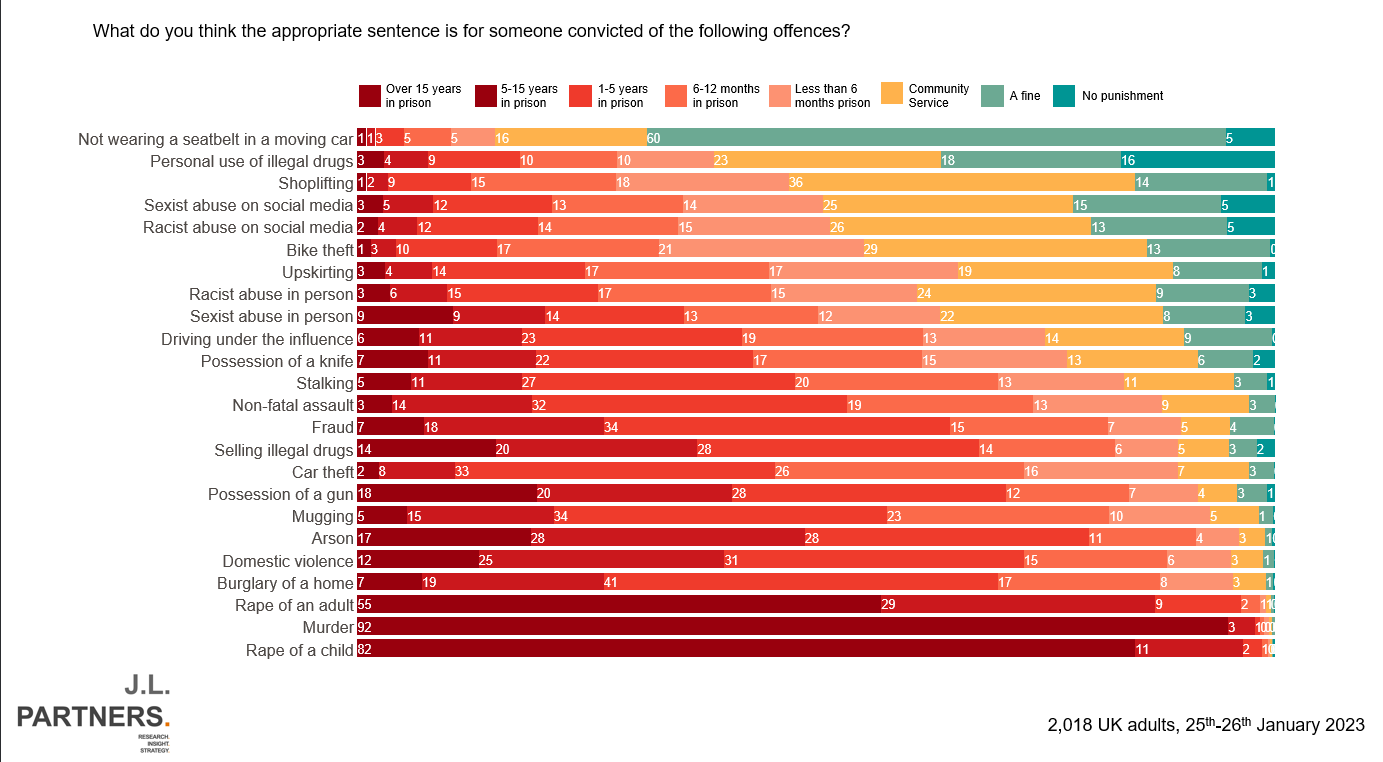
As an illustration of the rift between the people who suffer from the criminal and sub-criminal activities of the “non-law-abiding community” and those who are fully insulated from that same community, this is pretty typical. Very similar rifts would almost certainly be found in Canada, the United States, Australia, and New Zealand. When you have no skin in the game, you can let your virtue signalling freak flag fly, and our elites have no skin in the game.
Comments Off on British attitudes to crime differ substantially between average Britons and the ruling elite
Why Japan Surrendered in WW2: Stalin or the Bomb?
Real Time History
Published 10 Mar 2023
It’s common wisdom that the nuclear bombs dropped over Hiroshima and Nagasaki caused the Japanese surrender at the end of the 2nd World War. However, there has been a fierce historical debate if this narrative omits the role of the Soviet invasion of Manchuria in August 1945 — or if this invasion was actually the main cause for the surrender.
(more…)
Comments Off on Why Japan Surrendered in WW2: Stalin or the Bomb?
“… when people are sticking warning labels on P.G. Wodehouse, something is seriously wrong”
In The Conservative Woman, Alan Ashworth stands aghast at the very notion of putting a content warning on an adaptation of a P.G. Wodehouse short story:

Dominic Sandbrook in the Mail on Sunday draws attention to BBC Radio 4 Extra and its latest repeat of an adaptation of P.G. Wodehouse’s Psmith in the City. It is preceded by an announcement that listeners should steel themselves for “some dated attitudes and language”.
You don’t say. The story was written well over a century ago, appearing first as a serial in The Captain magazine in 1908 and 1909 before being published as a book by A & C Black in 1910.
In it Psmith (the P is silent) and his old school friend Mike Jackson are reunited when they find themselves working for the New Asiatic Bank, a thinly disguised portrait of the Hongkong and Shanghai Bank (now HSBC) where Wodehouse himself endured a torrid spell before his writing career took off.
The two chums have several run-ins with management and Mike is eventually fired before Psmith solves all his problems and has him reinstated. Of course, as always in Wodehouse’s world, there is no sex, no angst, nothing to frighten the horses.
So why the BBC announcement? Sandbrook writes: “At first I wondered if this must be some mistake. Perhaps the warning had been transposed from some more dangerous programme, such as a stand-up show by Bernard Manning?
“But the warning was meant for Psmith. So what were these toxic and potentially traumatising attitudes? For the life of me, I still don’t really know.
“At one point, Psmith talks of going ‘out East’, where you have ‘a dozen native clerks under you, all looking up to you as the Last Word in magnificence’. But was that it? Did that merit a warning?
“As it happens, this radio adaptation was made in 2008. Did the actors realise they were participating in something steeped in sick imperialistic assumptions? I doubt it.
“Venturing into the cesspit of social media, I often find Left-wing pundits insisting there is no such thing as cancel culture and that the whole thing is an evil Tory myth.
“But when people are sticking warning labels on P G Wodehouse, something is seriously wrong. Indeed, you could hardly find a more ludicrous target, because he was one of most tolerant, generous-spirited writers imaginable. So generous-spirited that he’d probably have laughed this off. ‘I never was interested in politics,’ Wodehouse once remarked. ‘I’m quite unable to work up any kind of belligerent feeling.’
“Being cut from a meaner cloth, however, I do feel worked up about it. When I think of these finger-wagging commissars sitting in judgment on a writer who has given so much pleasure to so many readers, I feel like Bertie Wooster’s Aunt Agatha, gearing herself up before a titanic tirade.
“Do we really need a warning that P G Wodehouse is ‘dated’? What next? A lecture before Hamlet, to warn us that poisoning your wife or killing your uncle is now considered poor form? A warning before Roald Dahl or Ian Fleming?
“But, of course, Dahl and Fleming don’t need warnings now, for they have been posthumously updated.”
Comments Off on “… when people are sticking warning labels on P.G. Wodehouse, something is seriously wrong”
M240 Bravo: America Replaces the M60
Forgotten Weapons
Published 7 Nov 2022In 1977, the US military adopted the FN MAG as the M240 in vehicular configuration to replace the less-than-successful M73/M219 machine guns. The USMC would get an early start adapting the 240 to ground configuration (the M240G), but it wasn’t until 1995 that the Army formally replaced the M60 with the MAG in M240B layout. The M240B has a number of differences from the standard MAG:
– Single-position gas regulator, giving about 600 RPM
– Picatinny rail on the top cover for mounting optics
– Front heat shield over the barrel to prevent heat mirage
– Top cover can be closed with the bolt either forward or backThe M240B has since been adopted by the Marines as well, and served extensively in Iraq and Afghanistan. It is a quite heavy gun (24+ pounds) but very well liked by its users for being exceptionally rugged, dependable, and accurate. The one we have today is in pristine condition, and one of just 11 transferrable examples registered in the US.
(more…)
Comments Off on M240 Bravo: America Replaces the M60
QotD: We used to call them “parlour pinks”
What’s life like in the Soviet Union? They neither know nor care, until the brute facts of life in the USSR are rubbed into their faces for so long that they have to acknowledge them. At which point they simply switch allegiances. Kolakowski’s essay doesn’t mention Paul Hollander’s Political Pilgrims, but they arrive at essentially the same conclusion — that instead of becoming disillusioned with Communism (Socialism, “social justice”) itself, the irritated butterflies of the Left grow disillusioned with a particular country or leader. The USSR has failed, yes, but — all together now! — “real Communism has never been tried”, so let’s put all our faith in Mao … and then Castro … and then Chavez, et cetera ad nauseam.
It’s all about maintaining the purity of the idea in the face of disappointing, vulgar, grubby reality. An honest-to-Marx Communist will come into plenty of contact with reality. A Leftist never will, because xzhey have convinced xzhemself that even the mugging they’re currently experiencing is a lofty and noble expression of authenticity. They’re willing to die for the Revolution, certainly — the urge for martyrdom has always been highly conspicuous on the Left. So long as they never feel that base, grubby, vulgar proletarian urge to defend themselves, they’ll be fine.
[…]
“Never cheer for your own.” When you come right down to it, that’s the Leftist motto. Leftists don’t deride “sportsball”, for instance, because they’re un-athletic little dweebs who were always picked last at recess (well, ok, not only that). It’s because cheering for a team, any team, is vulgar. It’s what grubby little proles do. (That’s another way to distinguish a Communist from a Leftist, by the way. Actual Commies love sports; look at all the resources the USSR poured into the Olympics, for instance. That’s because sports are good training for war).
Is Leftism curable? Can they be made to cheer for their own? Experience suggests that the cure will be very harsh indeed … if indeed it’s possible at all.
Severian, “Grubby Little Proles”, Rotten Chestnuts, 2020-05-31.
Comments Off on QotD: We used to call them “parlour pinks”
March 10, 2023
Having solved all other problems, Congress now investigates … (checks notes) … the Protestant Reformation
Chris Bray respectfully outlines some of the questions the honourable Congressmen Congresspersons Congressentities Representatives would be likely to pose to the witnesses:

Martin Luther nails his 95 theses to the door of All Saints Church in Wittenberg, 1517.
Painting by Ferdinand Pauwels (1830-1904) via Wikimedia Commons.
1.) Mr. Luther, you — sorry, having trouble with my reading glasses. It says here you … mailed 95 feces to a door? Do you feel that it was appropriate to put something like that in the mail?
2.) Mr. Calvin, sir, you have raised numerous objections to the elevation of the host. Shouldn’t you be equally concerned about the elevation of the hostess? Don’t you feel that gendered terms are problematic?
3.) For all the witnesses, I’m told you wish to choose your own pastures. Isn’t that a question best left to the farmers?
4.) Gentlemen, you apparently propose to dissolve the monasteries. But most of them are, in my understanding, made out of big rocks, with very solid walls. Wouldn’t that take a prohibitive amount of acid to dissolve those? Have you done an EIR?
5.) I must very candidly inform the witnesses that I cannot agree to your premise, and I frankly find it absurd to say that faith alone is the cause of salivation. Do you have credentials in the science of digestion?
Comments Off on Having solved all other problems, Congress now investigates … (checks notes) … the Protestant Reformation
Build a Tool Wall From Scraps and Junk
Rex Krueger
Published 9 Mar 2023You all have seen it in the background! But what’s actually on the tool wall?
(more…)
Comments Off on Build a Tool Wall From Scraps and Junk
The evolution of a slur
Scott Alexander traces the reasons that we can comfortably call British people “Brits” but avoid using the similar contraction “Japs” for Japanese people:

Someone asks: why is “Jap” a slur? It’s the natural shortening of “Japanese person”, just as “Brit” is the natural shortening of “British person”. Nobody says “Brit” is a slur. Why should “Jap” be?
My understanding: originally it wasn’t a slur. Like any other word, you would use the long form (“Japanese person”) in dry formal language, and the short form (“Jap”) in informal or emotionally charged language. During World War II, there was a lot of informal emotionally charged language about Japanese people, mostly negative. The symmetry broke. Maybe “Japanese person” was used 60-40 positive vs. negative, and “Jap” was used 40-60. This isn’t enough to make a slur, but it’s enough to make a vague connotation. When people wanted to speak positively about the group, they used the slightly-more-positive-sounding “Japanese people”; when they wanted to speak negatively, they used the slightly-more-negative-sounding “Jap”.
At some point, someone must have commented on this explicitly: “Consider not using the word ‘Jap’, it makes you sound hostile”. Then anyone who didn’t want to sound hostile to the Japanese avoided it, and anyone who did want to sound hostile to the Japanese used it more. We started with perfect symmetry: both forms were 50-50 positive negative. Some chance events gave it slight asymmetry: maybe one form was 60-40 negative. Once someone said “That’s a slur, don’t use it”, the symmetry collapsed completely and it became 95-5 or something. Wikipedia gives the history of how the last few holdouts were mopped up. There was some road in Texas named “Jap Road” in 1905 after a beloved local Japanese community member: people protested that now the word was a slur, demanded it get changed, Texas resisted for a while, and eventually they gave in. Now it is surely 99-1, or 99.9-0.1, or something similar. Nobody ever uses the word “Jap” unless they are either extremely ignorant, or they are deliberately setting out to offend Japanese people.
This is a very stable situation. The original reason for concern — World War II — is long since over. Japanese people are well-represented in all areas of life. Perhaps if there were a Language Czar, he could declare that the reasons for forbidding the word “Jap” are long since over, and we can go back to having convenient short forms of things. But there is no such Czar. What actually happens is that three or four unrepentant racists still deliberately use the word “Jap” in their quest to offend people, and if anyone else uses it, everyone else takes it as a signal that they are an unrepentant racist. Any Japanese person who heard you say it would correctly feel unsafe. So nobody will say it, and they are correct not to do so. Like I said, a stable situation.
He also explains how and when (and how quickly) the use of the word “Negro” became extremely politically incorrect:
Slurs are like this too. Fifty years ago, “Negro” was the respectable, scholarly term for black people, used by everyone from white academics to Malcolm X to Martin Luther King. In 1966, Black Panther leader Stokely Carmichael said that white people had invented the term “Negro” as a descriptor, so people of African descent needed a new term they could be proud of, and he was choosing “black” because it sounded scary. All the pro-civil-rights white people loved this and used the new word to signal their support for civil rights, soon using “Negro” actively became a sign that you didn’t support civil rights, and now it’s a slur and society demands that politicians resign if they use it. Carmichael said — in a completely made up way that nobody had been thinking of before him — that “Negro” was a slur — and because people believed him it became true.
Comments Off on The evolution of a slur
Tank Chats #168 | Vixen & Fox | The Tank Museum
The Tank Museum
Published 18 Nov 2022Join David Fletcher as he takes a look at the Vixen and Fox armoured cars.
(more…)
Comments Off on Tank Chats #168 | Vixen & Fox | The Tank Museum
QotD: Wine in French culture
When the French sought to reduce alcohol consumption in the 1950s, the government’s slogan was “No more than a litre of wine a day“, which must have seemed excessively nanny-statish at a time when primary school children were given cider for lunch. Wine consumption has quite drastically fallen in the decades since, by as much as two-thirds by some estimates.
Ed West, “The Frenchest things in the world … Part Deux”, Wrong Side of History, 2022-12-09.
Comments Off on QotD: Wine in French culture
March 9, 2023
“… the French Resistance effect is beginning to appear: After the Nazis leave France, everyone says they were always with the Resistance”
Chris Bray notices what we’re not supposed to be noticing:
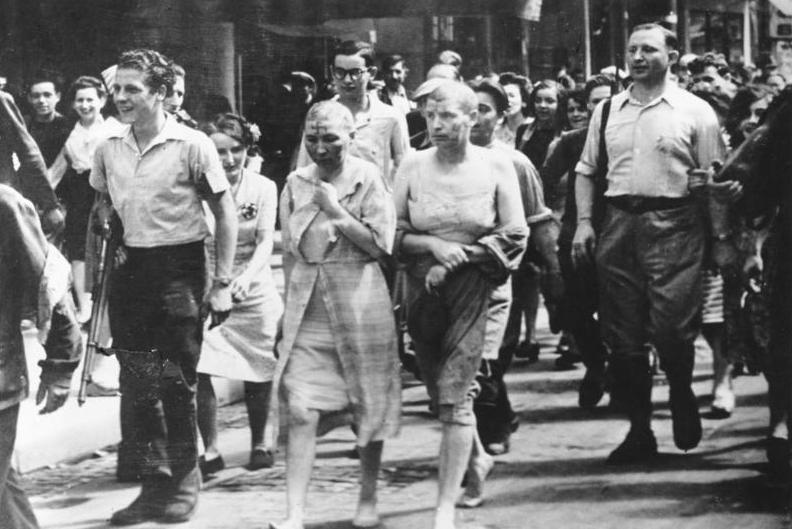
French women accused of collaborating with the Germans are paraded through the streets by members of the French Resistance after liberation, Summer 1944.
Original photo from the German Federal Archive via Wikimedia Commons.
Almost two years ago, with a moral panic still consuming the world and the narrative shift far in the future, the journalist Laura Dodsworth published a tough, concise, well-argued book describing the very deliberate efforts of the British government to create a widespread state of fear — that’s the title of the book, by the way — that would paralyze ordinary people and compel them to comply with harsh and repressive public health measures. You’ll be shocked to hear that she was attacked and vilified; one prominent review called State of Fear “an outrageously dumb book selling conspiracy hooey”.
Then, in 2023, Isabel Oakeshott gave us the halfwit government minister Matt Hancock’s pathetic whatsapp messages — in which he clumsily babbles about creating a state of fear to get the public to obey the government — and the rest is history. Laura Dodsworth was demeaned and defamed, and then she was vindicated.
Moral panics always fade. Manufactured crises always crack and collapse. Propaganda always has a “sell by” date, and then it turns rancid. The effect is comparable to what Warren Buffett says about a recession: When the tide goes out, you can see who’s been swimming naked.
This is where we are with the January 6 narrative, as the most horrible attack on Our Democracy™ since the Civil War collides with the image of a dork in Viking horns calmly wandering the hallways with a police escort. The political class is taking it well.
This image speaks:
That’s violent insurrectionist Jacob Chansley walking calmly through a crowd of police officers who aren’t making the slightest effort to stop him. That’s what happened. Other things also happened, and some of them involved violence and broken windows, but this is the act in the center ring of the circus. Now, the lawyer who represented this violent insurrectionist says plainly that Jacob Chansley was the victim of Brady violations, and other January 6 defendants are racing to raise the same point in court. The tide is going out.
[…]
And it seems possible to me, or rather it seems likely to me, that the French Resistance effect is beginning to appear: After the Nazis leave France, everyone says they were always with the Resistance. As narratives shift, and the moral meaning of an act during a moral panic is recoded, people may begin to remember their choices differently. We’ll see.


Comments Off on “… the French Resistance effect is beginning to appear: After the Nazis leave France, everyone says they were always with the Resistance”
Then: “Never be the first to stop clapping”. Now: “In our culture of exhibitionism, silence is suspect”
Chris Bray cross-posted this article by Christopher Gage, who had a painful realization while waiting on hold for a human customer service rep at British Gas:
British Gas has traded the lovely Ludwig van (much too excellent for these advanced times) for a two-chord earwig we once glorified as polyphonic ringtones. Whilst captive to the receiver, British Gas snatches the opportunity to douse you, an innocent and increasingly frozen bystander, in the warm soup of its right-on philosophy.
“British Gas is an inclusive company”, it purrs. “We believe all people, regardless of gender, ethnicity, or background, should be treated with dignity and respect.”
This divination, reader, was news to me. You see, I signed up to British Gas not for warm radiators and gas-lit stoves, but for the surreptitious fascism of a company with “British” in the name.
I assumed British Gas was firmly jackboots, shaved heads, and lumpy knuckles. On hold, I expected not a polyphonic ringtone but the greatest hits of Skrewdriver, with jaunty anthems such as “Keep Britain White” and “It’s All Because of The Jews”.
To my incomprehension, British Gas does not believe that Auschwitz was a holiday camp, nor, like Kanye West, that Hitler had his good points.
The horror. The horror.
Once you notice this culture of Obviousness, this modern theatre in which the captive audience is force-fed a diet of entirely humdrum beliefs shared by absolutely everyone save a few whack-jobs, you cannot unsee it.
A coffee shop I recently and regrettably frequented offered not only espresso and cortado and obscenely priced cheesecake but a syrupy treatise of that coffee shop’s founding beliefs. You’d think a coffee shop’s founding beliefs would be: “Buy coffee. Sell coffee.” No. This coffee shop was against all forms of discrimination.
Relentless is this modern culture of making the most obvious, universal statements and painting them as revolutionary.
When I decide I’d like gas piped into my home, or coffee piped into my stomach, my motivations hover around the middle of Maslow’s hierarchy of needs. Will this gas warm my home? Will this coffee induce a mild, somewhat enjoyable panic attack?
To reveal, like British Gas did, that one thinks all people should be treated with dignity and with respect is like revealing one doesn’t shit on a bus seat in full view of other passengers. That one is anti-shitting-in-public.
Much of the modern world is that episode of Seinfeld in which Kramer joins an AIDS march but refuses to wear the ribbon proclaiming his opposition to AIDS.
In our culture of exhibitionism, silence is suspect.
Comments Off on Then: “Never be the first to stop clapping”. Now: “In our culture of exhibitionism, silence is suspect”
Want to feel more depressed? Spend more time with your smartphone
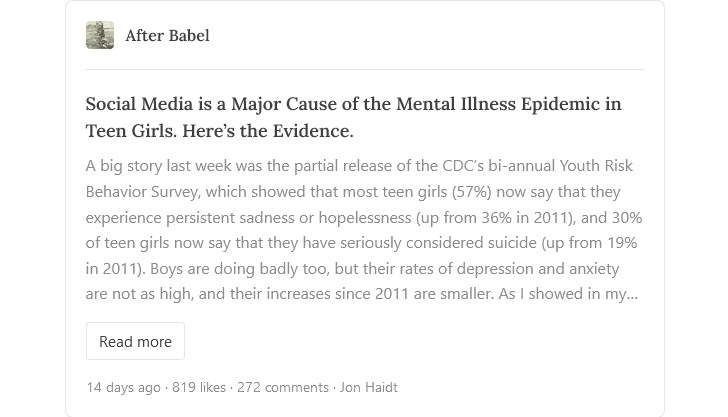
Freddie deBoer is convinced that much of the reason for widespread depression among teenagers can be traced directly to their obsessive devotion to the online world through their smartphones:
Are smartphones to blame for the mental health crisis among teens? The debate has picked up steam lately, in part because of the steady accumulation of evidence that they are indeed, at least partially. (As you know, I’m a believer.) Jonathan Haidt has done considerable work marshaling this evidence. But there’s an attendant question of how phones make kids miserable, if indeed they do. In this post I offer some plausible answers. This is mostly just speculation and I don’t know if the proffered explanations can be tested empirically.
I want to start by establishing a sort of meta-layer on which a lot of these problems rest. We might be inclined to say that these problems are inherently problems of the internet/online life/digital culture, rather than smartphones as such; you can be hurt by what I’m going to describe from a laptop as well as from a smartphone. And I think that’s right, except for one key difference: ubiquity. No matter how portable and light it is, you’re not reflexively checking your laptop on the subway platform or in the bathroom. The iPhone took all of the various pathologies of the internet, made it possible for them to be experienced repetitively and at zero cost morning and night, and dramatically scaled up the financial incentives for companies to exploit those pathologies for gain. You can certainly have an unhealthy relationship with the internet when it’s confined to your desktop. But phones make relentless conditioning and reflexive engagement a mass phenomenon.
The other overriding factor here is the fact that adolescents are still developing mentally, and thus are likely more susceptible to these problems.
Constant exposure to unachievable conditions. Back in my youth, you might watch an MTV show about how rich people lived, or leaf through a magazine like US Weekly, and be exposed to opulence and material excess. Or you might go on vacation and see how the other half lives if you took a tour of the Hollywood hills or whatever. You were perfectly well aware that rich people and their privileged lives existed. But then you turned off the show or you put down the magazine or your vacation ended, and unless you were born rich, you lived in an environment that of necessity was modest and real. Your friends might have lived in nice houses, but you didn’t see riches everywhere you looked, and your definition of what a hot girl looked like was mostly derived from the girls you went to school with. Your environment conditioned the scope of your desires.
Now, exposure to lifestyles that are completely unachievable is constant. Instagram is a machine for making you feel like whatever you’ve got isn’t enough. (That’s how it functions financially, through advertising idealized lives.) There are young people out there who have arranged their various feeds such that they’re always a few seconds away from seeing concerts they can’t attend, cars they can’t drive, houses they can’t live in, clothes they can’t wear, women they can’t fuck or whose bodies they can’t have, places they can’t travel to, food they can’t eat, and lives they can’t live. When I was young, if I wanted to see a picture of a Ferrari, I had to seek out a picture of a Ferrari. It was hard to see suggestive photos of intimidatingly hot women, which is why the Sports Illustrated swimsuit edition was a big deal. Mostly, the world around you was quotidian and its pleasures attainable. What can it be doing to these generations of young people, having completely unrealistic visions of what life is like being shoved into their brains all the time? How could their actual lives ever compare?
(Incidentally, I am thoroughly convinced that a majority of self-described incels are men who could find meaningful and fulfilling sexual and romantic success, both short-term and long, but who have developed such a wildly unrealistic idea about what actual human women look like that their standards are laughably high. And it’s easy to make fun of that, but I also think that the conditioning inherent to constantly looking at filtered and photoshopped pictures is powerful.)
Comments Off on Want to feel more depressed? Spend more time with your smartphone
Look at Life – The Cherry Pickers (1965)
PauliosVids
Published 20 Nov 2018Following the 11th Hussars from Hanover to Coburg.
Comments Off on Look at Life – The Cherry Pickers (1965)


