
Finding ore in the pre-modern period was generally a matter of visual prospecting, looking for ore outcrops or looking for bits of ore in stream-beds where the stream could then be followed back to the primary mineral vein. It’s also clear that superstition and divination often played a role; as late as 1556, Georgius Agricola feels the need to include dowsing in his description of ore prospecting techniques, though he has the good sense to reject it.
As with many ancient technologies, there is a triumph of practice over understanding in all of this; the workers have mastered the how but not the why. Lacking an understanding of geology, for instance, meant that pre-modern miners, if the ore vein hit a fault line (which might displace the vein, making it impossible to follow directly) had to resort to sinking shafts and exploratory mining an an effort to “find” it again. In many cases ancient miners seem to have simply abandoned the works when the vein had moved only a short distance because they couldn’t manage to find it again. Likewise, there was a common belief (e.g. Plin. 34.49) that ore deposits, if just left alone for a period of years (often thirty) would replenish themselves, a belief that continues to appear in works on mining as late as the 18th century (and lest anyone be confused, they clearly believe this about underground deposits; they don’t mean bog iron). And so like many pre-modern industries, this was often a matter of knowing how without knowing why.
Once the ore was located, mining tended to follow the ore, assuming whatever shape the ore-formation was in. For ore deposits in veins, that typically means diggings shafts and galleries (or trenches, if the deposit was shallow) that follow the often irregular, curving patterns of the veins themselves. For “bedded” ore (where the ore isn’t in a vein, but instead an entire layer, typically created by erosion and sedimentation), this might mean “bell pitting” where a shaft was dug down to the ore layer, which was then extracted out in a cylinder until the roof became unstable, at which point the works were back-filled or collapsed and the process begun again nearby.
All of this digging had to be done by hand, of course. Iron-age mining tools (picks, chisels, hammers) fairly strongly resemble their modern counterparts and work the same way (interestingly, in contrast to things like bronze-age picks which were bronze sheaths around a wooden core, instead of a metal pick on a wooden haft).
For rock that was too tough for simple muscle-power and iron tools to remove, the typical expedient was “fire-setting“, which remained a standard technique for removing tough rocks until the introduction of explosives in the modern period. Fire-setting involves constructing a fuel-pile (typically wood) up against the exposed rock and then letting it burn (typically overnight); the heat splinters, cracks and softens the rock. The problem of course is that the fire is going to consume all of the oxygen and let out a ton of smoke, preventing work close to an active fire (or even in the mine at all while it was happening). Note that this is all about the cracking and splintering effect, along with chemical changes from roasting, not melting the rock – by the time the air-quality had improved to the point where the fire-set rock could be worked, it would be quite cool. Ancient sources regularly recommend dousing these fires with vinegar, not water, and there seems to be some evidence that this would, in fact, render the rock easier to extract afterwards.
By the beginning of the iron age in Europe (which varies by place, but tends to start between c. 1000 and c. 600 BC), the level of mining sophistication that we see in preserved mines is actually quite considerable. While Bronze Age mines tend to stay above the water-table, iron-age mines often run much deeper, which raises all sorts of exciting engineering problems in ventilation and drainage. Deep mines could be drained using simple bucket-lines, but we also see more sophisticated methods of drainage, from the Roman use of screw-pumps and water-wheels to Chinese use of chain-pumps from at least the Song Dynasty. Ventilation was also crucial to prevent the air becoming foul; ventilation shafts were often dug, with the use of either cloth fans or lit fires at the exits to force circulation. So mining could get very sophisticated when there was a reason to delve deep. Water might also be used to aid in mining, by leading water over a deposit and into a sluice box where the minerals were then separated out. This seems to have been done mostly for mining gold and tin.
Bret Devereaux, “Iron, How Did They Make It? Part I, Mining”, A Collection of Unmitigated Pedantry, 2020-09-18.
March 9, 2023
QotD: Iron ore mining before the Industrial Revolution
March 8, 2023
Perhaps the Prime Minister ran out of glitterbomb distractions?
In The Line, Matt Gurney speculates on why the federal government needed to be “punched in the face” for literally weeks before finally taking (some) action:

Let’s acknowledge something right at the top: no one really knows what the hell the prime minister proposed yesterday. Not in any specific policy sense, at any rate. But boy, did we ever learn something about how the Liberals are viewing this politically.
After weeks of bobbing and weaving and throwing out fistfuls of increasingly ridiculous chaff, Justin Trudeau has belatedly agreed to a series of actions to probe Chinese electoral interference in Canada. And maybe other interference? We don’t know. We do know it’ll involve NSICOP, which is an acronym in desperate need of an agreed-upon pronunciation, if Monday’s press conference was any guide. NSICOP is a joint House-Senate committee that reviews various matters relating to Canada’s national security and intelligence (read this on its website and you’ll know more than 99.9 per cent of Canadians do about NSICOP). There’s also going to be a splash of the National Security and Intelligence Review Agency (NSIRA), plus a special rapporteur. The special rapporteur will apparently be given broad powers and, should they recommend a full public inquiry, the PM will accept that.
Hell of an endorsement for someone who hasn’t been selected yet. It’s almost like the PM decided he had to make an announcement before he was ready to actually share many details about that announcement, for some reason. Like the announcement itself was the point. Weird, eh? Wonder what that was about. In any case, all we know is it’ll be an eminent Canadian.
Shoutout to all you eminent Canadians out there, I guess. Brush up those cover letters.
Winston Churchill frequently has this attributed to him: “You can depend upon the Americans to do the right thing. But only after they have exhausted every other possibility.” Our Canadian version might be that you can depend on Prime Minister Trudeau to do something, but only after he’s exhausted all of his glitterbombs on distracting public attention.
The way that the Liberals responded wasn’t shocking. They only have a few plays left in their playbook, and we’ve seen something just like this only a few weeks ago. (Which is why I’m wondering if they actually only have the single play left, come to think of it.) The Liberals have responded to the barrage of news stories over Chinese interference exactly the way they did over their controversial gun-control amendments from the fall. First, deny there’s a problem. Then accuse anyone saying there’s a problem of being Donald Trump 2.0 or somesuch. Then just cut right to the chase and call them racist. When that doesn’t work, wait a few days to see if the problem goes away. When it doesn’t — indeed, when it gets worse — that’s when you finally admit that you can’t just yell “DISINFORMING MAGA BIGOTS!” at people and watch as your problem magically evaporates.
With guns, after everything else failed, they withdrew the amendments (though I imagine they’ll try again, though probably with no better luck). With China interference, it was agreeing to some kind of process. All the unfilled blanks notwithstanding, even the fact that something is being agreed to shows a dawning of political reality in the PMO: ignoring this and hoping the leaks stop if you called enough people racist Trumpers wasn’t going to work. Clearly, sometime in the last few days, the PM and his staff reached the acceptance stage, and concluded that either they had to admit that there was enough here to warrant some kind of serious process, or they could just start randomly talking about abortion in the hopes that people fell for that.
No, no, wait. They tried that anyway.
It would be fascinating to know what specifically led to the mental breakthrough that enabled Monday’s announcement. Weeks of denials, evasions and counterattacks, a day of performatively fretting about abortion, and then, zap!, we’re getting an rapporteur — an eminent one! — and a process. Maybe they looked at some internal polling. Maybe they’re worried about a big scoop that’s yet to land. Or maybe they’re just tired of being on the defensive and figured that the proposals would stand a decent chance of smothering the issue to death with pillows stuffed with bureaucracy and abbreviations.
Feeding a Medieval Outlaw
Tasting History with Max Miller
Published 7 Mar 2023
(more…)
“By fostering intense family loyalties and strong nepotistic urges”, cousin marriage “makes the development of civil society more difficult”
Ed West on what he calls the worst western foreign policy disaster since 1204, the Iraq quagmire:

Mohammed Saeed al-Sahhaf, better known in the West as “Baghdad Bob” or “Comical Ali”, Iraqi Minister of Information for President Saddam Hussein.
This month marks the 20th anniversary of the greatest western foreign policy disaster since the Fourth Crusade. It was the pre-eminent modern-day example of folly, driven by wishful thinking, utopianism and a lack of interest in history and how human societies differ. This was mostly carried out by good people, including our own Tony Blair, and promoted by thoughtful and humanitarian commentators who thought they were making the world a better place.
The White House regime which brought chaos and misery to Iraq were most of all entranced by The Weekly Standard, the now-defunct magazine most associated with neoconservative foreign policy. Had any of them read The American Conservative instead, they might have avoided the whole tragedy. In particular they ought have read Steve Sailer’s “The Cousin Marriage Conundrum“, printed in the run-up to the invasion and in which the author made a seemingly curious argument for why nation-building in Iraq would fail — its high rates of cousin marriage.
Pointing out that between 46 and 53 percent of Iraqis who married did so to first or second cousins, Sailer wrote that: “By fostering intense family loyalties and strong nepotistic urges”, cousin marriage “makes the development of civil society more difficult”. The neocon dream of jumpstarting democracy was therefore clearly doomed to failure.
Even those with a cursory knowledge of the country knew that Iraq was split between Sunni and Shia Arabs, as well as Kurds in the north, each group’s area of dominance roughly corresponding to three former Ottoman provinces. However, these were further subdivided into “smaller tribes, clans, and inbred extended families — each with their own alliances, rivals, and feuds”, in total about 150 tribes comprising some 2,000 clans.
Saddam’s politics were mired in blood, in both senses. He came from the al-Bu Nasir, a tribe comprising some 25,000 people based in the town of Tikrit, and his regime was filled with his relatives. His political career had begun in 1957 when the 20-year-old had joined the revolutionary Ba’ath (“Resurrection”) Party, following his uncle Kharaillah Tulfha, who had fought against the British in the Second World War. Tulfha would become his father-in-law, for Saddam also married his first cousin, although he later took a second wife. Family life wasn’t entirely harmonious, and the man who introduced that couple, Saddam’s food taster, was later stabbed to death by the dictator’s psychotic eldest son Uday at a party thrown by Egyptian president Hosni Mubarak.
The unfortunate food taster was an Assyrian Christian, and within Saddam’s regime religious minorities could rise high, as is often the case in empires, because they presented no threat. His foreign minister, Tariq Aziz, was also a Christian, his birth name being Mikhail Yuhanna.
The family was everything in Saddam’s Iraq. Mark Weiner wrote in The Rule of the Clan of countries governed by “clannism” that: “These societies possess the outward trappings of a modern state but are founded on informal patronage networks, especially those of kinship, and traditional ideals of patriarchal family authority. In nations pervaded by clannism, government is co-opted for purely factional purposes.” The inevitable result of clannism is kin-based corruption whereby resources, positions and other rewards are monopolised by family groups. In these societies, Weiner wrote, “the nuclear family, with its revolutionary, individuating power, has yet to replace the extended lineage group as the principle framework for kinship or household organisation”.
The Weekly Standard was called the in-flight magazine of Air Force One, but presumably there weren’t that many White House staffers reading the American Conservative at the time, a publication started by Pat Buchanan, the great Republican critic of neocon foreign policy. So the Coalition blundered into a disastrous invasion that cost hundreds of thousands of lives, wrecking Iraq and leaving many areas newly-divided along sectarian lines, while minorities like the Christians and Mandaeans were driven almost to extinction.
First to the Fight: The Marines’ Reising M50 SMG
Forgotten Weapons
Published 4 Nov 2022Eugene Reising developed a .45 ACP submachine gun in the late 1930s that was basically the opposite of the Thompson — it was light and handy, fired from a closed bolt with a delayed blowback action, and was inexpensive to produce. Reising contracted with Harrington & Richardson to produce the gun, and when it entered the market in early 1940 it found immediate interest from the USMC. Looking initially to equip the Marine Paratroop Regiment (Paramarines), the Corps wanted a gun that was light and compact. The Reising M55 with its folding stock was certainly those things and since the Thompson was essentially unavailable anyway (all production was going to the Army and foreign contracts), the Corps adopted the Reising with initial purchases of both the M50 and M55 in January and February of 1942.
What we are looking at today is an early production M50. It is blued with 29 barrel fins and the early style of sights, stock screw, trigger guard, magazine release, stock (the lacquer coating and sling swivels having been added by a previous owner), and firing pin. Later production guns would be improved and strengthened in various ways, but the Reising would never quite meet the needs of frontline combat troops, much to the displeasure of the Marines who first used them in the Pacific theater. Lacking interchangeable parts and susceptible to fouling and malfunctions, the Reisings were quickly replaced by other arms — some Johnson M1941 rifles, some M1 and M1A1 carbines, and various other guns. Rotated back to duties like ship boarding parties, guards, and military police, the Reising served very well. They were indeed handy and accurate guns, just not built for the extreme rigors of Pacific beach assaults and jungle foxholes.
(more…)
QotD: Who destroyed the Great Library?
The problem, however, is that there is no evidence that the Serapeum still contained any library by 391 AD and some good evidence indicating that it did not.
When the mythic version of the story of the destruction of the Serapeum gets told it usually begins without explaining why the temple was attacked. These retellings focus on the supposed destruction of its library, so they tend to assume that the mob was there simply because they hated learning. But several accounts of the end of the temple note that it came as the climax of a series of attacks by pagans on Christians in reaction to the desecration of pagan idols. Sozomen’s account details what happened next:
They killed many of the Christians, wounded others, and seized the Serapion, a temple which was conspicuous for beauty and vastness and which was seated on an eminence. This they converted into a temporary citadel; and hither they conveyed many of the Christians, put them to the torture, and compelled them to offer sacrifice. Those who refused compliance were crucified, had both legs broken, or were put to death in some cruel manner. When the sedition had prevailed for some time, the rulers came and urged the people to remember the laws, to lay down their arms, and to give up the Serapion (Sozomen, History of the Church, VII.15)
Sozomen was writing in the following century and, as a Christian, may not be reliable on the lurid details, but Socrates Scholasticus, writing a little closer to the events, confirms that many Christians were killed in the unrest. A stand-off followed, with Roman troops surrounding the temple while negotiations went on with the pagan militants inside. This situation must have continued for many weeks, as a petition went to the emperor in Constantinople about the siege and Theodosius ruled that the pagans should be pardoned for their murders and allowed to leave but that the temple should be demolished. Angry at this compromise, as the soldiers began to carry out the order, the Christian mob joined in the destruction, and made sure the great idol of Serapis was also destroyed.
We have no less than five accounts of the destruction of the Serapeum – Rufinius Tyrannius, Socrates Scholasticus, Sozomen, Theodoret and Eunapius of Antioch – which is rare in ancient history and actually makes this one of the best documented events in the period. What is significant about them is that not one of them mentions a library. Some try to argue that the Christian chroniclers would be ashamed of the crime of destroying the last remnant of the Great Library and so hushed it up in their accounts. This argument is hard to sustain. Firstly, Christian historians of the time did record other shameful acts against pagans, including the assassination of Hypatia, so at least one or two of the four Christians who describe the end of the Serapeum could be expected to at least lament the loss of a library. Socrates Scholasticus, who condemned the death of Hypatia, was a Novatian “heretic” and thus no fan of the bishop Theophilus, who urged on the crowd at the temple’s demolition, yet he makes no mention of a library. Even more significantly, Eunapius of Antioch was a pagan, a scholar and a vehement anti-Christian, so had every reason to condemn any destruction of a library, yet he too makes no mention of it. That great defender of New Atheist bad history, the inevitable Richard Carrier, has attempted to dismiss this silence by Eunapius by blithely claiming that “his account is too brief”. Carrier assures his online fan club “[a]ll he describes is the raid on its pagan statues, and some vague looting otherwise. His concern is clearly with the offense to the gods”. This is, as usual with Carrier, total nonsense. Eunapius’ account in his Lives of the Philosophers runs to 548 words in English translation. Of these, a full 245 are not about pagan statues etc, but are devoted wholly to detailed denigration of the ignorant Christian monks who destroyed the temple. He calls them “men in appearance (who) led the lives of swine”, says they “fettered the human race to the worship of slaves” and mocks them for their worship of martyrs’ relics and their general stupidity. Given that around 40% of his account is taken up with this scorning and mocking of these monks, it is still very strange that this scholar neglects to mention in his condemnation that these ignorant oafs also happened to destroy one of the best libraries in the world.
The lack of any mention of a library is most likely explained by concluding that it was no longer there by 391 AD. Temples had begun to be starved of funds with the conversion of the emperors [to] Christianity and the slower but gradual conversion of many rich patrons and city benefactors. The Serapeum survived most of the fourth century, but it is very likely that the expense of maintaining an extensive library would have been a strain. We know that it was ransacked on the orders of the Alexandrian bishop George the Cappodocian c. 360 AD and it is likely the library was looted in this action. Significantly, writing around 378 AD, Ammianus Marcellinus gave a detailed description of the Serapeum and mentions its libraries using the past tense:
In here have been valuable libraries and the unanimous testimony of ancient records declares that seven hundred thousand books, brought together by the unremitting energy of the Ptolemies, were burned in the Alexandrine War when the city was sacked under the dictator Caesar. (Ammianus, Roman History XXII.16-17)
Ammianus is muddling the Serapeum with the main Mouseion library with his reference to Caesar’s fire and the mythical “700,000” books, but the rest of his description is detailed and unique to his work in many respects. Other references in his work indicate that he had visited Egypt himself, probably around 363 AD (or three years after the sacking of the temple by Bishop George), so it is highly possible that his account is that of an eye-witness. This means his use of the past tense about the temple library is significant. Overall, the idea that there was still any library there when the temple was demolished is dubious at best and almost certainly wrong.
Tim O’Neill, “The Great Myths 5: The Destruction Of The Great Library Of Alexandria”, History for Atheists, 2017-07-02.
March 7, 2023
Getting rid of the SAT won’t help low-income or minority students – in fact, it’ll hurt them
Rob Henderson explains why the notion of getting rid of SAT requirements will to the opposite of what is being claimed, based on his own experience:
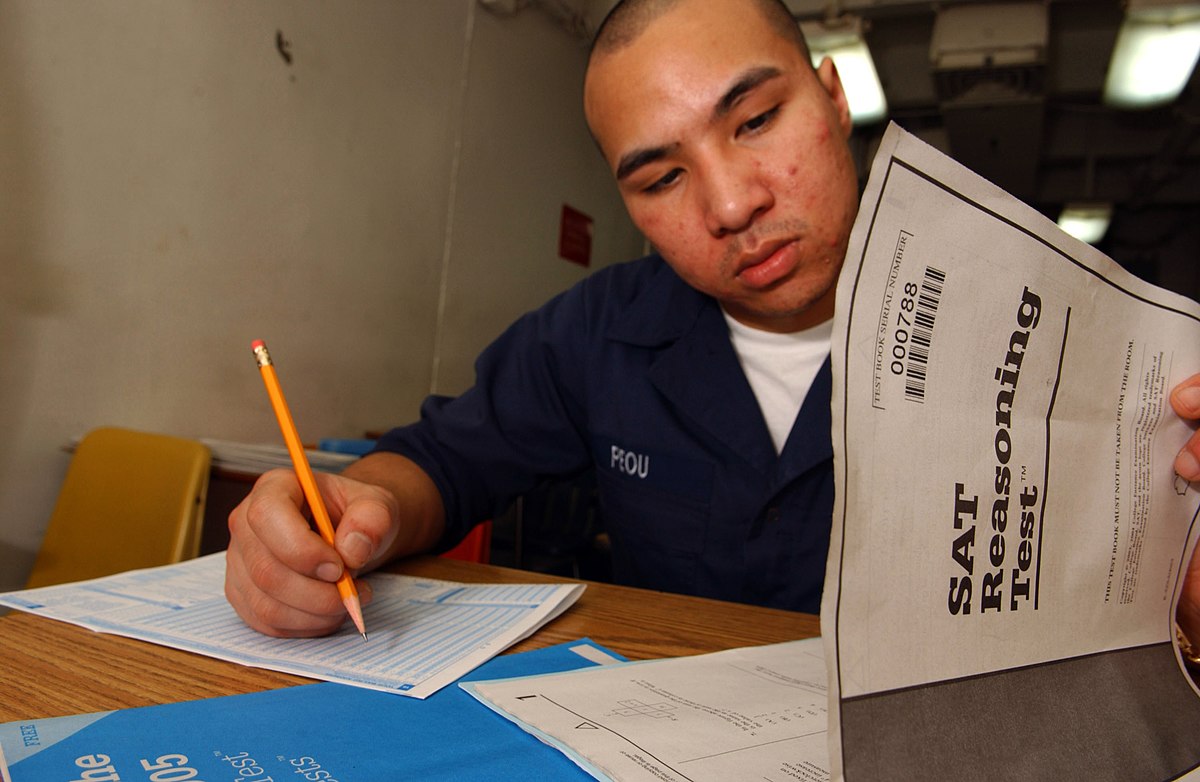
US Navy Seaman Chanthorn Peou takes the SAT aboard USS Kitty Hawk, 23 February, 2004.
US Navy photograph by Photographer’s Mate 3rd Class Jason T. Poplin via Wikimedia Commons.
I graduated in the bottom third of my high school class with a 2.2 GPA. Didn’t think of myself as “smart”. I thought a lot and read a lot. But I hated homework, teachers, rules, etc. I thought “smart” meant kids who did their homework and raised their hand in class. Those types.
My senior year of high school I took the required test to join the military — the Armed Services Vocational Aptitude Battery (ASVAB). Half my motivation to take this test was because I got to skip class. I spent the night before with my friends drinking Four Loko and playing Fight Night Round 3 on Xbox 360. Woke up with a hangover, chugged 20 ounces of Rockstar energy drink, and took the test. Afterwards, the Air Force recruiter showed me how to convert ASVAB to SAT scores. I got the same score as my smartest friend who always got straight-As and was headed for college. What the fuck? I thought.
At the time, I wasn’t aware these tests are thinly veiled IQ tests. The SAT, ASVAB, and the ACT are all highly correlated with IQ at about r = .8.
A study on Army recruits found that scores on an intelligence test, along with 2-mile run time, were the best predictors of success in infantry training.
Research on tank gunners found that replacing a gunner who scores around the 20th percentile with one who scores around the 55th percentile improves the likelihood of hitting a target by 34 percent.
To qualify, potential military recruits must score higher than roughly one-third of all who take the ASVAB. The lowest acceptable percentile score to join is 36 for the Air Force, 35 for the Navy, 32 for the Marine Corps, and 31 for the Army. By definition, the worst test taker who makes it into the military still scores higher than one-third of his or her peers. The military slices off the bottom third of standardized test-takers, not allowing them to join.
The psychologist and intelligence researcher Linda Gottfredson has written:
IQ 85 … the U.S. military sets its minimum enlistment standards at about this level … The U.S. military has twice experimented with recruiting men of IQ 80-85 (the first time on purpose and the second time by accident), but both times it found that such men could not master soldiering well enough to justify their costs.
In the 1960s, Secretary of Defense Robert McNamara launched Project 100,000 which lowered the testing requirement. This allowed people at the 10th percentile (80~ IQ) — a standard deviation lower than the previous standard — to join.
Supposedly, the aim was to alleviate poverty. LBJ had recently begun his War on Poverty program. The story was that getting more recruits into the military would help them move into the middle class. And they needed more recruits for the Vietnam War. Lowering recruitment standards was an easy way to get them.
Recruits of Project 100,000 were 9 times more likely to require remedial training and training took up to 4 times longer to complete compared to their peers who had entered under the higher score requirement. In Vietnam, men recruited under the lower testing threshold were 2.5 times more likely to die in combat.
Did the veterans who made it home achieve upward mobility? No. Compared to civilians with similar attributes who were not recruited, McNamara’s Morons (as they were later termed) were less likely to be employed, less likely to own a business, and obtained less education. Later, the policy changed to improve the talent pool of the armed forces. Higher ASVAB score thresholds were reinstated. Along with additional rigid requirements.
Today, eight out of ten Americans between 17 and 24 are ineligible for military service. Mostly due to obesity, medical issues, and criminal records.
Anyway, seeing my ASVAB score was the first time I learned I could have been a good student. It was possible. How many kids out there are like this. Kids who have fucked up lives and get bad grades which mask their underlying potential. Potential that a standardized test could reveal.
The SAT is a “barrier” according to that NYT op-ed. But it’s also a gateway. Most poor kids don’t take the SAT. Or any other standardized test. More should.
“The First Soldier” – Albert Séverin Roche – Sabaton History 118
Sabaton History
Published 6 Mar 2023This song is the story of Albert Roche, who is very much forgotten today, but after the First World War was THE hero of France. He was hotheaded and tempestuous, but above all he was GOOD. His service — and his legend from that war — is just remarkable, and today we share the war stories of the First Soldier of France.
(more…)
The lab leak in Wuhan was bad, but the cover-up after the fact is much worse
Jon Miltimore outlines some of the recent confirmations of so many conspiracy theorists’ speculations about the origin of the Wuhan Coronavirus:

Wuhan Institute of Virology.
Wikimedia Commons.
More than three years after the Covid-19 outbreak, the world is still reeling from the virus and the global response to it.
Some 6.8 million people have already died from the virus, according to official statistics, including an estimated 1.1 million Americans. Each day the toll climbs higher; globally, more than 10,000 people die each week.
A bevy of government assessments now indicate that the likely source of the virus was not a wet market, but the Wuhan Institute of Virology, which for years has dabbled in the creation of chimeric coronaviruses.
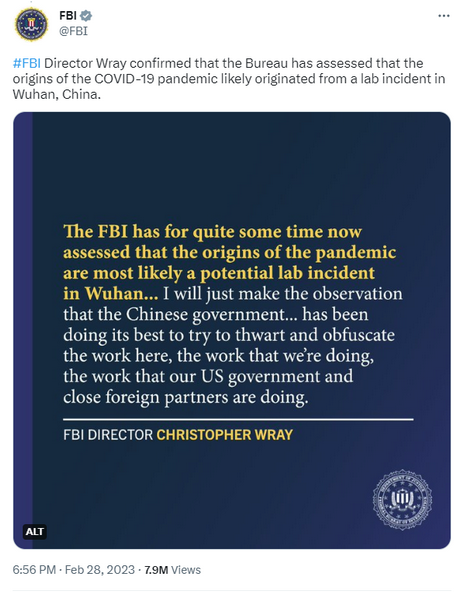
Last Sunday, the Wall Street Journal reported that the US Department of Energy had concluded the Wuhan lab was likely the origin of the pandemic. Days later the FBI chimed in, declaring that “the Bureau has assessed that the origins of the COVID-19 pandemic likely originated from a lab incident in Wuhan, China”.
If true, it’s not hyperbole to say this would be the greatest scandal of the century.
As the Washington Post reported nearly two years ago, State Department cables had previously warned of safety issues at the WIV, where researchers were studying bat coronaviruses. The cables were sent after science diplomats made a January 2018 visit to the Wuhan lab on behalf of the US embassy in Beijing. What the officials found at the lab, which in 2015 had become China’s first facility to achieve the maximum level of international bioresearch safety, shocked them.
Bad, even shocking, to those who refused to listen to the whistleblowers early in the pandemic. Worse, however, is the complicity of western government and media in the cover-up:
While the US government’s involvement in the Wuhan lab leak scandal may have been inadvertent, its attempt to avoid potential responsibility and conceal the truth is now apparent.
From the beginning of the pandemic, Dr. Fauci — the same Dr. Fauci whose agency awarded a $3.7 million grant to EcoHealth Alliance, which funded coronavirus research at the Wuhan lab — became the leading voice denying the possibility that Covid-19 could have emerged from the WIV.
It was “molecularly impossible” for viruses at Wuhan to have mutated into the current viral strain, he claimed in October 2021. In April the previous year he called the lab-leak-theory “a shiny object that will go away soon”, later noting that the virus’ “mutations” were “totally consistent with a jump of a species from an animal to a human”. In May 2020, he told National Geographic that “everything … strongly indicates” that the virus “evolved in nature”, calling the lab-leak theory a “circular argument”.
Scientists are of course entitled to their opinions, but there are two big problems that accompany Fauci’s public statements.
The first problem is that while these statements were being issued publicly, a different conversation was taking place privately, The New York Times noted Tuesday.
“… in 2020, many of those scientists who would become the most stalwart critics of the lab-leak theory privately acknowledged that the origins of the pandemic were very much up for debate”, writes David Wallace-Wells, “and that a laboratory leak was a perfectly plausible — perhaps even the most likely — explanation for the emergence of SARS-CoV-2 in Wuhan a few months earlier.”
We know this because a series of emails obtained by BuzzFeed through FOIA requests show that some of the world’s top virologists initially believed that the lab-leak hypothesis was at least as plausible as natural evolution theory. Specifically, the virologist and natural biologist Kristian Andersen described the new virus as “inconsistent with expectations from evolutionary theory”. In another email, Jeremy Farrar, the incoming head scientist of the World Health Organization, summarized the perspectives of scientists who concluded the “accidental release theory” was the likeliest scenario — “70:30” or “60:40” in favor. (Farrar put the odds at 50-50.)
These views were not made public, however. And following a Feb. 1 conference call arranged by Fauci, scientists published a paper in Nature expressing their belief that the most likely scenario was that the virus naturally evolved on its own.
“Our analyses clearly show that SARS-CoV-2 is not a laboratory construct or a purposefully manipulated virus”, the scientists, including the initially skeptical Andersen, emphatically noted.
So just a few months into the pandemic, scientific researchers were raising concerns in private, but governments pushed legacy media and social media platforms to police public discourse and to actively suppress public doubts of exactly the same sort that the experts were discussing among themselves.
How Would a Nuclear EMP Affect the Power Grid?
Practical Engineering
Published 8 Nov 2022How a nuclear blast in the upper atmosphere could disable the power grid.
(more…)
QotD: The Stoic view of beauty
Like all materialists, then, Stoics had a real problem with things like beauty. If you’re a materialist, Beauty is either a refutation of your theory, or a tautology (“certain arrangements of atoms produce chemical reactions that our brains interpret as pleasant” is just a fancy way of saying “beautiful things are beautiful because they’re beautiful”). Back in grad school, in one of the deepest, darkest, most dungeon-like corners of the university’s book morgue, I discovered Ayn Rand’s attempt at an Objectivist aesthetics. Her conclusion, stripped of her inimitable self-congratulatory prose, is here:
At the base of her argument, Rand asserts that one cannot create art without infusing a given work with one’s own value judgments and personal philosophy. Even if the artist attempts to withhold moral overtones, the work becomes tinged with a deterministic or naturalistic message. The next logical step of Rand’s argument is that the audience of any particular work cannot help but come away with some sense of a philosophical message, colored by his or her own personal values, ingrained into their psyche by whatever degree of emotional impact the work holds for them.
Rand goes on to divide artistic endeavors into “valid” and “invalid” forms …
In other words, there’s no art, only propaganda. Looks like ol’ Marcus really missed a trick, statecraft-wise, doesn’t it?
Severian, “On Fine Writing Etc.”, Everyday Stoicism, 2020-05-04.
March 6, 2023
Britain’s Free Speech Union at three
Earlier this month, Toby Young’s Free Speech Union celebrated its third birthday:

Toby Young founded the Free Speech Union in early 2020, and on Wednesday, 1 March a party was thrown to celebrate the organisation’s third birthday. The delicate baby born just before the Covid-19 lockdowns has grown into a boisterous, disruptive toddler that stomps about the political scene breaking things.
Over 100 people came to the In and Out on St James’s Square to enjoy the FSU’s success, including Professor Nigel Biggar, whose book Colonialism was effectively cancelled by Bloomsbury when the publisher’s executives decided that “public feeling” was against its publication. The legal profession was well-represented — Francis Hoar acted as counsel in various legal challenges for those damaged by the government’s lockdowns. He was heard to complain that the Covid-19 inquiry under Lady Hallett had granted core participant status to various bereaved family groups and those suffering from long Covid, but had denied it to the hospitality and other businesses which had been pushed into bankruptcy. Other attendees included Matthew Elliott, who led Vote Leave; Matt Ridley, the author of The Rational Optimist; and Adam Afriye MP. The FSU has been remarkably successful in raising funds, and there was a good turn out of donors like Lady Bell, the widow of Bell Pottinger founder Lord Bell of Belgravia.
Young told the room what his creation had achieved in its short life so far — a paying membership of 11,000; more than 2,000 cases taken on; a staff of 16 including eight full time employees — and talked about his political campaigns. Currently in his crosshairs is the Worker Protection (Amendment of Equality Act) Bill, which has been tabled by Vera Hobhouse MP and is supported by the government. The Equality Act already imposes a duty on employers to stop their workers from being harassed by other employees in relation to a protected characteristic such as sexual orientation, disability or age. Hobhouse’s bill will extend that duty so companies can be liable for third parties’ harassing actions, unless the employer has taken “all reasonable steps” to protect them.
It is almost certain to have a chilling effect on free speech in the workplace, as well as creating additional costs which will have to be passed on to consumers — perhaps good news for HR departments, probably bad news for everyone else. The FSU hopes to see amendments proposed to the bill which will need to have public consultation, thereby delaying its parliamentary progress. It is hoped that the delay will prove fatal.
Updating Pascal’s Wager
David Friedman discusses moral realism and comes up with an improvement to Blaise Pascal’s famous wager:

Blaise Pascal from Practical Physics (1914), by Macmillan and Company.
Wikimedia Commons.
Blaise Pascal famously argued that one ought to believe in the Catholic faith because the enormous payoff if it was true, heaven instead of hell, made it in your interest to believe even if you thought the probability that it was true was low.
There are three problems with the argument. The first is that belief is not entirely a matter of choice — I cannot make myself believe that two plus two equals five however much I am offered for doing so. The second is that belief motivated not by love of God but by love of self, the desire to end up in Heaven instead of Hell, might not qualify you for admission. The third is that the argument applies to many doctrines other than Catholicism and so gives you no way of choosing among Christian sects or between Christianity and alternative religions, short of somehow estimating the probability that each is true and the associated payoff and choosing the one with the highest expected return.
I, however, have an improved version of the argument free from all of those problems, an argument not for Christianity but for moral realism.
One explanation of our moral feelings is that right and wrong are real and our beliefs about right and wrong at least roughly correct. The other is that morality is a mistake; we have been brainwashed by our culture, or perhaps our genes, into feeling the way we do, but there is really no good reason why one ought to feed the hungry or ought not to torture small children.
If morality is real and you act as if it were not, you will do bad things — and if morality is real you ought not to do bad things. If morality is an illusion and you act as if it were not you may miss the opportunity to commit a few pleasurable wrongs but since morality correlates tolerably, although not perfectly, with rational self interest, the cost is unlikely to be large. It follows that if you are uncertain which of the two explanations is correct you ought to act as if the first is.
No god is required for the argument, merely the nature of right and wrong, good and evil, as most human beings intuit them. The fact that you are refraining from evil because of a probabilistic calculation does not negate the value of doing so — you still haven’t stolen, lied, or tortured small children. One of the odd features of our intuitions of right and wrong is that they are not entirely, perhaps not chiefly, judgements about people but judgements about acts.
How the powers-that-be got drunk on (practically unlimited) power with the pandemic lockdowns
Brendan O’Neill on the revelations from the release of British government officials’ informal chats on WhatsApp as the initial lockdowns were imposed:

“Covid 19 Masks” by baldeaglebluff is licensed under CC BY-SA 2.0


They were laughing at us. They didn’t only lock us down. They didn’t only suspend virtually every one of our civil liberties, including a right none of us ever expected to lose: the right to leave our own homes. They didn’t only spy on us with drones, and encourage us to snitch on that neighbour going for a sneaky second jog, and fine teenagers life-ruining sums of money for holding house parties. They also chuckled about it. It was funny to them. In one of the most startling WhatsApp chats revealed in the Daily Telegraph‘s Lockdown Files, a senior civil servant says the following about Brits returning from trips abroad who were forced to quarantine in a stuffy hotel room for 10 days: “Hilarious“.
It was Simon Case, the UK’s top mandarin. In February 2021 he had a breezy virtual chat with Matt Hancock, the then health secretary. A policy had just been introduced stipulating that any Briton returning from a “red list” country – which eventually included 50 states around the world, including India and vast swathes of Africa – would have to quarantine in a hotel at a cost of £1,750 per person, later rising to £2,285. A total of 200,000 British citizens and residents endured this painful, expensive quarantine. To Hancock and his civil-service pals it was all a big laugh. “I just want to see some of the faces of people coming out of first class and into a premier inn shoe box”, chortled Mr Case. He later asked Hancock: “Any idea how many people we locked up in hotels yesterday?” Locked up in hotels. Hancock replied that 149 people “are now in Quarantine Hotels due to their own free will!”. “Hilarious”, said Case.
Hilarious? Tell that to the people whose lives were ruined by this policy. The idea that it was just reckless rich folk jetting off to exotic destinations that were on the “red list” is ridiculous, as academic Aleksandra Jolkina has explained. Consider the NHS worker who travelled to Ethiopia to visit his dying uncle and look after his sick mother. While he was there Ethiopia was added to the “red list”, meaning he could not return to the UK; he couldn’t afford to. Or the Briton who travelled to Pakistan to visit his terminally ill father. He was forced to raid the family savings to pay the return quarantine fee. As a result, his “family’s ability to survive financially” was put “at risk”. Or think about the many Brits who did not go abroad, to one of those supposedly toxic countries, because they didn’t have the funds for that stay in a “premier inn shoe box”. People who, as Jolkina describes it, could not “visit their ill relatives or wish them a final farewell”. Hilarious, right?
The sinister cruelty of lockdown is laid bare in this grotesque vision of officials laughing over a policy that caused so much heartache and hardship among often low-earning Brits whose only crime is that their families live overseas. You couldn’t have asked for a better snapshot of the feudalistic authoritarianism that underpinned the ideology of lockdown. Civil servants working from their plush homes having a giggle about a policy that inflicted severe financial pain on the diverse working classes. A health secretary breaking his own guidelines to snog his mistress while sending snide WhatsApp messages about a policy that prevented poorer citizens from kissing the cheek of a dying relative. For me, this is the most important thing about the Lockdown Files – their revelation of just how morally cavalier and even inhuman the political elites can become when they are drunk on power, when they are liberated from democratic accountability to pursue whatever extreme policies they like.
The Telegraph‘s Lockdown Files are based on more than 100,000 WhatsApp messages sent and received by Matt Hancock in the pandemic years. Hancock gave the messages to Isabel Oakeshott when she was co-writing his book, Pandemic Diaries, and now Ms Oakeshott has given them to the Telegraph. They provide only a partial insight into the machinations of lockdown, of course. Hancock is not the centre of the universe, whatever he might think to the contrary. And he says some of the messages are being taken out of context. Perhaps. Nonetheless, the Lockdown Files represent our first serious reckoning with lockdown, our first glimpse at what was happening behind the scenes of this unprecedented exercise in social control. And it’s not a pretty picture.
The Rise and Fall of Fast Food Architecture
Stewart Hicks
Published 3 Nov 2022What happened to McDonald’s? Their restaurants used to be so iconic. It was impossible to mistake one, for say, a Wendy’s. Distinguished architecture used to be an important part of a brand’s identity. But today, fast food restaurant’s all look the same. Bland grey boxes. The great convergence toward this standard has been called “Chipotle-ification”. In this video, we trace the changing restaurant designs of McDonald’s, from the iconic golden arch era to the soulless boxes of today. We break down the architecture and the forces at play in the great homogenization of fast food architecture.
(more…)


