
Polyus
Published 16 Jul 2021The Canadair CL-215 is the most successful flying boat amphibian since the second world war. Its multi-role capabilities range from aerial spraying, search and rescue, cargo service, to its most notable role, as a water bomber. It has the most outstanding performance of any aerial fire fighting platform. Starting production in the late 1960s, it continued production in several forms through ownership by Bombardier and later by Viking Air. The latter is currently developing the exciting next generation CL-515 First Responder with deliveries expected in 2024.
(more…)
July 20, 2023
Water Bombing Workhorse That Keeps On Evolving; the story of the Canadair CL-215, 415, and 515
Comments Off on Water Bombing Workhorse That Keeps On Evolving; the story of the Canadair CL-215, 415, and 515
QotD: Advertising to a semi-captive audience
You know how drug companies pay six or seven figures for thirty-second television ads just on the off chance that someone with the relevant condition might be watching? You know how they employ drug reps to flatter, cajole, and even seduce doctors who might prescribe their drug? Well, it turns out that having 15,000 psychiatrists in one building sparks a drug company feeding frenzy that makes piranhas look sedate by comparison. Every flat surface is covered in drug advertisements. And after the flat surfaces are gone, the curved sufaces, and after the curved surfaces, giant rings hanging from the ceiling.
The ads overflow from the convention itself to the city outside. For about two blocks in any direction, normal ads and billboards have been replaced with psychiatry-themed ones, until they finally peter off and segue into the usual startup advertisements around Market Street.
Scott Alexander, “The APA Meeting: A Photo-Essay”, Slate Star Codex, 2019-05-22.
Comments Off on QotD: Advertising to a semi-captive audience
July 19, 2023
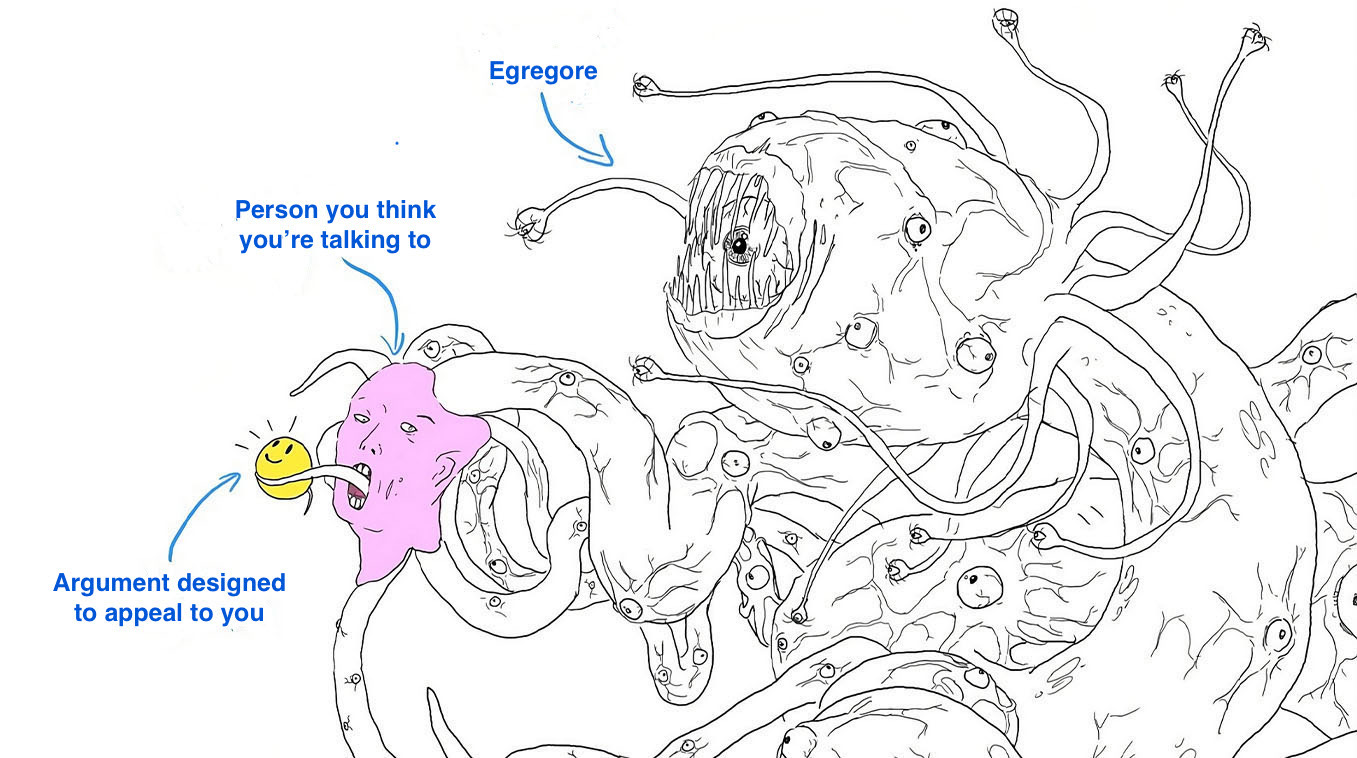
Infohazards on the internet of lies lead us into the clutches of “egregores”
The latest review at Mr. and Mrs. Psmith’s Bookshelf from John Psmith, is on the 1872 novel Demons by Fyodor Dostoevsky”. I didn’t read the post immediately, as Russian literature and I aren’t even nodding acquaintances. I should have remembered that both of the Psmiths have an amazing ability to tell you a lot more than a “review” would normally contain, and this one certainly lived up to expectations, including a brief discussion of philosopher Charles Taylor’s ideas about pre-modern versus modern concepts of the self. Most pre-modern cultures believed in external influences having disproportional impact on the person, while most modern cultures believe the influences arise internally within the mind. Most pre-modern cultures also feared the self could be taken over, or possessed, by malevolent external entities, ideas, or thoughts:

Dostoevsky obligingly gives us a character who’s clearly possessed in exactly this sense — a dissolute nobleman around whom the various radical conspiracies swirl. He is, simultaneously, a subversion of the brooding Byronic hero archetype that was so popular in 19th century European literature, and an eerie anticipation of the modern concept of the serial killer. How did he get this way? Remember the modern view of our desires is that they come from within us, and indulging them leads to inner harmony. But the older and truer view is that they can come from outside, force their way into our skulls through an opening, set their hooks in our brains, lay their eggs. These fledgling desires start out small and weak, but to indulge them is to feed them, grow them, until they take over their host and move its mouth and limbs around like a puppet. In this sense the porn addict, the drug addict, and the rage addict are all alike: sensual dissipation gets boring eventually, and you need harder and harder stuff to feel the same thrill, until one day you reach for something so hard you lose yourself forever.
The Dostoevskian twist to all this is that the proto-serial killer is far more sympathetic, and ultimately more redeemable, than the revolutionaries. The radicals’ motivations spring from the same emotional source as his, theirs are just sublimated into politics, which is why the form of the dystopia doesn’t really matter to them, all that matters is that there be a boot stomping on a human face. The sexual sadism of the serial killer is unflinchingly portrayed as less disordered and less socially destructive than its political equivalent and, ultimately, as rather basic. It’s actually quite easy to miss all of this because it’s so deeply at odds with modern sensibilities. Not just “serial killers are better than communists actually,” but also “serial killers are really pretty boring actually,” and all from the guy who just invented serial killers.1
But what if the radicals aren’t sublimating anything at all? What if there’s another kind of demon, another kind of infohazard, another kind of meme, which rather than infecting or possessing individuals, instead tries to do that to entire societies? Such a being might still work through individuals, the way a Haitian voodoo spirit speaks through a chwal, but here the individual puppet is not a target, but rather an instrument or a transmission vector. The internet jargon for such a being is an “egregore,” and you’ve encountered them before: the bizarre fad that sweeps through a middle school class like a wildfire, the war fever that grips a nation and turns it overnight into a basket of bloodthirsty lunatics. Dance crazes, viral TikTok challenges, internet-mediated mental illnesses. There’s a classic Futurama gag involving the Brain Slug Party, but the real joke is that every party is the Brain Slug Party, they’re all egregores. Have you ever spoken with somebody who had hashtags in their Twitter bio? If you looked carefully, you may have seen the slender, silvery proboscis emerging from the back of their neck and vanishing into the ether. If you listened carefully, you may have heard the alien metallic clacking of the egregore’s mandibles, as it sent messages down that tube for the meat puppet to vocalize.
Sometime in the mid-19th century, an egregore was born in the Russian Empire. It went by a thousand different names — among them: anarchism, communism, nihilism, democracy. What’s that? Those four ideologies are completely opposed to one another? That’s the entire point! It wasn’t actually any of those things, it was an egregore, its true name was something like Melkhorbalai or Uztaa-Binoreth. It wore those other names like skins when it was convenient to do so, which is why in the real life history of 19th century Russia we see countless examples of individuals switching between communism, anarchism, and democracy like they were flavors of ice cream.
The egregore wanted none of these things: it wanted to grow, to spread, to manifest itself into this reality. Madly, it willed destruction, and the more destruction it caused the stronger it got, and the easier further destruction became, a runaway exothermic reaction endlessly feeding on itself. So the reformist zeal of the 1840s became Nechayev’s insane nihilism of the 1870s, then the even more insane terrorism of 1900-1917 with which I opened this review, until finally, strengthened by half a century of blood sacrifice, that rough beast slouched towards St. Petersburg to be born. The trauma of that birth ripped apart first Russia, then Europe, then it almost ate the rest of the world too.
Could anything have stopped it sooner? In Dostoevsky’s story there’s one character who tries lamely to stand in the way of the swirling, coalescing, immaterial malevolence. He is a reactionary, a newly-freed former serf,3 and (like Dostoevsky himself) a repentant former revolutionary. He’s young and hip, but has old and edgy views, a perfect stand-in for online “trads”. Given Dostoevsky’s own views it would be easy to make him the hero of the story, but Dostoevsky is too great a writer for that, and instead makes him a pathetic LARPer:
“I only wanted to know, do you believe in God, yourself?”
“I believe in Russia … I believe in her orthodoxy … I believe in the body of Christ … I believe that the new advent will take place in Russia … I believe …” Shatov muttered frantically.
“And in God? In God?”
“I … I will believe in God.”
How great a description is that of all the crusader-avatar twitter accounts named “DeusVult1571”? Imagine one of them blubbering: “I believe in based aesthetics … I believe in Western civilization … I believe in the Hajnal line … I believe …” Ah, but do you believe in God? Probably some of them do, but for many others it’s a pose, or a meme, or a philosophical premise that they must accept in order to turn the rest of the brand they’ve assumed into a self-consistent whole.2 For these, the god they worship is just another egregore — one small and weak for now, less threatening perhaps than some others, but feed it, let it grow, and see how fast it turns on you.
The other force that could have resisted the growing darkness is the parents’ generation, the liberals of 1848, Turgenev’s boomers. We already know how that turned out in real life, but while Dostoevsky didn’t live to see it happen, he had these peoples’ number. Once so bold in condemning their government and sneering at their civilization, they are suddenly timid in the face of their children, terrified of being seen as uncool or conservative or just not with it. That’s a good way to raise a psycho, and Dostoevsky more than hints that everything which follows is ultimately their fault. And it’s a bad way to face down an egregore. Doing that requires boldness and … well:
“But this is premature among us, premature,” he pronounced almost imploringly, pointing to the manifestoes.
“No, it’s not premature; you see you’re afraid, so it’s not premature.”
“But here, for instance, is an incitement to destroy churches.”
“And why not? You’re a sensible man, and of course you don’t believe in it yourself, but you know perfectly well that you need religion to brutalise the people. Truth is honester than falsehood …”
“I agree, I agree, I quite agree with you, but it is premature, premature in this country…” said Von Lembke, frowning.
“And how can you be an official of the government after that, when you agree to demolishing churches, and marching on Petersburg armed with staves, and make it all simply a question of date?”
“Premature, premature”, is what the useless normies will bleat when our own radicals are blowing up Mt. Rushmore and pulling down statues of George Washington. Who are these radicals? I have no idea what the egregore will call itself this time. It doesn’t matter. Its true name sounds to human ears like a high-pitched mechanical screeching and clicking, a sound calculated to drive men mad, and to drive madmen into making it real.
1. I’m told that the internet jargon for this is an “unbuilt trope.”
2. Dostoevsky positions a former serf as the defender of “Holy Russia,” Orwell suggests that if there is hope it lies in the proles, Bismarck believed the poor would serve as a reactionary bulwark against liberalism, and MAGA believes that various dispossessed and subaltern groups will keep America great. Are they all correct? No. They’re all wrong. The lower classes have no special compass for political or religious truth, they’re just almost definitionally slightly behind the times. When an egregore is rapidly accumulating strength, they’re likely to oppose it out of inertia, but they’re as vulnerable as anyone to its blandishments, and will just as vigorously defend the new thing once it has taken over.
3. Look, I have a lot of sympathy for these guys. Like the Russian radicals of the 1870s, they correctly observe that there’s something insane and rotten about our society, but unlike those radicals they’re attracted to something that’s really out there and really true and good. “Fake it til you make it” is not the worst strategy ever invented for securing a mature and authentic faith in a supreme being. But once you’re in that state, there’s a clock running, your time is limited, there are other things out there in the night, attracted by the smell of lost and receptive souls.
Comments Off on Infohazards on the internet of lies lead us into the clutches of “egregores”
Diplomats Fight the Nazis in Budapest – War Against Humanity 104
World War Two
Published 18 Jul 2023Hungary’s Jews are facing a Holocaust machine in overdrive. The deportation trains are arriving in such volume that even the extermination factory of Auschwitz can barely keep up with the pace. The entire country swiftly becomes Judenfrei and the Jews of Budapest sit helplessly as Adolf Eichmann and his Hungarian collaborators tighten the noose around them. Admiral Miklós Horthy is one of the few who can save them, but so far he has done nothing. Will that change?
(more…)
Comments Off on Diplomats Fight the Nazis in Budapest – War Against Humanity 104
Ever wonder where the term “two-spirit” came from?
In Spiked, Malcolm Clark explains the origin of the now commonly used term as a portmanteau for many different words — with significant variation in meaning — in indiginous languages:

Typical media presentation of Two-spirit individuals
The term two-spirit was first formally endorsed at a conference of Native American gay activists in 1990 in Winnipeg in Canada. It is a catch-all term to cover over 150 different words used by the various Indian tribes to describe what we think of today as gay, trans or various forms of gender-bending, such as cross-dressing. Two-spirit people, the conference declared, combine the masculine and the feminine spirits in one.
From the start, the whole exercise reeked of mystical hooey. Myra Laramee, the woman who proposed the term in 1990, said it had been given to her by ancestor spirits who appeared to her in a dream. The spirits, she said, had both male and female faces.
Incredibly, three decades on, there are now celebrities and politicians who endorse the concept or even identify as two-spirit. The term has found its way into one of Joe Biden’s presidential proclamations and is a constant feature of Canadian premier Justin Trudeau’s doe-eyed bleating about “2SLGBTQQIA+ rights”.
The term’s success is no doubt due in part to white guilt. There is a tendency to associate anything Native American with a lost wisdom that is beyond whitey’s comprehension. Ever since Marlon Brando sent “Apache” activist Sacheen Littlefeather to collect his Oscar in 1973, nothing has signalled ethical superiority as much as someone wearing a feather headdress.
The problem is that too many will believe almost any old guff they are told about Native Americans. This is an open invitation to fakery. Ms Littlefeather, for example, may have built a career as a symbol of Native American womanhood. But after her death last year, she was exposed as a member of one of the fastest growing tribes in North America: the Pretendians. Her real name was Marie Louise Cruz. She was born to a white mother and a Mexican father, and her supposed Indian heritage had just been made up.
Much of the fashionable two-spirit shtick is just as fake. For one thing, it’s presented as an acknowledgment of the respect Indian tribes allegedly showed individuals who were gender non-conforming. Yet many of the words that two-spirit effectively replaces are derogatory terms.
In truth, there was a startling range of attitudes to the “two-spirited” among the more than 500 separate indigenous Native American tribes. Certain tribes may have been relaxed about, say, effeminate men. Others were not. In his history of homosexuality, The Construction of Homosexuality (1998), David Greenberg points out that those who are now being called “two spirit” were ridiculed by the Papago, held in contempt by the Choctaws, disliked by the Cocopa, treated by the Seven Nations with “the most sovereign contempt” and “derided” by the Sioux. In the case of the Yuma, who lived in what is now Colorado, the two-spirited were sometimes treated as rape objects for the young men of the tribe.
Comments Off on Ever wonder where the term “two-spirit” came from?
Win A Point, Add A Layer Of Clothing | Badminton Insight Singles Match
Badminton Insight
Published 10 Apr 2022A Badminton singles match BUT each time someone wins a point we have to add a layer of clothing!
(more…)
Comments Off on Win A Point, Add A Layer Of Clothing | Badminton Insight Singles Match
QotD: If they were serious …
I suppose this should be a post unto itself, but very briefly, If They Were Serious about war with China, you’d expect a few very basic things. Massively stepped-up armaments production, if nothing else, and if you wanted to be really slick about it, you’d do it under the guise of replenishing all the stocks we sent to our plucky allies in Ukraine — purchase orders for 100x the total amount shipped to Keeeeeve, that kind of thing. But that’s the kind of retooling that’s hard to hide, because it would also involved massively stepped-up mining, refining, and so on, not to mention upgrading the transportation infrastructure and so on.
None of those things appear to be happening. And since even an all hands on deck, Nazi-style crash rearmament program has a lag time of a few years, If They Were Serious about premiering Showdown in the Taiwan Strait anytime in the next decade, they’d be jamming that shit out NOW. Right now. Afterburners full.
You also need soldiers to use all that stuff, so you’d expect massively stepped-up military recruiting. Which would entail, at minimum, a push to get American boys into some kind of fighting shape. Which not only isn’t happening, but the exact opposite is happening. Unless you want Uncle Sugar to pay for your “top surgery” or your addadicktome, why would anyone enlist? When you further consider that the same TLAs who are so smoothly rolling out their Hate the Han™ campaign could easily order up some ultra-jingoistic remakes of Stallone movies from the 1980s, it seems as if They are not, in fact, Serious …
… but some of the nodes are, because failure is a distributed system. I love playing If They Were Serious — it’s my favorite drinking game — but alas for me, it relies on the Assumed Internal Consistency Fallacy. Like the Japanese Navy, or the Wehrmacht on the Eastern Front, or even poor Adm. Kimmel, you’ve got certain nodes of the Apparat performing competently to brilliantly in the service of skull-fuckingly stupid objectives, or NO objectives. The Flying TIGRs are even dumber than [Hitler], who at least called a meeting to say “Hey, how’s about we invade Russia in the winter?” While it’s clear to everyone who matters that the TIGRs really really really really really want their war, nobody’s in charge, so everyone is left to figure it out as best they can, on their own initiative, with the resources they have to hand.
And again, much like the Wehrmacht etc., the better the competent nodes perform, the harder and faster the overall system failure. We’re going to end up charging headlong into a war with China because the TLAs at Twitter etc. are doing such a great job making Hate the Han™ the Current Thing. Meanwhile, one imagines Brandon’s handlers telling their Chinese paymasters that no no, that won’t be happening, please don’t cut off our paychecks. And since they’re pretty good at their job, too — their job being “telling Beijing what they want to hear while lugging away huge sacks of cash” — it’s gotta fuck with the People’s Liberation Army command staff.
Consider further that the Army (etc.) are, Kimmel-style, doing a pretty decent job of carrying out their on-paper objectives. Kimmel was told “Get the Fleet ready for a likely confrontation with Japan a few years down the line”, and he did it. The Fistagon has told all its commanders to get ready for a war with China, yeah, sometime down the line … but right now, the important thing is to get as many gays, girls, and trannies as possible into uniform while promoting the Diversity that’s already in uniform as far up the chain of command as possible. General Sasqueetchia, in command of the Fightin’ 45th Mechanized Hairdresser Battalion, says thanks for a job well done … and it IS a job well done, according to the only actual orders anyone has received.
Fun times, right?
Severian, “Failure Nodes”, Founding Questions, 2023-04-18.
Comments Off on QotD: If they were serious …
July 18, 2023
Life lessons from Thomas Sowell’s memoir
Rob Henderson took a lot away from his recent reading of Thomas Sowell’s A Personal Odyssey, including some fascinating lessons from Sowell’s time in the US Marine Corps:

Trust people who value being honest more than being nice.
As the Korean War intensified, Sowell was drafted into the Marine Corps. He notes that color did not matter, as all new recruits were treated with equal disdain. Sowell describes his life in the Marine barracks in Pensacola. There were two non-commissioned officers permanently stationed to oversee the young marines. One was Sergeant Gordon, “a genial, wisecracking guy who took a somewhat relaxed view of life”. The other was Sergeant Pachuki, “a disciplinarian who spoke in a cutting and ominous way” and was always “impeccably dressed”.
Sowell and his peers preferred Sergeant Gordon, as he was more easygoing. Sowell had to go into town to pick up a package. Sowell asked his Chief Petty Officer if he could leave the base to retrieve his package. Sowell received permission.
Later, while Sowell was not on base, he was marked as absent and was accused of being AWOL (absent without leave), a serious offense. Sowell knew Sergeant Gordon, the nice one, had overheard him asking for permission to leave the base. Gordon denied having heard anything, and told Sowell, “You’re just going to have to take your punishment like a man”. Gordon fretted that if he crossed the higher-ups, he would be reassigned to fight in Korea.
But unasked, Sergeant Pachuki came forward and spoke with the colonel, explaining the situation. As a result, Sowell was exonerated and returned back to his duties.
Referring to Gordon, the “nice” sergeant who betrayed him, Sowell writes, “People who are everybody’s friend usually means they are nobody’s friend”.
A “free good” is a costless good that is not scarce, and is available without limit.
Sowell would regularly needle Sergeant Grover, another member who outranked him.
Here’s the excerpt:
Some were surprised that I dared to give Sergeant Grover a hard time, on this and other occasions, especially since he was a nasty character to deal with. Unfortunately for him, I knew that he was going to give me as hard a time as he could, regardless of what I did. That meant it didn’t really cost me anything to give him as hard a time as I could. Though I didn’t realize it at the time, I was already thinking like an economist. Giving Sergeant Grover a hard time was, in effect, a free good and at a zero price my demand for it was considerable.
Sowell learned he could receive something he enjoyed (pleasure at provoking Grover) in exchange for nothing.
Much of what you see has been carefully curated with an agenda in mind.
One of Sowell’s assignments in the Marine Corps was as a Duty Photographer on base. One day after submitting some of his photos, Sowell had the following exchange with the public information office sergeant:
“They are good pictures, he said. “But they do not convey the image that the public information office wants conveyed.”
“What’s wrong with them?” I asked.
“Well, take that picture of the reservists walking across the little wooden bridge carrying their duffle bags.”
“Yeah. What’s wrong with it?”
“The men in that picture are perspiring. You can see the damp spots on their uniforms.”
“Well, if you carry a duffle bag on a 90-degree day, you are going to sweat.”
“Marines do not sweat in public information photographs.”
“Okay, what was wrong with the picture of the reservists picking up shell casings after they had finished firing? That was one of my favorites.”
“Marines do not perform menial chores like that, in our public relations image.”
“But all these photos showed a very true picture of the reservists’ summer here.”
“We’re not here to tell the truth, Sowell,” he said impatiently. “We are here to perpetuate the big lie. Now, the sooner you understand that, the better it will be for all of us.”
When I visited the Air Force recruiter in high school, I saw the brochures with images of well-groomed airmen in their dress blues graduating from basic training. I had no knowledge that much of that training would involve mind-numbing minutia. I suppose this is true for other career fields too. You see radiant coverage of academic research in legacy media outlets, or fun twitter threads outlining interesting research findings. You see the brand new hardcover book with all the glowing blurbs and reviews. You don’t see all the drudgery of research or writing behind the scenes.
Sometimes, it doesn’t pay to have too big a reputation.
Sowell and his fellow marines would sometimes have impromptu boxing matches around the barracks on base. One day Sowell was up against another guy and threw a sloppy right hand. The guy stumbled back, tripped, and fell to the ground. Although Sowell had swung and missed, witnesses thought he had knocked the other guy out.
Later, Sowell went up against another guy named Douglas. Douglas relentlessly came at Sowell and gave him a serious beating. Douglas told Sowell afterwards that the reason he was so aggressive was that he feared Sowell’s “one punch” could turn the fight around at any time. “Sometimes,” Sowell writes, “it doesn’t pay to have too big a reputation.”
Comments Off on Life lessons from Thomas Sowell’s memoir
Seaplanes? How 1940s. No, we’re seeking to “leverage emerging technologies” instead
CDR Salamander wonders about a modern need for military sea rescue capability that the US Navy filled with flying boats and seaplanes during the Second World War, then supplemented with helicopters during Korea and Vietnam. For ocean search-and-rescue in a combat environment in the present or near future, what are the USN’s plans?
I will be the first person to admit that good, well-meaning, and informed people can disagree with seaplanes in general or the US-2 specifically, but they have to engage the conversation. Directly argue the requirement or offer realistic alternatives.
This does neither. If anything is demonstrates the narrowness of thought and fragility of substance used in opposition.
What an patronizingly toxic stew that answer is. I highly doubt Lung typed out that answer himself, so my commentary below is not directed at him personally, but … and it is what comes after the “but” that counts — but at the three-digit J or N code that extruded that from the random acquisitions professional statement subroutine from ChatGPT.
Let’s give that answer a full Fisking;
- “The Indo-Pacific operational environment has evolved significantly since World War II”:
Let me check my WWII Pacific chart, my Vietnam War era globe, and GoogleEarth … and … no. The geography has not changed. The distances have not changed. The requirement of thousands of years to take and hold territory or eliminate your enemy from access to it has not changed. All the little islands, regardless of what Al Gore and John Kerry say, are still there. As we are seeing in the Russo-Ukrainian War, a million PPT slides saying so does not change the fundamentals of war.
Sentence one is invalid.
- “The employment of seaplanes today would not meet the operational demands and current threat scenario.”
Is there an operational demand for us to rescue downed airmen and to be able to reach remote islands without airfields? Yes. Does your “current threat scenario” run from Northern Japan through to Darwin, Australia? Yes.
Sentence two is invalid.
- “However, we support the continuous development of new and innovative solutions that may provide solutions to logistical challenges.”
So, you define “new” as something that only exists on PPT slides? By “continuous development” you mean never matures as a design that goes into production. By “innovative” you mean high on technology risk. Undefined program risk. Unknown design risk. No known production line or remote estimate to IOC, much less FOC when we know that the next decade is the time of most danger of the next Great Pacific War.
Sentence three is irresponsible and professionally embarrassing given the history of transformational wunderwaffe this century.
- “As an example, DARPA’s Liberty Lifter X-Plane seeks to leverage emerging technologies that may demonstrate seaborn strategic and tactical lift capabilities.”
Well, goodness, we will have to micro-Fisk this gaslighting horror show of a sentence. To start with, they are talking about either this from General Atomics;
… that could only be used on a very few select beaches under ideal weather in a completely permissive environment and could only be used for one specific mission and nowhere any possible hostile aircraft or ground forces. Also looks like we’d need a whole new engine and a small town’s worth of engine mechanics to maintain the maintenance schedule on those engines.
Then we have this offspring of an accidental mating of the Spruce Goose with the Caspian Sea Monster idea from Aurora Flight Sciences;
I give the odds of either one of those taking to the air prior to 2035, if ever, on par with a return of the submarine LST of Cold War fame (deck gun not included).
Let’s get back to the wording of that dog’s breakfast of a final sentence. Feel slimy reading it? You should;
- “seeks to leverage” — that is just a way of saying, “hope in magic beans.” Gobbledegook.
- “emerging technologies” — oh, you mean something that hasn’t left the computer, white board, or PPT slide.
- “that may demonstrate” — so, even if our magic beans managed to fuse unobtainium with Amrita, we’re not really sure if the strip mining of strange blue creatures’s holy sites and drilling holes in the soft pallet of whale-like thing will result in something of use.
- “strategic and tactical lift capabilities” — I’m sorry, an eight or ten-engined aircraft that any goober with a 1960s-era iron-sighted RPG-7 could target at maximum range is going do anything “tactical” — especially at the expected price of those things and the resulting precious few that wind up displacing water. Oh, and you admit that it will only be used for cargo, so it can’t do the full range of possible missions the US-2 can … just cargo. On just a few beaches that are fully surveyed ahead of time. At the right tide. In the right weather. In a 100% safe and permissive environment.
- The final sentence is a caricature.
Rep. Austin Scott (R-GA) should feel at least mildly insulted by this reply. It was a serious question given a canned answer that, slightly modified, could have been provided at any time in the last quarter century by the lethargically complacent maintainers of the suboptimal habits of the mistakingly entitled acquisitions nomenklatura



Comments Off on Seaplanes? How 1940s. No, we’re seeking to “leverage emerging technologies” instead
At some point we moved from “therapy for serious issues” to “it’s totally normal for everyone you know to be in therapy”
In occasional conversations with younger folks (mainly Millennials and GenZ’ers), it’s surprising how often the topic of “therapy” comes up. Everyone I talk to under the age of 40 seems to be in therapy for this or that … when did that change? I’m no iron man (ask any of my friends), but it would never have occurred to me to seek counselling for what appeared to be the ordinary kind of issues that everyone else was dealing with. Friends and acquaintances who did were almost always struggling with some out-of-the-ordinary concern and certainly weren’t eager to discuss the course of their sessions as part of casual chit-chat. Freddie de Boer seems to share some of my discomfort on this topic:
Ladies, is your man engaging in the method of quasi-scientific self-improvement that’s currently mandated by high-status urbanites aged 21-45? If not, run, girl.
Before you go worrying or lecturing over my title here, let me say my personal life has never been better, really. But my total alienation from what I take to be my culture and its various attitudes and assumptions just grows and grows. Every day, it seems, there’s a fresh horror, and nowhere does it smack me in the face more than with mental health.
The above advertisement, which I think premiered in 2022, takes the medical tool of therapy and renders it a bit of dating-market gamesmanship, something bros just have to get on board with in order to hook up with high-value gals. I don’t expect a 30-second advertisement to reflect the reality that therapy is a frequently-adversarial process, that it’s at times uncomfortable by design, that it only works for certain kinds of problems, or that there are times when it can actually exacerbate them. And while I certainly do hold it against them for contributing to the corrosive “everybody should be in therapy” attitude — which is little different from believing that everybody should be on antibiotics — I also know that a for-profit therapy company is going to be pushing that line. (A macro-problem with for-profit medicine lies in the fact that the financial incentive is always to go on treating a medical problem forever without curing it.) What really gets to me is how a therapy company is going out of its way to make therapy appear so trivial, how the characters appear deliberately portrayed as unserious people and therapy so unapologetically represented as just a dating-market football. The commercial is somehow both grandiose about therapy’s purpose and dismissive about therapy’s actual use.
I don’t know how it is that we’ve simultaneously spent so much time validating and honoring people who struggle with their mental health and at the same time made mental health as a topic so frivolous.
I appreciated this conversation about TV therapy from The New Yorker. In it, Inkoo Kang says “I feel like there’s this idea that therapy is easy. And then you actually go to therapy, and you’re, like, ‘Oh, this is actually the worst’. That particular realization is very rarely dramatized.” I would argue that if therapy never feels like the worst, then you probably aren’t getting as much as you could out of the therapeutic process. Part of what makes finding and sticking with a therapist so difficult is that it’s close to impossible to divide your sense of what you want from a therapist from a broader understanding of what you need from a therapist. Are you sure you don’t like your current therapist because you’re “just not vibing with them”? Are you sure you want to fire your therapist because they seem “toxic”? Or is it because you signed up for therapy expecting it to be a constant exercise in validating everything you think and say and instead you’re one of the lucky few with a therapist who actually does their job and sometimes calls you on your bullshit? Of course, some therapists really aren’t very good, or more commonly, you can be a receptive patient and the therapist can be a competent practitioner but you have communication styles that just don’t gel. These things can be very difficult to parse on your own, which is why I always tell people to give it more time than they think they need. But either way, nothing is served by this effort to make therapy just another elite checklist item that shows you’re an enlightened person, except maybe Betterhelp’s share price.

Comments Off on At some point we moved from “therapy for serious issues” to “it’s totally normal for everyone you know to be in therapy”
Manville Gas Gun
Forgotten Weapons
Published 29 Oct 2012Charles Manville developed this weapon in the 1930s as a riot control tool, and they were built in 12ga, 25mm, and 37mm. We should point out that the 12ga version was for tear gas rounds only (like today’s 12ga flare launchers) and not safe to use with high-pressure ammunition. Anyway, it was intended for use by prison guards and riot police, offering a much greater ammunition capacity than any other contemporary launcher.
During World War II, Manville tried to sell the military on a high-pressure version to fire 37mm explosive rounds, but was unsuccessful. Instead, the Manville company spent the was making parts for the Oerlikon 20mm AA guns, and the tooling for the gas launcher was all destroyed.
(more…)
Comments Off on Manville Gas Gun
QotD: “Nothing to lose”
In line with the notion that people need “a stake in society” in order to refrain from breaking shop windows and taking what they think they have been wrongfully denied (interestingly, the bookshop was the only shop in a very badly looted commercial street that went completely unscathed during the riots), a man called Earl Jenkins — “who was one of up to 60 youth workers who went on to the streets of Toxteth [a poor area of Liverpool] during the disturbances to persuade youngsters not to get involved” — was reported in the Guardian to have said, “If you’ve got nothing to lose, you’ll do what you can to survive, won’t you?”
There was no comment in the newspaper on the deep contradiction in the attitude of Earl Jenkins (let us leave aside the question of how many “youth workers” in Toxteth are needed to prevent a riot there). For if it is true that the riots were a survival mechanism, why was Earl Jenkins trying to persuade young people not to join in? Did he not want them to survive? Suffice it to say that the objects looted during the riots were not such as people on the verge of famine, or who fear that famine is around the corner, might be expected to loot. They were, rather, the things that spoilt children might be expected to want for their birthday.
The term “If you’ve got nothing to lose” in this context is ambiguous. It might mean such penury, such drastic poverty, that you possessed nothing that could have been removed from you. But it clearly cannot mean this, since all the rioters were at liberty, and were clothed, fed, housed, educated (if unsuccessfully), provided with medical care, and given at least a small income, much of which could, in theory at any rate, be removed from them. They could be made homeless; their central heating could be turned off; they could go hungry and literally penniless, made to wear rags; their telephones could be taken from them; they could be deprived of their liberty and even enslaved.
But none of this was going to happen to them and they knew it perfectly well; so in this sense it was indeed true that they had nothing to lose. One of the commissioners appointed to enquire into the riots actually put it succinctly:
When people don’t feel they have a reason to stay out of trouble, the consequences for communities can be devastating …
But the reason they “don’t feel a reason to stay out of trouble” is not because they have nothing to lose in the sense of being so deeply impoverished that they have nothing removable from them, it is because they have nothing to lose because they know that whatever they have will never be removed from them, under any circumstances whatever.
Theodore Dalrymple, “It’s a riot”, New English Review, 2012-04.
Comments Off on QotD: “Nothing to lose”
July 17, 2023
The WEF considers whether to use the carrot or the stick next time
Elizabeth Nickson on the World Economic Forum’s latest gathering in China:

Last week the WEFers held their summer camp in China. More to come, they warned us. More pandemics, more catastrophic global warming, more inflation, hell on wheels, they promise us, Armageddon is coming. Be very afraid.
The following was a particularly lovely event:
“How to Stay Within Planetary Boundaries — Carrot or Stick?” which focused on whether to incentivize or force compliance with “climate goals”. It was hosted by some joker who edits a magazine called Nature Energy, no doubt funded by the WEF and read by exactly nobody. And some very po-faced morons of various colors, paid in the six figures, cited a bunch of falsified statistics ending with these pretty little paragraphs:
We are — broadly speaking — agreed that we need to get on track towards a net-zero, climate-safe and nature-positive future, but we know this will not be easy. And we’re going to need to change behaviours of both individuals but also the way that our industries and corporations and also our governments work and practices.
We’re going to need to do this through a mixture of carrots and hopefully perhaps not so many sticks, in some kind of mix. And there is a very active and live debate as to how we go about this. But we’re likely to see an increasing move towards more stick-like interventions …
These guys, they make me laugh. Seriously? How stupid do they think we are? How hated are they? All over the world, they are loathed and laughed at. Every time one of them is taken out, we laugh and laugh and laugh. Larry Fink from BlackRock? Hiding, Scared. Mocked, publicly humiliated. We need a lot more of that.
[…]
They have to destroy western culture, because we middle-class-unnecessary-eaters are too damned uppity. They have stolen so much that when the tipping point arrives, and it will, they will be hung from the highest tree. “Better to ruin those likely to catch and imprison us, and feed on peasants and serfs, the desperate in the rest of the world.”
Proof?
OK, let’s review the Biden/Trudeau/Macron/Sunak economy shall we? Since the out-in-the-open globalist theft of elections during the past three years — Sunak was installed, Trudeau is the most hated man in Canada, Biden is gaga and Macron is just crazy — this is what the bottom 50% are experiencing. Short form, ground into the dirt.
Ninety percent of the jobs “created” were those gained back after the pandemic. Most jobs are going to the foreign born – they work cheap.
Of the roughly 900 days Joe Biden has been in the White House, real wages have fallen for almost 700 days — about 75% of Biden’s time in office. All total, the collective drop in real wages has been 3% rather than the robust real wage gains workers deserve and expect.
Every single American has lost $36,000 to Biden’s inflation. It has crippled us, especially those working in the real (not digital) economy — Uber drivers, truckers, farmers, manufacturers, ranchers, the bottom 50% — gas prices have gone up 50%. Home heating up 23%, milk 16%, beef 25%, eggs 83%. Home prices 32%, rents 15%, electricity 21%.
Let’s not even talk about interest rates. Ten raises in the last 30 months. Last week the Bank of Canada gave its people $26 million in bonuses. Meanwhile, people are losing their houses.
How much more punishment are we expected to take? This is directly caused by their mad hatter spending during the pandemic — which was fake but for a few months in early 2020 — and their subsequent restriction of the energy supply. Restriction of energy causes prices to skyrocket because producing anything requires energy.
Comments Off on The WEF considers whether to use the carrot or the stick next time
Canada has been one of the biggest freeloaders in NATO for more than 40 years
From the weekend Dispatch from the editors of The Line, some indication that even the American legacy media are tired of Canada’s generations-long peace dividend freeloading at the expense of our allies:

American media doesn’t often notice Canada, and as much as Canadians like to whinge about being ignored, the lack of interest in our affairs from south of the border is usually a good thing. If you’re looking for a rule of thumb here, it’s this: attention from the Americans is almost always negative.
A case in point this week was an editorial published by the Wall Street Journal on Wednesday, headlined “Canada is a military free-rider in NATO”. The subhed was “Ottawa still spends only a pathetic 1.38% of GDP on defense”. The editorial makes a number of points almost all of which will be familiar to readers of the Line, which are all variations of: Canada shirks its NATO commitment to spend two per cent of GDP on defence, while engaging in relentless virtue signalling and moral preening, both domestically and to its allies. It treats national defence as social project, while doing little to nothing in the way of actually projecting the power that is needed to defend the values it purports to advance.
There are some absolutely killer lines in the editorial, beginning with the lede: “Canadian Prime Minister Justin Trudeau was in Lithuania this week for the annual NATO summit, but it’s too bad there wasn’t a junior table where he could sit.” A few paragraphs later: “Last week Ottawa put in its two cents against cluster munitions. But asking its citizens to meet their actual obligations to the cause of freedom is apparently too much to ask.” And then: “Nowadays Ottawa can be counted on to ‘fight’ for human rights, which is to say that it talks a lot about them.”
Again, for anyone paying attention here in Canada, these are not new arguments. But the editorial does add one twist at the end, suggesting that if Canada can’t be bothered keeping its NATO commitments, then perhaps it should be kicked out of the G7 and replaced by a country willing to play a leadership role. They suggest Poland as a possibility.
Reaction in Canada has been surprisingly muted. On our own social media feeds, we noted a lot of rather sad attempts at dismissing the editorial — the paper is a Rupert Murdoch owned rag; this is Trumpist nonsense; Europeans juice their defence spending through useless mandatory service requirements. But curiously, we didn’t see anyone try to pull a Julie Dzerowicz and argue that, despite all evidence to the contrary, Canada is actually punching above its weight in NATO.
Look, some of us here at The Line have been reading harsh editorials on Canada’s defence spending for decades. (We’ve written a few, too!) And we’ve never seen anything remotely this harsh from an American outlet. This is absolutely devastating stuff, and it can’t be simply shrugged off because of the source.
A bit of history: In 1995, the Wall Street Journal published an editorial calling Canada “an honorary member of the Third World” in an editorial that also referred to the Canadian dollar as the “northern peso”. This was in response to Canada’s national debt and tax rates hitting unsustainable levels. We were an economic basket case, and the Americans were starting to notice.
Lots of Canadian commentators dismissed the editorial on the grounds that the WSJ was just pushing the supposedly-discredited Reagan/Thatcher/Mulroney “neoliberal” agenda. But later that year the Chrétien government, with Paul Martin as finance minister, introduced one of the most significant budgets in Canadian history. They slashed federal spending in ways not seen since the end of the Second World War, slashed the public service, gutted the department of defence. But three years later they had balanced the budget, inaugurating an extended period of federal fiscal responsibility that lasted until the election of the Trudeau Liberals in 2015.
The point is not that there’s a cause and effect here — Jean Chrétien and Paul Martin didn’t sit down and go “oh shit, the Journal has weighed in, we have to do something”. It’s that when serious American media get around to noticing stuff about Canada, it is usually because the stuff they are noticing has become such a problem for other countries that our national Emperor’s New Clothes routine is no longer tenable. It is a sign that things have to change, and quickly.
Remember, the Liberal government doesn’t deny that Canada is a NATO laggard and a free rider on defence. Justin Trudeau has admitted as much, both publicly and privately. But up till now, his attitude has been to sort of smirk at the Americans, give his usually smarmy shrug, and say “what are you going to do about it?”
What the Wall Street Journal editorial does is suggest that there could be real consequences for our professed indigence. It is one thing to be left out of AUKUS, which the Liberals continue to falsely characterize as a submarine procurement deal. Getting kicked out of the G7 would something else entirely — it’s the sort of thing the sorts of people who vote Liberal tend to care about.
Canada’s current attitude to collective defence is not sustainable. Our allies have noticed. Either we change, or our allies will change things for us.
Comments Off on Canada has been one of the biggest freeloaders in NATO for more than 40 years
Uncancelled History with Douglas Murray | EP. 06 George Washington
Nebulous Media
Published 27 Dec 2022Allen Guelzo joins Douglas Murray on this episode to discuss George Washington. From his early childhood to his years as president, the two analyze the founding father’s legacy. Should the first president stay cancelled?
(more…)
Comments Off on Uncancelled History with Douglas Murray | EP. 06 George Washington


