Quotulatiousness

March 23, 2024

“At least they didn’t arrest the dog”

Filed under: Britain, Government, Law, Liberty, Politics — Tags: , , , — Nicholas @ 04:00

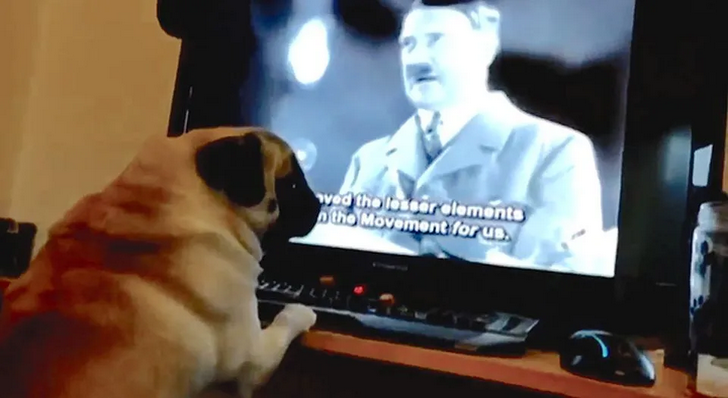
Andrew Doyle revisits the Nazi pug story as new Scottish blasphemy hate speech laws are about to come into force at the beginning of April:
If you’re deluded enough to suppose that human history works in a progressive linear fashion, the example of Scotland should swiftly change your mind. Once the home of the Enlightenment, the country has now veered into authoritarianism under the control of the SNP. The party’s new hate crime law will come into force on April Fools’ Day, and no-one in government is seemingly able to give examples of “crimes” that would be covered by this legislation that aren’t already criminal. When specifically asked on the BBC’s Newsnight whether “misgendering” would result in prosecution, SNP backbench Fulton MacGregor could only mutter: “Well, it depends on the circumstances”. How reassuring.

For all MacGregor’s “faith” that the law would be “properly” implemented, nonbelievers are right to be cautious. Vaguely worded legislation is bound to be exploited, and has been many times in the past. This is particularly the case when it comes to “hate speech”, a concept for which no adequate definition has ever been achieved. The best the Irish government could muster for their forthcoming hate crime bill is that hatred “means hatred”. In these times of slippery authoritarian wordplay, that’s about as specific as we can expect.

The Scottish police have claimed that they will not “target” comedians and actors under the new legislation, and yet at the same time have sworn to investigate every complaint. Thankfully, activists never make spurious complaints against their ideological opponents in the hope of seeing them silenced. Oh wait. They do. All the time.

[…]

So for all of the claims that our concerns about the new hate crime law are unfounded, and that the police would never prosecute anyone for a gag, we should remember that they already have. This legislation will simply make it easier for activists within and without the police force to weaponise the law against those deemed to be subversive. On the day of Meechan’s arrest, one police officer affirmed that he must be “an actual Nazi trying to inspire people to become Nazis”. The judge eventually agreed, in spite of the fact that after two years of investigation the police had uncovered no evidence of far-right sympathies.

Of course those who wish to criminalise dissent will not stop at comedians. They’ll also be keen to crack down on anyone who knows the difference between men and women and is willing to declare this esoteric knowledge out loud. Although it has become a cliché to cite George Orwell’s Nineteen Eighty-Four in such circumstances, that is only because it is so apposite: “The Party told you to reject the evidence of your eyes and ears. It was their final, most essential command”.

I do not sincerely believe that the police will turn up at our Comedy Unleashed show next Monday. It seems unfathomable that we might see a kind of re-enactment of the closing scenes of The Blues Brothers, with police officers standing in the shadows of the club to monitor the show for heterodox content. But then, I would never have anticipated that in a free country someone who made a video mocking Nazis would end up with a criminal record. Of course our show will be offensive to those who choose to be offended. Such is the nature of comedy. The only way to avoid such a situation would be for the acts to stand on stage in total silence. And even then, someone might find this offensive to mutes.

Bhutan

Filed under: Asia, Britain, Government, History, India — Tags: , , , , , , — Nicholas @ 03:00

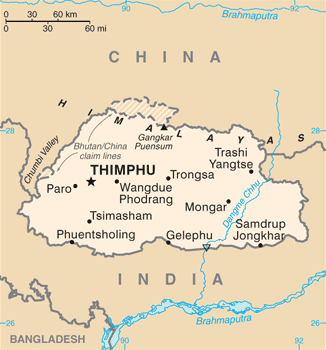
Ned Donovan recounts his recent trip to Bhutan, situated in the Himalaya mountains between India and China:

Bhutan map from the CIA World Factbook, 2010. Chinese-disputed border areas are marked with dashed lines and darker shading.
Wikimedia Commons.

Bhutan has long been a place I had wanted to visit, but it isn’t as simple as booking a ticket.

It would be remiss not to quickly situate Bhutan and its history for those unaware. It is a small kingdom east of Nepal and nestled between India and China. It has a population of around 750,000, almost all of whom are devout Buddhists. It was once a land of feuding Tibetan chieftans who were united in the 1630s by a remarkable warrior and Buddhist lama called Ngawang Namgyal. Namgyal died in 1651, but his death was kept a secret from the country for more than 50 years, with officials simply saying that the king was “on an extended retreat” and continued to keep Bhutan together by issuing decrees in his name.

While Namgyal was seen as the spiritual leader, he also established a temporal monarchy which in a slightly modified form still exists today under the leadership of the Wangchuk dynasty. The King of Bhutan’s title is the Druk Gyalpo, which literally translates to Dragon King. Over time Bhutan, being small but strategically located, faded in and out of the spheres of influence of the day from the Mughals to the British Raj. It would have been subsumed into the latter like other princely states, but in the 19th Century a British civil servant placed some files relating to Bhutan into a folder marked “External” instead of “Internal”, a small decision that ensured it remains an independent country today, albeit one “guided” on matters of defence and foreign affairs by a treaty with India.

The country only opened its borders to foreigners in 1974, to mark the coronation of the Fourth King, Jigme Singye Wangchuck. His Majesty saw the opportunity to take advantage of his accession to showcase Bhutan and its unique culture and traditions to the world, but was also aware that unrestricted tourism would put those at risk. Over time, this developed into a vision known as “High Quality, Low Volume” tourism. All visitors must have a guide and driver and also pay a daily fee — currently $100. In 1974, 287 foreigners visited Bhutan, and in 2019 more than 70,000 fee paying tourists came.

As a result of this policy, the trips are largely cultural. You take hikes in unimaginable scenery, watch local festivals where masked creatures tell villagers morality tales, and sit with locals to eat dishes made up mostly of chilis. For fun people relax with the national sport of archery, singing deliciously rude songs to put off their friends while they take shots. Tourists get to have a go but the target is brought closer and you get to use the same kind of bow young children do. Civil servants go to work in traditional dress and robe-clad monks pepper society. In the five days I spent there, much was spent talking to our compulsory guide who was a lovely man named Yarab, who had once been on the Bhutan national football team. One story Yarab told me was that of Bhutan’s transition to democracy.

The previously mentioned Fourth King oversaw Bhutan’s transition into the modern world – but with a catch. Bhutan’s development could not come at the cost of its people’s happiness. Thousands of kilometres of roads were built, free at point of use clinics quickly filled the country, and electricity and telephone hookups turned King Jigme Singye’s isolated kingdom where almost no one had access to healthcare or education into a remarkably healthy and literate little state in the space of just a few decades. Much of the money to make this possible came from selling hydroelectricity generated by dams that are powered by Himalayan glaciers. The Fourth King explained that: “water is to us what oil is to the Arabs”.

The Roman Army’s Biggest Building Projects

toldinstone
Published Dec 15, 2023

The greatest achievements of the Roman military engineers.

Chapters:
0:00 Introduction
0:38 Marching camps
1:36 Bridges
2:40 Siegeworks
3:26 PIA VPN
4:32 Permanent forts
5:49 Roads
6:24 Frontier defenses
7:41 Canals
8:21 Civilian projects
8:54 The aqueduct of Saldae
(more…)

QotD: The SCIENCE was SETTLED in the 1970s

When it comes to Leftie, it’s really hard to sort out what’s intentional from what’s merely wrong, or outdated, or stupid, or some combination of the above. So while there really does seem to be some kind of coordinated push to get us to eat grass and bugs, the red meat thing is, I think, just old misinformation that Leftie can’t admit has been overtaken by events (because, of course, Leftists can never be wrong about anything). And I’ll even kinda sorta give them a pass on that, because I know a lot of medical people who learned the “red meat is bad for you” mantra back in the days and still haven’t gotten over it …

For younger readers, back in the late 70s the nutritional Powers That Be got in bed with the corn lobby. It sounds funny, but they were and are huge, the corn lobby — why do you think we’re still getting barraged with shit about ethanol, even though it’s actually much worse for the environment than plain ol’ dinosaur juice, when you factor in all the “greenhouse emissions” from growing and harvesting it? Anyway, ethanol wasn’t a thing back then … but corn syrup was, and so suddenly, for no reason whatsoever, the PTB decided that fat was bad and carbohydrates were good.

Teh Science (TM) for this was as bogus and politicized as all the other Teh Science (TM) these days, but since we still had a high degree of social and institutional trust back then — living in a country that’s still 85% White will do that — nobody questioned it, and so suddenly everything had to be “fat free”, lest you get high blood pressure and colon cancer and every other damn thing (ever notice how, with Teh Science (TM), everything they decide is bad suddenly correlates with everything that has ever been bad? Funny, that). But since fat is what makes food taste good, they had to find a tasty substitute … and whaddya know, huge vats full of corn syrup just kinda happened to be there. Obesity rates immediately skyrocketed; who’d have thunk it?

… but again, this isn’t a deliberate thing with your average Leftie. You know how they are about Teh Science (TM), even Teh Science (TM) produced by people who thought polyester bellbottoms were a great look, which alone should tell you everything you need to know. They just learned “red meat is bad”, and so, being the helpful sorts they are, decided to boss you around about it. You know, for your own good.

Severian, “Friday Mailbag / Grab Bag”, Rotten Chestnuts, 2021-06-25.

March 22, 2024

Rome conquered Greece … militarily, anyway

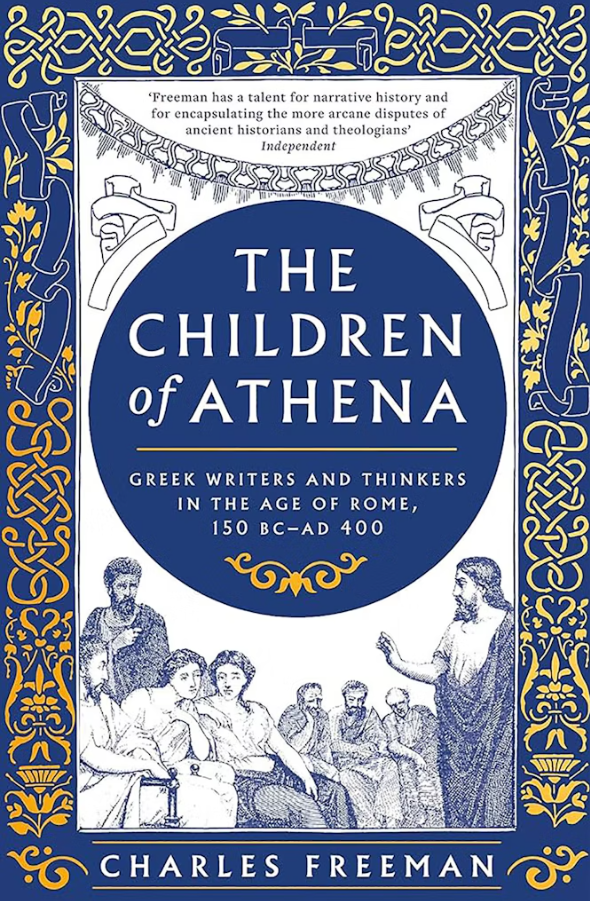
In The Critic, Gavin McCormick reviews Charles Freeman’s new book The Children of Athena: Greek writers and thinkers in the age of Rome, 150BC – 400AD:

“To a wise man,” said the first-century wonderworker Apollonius of Tyana, “everywhere is Greece.” That is to say, Greece is not a mere place, but a special state of mind. For Apollonius, on his extensive travels around the Greco-Roman world, the purported truth of this maxim is seldom open to doubt.

The author of Apollonius’s colourful biography, Philostratus, depicts his hero as not just a philosopher but also an impossibly accomplished champion of culture — a confounder of logic and expectations who could vanish in plain sight, now fascinating Roman emperors and foreign sages, now inspiring whole towns into acts of celebration and renewal. The guiding ideology that drove this hero is a heady mix of philosophy, religion, magic and political insouciance — or, to give it another name, Hellenism.

In the context of the third-century world, where Christianity was an increasingly noteworthy presence in the towns and cities of the Roman empire, pagans such as Philostratus were keen to highlight what their own tradition had to offer.

In fact, he seems almost to present his hero as a pagan rival to Jesus. And, in turn, Apollonius — in his successful renewal of the shrines and local cults of Hellas — seems to hint at what Philostratus would like to see happen in his own contemporary context.

Despite living under Rome, Apollonius (and Philostratus) wants to celebrate an emphatically Greek form of culture. The celebration of Greek culture in the Roman world was, of course, nothing new, and it was something the Romans themselves had long enjoyed.

Alongside their admiration for Greek literature, philosophy, art and architecture, there was the successful movement known as the “Second Sophistic” — whose parade of Greek-speaking intellectuals left a heavy imprint on the public life of the High Roman Empire.

But it is striking nonetheless that the virtues of Hellas — not Rome itself — were what many educated citizens of the empire turned to when they thought of cultural renewal. Indeed his was precisely the route taken later in the fourth century by the last pagan emperor of Rome, himself a champion of all things Greek, Julian the so-called Apostate.

Charles Freeman’s latest book, Children of Athena, is a highly readable tour through the lives and accomplishments of some of the great exponents of Greek culture under Rome. He introduces readers to a bracingly varied and energetic cast of characters — the geographers, doctors, polymaths, botanists, satirists, and orators are just part of the repertoire. In an early chapter, we meet the brilliant Greek historian Polybius, who wrote in the tradition of Herodotus and Thucydides, while training his sights on the rise of Rome in his own time.

Four years later

Kulak hits the highlights of the last four years in government overstretch, civil liberties shrinkage, the rise of tyrants local and national, and the palpably still-growing anger of the victims:

4 years ago, at this exact moment, we were in the “two weeks” that were supposed to flatten the Curve of Covid.

4 years ago you were still a “conspiracy theorist” if you thought it would be anything more than a minor inconvenience that would last less than a month.

Of course if you predicted that this would not last 2 weeks, but over 2 years; that within 2 months anti-lockdown protests would end in storming of state houses and false-flag FBI manufactured kidnapping attempts of Governors; that within 3 riots would burn a dozens of American cities; that the election would be inconclusive; that matters would go before the US Supreme Court, again; that a riot/mass entrapment would take place within the halls of congress … And then that this was just the Beginning …

That Big-Pharma would rush a vaccine which may well have been more dangerous that the virus; that Australia and various countries would build concentration camps for unvaccinated; that nearly all employers would be pressured or mandated to FORCE this vaccine on their employees; that vaccine passports would be implemented to track your biological status; that Canada and several other countries would implement travel restrictions on the unvaccinated and collude with their neighbors to prevent their population escaping; and then that, nearly 2 years from 2weeks to slow the spread, Canadians!? would mount one of the most logistically complex protests in human history, in the dead of winter, besieging Ottawa and blockading the US border to all trade in an apocalyptic showdown to break free of lockdowns …

Well … not even Alex Jones predicted all of that, though he got a remarkable amount of it.

Indeed the reverence with which Jones is now treated, a Cassandra-like oracle who predicts the future with seemingly (and memeably) 100% clairvoyance only to doomed to disbelief. That alone would have been unpredictable, or unbelievable in those waning days of the long 2019, those first 2-3 months when you could imagine 2020 would MERELY be an Trumpianly heated election cycle like 2016, and not a moment Fukuyama’s veil threatened to tear and History pour back into the world.

Oh, and also the bloodiest European war since the death of Stalin broke out.

If you peasants won’t buy EVs voluntarily, the government will make it mandatory

Filed under: Economics, Government, USA — Tags: , , , — Nicholas @ 03:00

Tom Knighton notes that the government isn’t happy with us dirt people because we’re not all rushing to voluntarily give up our old fashioned internal combustion vehicles and replace them with shiny new electric vehicles like we’re supposed to:

Nissan Leaf electric vehicle charging.
Photo by Nissan UK

I’ve written a lot about electric vehicles (EVs) over my time at Substack. My take is, as it always is, that I like the concept, but they’re not ready for prime time. In particular, their range and recharge time means they lose in a head-to-head comparison with internal combustion engines (ICE).

For some people, even as things currently stand, EVs make sense. They may have charging stations at work and only use them for commutes to and from their place of employment, making all of these concerns irrelevant.

Yet a lot of people don’t have that. They have concerns about EVs and so they don’t see them as a viable option, which is why people aren’t buying them.

Enter the EPA.

It seems that if we won’t willingly do what they want, they’ll just force us to buy something we don’t want.

    “Outlaw your car” sounds like such an outrageous phrase, and technically speaking, it isn’t true — but only barely. What practical difference is there between outlawing something, and regulating it out of existence?

    That’s exactly what the EPA intends to do this week with strict new rules going forward against gas- and diesel-powered cars and light trucks.

    Expected as soon as Wednesday, the Biden EPA “is poised to finalize emissions rules that will effectively require a certain percentage — as much as two-thirds by 2032 — of new cars to be all-electric”, according to Inside EVs. Politico sells the expected rule as one that would “tackle the nation’s biggest source of planet-warming pollution and accelerate the transition to electric vehicles”.

    The rule would require carmakers to cut their average emissions of carbon dioxide by 52% between 2027 and 2032. EPA projects that the standard would push the car industry to ensure that electric cars and light trucks make up about 67% of new vehicles by model year 2032.

Of course, this led to pushback by people like dealer groups and car companies who argued, as I typically do, that the American people weren’t ready for that, in part due to the price of EVs and the lack of charging stations.

So the EPA has decided to make it so that we probably can’t afford ICE cars and trucks, either, so we might as well go with EVs instead.

And people wonder why I want to dismantle the EPA at the same time as I dismantle the ATF. It’s for the same damn reason. They just make up rules that impact people’s lives and businesses, all because of their own political agenda.

Of course, raising the prices on all cars by making the emissions standards virtually impossible to meet without making the cars so expensive isn’t going to prompt a lot of people to buy electric. It’ll just make them buy older, less fuel-efficient models.

The market for used cars was already getting pretty spicy before the pandemic. Dealers were barely able to accept trade-in vehicles before they were selling them off the lot to other buyers (and there were waiting lists of willing buyers for certain kinds of vehicles … not even particularly special vehicles, either). I don’t know if that situation has changed since the pandemic, but it indicated to me that the demand for good quality used vehicles must be coming from people who’d consciously chosen not to buy newer, more expensive cars (and pretty much by definition, every EV was more expensive than an equivalant ICE vehicle).

Char B1 V Panzer III | Size doesn’t matter – it’s how you use it!

Filed under: France, Germany, History, Military, Weapons, WW2 — Tags: , — Nicholas @ 02:00

The Tank Museum
Published Dec 15, 2023

Two tanks that fought against each other in the early part of World War Two. On one side, the heavily armoured French Char B1 … on the other, the mobile German Panzer III. On paper it’s no contest – but what actually happened when these two tanks fought it out in 1940?

00:00 | Intro
00:49 | Char B1 History
02:16 | Radio Communications
02:45 | Panzer III Crew
03:43 | Char B1 Crew
05:16 | Char B1 V Panzer III
(more…)

QotD: Degenerative progressivism

Filed under: Politics, Quotations — Tags: , , — Nicholas @ 01:00

There are many “progressives” who will claim to have been assaulted if someone makes a remark in their presence which troubles their conscience but who think it is a world of hilarity when an elected official, or anyone who has in fact accomplished something, is made a figure of fun at the hands of an actual assault. There is nothing surprising in this. Only another sad example of what now passes for a once noble aspiration of the left to find dignity in people’s lives no matter their station or situation.

Ghost of a Flea, “Law and order”, Ghost of a Flea, 2005-06-21.

March 21, 2024

Banksy is “a jester to the woke court, the cheeky clown of received opinion”

Filed under: Britain, Media, Politics — Tags: , , , , — Nicholas @ 05:00

As a certified curmudgeon, I’ve never seen the attraction of Banksy’s various bits of artistic … whatever it is properly called. At Spiked, Brendan O’Neill helps put Banksy into proper perspective:

I guess it wasn’t enough that us polluting plebs are chided for our transgressions against Mother Nature every time we watch a BBC nature documentary. And by politicians of all persuasions. And by columnists who summer in Tuscany. And by aristocratic arseholes called Edred and Poppy who won’t even let us enjoy the football or the snooker without cutting through the fun with their cut-glass tones to remind us we’re hazardous to Gaia. No, we also have to be walloped with an eco-sermon as we cycle to work down the Hornsey Road.

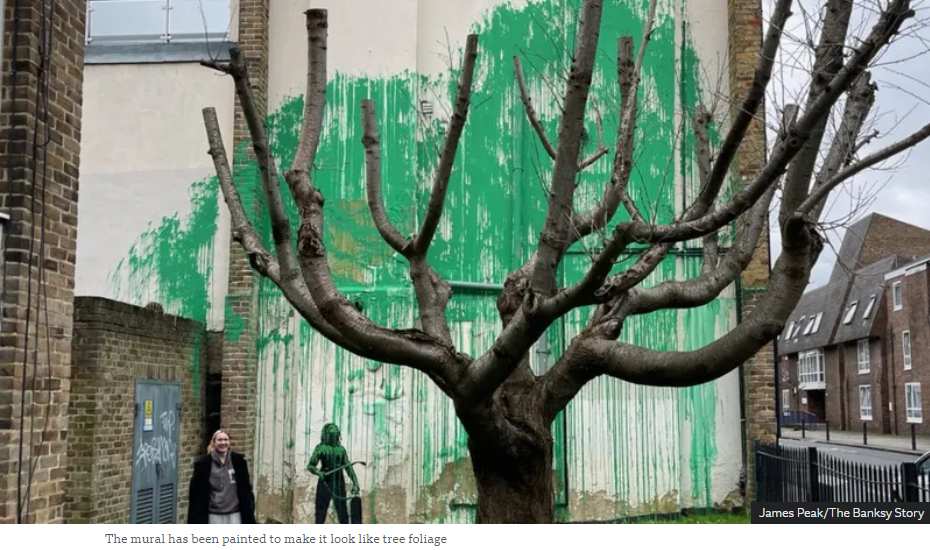
Unsurprisingly, the elites are lapping up Banksy’s latest missive in spray paint. A Radio 4 expert on Banksy – I’m dying – raved to the BBC that his message is “clear” and it “really resonates”: “Nature’s struggling and it is up to us to help it grow back.” The founder of Haringey Tree Protectors – I’m not making this up – gushed in the Guardian about how Banksy’s “stark image” reminds us that “in the climate crisis we just can’t continue treating our tree canopy with such savagery”. Pruning leaves is barbarism now. You just know that when green-fingered Charles III saw the Banksy pic during his morning peruse of the papers he gave it a kingly nod of approval.

That’s what Banksy is, isn’t it – a jester to the woke court, the cheeky clown of received opinion? He larps as rebellious, sneaking about in the dead of night to put up his technically illegal “art”, but in truth he has not once voiced an opinion that wouldn’t win noisy murmurs of approval at a soirée in Daunt Books. Brexit is bad, Israel is insane, the paparazzi are scum, don’t vote Tory, capitalism is a rat race, Save the Planet – honestly, browsing Banksy’s back catalogue of stencilled eyesores is like being stuck in a lift with one of those craft-beer centrists who says cockwomble a lot.

His Finsbury Park fake tree captures the conformist thinking that hides in his guerrilla-art performance. It’s a public-information campaign masquerading as graffiti. “Save the trees” – Rishi Sunak could say that. He has, in fact. He recently announced a ban on felling trees without “proper consultation”. Banksy’s tree also has that whiff of hysteria that always attends dinner-party efforts to alter the behaviour of the lower orders. The idea that we’re obliterating trees with “savagery” is bullshit. London’s a forest. Literally. The UN defines a forest as anywhere that is at least 20 per cent trees – London is 21 per cent trees. The “world’s largest urban forest”, as Time Out puts it.

So relax, Banksy. Chill in the no doubt cushy pad you bought from selling your graffiti to philistine luvvies. London’s fine. If anything were to make me leave this great city, it wouldn’t be a want of trees but the oversupply of your sixth-former propaganda. Only a few months ago he put up a “STOP” sign in Peckham decorated with three drones to signal his desire for a ceasefire in Gaza. Radical.

Look, it can be irritating when artists decide to épater la bourgeoisie. That slogan, dreamt up by the decadent poets of late 19th-century France, means to take glee in scandalising the middle classes. But surely Banksy’s style of pandering to the middle classes – let’s call it servir la bourgeoisie – is worse? He is simply smuggling the received wisdom of society’s self-styled betters under the cover of edgy graffiti. From his anti-Brexit mural showing a workman sadly chipping one of the yellow stars from the EU flag to his image of Brits pledging their allegiance to the flag of Tesco – consumerism is slavery, y’all – his every utterance is chattering class to the core.

“That is a catastrophic miscalculation for the NDP, and it’s the single best thing that happened to Poilievre”

In The Line, Matt Gurney reflects on what he got wrong about Pierre Poilievre and why he misread the situation leading up to Poilievre becoming Conservative leader:

Pierre and Ana Poilievre at a Conservative leadership rally, 21 April, 2022.
Photo by Wikipageedittor099 via Wikimedia Commons.

“Think of Trudeau in late 2019,” he told me from the bar. “India trip. SNC-Lavalin. ‘Thank you for your donation.’ Black and brown face. Canadians were souring on him. They were starting to think he was a fake, and maybe a bit of an asshole. His disapproval ratings were soaring. Then COVID hits, and he’s doing his smiling, reassuring press conferences every day outside his house. His disapprovals tank. Canadians are reminded of 2015 Trudeau. But then pandemic ends, and we’ve got some Trudeau missteps. ‘Unacceptable people’, COVID-era wedges. He’s going back to his 2019 position: people don’t like him.”

“And then,” he told me, “just as Canadians are starting to think the PM is an asshole again, the NDP decides to sign an agreement with him. [NDP leader] Jagmeet [Singh] could not have screwed up more. This is a historical, books-to-be-written-about-it screw up. Because just as Canadians are remembering that they don’t like the PM, Singh is giving those voters no reason to go to the NDP.”

Normally when the Liberal vote collapses, he continued, those voters disperse across all the parties. But CASA, my source told me, was like a funnel, forcing all the voters the Liberals were losing to go to the Conservatives instead of going everywhere. “If you’re angry at Trudeau, if you don’t like him, if you’re sick of him, you can only go Conservative this time. Singh did that. That is a catastrophic miscalculation for the NDP, and it’s the single best thing that happened to Poilievre. None of us saw that coming.”

He had other thoughts, as did others I spoke to. The People’s Party having been neutered as a threat was something I heard repeatedly, which matters, but not in the way that you think. “The PPC wasn’t a huge draw on our voters,” a senior Tory told me. “People still think the PPC was just our most-right-wing fringe. Wrong. It was drawing voters from everywhere, including typical non-voters. So the problem wasn’t that we were losing votes. The problem was that the fear of the PPC gave too many of our western MPs licence to get away with anything or oppose anything. ‘If we do/don’t do this, Maxime Bernier is going to kill us!’ Guess what? Portage-Lisgar was Bernier’s best possible shot and we annihilated him. No one is afraid of the PPC anymore. No one can use the PPC as leverage against the leader.”

I asked about that — Poilievre’s hold over his own party. In my 2021 column, I had noted that O’Toole never really had full control. Every Conservative I spoke to agreed: Poilievre has the most control over his caucus of any CPC leader they can remember. Better than O’Toole, better than Andrew Scheer, and as good, at least, as Stephen Harper. Not all the MPs were thrilled when O’Toole was replaced, but the smell of impending victory has a way of winning over new friends.

I talked with the source at the bar for a long time, and we covered a lot of ground. A lot has gone right for Poilievre, he said. Some of it is luck, some of it is timing, but some of it is entirely to Poilievre’s credit. My source isn’t one of Poilievre’s guys, so to speak. He’s just long-time CPCer, who served all four leaders of the modern era. He has never hesitated to critique the current leader in our chats, but he gave credit where he felt it due. “Poilievre was talking cost of living and inflation back when the PM was taking time at press conferences to tell everyone he doesn’t care about monetary policy, and when the finance minister and the governor of the Bank of Canada were telling everyone there was nothing to worry about, and when all the economists on Twitter were saying that deflation was the worry. Poilievre was right. In public, loudly, right. About the issue that was about to completely take over Canadian political conversation. He called it. Trudeau, Macklem and Freeland were wrong. People may not remember the details, but they remember that.”

Minneapolis rejects Uber (and economic reality)

Filed under: Business, Economics, Government, USA — Tags: , , , , , — Nicholas @ 03:00

Jon Miltimore is upset that he won’t be able to use Uber or Lyft ridesharing services in the Twin Cities after the Minneapolis City Council voted to make the business uneconomical:

“UBER 4U” by afagen is licensed under CC BY-NC-SA 2.0

The ride-hailing services Uber and Lyft announced last week that they are pulling up stakes in the Twin Cities because of a new ordinance designed to raise driver pay.

The Minneapolis City Council voted 10–3 to override the veto of Mayor Jacob Frey, passing a policy that will raise the pay of drivers to the equivalent of $15.57 per hour.

In response to the plan, Uber and Lyft announced that they will cease offering rides beginning May 1 throughout the entire Twin Cities, the 16th largest metro in the United States, saying operations were economically “unsustainable” under the plan.

“We are disappointed the Council chose to ignore the data and kick Uber out of the Twin Cities, putting 10,000 people out of work and leaving many stranded,” Uber said in a statement.

As a resident of the Twin Cities suburbs, I find this news a bit alarming. In fact, I find it infuriating.

City Council supporters say they simply want drivers to earn the minimum wage, but if that’s the case, they passed the wrong ordinance. The Star Tribune reports that council members “seemed oblivious” to a recent Minnesota Department of Labor and Industry study that concluded drivers could be paid $0.49 per minute and $0.89 per mile and make the minimum wage.

“By contrast, the plan approved by the City Council guarantees a floor of $1.40 per mile and 51 cents per minute,” the newspaper reports.

In other words, the wage plan the council passed doesn’t appear remotely close to the minimum wage. But this ignores the larger problem: Neither the Minneapolis City Council nor the state of Minnesota should be setting the wages of Uber or Lyft drivers.

Nobody is forcing drivers to give rides. The arrangement between ride-share companies and drivers is an entirely voluntary one. This is the beauty of gig work. It allows people flexibility and choice about how they’d like to spend their time.

French NATO Standardization: the MAS 49-56 in 7.62mm

Filed under: France, History, Military, Weapons — Tags: , , , , , — Nicholas @ 02:00

Forgotten Weapons
Published May 27, 2019

In the late 1950s, France was still part of the NATO integrated military structure. When the 7.62x51mm cartridge was adopted as standard for the alliance, France looked to be in a good position to simply convert their MAS 49-56 rifles to use it. After all, the 7.5mm cartridge the rifle was designed for was very similar to the new NATO round. After several years of trials, however, the project was dropped as impractical. It turned out that the much different pressure curve of the 7.62mm round would require significant redesign of the MAS rifles. They suffered from poor extraction, broken parts from high bolt velocity, and other issues (not coincidentally, the exact same problems reported with the 308 MAS 49-56 rifles imported by Century …). The St Etienne factory only made a total of 150 of them in 7.62x51mm before the project ended.
(more…)

QotD: South Africa under Thabo Mbeki

[During Nelson Mandela’s presidency, Thabo] Mbeki quickly began to insist that South Africa’s military, corporations, and government agencies bring their racial proportions into exact alignment with the demographic breakdown of the country as a whole. But as Johnson points out, this kind of affirmative action has very different effects in a country like South Africa where 75% of the population is eligible than it does in a country like the United States where only 13% of the population gets a boost. Crudely, an organization can cope with a small percentage of its staff being underqualified, or even dead weight. Sinecures are found for these people, roles where they look important but can’t do too much harm. The overall drag on efficiency is manageable, especially if every other company is working under the same constraints.

Things look very different when political considerations force the majority of an organization to be underqualified (and there are simply not very many qualified or educated black South Africans today, and there were even fewer when these rules went into effect). A shock on that scale can lead to a total breakdown in function, and indeed this is precisely what happened to one government agency after another. Johnson notes that this issue, and particularly its effects on service provision to the rural poor, pit two constituencies against each other which many have tried to conflate, but are actually quite distinct. The immiserated black lower class (which the ANC purported to represent) didn’t benefit at all from affirmative action because they weren’t eligible for government jobs anyway, and they vastly preferred to have the whites running the water system if it meant their kids didn’t get cholera. The people actually benefited by Mbeki’s affirmative action policies were the wealthy and upwardly-mobile black urban bourgeoisie, a tiny minority of the country, but one that formed the core of Mbeki’s support.

That same small group of educated and well-connected black professionals was also the major beneficiary of Mbeki’s other signature economic policy: Black Economic Empowerment (BEE). Oversimplifying a bit, BEE was a program in which South African corporations were bullied or threatened into selling some or all of their shares at favorable prices to politically-connected black elites, who generally returned the favor by looting the company’s assets or otherwise running it into the ground (note that this is not the description you will find on Wikipedia). The whole thing was so astoundingly, revoltingly corrupt that even the ANC has had to back off and admit in the face of criticism from the left that something went wrong here.

What made BEE so “successful” is that it was actually far more consensual than you might have guessed from that description. In many cases, the white former owners of these corporations were looking around at the direction of the country and trying to find any possible excuse to unload their assets and get their money out. The trouble was that it was difficult to do that without seeming racist, because obviously racism was the only reason anybody could have doubts about the wisdom of the ANC. The genius of BEE is that it allowed these white elites to perform massive capital flight while simultaneously framing it as a grand anti-racist gesture and a mark of their confidence in the future of the country.

This is one particular instance of a more general phenomenon, which is that at this stage pretty much everybody was pretending that things were going great in South Africa, when things were clearly not, in fact, going great. But this was the late 90s and early 00s, the establishment media had a much tighter hold on information than it does today, and so long as nobody had an interest in the story getting out, it wasn’t going to get out. Everybody who mattered in South Africa wanted the story to be that the end of apartheid had resulted in a peaceful and harmonious society, and everybody outside South Africa who’d spent decades supporting and fundraising for the ANC wanted this to be the story too.

John Psmith, “REVIEW: South Africa’s Brave New World, by R.W. Johnson”, Mr. and Mrs. Psmith’s Bookshelf, 2023-03-20.

March 20, 2024

Google’s unmissable leftward biases

Filed under: Media, Politics, Technology, USA — Tags: , , , — Nicholas @ 04:00

Tom Knighton on a recent New York Post article calling out Google for their strong political biases and how they inform everything that Google and its subsidiaries and affiliates do:

Once, the company was well-known for having the phrase “Don’t be evil” painted on a wall in their headquarters. It’s a noble sentiment, but apparently, it’s now more like “Don’t be evil.”

That’s pretty clear after what we learned from the New York Post:

    Google has been putting its thumb on the scale to help Democratic candidates win the presidency in the last four election cycles during which it censored Republicans, according to a right-leaning media watchdog.

    The Media Research Center published a report alleging 41 instances of “election interference” by the search engine since 2008.

    The MRC published a report accusing Google of having “utilized its power to help push to electoral victory the most liberal candidates…while targeting their opponents for censorship.”

    The report comes weeks after AllSides conducted an analysis which found that news aggregator Google News skewed even more off the charts in 2023.

    Google has also come under fire after its Gemini AI image generator produced “woke”-inspired and historically inaccurate images such as black Vikings, female pope and Native Americans among the Founding Fathers.

Now, Google denies the claims and someone close to the company took issue with the methodology used to detect this supposed interference.

But the truth of the matter is that there’s absolutely no reason to believe Google on this because we’ve seen enough of it previously to know better.

For example, YouTube has a profoundly leftward bias. The site is notorious for silencing right-wing voices while allowing leftists to get away with trampling community standards willy-nilly. YouTube is owned by Google, which means they’re at least tacitly endorsing the strategy.

From there, it’s not difficult to see the mothership taking on a similar role, if not originating it. They’re just able to hide it easier.

But even there, we can see it.

I use Google’s news feed regularly, particularly for my work at Bearing Arms. It’s common for me to look up “gun rights” and the first article that shows up, unless I set it for the most recent stories, be one treating them as a negative thing.

So yeah, I have no doubt that Google is playing favorites.

The worst part is that there isn’t anything that can be done through the legal system as far as I’m aware. But that doesn’t mean someone there didn’t realize what they are doing is wrong.

Most probably didn’t, though. They believe the Holy Progressive Cause is so vital, so unerringly good, that they can and should do anything to serve it. That includes displaying a staggering degree of bias in the service of what you believe to be the greater good, your business be damned.

But they knew it would be considered wrong by a great many people, which is why they’re hiding it.

« Newer PostsOlder Posts »

Powered by WordPress