Quotulatiousness

March 20, 2024

This “should be a reality check for the technocracy”

Ted Gioia on the SXSW audience reaction to being presented with full-quill AI enthusiasm that didn’t match the presenters’ expectations at all:

Tech leaders gathered in Austin for the South-by-Southwest conference a few days ago. There they showed a video boasting about the wonders of new AI technology.

And the audience started booing.

At first, just a few people booed. But then more and more — and louder and louder. The more the experts on screen praised the benefits of artificial intelligence, the more hostile the crowd got.

The booing started in response to the comment that “AI is a culture.” And the audience booed louder when the word disrupted was used as a term of praise (as is often the case in the tech world nowadays).

Ah, but the audience booed the loudest at this statement:

    I actually think that AI fundamentally makes us more human.

The event was a debacle — the exact opposite of what the promoters anticipated.

And it should be a reality check for the technocracy.

If they were paying attention, they might already have a hunch how much people hate this stuff — not just farmers in Kansas or your granny in Altoona, but hip, progressive attendees at SXSW.

These people literally come to the event to learn about new things, and even they are gagging on this stuff.

It’s more than just fears about runaway AI. Prevailing attitudes about digital tech and innovation are changing rapidly in real time — and not for the better. The users feel used.

Meanwhile the tech leaders caught in some time warp. They think they are like Steve Jobs launching a new Apple product in front of an adoring crowd.

Those days are gone.

Not even Apple is like Apple anymore. A similar backlash happened a few weeks ago, when Apple launched its super-high-tech virtual reality headset. The early response on social media was mockery and ridicule — something Steve Jobs never experienced.

This is the new normal. Not long ago we looked to Silicon Valley as the place where dreams came from, but now it feels more like ground zero for the next dystopian nightmare.

He’s not just a curmudgeonly nay-sayer (that’s more me than him), and has some specific things that are clearly turning a majority of technology users against the very technology that they once eagerly adopted:

They’re doing so many things wrong, I can’t even begin to scratch the surface here. But I’ll list a few warning signs.

You must be suspicious of tech leaders when …

  1. Their products and services keep getting worse over time.
  2. Their obvious goal is to manipulate and monetize the users of their tech, instead of serving and empowering them.
  3. The heaviest users of their tech suffer from depression, anxiety, suicidal impulses, and other negative effects as a result.
  4. They stop talking about quality, and instead boast incessantly about scalability, disruption, and destruction.
  5. They hide what their technology really does — resisting all requests for transparency and disclosure.
  6. They lock you into platforms, forcing you to use new “features” and related apps if you want to access the old ones.
  7. They force upgrades you don’t like, and downloads you don’t want.
  8. Their terms of use are filled with outrageous demands and sweeping disclaimers.
  9. They destroy entire industries not because they offer superior products, but only because as web gatekeepers they have a chokehold on information and customer flow — which they use ruthlessly to kill businesses and siphon off revenues.

Every one of those things is happening right here, right now.

We’re doing the technocracy a favor by calling it to their attention. If they get the message, they can avoid the coming train wreck. They can return to real innovation, with a focus on helping the users they now so ruthlessly exploit.


Jointing on a Bandsaw | Paul Sellers

Filed under: Tools, Woodworking — Tags: , , , — Nicholas @ 02:00

Paul Sellers
Published Dec 1, 2023

This bandsaw hack is one you have never seen before because I invented it.

Planing dead flat for hand planing or power planing can take time, but this bandsaw method takes only a few short minutes to do, and you are on your way to your work faster than blinking.
(more…)

QotD: Ancient Greek tyranny

The normal expectation for Greek tyranny is that the system works like the Empire from Star Wars: A New Hope, where the new tyrant abolishes the Senate, appoints his own cronies to formal positions as rulers and generally makes himself Very Obviously and Formally In Charge. But this isn’t how tyranny generally worked: the tyrant was Very Obviously but not formally in charge, because he ruled extra-constitutionally, rather than abolishing the constitution. This is what separates tyranny, a form of extra-constitutional one man rule, from monarchy, a form of traditional and thus constitutional one-man rule.

We see the first major wave of tyrannies emerging in Greek poleis in the sixth century, although this is also about the horizon where we can see political developments generally in the Greek world, still our sources seem to understand this development to have been somewhat novel at the time and it is certainly tempting to see the emergence of tyranny and democracy in this period both as responses to the same sorts of pressures and fragility found in traditional polis oligarchies, but again our evidence is thin. Tyrants tend to come from the elite, oligarchic class and often utilize anti-oligarchic movements (civil strife or stasis, στάσις) to come to power.

Because most poleis are small, the amount of force a tyrant needed to seize power was also often small. Polycrates supposedly seized power in Samos with just fifteen soldiers (Hdt. 3.120), though we may doubt the truth of the report and elsewhere Herodotus notes that he did so in conspiracy with his two brothers of whom he killed one and banished the other (Hdt. 3.39). I’ve discussed Peisistratos’ takeover(s) in Athens before but they were similarly small-ball affairs. In Corinth, Cypselus seized power by using his position as polemarch (war leader) to have the army (which, remember, is going to be a collection of the non-elite but still well-to-do citizenry, although this is early enough that if I call it a hoplite phalanx I’ll have an argument on my hands) expel the Bacchiadae, a closed single-clan oligarchy. A move by any member of the elite to put together their own bodyguard (even one just armed with clubs) was a fairly clear indicator of an attempt to form a tyranny and the continued maintenance of a bodyguard was a staple of how the Greeks understood a tyrant.

Having seized power, those tyrants do not seem to have abolished key civic institutions: they do not disband the ekklesia or the law courts. Instead, the tyrant controls these things by co-opting the remaining elite families, using violence and the threat of violence against those who would resist and installing cronies in positions of power. Tyrants also seem to have bought a degree of public acquiescence from the demos by generally targeting the oligoi, as with Cypselus and his son Periander killing and banishing the elite Bacchiadae from Corinth (Hdt. 5.92). But this is a system of government where in practice the laws appeared to still be in force and the major institutions appeared to still be functioning but that in practice the tyrant, with his co-opted elites, armed bodyguard and well-rewarded cadre of followers among the demos, monopolized power. And it isn’t hard to see how the fiction of a functioning polis government could be a useful tool for a tyrant to maintain power.

That extra-constitutional nature of tyranny, where the tyrant exists outside of the formal political system (even though he may hold a formal office of some sort) also seems to have contributed to tyranny’s fragility. Thales was supposedly asked what the strangest thing he had ever seen was and his answer was, “An aged tyrant” (Diog. Laert. 1.6.36) and indeed tyranny was fragile. Tyrants struggled to hold power and while most seem to have tried to pass that power to an heir, few succeed; no tyrant ever achieves the dream of establishing a stable, monarchical dynasty. Instead, tyrants tend to be overthrown, leading to a return to either democratic or oligarchic polis government, since the institutions of those forms of government remained.

Bret Devereaux, “Collections: How to Polis, 101, Part IIa: Politeia in the Polis”, A Collection of Unmitigated Pedantry, 2023-03-17.

March 19, 2024

Greek History and Civilization, Part 5 – The Greeks Fight Back

Filed under: Greece, History — Tags: , , , , , , — Nicholas @ 04:00

seangabb
Published Mar 17, 2024

This fifth lecture in the course deals with the defeat of Persian invasion of Greece in 480 BC, ending with the creation of the Delian League and the varying fortunes of Xerxes and Themistocles.
(more…)

Canada’s new international role: the object lesson in failure and tyranny

Tristin Hopper rounds up some of the foreign impressions of Canada’s descent into the west’s object lesson in what not to do in almost every area:

In just the last week, there have been two separate columns in British newspapers framing Canada as a model of what not to do.

Both were inspired by the tabling of Bill 63, the Liberals’ Online Harms Bill. The Spectator said that it effectively engendered the founding of a Canadian “thought police”. The Telegraph cited it as evidence that “Canada’s descent into tyranny is almost complete”.

This didn’t used to happen. It wasn’t too long ago that Canadian politics were famously inaccessible to the wider world. For Canada’s 2008 federal election, The Spectator covered it with a blog post that mostly mused on how nobody cared. “It’s curious that Canada receives almost no foreign coverage, even in Britain where there are, after all, plenty of people with Canadian relatives or connections,” it read.

But now – on topics ranging from assisted suicide to housing affordability to internet regulation – it’s not infrequent that Canada will be cited in foreign parliaments and in foreign media as the very model of a worst-case scenario.

It was just six months ago that The Telegraph scored a viral hit with a mini-documentary framing the political situation in Canada as a “warning to the West”.

“Under Justin Trudeau, Canada has sought to position itself as the global bastion of progressive politics,” reads a synopsis for the film Canada’s Woke Nightmare, which has garnered more than five million views.

The documentary notes that Canada is now at the absolute global vanguard of progressive issues including harm reduction, assisted suicide and gender ideology.

[…]

If the Online Harms Act is suddenly garnering headlines across the rest of the Anglosphere, it’s not because Canadian politics are inherently interesting to the wider world. Rather, it’s because Bill C-63 – just like any number of Trudeau policies before it – is proposing to do things that no other Western democracy has yet proposed.

While plenty of Canada’s peer countries have hate speech controls, Bill C-63 was able to raise even European eyebrows with life sentences for “advocating genocide”, and a provision for police to mandate house arrest merely on suspicion that a Canadian was likely to commit a hate crime.

The Wall Street Journal, for one, profiled the bill as a real-life example of the 2002 film Minority Report, which depicts a dystopian future in which citizens are jailed for “pre-crime”.

Or in the critical words of The Spectator, “this legislation authorises house arrest and electronic tagging for a person considered likely to commit a future crime … if that’s not establishing a thought police, I don’t know what is”.

Buildings Can Make You A Better Builder

Filed under: Architecture, History, USA, Woodworking — Tags: , , — Nicholas @ 02:00

Lost Art Press
Published Nov 26, 2023

✅ Read and subscribe to the Lost Art Press Blog: https://blog.lostartpress.com/

QotD: “Not In Our Name”

Filed under: Humour, Middle East, Military, Politics, Quotations, USA — Tags: , , — Nicholas @ 01:00

Meanwhile, the Worldwide Sisterhood Against Terrorism And War, which includes Susan Sarandon, Gloria Steinem, Alice Walker and about 75 other sisters and is “Worldwide” mainly in the sense the World Series is, organized a petition called “Not In Our Name”. “We will not support the bombing,” they declared, and who can blame them? I dropped out of women’s studies in Grade Two, but, as I recall, a bombing campaign is a quintessential act of patriarchal oppression and sexual domination. The male pilot, looming over the curvy undulating form of the Third World hillside, unzips his bomb carriage and unleashes his phallic ordinance to penetrate his target. Needless to say, he explodes on contact, typical bloody men.

Mark Steyn, “Omar’s Girls”, National Post, 2001-11-29.

March 18, 2024

Life among the WEIRD

Filed under: Books, Economics, History — Tags: , , — Nicholas @ 04:00

Rob Henderson reviews The WEIRDest People in the World: How the West Became Psychologically Peculiar and Particularly Prosperous by Joseph Henrich:

The word “WEIRD” stands for “Western, Educated, Industrialized, Rich, Democratic.” It is also a convenient way to communicate that people from such societies are psychologically different from most of the rest of the world and from most humans throughout history.

In short, the Western Church (Henrich’s term for the branch of Christianity that rose to power in medieval Europe) enacted a peculiar set of taboos, prohibitions, and prescriptions regarding marriage and family. This dissolved Europe’s kin-based institutions, and gave rise to a more individualistic psychology, which in turn spurred the creation of impersonal markets in which people grew used to interacting with and trusting unrelated strangers, and propelled the development of voluntary institutions, universally applicable laws, and innovation.

Characteristics of WEIRD people

WEIRD people are hyper-individualistic, self-obsessed, nonconformist, analytical, and value consistency. We try to be “ourselves” across social contexts and prize “authenticity”.

The book reviews research indicating that Americans rate those who show behavioral consistency during interactions in different contexts as more “socially skilled” and “likable” compared to those who are more behaviorally flexible. In contrast, non-WEIRD people view personal adjustments as reflecting social awareness and maturity.

In addition to valuing behavioral consistency, WEIRD people are more likely to feel guilt than shame. In contrast, non-WEIRD people are more likely to experience shame as opposed to guilt. Shame is the result of not living up to the expectations of one’s community. Guilt is a private emotion that results from falling short of our own expectations, rather than the community’s.

Relatedly, a recent study found that people can experience shame for being accused of actions they didn’t commit. The accusation alone was enough to elicit this powerful emotion. Shame is a reaction to others believing we did something bad rather than a reaction to actually doing something bad.

Delayed gratification also appears to be more prevalent in WEIRD societies. When researchers offered WEIRD people the choice between a smaller monetary payment up front, or a larger sum later, they tended to choose the larger sum. In contrast, most non-WEIRD people preferred the immediate, smaller, reward.

Interestingly Henrich relays data suggesting that greater patience is most strongly linked to positive economic outcomes in lower-income countries. Put differently, the tendency to defer gratification seems to be especially more important for economic prosperity in countries where formal institutions are less effective. This pattern holds within countries as well, such that patient people obtain higher incomes and more education. Patience is related to success after controlling for IQ and family income, and, even within the same families, more patient siblings obtain more education and higher earnings later in life.

Moreover, WEIRD people are more likely to adhere to rules even in the absence of external sanctions. The book reports that until 2002, U.N. diplomats from other countries were immune from having to pay parking tickets in New York City. Diplomats from the UK, Sweden, Canada, and other countries received a total of zero parking tickets. But diplomats from Bulgaria, Egypt, and Chad, among other non-WEIRD countries accumulated more than 100 tickets per member of their respective delegations. When diplomatic immunity was lifted, parking violations declined, but the gap between countries persisted.

But while they may be patient and rule-following, WEIRD people are more likely to be fair-weather friends. Relative to other populations, WEIRD people assign higher value to impartiality and show less favoritism toward friends, family members, and co-ethnics. We are more likely to abhor nepotism and believe in universally applicable principles.

Slimy “nudgers” want to manipulate the food you buy by “denormalizing” what you enjoy

Filed under: Britain, Business, Food, Media — Tags: , , , , , — Nicholas @ 03:00

Christopher Snowden on the self-imagined elites’ desire for you dirt people to eat a different diet than you would voluntarily choose for yourselves:

On Thursday, Legal & General Investment Management’s senior global environmental, social and governance (ESG) manager told Nestlé to sell less sugar. It’s not for want of trying. In 2018, Nestlé launched Milkybar Wowsomes with 30% less sugar than a Milkybar. The company described it as a “great tasting product” that was the result of “a scientific breakthrough” but when it was discontinued in 2020, Nestlé lamented that demand for it had been “underwhelming”. In 2021, it launched a non-HFSS version of Shreddies called Shreddies The Simple One which contained just four ingredients. The company said:

    We know that consumers are looking to eat more healthily, especially following the pandemic. Shreddies The Simple One is an exciting new addition to the breakfast table that caters to growing demand, with a delicious taste consumers will love.

Consumers did not, in fact, love it and it was withdrawn from sale the following year.

Today, the King’s Fund has added its voice to the call for mandatory reformulation targets enforced with heavy fines. The King’s Fund’s job has traditionally been to get more money for the NHS but it is under new management with Sarah Woolnough, a former trustee of Action on Smoking and Health and former CEO of Cancer Research UK, so it is now involved in lifestyle regulation.

    Compelling food manufacturers to strip out large amounts of fat, salt and sugar would help “denormalise” the routine consumption of unhealthy food, Sarah Woolnough, the chief executive of the King’s Fund, told the Guardian.

The word “denormalise” is taken straight from the anti-tobacco playbook. See how it works yet?

As the Guardian points out, the King’s Fund has done some polling which finds that reformulation is hugely popular in the abstract.

    Overall, 67.3% of Britons agree that the government should require companies to reduce the amount of fat, salt and sugar they put in their products, a survey for the influential health thinktank undertaken by Ipsos Mori found. Only 5% disagreed.

This is a beautiful example of the difference between stated preferences and revealed preferences. People love the idea of fat, salt and sugar being removed from food. Who wouldn’t, so long as the food tasted the same? But it doesn’t taste the same. It tastes considerably worse. And when reformulation isn’t physically possible — for example, with nearly all confectionery, biscuits and cakes — the only way to meet the target is by shrinking the product. Some chocolate bars are now so small that a dual pack is the default (and so, as with the sugar tax, big business is doing rather well out of it). And, yes, that is because of the government’s reformulation scheme.

If pollsters asked people if they are in favour of shrinkflation, I doubt many would say yes. As for reformulation, the only way to get an informed opinion would be to do a taste test using the “before” and “after” versions of popular food products and ask people whether the government should mandate the reformulated version and ban the original version. Again, I doubt many people would give unqualified support for reformulation.

Fortunately, we don’t need to carry out such experiments because the public have been offered reformulated products many times in the real world. Sometimes they become popular — in which case there is no need for government coercion — but very often they are a flop, and in many cases they cannot even be attempted.

The British public have put up with a lot from meddlesome puritans in the last 20 years, but I strongly suspect that if the government tried to force us to eat the likes of Milkybar Wowsomes and Shreddies The Simple One, the thin blue line would finally snap.

Moore’s Patent Revolver (Swing-Out Cylinder)

Filed under: History, Military, USA, Weapons — Tags: , , , , , , — Nicholas @ 02:00

Forgotten Weapons
Published Feb 13, 2015

Manufactured in Brooklyn from 1861 until 1863, Moore’s revolver was a 7-shot single-action piece firing .32 rimfire cartridges. What makes it unique is its swing-out cylinder design — the first commercial revolver in the US to use this mechanism. A latch on the back of the frame released the entire barrel and cylinder assembly, allowing it to tip over to the right, exposing the chambers for loading and unloading. The ejector rod is stored under the barrel, but must be removed and used by hand when needed. Moore’s revolvers were popular with New Yorkers heading off to the Civil War and almost 8000 were made, but production was halted when Rollin White successfully sued for patent infringement (over his patent on the bored-though cylinder).

http://www.forgottenweapons.com

Theme music by Dylan Benson – http://dbproductioncompany.webs.com

QotD: Self-hatred (aka “false consciousness”)

Filed under: Media, Politics, Quotations, USA — Tags: , , — Nicholas @ 01:00

The expectation that a commentator’s views must be in lockstep with his or her ethnic, religious, or sexual identity is always distasteful — particularly when blacks, women, gays, or Jews are labeled “self-hating” when they refuse to toe the perceived party line.

Cathy Young, “When Jews wax anti-Semitic”, Boston Globe, 2005-02-07.

March 17, 2024

Smiling Albert Takes Command – WW2 – Week 290 – March 16, 1945

Filed under: Germany, History, Italy, Japan, Military, Pacific, Russia, USA, WW2 — Tags: , , , , , , — Nicholas @ 04:00

World War Two
Published 16 Mar 2024

After the Allies took a Rhine Bridge last week, Adolf Hitler has again shuffled his commanders, moving Kesselring to the west. Meanwhile, the German offensive in Hungary comes to its end — and it does not end well for the Germans. The Japanese are nearly defeated on Iwo Jima, are feeling a bit of desperation in Burma, but are far, far from defeated on Luzon.

01:02 Recap
01:33 Remagen Bridge and the Western Front
06:44 Army Group Courland and 3rd Belorussian Front
10:23 Konev’s new attacks
11:29 Operation Spring Awakening ends
15:00 A German surrender in Italy?
17:01 Japanese being ground down on Iwo Jima
18:12 The war in the Philippines
20:48 The war in Burma
23:07 Summary
23:36 Conclusion
(more…)

Problematic art, again

Filed under: Britain, Media, Politics — Tags: , , — Nicholas @ 03:00

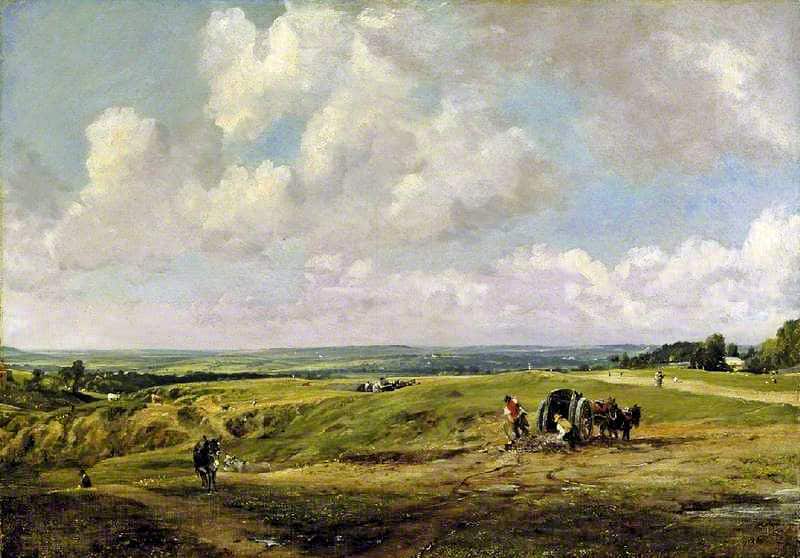
David Thompson calls to our attention yet another outbreak of problematic racist white supremacy in … landscape paintings?

Hampstead Heath by John Constable, 1820.

Above, John Constable’s Hampstead Heath, circa 1820. Beware its morally corrupting influence.

The problem, we’re told, is that paintings from the eighteenth and nineteenth centuries are “leaving very little room for representations of people of colour”. And obviously, even the past must be made “inclusive and representative”. Which seems to mean that we must all pretend that our islands’ population and cultural assumptions have always looked like those of, say, twenty-first century London, a city whose demographics bear little relationship to those of the country as a whole, even in the twenty-first century.

It occurs to me that notions of racial “representation” will likely be distorted by the embrace of rather parochial progressive conceits, and by proximity to the nation’s capital, which in my lifetime has gone from a native white-majority city, over 90%, to a native white-minority one, around 35%, and which is wildly out of step with the rest of the nation. Things that are denounced as “horribly white”, or whatever the current term of disapproval is, may not seem so to people who live in, say, Chesterfield or Plymouth.

But apparently, museum visitors must be warned that the sight of a Constable landscape may trigger TERRIFYING BLOOD AND SOIL TENDENCIES. Or at least inspire thoughts of historical attachment, continuity, and belonging – thoughts that may be disconcerting or very much frowned upon, if only by the – wait for it – keepers of our heritage.

Green Beer (You Suck at Cooking) Episode 87

Filed under: Europe, Food, History, Humour — Tags: , , — Nicholas @ 02:00

You Suck At Cooking
Published Mar 17, 2019

The history of Ireland is a long and storied one, and one I know next to nothing about. The history of St. Patrick is a short one, relative to the length of the history of the world. The current St. Patrick’s day celebrating has little or nothing to do with the actual St. Patrick, and that’s the way we like it.

The first step to making green beer is to add a few drops of food coloring, then add beer. When selecting a glass to drink it out of, make sure it’s transparent, that way you are able to see the green part of the beer not only from the top or from within the stomach, but also from the side while drinking beer.

While pouring the beer, making sure not to pour it from a great height. This will decrease the amount of bubbles that end up in the beer when you are drinking it, and therefore the enjoyment. If you were aware of the lengths that the manufacturers went to in order to get bubbles inside of that beer in the first place, you wouldn’t even drink it at all.

While drinking the beer, make sure you don’t allow the beer to come into contact with anything that could get stained, such as your clothes, dog, or mouth. If you swallow quickly enough you can keep your mouth from turning green permanently.

If you dislike drinking beverages that are colored green but want to get into the festive spirit, simply tape green construction paper around your drinking vessel, and dye your beer purple instead.

QotD: Imperial Japan and Nazi Germany never had a “long game” … but Stalin did

Though both the Germans and the Japanese had every intention of starting major wars, as everyone knows they seemingly put zero thought into what they’d do once they won. I know, I know, [Himmler] had his sweaty wet dreams about Wehrbauern on the vast Russian steppes, but all but the most rudimentary post-victory planning seems to have been beyond the Third Reich’s capacity — the Reich Resettlement Office, for instance, was tiny even when the war looked like it would be over by Christmas. The Japanese were, if anything, even dumber — they honestly seemed to believe they could run China, all of it, and even India Manchukuo-style.

The Russians, meanwhile, never stopped playing the long game. While Goebbels made a few token gestures at rapprochement with “the West” (yeah, they called it that), and to sell Nazism to ditto, his heart wasn’t in it, any more than the Japanese’s heart was in their “Greater East Asia Co-Prosperity Sphere” hooey. Stalin, by contrast, was always pimping Communism to the West — even in the deepest, darkest days of the war, when it looked like the Wehrmacht was about to march into Moscow, the propaganda directed at the West continued full blast.

Like the German and Japanese aircraft industries, the German propaganda industry was ideologically locked into its core mission: To sell Nazism to Germans. And they were aces at it, no doubt … but then the mission changed. The smart thing for the Germans (and Japanese) to have done with their conquered territories was, in the context of the war, to ease up on the Nazi shit for the duration. The Nazis could’ve had zillions of Ukrainians fighting for them in 1941 just as the Japanese probably could’ve waltzed into India in 1941 had they not been so … well, so Japanese, in the rest of the Pacific rim. Stalin would’ve done it in a heartbeat, had the situation been reversed, and to hell with “authentic” Marxism-Leninism. Win the war first; square the ideology later.

As this is running way long, one example should suffice. Goebbels approached the task of selling Nazism to Germans in the most German way possible: He created the Reich Culture Chamber, which controlled all newspapers, radio broadcasts, film distribution, etc. And it worked, as far as it went — Goebbels deserves his “evil genius” rep — but as we’ve seen, that locked the leadership into an ideological straightjacket. Telling the Wehrmacht to ignore the Commissar Order and buddy up with the Ukrainians would’ve been the smart thing to do, militarily, but it was culturally impossible. Goebbels did his job too well … and then the mission changed.

The Soviets had a similar problem inside the USSR, but — here’s Stalin’s evil genius — they had free reign in propagandizing the West. Goebbels hardly bothered, but the Soviets poured massive resources into it. Forget, as far as you can, everything you think you know about “Nazism” […]. Even if you look at it as objectively as possible, it still seems ridiculous, and there’s a simple explanation for that — it’s not for you. Unless you were a pure blooded Aryan, actually living in Germany (or within Germany’s potential military reach), [they] couldn’t care less about you. Which made being a “Nazi” in, say, America uniquely pointless — you just look like a bigot at best, a traitorous bigot at worst.

Being a “Communist”, though? That was universal. Indeed, that made you a Smart person, a very very smart person, and morally superior to boot. Why? Because you care so much that you’ve mastered this large body of deliberately esoteric doctrine, comrade … all straight out of the NKVD playbook. And if actual life as it was lived in the Soviet Union didn’t quite measure up to the promises, well, that’s because they didn’t have the right people — people like YOU — running things. It’s fucking brilliant — a totally ideologically closed, indeed brutal, system at home, presented as the most open-minded, enlightened, tolerant one possible abroad.

Which is why Joey G. needed a huge Reich Culture Chamber that never came close to justifying its budget, and Stalin needed, effectively, nothing. Being so very, very Smart, wannabe “elites” in the West were happy to spread Commie propaganda for free. The NKVD, let alone the Gestapo, ain’t got shit on the Junior Volunteer Thought Police of Twitter and Facebook …

… which forces us to confront the question: Which model of propaganda are our rulers using? Has the one morphed into the other? Is it real, or is it just “German efficiency”?

Severian, “The Myth of German Efficiency”, Rotten Chestnuts, 2021-05-26.

« Newer PostsOlder Posts »

Powered by WordPress