
Forgotten Weapons
Published Dec 15, 2023“EROP” was a small company based in Paris, which produced about 18 submachine gun prototypes between 1954 and 1956. These were submitted to French military trials in several different configurations first in 1954 and later in 1956, and none of them were given any further consideration after that.
Mechanically, the EROP guns are closed-bolt and striker-fired, using modified MP40 magazines (and chambered for 9mm Parabellum). They use a small square-profile tubular receiver, and several (including this particular one) have a very perplexing buttstock system that I really can’t figure out.
Many thanks to the IRCGN (Institut de Recherche Criminelle de la Gendarmerie Nationale) for allowing me access to film this unique SMG for you!
(more…)
March 27, 2024
Weirdest of the French Trials SMGs: the EROP 1954
QotD: Roman imperial strategy
There’s a useful term in the modern study of international relations, called “escalation dominance”. What escalation dominance means is that in any sort of conflict, there’s a big game theoretic advantage to being the one who decides how nasty it’s going to be. Ancient wars usually moved slowly up a ladder of escalation, from dudes yelling insults at each other across the border, to some light raiding and looting, to serious affairs where armies made an actual effort to kill and subjugate each other or conquer land.1 Highly mobile forces tended to work best at the lower rungs of the escalation ladder, and Rome frequently allowed conflicts to stay simmering at this level. But the existence and loyalty of the legions meant that it was their choice to do so, because they could also choose to slowly and inexorably march towards your capital city killing everything in their path and doing something truly unhinged when they got there, like building multiple rings of fortifications or a giant crazy siege ramp in the desert. And, paradoxically, the fact that they could do this meant that they didn’t have to as often. Thus the threat of disproportionate escalation became the ultimate economizing measure, by preventing wars from breaking out in the first place.
If deterrence fails and you have to fight, then the next best way to economize on force is by making somebody else do the fighting for you. In the late Republic and early Empire, much of Roman territory wasn’t “officially” under Roman rule. Instead, it was the preserve of dozens of petty and not-so-petty kingdoms that, on paper at least, were fully independent and co-equal sovereign entities.2 Rome actually went to some effort to keep up the charade: the client rulers were commonly referred to as “allies” [socii], and Rome took care never to directly tax or conscript their citizens. But, to be clear, it was a charade. If any of these “allies” ever wanted to leave the alliance or conduct any sort of independent foreign policy, he would not continue to be a king for long. Oftentimes the legions wouldn’t even have to show up — the terrified citizens of the client kingdom would overthrow and execute their wayward ruler themselves, in the hopes that Rome might thereby be induced not to make an example of the citizenry.
What was the point of all of this complicated kabuki theater? Once again, it’s about economy of force, this time on both the “input” and the “output” sides of the great machine of the state. On the input side: efficient government is hard to scale. Roman provincial governors were legendarily corrupt, and could get up to all kinds of mischief out there without supervision. Having a Roman ruling a whole bunch of non-Romans was also bound to cause resentment: it could lead to rebellions, or worse, tax-evasion. All of these problems were solved by pretending to have the barbarians be ruled by one of their own, a barbarian king. He could collect the taxes, and suppress revolts, and generally keep an eye on things. Moreover, as a fellow barbarian, he would know better how to keep his subjects in line, and would be less likely to commit an awkward cultural blunder. On the output side, he could also deal with border raids and other low-intensity threats. This exponentially magnified Roman military power, because it meant that instead of being stuck on garrison duty, spread out along the frontiers, the legions could be concentrated in a strategic reserve. They could then be deployed for “high intensity” operations in some remote part of the empire without worrying that they were thereby leaving the borders unguarded: operations like conquering new lands, or persuading a rebellious client kingdom that their interests lay with Rome.
If you can’t make somebody else do the fighting, then the next, next best thing is to carefully choose the time, circumstances, and location of the fight. Ideally you would muster a heavy concentration of your own forces and confront the enemy while they’re still dispersed. Ideally the ground would be thoroughly surveyed, well understood, and perhaps even prepared with static defenses. Ideally your own forces would have ample supply and good lines of communication, and your opponent would have neither of these things. It was to all these ends that in the second of the periods Luttwak surveys, the Romans built the limes3 — a massive system of defensive emplacements. These extended for thousands of miles around almost the entire frontier of the empire, but the most famous portion was Hadrian’s Wall.
John Psmith, “REVIEW: The Grand Strategy of the Roman Empire by Edward Luttwak”, Mr. and Mrs. Psmith’s Bookshelf, 2023-11-13.
1. This is actually also true of modern wars, and if you think you have an exception in mind, you may just not know the history that well. For instance, the current war in the Donbass wasn’t really a surprise invasion, but is best viewed as the latest and most violent stage of a conflict that’s been slowly ratcheting up for a decade.
2. Were you ever confused by who exactly this King Herod guy in the Gospel stories was? Why was there a king and also a Roman governor? He was precisely one of these client rulers!
3. Pronounced “lee-mays”, not like the fruit.
March 26, 2024
Why the USN isn’t using their “Littoral Combat Ships” in the Red Sea littoral zone
CDR Salamander explains why the US Navy has chosen not to deploy the ships specifically designed and built to operate in environments like the Red Sea:
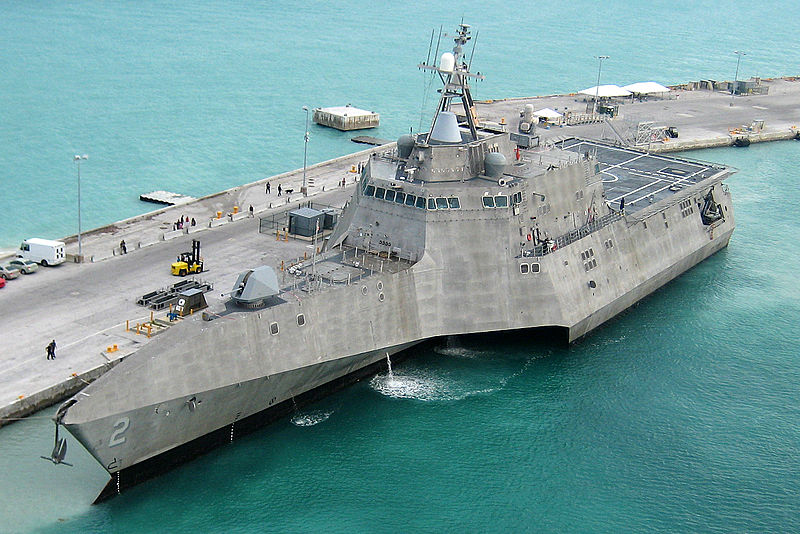
LCS USS Independence (LCS-2)
On yesterday’s Midrats, my co-host mentioned that recently in the Red Sea our Navy has seen the most littoral combat it has in a very long time, but our Littoral Combat Ships are not to be seen. Why? Simple. They cannot conduct combat on the littorals.
This AM, fellow “First LCS Critic” Chapomatic sent me a link to an article from September of last year that I think at the time I made a passing comment on over at X, but did not bring here. Well, let’s fix that.
Why do we need to periodically drag LCS out of the gimp box and hoist her up for all to behold? Simple; as an example to others. We simply cannot afford another CG(X) or DDG-1000 situation with DDG(X) or any other ship we have in the design phase. We have already lost one generation of ship design due to the Age of Transformationalism.
With the Constellation Class FFG we now have building, we are at last taking the course I first suggested in 2006 to correct the error of LCS. That is our version of FREMM that was first commissioned by the French in 2012, a dozen years ago.
LCS was not a problem with our shipbuilding industry or even our design people – though there are areas to critique there. No, this was a people problem, a mindset problem, a culture problem.
It needs to be dragged up regularly. I last did a dedicated post on it back in August 2023. It is time.
As we dive into the details remember this; since the disaster of LCS no senior personnel have yet been held to public account. We have the same acquisition system. We have the same incentives and disincentives as before. Critics of LCS were pushed over to the off-ramp; its most NORK-like advocates promoted.
There is no guarantee this won’t happen again.
Joaquin Sapien at ProPublica and his extensive almost novella – not just an article – on LCS that even opens with a quote of the phrase that first came into the general conversation here on CDR Salamander; The Inside Story of How the Navy Spent Billions on the “Little Crappy Ship”.
Sadly, we did not even get a mention or link – though most of the arguments are the same ones we’ve been making here and on the OB Blog since 2004 – if you spot me six months or so, two decades ago.
Some people have critiques of ProPublica, especially from the right side of the spectrum, but I’m sorry – their critique here is spot on.
It starts right in center mass;
The USS Freedom had its own special place within the armada. It was one of a new class of vessels known as littoral combat ships. The U.S. Navy had billed them as technical marvels — small, fast and light, able to combat enemies at sea, hunt mines and sink submarines.
In reality, the LCS was well on the way to becoming one of the worst boondoggles in the military’s long history of buying overpriced and underperforming weapons systems. Two of the $500 million ships had suffered embarrassing breakdowns in previous months. The Freedom’s performance during the exercise, showing off its ability to destroy underwater mines, was meant to rejuvenate the ships’ record on the world stage. The ship was historically important too; it was the first LCS built, the first in the water, commissioned just eight years prior.
The summary of their findings in spot on, especially the last sentence;
Our examination revealed new details on why the LCS never delivered on its promises. Top Navy leaders repeatedly dismissed or ignored warnings about the ships’ flaws. One Navy secretary and his allies in Congress fought to build more of the ships even as they broke down at sea and their weapons systems failed. Staunch advocates in the Navy circumvented checks meant to ensure that ships that cost billions can do what they are supposed to do.
Both inside and outside the Navy, LCS critics warned two decades ago that 2024 would find the Little Crappy Ship roughly where it wound up
Montreal’s La Presse issues apology for antisemitic editorial cartoon
Caroline Glick discusses the blood libel cartoon published by Montreal’s La Presse on 20 March, 2024:

According to Canada’s La Presse, Israeli Prime Minister Benjamin Netanyahu is a vampire, and he is poised to suck the life out of the Palestinians in Rafah, Hamas’s final outpost in southern Gaza. The publication that was once a paper of record in Canada ran a political cartoon on March 20 portraying Netanyahu as a vampire, with a huge hooked nose, pointy ears and claws for fingers, dressed in Dracula’s overcoat while standing on the deck of a pirate ship.
The caption, written in blood-dripping red letters, read: “Nosfenyahou: En Route Vers Rafah.” Nosferatu, the Romanian word for vampire, was the title of a proto-Nazi German silent horror film from 1922 chock-full of anti-Semitic poison. The film, which became something of a cult flick, featured a vampire with a long Jewish nose. He arrived at an idyllic German town with a box full of plague-carrying rats that he released on the innocent villagers as he plotted to suck his realtor’s blood.
La Presse‘s cartoon didn’t leave any room for imagination. It wasn’t making a political or military argument against Israel’s planned ground operation in Rafah. Its goal wasn’t to persuade anyone of anything.
The Netanyahu-the-vampire cartoon asserted simply that Netanyahu is a Jewish bloodsucker and, more broadly, the Jewish state — and Jews worldwide — must be vigorously opposed by all right-thinking people who don’t want Jewish vampires to kill them.
As the paper no doubt anticipated, the cartoon provoked an outcry from Canadian Jews and some politicians. And after a few hours, the newspaper took it off its website and apologized. Anyone who thinks that means that the good guys won misses the point of the move. The Jewish outcry and pile-on by politicians and media coverage proved the point. Jews are evil and control everything, even what a private paper can publish. Like Nosferatu in its day, the cartoon will become a piece of folklore, additional proof that the Jews are the enemy of humanity.
In other words, the cartoon was a blood libel.
We’re seeing lots and lots of it these days. And so, it is worth recalling what a blood libel is.
In its original form, of course, the libel was specifically about blood. About 1,000 years ago, Christians in England began accusing Jews of performing ritual murders of Christian children to use their blood to bake Passover matzahs.
The accusation was inherently insane. Jewish law prohibits murder. It prohibits cannibalism. It prohibits child sacrifice. It prohibits eating food with blood. But none of that mattered. Like the cartoon in La Presse, the blood libel didn’t seek to persuade anyone. It presumed that its target audiences already hated Jews or had a latent tendency to hate Jews, which the blood libel aimed to unleash. The purpose of the blood libel was to scapegoat the Jews and to incite target audiences from London to Damascus to act on that hatred. Over the millennium, hundreds of thousands of Jews were massacred in Europe and the Islamic world in response to blood libels.
What Makes a Good Book
Lost Art Press
Published Nov 26, 2023✅ Read and subscribe to the Lost Art Press Blog: https://blog.lostartpress.com/
🏪 Visit Our Store: https://lostartpress.com
QotD: Cavalry logistics for Steppe raiders
Each steppe warrior rode to battle with not one horse, but several: typically five to eight. For reasons that will rapidly become obvious, they preferred mares for this purpose. The Steppe warrior could ride the lead horse and keep the rest of them following along by connecting them via a string (thus “horse-string logistics”), such that each steppe warrior was his own little equine procession. These horses are, you will recall, fairly small and while they are hardy, they are not necessarily prodigiously strong, so the warrior is going to shift between them as he rides, sparing his best mount for the actual fight. Of course we are not looking at just one warrior on the move – that would be very dangerous – but a group on the move, so we have to imagine a large group (perhaps dozens or hundreds or even thousands) of warriors moving, with something like 5-8 times that many horses.
[Edit: It is worth noting that a horse-string war party might well also bring some number of sheep with them as an additional food supply, herding them along as the army rode. So even here, sheep maintain their importance as a core part of the subsistence system.]
Now of course the warriors are going to bring rations with them from the camp, including milk (both liquid in leather containers and dried to qurut-paste) as well as dried meat. But the great advantage of moving on mares is that they when they are lactating, mares are already a system for turning the grass of the steppe into emergency rations. As Timothy May (op. cit.) notes, a mare produces around 2.25-2.5 quarts of milk in excess of the needs of her foal per day during her normal five-month lactation period, equal to about 1,500kcal/day, half of the daily requirement for a human. So long as at least two of the horses in the horse-string were lactating, a steppe warrior need not fear shortfall. This was more difficult in the winter when less grass was available and thus mare’s milk became scarce, which could impose some seasonality on a campaign, but a disciplined band of steppe warriors could move massive distances (the Mongols could make 60 miles a day on the move unencumbered, which is a lot) like this in just a few months.
In adverse conditions (or where time permitted because meat is tasty), steppe warriors on the move could also supplement their diet by hunting, preserving the meat as saddle-jerky. In regions where water became scarce, we are frequently told that the Mongols could keep going by opening a vein on their horse and drinking the blood for both nourishment and hydration; May (op. cit.) notes that a horse can donate around 14 pints of blood without serious health risk, which is both hydrating, but also around 2,184kcal, about two-thirds of the daily requirement. This will have negative impacts on the horses long term if one keeps doing it, so it was an emergency measure.
The major advantage of this kind of horse-string logistics was that a steppe warrior party could move long distances unencumbered by being essentially self-sufficient. It has a second major advantage that I want to note because we’ll come back to it, they light no fires. For most armies, camp fires are essential because food preparation – particularly grains – essentially requires it. But a steppe warrior can move vast distances – hundreds of miles – without lighting a fire. That’s crucial for raiding (and becomes a key advantage even when steppe warriors transition to taking and holding territory in moments of strength, e.g. the Mongols) because sight-lines on the steppe are long and campfires are visible a long way off. Fireless logistics allow steppe warriors to seemingly appear from the steppe with no warning and then vanish just as quickly.
That said, these racing columns of steppe warriors, while they could move very fast and be effectively independent in the short term, don’t seem generally to have been logistically independent of the camp and its herds of sheep in the long term. Not only, of course, would there be need for things like hides and textiles produced in the camp, but also the winter snows would drastically reduce the mares milk the horses produced, making it more difficult to survive purely on horse-string logistics. Instead, the camp formed the logistical base (and store of resources, since a lot of this military activity is about raiding to get captives, sheep and horses which would be kept in the camp) for the long range cavalry raids to strike out from. To the settled peoples on the receiving end of a Mongol raid, it might seem like the Mongols subsisted solely on their horses, but the Mongols themselves knew better (as would anyone who stayed with them for any real length of time).
Bret Devereaux, “That Dothraki Horde, Part II: Subsistence on the Hoof”, A Collection of Unmitigated Pedantry, 2020-12-11.
March 25, 2024
Vernor Vinge, RIP
Glenn Reynolds remember science fiction author Vernor Vinge, who died last week aged 79, reportedly from complications of Parkinson’s Disease:

Vernor Vinge has died, but even in his absence, the rest of us are living in his world. In particular, we’re living in a world that looks increasingly like the 2025 of his 2007 novel Rainbows End. For better or for worse.
[…]
Vinge is best known for coining the now-commonplace term “the singularity” to describe the epochal technological change that we’re in the middle of now. The thing about a singularity is that it’s not just a change in degree, but a change in kind. As he explained it, if you traveled back in time to explain modern technology to, say, Mark Twain – a technophile of the late 19th Century – he would have been able to basically understand it. He might have doubted some of what you told him, and he might have had trouble grasping the significance of some of it, but basically, he would have understood the outlines.
But a post-singularity world would be as incomprehensible to us as our modern world is to a flatworm. When you have artificial intelligence (and/or augmented human intelligence, which at some point may merge) of sufficient power, it’s not just smarter than contemporary humans. It’s smart to a degree, and in ways, that contemporary humans simply can’t get their minds around.
I said that we’re living in Vinge’s world even without him, and Rainbows End is the illustration. Rainbows End is set in 2025, a time when technology is developing increasingly fast, and the first glimmers of artificial intelligence are beginning to appear – some not so obviously.
Well, that’s where we are. The book opens with the spread of a new epidemic being first noticed not by officials but by hobbyists who aggregate and analyze publicly available data. We, of course, have just come off a pandemic in which hobbyists and amateurs have in many respects outperformed public health officialdom (which sadly turns out to have been a genuinely low bar to clear). Likewise, today we see people using networks of iPhones (with their built in accelerometers) to predict and observe earthquakes.
But the most troubling passage in Rainbows End is this one:
Every year, the civilized world grew and the reach of lawlessness and poverty shrank. Many people thought that the world was becoming a safer place … Nowadays Grand Terror technology was so cheap that cults and criminal gangs could acquire it. … In all innocence, the marvelous creativity of humankind continued to generate unintended consequences. There were a dozen research trends that could ultimately put world-killer weapons in the hands of anyone having a bad hair day.
Modern gene-editing techniques make it increasingly easy to create deadly pathogens, and that’s just one of the places where distributed technology is moving us toward this prediction.
But the big item in the book is the appearance of artificial intelligence, and how that appearance is not as obvious or clear as you might have thought it would be in 2005. That’s kind of where we are now. Large Language Models can certainly seem intelligent, and are increasingly good enough to pass a Turing Test with naïve readers, though those who have read a lot of Chat GPT’s output learn to spot it pretty well. (Expect that to change soon, though).
One major change in sexual behaviour since the mid-20th century
David Friedman usually blogs about economics, medieval cooking, or politics. His latest post carefully avoids (almost) all of that:

I didn’t have a convenient graphic to use for this post … but I know not to Google something like this.
My picture of sexual behavior now and in the past is based on a variety of readily observable sources — free online porn for the present, writing, both pornography and non-pornographic but explicit, for the past. On that imperfect and perhaps misleading evidence the pattern of when oral sex was or was not common in our society in recent centuries is the opposite of what one would, on straightforward economic grounds, expect.
Casanova’s memoirs provide a fascinating picture of eighteenth century Europe, including its sexual behavior. He mentions incest, male homosexuality, lesbianism, which he regards as normal for unmarried girls:
Marton told Nanette that I could not possibly be ignorant of what takes place between young girls sleeping together.
“There is no doubt,” I said, “that everybody knows those trifles …
I do not believe he ever mentions either fellatio or cunnilingus. Neither does Fanny Hill, published in London in 1748, when Casanova was twenty-three.
Frank Harris, writing in the early 20th century, is familiar with cunnilingus, uses it as a routine part of his seduction tactics, but treats it as something sufficiently exotic so that he had to be talked into trying it by a woman unwilling to risk pregnancy. I do not think he ever mentions fellatio.
Modern online porn in contrast treats both fellatio and cunnilingus as normal parts of foreplay, what routinely comes between erotic kissing and vaginal intercourse.
One online article on the history of fellatio that I found dated the change in attitudes to after the 1976 Hite Report, which found a strongly negative attitude among women to performing it. In contrast:
Today, the act is something more like bread before dinner: noteworthy only if it’s absent. (Fifty Shades of Grey and How One Sex Act Went Mainstream)
And from another, present behavior:
Oral sex precedes and often replaces sexual intercourse because it’s perceived to be noncommittal, quick and safe. For some kids it’s a cool thing to do; for others it’s a cheap thrill. Raised in a culture in which speed is valued, kids, not surprisingly, seek instant gratification through oral sex (the girl by instantly pleasing the boy, the boy by sitting back and enjoying the ride). A seemingly facile command over the sexual landscape of one’s partner is achieved without the encumbrances of clothes, coitus and the rest of the messy business. The blow job is, in essence, the new joystick of teen sexuality. (Salon)
Contrasted with:
When I was a teenager, in the bad-taste, disco-fangled ’70s, fellatio was something you graduated into. Rooted in the great American sport of baseball, the sexual metaphors of my generation put fellatio somewhere after home base, way off in the distant plains of the outfield. In fact, skipping all the bases and going directly to fellatio was the sort of home run reserved only for racy, borderline delinquents, who enjoyed a host of licentious and forbidden activities that made them stars in the firmament of teen recklessness.
WWII Allied Vehicles – Universal Carrier
Ontario Regiment Museum
Published Jan 26, 2022This multi-part series was originally created in support of our friends at D-Day Conneaut for presentation during their live stream in 2020.
In part 5 the Museum’s Operation Manager Dan Acre details the history of a Canadian-made WWII vehicle, the Universal Carrier. (Please forgive the sound quality, it was one of the first videos we produced in the early stages of the pandemic.)
(more…)
QotD: Generational politics
I’ve been making this point for years, but you’ve all been too busy projecting your guilt onto others and blaming them for all your problems to listen to me.
The reason I get fixated on certain topics is because they in some way powerfully reflect this theme of misplaced blame. This may burst quite a few of your bubbles, but the fact that I’ve focused on the endless bashing of whites for years is not a sign of how deeply in love I am with white people but rather a fascination with the fact they’re getting blamed for many things that demonstrably aren’t their fault. It’s the same reason I focus on the gender wars — men nearly aren’t as awful as they’re being depicted, and women are nowhere near as innocent as the current narrative says they are.
If you haven’t been paying attention, there’s been escalating intergenerational hostility across our fair land, and people are increasingly identifying with dumb, media-manufactured generational names — AKA Baby Boomers, Gen X, Millennials, and Gen Z — as if they were scientific categories that are predictive of human behavior rather than arbitrary designations along the lines of Virgo, Capricorn, Scorpio, and Leo.
It’s some weird new metastasized form of identity politics. And, since it comes with the turf, these groups are blaming each other for all that ails the world.
It’s dumber than astrology […] but this intensely stupid way of framing the world refuses to die.
Jom Goad, “The Myth of Boomer Privilege”, Taki’s Magazine, 2019-11-03.
March 24, 2024
Chiang versus Mountbatten – WW2 – Week 291 – March 23, 1945
World War Two
Published 23 Mar 2024Chiang Kai-Shek is demanding his Chinese troops back from Burma, but this doesn’t fit well with Mountbatten’s plans for the region. In Burma, Bill Slim’s forces liberate Mandalay this week and make plans to head south for Rangoon. There’s also friction elsewhere in Allied command — between the Soviets and the Western Allies — over Italy. In the field in Europe, the Soviets advance all along the eastern front, and in the west, the Allies secure another Rhine crossing, and they also launch a double operation to send even more men across the river in force.
0:00 Intro
0:53 Recap
1:20 Iwo Jima
2:15 Plans for Okinawa
3:53 Mandalay liberated and plans for Burma
08:19 Allied Machinations about Italy
10:25 Soviet advances all along the Eastern Front
16:55 Plans for Operation Grapeshot
17:45 Four Allied Operations in the west
23:25 Summary + Conclusion
(more…)
“[A] term was coined in Britain for playing music on your phone in public: ‘sodcasting’ – after ‘sod’ for ‘sodomite’, i.e. something that only a total ASSHOLE would do”
We’ve all been there at some point, especially in waiting rooms or on public transit: someone is either accidentally or deliberately subjecting everyone else in the vicinity to their personal soundtrack:

The modern world is noisy, I get that. I’m fine dealing with busy, urban places. But that surely makes those other places where you can escape the noise all the more vital in the constant struggle for sanity in this century. This is perhaps the one issue on which uber-leftist Elie Mystal and I agree. He found himself this week in a waiting room, full of peeps “listening to content on their devices with no headphones … LOUDLY. What the SHIT is this?? Is this normal?” His peroration: “I’M DEAD. I CAN FOR REAL FEEL THE VEINS IN MY HEAD THROBBING. THIS IS HOW I DIED.” #MeToo, my old lefty comrade.
The degradation of public space in America isn’t entirely new, of course. As soon as transistor radios became portable, people would carry them around — for music or sports scores on construction sites or wherever. But the smartphone era — thanks once again, Steve Jobs, you were so awesome! — gave us an exponential jump in the number of people with highly portable sound-broadcasting machines in every public space imaginable. In other words: Hell on toast.
At the beginning of this phone surge, a term was even coined in Britain for playing music on your phone in public: “sodcasting” — after “sod” for “sodomite”, i.e. something that only a total ASSHOLE would do. Sodcasting was just an amuse bouche, though, compared with our current Bluetooth era, where amplifiers the size of golf-balls have dialed it all up to 11, and the age of full-spectrum public cacophony — including that thump-thump-thump of the bass that carries much farther than the sodcasting treble — has truly begun.
National parks? They are now often intermittent raves, where younger peeps play loud, amplified dance music as they walk their trails. On trains? There is now a single “quiet car” when once they all were, because we were a civilized culture. Walk down a street and you’ll catch a cyclist with a speaker attached to the handlebars, broadcasting at incredible volume for 50 feet ahead and behind him, obliterating every stranger’s conversation in his path.
On a bus? Expect the person sitting right behind you with her mouth four inches from your ears to have a very loud phone conversation, with the speaker turned up, and the phone held in front of her like a waiter holding a platter. The things she’ll tell you! Go to a beach and have your neighbors play volleyball — but with a loud speaker playing Kylie Minogue remixes to generate “atmosphere”.
When did we decide we didn’t give a fuck about anyone else in public anymore?
It’s not as if there isn’t an obvious win-win solution for both those who want to listen to music and those who don’t. Let me explain something that seems completely unimaginable to the Bluetoothers: If you can afford an iPhone, you can afford AirPods, or a headset, or the like. Put them in your ears, and you will hear music of far, far higher quality than from a distant Bluetooth, and no one else will be forced to hear anything at all! What’s not to like? It follows, it seems to me, that those who continue to refuse to do so, who insist that they are still going to make you listen as well, just because fuck-you they can, are waging a meretricious assault on their fellow humans.
What could be the defense? The Guardian — who else? — had a go at it:
the ghetto blaster reminds us that defiantly and ostentatiously broadcasting one’s music in public is part of a history of sonically contesting spaces and drawing the lines of community, especially through what gets coded as “noise” … it represents a liberation of music from the private sphere in the west, as well as an egalitarian spreading of music in the developing world.
The first point is not, it seems to me, exculpatory. It’s describing an act of territorial aggression through sound. The second point may have some truth to it — but it hardly explains the super-privileged NYC homos on the beach or the white twenty-something NGO employees in the park. But would I enjoy living in Santo Domingo where not an inch — so far as I could see and hear when I was there — was uncontaminated by overheard fluorescent lights and loud, bad club music? Nope.
Whenever I’ve asked the sonic sadists whether they actually understand that they are hurting others, they blink a few times, their mouths begin to form sentences, and then they look away. Or they’ll tell me to go fuck myself, or say I’m the only one who has complained, which is probably true because most people don’t want public confrontation, and have simply given up and moved on. Then there is often the implication that I’m the one being the asshole. On no occasion has anyone ever turned their music off after being asked to. Too damaging to their pride.
One reddit forum-member had this excuse: “It’s because earbuds hurt my ears and headphones don’t stay on.” Another got closer: “A lot of people that play their music out loud think that others won’t mind it.” Self-absorption. One other factor is simply showing off: at Herring Cove, rich douchefags bring their expensive boats a little off-shore so they can broadcast with their massive sound systems. It strengthens my support for the Second Amendment every summer.
Gahendra: the Nepalese Not-A-Martini
Forgotten Weapons
Published Jul 8, 2018(This video has been updated from its original form to fix translation issues and to clarify that Nepal was not, in fact, a British colony. Originally published January 10, 2017.)
Long a mysterious unknown member of the Martini family, the Nepalese Gahendra rifles finally became available in the US and Europe after IMA purchased Nepal’s cache of historic arms. The Gahendra is a uniquely Nepalese design built to sidestep British reluctance to supply military arms to the country. Developed by a General Gahendra (who is also responsible for the Bira copy of the Gardner Gun), the rifle is not actually a Martini at all. Instead, it shares its mechanical features mostly with the earlier Peabody falling block rifles, using a hammer and flat mainspring (the Martini improvement replaces there with a striker and coil spring).
Gahendras are chambered for the standard British .577/.450 Martini cartridge, although their bore diameters vary substantially, and one should absolutely slug a specific rifle before loading ammunition for it. In fact, unless you are capable of proficiently assessing the safety of the Gahendra, it is wiser not to shoot them at all. These rifles were individually handmade well over a hundred years ago using steels of questionable metallurgy and hardening.
That said, the guns were actually much better made than most people assume, considering their non-interchangeable parts. Craftsmen built each rifle part by part, giving the factory an output of just four rifles per day. Production began in the 1880s, and according to the Nepalese government ended prior to 1899. Dates on the rifles, however, are commonly found as late as 1911. These dates are generally assumed to be inventory or refurbishment dates.
(more…)
QotD: Adolescence
In the old days, of course (in every culture), adulthood came earlier, and adolescence was merely its apprentice form. Now thanks to an extended, debilitating system of “education”, bureaucratically controlled, adolescence itself, or the semblance of it, may be extended past the age of thirty; and with the further interventions of what I call Twisted Nanny State, from birth (when permitted) to death (however caused). The old notion that one must take responsibility for oneself and in one’s neighbourhood (whatever that may be) has come to be replaced by the new notion that one is the member of a demographic group, to be assigned responsibilities by one’s progressive betters.
David Warren, “Against ‘education'”, Essays in Idleness, 2019-09-06.
March 23, 2024
Ireland’s Varadkar heads for the showers
In Spiked, Brendan O’Neill discusses the “shocking” — but not actually shocking — resignation of Ireland’s Taoiseach (prime minister):

Leo Varadkar and Rishi Sunak
Composite image from extra.ie
“I am no longer best man to be Irish PM”, said a BBC headline this week, summarising Leo Varadkar’s resignation speech. The truth, Leo, is that you were never the best man to be Irish PM. He was never elected by the people to be taoiseach, instead securing that seat of power by appointment and backroom dealing. And once there, once he’d been gifted the highest office in the land by his allies in Dublin 4, he wielded government not for the people, but against them. He bent Ireland to what was essentially a vast real-time experiment in social re-engineering and thought control.
An unelected ruler using his power and clout to correct the country and improve the people? There’s a word for that. And it isn’t “democracy”.
Varadkar announced his resignation on Wednesday. In an emotional speech he said he was stepping down as leader of Fine Gael immediately and will step down as taoiseach once his successor has been chosen. His “shock departure” followed the people’s crushing defeat of the twin referendum he put forward. Overwhelming majorities rejected his proposals to alter the Irish constitution to update its definition of “family” and to fix what Varadkar damned as its “very sexist” reference to a woman’s “duties” in the home. No thanks, said the electorate, in the biggest ever referendum loss by an Irish government.
Even the fact that Varadkar’s stepping down is widely seen as a “shock move” speaks to the haughtiness, the outright unworldliness, of his political kind. To many of us it makes perfect sense that a PM would bugger off after suffering a historically unprecedented bloody nose from voters. But it seems the Varadkar clique thought they could ride it out. “No biggie” was their view. Until his “shock departure” on Wednesday, reports the Guardian, “the political fallout from the [referendum] debacle had widely been expected to be limited”.
Who expected that? I’m sure those voters who gleefully seized the opportunity of the referendum to give the middle finger to Varadkar and the rest of the establishment didn’t expect the impact of their discontent to be “limited”. It is a testament to the arrogance of technocracy, to the chasm that has emerged between Ireland’s rulers and Ireland’s ruled, that the Dublin establishment thought it could shrug off the largest drubbing it has ever received from voters.
In the end, tellingly, it seems it was disgruntlement from within his own party ranks, rather than the disgruntlement of the oiks, that convinced Varadkar to go. He was facing “increasing discontent within Fine Gael”, with some party bigwigs worried he’s an “electoral liability”. Everything you need to know about the man is contained in the fact that he essentially shrugged when the masses rose up against him but bolted when his fellow clerisy members criticised him. To the technocrat, the disapproval of their dinner-party circle carries far more weight than the discontent of ordinary people.
If Varadkar was edged out by the tut-tutting of movers and shakers, it would be a fitting end to a career that always owed more to the intrigue of political insiders than to the enthusiasm of the electorate. It is an unremarked upon truth that Varadkar was never installed into power by the people. He first became taoiseach in 2017 when then taoiseach Enda Kenny resigned as leader of Fine Gael. Varadkar was elected new party leader and became taoiseach on the back of it. So he became PM of Ireland on the back of the deliberations of 25,000 party members, not the ballots of the people.
Actually, even members of Fine Gael weren’t especially enthused by him. Varadkar’s opponent in the 2017 leadership contest – Simon Coveney – won almost twice as many votes from party members: 7,051 to Varadkar’s 3,772. But Varadkar won more votes from members of the parliamentary party – 51 to Coveney’s 22 – which meant Fine Gael’s weighted electoral college ruled in his favour rather than Coveney’s. From the get-go, Varadkar’s rule of Ireland was more an accomplishment of elite patronage than democratic keenness.


