
The Korean War by Indy Neidell
Published 17 Dec 2024The last UN forces still in the northern half of Korea begin their frantic retreat by sea. The evacuation is a huge operation involving over 100,000 men, and needs to go off smoothly if the UN want any hope of halting the Chinese advance. Eighth Army, who spend this week retreating, are certainly not up to the task on their own.
Chapters
00:00 Intro
00:50 Recap
01:07 Failures of Command
05:36 Hungnam Evacuation
09:02 Eighth Army Situation
13:07 National Emergency
14:12 Conclusion
15:48 CTA
(more…)
December 18, 2024
The Korean War 026 – Chinese Victory in North Korea Complete – December 17, 1950
Comments Off on The Korean War 026 – Chinese Victory in North Korea Complete – December 17, 1950
The modern Furies
In Greek mythology, the Erinyes (the Furies) — euphemized as the Eumenides (the “Gracious ones”) were the goddesses of vengeance. You may dismiss the ancient Greeks and their beliefs, yet they often encapsulate hidden wisdom for those who know how to interpret their stories. Today, as Janice Fiamengo points out, we have no need for mythological Furies, as they’re frequently embodied in otherwise ordinary women:
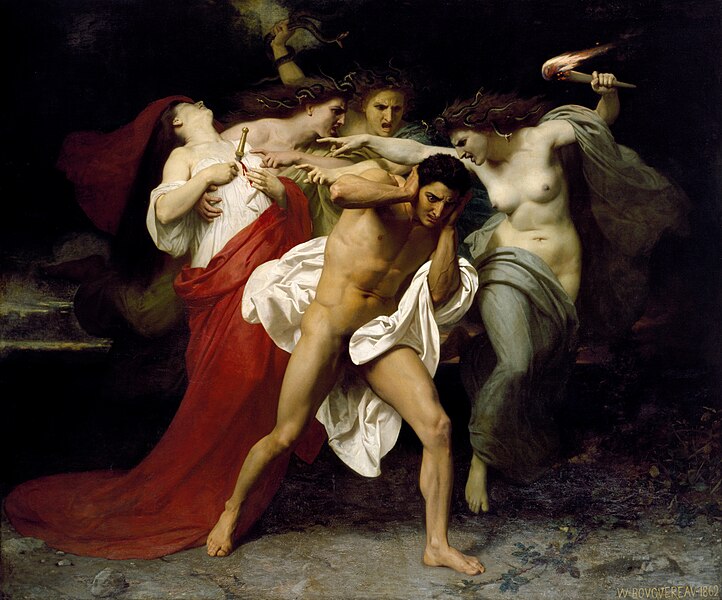
The Remorse of Orestes or Orestes Pursued by the Furies
Oil painting by William-Adolphe Bouguereau, 1862, in the Chrysler Museum of Art via Wikimedia Commons.
Feminist uproar over Trump’s election was easy to predict, and not long in coming. Within ten days of the election, Clara Jeffery wrote in Mother Jones that “Women are furious — in a Greek mythology sort of way“. Taking examples from TikTok, Jeffery chronicled abundant “sorrow, disbelief and terror, but also incandescent rage”, which many women vowed to exorcise on men: “‘If his ballot was red, his balls stay blue‘”, she quoted one.
In The New York Times, a 16-year-old girl, Naomi Beinart, charted her tumultuous emotions, which included a sense of betrayal because her male classmates had carried on with their lives on the day after the election, seemingly immune to the girls’ all-pervasive gloom and outrage. “Many of them didn’t seem to share our rage, our fear, our despair. We don’t even share the same future,” Beinart opined melodramatically.
No one with even a minimal acquaintance with social media can have missed the many similar, raging reactions: the heads being shaved, the death threats, the promised sex strikes, the fantasies of revenge against Trump-voting husbands. We are to understand that the re-election of a man rumored to lack sufficient pro-abortion commitment justifies thousands of self-recorded screams, imprecations, and poisoning plots.
At least one group of women gathered physically in Wisconsin to shout their angst and anger at Lake Michigan, and there have already been tentative (though apparently less enthusiastic than formerly) plans for a revival of the anti-Trump Women’s March protests, in which women with vulgar placards and pink hats exhibited their “collective rage“.
Women’s rage is all the rage.
It is not enough, it seems, for these women to say that they are disappointed by Trump’s win, and certainly inadequate for them to state strong disagreement with his policies or style. Expressing evidence-based positions is the sort of thing a rational person would do, and significant groups of women appear increasingly uninterested in rational talk or behavior. Instead, they reach for the most extreme language, tone of voice, postures and actions to express what feminist journalist Rhiannon Lucy Cosslett called the “visceral” “body horror” produced by the Trump victory, including the “profound physical revulsion” Cosslett and many of her sisters allegedly feel simply as a result of seeing one of Trump’s tweets (talk about fragility!).
Like so many feminist pundits telling us of women’s “horror” and “fury“, the emphasis is squarely on feeling and the female body, as if to bypass the intellect and the will altogether. The idea some feminists once scorned — that women are less reasonable and self-controlled than men — seems to have become a feminist axiom.
[NR: Edited to fix the broken URL.]
Comments Off on The modern Furies
How to Make a Wallclock | Episode 1
Paul Sellers
Published Jul 19, 2024Why are we making another Wallclock? Find out here: https://woodworkingmasterclasses.com/…
The basis for everything Paul has taught in woodworking to woodworkers around the world has been that with three joints and ten hand tools, you can make just about anything from wood. Each of these joints is irreplaceable and so each one stands alone in its importance of use.
The variations on the joints can triple, and in the case of the housing dado, there are but two additional versions. In this project, we take the most complex of the three versions to make our clock.
By the time you have made this joint and the clock, you will be fully equipped to make the other two versions. The tools you will use for all three variations are the same. We walk you through each step to bring total clarity to the tools, the joinery, and the methods and techniques. You will love making this oak wallclock project as much as Paul has in the dozens he has made since he designed it.
Remember, all the methods used will be adopted for dozens upon dozens of other projects throughout your life.
(more…)
Comments Off on How to Make a Wallclock | Episode 1
QotD: Western shaming – the grass is always greener overseas
In the late 1950s, many elites in the United States bought the Soviet Union line that the march of global communism would “bury” the West. Then, as Soviet power eroded in the 1980s, Japan Inc. and its ascendant model of state-sponsored industry became the preferred alternative to Western-style democratic capitalism.
Once Japan’s economy ossified, the new utopia of the 1990s was supposedly the emerging European Union. Americans were supposed to be awed that the euro gained ground on the dollar. Europe’s borderless democratic socialism and its “soft power” were declared preferable to the reactionary U.S.
By 2015, the EU was a mess, so China was preordained as the inevitable global superpower. American intellectuals pointed to its high-speed rail transportation, solar industries and gleaming airports, in contrast to the hollowed-out and grubby American heartland.
Now the curtain has been pulled back on the interior rot of the Chinese Communist Party, its gulag-like re-education camps, its systematic mercantile cheating, its Orwellian surveillance apparatus, its serial public health crises and its primitive hinterland infrastructure.
After the calcification of the Soviet Union, Japan Inc., the EU and the Chinese superpower, no one quite knows which alternative will next supposedly bury America.
Victor Davis Hanson, “The Cult of Western Shaming”, Townhall.com, 2020-01-29.
Comments Off on QotD: Western shaming – the grass is always greener overseas
December 17, 2024
The rejection-in-advance of Bovaer as a “climate-friendly” “solution” to the “problem” of climate change
At Watts Up With That?, Charles Rotter documents yet another imposed-from-above bright idea that consumers are already eager to reject:

When global elites and bureaucrats decide they must “fix” the world, the results often speak for themselves. Take the latest technocratic debacle: Bovaer, a feed additive designed to reduce methane emissions from cows, marketed as a “climate-friendly” solution. It’s now being shelved by Norwegian dairy producer Q-Meieriene after consumers flatly rejected its so-called “climate milk”.
This is more than a simple story of market rejection. It’s a cautionary tale of what happens when governments, corporations, and globalists push policies and products that tamper with the food supply to address a problem that may not even exist.
The Quest to Solve a “Crisis”
Bovaer, developed by DSM-Firmenich, has been touted as a game-changer in the fight against methane emissions — a major target of climate policies. The additive is said to suppress a key enzyme in the cow’s digestive process, reducing methane emissions by up to 30%. Regulatory bodies in over 68 countries, including the EU, Australia, and the U.S., have approved its use.
But let’s step back for a moment. Why are we targeting cow burps and farts in the first place? Methane is indeed a greenhouse gas, but it’s also a short-lived one that breaks down in the atmosphere within about a decade. Moreover, cows and bison have been emitting methane for millennia without triggering apocalyptic climate shifts. Yet suddenly, livestock emissions are treated as a planetary emergency demanding immediate action.
This myopic focus on cow methane is a prime example of how climate zealotry warps priorities. Rather than addressing real and immediate issues — like the energy crises their own policies create — governments and globalists have decided to micromanage how your milk is produced, all to reduce emissions by an imperceptible fraction of a percentage point.
Consumer Rebellion
The backlash against Bovaer has been swift and fierce. In Norway, Q-Meieriene began using the additive in 2023, branding the resulting product as “climate milk”. The response? Consumers overwhelmingly rejected it, leaving supermarket shelves stocked with unsold cartons while Bovaer-free milk flew off the shelves.
Facing dismal sales, Q-Meieriene recently announced it would discontinue the use of Bovaer, stating:
Demand for Q climate milk has not been high enough to continue production … we phased out the use of methane suppressants in cow feed and are putting this project on pause.
https://www.nettavisen.no/nyheter/ville-redde-klimaet-med-prompe-fri-kumelk-snur/s/5-95-2166980
This is not merely a marketing failure. It reflects a broader consumer revolt against the technocratic imposition of “solutions” no one asked for. People are increasingly skeptical of being told that their daily choices — what they eat, how they travel, how they heat their homes — must be sacrificed on the altar of climate orthodoxy.
Comments Off on The rejection-in-advance of Bovaer as a “climate-friendly” “solution” to the “problem” of climate change
Canada’s deputy prime minister heads for the exits
After being informed by Justin Trudeau that he no longer wanted her to be the finance minister on Friday, but still apparently expecting her to present the fall economic statement on Monday, Chrystia Freeland instead submitted her resignation from cabinet:

In the National Post, John Ivison calls it her “gangster move” against Trudeau:
Who saw Chrystia Freeland pulling a gun, after Justin Trudeau unsheathed a knife?
The finance minister is an unlikely champion of the Chicago Way, but she has just pulled off a coup that may end up toppling this government.
Just hours before she was due to give her fall economic statement, she quit.
Despite the widespread media speculation about a falling out between Freeland and Trudeau, it’s a good bet that no one was more surprised at the finance minister’s gangster move than the prime minister.
Her resignation letter was savage. She said that on Friday, Trudeau had told her he no longer wanted her as finance minister and offered her another job in cabinet.
She said that she concluded she had no option but to resign because she had lost the prime minister’s confidence.
The casus belli was the multi-billion-dollar affordability package that included a two-month GST holiday and mailing $250 cheques to nearly 19 million working Canadians.
As the National Post reported late Sunday, Freeland had already reversed the government’s position on the rebate cheques that would have cost an estimated $4.68 billion. One person with knowledge of the plans said that the measure will not be in the fiscal update but the government hopes to take another look in the new year, if it can find another party to support it.
Oh, and the financial update Freeland was still expected to deliver after being underbussed by Trudeau? It apparently did get released:

You can always count on the Babylon Bee to find the most accurate and tasteful way to present the news:

Comments Off on Canada’s deputy prime minister heads for the exits
QotD: Capitalism is a combination of laziness, stupidity, and greed
Tim Worstall, “Folks Are Copying SpaceX – That’s How Capitalism Works”, It’s all obvious or trivial except …, 2024-09-16.
Comments Off on QotD: Capitalism is a combination of laziness, stupidity, and greed
December 16, 2024
The Price of Victory by N.A.M. Rodger
In The Critic, Phil Weir reviews the final volume in N.A.M. Rodger’s three-book study of the history of the Royal Navy:
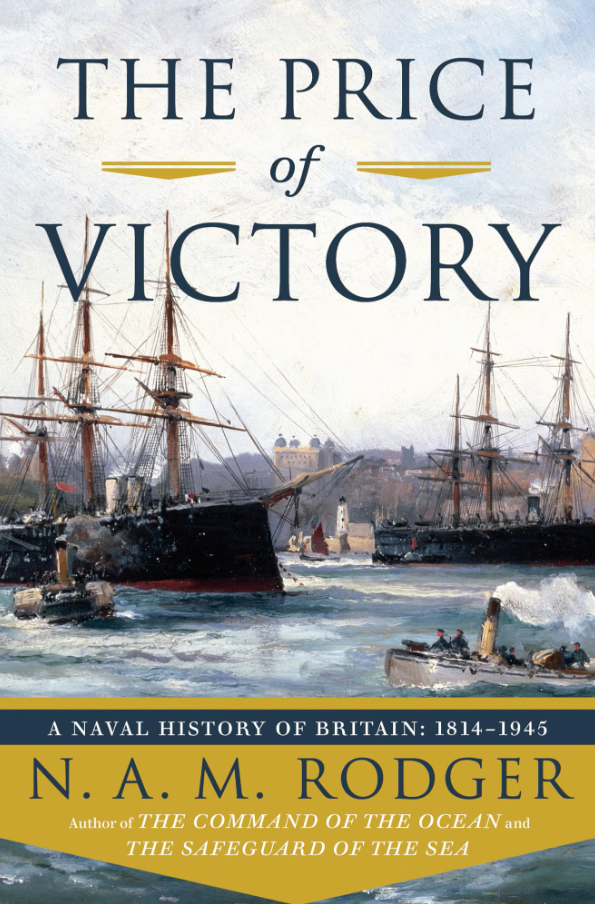
This October a major scholarly achievement was realised with the publication of The Price of Victory, the third and final instalment of N.A.M. Rodger’s great trilogy on the naval history of Britain from 660 AD to 1945. It has been an odyssey, albeit one that to complete took more than three times longer than Homer’s hero took to journey home.
The first volume, Safeguard of the Sea, was published back in 1997, some six years after Rodger had left his job as Assistant Keeper of the Public Records at the then Public Records Office to join the National Maritime Museum. Having moved to Exeter University, he completed the second volume, Command of the Ocean, covering the period from 1649 to 1815, in 2004.
Mindful of the fates of others who have attempted grand, multi-volume naval histories of Britain, Nicholas Rodger, now aged 74, was known to quip that one of his key aims was to become the first historian to live to see it completed. What he describes as “an exciting episode of brain surgery” delayed the completion of the final volume for several years, and left achieving this a closer-run thing than was — one suspects — entirely comfortable.
To the immense relief of all, Rodger recovered to complete his great work, and it has, emphatically, been well worth the wait. The Price of Victory is, like its predecessors, a most substantial work in both physical and scholarly senses.
At the outset of his task, Rodger aimed to create “not a self-contained ‘company history’ of the Royal Navy, but a survey of the contribution which naval warfare with all its associated activities has made to national history”. In doing so, he sought to link naval warfare “to political, social, economic, diplomatic, administrative, agricultural, medical, religious and other histories which will never be complete until the naval component of them is understood”.
He has succeeded handsomely, firmly entwining naval and naval-related matters into the core fabric of the history of the British Isles. The Price of Victory is a worthy conclusion to an epic series that will both stand in its own right and, as he hopes, serve as a baseline for future scholarly endeavours.
The vast, polyglot erudition underpinning Rodger’s prose wears no disguise. Yet, for all its great length and the density of knowledge each page imparts, The Price of Victory is, like its two preceding volumes, a lively read, leavened with the author’s dry wit.
Comments Off on The Price of Victory by N.A.M. Rodger
Winners and losers from free trade
At the Foundation for Economic Education, Patrick Carroll responds to a recent Robert Reich rant about the winners and losers under free trade:
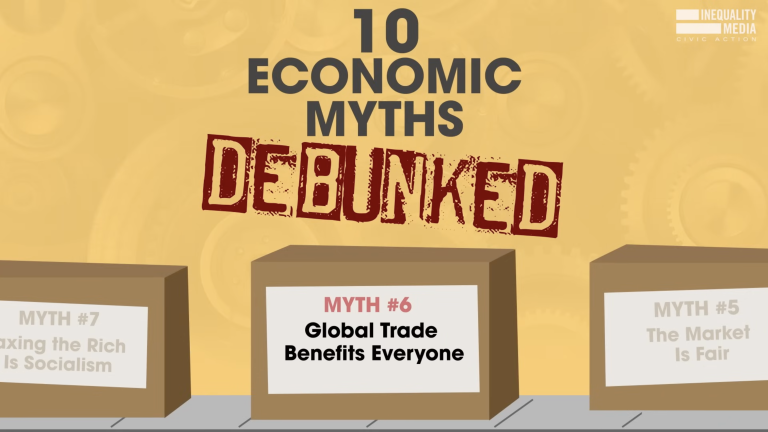
Image Credit: YouTube screenshot – Robert Reich
Myth #6 on Robert Reich’s list of economic myths is called “Global Trade Benefits Everyone”.
“Have you heard this lie?” Reich opens. “‘Global trade is good for everyone.'” His pants then light on fire. “Ahh!” he screams. “That’s bunk!”
Watching that opening sequence was an immediate déjà vu moment for me, because I had recently come across an article making the same claim as Reich. The article argued that free market economists are simply wrong to claim that “everyone gains” from free trade, because clearly there are some losers.
The ironic part is, that article was written by none other than Bryan Caplan, one of the world’s leading free market economists.
“What makes me so sure that ‘Everyone gains from X’ is invariably a blatant falsehood? Because every change causes price movements, which are automatically bad for someone or other,” Caplan writes. “The Industrial Revolution was great overall, but hurt traditional craftsmen. The Internet is great overall, but hurt travel agents. Congestion pricing is great overall, but bad for cheapskates with high traffic tolerance. Free trade is great overall, but not for workers and investors in industries that can’t survive at world prices.”
[…]
This would be a rather short article if Reich were simply making the same point as Caplan. “I agree, but Caplan said it better,” would probably be my thesis. But alas, Reich goes in a rather different direction than Caplan does, and that’s where some more rigorous analysis is needed. Here’s how he presents his argument:
Many economists believe in the doctrine of comparative advantage, which posits that trade is good for all nations when each nation specializes in what it does best. But what about costs to workers and the environment? What if a country’s comparative advantage comes from people working under dangerous or exploitative conditions, or from preventing them from forming labor unions, or allowing employers to hire young children? Or from polluting the atmosphere or the ocean, or destroying rainforests and polluting groundwater?
Reich makes a fair point that global trade isn’t all sunshine and roses. Working conditions in some places are atrocious, and environmental damage is also a very real problem. But the fact that working and environmental conditions are far from ideal in many parts of the world does not mean that restricting trade will necessarily make things better. In fact, it’s quite likely that less trade would make things worse, because it would cut off the global poor from opportunities for production and economic growth.
Reich highlights the costs of trade, but there are also immense benefits that the global poor reap from the arrangement. If these benefits outweigh the costs — as they likely do in most cases — then who’s really the advocate of the downtrodden: the ones cheering on mutually beneficial trade, or the ones trying to stop it because they can only see the downsides?
To be fair, Reich doesn’t come out and advocate for cutting off trade. But this raises the question: what exactly is he advocating for? Anyone can point out problems, but the real question is: what solution are you proposing? Maybe he’ll tell us in the next section:
My old boss Bill Clinton called globalization “the economic equivalent of a force of nature, like wind or water”. But globalization is not a force of nature. Global trade is structured by rules negotiated between nations about which assets will be protected and which will not. These rules determine who benefits and who is harmed by trade. Over recent decades, trade deals such as the North American Free Trade Act (NAFTA) and agreements under the World Trade Organization (WTO) have protected the assets of US corporations, including intellectual property.
Reich goes on to list a few ways that these rules have helped large corporations, such as oil companies, financial institutions, Big Pharma, and Big Ag.
Watching this part of the video ushered in a second instance of déjà vu. I remembered reading somewhere, just recently, that NAFTA was rotten to the core, just like Reich was saying.
Yet again, it was a staunch free market economist making this point — Murray Rothbard, in a number of incisive articles that were part of his 1995 anthology Making Economic Sense. The problem, said Rothbard, is that NAFTA was really the opposite of free trade.
Comments Off on Winners and losers from free trade
The academic battle over the legacy of the British Empire
In the Washington Examiner, Yuan Yi Zhu reviews The Truth About Empire: Real histories of British Colonialism edited by Alan Lester:
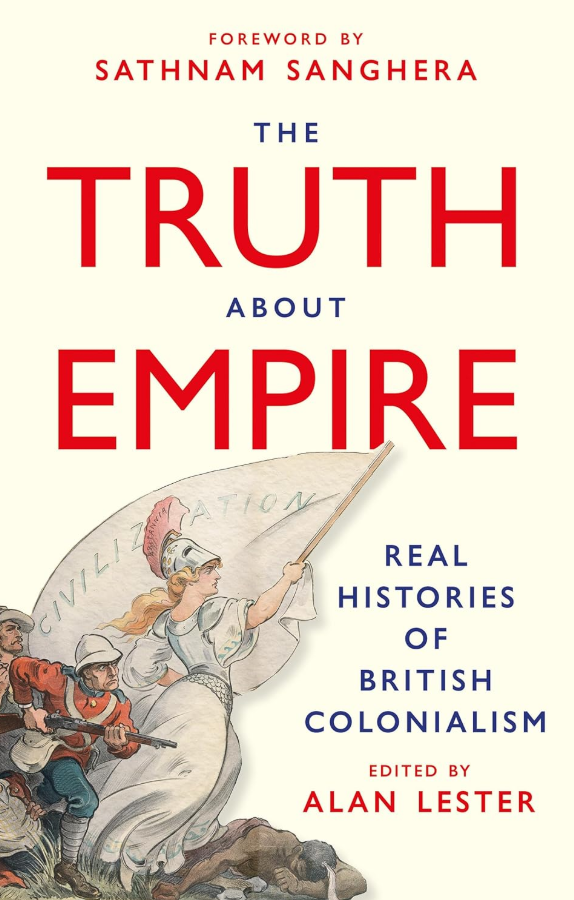
… the story fitted awkwardly with the new dominant historical narrative in Britain, according to which the British Empire was an unequivocally evil institution whose lingering miasma still corrupts not only its former territories but also modern-day Britain.
When Kipling lamented, “What do they know of England, who only England know?” he was not being elegiac as much as describing a statistical fact. Contrary to modern caricatures, apart from episodic busts of enthusiasm, Britons were never very interested in their empire. At its Victorian peak, the great public controversies were more likely to be liturgical than imperial. In 1948, 51% of the British public could not name a single British colony; three years later, the figure had risen to 59%. Admittedly, this was after Indian independence, but it should not have been that hard. Proponents of the “imperial miasma” theory are right in saying that British people are woefully ignorant about their imperial past; but that was the case even when much of the world was colored red.
The Truth About Empire: Real Histories of British Colonialism is a collection of essays edited by Alan Lester, an academic at the University of Sussex who has been at the forefront of the cultural conflict over British imperialism on the “miasma” side — though, like all combatants, he denies being a participant. Indeed, one of the book’s declared aims is to show that its contributors are not engaged in cultural warring.
Their nemesis, whose name appears 376 times in this book (more often than the word “Britain”) is Nigel Biggar, a retired theologian and priest at the University of Oxford. In 2017, Biggar began a project to study the ethics of empire alongside John Darwin, a distinguished imperial historian. The now-familiar academic denunciations then came along, and Darwin, on the cusp of a quiet retirement, withdrew from the project.
Lester was not part of the initial assault on Biggar but has since then emerged as his most voluble critic. He disclaims any political aims, protesting that he and his colleagues are engaged in a purely scholarly enterprise, based on facts and the study of the evidence.
Yet some of Lester’s public interventions — he recently described a poll showing that British people are less proud of their history than before as an “encouraging sign” — are hard to square with this denial. Biggar, by contrast, is refreshingly honest that his aims are both intellectual and political. I must add that both men are serious scholars, which is perhaps why neither has been able to decisively bloody the other in their jousts.
[…]
“What about slavery?” asks Dubow’s Cambridge colleague Bronwen Everill. Unfortunately, her four pages, which read like a last-minute student essay, do not enlighten us. The most she can manage is to point to an 18th-century African monarch abolishing the slave trade as evidence that the British do not deserve any plaudits for their abolitionist efforts across the world, whose cost has been estimated at 1.8% of its gross domestic product over a period of 60 years.
Meanwhile, Abd al Qadir Kane, Everill’s abolitionist monarch, only objected to the enslavement of Muslims but not to slavery generally, his progressive reputation resting mainly on the misunderstandings of Thomas Clarkson, an overenthusiastic English abolitionist. (Either cleverly or lazily, Everill quotes Clarkson’s misleading account, thus avoiding the need to engage with the historiography on Islamic slavery in Africa.)
Everill’s central argument is that abolitionism allowed Britain to rove the world as a moral policeman and to overthrow rulers who refused to abolish slavery. It is never clear, however, why this was morally bad. If anything, Britain did not go far enough: Well into the 1960s, British representatives still manumitted slaves on an ad hoc basis in its Gulf protectorates, when the moral thing would have been to force their rulers to abolish slavery, at gunpoint if necessary.
Comments Off on The academic battle over the legacy of the British Empire
Whippet – Fast and Furious 1918 | Tank Chats Reloaded
The Tank Museum
Published Aug 16, 2024Was the British Medium Mk A Whippet the world’s first proper tank?
Able to do 8mph, but incredibly difficult to drive, Whippet was far faster than the British heavy tanks of WW1. Using their speed, Whippets were able to operate behind the enemy front line to destroy enemy formations and create chaos. At a stroke, the tank was transformed from what was effectively a siege engine to a fast-moving weapon of attack and exploitation.
At Amiens in August 1918, a Whippet called Musical Box went on a nine-hour rampage in the German Army’s rearward area destroying an infantry battalion, a divisional supply column and an artillery battery, an unheard of feat.
In this film, we look at the Tank Museum’s rare surviving Whippet, what she was like to crew and fight, tell the story of Musical Box‘s rampage and examine the unique achievement of the Whippet on the WW1 battlefield.
00:00 | Intro
02:08 | Breaking the Stalemate
03:45 | A New Design
08:29 | Does It Work?
09:36 | The Tank Corps’ Surprise
11:41 | Proving Its Worth
16:25 | Armoured Warfare RevolutionisedThis video features archive footage courtesy of British Pathé.
Comments Off on Whippet – Fast and Furious 1918 | Tank Chats Reloaded
QotD: Movie and video game portrayals of generalship in pre-modern armies
This is also true, of course, in films. Our friend Darius III from Alexander (2004) silently waves his hand to mean “archers shoot!” and also “chariots, charge!” and then also “everyone else, charge!” Keeping in mind what we saw about the observation abilities of a general on horseback, you can well imagine how able Darius’ soldiers will have been to see his hand gestures while they were on foot from a mile or so away. Yet his army responds flawlessly to his silent arm-gestures. Likewise the flag-signalling in Braveheart‘s (1995) rendition of the Battle of Falkirk: a small banner, raised in the rear is used to signal to soldiers who are looking forward at the enemy, combined with a fellow shouting “advance”. One is left to assume that these generals control their armies in truth through telepathy.
There is also never any confusion about these orders. No one misinterprets the flag or hears the wrong orders. Your unit commanders in Total War never ignore or disobey you; sure the units themselves can rout, but you never have a unit in good order simply ignore your orders – a thing which happened fairly regularly in actual battles! Instead, units are unfailingly obedient right up until the moment they break entirely. You can order untrained, unarmored and barely armed pitchfork peasant levies to charge into contact with well-ordered plate-clad knights and they will do it.
The result is that battleplans in modern strategy games are often impressive intricate, involving the player giving lots of small, detailed orders (sometimes called “micro”, short for “micromanagement”) to individual units. It is not uncommon in a Total War battle for a player to manually coordinate “cycle-charges” (having a cavalry unit charge and retreat and then charge the same unit again to abuse the charge-bonus mechanics) while also ordering their archers to focus fire on individual enemy units while simultaneously moving up their own infantry reserves in multiple distinct maneuvering units to pin dangerous enemy units while also coordinating the targeting of their field artillery. Such attacks in the hands of a skilled player can be flawlessly coordinated because in practice the player isn’t coordinating with anyone but themselves.
Bret Devereaux, “Collections: Total Generalship: Commanding Pre-Modern Armies, Part II: Commands”, A Collection of Unmitigated Pedantry, 2022-06-03.
Comments Off on QotD: Movie and video game portrayals of generalship in pre-modern armies
December 15, 2024
The fall of the house of Assad
In the New English Review, Theodore Dalrymple considers the fall of Syria’s dictator as the al-Assad family is finally toppled from power:
When I saw video clips of the joyful toppling of statues of Bashar al-Assad, as well as the tearing from walls of his ubiquitous portrait, I wondered what it must be like to be a dictator and see images of yourself everywhere (not that I have any ambitions myself in that direction).
Do you come to imagine, for example, that they are a manifestation of genuine popular affection for yourself, or are you like the Nicaraguan dictator Anastasio Somoza, of the poem by Ernesto Cardenal “Somoza Unveils a Statue of Somoza in the Somoza Stadium” (the fact that Cardenal, a Nicaraguan priest, was a commie doesn’t mean that he wasn’t a good poet).
The Somoza of the poem is perfectly clear-sighted. He knows that people didn’t erect the statue spontaneously, out of love for him, because he knows that he himself ordered it to be erected. Nor does he think that it will be a perpetual monument to himself because he knows also that the people will tear it down as soon as they can. No, he had it erected because he knew that the people would hate it, in other words that it would humiliate them, and a humiliated people is easy to cow into submission, at least until — to use a word of slightly different zoological connotation — the worm turns. (A note to pedants before they write in: I do not think that the verb to cow has any etymological link with the female herbivore known as the cow.)
It seems to me, however, that Cardenal may have simplified a little. Such is the complexity and potential dishonesty of the human mind that a dictator would be perfectly capable of imagining that a statue of himself is a manifestation of people’s affection for him and that there are people plotting to bring down both the statue and him because they hate him. This is not totally irrational or impossible. After all, as Americans know, even in a free democracy some people love the leader and some people hate him (usually more of the latter after he has been in power for some time).
Assad junior, it seems to me, is a living refutation of Solzhenitsyn’s famous remark that Macbeth was capable of killing only a handful of people because he was motivated by no ideology, and it requires an ideology to bring about hecatombs of the Nazis or Communists. Assad junior had a self-justification for his rule, no doubt, as every ruler and dictator has and must have, but he did not really possess a full-blown ideology in Solzhenitsyn’s sense. His trajectory is worth recalling.
The son of a monstrous dictator, he seems at first to have had no inclinations in that direction himself. Among other things, he didn’t seem to have the physical attributes of a dictator, but rather of someone pliant and weak, more herbivore than carnivore, more giraffe rather lion (though giraffes can kick a lion to death). And it spoke rather well of him that he should qualify as a doctor, apparently quite genuinely so, and wish to become an ophthalmologist, to which end he studied in London, where his conduct was not that of a spoilt brat but by all accounts rather modest — laudably so, in the circumstances.

Comments Off on The fall of the house of Assad
Nazi Tanks Advance on Kursk: Prokhorovka Part 1
World War Two
Published 14 Dec 2024German tanks advance on Kursk, smashing through Soviet defences and setting the stage for one of history’s most legendary tank battles — The Battle of Prokhorovka. In this six part miniseries we will cover the fierce fighting, the strategies, and the men and machines that take part in this battle.
(more…)
Comments Off on Nazi Tanks Advance on Kursk: Prokhorovka Part 1


