Quotulatiousness

January 16, 2025

For some unknowable reason, high-tax states keep losing population to low-tax states

Filed under: Business, Economics, Government, USA — Tags: , , , , , , — Nicholas @ 03:00

It sure is a mystery:

“U-Haul Rental Truck (44601958941)” by HireAHelper is licensed under CC BY 2.0 .

This probably won’t come as a surprise to many readers, but when people move, they tend to prefer migrating to places where, among other considerations, the taxes are lower than in their old digs. Data from the U.S. government as well as from moving companies reveals that — as we’ve seen in the past — high-tax states are losing residents to states that take a smaller bite out of people’s wallets.

“Americans are continuing to leave high-tax, high-cost-of-living states in favor of lower-tax, lower-cost alternatives. Of the 26 states whose overall state and local tax burdens per capita were below the national average in 2022 (the most recent year of data available), 18 experienced net inbound interstate migration in FY 2024,” Katherine Loughead wrote last week for the Tax Foundation. “Meanwhile, of the 25 states and DC with tax burdens per capita at or above the national average, 17 of those jurisdictions experienced net outbound domestic migration.”

Loughead crunched numbers from both the U.S. Census Bureau as well as U-Haul and United Van Lines. The government data tracks population gains and losses across the country while numbers from the private companies is helpful for comparing flows in and out of various states. The results are revelatory, though not unexpected.

“For the second year in a row, South Carolina saw the greatest population growth attributable to net inbound domestic migration” according to Census Bureau figures. The Tax Foundation separately ranks South Carolina at number 9 for tax burden, with 1 being the lowest tax burden among states and 50 the highest. Rounding out the top-10 population-gainers were Idaho (ranked 29), Delaware (42), North Carolina (23), Tennessee (3), Nevada (18), Alabama (20), Montana (27), Arizona (15), and Arkansas (26).

According to census data, Hawaii lost the biggest share of its population to other states; it’s ranked at 48 for the third-highest tax burden in the country. The rest of the top 10 states for population outflow were New York (50), California (46), Alaska (1), Illinois (44), Massachusetts (37), Louisiana (12), New Jersey (45), Maryland (35), and Mississippi (21).

Numbers released this month by U-Haul and United Van Lines showed migration patterns closely, but not precisely, tracking the Census Bureau’s information. Loughead attributes the disparities, at least in part, to the companies’ varying geographic coverage and market share.

Augustus and the Roman Army – the first emperor and the creation of the professional army

Filed under: Europe, History, Military — Tags: , , , , , — Nicholas @ 02:00

Adrian Goldsworthy. Historian and Novelist
Published 7 Aug 2024

We take a look at Caesar Augustus, the first emperor (or princeps) of Rome and the great nephew of Julius Caesar. Ancient sources — and Shakespeare and Hollywood — depict him as politician and no soldier in contrast to Mark Antony. How true is this? More importantly, how did the man who created the imperial system and re-shaped society change the Roman army?

This video is based on a talk I gave in 2014 at the Roman Legionary Museum in Caerleon — a museum and adjacent sites, well worth a visit for anyone in or near South Wales.

QotD: “At promise” youth

Filed under: Bureaucracy, Education, Quotations, USA — Tags: , , , — Nicholas @ 01:00

A new law in California bans the use, in official documents, of the term “at risk” to describe youth identified by social workers, teachers, or the courts as likely to drop out of school, join a gang, or go to jail. Los Angeles assemblyman Reginald B. Jones-Sawyer, who sponsored the legislation, explained that “words matter”. By designating children as “at risk”, he says, “we automatically put them in the school-to-prison pipeline. Many of them, when labeled that, are not able to exceed above that.”

The idea that the term “at risk” assigns outcomes, rather than describes unfortunate possibilities, grants social workers deterministic authority most would be surprised to learn they possess. Contrary to Jones-Sawyer’s characterization of “at risk” as consigning kids to roles as outcasts or losers, the term originated in the 1980s as a less harsh and stigmatizing substitute for “juvenile delinquent”, to describe vulnerable children who seemed to be on the wrong path. The idea of young people at “risk” of social failure buttressed the idea that government services and support could ameliorate or hedge these risks.

Instead of calling vulnerable kids “at risk”, says Jones-Sawyer, “we’re going to call them ‘at-promise’ because they’re the promise of the future”. The replacement term — the only expression now legally permitted in California education and penal codes — has no independent meaning in English. Usually we call people about whom we’re hopeful “promising”. The language of the statute is contradictory and garbled, too. “For purposes of this article, ‘at-promise pupil’ means a pupil enrolled in high school who is at risk of dropping out of school, as indicated by at least three of the following criteria: Past record of irregular attendance … Past record of underachievement … Past record of low motivation or a disinterest in the regular school program.” In other words, “at-promise” kids are underachievers with little interest in school, who are “at risk of dropping out”. Without casting these kids as lost causes, in what sense are they “at promise”, and to what extent does designating them as “at risk” make them so?

This abuse of language is Orwellian in the truest sense, in that it seeks to alter words in order to bring about change that lies beyond the scope of nomenclature. Jones-Sawyer says that the term “at risk” is what places youth in the “school-to-prison pipeline”, as if deviance from norms and failure to thrive in school are contingent on social-service terminology. The logic is backward and obviously naive: if all it took to reform society were new names for things, then we would all be living in utopia.

Seth Barron, “Orwellian Word Games”, City Journal, 2020-02-19.

January 15, 2025

Is there anything climate change can’t do?

Filed under: Government, Media, Politics, USA — Tags: , , , , , — Nicholas @ 05:00

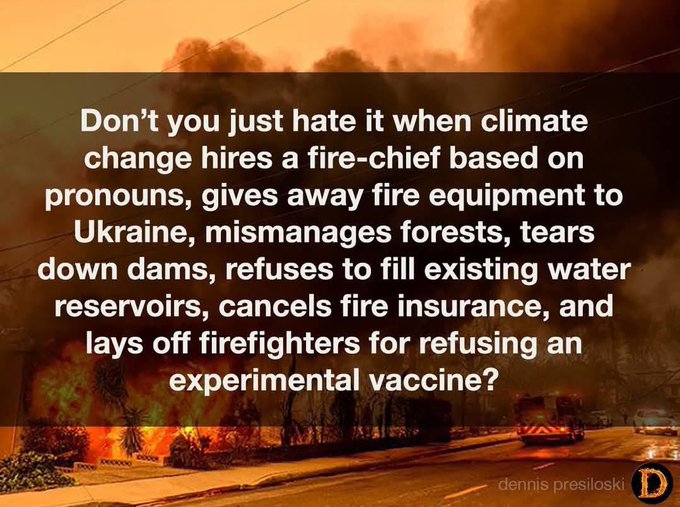
Seen on social media earlier this week:

Confirming this, Chris Bray talks about current reporting on the wildfires in and around Los Angeles:

In his much-discussed piece on the Los Angeles fires at the Free Press, Leighton Woodhouse looks to Mike Davis for a narrative foundation. In his book Ecology of Fear, Woodhouse notes, Davis “argued that the area between the beach and the Santa Monica Mountains simply never should have been developed. No matter what measures we take to prevent it, those hills are going to burn, and the houses we erect upon them are only so much kindling.” Malibu and the Palisades, the land of hard living. That’s why so many rich and famous people lived there: because it was so inherently miserable and dangerous.

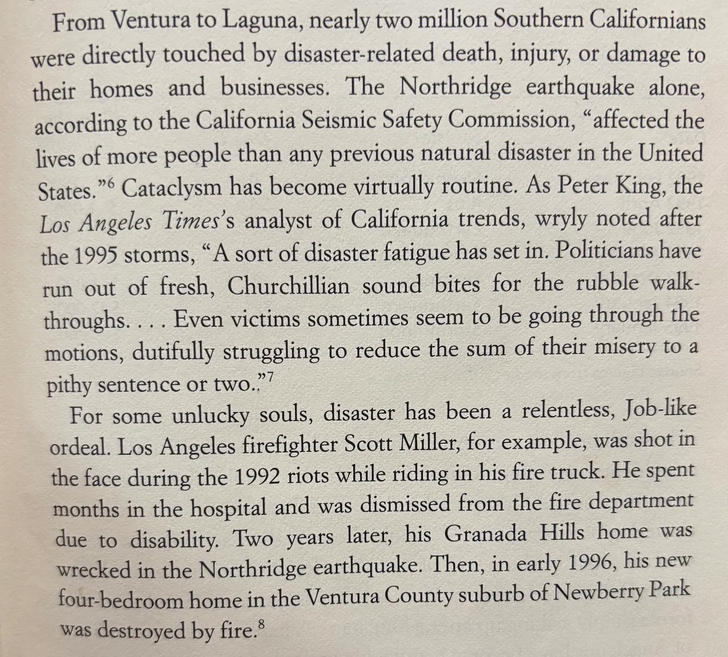
Mike Davis was full of shit for thirty years — he died in 2022 — and I’ve been rolling my eyes at him throughout. He described Los Angeles as an “apocalypse theme park”, a place of ruin and pain, populated by hardened survivors who, “dutifully struggling”, stagger on through the “Job-like ordeal” of clinging to a brutal landscape.

Also, Sierra Madre has bears. The Los Angeles suburbs are a place of horror and agony, because they back into the mountains, where blood-clawed wild animals prowl and stalk and slaughter. Places where life is especially grim and sanguinary, pgs. 240-41: Bradbury, La Crescenta, Glendora, the areas around the hellscape of Santa Barbara. A poodle was eaten by a mountain lion in Bradbury once, as neighbors gaped in open-jawed terror, YET STILL DO FOOLS ENDURE THE HORROR OF LIVING IN SUCH A PLACE.

Current real estate listings in Bradbury, a gated hillside community incorporated as an independent city in the San Gabriel Valley with a population of about 900 people:

How then would ye endure such horror, oh pilgrim, to live thus amid such blood and death? How bearest thou brutal existence upon this land?

Famously, in 1999, the Los Angeles Times, which used to be a newspaper, ran a long story examining Mike Davis and his vision of Southern California. It’s full of sentences like this:

  • Los Angeles’ most provocative social critic has stretched, bent and broken more than a few facts in “Ecology of Fear,” his latest, darkly themed work on the urban area he claims to love.
  • … more than a third of the time there were factual problems with his work.
  • Davis concedes the error.
  • Davis does not say where he got this piece of information.
  • “I honestly don’t know what I’m referring to,” Davis said.
  • Some of Davis’ mistakes involve mergers of fact and fiction, including making up a quote.
  • Davis attributes the false quote to a mix-up.
  • Then he takes readers on a partial flight of fantasy …
  • An examination of the Malibu Times article shows that Davis made up the parts about the jewels, the hair color, the kayakers’ occupations, the evidence of their callous classism and the ethnicity of their maids.
  • Davis is mischievously unrepentant.
  • Davis also merges fact and literary fiction, without acknowledgment, while arguing that Pomona, like other older, outer suburbs, is dying.

And so on.

The Times concluded that Davis could be read as “a polemicist, who makes cogent, incisive arguments on big themes”, but not as “a historian who is expected to be reliable, even on details”.

The Korean War 030 – Revived North Korean Army Strikes Wonju – January 14, 1951

Filed under: Asia, China, History, Military, USA — Tags: , , , , , — Nicholas @ 04:00

The Korean War by Indy Neidell
Published 14 Jan 2025

UN troops around Wonju get a gentle reminder that they’re not only fighting the Chinese. The North Koreans are back, and hammer the weak point in the UN lines all week. With UN forces still organizing a defence, and lots of holes in their formation, will they be able to hold on? Or will failure here undo all of Eighth Army Commander Matt Ridgway’s good work thus far?

Chapters
00:00 Intro
00:45 Recap
01:06 Disposition
02:00 The KPA Attack
05:38 Cracking an Almond
07:55 The New Eighth Army
10:50 At the UN
12:41 Summary
12:57 Conclusion
(more…)

German democracy continues to reel under continued pressure from Elon Musk

Filed under: Germany, Media, Politics — Tags: , , , — Nicholas @ 03:00

Wasn’t it just the other day that the progressive legacy media in the US were accusing Elon Musk of being Hitler? Apparently his day job(s) aren’t keeping him busy enough because the German progressive legacy media are singing the same song:

The Christmas holidays are over, the politicians and the media have awakened from their winter sleep, and Germany finds itself in the thick of an election campaign. Almost every day there is a new poll, and in almost every new poll, Alternative für Deutschland gets stronger. An Infratest dimap poll published on 9 January (survey conducted from 6–8 January) pegs them at 20%; a Forschungsgruppe Wahlen poll published on 10 January (survey conducted from 7–9 January) has them at 21%; and the latest INSA poll, published today (survey conducted from 6–10 January) places them at 22%:

For the centre-right CDU and CSU, the story is the opposite – one of a steady decline from the low- to mid-30s in December, to around 30% or just below in the latest surveys. The right-leaning vote overall is holding steady, at around 51%. Support is merely wandering from the acceptable Union parties behind the cordon sanitaire. Every day the establishment loses a few more seats; they vanish into the abyss of the Brandmauer, and the hurdles to the lusted-after CDU/CSU-Green coalition grow ever higher.

Some of this is surely down to the Musk Effect. Musk’s endorsement of the AfD and his conversation with Alice Weidel on Thursday (however much a disappointment I found it be) has surely normalised the party for a small but significant number of German voters. The media vilification of the American tycoon is as unbalanced and hysterical as it is unconvincing …

The latest cover of Stern magazine: “Attack on our election: Fake news, cyber warfare and rabble-rousing – this is how Elon Musk and Vladimir Putin are manipulating the German election.”

… and it comes all too late. Until December, Musk enjoyed mainstream credibility in Germany; our rulers eagerly celebrated his Gigafactory in Berlin-Brandenburg as a sign that all was not so terrible for German industry after all. They made Musk into a symbol for the carbon-free, electrical-vehicle future that awaits us all. It is hard to turn around in an instant and reconstruct the man as literally Hitler.

Desert Storm: The Gulf War 1990-1991

Filed under: Britain, France, History, Middle East, Military, USA — Tags: , , , , — Nicholas @ 02:00

Real Time History
Published 6 Sept 2024

When Saddam Hussein invaded Kuwait in the summer of 1990, he didn’t anticipate a massive international backslash and unanimous Security Council response. Soon a broad military Coalition under leadership of the United States assembled and kicked the Iraqi Army out of Kuwait. In the aftermath several Iraqi groups rose up against Saddam but the Coalition didn’t support a regime change.

CHAPTERS:
00:00 Intro
00:29 Saddam Hussein Victorious (but Broke)
03:49 Iraqi Invasion of Kuwait
06:02 The Coalition Against Iraq Forms
08:37 Operation Desert Shield
10:55 Operation Desert Storm
20:26 Iraqi Highway of Death
21:39 Iraqi Uprisings
(more…)

QotD: Innovations hiding in plain sight

Filed under: Economics, Quotations, Technology — Tags: , , , — Nicholas @ 01:00

This sentence, from the Wall Street Journal, strikes me as being profoundly wrong:

    Today, another half-century later, a coast-to-coast flight still takes you as long as it took your father in the 1970s. And with the major exception of computers, nothing in your luggage is likely to be much more useful or valuable than dad’s equivalent.

It may well be the case that aeroplanes fly at the same speeds that they did in the 1970s. I don’t know for sure, but my understanding is that supersonic speeds were banned due to noise factors. No doubt someone in the thread will clear that up. Let’s also concede the point about “major exception of computers” – like wow, let’s ignore the single greatest area of human innovation in the past 20 years.

Okay – the material your luggage is made out of is very strong and very light weight compared to luggage in the 1970s. Your luggage will have wheels on it now. Luggage with wheels would have been a luxury item in the 1970s. The entertainment on the flight will be much better than what it was in the 1970s. Remember the single movie in the cabin? That was a feature of flying until the late 1990s. I reckon the food the would be better too, today. Hard to believe, but yes.

Then what about the computers? Paper tickets? Movies on demand on your own device? Books loaded on your own device?

So while it may be true that the experience of flying is very similar – hurry up and wait, fly through the air, and arrive at a destination faster than all alternatives. But many, many aspects of the experience are very different and much improved. Cheaper too.

When thinking of innovation, it’s not just gadgets and new-fangled things that we should think about – it’s improved business models and improvements in pre-existing gadgets that we should think about too.

Sinclair Davidson, “Has innovation stalled?”, Catallaxy Files, 2019-12-14.

January 14, 2025

Andrew Sullivan on the “grooming gangs” scandal in Britain

Filed under: Britain, Government, Law, Media, Politics — Tags: , , , , , , — Nicholas @ 04:00

These rape gangs have been operating for more than a decade in English towns and cities yet the government does everything it possibly can to avoid taking action, for fear of being accused of racism (or perhaps fear of what they’d discover if they did properly investigate) and losing all those Muslim votes:

The first response of most human beings to news of irredeemably evil acts is to ask who committed them. And if the answer makes us deeply uncomfortable, we tend to move on pronto. You see this most obviously on social media with news of an atrocity. Was the shooter white, a Democrat, a Republican, Muslim, MAGA, woke, trans? And where did the victim fit into these categories?

Our priors instantly color our moral judgment, and even our sense of the seriousness of the offense. And the temptation simply to deny what seems to be in front of our nose can be overwhelming.

[…]

The more intense the horror, the more powerful the instinct to doubt when you first hear of it. The sex-abuse scandal in my own church first numbed and incapacitated me. It took some time for me to see the totality of what had happened, and how deeply it had destroyed Catholic moral authority. Again, when I first read about, say, the Catholic school for deaf children where a priest had picked his victims among those whose parents did not know sign language, the feeling of horror was almost too much to process at all. And as with the Bush administration’s torture policy, it took even more time to grasp how this moral rot had been enabled by the very top.

This is why, I think, the scandal of Britain’s Pakistani rape-gangs, and the institutional negligence toward tens of thousands of underage victims over several years, has had a second burst of life. A serious national inquiry on the scandal was conducted years ago (its recommendations not yet implemented). But several towns with the worst records were omitted from that inquiry; and the sheer scale and depravity of what happened has finally begun to sink in. The precipitant was Elon Musk pontificating about the scandal on X, as part of his campaign to bring down Keir Starmer.

The details are hard to absorb. Think of the hideous abuse suffered by that extraordinary French woman, Gisèle Pelicot, sedated and raped by dozens of French men, organized by her husband. Now think of that kind of organized gang-bang — but make it close to ubiquitous in some towns and the victims under-age girls: raped, brutalized, mutilated, beaten, their lives destroyed. Yes, it was that bad. Tens of thousands of rape victims across the country. This is how one British judge addressed some culprits at sentencing:

    You coerced her into providing sex to vast numbers of strangers. Up to four or five men would be invited to addresses so they could have sex with her … Threats were made to kill her … If she resisted, she would be coerced. Customers would become angry … If oral sex was required, her head would be pushed down, her hair pulled and she would be slapped. Strangers would burn her with cigarettes. A stranger almost throttled her. One deliberately scratched her vagina with his nails. One inserted a hairbrush into her vagina.

The victim was just 13 years old. And she wasn’t unconscious. In just one town, a “conservative estimate is that approximately 1,400 children were sexually exploited” between 1997 and 2013. And in communities dominated by men of Pakistani origin, largely from the Mirpuri region of Kashmir, who held huge sway over the police and local community — just like the Catholic Church in Boston — cover-ups were routine.

Among the abuse concealed: gang-rapes of a single minor by 20 men; putting a pump into a girl’s anus so more men could penetrate her at once; and constant threats of murder of the girls or their families if anyone spoke up. In one case, a minor was arrested and charged with prostitution for having oral sex in a car with a john. When she attended her trial, she discovered that the magistrate in charge of her case was the man she’d fellated. No one knows the full number of minor girls affected, but it is in at least the tens of thousands, and possibly in the six figures.

Why was this allowed to go on for so long? For the same reason the Catholic Church covered up child rape for decades, and Dick Cheney covered up torture. Because the orthodoxies of Catholicism, of the American military, and, in this case, the multicultural experiment were respectively involved. These orthodoxies were sacred, their cultural power extreme. Catholic Boston, conservative America, and elite liberal Britain therefore defended their own orthodoxies for a very long time. And with every successful deflection of responsibility, the number of victims increased.

The truth damns the multicultural project in Britain. Rather than integrating these men of Pakistani heritage, insisting that they adopt the laws and mores of the native population, and treating them like everyone else, the UK elites celebrated cultural difference, enabled the siloing of these populations, bemoaned their own white working-class populations, and forbade any criticism of Islam. So if you called out this stuff, you were instantly called racist. After all, to accuse a non-white minority of raping white girls was a trope right out of white-supremacist fever dreams. And yes, it is a hideous racist trope — from the depths of the American South. But sometimes the trope is the truth.

In all the major cases, I’ve found no reported evidence of Pakistani or Muslim girls being groomed and raped — only poor, white natives. The justification among the rapists, moreover, was that these non-Muslims were sluts who were asking for it and beneath contempt. Racist insults were common as these girls were brutally abused. These were not just rapes, but hate crimes of a grisly sort.

The deliberate enshittification business plan of every “tech” company

Filed under: Business, Media, Technology — Tags: , , , — Nicholas @ 03:00

It may be hard to believe, but once upon a time we actually used to look forward to new technology releases and updated software. I know, I know, that’s asking you to believe fairy tales in our current “enshittification-as-a-service” technology dystopia. The Bone Writer — who worked in the same tech field that I once did — clearly understands why the promise of new technology has turned so negative:

Dead technology. Not because they’re broken, but because they’re no longer supported and THEREFORE no longer work.

I was straightening some stuff/junk up and came upon a pile of my e-Waste. It’s a damn shame that electronics devices are a planned obsolesce when they shouldn’t be. Especially the tablets and e-readers that would still work if the mothership, the corpo HQ, the evil Tech Bros, actually cared about their customers at all.

Do we need legislation that offers up some sort of tax write off incentive to get companies to support their shit for at least 10 years? I know what you’re saying … “That’s not a free market economy.” Yeah … well … The tech sector broke the free market economy a long time ago and now they actively hurt everyone with their greed and drive to force people into what comes next, every month to 3 months to 1 year.

That’s another reason prices never come down on tech stuff. They put out something new monthly to yearly, with just a small addition to the software or the design. Then they push it on people as if it is the BEST thing there ever was, creating FOMO. Then, some people will upgrade with every new device or software version sold.

[…]

Agile is the Devil’s Tool for Creating More Waste

Agile is the method that is used to push new software and updates out continuously. Get those updates out there and keep that device or software looking shiny but hold back the good stuff for the next big release. Even though the current iteration can likely support the next big release, we’re not going to do that. This way we can sell more shit to people and they will have FOMO so they will buy it up. Even though, the next big release isn’t all that great anyway… They consumer will eat it up.

Recycle It

The activist techies will just say, “Go ahead and recycle the old stuff.” As if it really gets recycled. More often than not (only 10% of recycled stuff actually gets recycled), it gets buried or sent to other countries to be disassembled and buried there, out of site. Both the tech sector and fashion industry are guilty of this. Meanwhile, YOU are told that if you recycle, you are doing your part to clean up the world, when you’re really just sending stuff elsewhere to pollute a third world country. Sleep easy though, it isn’t in YOUR backyard.

Baking the Original Brownie – The History of Brownies

Filed under: Books, Food, History, USA — Tags: , , , , — Nicholas @ 02:00

Tasting History with Max Miller
Published 3 Sept 2024

Fudgy brownies with walnuts

City/Region: Chicago, Illinois
Time Period: 1904

I love a gooey, chocolatey brownie, so I opted not to make the first recipe for something called brownies from 1896, because it had no chocolate and instead used molasses. Certainly not the brownies of my heart.

There are a couple of origin stories about brownies, but the one for Bangor brownies goes that a housewife forgot to put baking powder into her chocolate cake. While I question the validity of this story, we do see a lot of recipes for Bangor brownies during the early 20th century that closely resemble brownies today.

While these may not rival my favorite modern ones, they’re very good. They come out fudgy and dense without being heavy and have a surprising amount of chocolate flavor for the amount of chocolate in the recipe. No matter their origin, brownies haven’t changed all that much in the last 120 years.

    Bangor Brownies
    Cream one-half cup of butter, one cup sugar. Add two squares (one-quarter cake) Baker’s chocolate, melted, two eggs. One half-cup pastry flour and one-half cup chopped walnuts. Spread on baking tins and bake fifteen minutes in a moderate oven.

    Service Club Cook Book, 1904

(more…)

QotD: Ritual in medieval daily life

Filed under: Europe, History, Quotations, Religion — Tags: , , , , , , — Nicholas @ 01:00

I am not in fact claiming that medieval Catholicism was mere ritual, but let’s stipulate for the sake of argument that it was — that so long as you bought your indulgences and gave your mite to the Sacred Confraternity of the Holy Whatever and showed up and stayed awake every Sunday as the priest blathered incomprehensible Latin at you, your salvation was assured, no matter how big a reprobate you might be in your “private” life. Despite it all, there are two enormous advantages to this system:

First, n.b. that “private” is in quotation marks up there. Medieval men didn’t have private lives as we’d understand them. Indeed, I’ve heard it argued by cultural anthropology types that medieval men didn’t think of themselves as individuals at all, and while I’m in no position to judge all the evidence, it seems to accord with some of the most baffling-to-us aspects of medieval behavior. Consider a world in which a tag like “red-haired John” was sufficient to name a man for all practical purposes, and in which even literate men didn’t spell their own names the same way twice in the same letter. Perhaps this indicates a rock-solid sense of individuality, but I’d argue the opposite — it doesn’t matter what the marks on the paper are, or that there’s another guy named John in the same village with red hair. That person is so enmeshed in the life of his community — family, clan, parish, the Sacred Confraternity of the Holy Whatever — that “he” doesn’t really exist without them.

Should he find himself away from his village — maybe he’s the lone survivor of the Black Death — then he’d happily become someone completely different. The new community in which he found himself might start out as “a valley full of solitary cowboys”, as the old Stephen Leacock joke went — they were all lone survivors of the Plague — but pretty soon they’d enmesh themselves into a real community, and red-haired John would cease to be red-haired John. He’d probably literally forget it, because it doesn’t matter — now he’s “John the Blacksmith” or whatever. Since so many of our problems stem from aggressive, indeed overweening, assertions of individuality, a return to public ritual life would go a long way to fixing them.

The second huge advantage, tied to the first, is that community ritual life is objective. Maybe there was such a thing as “private life” in a medieval village, and maybe “red-haired John” really was a reprobate in his, but nonetheless, red-haired John performed all his communal functions — the ones that kept the community vital, and often quite literally alive — perfectly. You know exactly who is failing to hold up his end in a medieval village, and can censure him for it, objectively — either you’re at mass or you’re not; either you paid your tithe or you didn’t; and since the sacrament of “confession” took place in the open air — Cardinal Borromeo’s confessional box being an integral part of the Counter-Reformation — everyone knew how well you performed, or didn’t, in whatever “private” life you had.

Take all that away, and you’ve got process guys who feel it’s their sacred duty — as in, necessary for their own souls’ sake — to infer what’s going on in yours. Strip away the public ritual, and now you have to find some other way to make everyone’s private business public … I don’t think it’s unfair to say that Calvinism is really Karen-ism, and if it IS unfair, I don’t care, because fuck Calvin, the world would’ve been a much better place had he been strangled in his crib.

A man is only as good as the public performance of his public duties. And, crucially, he’s no worse than that, either. Since process guys will always pervert the process in the name of more efficiently reaching the outcome, process guys must always be kept on the shortest leash. Send them down to the countryside periodically to reconnect with the laboring masses …

Severian, “Faith vs. Works”, Rotten Chestnuts, 2021-09-07.

January 13, 2025

Muttering something about “manifest destiny” while glancing north

Filed under: Cancon, Media, Politics, USA — Tags: , , , , , — Nicholas @ 05:00

The Line‘s weekly dispatch is, as usual, mostly behind the paywall but the portion visible to cheapskates contains much of interest:

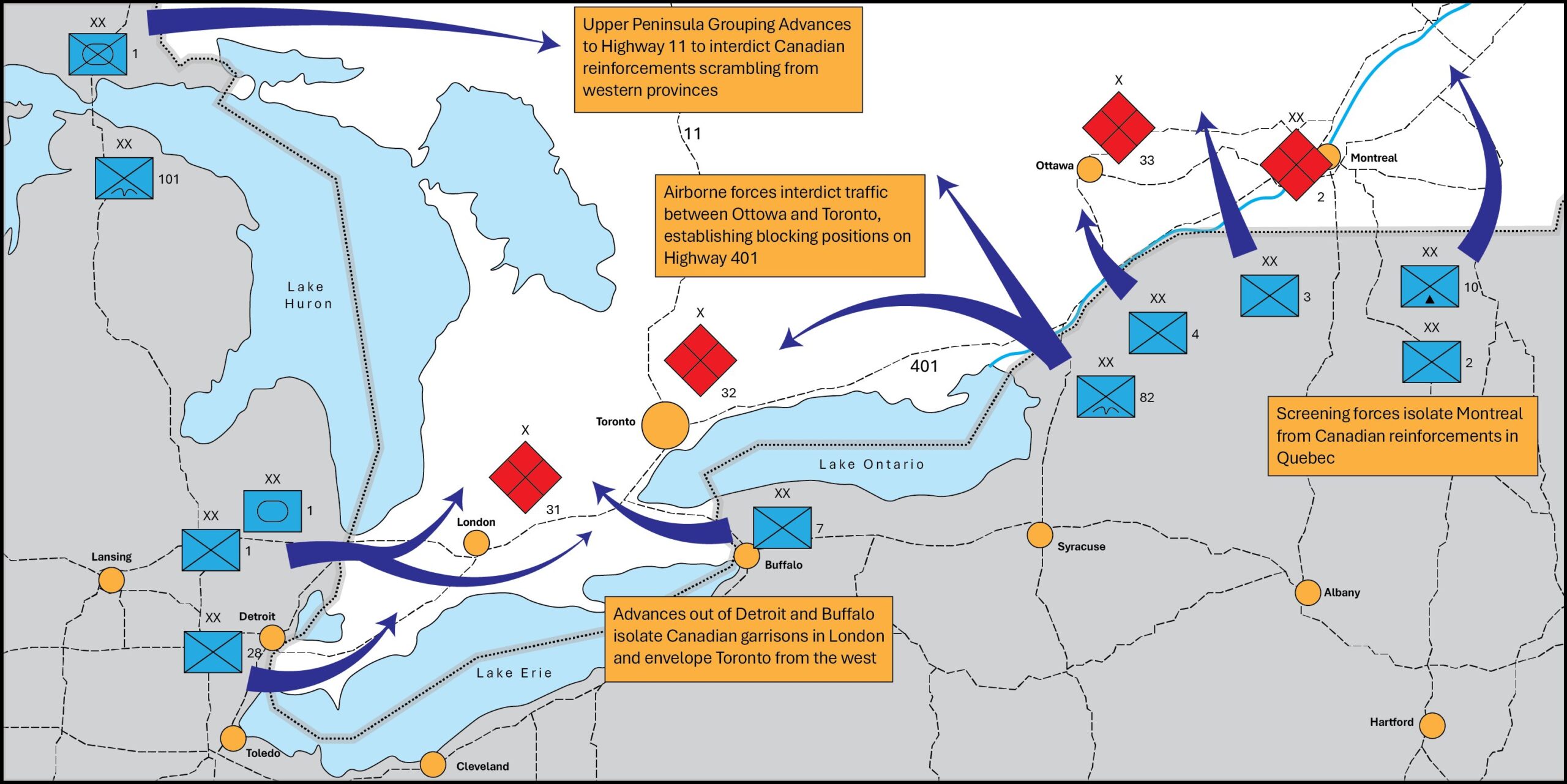
Manifest Destiny, 2025? Big Serge’s updated map for the old US War Plan Red for a military invasion of Canada.

It’s no coincidence that as Canada’s leadership devolved into its own navel, the very-soon-to-be-inaugurated Donald Trump escalated his provocations. This week, Trump threatened to use “economic force” to push Canada to bend the knee. Meanwhile, we cannot help but notice that the idea of a Canadian state is starting to gain significant traction in even moderate and mainstream American conservative circles. Meanwhile, we’ve got Alberta Premier Danielle Smith supping with Kevin O’Leary and Jordan Peterson down in Mar-a-Lago.

Tap tap. May we suggest that you peruse the safety cards tucked into the back of your seat, buckle up, and take note of your nearest emergency exits?

Whether we are talking about some kind of economic union, or a full-blown annexation, the fact that at least some in America are reviving the term “Manifest Destiny” is a possibility that we can no longer afford to dismiss as mere trolling. While we hope that the Trump administration is going to be so bogged down with other policy priorities that “Canada 51” is soon overshadowed, your Line editors have been game theorying out a host of possible scenarios and … none of them look great. If Trump et al get serious about this idea — and, again, we have no way to know if they will get serious about this idea — then we at The Line fear that Canada is in for some serious turmoil in the coming few months.

As I said in an email to Severian the other week, “… Canada will have very little ability to react to whatever Hitler, er, I mean “Trump” will do as soon as he’s inaugurated. It was clear before this that Trudeau cared very little about ordinary Canadians’ lives, but this really is dereliction of duty on a cosmic scale. If Trump does follow through with that huge tariff, the Canadian economy is likely to collapse, as we’re so deeply intertwined with the US on so many levels. Sadly, this might make it even more attractive to Trump, as it would absolutely encourager les autres on a global scale. If the BOM is willing to destroy the economy of his closest trading partner, what might he do to France? Or Germany? Or South Korea?” Back to the dispatch:

To explain our alarm, let’s first look at another news item to cross the desk. This week, Justin Trudeau travelled south to attend the funeral of Jimmy Carter, and stopped at the CNN studios for a quick interview with Jake Tapper on the way through.

On the whole, we think his interview was fine. Look, Trudeau’s been through a lot in the last few days, and considering the circumstances, it’s not reasonable to expect a breakthrough performance. So we’re being a bit unkind to nitpick, but something he said during that interview deserves scrutiny.

Justin Trudeau got far too comfortable with being treated as a progressive superstar, not only among the sycophants with CBC nametags but even on the international stage … perhaps especially on the international stage. Trudeau was always inclined to the performative in everything he did, and he might well only feel fully alive when cameras are rolling. The evidence certainly seems to point in that direction.

The “most prolific Canadian actor” meme was mildly amusing during Trudeau’s first term in office, as he went out of his way to put on elaborate costumes and to perform for the audience. This sort of thing was understandable if not particularly welcome to those who wanted Canada to be taken seriously by our allies and trading partners. It was clichéd to joke about what novelty socks Trudeau was wearing at any given international event … because it was his trademark. As was the clearly diminished respect he got as his time in office went on.

When asked about Trump’s provocations, Trudeau affirmed Canadians’ pride in their own sovereignty by noting — half jokingly, we presume — that we fundamentally define ourselves as “not American”.

Firstly, this is not a particularly diplomatic jibe to be launched at actual ordinary Americans; it made us wince to consider how it must have landed to CNN’s ordinary watching audience.

Secondly, if the only way in which Canadians can define themselves nowadays is “not-American”, Jeez, that’s an extraordinarily thin peg upon which to hang a hat.

This stuff matters.

It is to wince. However, even that pathetic response was better than launching into yet another diatribe about Trudeau’s firm conviction that Canadians are all genocidal white supremacist morons, I guess.

The ability of a population to withstand neighbourly aggression — “economic force”, if you will — depends on two things. The first is internal social cohesion and identity. The second is what the aggressor is willing to do or offer in order to secure capitulation.

In this case, the second part of that equation is outside our control. So we look to the first: does Canada have a strong sense of self right now? Do its leaders command the moral authority necessary to create the social cohesion required to withstand a period of sustained material sacrifice?

If we are “not Americans”, it rather asks the question why aren’t we Americans? And, more crucially, what are we actually willing to give up in order to preserve that independence?

A people can be rallied to make extraordinary sacrifices for a greater ideal, including the ideal of independent nationhood. Look at the sacrifices of blood and treasure made every day in Ukraine, for example.

If necessary, Canadians can band together and survive on lentils and supply managed dairy and eggs for many months or years. We can pull together through a period of inconceivable material hardship — but only if we’re doing it for something. Canadians, as per usual, can talk a big game, but how many of us are willing to suffer a real collapse of our quality of life to preserve a quasi-ironic, tautological, or negative self-identity?

Before Trudeau’s time in office, I wouldn’t have thought to question Canadians’ pride in their country and willingness to defend it. Nearly ten years later, Trudeau and his minions have done a fantastic job of undermining any kind of patriotic enthusiasms in our “post-national state”, haven’t they?

We at The Line don’t believe there is even a vanishingly small chance of the Americans using martial force to secure Canada — and if they choose to amass a brigade at the border on Monday morning, we’re all taking the Pledge of Allegiance by noon, so let’s not grace this fantasy with a lot of real consideration.

I’d love to refute that, but it’s probably true, at least in the more densely populated areas of southern Canada … the US could send a brigade north to Vancouver, another to Calgary, another to Winnipeg, and one to Montreal. Thanks to the lower lakes, it’d take a bit more to secure Toronto and Ottawa but not a lot more. We literally couldn’t stop them, both because our very limited troops are not positioned to stop an invasion from the south and because they’re not even close to being in a ready-to-move condition. Even our local reserves would have to be notified, travel to their local armouries, be issued weapons and the very limited amount of ammunition kept in local storage and by the time they were ready, there’s a foreign flag waving over Queen’s Park and Parliament hill.

Big Serge’s map at the top of this post vastly overstates the number of US troops necessary to secure the major population areas.

However, it is worthwhile to imagine it as a pure thought experiment: what would you really be willing to give up in order to continue to be “not-American”.

Your investment savings? Your property? Your house? Would you sacrifice the life of your child, or your grandchild, to preserve the legal independence of Canada?

We ask this question not because we think it’s going to come to that, but rather because these questions test the integrity of our national concept. They allow us to examine our resilience, and our willingness to withstand an assault of an economic or moral nature. And, folks, we’re just not convinced that our national resilience is very high at the moment.

Well, I’m sure a lot of new Canadians would want the rest of us to defend the place while they take advantage of all the government and corporate positions that need to be “diversified” … surely us evil white supremacists are willing to lay it all on the line for a more diverse society, right?

It was interesting to us to note, this week, that the most powerful moral appeal for the concept of nationhood was proposed in a Globe and Mail oped by Jean Chrétien. While we salute the old patriot, we can’t help but point out that he’s, well, very old — 91, to be precise.

We at The Line have a sneaking suspicion that Canadian patriotism and, more importantly, a willingness to make serious sacrifices to preserve that patriotism, is going to decline precipitously by age cohort in any well-constructed survey of the topic.

Would the young fight to preserve Canada against the Russians or the Chinese? Yes, we think our fellow Canadians could absolutely be called upon to make serious sacrifices to circumvent the rule of autocrats and dictators. But to prevent being subsumed by the — checks notes — wealthiest and most powerful democratic nation on earth (presuming America stays that way)? A nation that shares almost all of our essential values; one that looks and sounds just like us, and would probably provide a better set of opportunities to our kids? The place an increasing number of us are going to do start business and receive timely medical care?

Why?

Why would we do that? Can someone — anyone — please articulate a vision, here? Is anyone in our leadership class even trying?

It’s been noted many times that people are willing to charge even bare-handed into machine guns and cannons for things like “Liberté, égalité, fraternité“, but nobody is going to man the ramparts for “peace and good government”.

We put a lot of the blame for this on Justin Trudeau, and on the identitarian politics that consciously sought to undermine national legitimacy in the pursuit of progressive ends. But, if we’re being honest, we think this complacency of identity predates these social movements by many decades.

The Liberal Party as an institution owns a lot of it for the ways in which the “Natural Governing Party” has tied national identity to its preferred partisan policy options, at the direct expense of more transcendental and bi-partisan national self concepts. The Liberals have usurped “Canada” into a party brand

The national flag is effectively the Liberal Party flag … thanks Mr. Pearson!

and marshalled the very concept of “patriotism” to build consensus for picayune material entitlements. Trudeau couldn’t even help but do this in his CNN interview with Jake Tapper this week: “We delivered $10-a-day childcare. We’re delivering a dental care program that provides free dental care for people who don’t have coverage. We’re moving forward on a price on pollution that puts more money in the pockets of eight out 10 Canadians.”

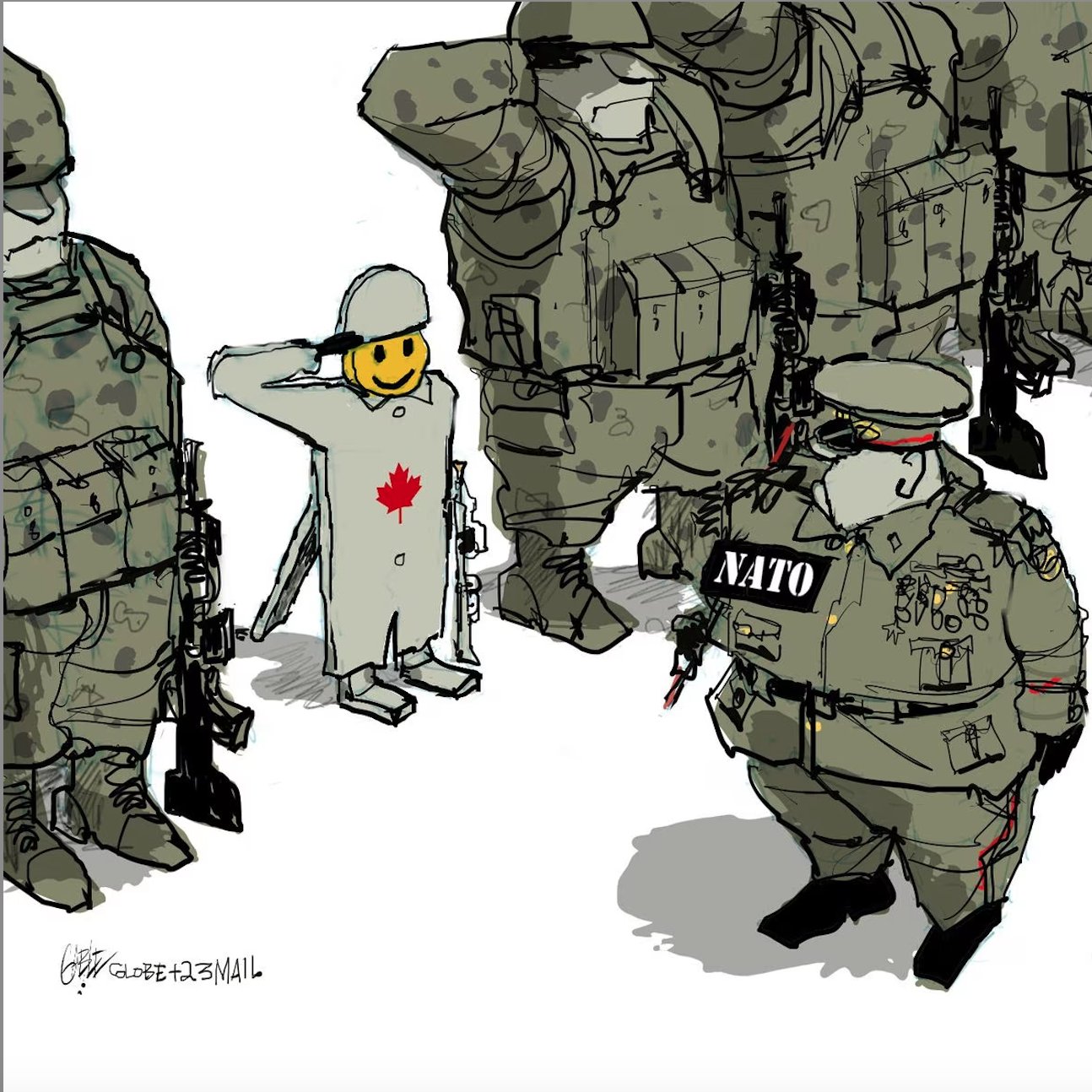
We suppose Trudeau found that argument very compelling argument to Americans marvelling at Canada’s inability to meet its basic NATO commitments.
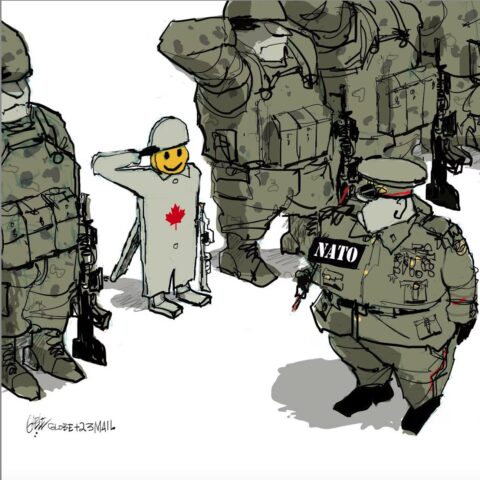
The weird thing is that Trudeau could have deflected a lot of these criticisms by our NATO allies almost painlessly without spending any more money directly on the Canadian Armed Forces“It’s well known that Justin Trudeau has no time for military issues, but it’s surprising that he hasn’t done a few things that wouldn’t increase the actual spending on the CAF, but would be “bookkeeping” changes that would shift some existing government spending into the military category, like militarizing the Canadian Coast Guard. (That is, moving the CCG from the Fisheries and Oceans portfolio into the National Defence portfolio, not actually putting armaments on CCG vessels. Something similar could be done with the RCMP, switching it from Public Safety to National Defence with no other funding or operational changes.) That Trudeau hasn’t chosen to make even these symbolic changes shows that he actively opposes fulfilling the commitment his government has made twice in the last ten years for reasons of his own.”

This tactic has been very electorally effective for the Liberals, no doubt, but it’s also reduced the idea of “Canada” to a smug transactional exchange. “Canada” as nothing more than what provinces and citizens can wheedle out of the commonweal in transfer payments, equalization cheques, and grandiose but poorly executed national program spending. At least we’re better than America, though, right? We’re “not American!” — we’re so much more thoughtful and compassionate, as evidenced by the entitlements we’ve voted for ourselves, secure in the knowledge that the troglodytes to the south will spend and bleed and die for our coddled asses if Russia lobs a missile from the North.

Canada has become a question of what we, citizens, are able to get, rather than one of what we’re willing to give. And we’re smarmy, preachy assholes about it, to boot. (There’s a very famous political quote we could drop in here about what citizens can do for their countries and vice versa, but you’ll know why we aren’t, if you can guess the quote! It would be a little on the nose.)

A nation that is unwilling to make serious sacrifices of blood and treasure to protect its own sovereignty is a nation that is going to cease to be a nation sooner or later — and if we judge Canada by its commitment to its military, ours is a nation that has regarded itself as a quasi-ironic post-modern punchline for many generations now.


Forgotten War – Ep 7 – Imphal ’44 Pt1 – Planning Prevents

Filed under: Britain, History, India, Japan, Military, USA, WW2 — Tags: , , , , — Nicholas @ 04:00

HardThrasher
Published 12 Jan 2025

DO NOT PANIC IF YOU HAVEN’T WATCHED THE OTHER VIDEOS IN THIS SERIES YOU CAN START HERE

A video discussing the planning phase of the Battles of Imphal and Kohima at the start of 1944

Please consider donations of any size to the Burma Star Memorial Fund who aim to ensure remembrance of those who fought with, in and against 14th Army 1941–1945 — https://burmastarmemorial.org/
(more…)

The “Thucydides Trap”

Filed under: Books, China, History, Military, USA — Tags: , , , , , , — Nicholas @ 03:00

At History Does You, Secretary of Defense Rock provides a handy explanation of the term “the Thucydides Trap”:

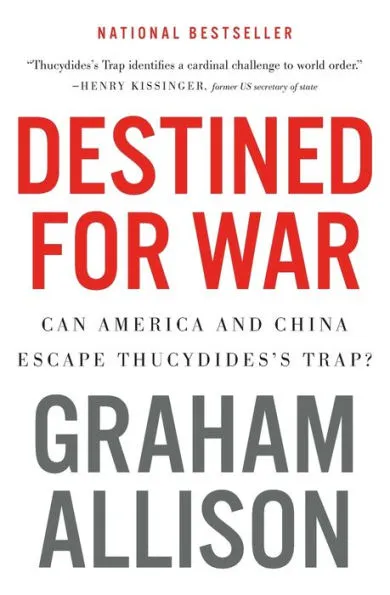
In the world of international relations, few concepts have captured as much attention — and sparked as much debate — as the “Thucydides Trap”. Brought to prominence by Harvard political scientist Graham Allison, the term suggests that conflict is almost inevitable when a rising power threatens to displace an established one, a dynamic often invoked to frame the strategic rivalry between the United States and China. Lauded as a National Bestseller and praised by figures like Henry Kissinger and Joe Biden, Allison’s Destined for War: Can America and China Escape Thucydides’s Trap? has become a staple of policy discussions and academic syllabi. Yet beneath the widespread acclaim lies a deeply flawed analysis, one that risks oversimplifying history and perpetuating a fatalistic narrative that could shape policy in dangerous ways. Far from an inescapable destiny, the lessons of history and the nuances of modern geopolitics suggest that the so-called “trap” may be more myth than inevitability.

The term “Thucydides Trap” is derived from a passage in the ancient Greek historian Thucydides’ work History of the Peloponnesian War, where he explained the causes of the conflict between Athens (the rising power) and Sparta (the ruling power) in the 4th century BC. Thucydides famously wrote

    It was the rise of Athens and the fear that this instilled in Sparta that made war inevitable.

Allison defines the “Thucydides Trap” as “the severe structural stress caused when a rising power threatens to upend a ruling one”.1 More articles by Allison using this term previously appeared in Foreign Policy and The Atlantic. The book, published in 2017, was a huge hit, being named a notable book of the year by the New York Times and Financial Times while also receiving widespread bipartisan acclaim from current and past policymakers. Historian Niall Ferguson described it as a “must-read in Washington and Beijing”.2 Senator Sam Nunn wrote, “If any book can stop a World War, it is this one”.3 A brief search on Google Scholar reveals the term “Thucydides Trap” has been cited or used nearly 19,000 times. In 2015, Australian Prime Minister Malcolm Turnbull even publicly urged President Xi and Chinese Premier Li Keqiang to avoid “falling into the Thucydides Trap”.4 One analyst observed that the term had become the “new cachet as a sage of U.S.-China relations”.5 The term has become so prominent that it is almost guaranteed to appear in any introductory international politics course when discussing U.S.-China relations.

Allison wrote in his essay “The Thucydides Trap: Are the U.S. and China Headed for War?” in The Atlantic published in 2015, “On the current trajectory, war between the United States and China in the decades ahead is not just possible, but much more likely than recognized at the moment” forewarning, “judging by the historical record, war is more likely than not”.6 A straightforward analysis of the 16 cases in the book and previous essays might indicate that, based on historical precedent, there is approximately a 75 percent likelihood of the United States and China engaging in war within the next several decades. Adding the additional cases from the Thucydides Trap Website would still leave a 66 percent chance, more likely than not, that two nuclear-armed superpowers will go to war with one another, a horrifying and unprecedented proposition.7

With such alarm, it’s no surprise that the concept gained such widespread attention. The term is simple to understand and in under 300 pages, Allison delivers a sweeping historical narrative, drawing striking parallels between events from ancient Greece to the present day.8 International Relations as a field often struggles to break through in the public discourse, but Destined for War broke through, making a broad impact on academic and popular discourse.


    1. Graham Allison, Destined For War: Can America and China Escape Thucydides’s Trap? (Boston: Houghton Mifflin Harcourt, 2017), 29.

    2. Ibid., iii.

    3. Ibid., vi.

    4. Quoted by Alan Greeley Misenheimer, Thucydides’ Other “Traps”: The United States, China, and the Prospect of “Inevitable” War (Washington: National Defense University, 2019), 8.

    5. Misenheiemer, 1.

    6. “Thucydides’s Trap Case File” Belfer Center for Science and International Affairs, Harvard Kennedy School, accessed December 31, 2024

    7. Graham Allison, “The Thucydides Trap: Are the U.S. and China Headed for War?” The Atlantic, September 24, 2015.

    8. Misenheimer details what Thucydides actually said about the origins of the Peloponnesian War, 10-17.

« Newer PostsOlder Posts »

Powered by WordPress