
World War Two
Published 11 Oct 2025Feb 19, 1941 — North Africa flares up as German air and naval pressure around Tripoli and Benghazi intensifies and the first ground clashes break out near El Agheila. This episode follows X Fliegerkorps strikes, Royal Navy submarine successes (including the sinking of the cruiser Armando Diaz), and the shipment of men and matériel that leads to the new Deutsches Afrikakorps. British command, distracted by events in Greece, underestimates Axis moves, setting the scene for an ambush of Commonwealth patrols and the opening shots of the Desert War.
(more…)
October 13, 2025
North Africa Ep. 3: Stukas, Submarines … and a Trap
Comments Off on North Africa Ep. 3: Stukas, Submarines … and a Trap
Stephen Fry’s Odyssey weighed in the balance and found wanting
Bryan Mercadente received a copy of Stephen Fry’s latest foray into Greek mythology and not only is not impressed, he writes, “Every page wasted on Fry is a page stolen from the real thing. The copy my aunt has given me for my birthday is already skimmed with disgust and thrown into the dustbin: it is too disgusting for the charity shops.”

The Iliad and Odyssey are the founding works of our civilisation. They are poems of war, loss, exile, and return. The hero of The Odyssey is a liar, a man of cunning and cruelty, but also a survivor who longs for home. The Homeric poems have come to us out of the Bronze Age. They have survived the collapse of at least two civilisations, and will survive the collapse of our own. They survive because they are already perfect. The hexameters carry an austere music. Their formulaic epithets — “ῥοδοδάκτυλος Ἠώς“, “πόδας ὠκὺς Ἀχιλλεύς“, “δῖος Ὀδυσσεύς” — are the memory-tricks of a sung tradition, but they also give the poems a dignity that no one who reads them can ever forget. Like The Iliad, The Odyssey was not written to be read in comfort with a cup of tea. It was composed to be chanted in smoky halls to men who might be dead tomorrow.
Stephen Fry knows none of this. Or if he knows it, he does not care. His Odyssey is Homer without the difficulty. It is Homer stripped of his grandeur, reduced to banter and “relatable” anecdotes. The Observer praised it for bringing “contemporary relevance” to the myths. That line is damning enough. Homer does not need contemporary relevance. A book that has spoken to audiences across three thousand years already possesses the only relevance that matters. To make Homer relevant is to make him trivial.
The Guardian called the book “relatable and full of humour“. Again, the praise condemns. Relatable? Homer is not relatable. The world he describes is harsh and alien. His heroes live by honour and die by the sword. They weep like children and sacrifice to gods who may or may not answer. That strangeness is the point. It is what makes Homer worth reading. To make him “relatable” is to gut him of meaning.
The Irish Independent calls Fry “A born storyteller“. This blurb, like the others, is the language of people who cannot read. No serious critic would praise a reteller of Homer as “a born storyteller”, as if the original poet were not the greatest storyteller of them all. These blurbs are not criticism. They are advertising slogans. And they work. The book is a bestseller.
Why, then, is Fry’s book a bestseller? Not because of merit. It sells because of Stephen Fry himself. For thirty years, he has been cultivated as a “national treasure”. He is the ideal leftist intellectual: clever enough to appear learned, shallow enough never to disturb. He quotes Wilde, sprinkles in Latin tags, and sprinkles them badly. His claque tells us that he is bipolar, gay, witty, and charming. He is on panel shows, chat shows, and literary festivals. He is always agreeable, always moderate, and always applauded.
Fry has built a career on the fact that the English middle classes like to feel cultured without effort. They want Plato without philosophy, Shakespeare without metre, Wagner without subversion, Homer without Greek. They want to be reassured that the classics are not difficult or dangerous, but fun. Fry gives them what they want. He domesticates the wild. He reduces epic to anecdote. He packages civilisation as entertainment.
It is not enough to call this dumbing down. It is worse. Dumbing down implies a reduction in complexity. What Fry does is not simplification but falsification. The Odyssey is not a sequence of funny stories about gods and monsters. It is about endurance and the fragility of human life under the indifference of the divine. To make it “funny” is to destroy it. It is as if someone rewrote the Inferno as a travel blog or recast the Iliad as a football commentary. The whole point of the work is lost.
Popularity, however, is not a defence. It is an indictment. Books that sell by the million are almost always worthless. They are consumed because they flatter the prejudices of the public. They make readers feel clever without having to be clever. They make them feel cultured without culture. They are the literary equivalent of processed food: cheap, sweet, addictive, fattening.
What, then, is the harm? Why not let people have their Fry and be happy? So what if his writing is as inconsequential as his suicide attempts? The harm is that time is short. Every hour spent on Stephen Fry is an hour not spent on Homer. It is an hour subtracted from Gibbon, Johnson, or Shakespeare. It is an hour less of life. The opportunity cost is everything. Bad books are not neutral. They are parasites. They feed on the hours that might have been spent on good ones.
Comments Off on Stephen Fry’s Odyssey weighed in the balance and found wanting
QotD: Christian observance in the late Middle Ages
It’s hard to convey just how overwhelming spiritual life was in the late Middle Ages, but I’ll try. If you can find a copy for cheap (or have access to a university library), browse around a bit in Eamon Duffy’s The Stripping of the Altars. I can’t recommend it wholeheartedly, not least because I never managed to finish it myself — it’s dense. This is not because Duffy is a bad writer or meager scholar. He’s a titan in his field, and his prose is pretty engaging (as far as academic writing goes). It’s just that the world he describes is mind numbing.
Everything is bound by ritual. Hardly a day goes by without a formal religious ceremony happening — over and above daily mass, that is — and even when there isn’t, folk rituals fill the day. Communal life is almost entirely religious. Not just in the lay brotherhoods and sisterhoods that are literally everywhere — every settlement of any size has at least one — but in the sense that the Church, as a corporate entity, owns something like 30-50% of all the land. In a world where feudal obligations are very real, having a monastery in the vicinity shapes your entire life.
And the folk rituals! The cult of the saints, for instance — reformers, both Lutheran and Erasmian, deride it as crudely mechanical. There’s St. Apollonia for toothache (she had her teeth pulled out as part of her martyrdom); St. Anthony for skin rashes; St. Guinefort, who was a dog (no, really), and so on. The reformers called all of this gross superstition, and it takes a far more subtle theologian than me to say they’re wrong. But the point is, they were there — so much so that hardly any life activity didn’t have its little ritual, its own saint.
And yet, as suffused with religion as daily life was, the Church — the corporate entity — was unimaginably remote, and unfathomably corrupt. Your local point of contact with the edifice was of course your priest, who was usually a political appointee (second sons went into the Church), and, well … you know. They probably weren’t all as bad as Chaucer et al made them out to be (simply because I don’t think it’s humanly possible for all of them to be as bad as Chaucer et al made them out to be), but imagine having your immortal soul in the hands of a guy who’s part lawyer, part used car salesman, part hippy-dippy community college professor, and part SJW Twitter slacktivist (with extra corruption, but minus even the minimal work ethic).
Severian, “Reformation”, Founding Questions, 2022-03-07.
Comments Off on QotD: Christian observance in the late Middle Ages
October 12, 2025
Restricting activism from the bench
As we’ve seen far too many times in Canadian courts, when judges become politically active, they can produce far worse situations than the politicians who cynics might say are specialists in that discipline. British judges, however, are still well ahead of their Canadian counterparts:
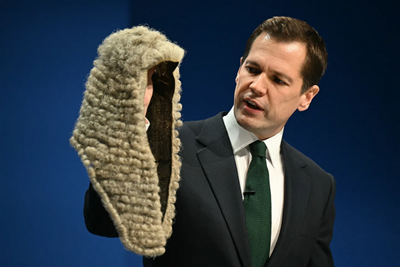
Until judges are replaced by robots, we will have to accept the reality of activist judges. Even the most august patriarch of the bench cannot wholly escape his innate human biases. And so perhaps there was something in Robert Jenrick’s speech at this week’s Conservative Party Conference, in which he announced that, if elected, the Tories would empower the Lord Chancellor to appoint judges and more carefully scrutinise their political activities.
Those who have supported the ideological capture of our major institutions were understandably furious. The New Statesman claimed that Jenrick had “declared war on the judiciary”. But then, the New Statesman is an activist publication which can make no serious claim to impartiality or sound journalistic standards. (Those in any doubt about its mendacity should take the time to read about its shameful treatment of Roger Scruton.)
The problem of an activist judiciary is currently preoccupying the White House, given that a number of federal judges have attempted to block executive policies or have issued nationwide injunctions. Trump himself was convicted on thirty-four felony counts by a judge who had made small political donations to Democratic-aligned causes. It seems clear that given these circumstances he ought to have recused himself. The entire case, of course, was an example of the law being twisted for politically partisan ends. (The best overview is by the senior legal analyst for CNN, Elie Honig, which can be read here.) Little wonder that Trump now appears to be seeking revenge through the courts.
In the UK, there have been a number of revelations of judges tied to political causes whose claim to impartiality seems shaky at best. During his speech, Jenrick spoke of those judges who have been associated with pro-immigration campaign groups and have “spent their whole careers fighting to keep illegal migrants in this country”. Many commentators have observed a generalised bias toward asylum applications, sometimes to an absurd extent. Who could possibly forget the Albanian criminal whose deportation was halted by an immigration tribunal on the grounds that his ten-year-old son did not like foreign chicken nuggets?
Leaving such outliers aside, most of us will have noticed patently ideological remarks occasionally uttered by judges during sentencing. In the Lucy Connolly case, the judge explicitly expressed his support for the creed of DEI before sentencing her to 31 months in prison for an offensive and hastily deleted post on social media. “It is a strength of our society that it is both diverse and inclusive”, he said. It couldn’t be much clearer than that.
That lawfare has become a major weapon in the settling of political disputes should trouble us all. Judges are not accountable to the electorate, and so any suggestion that they are exercising power for their own political ends is bound to be interpreted as a threat to democracy. Inevitably, Jenrick’s criticism of activist judges, and his call for them to be removed, has led to some commentators assuming that he would prefer judges who simply acted according to the government’s bidding. That way lies tyranny.
Comments Off on Restricting activism from the bench
A second American Civil War would not resemble the first one
The American Civil War, if you try to look at the big picture, started off with the states dividing as this Wikipedia map indicates (although no state was all secessionist or all unionist, of course):
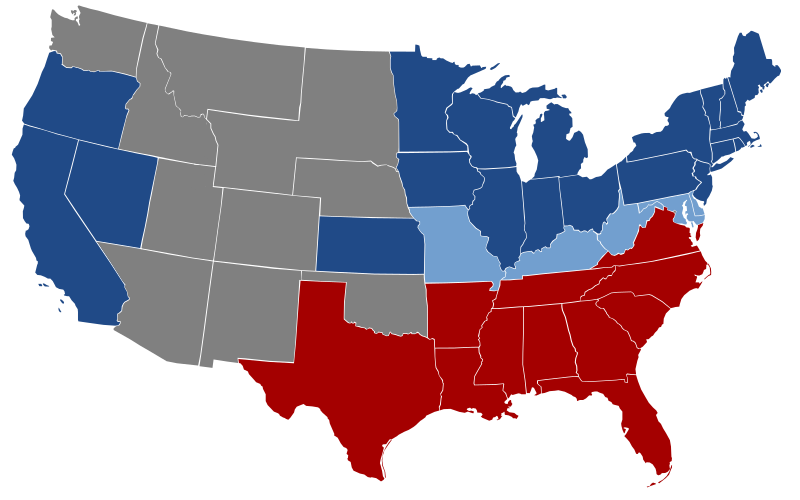
Union states in blue (light blue for states that permitted slavery), Confederate states in red.
Map by Júlio Reis via Wikimedia Commons.
Potential lines of demarcation today, well, here’s a guess from a few years ago based on county voting patterns, and again it’s still an approximation:
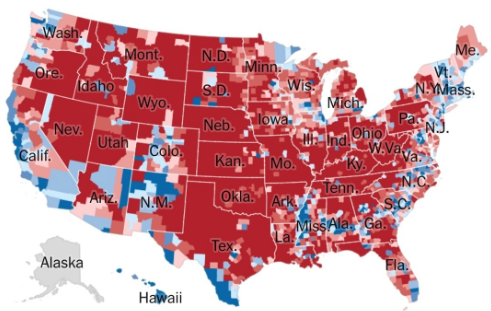
Any civil strife on this modern battlefield will be very unlike the organized Union and Confederate armies of 1861-65 having stand-up battles against one another in the countryside. Tom Kratman wrote about a potential civil war breaking out several years ago and has reposted the first part on his Substack:
I can’t quite shake the feeling that the side that wins any new civil war, to the extent that anyone can be said to “win” such a frightfulness, will be the side that a) engages in as humanitarian a form of ethnic and political cleansing as possible, first, and b) shoots second. I say “as humanitarian … as possible” because, as previously discussed,1 we are not a nation of red and blue states. Rather, instead of red and blue states, we are, as discussed a couple of years ago, “counties and neighborhoods and streets and the couch versus the bedroom after an argument with a spouse or significant other over political matters”. In short, anyone who engages in really harsh internal security measures will tend to drive people who should be its friends over to the other side. Since I’m writing this on behalf of the more or less anti-bolshevik, anti-progressive, anti-SJW2 half of the country, let me emphasize that, when the northeast, the left coast, “Yes, we old retired farts can be bribed by robbing the future” Florida, “Under the Fairfax County Bootheel” Virginia, “Cannot control Baltimore” Maryland, and CorruptionRus Illinois, unchained from the restraints we’ve imposed on them, go full lunatic lefty, let them turn into Beirut of the 80s while we try to maintain something approaching civilization as long as we can. Yes, that means I think it would be easier for us to conquer or reconquer a California devolved into its own civil war if we can avoid the same in our areas.
Note that it’s a fine line we’ll have to try to walk, rounding up those who would turn us into Beirut, without rounding up those whose rounding up will cause their friends and family to turn us into Beirut. My suggestion would be using extreme measures for those who are certain enemies, but safe and comfortable lagering or exile for those about whom there might be some doubts.
Though I may find it distasteful, honesty compels that I not shy away from that other aspect of securing the base areas, ethnic cleansing. If this nightmare comes to pass then ethnic cleansing is going to happen, I am certain, to at least three groups, Moslems, Blacks, and Hispanics. Some of it will probably come in the form of self-exile, but I would be very surprised if more of it isn’t forced. So let me throw a little damper on the KKK/alt-white-wing of my readership, if any; Trump is leading by comfortable margins in Louisiana (over a third Black and Hispanic), Mississippi (close to 40% Black and Hispanic), and Alabama (over a quarter). He’s not leading in those places by the kinds of margins he is without a more than fair sprinkling of Blacks and Hispanics, who will not be much like the rioting for fun and profit thugs of Black Lives Matter (and White Lives Don’t). Those people are us as much as anyone can be. It would be a grievous and perhaps unhealable wound to your alleged souls if you don’t treat them that way.
- http://www.everyjoe.com/2015/01/12/politics/breakup-of-united-states-terrible-idea/#1
- SJW stands for social justice warrior. Unlike many such epithets, this one was coined by the people to whom it applies. Think of idiot PhDs who call canoeing “racist”, the universe of the trigglypuffs, and those who consider eating a taco to be a crime against Mexicans, if not even a crime against humanity, which latter classification expressly excludes whites.
Update, 14 October: Welcome, Instapundit readers! Please do have a look around at some of my other posts you may find of interest. I send out a daily summary of posts here through my Substack – https://substack.com/@nicholasrusson that you can subscribe to if you’d like to be informed of new posts in the future.
Inventing boring Sundays – a British innovation
Ed West ruminates on the phenomenon of boring British Sundays and explains how they got that way:

Nietzsche thought that this was the whole idea, that the English designed Sundays that way in order to encourage people to appreciate the working week. In Beyond Good and Evil, he described how “The industrious races complain a great deal about having to tolerate idleness: it was a masterpiece of the English instinct to make Sunday so holy and so tedious, a form of cleverly invented and shrewdly introduced fasting, that the Englishman, without being aware of the fact, became eager again for weekdays and workdays.”
There may be some truth in this, so that before the Industrial Revolution there was the “Industriousness Revolution”, with a new emphasis on work rather than leisure. This is something which Joseph Henrich noted from studying reports from the Old Bailey between 1748 to 1803, and “spot-checks” observations about what Londoners were doing at a particular moment:
The data suggest that the workweek lengthened by 40 percent over the second half of the 18th century. This occurred as people stretched their working time by about 30 minutes per day, stopped taking “Saint Mondays” off (working every day except Sunday), and started working on some of the 46 holy days found on the annual calendar. The upshot was that by the start of the 19th century, people were working about 1,000 hours more per year, or about an extra 19 hours per week.
Before the Industriousness Revolution it was common for people to enjoy a number of saints’ days as holidays, including the three-day weekends offered by these “Saint Mondays”. That all changed with the arrival of Protestantism, with its scepticism towards saints’ days, William Tyndale arguing that these were only celebrated by convention and that there wasn’t anything special about them.
While they were keen to abolish holidays, the reformers also believed in making the Sabbath more godly, and so the Boring English Sunday was invented. This followed from a growing sense that leisure time was wasted time, but it was also the case that many of the Protestant reformers just didn’t like people having fun. In God is an Englishman, Bijan Omrani noted how “From the end of the 1500s, Puritan preachers condemned the way people generally spent their Sundays: ‘full heathenishly, in taverning, tippling, gaming, playing and beholding bear-baitings and stage-plays, to the utter dishonour of God'”.
Theologian William Perkins believed that Sunday “should be a day set apart for the worship of God and the increase in duties of religion”. Lincolnshire cleric John Cotton said in 1614 that it should be unlawful to pass Sunday without hearing at least two sermons; the idea of going to church twice would have filled my ten-year-old self with intense horror.
Hugh Latimer asked: “What doth the people do on these holidays? Do they give themselves to godliness, or else ungodliness … God seeth all the whole holidays to be spent miserably in drunkenness, in glossing, in strife, in envy, in dancing, dicing, idleness, and gluttony”.
Latimer also disliked holidays for quite modern-sounding reasons related to social inequality, noting that “in so many holidays rich and wealthy persons … flow in delicates, and men that live by their travail, poor men … lack necessary meat and drink for their wives and their children, and … they cannot labour upon the holidays, except they will be cited, and brought before our officials”.
The reverse argument is now made against allowing supermarkets to drop Sunday trading hours – that it pressures working people into excessive toil so that Waitrose shoppers don’t suffer any inconvenience. Although, reading Latimer, I can’t help but suspect that his real objection was to people having fun.
The reformers won, and English Sundays became notably dull. Banjani quoted children’s writer Alison Uttley, who said of Sundays that “Nobody ever read a newspaper or whistled a tune except hymns”.
Comments Off on Inventing boring Sundays – a British innovation
Why the Roman Army Conquered the World – Adrian Goldsworthy
Nathan Watson
Published 10 Nov 2024@AdrianGoldsworthytheAuthor talks about the Roman Army and Diplomacy
Comments Off on Why the Roman Army Conquered the World – Adrian Goldsworthy
QotD: Male privilege revealed
Vincent described herself as a “bull dyke” and held strong feminist views. She expected, throughout the course of the experiment to uncover the secrets of male privilege and the societal advantages that, she was sure, are afforded to men. She anticipated that living life as a man would validate her beliefs that men lead easier lives and wield unchecked power. She figured that, at the very least, she could enjoy a couple of years as a powerful male.
Vincent disguised herself as a man by getting a new hair style and giving herself a fake five o’clock shadow, among other things. She had always been considered rather masculine in her usual feminist and lesbian circles, so she figured she could pass rather easily as a man, if perhaps a slightly effeminate one. She was right.
Her initial assumptions changed when Vincent discovered that men, contrary to her expectations of power and privilege, face their own unique set of pressures and struggles. Men, she discovered, were expected to suppress any signs of vulnerability. This quickly led to feelings of extreme isolation that she did not expect. Nobody “had her back” because, as far as they knew, she was just a man, and should “man up”. She quickly realized that men do not have inherently easier lives. Her preconceived notions of in-born male advantage evaporated. She was getting worried.
She realized that women do not have empathy for the struggles of men.
Norah, as Ned, experienced the behavior of women toward men firsthand. At one point, she tried dating women as a man. She figured this would be incredibly easy for her. Not only was she a woman herself and knew how women think, but she was also a lesbian and already liked women. She worried at first that she’d be too good at it and would have to tell interested women that she was a woman to stop them from pursuing her.
The reality was sharply different from her expectations. Her apparent femininity came across as her simply being an effeminate man. This caused women to be disinterested in her and their rejections were dismissive, cold, and often extremely brutal. Women would sometimes treat her with suspicion or outright hostility as they assumed her intent was negative.
These interactions eventually led Vincent to start developing misogynistic thoughts. That’s right: women treated her so poorly when they believed her to be a man that she started to develop misogynistic thoughts.
Interestingly, many of the supposedly straight women she had attempted to date, even those who had been brutal and cold toward her, immediately expressed interest in a lesbian “hook-up” when she told them she was a woman who had been disguised as a man for the sake of journalism.
Perhaps there’s no such thing as a “straight woman”. Is there even a such thing as a lesbian?
CTCG, “UNDERCOVER: A Feminist’s Year Living as a Man”, Codex Trivium Cosmic Genesis, 2025-06-16.
Comments Off on QotD: Male privilege revealed
October 11, 2025
Toddler politics – don’t discuss, just shriek and cry and hit
At Woke Watch Canada, T.G. Kelemen illustrates the difficulty of trying to have a logical discussion with someone who refuses to engage intellectually as an adult and instead pours everything into the kind of emotional incontinence toddlers indulge in:
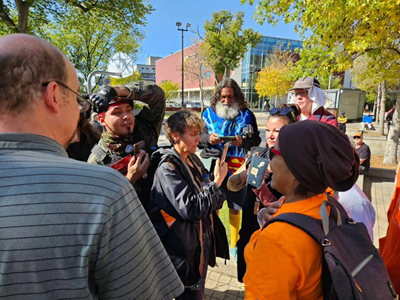
Source: Frances Widdowson, Facebook
It’s 2025.
Ask a question, get a tantrum. Make a point, get a protest.
And if you’re unlucky enough to be a calm, middle-aged academic like Frances Widdowson, who dared to speak plainly about a hoax everyone else is pretending is holy scripture, you don’t get debate.
You get a mob.
You get walls pounded. Doors blocked. Students shrieking like toddlers in a sugar crash. And who’s leading it?
Not war-hardened political activists. Not deep-thinking men of conscience.
No — it’s women. Grown women. Educated. Empowered. Enraged.
But not enlightened.
Welcome to the “regressive” West, where a large and growing portion of womanhood has been educated not to argue, but to erupt. To scream instead of speak. To censor instead of counter. To “feel”, and then enforce those feelings on everyone else.
What used to be a bad breakup is now a political position.
What used to be a mood swing is now being proposed as legislation.
Kamloops: Hysteria and Mass Psychosis
Let’s rewind. Canada. 2021. The Kamloops Indian Residential School story breaks. “Unmarked mass graves”, they say. “215 children”, they whisper. Every outlet repeats it. Politicians take a knee. Flags at half-mast. Even the Pope apologizes, having already formally done so twice, with countless statements of regret.
No bodies are found. No evidence. No excavation. One inconclusive radar scan and a theory.
And still: nothing.
But the narrative’s already set. When Frances Widdowson says, when she suggests maybe we need evidence before enshrining national guilt into law, she’s hounded. Not with counter-arguments. Not with facts.
With a toddler’s unhinged rage.
The women who confronted Widdowson aren’t showing the understandable, righteous anger mature people show in response to obvious injustice. No. What we have is full-grown girl-children who aren’t getting their way throwing their emotional and psychological scat in her face. Why? Simply for disagreeing with them.
In February 2023, invited to speak at the University of Lethbridge, Widdowson faced similar militant protest. The lecture was shut down. Protesters, mostly female, banged on walls, wailed through the halls, and demanded she be de-platformed. One group called her a “residential school denier”. Another called her “unsafe”. Some students cried in interviews, claiming trauma.
Trauma? From a talk you didn’t even attend?
That’s the playbook now. You don’t have to hear the words. Just say you were harmed. The more you feel, the more you’re right. Welcome to emotional absolutism where logic is violence and hysteria is virtue.
Can modern women handle the responsibility their suffrage and freedom demands? Judging their own behavior, the answer is a resounding no.
Comments Off on Toddler politics – don’t discuss, just shriek and cry and hit
Crossing the line between “justice” and “persecution”
At The Intrepid Viking, Roxanne Halverson notes just how determined the Canadian justice system was to inflict the most pre-trial punishment as possible on Tamara Lich and Chris Barber for their leadership role in the Freedom Convoy:

Tamara Lich and Chris Barber
Photos from The Intrepid Viking
The convoy leaders, Lich and Barber, […] finally learned their fate in an Ottawa courtroom on October 7th, 2025, almost four years since the trucks first rolled into the capital, and over two years since their trial began on September 5, 2023. Rather than the unwarranted and what can only be described as vindictive prison terms sought by the Crown, Justice Heather Perkins-McVey instead sentenced them both to conditional non-custodial sentences of 18 months. A decision, one can be sure, the Crown is not pleased with and one that is nothing short of humiliating given it falls farther short from the seven and eight year terms they argued for than they could have possibly imagined.
[…]
But Lich and Barber have indeed suffered. Both have been put through the legal grist mill of what now serves as Canada’s justice system since they day they were put into handcuffs and arrested on February 17/18, 2022. Barber was released on a bail bond of $100,000 after a night in jail with his wife acting as surety, meaning she would forfeit that amount if he breached his bail conditions. Under those conditions he was required to leave Ottawa within 24 hours of his release and depart Ontario in 72 hours, no longer support the Freedom Convoy and cease contact with fellow organizers. Breach of these conditions could also have landed him back in jail. His business and personal finances were also frozen for three months as part of the government’s illegal actions under the Emergencies Act. And now, to further try and impair and punish him financially the Crown prosecutors on this case are still attempting to seize and destroy his truck and livelihood, Big Red, which became a symbol of the Freedom Convoy. That matter is expected to be settled by Justice Perkins-McVey in court in November of 2025.
Lich, after her arrest spent a total of 49 days in jail before she was even convicted of any offence. Denied bail after her initial arrest in February, she spent 19 days in remand custody in an Ottawa jail because a judge deemed it was “necessary for the protection and safety of the public“. She was finally released on March 7, 2022 after an Ontario Superior Court Justice overturned the lower court’s outlandish ruling.
The vindictive nature of the first Crown prosecutor on their case, Moiz Karimjee, soon came to light when Lich was announced the winner of the George Jonas Freedom Award in May of 2022. He petitioned to have her bail revoked, arguing that being a recipient of the award was a breach of her bail conditions. Justice Kevin Phillips disagreed and amended provisions of her bail to allow her to attend the award dinner in Toronto, but still prohibited her from communicating with “certain” individuals at the dinner unless in the presence of legal counsel.
Karimjee, seemingly obsessed with seeing her back in jail, accused Lich of another alleged bail breach after she attended the award dinner when video evidence later surfaced of her having a brief congratulatory interaction with Tom Marazzo a Freedom Convoy organizer she was prohibited from interacting with. As a result, on June 27 Karimjee dispatched two Ottawa homicide detectives, yes homicide detectives, to her home in Medicine Hat to put the diminutive grandmother in shackles and fly her back to Ottawa and throw her back in jail. She was finally released following another bail hearing, in which Karimjee made every effort to keep her behind bars, but justice prevailed and she was released from custody on July 27, 2022.
Lich’s lawyer Lawrence Greenspon was highly critical of Karimjee’s actions stating, “This is the third time the crown has tried to incarcerate Ms. Lich, this time for a three-second interaction, and a photo. The prosecutorial response to this far exceeds the severity of the alleged breach“. Further remarking on the situation, Greenspon added, “Had there been a proper investigation before Tamara Lich was arrested, shackled, hauled halfway across the country and then kept in jail for 30 days, they would have realized that her then-counsel were present at the time and therefore these charges should never have been laid“.
And like Barber, and many other convoy protesters, Lich’s bank accounts were also frozen by the government under the Emergencies Act for a period of three weeks.
On the social media site formerly known as Twitter, Eve Chipiuk posted:
Keith Wilson, K.C. @ikwilson
The Freedom Convoy trial has disgraced Canada’s justice system – The Spectator, Australia spectator.com.auRead it and weep, snowflakes. The lies are exposed, the facts don’t lie, and people across the world can see the truth.
The question remains: when will you stop lying to yourself and others, and start thanking your fellow citizens for fighting for your freedom?
“Tamara Lich and Chris Barber, organizers of the most successful protest in Canadian history, kept their cool, kept the peace and brought national unity, patriotism and common sense back to Canada after the pandemic – this, despite the sustained efforts of the most aggressively controlling, divisive government the nation has ever had. They achieved this under intense pressure and at great personal cost.
They’re national heroes, and the persecution waged against them is destroying trust in the Canadian judicial system, though the judge involved does not seem to realize it. Justice Perkins-McVey said in court that if she discharged the defendants, it would “undermine confidence in the administration of justice”.
But it’s quite the opposite …
There was another ironic moment at the sentencing. The judge announced, “Politics has no place inside this courtroom” – yet the trial has been widely viewed as nothing more than the political vengeance of Doug Ford and the Ontario government.
If it weren’t for politics, Lich and Barber would never have been arrested, let alone put through jail time, solitary confinement, loss of employment, years of drawn-out, costly legal proceedings, onerous bail conditions and emotional strain …
This means the public is paying twice – once as taxpayers, with money intended to pursue real criminals wasted on a political vendetta – and once again, voluntarily, to support the brave people who stood up to ask for an end to lockdowns and vaccine mandates.
This is the same public that already gave $24 million to the truckers to help them go to Ottawa and protest vaccine mandates and lockdowns: $24 million that never reached them, because politicians colluded with fundraising sites and banks to freeze the money, debank the protestors and doxx the donors, all without a court order. No criminal charges have been laid in Canada, to this writer’s knowledge, against the perpetrators of these deeds, though they damaged national institutions far more than any protest ever could.
Justice Perkins-McVey is right to be concerned about confidence in the administration of justice. Many Canadians share her concern. Sadly, her handling of this case has done little to dispel their fears.”
Comments Off on Crossing the line between “justice” and “persecution”
Antifa declared a foreign terrorist organization
On the social media site formerly known as Twitter, ESR claims a win from his earlier analysis posts on Antifa in the United States:

For those of you who have been tracking my intelligence analysis posts about Antifa, I now get to claim a correct prediction.
The President of the United States has declared Antifa a foreign terrorist organization.
Providing aid to an FTO is a crime (18 U.S.C. § 2339B). This declaration unlocks the legal tools required to go after Antifa’s funding network and allies, both foreign and domestic.
Those of you who are watching as USAID was unmasked as a left-wing slush fund won’t have any trouble understanding how the funding network functions. Allies of revolutionary Communism and nihilism at large charitable foundations direct money to smaller foundations which act as pass-throughs to others. After enough layers of this to maintain deniability (because the federal statute specifies “knowingly”), direct enablers of terrorism collect the money and use to fund things like a bullet ripping through Charlie Kirk’s neck.
There’s some rake-off along the way, of course. Can’t have all those elite failsons and faildaughters going without sinecures, after all. They have expensive habits to maintain.
Following the FTO declaration, the government can now gin up a case for seizing the assets of anybody in the funding chain, all the way back to the initial donors. The usual doctrine that “knowingly” extends to those who should have known, and who willfully failed to perform due diligence in order to avoid criminal exposure, applies here. Precedent for this was well established by organized-crime prosecutions 50 years ago; it’s why we have RICO laws.
It remains to be seen how much political will there is to actually bring down this hammer. In the maximal scenario,
(1) Trump issues a loud public warning to all charitable donors that they’d better cut ties to any organization that doesn’t provide them with full transparency about where the money is going.
(2) Left-wing dark money outfits like Arabella and the Tides Foundation get sent formal spoliation-of-evidence warnings, followed swiftly with audits by people with zero sense of humor.
I wish I were confident that all of this is going to happen. There’s going to be a lot of obstruction from Democrats and screaming by the media — the people who keep telling you that Antifa doesn’t exist because they want to keep their army of brownshirts intact. The administration could lose its nerve.
But at least it’s possible now. The political conditions for it are better than they have been in my entire lifetime.
Update: Fixed messed-up URL.
Comments Off on Antifa declared a foreign terrorist organization
Haenel’s Prototype Simplified Sturmgewehr StG45(H)
Forgotten Weapons
Published 26 May 2025In December 1944, the Haenel company received permission to produce a simplified version of the StG-44 Sturmgewehr. The idea was to keep the mechanical system and controls as similar as possible to the design in use, but simplify the design to reduce the cost and time of production. The design was never completed, and this is the only known surviving prototype. It was most likely captured by American forces when they occupied the Haenel factory in April 1945, although that is not documented. It is a pretty impressive adaptation of the StG design; far simpler to manufacture than the original design. Would it have worked? We don’t know for sure as there are no known German or American test reports, but it certainly seems viable to me.
Thanks to the Springfield Armory National Historic Site for giving me access to this truly unique specimen from their reference collection to film for you! Don’t miss the chance to visit the museum there if you have a day free in Springfield, Massachusetts: https://www.nps.gov/spar/index.htm
(more…)
Comments Off on Haenel’s Prototype Simplified Sturmgewehr StG45(H)
QotD: Riot control tips
2. Riot Control Women. They’re rather preposterous, in the main, if employed on the riot control line. It’s one of the reasons why MPs have for long been useless at riot control; they’re simply too heavily laden with women, who almost universally lack the size, strength, and aggressiveness for hand to hand combat with stone age weapons. Indeed, while the infantry and other combat and combat support unit in the old 193rd were excellent at riot control, the MPs – yes, I have seen it – were useless. Worse, riot control is a perfect environment to cause what the Israeli’s found out when they mixed men and women in the same units in their War of Independence; men will abandon the mission to succor one of their own women. This is the fault of the men, by the way, and not of the women, but it is even more the fault of the dogmatic shitheads of the left who refuse to see men and women for what they are.
3. Rioting women. I don’t care if you have a warrant for their arrest for murder, arson, mayhem, and massacre, plus cellulite and bad makeup, do not arrest or detain them at the scene. Shoot them if their conduct (to include dress) warrants it, but otherwise just push them away or wound them slightly and push them away. Why? Because, though ill-disciplined rabble, for the most part, the rioters are also mostly male and will also rush to the defense of “their” women. There is no better substitute for the cohesion and moral fiber a mob usually lacks than going after the women in the mob. They can turn ferocious very quickly, indeed, if you do.
And that’s all good and maybe it will get us through the summer, should it turn out as badly as it might, but, America, I suspect that you and the president are ultimately still going to need a dedicated, well trained, highly mobile, professional force for riot suppression.
Tom Kratman, The social media site formerly known as Twitter, 2025-06-11.
Update, 12 October: Welcome, Instapundit readers! Please do have a look around at some of my other posts you may find of interest. I send out a daily summary of posts here through my Substack – https://substack.com/@nicholasrusson that you can subscribe to if you’d like to be informed of new posts in the future.
October 10, 2025
We have to destroy European democracy to save European democracy
Every week it seems like the undemocratic powers-that-be in Europe have had to pull legalistic strings to ensure that the popular will is not translated into political power in nation after nation. Unsurprisingly, the candidates and parties subject to these serial interferences are almost all populist and right-wing. On his Substack, Frank Furedi explains “the EU’s quest to monopolize the doctrine of the Truth”:
Army of Fact Checkers – Roots & Wings with Frank Furedi
In recent years globalist institutions – including the European Union Commission have become obsessed with the circulation of disinformation. In particular, they point the finger of blame on outside external actors whose fake news supposedly threatens the very existence of democracy. According to the EU Commission “Foreign information manipulation and interference is a serious threat to” European values. It claims that “it can undermine democratic institutions and processes by preventing people from making informed decisions or discouraging them from voting1.
The narrative of foreign misinformation is invariably used to discredit political parties and electoral results that are not to the liking of the centrist technocratic elites that run the EU as well as numerous western governments. Foreign information manipulation served as an excuse to bar a populist candidate from running for the post of the President of Romania. Since by all accounts he was the likely winner of this contest his elimination from the race could be interpreted as a soft coup d’etat. Similar objections were made about foreign interference during the referendum for Brexit as well as during the recent elections in Moldavia and Czechia.
Alarmist accounts of the threat posed by foreign information manipulation rest on the claim that the circulation of so much unreliable information makes it impossible for people to make an informed choice. Yet the electorate has always faced the challenge of having to distinguish factually accurate claims from false ones. Public life was always forced to confront the problem of who to believe and whose words are trustworthy. Throughout history different actors and technologies were blamed for misleading people with false information and dangerous ideas. In ancient Greece it was the smooth-tongued demagogue who could effortlessly and purposefully transmit lies to capture the attention of the public, who served as the personification of misinformation. During the centuries to follow the finger of blame has been pointed at books, mass-publication newspapers, radio, television and now the Internet
Since information manipulation has played an important role in the political life of western societies since the 18th century, it is far from evident why the contemporary public should no longer be able to make “informed choices” and why they should feel discouraged from voting? Despite the recent EU Commission induced panic about information manipulation, the percentage of people voting in the 2024 EU elections was 51 percent, the highest rate of turnout since 1994, when it was 56 percent.
People have always had to contend with fake news and propaganda. So why should they be more likely to be fooled by it today than in the past? The standard argument used to justify this EU elite promoted panic is that new technologies “have made it possible for hostile actors to operate and spread disinformation at a scale and with a speed never seen before”.2 It is worth remembering that the same arguments were used to warn against new information technologies since the 19th century. Even in the late 20th century the media was blamed by politicians for their electoral failures.
Kirsten Drotner has used the term media panic – that is a panic about the media -to highlight the recurrent tendency for change and innovation of the media to incite anxiety and fear.3 Such reactions were a response to the expansion of both publishing and the reading public in the 18th century. The expansion of the media and its commercialization created an environment where competing views and opinions helped foster a climate where the question of which sources could be trusted were raised time and again.
- https://commission.europa.eu/topics/countering-information-manipulation_en
- https://commission.europa.eu/topics/countering-information-manipulation_en
- Drotner, K.(1999) “Dangerous Media? Panic Discourses and Dilemmas of Modernity”, Paedagogica Historica: International Journal of the History of Education, 35:3, 593-619.
Comments Off on We have to destroy European democracy to save European democracy


