
What seemed to me to make white Burgundies worth the effort was the fact that they tended to have more character, to be better balanced, more elegant … more, how you say in English … more Catherine Deneuve. More Jules and Jim than Die Hard; less top-heavy and more food-friendly than New World wines. On the other hand, it was and is quite possible to spend forty bucks on a bottle that tastes like it has been barrel-fermented with a big clump of terroir, or with Pierre’s old socks, or possibly his former cat. Yikes! Rather too much character, mon cher.
Jay McInerney, Bacchus & Me: Adventures in the Wine Cellar, 2002.
February 26, 2020
QotD: Chardonnay
Comments Off on QotD: Chardonnay
January 1, 2020
QotD: “Bin End” sales
Richard Best, The Frugal Oenophile Newsletter, 2005-07-13.
Comments Off on QotD: “Bin End” sales
December 26, 2019
QotD: “Saving” a special bottle of wine
If you find yourself earmarking a bottle of wine as particularly special, go a step further and decide immediately what you’re saving it for. Don’t expect a suitable event to materialize later, because our psychology is working against us and as time goes by the exalted wine becomes harder to open.
Richard Best, The Frugal Oenophile, 2004-12-09.
Comments Off on QotD: “Saving” a special bottle of wine
October 19, 2019
Churchill Was a Drunk… or Was He? – Doped WW2 Leaders Part 2
World War Two
Published 17 Oct 2019Winston Churchill was one of the most influential figures of World War Two. But as a heavy drinker he must have been under influence of constant drunkenness, right?
Watch Part 1 about Hermann Göring here: https://youtu.be/8H7arcUi7zQ
Join us on Patreon: https://www.patreon.com/TimeGhostHistory
Or join The TimeGhost Army directly at: https://timeghost.tvFollow WW2 day by day on Instagram @World_war_two_realtime https://www.instagram.com/world_war_t…
Join our Discord Server: https://discord.gg/D6D2aYN.
Between 2 Wars: https://www.youtube.com/playlist?list…
Source list: http://bit.ly/WW2sourcesHosted by: Indy Neidell
Written by: Francis van Berkel
Produced and Directed by: Spartacus Olsson and Astrid Deinhard
Executive Producers: Bodo Rittenauer, Astrid Deinhard, Indy Neidell, Spartacus Olsson
Creative Producer: Joram Appel
Post Production Director: Wieke Kapteijns
Research by: Francis van Berkel
Edited by: Michal Drzewiecki
Map animations: Eastory
Sound design: Marek KaminskiColorisations by Norman Stewart and Julius Jääskeläinen https://www.facebook.com/JJcolorization/
Eastory’s channel: https://www.youtube.com/channel/UCEly…
Archive by Screenocean/Reuters https://www.screenocean.com.Sources:
– IWM: A 11590
– Wine and whiskey icons by Made by Made, papers icon by Pauline, Breakfast icon by shashank singh, Champagne icons by Made by Made and Jenie Tomboc, Heart icon by Sophia Bai, alcohol icon by Flatart, beef icon by Igé Maulana, Beer by Valeriy, Cheese by Erin Agnoli, red wine by sasha willins, Brandy by NAS, all – the Noun Project
– Royalty free music of BensoundA TimeGhost chronological documentary produced by OnLion Entertainment GmbH.
From the comments:
World War Two
22 hours ago (edited)
We make an effort to approach history as unbiased as possible. The result is what we think is a balanced videos on Churchill’s alcohol (ab)use. For those of you who are new here, we are following World War Two Week by Week, in which we do pay a lot of attention to all those smaller but still significant events. If you would like to watch the series, make sure to subscribe and to click here to start watching from episode one: https://www.youtube.com/watch?v=3-A1gVm9T0A&list=PLsIk0qF0R1j4Y2QxGw33vYu3t70CAPV7XCheers,
The TimeGhost team.

Comments Off on Churchill Was a Drunk… or Was He? – Doped WW2 Leaders Part 2
Auberon Waugh’s wine book has been republished
It’s reviewed along with another book on Waugh by Henry Hitchings in the Times Literary Supplement:
“Looking back over my career to date, and at all the people I have insulted, I am mildly surprised that I am still allowed to exist”, wrote Auberon Waugh in 1980. For the remaining twenty-one years of his life he took pleasure in adding to his list of victims. Feminism and AIDS were bracketed together as “plagues”, ramblers were “semi-uniformed thugs”, the “lower classes” appeared “ugly, boring, humourless and desperately conceited”, and the female delegates at a Labour Party conference struck him as “either hunch-backed or hairy-legged or obviously lesbian”. It’s natural to associate such views with an age now pretty remote. But Waugh was born in the same year as John Cleese and Margaret Drabble; he was younger than Jilly Cooper and Vanessa Redgrave, John Prescott and David Dimbleby. Were he still alive, he would not yet be eighty.
[…]
A lot has changed since the period that Waugh on Wine covers. The British mass market is no longer in the grip of a “depraved” taste for semi-sweet wine. The drinkers he has in mind when he refers solecistically to “the hoi polloi” do not exhibit a “passion for filth” by favouring cheap Teutonic gut-rot. Pink champagne is easy to find, and Chianti is no longer the preserve of nurses hosting dinners in fifth-floor flatshares in Fulham. A large proportion of the most sought-after French wines now end up in Chinese cellars. The globalization of demand has stretched prices. When Waugh complains about the cost of 1982’s most rarefied clarets, he proposes as an alternative Château Léoville-Las Cases at £9 a bottle; anyone thinking of laying down its 2018 counterpart will have to find around twenty-five times that amount.
The durability of a few of Waugh’s claims is hard to assess. For instance, do the “semi-professional poules de luxe on the fringes of café society” continue to disappoint their admirers by failing to serve good vintage port? Yet much remains as it was. Dry white Bordeaux still doesn’t have a great following in Britain. Neither, more regrettably, do the best German wines. It is true that in America “only obvious alcoholics drink anything like as much as the ordinary English professional”. The British still go on holiday to France and return full of hyperbolic enthusiasm for some local plonk that they have been inspired to import in large quantities – only to find, once it arrives in Blighty, that it is no more potable than the contents of a fish tank. There is a certain prescience, too, in Waugh’s remark that the best wines are, increasingly, beyond English pockets “shrunk by the growing indolence, incompetence and indiscipline of our island race”.
Waugh writes entertainingly about the social life of the drinker: “A tremendous amount of unnecessary suffering goes on under the name of Liebfraumilch“. An enterprising young wine merchant is portrayed as someone who “in earlier times, might have spread terror among the fat galleons of the Spanish main”. He shies away from no quarrel: with greedy producers, covetous investors “who treat fine wine like rare postage stamps”, and wine merchants who spew out empurpled hype. Oddly, though, he clings to the belief that people choose wine in order to impress their friends, not to gratify their own palates, and he likes to pretend that perplexity exists where in fact there is none – “Aperitifs are not to be confused with aperients, which are laxatives designed to open the bowels”.
[…] Reflecting later on the effects of his “camped up” approach to writing about wine, he provided what could be taken as an epitaph for an entire stratum of maverick journalism: “I am not sure that it helps much, but it is more amusing to read”.

H/T again to Colby Cosh for the link.
Comments Off on Auberon Waugh’s wine book has been republished
August 2, 2019
Doug Ford’s sudden onset “Winegate” scandal
Ontario premier Doug Ford is now taking flak for promoting an Ontario winery after his party accepted what some Toronto media reports characterized as a “generous” donation from the winery’s owner. How generous? Are we talking millions? Tens of millions? A thousand dollars. Toronto media considers $1,000 to be enough money to sway the provincial government and at least one local media outlet encouraged its readers to boycott the winery. But that turned out to be only the tip of the iceberg from a media investigation point of view: Ford’s ultra-cheesy “Ontario News Now” party propaganda channel had given Ford’s endorsement to at least four other mega-corporations whose political contributions may have gone as eye-wateringly high as $2,000! Torontonians may never have heard of these corporate puppet-masters who clearly now control Premier Ford’s every waking moment, but as Canadians have never seen corruption on this scale before — nearly ten thousand dollars in political contributions!! — they’re demanding all the usual things that media-ginned-up protests tend to demand.
“Pelee Island winery”by John Kannenberg is licensed under CC BY-NC-ND 2.0


At the National Post, Chris Selley wonders why the Ontario Progressive Conservatives are acting just as badly as the Liberals they replaced:
When it comes to Canadian politicians and money, it might be difficult to explain to a foreign visitor exactly what’s kosher and what’s not. Ontario Premier Doug Ford got some bad press this week for having promoted the Pelee Island Winery in one of his impossibly cheesy “Ontario News Now” propaganda videos, just weeks after the winery’s owner, Walter Schmoranz, donated $1,000 to Ford’s Progressive Conservatives. In isolation, it didn’t look great. If it’s a coincidence, as the premier claims, then it’s the sort of coincidence a government wishing to claim moral rectitude should endeavour to avoid.
Viewed in the broad landscape of Canadian politics, however, it all seems rather overblown. Politicians regularly stump for certain products and businesses, after all, implicitly at the expense of others. More to the point they routinely give businesses free money without asking us, and not out of the goodness of their hearts.
According to David Akin’s indispensable @ottawaspends Twitter feed, the federal government doled out $723,000 to wineries and winery associations this year and last. The Nova Scotia Winery Association hoovered up $522,000 of the total, plus another $175,000 back in 2012. Perhaps it would be cynical to observe that the riding of West Nova, home to the Annapolis Valley wineries, is notorious for changing hands between the Liberals and Conservatives. Whoops — too late.
Here in Ontario, meanwhile, between 2013 and 2018, the province and feds collectively gave away at least $1.1 million to wineries and $1.5 million to breweries, plus $140-odd million more to an endless queue of cap-in-hand distillers, mushroom farmers, meat processers, goat dairies, sugarmakers and bakeries. Pelee Island Winery isn’t on that list, incidentally, which might put the premier’s non-financial contribution — quid pro quo or not — in perspective.
All that taxpayer dough got handed out under a program called Growing Forward 2, which was an “initiative that encouraged innovation, competitiveness and market development, adaptability and industry sustainability in Canada’s agri-food and agri products sector.” That’s a fancy way of saying “corporate welfare,” which can be unpopular in Canada when it comes to bailing Bombardier out of its latest fiasco or buying the Weston clan new freezers, but which is entirely uncontroversial when it comes to smaller, less obviously villainous businesses — especially if they happen to be farms.
Comments Off on Doug Ford’s sudden onset “Winegate” scandal
May 1, 2019
The Wine Lover Meltdown that Changed the Wine World Forever
Today I Found Out
Published on 26 Mar 2019Check out my other channel TopTenz! https://www.youtube.com/user/toptenznet
Follow Simon on social media:
https://twitter.com/SimonWhistler
https://www.instagram.com/simonwhistler/Never run out of things to say at the water cooler with TodayIFoundOut! Brand new videos 7 days a week!
More from TodayIFoundOut:
Why Does the Yolk of an Overcooked Hard Boiled Egg Turn Green
https://youtu.be/ytqpeHcFT3YWhat’s the Difference Between Brown Eggs and White Eggs?
https://youtu.be/je44qy-_MHYIn this video:
Outside of wine snobs, I think we can all agree that wine snobs are just the worst. This is not because virtually every study ever conducted into the field of wine tasting as a whole has concluded that it’s ridiculously easy to convince even the top sommeliers that $5 boxed white wine is the finest red wine ever bottled. Nor is it because wines they would happily sacrifice their first born to have a glass of and would have otherwise raved about, when told the glass contains a variety of some cheap wine they are to identify, are more than likely to claim it tastes akin to horse piss.
Want the text version? http://www.todayifoundout.com/index.p…
Comments Off on The Wine Lover Meltdown that Changed the Wine World Forever
March 8, 2019
QotD: Wine books as hagiography
Disasters of this sort happen much more rarely in books of the second category. Or rather, the things that do go wrong are sent from outside to try the heroic château-owners: items such as the French Revolution, the German occupation, hail, drought, floods, phylloxera, mildew and oidium. Disasters are there to be triumphed over; owners (or, at any rate, recent owners) are always doing their best, even when the world is less than the best possible. Greed, corruption, exploitation of employees and sharp practice turn up as rarely in the literary genre that is the château profile as does premarital bonking in Barbara Cartland. (And just out of interest, were there no collaborators in the vineyards during the last war? I’ve yet to read of any.) Of course, these books tend to be commissioned when the château is rich and its label famous; even so, it would be a nice change to read some day of an estate where the vineyards were wrecked, the workforce pissed, the proprietors fraudulent and the wine disgusting. In the meantime we have Asa Briggs: ‘I would not have written this book, however, had I not been invited to do so by the Duc and Duchesse de Mouchy, and they, along with other members of the Dillon family (who now own the vineyard) on both sides of the Atlantic, have given me great encouragement – and offered me memorable hospitality – throughout the inevitably protracted period of my research.’ Well, yes. Briggs does his little nods and bows, and writes with the bonhomie of a trusted courtier. He imparts all the key information that official sources will disclose about Haut-Brion; he writes effectively about the wider history of the Bordeaux wine trade (which perhaps should have been his subject in the first place), and fascinatingly about the city under the Revolution, when the owner of Haut-Brion was sent to the guillotine. But it is not for nothing that the name Asa Briggs, as a New Statesman competition entrant pointed out, is an anagram of Sir Gasbag. He just can’t help the pompous and the self-referential: ‘The year 1938, when I went up to university, was only an ‘average year’, rather like 1939, the first year I visited Bordeaux before war reached it … I have never tasted the 1955, the year of my marriage’. He is also a generous quoter of the gasbaggery of others. Take this insight from that ‘great citizen and long-time Mayor of Bordeaux’, Jacques Chaban-Delmas: ‘The spirit of a city takes bodily shape, so to say, across time and across the history that defines, affims and perpetuates both its identity and its raison d’être.’ Not much will have gone missing in the translation.
It is, no doubt, the fault of the genre, but Haut-Brion avoids controversy like a corked bottle. Briggs praises Edmund Penning-Rowsell’s ‘thoughtful and wide-ranging’ The Wines of Bordeaux, but does not quote its author’s judgement that ‘vinously the château has had its ups and downs in this century’. Briggs is ‘deeply impressed’ by Robert Parker and his ‘outstanding personality’, but does not refer to Parker’s assertion that the château produced ‘simplistic’ claret in the years 1966-74: ‘Whether this was intentional,’ Parker writes in Bordeaux, ‘or just a period in which Haut-Brion was in a bit of a slump remains a mystery. The staff at Haut-Brion is quick-tempered and sensitive about such a charge.’ Briggs also manages to blandify the potentially interesting anecdote. There is a story about Malcolm Forbes (‘who died while I was carrying out research for this book’), who at one extreme famously bought a bottle of Jefferson claret for $156,000, and at the other several hundred bottles of 1965 Haut-Brion for $5 a throw. ‘Forbes described himself as an appreciator of wine rather than as a collector, and he was a shrewd appreciator at that, a man who liked a bargain,’ Briggs notes. He records Forbes’s opinion that the 1965 got ‘better and better’ each time he drank it, the owner of Haut-Brion’s view that Forbes had been ‘quite right’ to have bought the wine, and ends by nervelessly quoting the Haut-Brion brochure to the effect that the wine is ‘astonishing for the vintage’. Sir Gasbag concludes: ‘Six thousand cases of Haut-Brion were produced in 1965. The comparative figures for 1964 and 1966 were 17,500 and 19,500. Forbes obviously knew what rarity meant.’ Among the fawning and the back-slapping lies a moderately interesting story about the penny-pinching of the super-rich. Of course, the reason the 1965 is ‘rarer’ than those on either side of it was because of climactic conditions which made it one of the crappiest of all postwar vintages, in which Haut-Brion produced a marginally less crappy wine than some of the other first growths. And would any vineyard-owner ever willingly dump on his own wine in overt contradiction of a millionaire client? I once attended a vertical tasting of a second-growth claret in the presence of the owner and her business manager. Among several excellent vintages there was an obvious super-dud of a 1958, which should long since have been emptied straight into the vinegar mother. When the owner arrived for the tasting she asked her manager in some puzzlement why they were showing the 1958. Because we have several hundred cases of it left,’ he replied. Whereupon, a few minutes later, she rose to her feet and gave measured praise to the lesser-known but arguably undervalued 1958.
Julian Barnes, “Did You Get Black Truffles on the Nose?”, Literary Review, 1994-10.
Comments Off on QotD: Wine books as hagiography
February 24, 2019
QotD: Wine books
There are three categories of wine book. The first are guides, like those of Robert Parker, which seek to offer practical help in the purchase and consumption of wines – though their effects are often contrary, adding feverishness to the acquisition (‘I’ve landed a 95-pointer!’) and self-consciousness to the drinking (‘Did you get black truffles on the nose?’). The second category consists of historical surveys and château profiles, the latter often little more than disguised puffery, since the author will have been given privileged access to the archives, and will have been vetted, if not actually chosen, by the château, will have been wined and dined until he – or, occasionally, she – is practically wearing the château’s label as a blazer badge. Famous wine houses are nowadays international businesses, and no less good at promoting themselves than Nike and Benetton. Thirdly, there are books of almost no practical value but which appeal to the nostalgic, fetishistic or cork-sniffing side of oenophilia: celebrations, anthologies, reminiscences of the wine country and its colourful characters, evocations of people and vintages often long since dead. The wine buff will often buy such useless treasures second-hand and will employ them to induce harmless reverie, rather like leafing through an old Sears Roebuck catalogue.
Julian Barnes, “Did You Get Black Truffles on the Nose?”, Literary Review, 1994-10.
Comments Off on QotD: Wine books
December 17, 2018
Miami has two really good plays in 41-17 loss to Minnesota
 Although the rest of the game may not be all that memorable for Dolphins fans, Minkah Fitzpatrick’s pick-6 in the second quarter and the 75-yard TD run to start the third were definite high points for Miami. Before Cousins threw that interception, Miami was down 21 points and the Vikings were threatening to run up the score. After the interception, the dreaded over-cautiousness came back to Cousins and he was clearly more worried about making mistakes than making plays. The Dolphins’ running touchdown was a fantastic effort that the football gods rewarded appropriately. Other than those two plays, however, there isn’t a lot of comfort for the team or the fans, especially when your quarterback ends up being sacked nine times.
The first quarter was practically flawless for the Vikings in new offensive co-ordinator Kevin Stefanski’s first game calling plays, with an almost perfect balance between passing plays and rushes. Dalvin Cook got his first rushing touchdown of the season and Latavius Murray ran in a second. Kirk Cousins was boasting a perfect passer rating at the end of the first fifteen minutes of play, and Miami didn’t have any answers at all.
Comments Off on Miami has two really good plays in 41-17 loss to Minnesota
December 14, 2018
QotD: Burgundy
If it’s red, French, costs too much, and tastes like the water that’s left in the vase after the flowers have died and rotted, it’s probably Burgundy.
Jay McInerney, Bacchus & Me: Adventures in the Wine Cellar, 2002.
Comments Off on QotD: Burgundy
November 20, 2018
QotD: Why do we drink?
Alcoholic beverages, like agriculture, were invented independently many different times, likely on every continent save Antarctica. Over the millennia nearly every plant with some sugar or starch has been pressed into service for fermentation: agave and apples, birch tree sap and bananas, cocoa and cassavas, corn and cacti, molle berries, rice, sweet potatoes, peach palms, pineapples, pumpkins, persimmons, and wild grapes. As if to prove that the desire for alcohol knows no bounds, the nomads of Central Asia make up for the lack of fruit and grain on their steppes by fermenting horse milk. The result, koumiss, is a tangy drink with the alcohol content of a weak beer.
Alcohol may afford psychic pleasures and spiritual insight, but that’s not enough to explain its universality in the ancient world. People drank the stuff for the same reason primates ate fermented fruit: because it was good for them. Yeasts produce ethanol as a form of chemical warfare — it’s toxic to other microbes that compete with them for sugar inside a fruit. That antimicrobial effect benefits the drinker. It explains why beer, wine, and other fermented beverages were, at least until the rise of modern sanitation, often healthier to drink than water.
What’s more, in fermenting sugar, yeasts make more than ethanol. They produce all kinds of nutrients, including such B vitamins as folic acid, niacin, thiamine, and riboflavin. Those nutrients would have been more present in ancient brews than in our modern filtered and pasteurized varieties. In the ancient Near East at least, beer was a sort of enriched liquid bread, providing calories, hydration, and essential vitamins.
[…]
Indirectly, we may have the nutritional benefits of beer to thank for the invention of writing, and some of the world’s earliest cities — for the dawn of history, in other words. Adelheid Otto, an archaeologist at Ludwig-Maximilians University in Munich who co-directs excavations at Tall Bazi, thinks the nutrients that fermenting added to early grain made Mesopotamian civilization viable, providing basic vitamins missing from what was otherwise a depressingly bad diet. “They had bread and barley porridge, plus maybe some meat at feasts. Nutrition was very bad,” she says. “But as soon as you have beer, you have everything you need to develop really well. I’m convinced this is why the first high culture arose in the Near East.”
Andrew Curry, “Our 9,000-Year Love Affair With Booze”, National Geographic, 2017-02.
Comments Off on QotD: Why do we drink?
June 18, 2018
How Georgian wine survived the Soviet Union and its central planners
Last week, Atlas Obscura posted a fascinating story by Nickolaus Hines on how Georgian winemakers somehow managed to keep their craft alive during the Soviet period of mass production and mandated conformity:
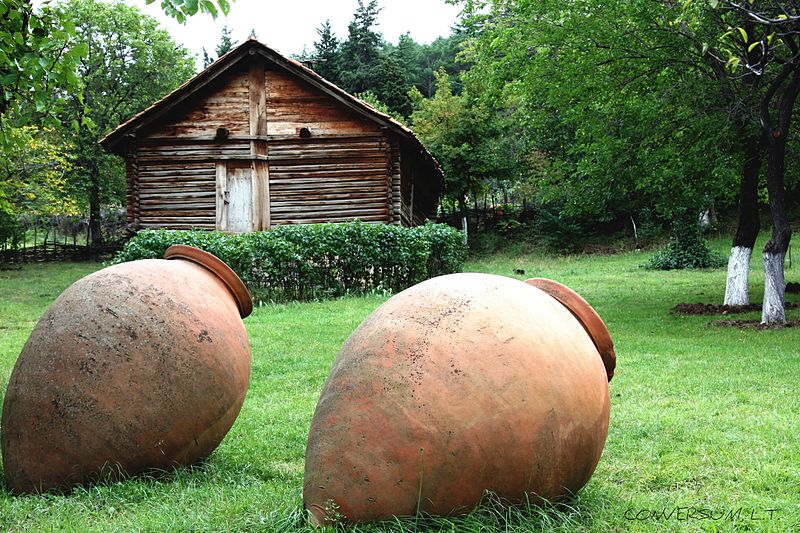
Georgian Kvevri or Qvevri wine fermentation vessels. They are typically buried in the ground and grapes are fermented, then the resulting wine is scooped or suctioned out and the qvevri will be cleaned and sterilized for the next year’s vintage.
Photo by Levan Totosashvili, via Wikimedia Commons.
Qvevri are cultural metaphors, writes Keto Ninidze, Kiknavelidze’s great-granddaughter and a Georgian winemaker, in an email. Much like how someone might give birth to a child, she says, qvevri give birth to wine. And after many years of giving life, the qvevri were used as a burial place. “So in Georgian cultural perception, [qvevri are] regarded as the cycle of life and death,” she says.
Georgia has the oldest wine culture in the world, and little changed from the earliest qvevri to Ninidze’s qvevri. Everything — down to the shape of the clay pots, the method of burying the qvevri, and letting crushed grapes ferment naturally inside — is passed down from generation to generation. When the Soviet Union took control of the country in 1921, this ancient winemaking tradition was pushed underground, where it almost disappeared. During these years, Georgian winemakers lost their land or had to give over all of their grapes every harvest. If they wanted to make their own wine, they’d have to forage grapes from wild vines on hillsides, in forests, and sometimes on the sides of village streets.
Before the Soviet Union imposed their rule on Georgia, though, more than 500 different grape varieties flourished in the country’s moderate climate, tempered by its proximity to the Black Sea. Thanks to the environment, wine grapes grow without much intervention. Back then, most grapes were picked by hand and crushed by foot. The juice, skins and stems and all, were then put into qvevri.
[…]
For around six months, natural yeasts ferment the juice inside the pots. The solid parts of the grapes filter the liquid, which funnels naturally towards the bottom. Once fermentation is over, the wine is suctioned or scooped out and bottled. Or, more likely, it’s stored in smaller pots. Then the cleaning process begins. The tools of the trade have upgraded, Ninidze says, and winemakers now wash qvevri with high pressure water, ash, and citric acid, then disinfect the vessels with sulphur smoke. What hasn’t changed is the immovability. Qvevri is “something you can’t take from one place to another,” Ninidze says, adding that once a winemaker chooses a spot for their qvevri, they’re rooted there until they pass it on or buy new qvevri.
This process didn’t budge for years. Then, the Soviet Union invaded and annexed Georgia in 1921. The slow, natural qvevri cycle — an extension of the Georgian lifestyle — didn’t fit Joseph Stalin’s five-year economic plans. These plans set economic goals and called for industrializing industries, including wine. Rural winemaking would need to be mechanized, and the wild-looking vines would need to be tamed. In the region of Kakheti, officials uprooted more than 500 native varieties. Steel tanks replaced the storied underground clay pots, too.
The government then redistributed and repurposed the annexed land previously used for wine, and built sterile buildings on top of them. “You see these Soviet buildings everywhere that are sturdy cement and nothing beautiful about them, but very practical,” Railsback says. “And then the Georgian [buildings] are more beautiful, and the architecture is really unique with hand-carved woodworking on the front of houses. There’s the Georgian look, and there’s the Soviet [look] that tried to demolish the culture and vibe — you feel that literally everywhere.”
During that time, families were given a single acre of land compared to the full vineyards they once tended to alongside their homes. Vines were ripped out and replaced with tidy rows of hardy, high-yielding varieties such as Saperavi and Rkatskeli. While they were plentiful and certainly sweet, they were bland and lacked the character of traditional Georgian vines. “There was one or two state factories that [processed] the whole yield of the country,” Ninidze says. “The production policy was of course industrial (especially after Stalin’s period), based on the five-year plans and neither the factories nor the farmers cared [about] the quality of the grape.”
Comments Off on How Georgian wine survived the Soviet Union and its central planners
May 31, 2018
QotD: Difficulties in using self-reported data
Nick Cohen, over in the Guardian, is busy telling us all that we must drink less and that Scotland raising the minimum price of alcohol (hitting poor people’s cheap cider and bargain booze, but not directly affecting craft lagers, appellation d’origine contrôlée wines and artisan gin) is a Good Thing because the industry makes its profits by exploiting addicts who are drinking themselves to death en masse.
It is a truth universally unacknowledged that, like drugs cartels, the drink industry makes most of its money from addicts. It thrives on hooked customers, who put boosting the brewers’ profits before their and their families’ health and happiness. Sixty per cent of alcohol sales – worth £27bn a year in England – are to “increasing risk” drinkers taking more than 21 units of alcohol a week, in the case of men (about 10 pints or two bottles of wine), and “harmful” drinkers taking more than 50… Twenty one units (14 for women) does not sound much in my world of journalism, but it is a sign of people who cannot go a day without a shot of their drug, which is as good a definition of an addiction as any.
Now, there’s a question there about who decided what that “risk” was and how large it was. Cohen gets into the Salvation Army-style temperance-league apocalyptic warnings about the horrors of heavy drinking and warns that by the time you’re knocking back fifty units a week (for men, thirty-five for women) you’re undergoing “full degeneration”.
But is that based on any firm evidence? One interesting study, reassuring to the toper, can be found here, which among other things makes the gentle point that since we either under-report what we consume, or we pour away half of the booze we buy undrunk, planning policy on what we admit to consuming may not be accurate.
Jason Lynch, “How Much Is ‘Too Much’?”, Continental Telegraph, 2018-05-08.
Comments Off on QotD: Difficulties in using self-reported data
April 14, 2018
Alcohol and health – if you torture the data long enough, it will give you the answer you want
Tim Worstall isn’t convinced that a recent study summarized in The Lancet is either honest or useful:
We have a new study out, in the Lancet no less, telling us that the new, lower, limits for reasonable alcohol consumption are just right. Well, of course the report says that, right? The problem being that it’s entirely contrary to the more general experience we’ve got of booze consumption. For, yes indeedy, there’s a level of drinking which will – as always, on average – shorten life. But our experience to date is that it’s several times what is the current measure of safe consumption. This basic understanding of ours being that no booze lowers lifespan, too much lowers it, a modicum increases it. The argument being the definition of modicum of course.
Observation of large populations being that modicum is anything from some up to perhaps 40 or even 50 units a week. This isn’t what the current study shows at all […]
I’m not in any manner a medical expert but that does look odd. 5 million observation years on half a million people, looks like 10 years on average per person. They’re using this to predict lifespan at age 40? When lifespan at 40 is, these days, a further 40 to 50 years or so? OK, maybe there’s some sekkrit decoder ring for epidemiologists here but anyone want to try and explain it?
Ah:
We focused our study on current alcohol drinkers
So the comparison doesn’t include those who don’t drink. We’re not therefore getting a baseline of no alcohol consumption to compare with. That is, by design, the study excludes the known to be higher death rates (or lower lifespans) of the temperance types. No, really:
Third, never-drinkers might differ systematically from drinkers in ways that are difficult to measure, but which might be relevant to disease causation.
Our more general stats do indeed say that heavy drinkers (that 40 to 50 unit level perhaps) and never drinkers have about the same lifespans. Quick, gotta exclude that information, eh?
As far as we’re concerned that’s probably enough. We’ll see what Snowdon has to say about it, shall we? Because this finding is contrary to pretty much everything else we know about booze consumption. Explaining why it is will be important.
Update, 15 April: It’s no wonder that people are confused about the benefits and/or drawbacks of drinking…
What you end up with when drawing strong conclusions based on non-experimental data with selection bias, lots of measurement error and dodgy comparison groups. (h/t: @RadaWilinofsky) pic.twitter.com/iUZQbTh6sB
— Amir Sariaslan (@AmirSariaslan) April 14, 2018
Comments Off on Alcohol and health – if you torture the data long enough, it will give you the answer you want


