Quotulatiousness

April 7, 2011

When to drink a wine

Filed under: Media, Quotations, Randomness, Wine — Tags: — Nicholas @ 09:26

Michael Pinkus tries to answer the inevitable question “When should I drink this wine?”

What I find myself telling people-who-ask sounds like a huge cop-out. I end up turning it around and asking them whether they like their wines fresh and fruity or with a little age on them, edging more towards the dried fruit or foresty floor.

Truth is, most people prefer their wines to have fruit rather than floor, which explains why new world producers, especially those in Chile, Argentina and Australia, do so well, their fruit is fresh, full and mouth-filling, especially at the time when most people drink them. Studies have shown that 90% of all wine is drunk within 24 hours of purchase, and 95% within 48 hours. That means that only 5% of you are lying your wines down for any length of time. That also means that you’re missing out on the best part of wine, its never-ending change-ability.

I trust that most of you have seen the movie Sideways — I seem to stick it into the DVD player (now Blu-ray) every year, it’s like catching up with old friend (granted they seem stuck in a Groundhog Day-like cycle — but until a sequel comes along I’m stuck with them). Anyway, I’m not ruining anything (for those who haven ‘t seen it) when I quote Maya here on the allure, and never-ending change-ability, of wine:

“It’s a living thing.” She begins. “… I like how wine continues to evolve, like if I opened a bottle of wine today it would taste different than if I’d opened it on any other day, because a bottle of wine is actually alive. And it’s constantly evolving and gaining complexity. That is, until it peaks … And then it begins its steady, inevitable decline.”

It’s rare for me to open a bottle of wine within 48 hours of purchase, unless I’m travelling, but I’ve seen this stat quoted frequently. I think it’s sad that so many people are missing out on the (in my opinion) greater pleasure of tasting wines that have been given an opportunity to mature. On the other hand, 90% of the wine that is made today isn’t intended to mature: wine makers respond to economic incentives just as much as everyone else does, and if that kind of wine sells well, that’s what they’ll end up producing.

March 23, 2011

Latest outlet for excess Chinese investment money: Bordeaux wineries

Filed under: China, Economics, Europe, France, Wine — Tags: — Nicholas @ 07:53

Running out of interesting investment opportunities? Some Chinese investors are moving into French wineries:

Walking among the ancient vines at Château de Malle, De Bournazel said many families struggled to make ends meet. “Nobody sells for pleasure, but you would struggle to find a chateau that wouldn’t sell for the right price. It’s sad, but I’d rather see families sell to the Chinese than tear themselves apart trying to keep a property.”

Rather than being viewed as conquerors, Chinese wine buyers are seen as saviours of the region — last year China overtook both Germany and the UK to become Bordeaux’s biggest customer, with exports growing by 67%. Bernard Farges, president of the Conseil Interprofessionnel du Vin de Bordeaux (CIVB), the body representing its wine growers and buyers, said Chinese investors buying vineyards would boost exports further.

“These are businessmen who believe in their investment, who are opening doors to a new market and ploughing money into properties to make great wine,” he said.

Others argue that the Chinese are simply the latest in a long line of foreign investors — including the Dutch, the English and the Danes — in Bordeaux.

That last part is certainly true: although you may not realize it, many of the wineries in the Bordeaux region have been foreign-owned for generations. The nationality of the foreign owners may change, but the principal is the same.

Of course, regardless of ownership, if the investors don’t maintain the property, they risk ruining their chances of benefitting from the purchase:

Not everyone is supportive of this new breed of Bordelais. Patrick Etineau recently sold Château de la Salle to a Chinese investor amid a storm of acrimony. “I found them very condescending,” he said. “They have the money and they think we are in penury.”

He says since the chateau was sold in January the vines have been left largely untended. “I was happy to sell, because I couldn’t maintain the property, but now I have the impression that they don’t care at all. We used to make beautiful wine, but this year I fear it will only be fit for the pigs.”

March 12, 2011

Drinking is good for you, but we still don’t know why it’s good for you

Filed under: Health, Science, Wine — Tags: , , — Nicholas @ 14:17

Moderate drinking (defined as 2-3 drinks per day) is proven to be healthy for most people, but the jury is still out on why it’s good for you:

Scientists say that more research needs to be done to understand why alcohol may be beneficial in small doses. Most commonly, evidence shows that alcohol is associated with increased cardiovascular health. Researchers at the University of Calgary recently analyzed data on alcohol consumption and heart disease and determined that those who drink one to two glasses of alcohol per day are up to 25% less likely to develop heart disease.

The team, lead by Dr. William Ghali, found that moderate drinking led to higher levels of “good” cholesterol and a decrease of a chemical responsible for blood clotting. It doesn’t matter if the booze is from Chateau Mouton-Rothschild or Labatt’s; “it does appear to be alcohol itself that is causing these favourable outcomes,” Dr. Ghali, a professor of medicine at the university, said.

February 27, 2011

Sunday book post

Filed under: Books, Economics, History, Media, Military, Wine — Tags: , , , , , — Nicholas @ 10:09

No, not my books: I’ve written lots, but they’re all technical manuals for software products the vast majority of you will never have heard of, and wouldn’t want to read about even if you had. I mean books I’ve read recently that I consider to be very good. I’ll categorize for convenience (both yours and mine):

Science Fiction and Fantasy

  • Darwin’s Watch: The Science of Discworld III, Terry Pratchett, Ian Stewart and Jack Cohen. An entertaining romp through (real) science placed within a fictional context. I read the first Science of Discworld book and quite enjoyed it, and this one is possibly even better. The Discworld, riding happily balanced on the backs of the four great elephants, who are in turn supported by the shell of the great turtle, has very different scientific principles than our own “exotic” roundworld. The most amusing part of the book is the wizards of the Unseen University attempting to ensure that Charles Darwin writes the “correct” book on roundworld. You’ll learn more science than you expect . . .
  • I Shall Wear Midnight, Terry Pratchett. The fourth of the Tiffany Aching sequence in the Discworld series. Although written for a younger audience, Pratchett’s sense of humour and brilliant presentation make this book eminently readable for all ages.
  • Cryoburn, Lois McMaster Bujold. The latest adventure of Miles Vorkosigan deals with the political and social implications of cryogenic preservation. No soaring battles in space, no stunner shootouts, no alien invasions. Sounds deadly dull, I realize, but I don’t think Lois could write a boring shopping list. It perhaps doesn’t stand alone quite as well as it might, but even if you haven’t read any of the other books in the series, I think you’ll find this worth reading.

History

  • The Canadian Army and the Normandy Campaign, John A. English. A book that undermines several widely held beliefs about the efficiency and capability of the Canadian First Army in 1944-45. Between incompetent, scheming generals and political interference, the Canadian Army was less than the sum of its parts, and the importance of training methods and doctrine are highlighted (that is, the faulty training methods in use probably added to the casualty lists in combat). Field Marshal Montgomery didn’t like or trust General Harry Crerar, but was forced to keep him in command due to Canadian government sensitivities. Montgomery’s view of Crerar almost certainly was reflected in the roles assigned to First Canadian Army after the Normandy landings.
  • The Grand Strategy of the Byzantine Empire, Edward N. Luttwak. A fascinating book about the differences between the Byzantine empire’s military and political goals and practices and those of the Roman empire from which it descended. Unlike Rome, the Byzantines were never the “superpower” of their part of the world, and their survival often depended on carefully constructed alliances, allies-of-convenience, and outright bribery of “enemies of their enemies”. Although not well remembered in the west, the survival of Byzantium almost certainly saved central Europe from conquest by the armies of the Caliph during the initial expansion of the Muslim empire. Byzantine armies rarely had much technological or doctrinal advantage over their opponents, so war had to be conducted with the key concept of retention of force: ambush, raid, counter-attack, feint, and misdirection became specialties because they offered (relative) effectiveness at lower risk of outright defeat.
  • In the Name of Rome: The Men Who Won the Roman Empire, Adrian Goldsworthy. A selection of mini-biographies of some of the greatest generals of the Roman empire. What is amazing, in reading about some of their careers, is how little actual military instruction Roman officers received, yet how effective the army could be in spite of that. Being an army officer was viewed as just part of the normal public service — in fact, it would have been problematic for a Roman patrician to remain with the army for an extended period of time, as it would slow down his progress through the civil government ranks.
  • The Defence of the Realm: The Authorized History of MI5, Christopher Andrew. If you wanted a thrilling account of the exciting and dangerous life of counter-espionage, you need to stick to works of fiction. The actual life of an MI5 officer is apparently much less James Bond and much more careful investigation, observation, and data correlation. Not that it isn’t an interesting career, but perhaps the “double oh” agents will get their own book (just kidding).

Economics

  • The Ascent of Money, Niall Ferguson. I enjoyed reading this one far more than I expected to: the author has a knack for carrying you through the less interesting bits without boring or lecturing you. The evolution of the modern monetary system, and the heroic roles played by unlikely characters in the process.
  • The Rational Optimist: How Prosperity Evolves, Matt Ridley. It’s easy to find depressing statistics and dreary anecdotes. Ridley’s view is that progress is a good thing, and that we’re enjoying a golden age even if we don’t realize it right now.

Biography

  • Robert A. Heinlein: In dialogue with his century Volume 1, William H. Patterson, Jr. I’ve been a huge fan of Heinlein’s works since I read Starship Troopers at about age 11. This biography more than met my expectations: I’d always regretted never having met Robert Heinlein, but between this book and Heinlein’s own autobiographical writings (Tramp Royale and Grumbles from the grave) I feel I’ve gotten as close to knowing him as possible — until the publication of Volume 2, anyway.
  • Thomas Paine’s Rights of Man, Christopher Hitchens. A lively appreciation of Thomas Paine’s most influential work, and much detail on his life. Paine was far from being the disreputable bomb-throwing anarchist his enemies painted him to be, but he also wasn’t the plaster saint his fans might imagine.

Wine

  • Billy’s Best Bottles: Wines for 2011, Billy Munnelly. Still the best annual wine guide for the everyday wine drinker in Ontario. If you like an occasional bottle of wine, but don’t want to study dozens of books in order to make a decision on what to buy, this is the book for you. He likes more “rustic” wines than I do, so I don’t find his recommendations in that category to be as useful, but he does a great job of sorting through the plethora of $10-20 wines available at the LCBO and tells you which ones are worth buying (and when to serve them).

February 24, 2011

Ontario’s wine industry: stupid from 2007?

Filed under: Cancon, Wine — Tags: , , , — Nicholas @ 12:15

Michael Pinkus has more than a couple of bones to pick with Ontario wineries:

This is what I wrote while sitting at my table just minutes after my Cuvee pre-tasting:
“Here I sit tasting the wines from the fruit of the labour of Ontario winemakers for the 2011 Cuvee media pre-tasting … It is here we taste what the competition organizers and judges have deemed the best. Actually let’s get more specific, before us is one wine from each winery that entered the competition and we are told “These wines represent each participating winery’s top scoring wine from the Cuvee judging held in January”. In other words these are the top scoring wines from each individual winery’s submission … 62 wines in total. [. . . A few] were fantastic, well made wines worthy of their price (especially the Pelham which was an absolute steal at $24.95). But then there were others, whom I will not mention here by name but instead by price: a $45 Reserve Cabernet Franc, a $45 Cab-Merlot, a $55 Red Blend, a $40 Reserve Franc and a $35 Red Blend, that should all be ashamed of themselves for unleashing sub-par quality at astronomical prices. I’m talking about sub-par wines at above par prices for what the consumer is getting. This is not just about hurting the individual winery’s reputation but also, as one colleague pointed out to me, Ontario’s reputation as a whole. It’s time to stop trying to get all your money back at one shot — this is a long term investment people, and a tough one at that.

[. . .]

I was prepared to post that on the blog and just walk away (in effect, putting my own head in the sand) letting the chips fall where they may, but then it started to eat at me more and more. I want to keep writing about his industry, but what can I say? The final straw happened two days later at the bi-weekly media LCBO Vintages tasting and I have to admit to you I was appalled by a few of the Ontario wines being offered. I hopped on the train back home and found myself thinking about both tastings and penned the following:

I have been gentle on some of you over the years but seriously if these wines represent the best Ontario has to offer, give me a break. If the wines I tried at the Cuvee preview are some of the best wines wineries have to offer, then some wineries are in BIG trouble: (what was with that nasty-ass Merlot Icewine?). Don’t care what they submit: (a flat, flabby, bland Sauvignon Blanc, is that really what your winery does best?). Have given up: (a Gewurzt that has no Gewurzt characteristic to it what-so-ever). Are not paying attention: (a fume blanc so heavy handed on the fume that there was no fruit at all). And are just wasting grapes: (a poor excuse for an ’07 made with Franc and Sauv, an ’07!!!).

Two days later, at the LCBO Vintages tasting (for the March 19, 2011 release) I had to pull out my best conspiracy-theory to explain some of the Ontario wines we sampled. I know full well that the LCBO isn’t trying to be helpful to the Ontario wine industry, but never did I think they would stoop to this level: the tasting included a lackluster Sauvignon Blanc and a horrible Red Blend (you know who you are) … I suggest to you that the LCBO takes some of these atrocious wines to make Ontario look bad … advertise a red, from a good vintage like 2005, for under $15, and people will buy it, sip on it and just as quickly spit it out, vowing never to buy Ontario wines again. Thanks for nothing LCBO.

I’m not saying they do that with every Ontario wine (case in point: Cave Spring Cellars 2009 Estate Gewurztraminer), but I think they throw in a ringer every-so-often just to screw with their major competition, the wineries. Am I just paranoid? Well find out for yourself, buy each and every Ontario wine that comes thru Vintages and you tell me they are in the caliber claimed by the Board’s Vintages website: “the fine wine and premium spirits business unit of the LCBO. Our experts shop the world for fine wine and premium spirits of exceptional value.” Now, not every wine is to everybody’s taste you’ll say — true — but some of those wines the board tries to pawn off as “fine” are only fine for salad purposes and that’s all. I don’t buy this argument. As they say on ESPN NFL Football broadcasts, “C’mon Man”, this just ain’t happening.

Sturgeon’s Law claims that “Ninety percent of everything is crap”, and that applies to wine just as much as it does to novels. A big difference for wine is that even the crap is far better than it was just ten years ago. Nowadays, a crap wine is merely boring, not undrinkable as they once were. But that being said, Michael’s comments are worth paying heed — Ontario’s wine industry has problems galore from nature (cool climate wine production but a customer base accustomed to imported hot climate wines), legal obstacles (Ontario still treats wineries as if they produce radioactive waste, not wine), and the normal exigencies of competition: there’s no need to compound these problems with avoidable ones like poor quality control or (as Michael suggests) contempt for their customers.

February 12, 2011

A bad day at the wine store

Filed under: Randomness, Wine — Tags: — Nicholas @ 10:08

H/T to Elizabeth, who sent me the link with the subject line “Don’t cry”.

February 11, 2011

Reif produces first Canadian raisins

Filed under: Cancon, Food, Randomness, Wine — Tags: — Nicholas @ 07:14

I always figured that we were too far north to produce raisins, despite our large-and-growing grape crops. Just because it was widely thought doesn’t mean it’s true:

“Originally, the idea was to make an appassimento-style wine that involves the drying of grapes that is common in a region of Italy where they make Amarone-style wines,” explains Reif Estate winemaker Roberto DiDomenico. DiDomenico and Reif Estate owner Klaus Reif, a 13th-generation winemaker who immigrated from Germany in the early 1980s and bought his uncle’s Niagara winery in 1987, had some contacts in Simcoe’s tobacco country. “We learned that there would be some kilns available as the tobacco industry has been waning,” says DiDomenico. They purchased two refurbished kilns that were shipped up to Reif Estates in the spring of 2009. And that’s when the process began. Almost. Explains Reif, “Our grapes that we use for the appassimento winemaking process were not yet ready, so we had these two kilns sitting here and we thought, what should we do with them now?”

Wine is made from grapes with seeds while raisins are generally made from seedless grapes. Niagara is wine country, but as luck would have it, a friend of Reif’s, John Klassen, who grows table grapes for supermarkets, happened to stop by the winery for a visit. “He was telling us that his grapes were ripe, but the supermarkets didn’t want them anymore,” says Reif. With those plump, juicy Sovereign Coronation grapes destined for the birds, Reif said, “Bring them in; we’ll try to make raisins.” (While most raisins are made from green grapes, these Niagara raisins are made from red grapes.) DiDomenico and Reif put the grapes in the tobacco kilns for three to four weeks to raisin-up.

February 10, 2011

Reason.tv responds to Hillary Clinton

Filed under: Economics, Law, Liberty, Politics, Wine — Tags: , , , — Nicholas @ 12:55

January 24, 2011

Investing in fine wine doesn’t diversify your portfolio

Filed under: Economics, Wine — Tags: , — Nicholas @ 08:31

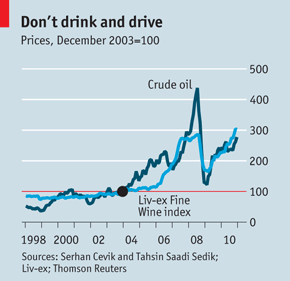
Following up to this post, The Economist agrees that fine wine tracks too closely to the price of oil to offer much diversification for investors:

A bottle of Château Pétrus ’82 can cost over $5,000, whereas the equivalent volume of crude oil sells for less than 50 cents. Château Brent may taste a tad rough, yet fine wine and crude oil have more in common than you might think. Their prices have risen and fallen in step in recent years (see chart).

Wine experts usually explain price movements by supply-side factors such as the effects of the weather and age, but research by Serhan Cevik and Tahsin Saadi Sedik, economists at the IMF, finds that supply has only a small impact on prices. Instead, fast economic growth in emerging economies has been much more important in recent years — as is the case for oil and other commodity prices.



Between 1998 and 2010 there was a correlation of over 90% between changes in oil and wine prices.

January 15, 2011

Fine wine as an investment

Filed under: Economics, Wine — Tags: , — Nicholas @ 09:54

While I personally think wine is a terrible choice for an investment vehicle, I’m at odds with a lot of people with more money than sense who choose to diversify their investments to include fine wine. However, it may not be the best kind of diversification:

The search for safe investments and risk hedging has apparently led some in recent years to start investing in fine wines. “In the past, one of the attractions of fine wine as an asset was its non-correlation with mainstream financial markets,” wrote the Financial Times‘ John Stimfig in 2009. “This provided investors with valuable portfolio diversification.” What could be less closely linked to the Fed funds rate than whether or not it was a good year for Bordeaux? But now the FT reports that a new paper by two IMF economists, Serhan Cevik and Tahsin Saadi Sedik, says that if this were ever true, it’s not anymore. Fine wine prices are just like oil, they find: they go up or down depending on how the rest of the economy is doing.

January 12, 2011

Armenian discovery may be earliest winery

Filed under: History, Wine — Tags: , — Nicholas @ 01:47

A recent find in Armenia shows evidence of grape pressing, vine cuttings, and fermentation vessels. It may be the earliest winery ever discovered:

While older evidence of wine drinking has been found, this is the earliest example of complete wine production, according to Gregory Areshian of the University of California, Los Angeles, co-director of the excavation.

The findings, announced Tuesday by the National Geographic Society, are published in the online edition of the Journal of Archaeological Science.

“The evidence argues convincingly for a wine-making facility,” said Patrick McGovern, scientific director of the Biomolecular Archaeology Laboratory at the University of Pennsylvania Museum in Philadelphia, who was not part of the research team.

I don’t know how far back it goes, but the evidence at this site shows that even 6,000 years ago, Vitis vinifera vinifera was the best choice to turn into wine.

December 16, 2010

Wine pricing: the trade-off between quality and prestige

Filed under: Economics, Randomness, Wine — Tags: — Nicholas @ 13:02

I haven’t actually listened to the Freakonomics podcast on whether expensive wines taste better, but I suspect the answer will be “no”.

I’ve been interested in wines for quite some time now, but I’ve found something that caps the amount of money I’m willing to pay for a bottle of wine to well under $100. Either my palate is insufficiently developed to taste the differences between a $40 wine and a $90 wine, or there really isn’t that much difference.

For most people, most of the time, once you get above the bargain-basement level of wine, you can usually find good, flavourful wine for between $15 and $20. What you may not be able to find is a wine in that price range that will impress your date or your guests. If you’re trying to impress, price will have to be one of the most important part of your decision: fewer people will be as impressed by your really good bargain as will be impressed by the big ticket bottle of “Chateau de Fancy French Name” . . . even if they taste the same.

Believe it or not, the most dominant flavor may be the dollars. Thanks to the work of some intrepid and wine-obsessed economists (yes, there is an American Association of Wine Economists), we are starting to gain a new understanding of the relationship between wine, critics and consumers.

One of these researchers is Robin Goldstein, whose paper detailing more than 6,000 blind tastings reaches the conclusion that “individuals who are unaware of the price do not derive more enjoyment from more expensive wine.”

So why do we pay so much attention to critics and connoisseurs who tell us otherwise?

That’s the question we set out to answer in this podcast.

December 14, 2010

Megan McArdle’s annual Kitchen Gift Guide

Filed under: Food, Randomness, Wine — Tags: — Nicholas @ 07:50

I don’t cook, except for very basic things, so this isn’t the sort of list I’d be able to compile for myself. Megan has been doing it for several years:

Yes, it’s that time of year again. Back by popular demand, expanded with the accumulated bounty of one moderately large wedding, it’s the kitchen gift guide. As usual, I am organizing by price, since everything on this list is something that I specially like having. [. . .]

Butter boat This uses evaporative cooling to keep butter at room temperature without spoiling. There’s a well for water, and then a butter dish that rests on top of it, and slowly wicks water through the ceramic. The upshot is that as long as you change the water every few days, you can keep butter in the dish for weeks — longer than a stick of butter usually lasts in our house, anyway. I have two, a white one for unsalted, and a green one for salted. It’s really a nice little present — who doesn’t like nice, soft, fresh-tasting butter?

We’ve got a couple of these, and they’re very useful . . . when we remember to refill them after using up the last of the current stick of butter.

Rabbit Corkscrew I’m a big fan of this — it makes opening a wine bottle basically foolproof. I feel it’s especially good for people who are losing hand strength, although you might also want to consider an electric corkscrew, which gets decent reviews. We’re also extremely pleased with the wine aerator that a friend got me for a bridal shower gift; it allows you to rapidly aerate red wine that you don’t have time to decant, improving the flavor. It would be a lovely gift paired with a corkscrew.

I’ve heard mixed reviews about the Rabbit — some people really love them, while others think they’re vastly overrated. I’m still happy with a simple lever-style corkscrew I picked up at the Williamsburg Winery on a trip to Virginia several years ago. The aerator is a good idea for those of us who don’t remember to decant the red wine far enough in advance. It won’t miraculously change the quality of the wine, but it will make up for a bit of the time you forgot to allow it to have for breathing.

December 9, 2010

QotD: Ontario’s “restrictive, puritanical, liquor laws”

Filed under: Bureaucracy, Cancon, Law, Liberty, Quotations, Wine — Tags: , , , , , — Nicholas @ 00:20

Later in the trip we were at a Napa Valley winery. During our winery tour, the guide mentioned that if we filled out an order form we could have a case of wine delivered to home or office. Then she stopped, looked at my friend and me, and said, “Oh wait, not to Ontario. You guys are worse than Utah.” She proceeded to list all the countries they ship to, two of which have majority Muslim populations. But Ontario was too much trouble, so they gave up trying. We could buy the wine and bring it over the border ourselves, but if it were to be shipped across the border it would clearly be illegal.

Our restrictive, puritanical, liquor laws are not just limited to restricting products or preventing private stores from selling alcohol. On our trip it became a running joke to point out things that were banned in Ontario. Happy hour is illegal in Ontario. I pointed to a seasonal winter beer in at a convenience store with a cartoon picture of Santa Claus on the label and noted it would be banned in Ontario. There is cheap beer across the U.S. because of intense competition, but Ontario has a price floor of $1.07 per bottle.

So I pose the question that I was asked in the bar in San Francisco. Why are we so puritanical when it comes to alcohol?

Hugh MacIntyre, “Ontario’s liberalism dies at the brewery door”, National Post, 2010-12-08

November 13, 2010

QotD: Drinker’s lesson

Filed under: Humour, Quotations, Wine — Tags: , — Nicholas @ 14:00

In “real life”, Amis was a no-nonsense drinker with little inclination to waste a good barman’s time with fussy instructions. However, there was an exception which I think I can diagnose in restrospect, and it is related to his strong admiration for the novels of Ian Fleming. What is James Bond really doing when he specifies the kind of martini he wants and how he wants it? He is telling the barman (or bartender if you must) that he knows what he is talking about and is not to be messed around. I learned the same lesson when I was a restaurant and bar critic for the City Paper in Washington, D.C. Having long been annoyed by people who called knowingly for, say, “a Dewar’s and water” instead of a scotch and water, I decided to ask a trusted barman what I got if I didn’t specify a brand or label. The answer was a confidential jerk of the thumb in the direction of a villainous-looking tartan-shaded jar under the bar. The situation was even grimmer with gin and vodka and became abysmal with “white wine”, a thing I still can’t bear to hear being ordered. If you don’t state a clear preference, then your drink is like a bad game of poker or a hasty drug transaction: It is whatever the dealer says it is. Please do try to bear this in mind.

Christopher Hitchens, “The Muse of Booze”, Everyday Drinking: The Distilled Kingsley Amis, 2008

« Newer PostsOlder Posts »

Powered by WordPress