
In “real life”, Amis was a no-nonsense drinker with little inclination to waste a good barman’s time with fussy instructions. However, there was an exception which I think I can diagnose in restrospect, and it is related to his strong admiration for the novels of Ian Fleming. What is James Bond really doing when he specifies the kind of martini he wants and how he wants it? He is telling the barman (or bartender if you must) that he knows what he is talking about and is not to be messed around. I learned the same lesson when I was a restaurant and bar critic for the City Paper in Washington, D.C. Having long been annoyed by people who called knowingly for, say, “a Dewar’s and water” instead of a scotch and water, I decided to ask a trusted barman what I got if I didn’t specify a brand or label. The answer was a confidential jerk of the thumb in the direction of a villainous-looking tartan-shaded jar under the bar. The situation was even grimmer with gin and vodka and became abysmal with “white wine”, a thing I still can’t bear to hear being ordered. If you don’t state a clear preference, then your drink is like a bad game of poker or a hasty drug transaction: It is whatever the dealer says it is. Please do try to bear this in mind.
Christopher Hitchens, “The Muse of Booze”, Everyday Drinking: The Distilled Kingsley Amis, 2008
November 13, 2010
QotD: Drinker’s lesson
November 11, 2010
Chinese wine buyers get all-VQA store that Ontario wine buyers can’t have
I’m all in favour of improving the visibility and availability of Ontario’s VQA wines in other markets, so this news is both good and infuriating simultaneously:
A couple of weeks ago the Government of Ontario announced the opening of an all-VQA wine store in China (in the city of Zhengzhou, the capital of Henan Province). Oh happy day — now the Chinese can drink (and copy) all the Ontario icewine they want . . . but this begs the question: why should the Chinese have an advantage that we Ontarians do not? Do the Chinese drink more Ontario wine? Why is it so important that China get the opportunity to drink Ontario wines that folks in Thunder Bay, Sault Ste. Marie and Sudbury can not?
I have nothing against the Chinese getting their hands on our wine; I’m glad to see a country embrace our wines as so many of us have embraced their food. But seriously, why should folks living in China have more and better access to Ontario wines then those of us living in the actual province. When I first heard the news, all I could say was an incredulous, “Seriously?” Has Ontario really become, as wine writer Dean Tudor puts it, every time he mentions Ontario, “a have not province”? When it comes to our own wine industry it keeps getting more and more “have not” and won’t get.
See what I mean? Great that they’re opening outlets in a new foreign market, but we still can’t get that kind of opportunity to buy here at home? All-VQA stores have been discussed (and rejected) before, but they’re apparently a great idea for foreign markets.
Update: Fixed the broken link.
October 29, 2010
Why some vintage dates matter more than others
If you’re not a wine fan, you may wonder why wine snobs pay so much attention to vintage dates. If you drink the occasional bottle of “Raunchy ‘Roo Red” or “Zesty Zebra Shiraz”, the vintage dates matter very little: by the name, you’d guess they’d be from Australia or South Africa, both hot climate wine countries. Vintage dates are much less important for hot climate wines: the variation from year to year is relatively small. As Michael Pinkus points out, however, it matters a great deal for cool climate wine countries:
Many wine drinkers never notice the vintage date on the wine they are drinking — they just blindly go off buying wine. I talk to many people and very few know what year they’re drinking, just the producer. In a wine region like Ontario that’s a odd way to be drinking your wine. We’re a cool climate region after all and if you don’t understand the difference between a good vintage wine a mediocre vintage wine you could be stuck with a lot of 2003s in your cellar for 10 years or more. The key is to know their drink-ability (2003) or conversely, know how long you should be holding onto wines like [these], a few extra years of aging will give these wines time to mature and integrate, drink them too early and you’ll miss out on all the fun.
In a cool climate region (Ontario, Bordeaux, New Zealand) Vintage date means more than in a hot climate region (Australia, Argentina, Chile) — there temps are always beautiful (read: warm and sunny) and vintage variation plays little part in the finished wine; while in a cool climate region harvest is a waiting game and in many years prayer is a grape farmers best friend.
Take 2010 for instance, this year has the likelihood and pedigree to be even better than the much lauded 2007. What makes 2010 better? Glad you asked. While 2007 had lots of heat and little rain (which grapes love), 2010 has been a longer growing season, with lots of heat and rain has come at the “appropriate” times. If you’ll recall our winter was very mild and bud break occured in April, at that time the prayer for farmers was the ‘Psalm of No Frost’. A longer growing season with lots of heat means good grapes — but that does not always apply to all grapes, but that’s really a discussion for another time.
Most determine a good season by how well the red grapes are going to be — in a cool region white grapes grow well year-after-year — but many of the Bordeaux red grapes struggle (Merlot, Cabernet Sauvignon and Cabernet Franc). 2007 was a great year for the usual Bordeaux varietals as well as others reds that don’t often ripen fully under the Ontario skies.
October 11, 2010
Have a drink – it won’t make you fat
In another positive move for wine fans, another study of women’s health shows that wine doesn’t make women fat:
Researchers found that regular moderate female drinkers were less likely to become obese after a 13 year study of more than 19,000 women.
The finding seems to contradict received dietary wisdom which has it that alcohol consumption leads to weight gain.
The body may use calories from alcohol in a different way from other foods which affects weight gain, doctors said.
It is thought that alcohol is broken down by the liver using a different metabolic pathway to create heat, rather than fat.
So don’t feel guilty about that glass of wine with dinner!
October 5, 2010
The next stage of wine competition?
Kim Willsher reports on a new device to measure the levels of antioxidants in red wine:
The matchbox-size device can measure antioxidants in a drop of wine placed on a test strip and is expected to sell to wine producers for around €2,000 (£1,720). The Swiss manufacturers Diagnogene are planning a model for wine drinkers. “I can absolutely see people choosing to buy one wine over another because they can see it is healthier for them,” said Hoda. “It will also help producers make wine with more polyphenols. We know these antioxidants come from the skin of the grapes, that red grapes are better than white, and that the levels can be determined by the length of fermentation and other factors.”
He said the Swiss pilot test had revealed pinot noir grapes to have the greatest health benefits. “Let’s be honest, it must be better to have a glass of wine than to take a pill. Within moderation, of course.”
Claims for the positive properties of wine — particularly red — on the heart and brain have long been made and not only by French bons vivants. In 2006 a study by British scientists published in Nature said: “Regular, moderate consumption of red wine is linked to a reduced risk of coronary heart disease and to lower overall mortality”.
Of course, given past experience, don’t expect regulators in Canada or the US to suddenly allow any claims of health virtue to appear on wine bottle labels. Wouldn’t want to encourage drinking, you know.
September 30, 2010
Even rustlers are going vegetarian
The scourge of the old west (at least in TV and movie representations) were cattle rustlers. Their modern counterparts are apparently grape rustlers:
Thieves in France have broken into a vineyard and stolen an entire crop of Cabernet Sauvignon grapes, say police.
They struck in Villeneuve-les-Beziers on Sunday night, taking advantage of a full moon and using a harvesting machine to seize 30 tonnes of the crop.
Farmer Roland Cavaille said similar crimes had taken place before in the Languedoc-Roussillon, one of France’s best-known wine growing regions.
He said the theft amounted to a year’s work and about 15,000 euro (£12,900).
“They used a harvesting machine to gather grapes. This means there was no need to have lots of people, two people would have been enough,” Mr Cavaille told Le Parisien newspaper.
“The area was quite isolated, it is a a few kilometres from the village and near a river. So the thieves were able to work safely.”
I’m sure there’s a joke in there about sour grapes, but I’m not clever enough to put it together.
September 13, 2010
Extensive wine list + iPad = increased profits
Since I started paying attention to wines, I’ve run into the problem that every wine novice encounters: you know too much about the cheap plonk a typical restaurant offers (and except in rare cases, it’s vastly over-priced), but you don’t know enough (or earn enough) to sample all the higher-priced offerings at better restaurants. In Ontario, where all imported wines must go through the LCBO, it’s easier to get a handle on less expensive offerings.
It’s when we’re travelling that the wine list quickly becomes a daunting trek through French, Italian, Spanish, and other producers’ wines. A possible solution is being tried out at Bone’s, in Atlanta:
Given the old-school setting, it could not seem more incongruous.
At Bone’s, Atlanta’s most venerable steakhouse, a clubby place of oak paneling and white tablecloths, the gold-jacketed waiters now greet diners by handing them an iPad. It is loaded with the restaurant’s extensive wine list, holding detailed descriptions and ratings of 1,350 labels.
Once patrons make sense of the touch-pad links, which does not take long, they can search for wines by name, region, varietal and price, instantly educating themselves on vintner and vintage.
Since their debut six weeks ago, the gadgets have enthralled the (mostly male) customers at Bone’s. And to the astonishment of the restaurant’s owners, wine purchases shot up overnight — they were nearly 11 percent higher per diner in the first two weeks compared with the previous three weeks, with no obvious alternative explanation.
I’ve been relatively fortunate in my wine ordering in restaurants in Saratoga Springs, Boston, and Charleston, but that was by careful selection to match my dinner partner’s food choices, and a bit of luck. Something like the iPad with a full wine list including tasting notes would make the task of ordering an appropriate wine much easier (and, to be honest, I’d probably be willing to spend a bit more than usual to get a more interesting wine).
August 12, 2010
Champagne serving tip
Shereen Dindar warns us that even though common sense has been vindicated on this issue, we shouldn’t get too cocky:
We now have a scientific study to confirm the widely accepted ritual of pouring bubbly down the side of a flute before drinking it actually makes sense.
Scientists in France found that pouring bubbly in an angled way and chilling the beverage in advance is best for preserving its taste, fizz and aroma.
Gérard Liger-Belair and colleagues — who published their findings in the Journal of Agricultural and Food Chemistry — studied carbon dioxide loss in champagne that was poured straight down the middle of a glass, as well as, down the side of an angled glass. They found that pouring champagne down the side preserved up to twice as much carbon dioxide.
I’m not a big Champagne fan — I don’t mind sparkling wines, but generally there are better values in Spanish Cava than in French Champagne — but no matter what your preference in bubbly, do yourself a big favour and serve your sparkling wine in the right kind of glass. Don’t use the caterer’s special — what they laughingly call a Champagne glass is almost ideally suited to producing the worst the wine has to offer. Use a proper Champagne “flute”, a tall narrow glass that concentrates the aromas (and the bubbles), not a wide, flat glass that dissipates ’em quickly.
June 24, 2010
Tempest in a wine glass
The most recent issue of OntarioWineReview included a snippet from an article originally published in Decanter on the outcome of a legal tussle between Reidel and Eisch over the term “breathable glass”:
Austrian glassmaker Riedel has declared victory in its lawsuit against its rival Eisch Glasskultur over false claims for breathable glass.
Riedel, Nachtmann and Spiegelau filed suit in Munich, Germany alleging that Eisch’s advertisement boasting ‘breathable glass’ constituted false advertising.
On 19 January the two parties agreed to settle after Eisch’s claim that its ‘breathable’ glasses were made using a secret process that ‘opens bouquet and aromas within 2 to 4 minutes’ was not supported in court.
The court ordered Eisch to cease claiming its glass is ‘Breathable’ or ‘Opens bouquet and aromas within 2 to 4 minutes’, or face penalties of up to €250,000, or imprisonment of up to six months for senior directors.
A few years ago, Elizabeth and I bought a set of the Eisch “breathable glass” wineglasses and actually tested them. I doubted the claim, as I couldn’t think of a way that glass could be altered to allow air to pass through that would not also change other characteristics like clarity. Later that evening, we sat down with our friend Brendan and tried to determine if there was any difference between the “breathable” and ordinary glasses.
It may just have been our willingness to believe, but we each thought the wine in the breathable glass was better than the same wine in an ordinary wine glass. That being said, we didn’t think the degree of improvement was enough to justify replacing all our Riedel glasses.
May 27, 2010
QotD: This isn’t what we mean by “the invisible hand”
Another Example of Your LCBO Hard at Work, Screwing You . . . If you’re feeling a pained sensation in your rear end, like a sandpaper wrapped glove entering your rectum, don’t worry fellow wine drinkers, that’s just the hand of the LCBO doing what they do best — sticking it to you. The LCBO has decided to take advantage of yet another potential money saving opportunity and has turned it into a money grab at your wallet. A recent article in the Toronto Star (“HST will lower tax on booze, but the price is going up ” – May 13, 2010) uncovered that the LCBO, instead of passing the HST savings on to you, which would have lowered the tax on booze from 12% to 8%, has decided to raise the price all in the name of “social responsibility”. Oh happy day, thank you LCBO for keeping me on the straight and narrow while lighting my pockets and lining yours in the process. Oh thank you — thank you.
Michael Pinkus, Ontario Wine Review, 2010-05-27
May 3, 2010
The end of a monopoly
Wine bottles have been sealed with natural cork for hundreds of years. It is an extremely good, natural product that has been used by almost all wine producers because it was better than every other economic sealant available. But cork has a problem that, as a natural product, it is subject to certain risks, the worst of which from a wine viewpoint was contamination with the chemical compound called 2-4-6 Trichloroanisole (usually abbreviated as TCA).
It only takes a tiny amount of TCA to ruin a bottle of wine: and it occurs naturally in the trees from which the cork is harvested. Wine producers and consumers were demanding a solution (wine writers have estimated that between 10% and 15% of all wines suffer from TCA tainting). As monopoly suppliers, however, the cork producers did very little — where else were wineries going to get their bottle closures?
Enter the competition:
By the 1990s, retailers and wineries were clamoring for a solution to wine taint but the cork industry didn’t respond. “No industry with 95% to 97% market share is going to see its propensity to listen increase —and that’s what happened to us,” says Mr. de Jesus from Amorim.
The outcry was just the opening needed by Mr. Noel, a Belgian immigrant who in 1998 began making what he calls “corcs,” he says in part to avoid lawsuits from cork producers, in his North Carolina plastics factory.
Mr. Noel, whose company had specialized in extruded plastics such as pool noodles, named the new business Nomacorc LLC. He eventually built a new, highly automated factory that does nothing but churn out the plastic stoppers, 157 million a month.
The business took off as wineries, desperate for closures that wouldn’t cause cork taint, lined up to buy his product. Nomacorc now has plants on three continents, which produce 2 billion corks a year.
I’m not a big fan of plastic corks — I’m starting to prefer modern Stelvin twist-off closures — but at least with a plastic cork, there’s almost no chance of TCA contamination. I don’t buy very expensive wines, so the most expensive wine I’ve lost to cork taint was only about $60, but that’s still more money wasted than I’m willing to put up with.
If you’ve ever had a glass of wine that smelled of mouldy cardboard, you’ve had TCA-contaminated wine.
April 29, 2010
More wineries to screw it up, er, I mean “on”
The debate over wine bottle seals may not be quite over, but the evidence is mounting that modern screw-top closures (PDF document) are going to win out over traditional cork and modern synthetic cork closures:
The image above shows the state of 14 bottles of white wine sealed under various closures 125 months (just over 10
years) after bottling. This closure trial was conducted by the Australian Wine Research Institute to assess the relative
effects of cork, plastic and screw cap closures on bottle-aged wine and has unequivocally shown the superiority of
screw caps in aging wine.[. . .]
The bottled wines were systematically analyzed over a 10 year period by sensory and analytical methods and
photographed (you can see the sequential photographs below). The bottle sealed with a screw cap is positioned on the
far left. While the pictures tell a convincing story, leaving little doubt as to which seal provides the most effective
method of preserving a wine, it is the sensory evaluation results that are most revealing. The wines sealed under screw
cap were still drinkable and showing appealing secondary aged characters while retaining freshness.
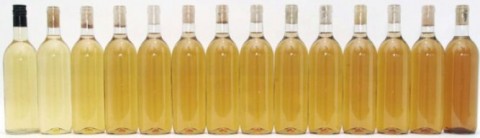
In spite of the obvious colour differences, those bottles all hold the same wine, from the same vintage. The bottle at the far right has darkened quite significantly and there’s quite a lot of sediment accumulated at the bottom of the bottle. Just looking at it, you’re probably correct to say it’s dead — don’t even bother uncorking it.
H/T to Michael Pinkus for the link.
April 2, 2010
QotD: The KGBO, er, I mean LCBO
Because we live under a monopoly regime that has no intention of loosening restrictive laws, we will never see “wine bar/stores” like this. Americans are jaded to these luxuries of free market access to wine and loads of selection. You read magazines where they tell you to talk with your retailer about finding the best wines from out of theway places and dedicated small producers, and the knowledgeable Ontarian’s reaction is “Yeah, right not in my lifetime will I see that.” While in the U.S. the ‘little guy’ whose passion for wine you can feel the moment you walk in the door and engage in a “which wine should I get” conversation. A recent discussion with an ex-pat American wine collector and drinker (just recently moved north of the 49th parallel) elicited disgust about the LCBO and its selection. “I’m from Chicago,” he tells me, “and I can’t find a decent bottle of wine up here and the selection is . . .” he trails off and shakes his head. Ontarians are used to it. We’ve grown up with Big Brother’s iron fist clamped firmly around our throat and his sweaty palm covering our eyes to what the world outside our borders is doing with booze (wine in particular).
I usually urge you to take a trip to wine country, but this year I want you to take a trip abroad, not to a wine country or region, but to a U.S. wine retailer or specialty shop, a grocery store will do in a pinch (yes I did say a grocery store). Check out, not only the selection but the price, what’s on sale and for how much, wines for under $4, 2 for 1, 3 for 1 or sometimes more for one low price. Discounts for multiple purchases, sale prices that actually seem like you are saving money and not just a dollar or two off. Pay attention to what you see, then ask yourself, “why don’t we have that here in Ontario?” You know the answer, it stares at you with big white letters on a big green background and they go by a four-letter acronym (do I really have to spell it out?) How about this, their first letters are L.C., although they should be K.G. If you are any kind of oenophile, be it novice or pro, you’ll realize that a trip across the border is enthralling and liberating — but then it’s back to the oppressive world of Ontario with Big Brother’s hands shielding you and stopping you and then you tell me honestly, which system would you like to live under?
Michael Pinkus, “Is it a Shop or is it a Bar? Whichever it is, I want one here”, Ontario Wine Review, 2010-04-01
March 24, 2010
Using carbon dating to detect fake vintage wines
Jon, my former virtual landlord, sent me this link on a subject I’ve blogged about before: detecting fakery and fraud in the fine and vintage wine market:
Up to 5% of fine wines are not from the year the label indicates, according to Australian researchers who have carbon dated some top dollar wines.
The team of researchers think “vintage fraud” is widespread, and have come up with a test that uses radioactive carbon isotopes left in the atmosphere by atomic bomb tests last century and a method used to date prehistoric objects to determine what year a wine comes from — its vintage.
[. . .]
“The problem goes beyond ordinary consumers being overcharged for a bottle of expensive wine from a famous winery with a great year listed on the label, that isn’t the right vintage year,” Jones said.
“Connoisseurs collect vintage wines and prices have soared with ‘investment wines’ selling for hundreds of thousands of dollars a case at auction,” he said.
I read Benjamin Wallace’s The Billionaire’s Vinegar which was rather an eye-opener about both the rare wine trade and the potential for fraud in that market (posts here and here). It’s nice to see that technology is coming to the rescue in cases where this kind of fraud is suspected.
March 18, 2010
You can’t say that . . . except in a wine column
Michael Pinkus collects a few choice things which can only be said on a wine tour, or in a wine column:
Top Ten Things That Sound Dirty In Winespeak, But Aren’t
Courtesy of fellow wine writer Dean Tudor (www.deantudor.com):
1. “Spit or swallow?”
2. “Stick your nose all the way in”
3. “She’s needs to open up a bit”
4. “I’ve had a ’69 with my sister”
5. “My God! Check out the legs on that Blue Nun!”
6. “I keep Sherry on the rack in my cellar”
7. “I find the Italians flacid and the French hard”
8. “There are too many whites in this room”
9. “You have to pull it out slowly, otherwise it’ll shoot all over the place!”
10. “Wow that really swelled up, can you stick it back in?”Here are two more, just to make it an even dozen:
11. “Me and the guys did a 10 year old Tawny, it was sweet”
12. “I’m sorry Madame but your Pouilly-Fuisse is awfully dry”


