Quotulatiousness

October 20, 2011

This is why you don’t want to be a wine importer in Ontario

Filed under: Bureaucracy, Cancon, Wine — Tags: , , , — Nicholas @ 08:53

In the lastest issue of the Ontario Wine Review, Michael Pinkus explains the 16-point process that all independent wine and liquor importers have to follow in order to get their products into customers’ hands:

Recently I received an email from an agent giving a blow by blow account of the process of getting booze onto the shelf of our beloved Monopoly, including the hair pulling and gnashing of teeth that goes along with it.

[. . .]

“I can take samples to the Licensees — Restaurants & Hotels — and if they want to buy it this is the procedure:

1) They must purchase a minimum of one full case
2) They must pay the LCBO a 25% deposit
3) If I want to reduce the freight rate down from $100+ per case to a reasonable freight rate . . . more like $12/case then I need to gather a minimum of 20 cases in orders with specific Licensees names on them who have all paid the deposit.
4) The LCBO Private Ordering department then processes the paperwork
5) The producer would then ship the product to an LCBO pick-up location
6) We wait until the LCBO consolidates our small order into a large container with other suppliers
7) The product usually takes 4 months to arrive and then spends another month going through Lab Analysis at a cost to the supplier of $175 per product.
8) When the product finally gets released we have to hope that the original licensees that ordered it all take delivery
9) The producer gets paid 60 – 90 days after the order lands in Ontario (while the agent pays to get it out of the Private Ordering warehouse).
10) The agent then has to chase the customer for at least 90 days to get them to pay since they will likely have an excuse not to have a cheque ready upon delivery
11) We have to do this for a total a 300 cases sold within one year to EARN the privilege of getting into the Consignment warehouse.
12) Once granted consignment space . . . we can start to ship from the producer to the LCBO consignment warehouse by the pallet (~56 cases)
13) In consignment, the product can be shipped without an advanced licensee order . . . but still must sell by the case to customers.
14) The producer gets paid once ALL of the order is sold through: 120 – 240 days later.
15) If the product does not sell through within 120 days of arrival then the LCBO confiscates the remaining order, discounts it, and puts it into a sale warehouse.
16) This frees up more space back in the consignment warehouse so that they can trap more agents into over-shipping and then the LCBO can punish them for trying to treat Ontario like a free enterprise liquor system.

Oh, and if the LCBO decides to add your product to their regular merchandise, you’ll be out of luck as it’ll probably sell for less than you can (and your hotel and restaurant customers are paying for exclusivity in a lot of cases, so they’ll stop ordering through you if it’s available in the LCBO retail stores).

October 6, 2011

Why the LCBO isn’t like Foodland Ontario

Filed under: Bureaucracy, Cancon, Food, Government, Wine — Tags: , , — Nicholas @ 09:01

Michael Pinkus tries to decide who to vote for in today’s Ontario election on the basis of who’d be the most likely to put Ontario’s wineries on an equal footing with foreign wineries in their own province:

It’s election day, and I don’t want to take up a lot of your time on a day when you should be concentrating on who to vote for. Over the past few months I have given you food for thought from Tim Hudak’s vision of the wine industry in Ontario to Andrea Horwath’s working with the LCBO option, and I heard or received nothing about the reigning Liberal party’s platform on the subject of the wine industry, I guess for them it will remain status quo. So I guess it’s up to you to decided where your loyalties lie and who you chose to believe as to what difference they’ll make, if any.

[. . .]

Part of an email I received about election promises …
“David Peterson campaigned on putting wine in corner stores in 1985 and he won — twice!
Mike Harris campaigned on putting wine in corner stores in 1995 and he won — twice!
Where are those promises in this campaign [I need to know who to vote for].”
– John

[. . .]

The LCBO affects all wineries in Ontario, but truthfully it is not the sole fault of the liquor board, they are just following their mandate to make money for the government. Two days before the election, the Grape Growers of Ontario released this plea:

“Consumer access to the wines made from Ontario grapes is a keystone issue for the future success of the industry, and unless Queen’s Park is willing to make substantive changes to the way it promotes and sells Ontario wines, the industry will continue to tread water … The domestic market share of Ontario wines is stagnant at around 39% while other winemaking regions are flourishing in their own backyard, some with market shares in excess of 90% … By making changes in the way the LCBO presents Ontario VQA wines on its shelves, how many Ontario VQA labels are available and how those wines get onto the LCBO list, accompanied by an increased, year-round promotional effort within the LCBO, the sales of Ontario’s wines will grow.”

They’re not telling you who to vote for, but they are asking you to be mindful of your vote. But I think it’s more to do with what happens after the election that counts, not the foreplay leading up to it. After the euphoria of victory has subsided we have to hold elected officials to what they promise, or pressure them to give us better and help our wineries, who are after all, tax payers themselves, yet work in a very restricted and restrictive environment. As a lover of Ontario wine you have to demand more. As the Grape Growers point out in that same plea: “We want to see provincial politicians who understand that marketing foreign wines in an agency owned by the province is like Foodland Ontario launching a promotion of Georgia peaches. It’s just not right. We can no longer afford to just sit back and watch.” Now that would be a nice change.

September 3, 2011

In praise of air conditioning

Filed under: Randomness, Technology, Wine — Nicholas @ 10:56

File this one under “first world problems”. Air conditioning is something that I’ve tended to take for granted . . . until this week, when our air conditioner failed. I should be grateful that the unit managed to last until nearly the end of summer before giving up the ghost, but it’s hard to feel grateful when even sitting still produces profuse sweating.

Even going to the basement isn’t much of a relief. My miniscule wine cellar is in the corner of the basement, and I monitor the temperature there. It’s usually in the range of 17-19 degrees. Yesterday it was 24. <sarc>That’ll help age those wines nicely</sarc>.

Update: Oh, joy: “Today’s weather: A high of 30 C feeling more like 40 C, the humidex advisory continuing. A mix of sun and cloud with scattered showers.”

Update, the second: Even better: “Heat alert issued for Toronto, public encouraged to stay cool, drink lots of fluids and monitor those at risk for heat-related illness.”

August 25, 2011

Niagara winemaker being punished for “stepping out of line”

Filed under: Bureaucracy, Cancon, Government, Law, Wine — Tags: , , , , — Nicholas @ 09:18

Michael Pinkus who rarely lets an opportunity pass to let us know how he dislikes the LCBO (or as he sometimes calls it, the KGBO), reports on the troubles of Daniel Lenko, who appears to have provoked retaliation from the board for his criticisms:

An “order to comply” certificate was slapped on Lenko’s winery door. The order, from the Region of Niagara dated July 18, 2011, listed two areas of concern an official found after inspecting Lenko’s property on June 29, 2011. First, “Lenko must cease and desist from discharging winery production waste” (Lenko says this waste is 99% water and 1% wine) into an unapproved septic tank and then discharging that onto the ground surface. Second, Lenko is ordered to apply to the Region for a permit to construct a sewage system and, upon application, submit a detailed design plan from a qualified engineer or sewage systems designer and, upon approval, proceed to install the new system by Sept. 14, 2011. Costs for this work could get into the $50,000+ mark.

[. . .]

Then it hit me. I saw Danny’s face peering back at me from between two barrels in a May 6, 2011 article in the Toronto Star entitled “Grape Expectations frustrated by LCBO”. In the article Danny, who has never been shy about his dislike for our monopoly system and those who run it, said: “In the real world, there’d be an alternative, some place else to sell our wines, but the LCBO’s the only game in town … They say they’re the best at what they do, but how can you say that when they have no competition? What’s wrong with having a VQA store?” Another prominent quote in the article is not attributed to anyone, but with Danny’s face front and centre at the top it is easy for any reader to make an inference (rightly or wrongly): “Would I like to get more of my product on the shelves? Sure. But why would I provoke an 800-pound gorilla? There’s just no way to win that battle.”

[. . .]

The aforementioned picture at the top of the article had a caption that read: “Daniel Lenko started his winery in 1999 using the grapes from the vines that his father planted in Beamsville in the Niagara Wine Region, in 1959. Lenko sells his wines from the kitchen of a small house on the vineyard which he also uses as a wine testing lab and an office.” Now what do you think it take for the LCBO to get on the horn with the AGCO (Alcohol Gaming Commision Ontario — who “oversee” the wineries) or even a local official and say to them: “maybe you’ll want to look into this Lenko guy a little harder” he is after all selling wine from his kitchen and a kitchen might not be considered a suitable place to be selling alcohol from. I think someone is making an example of Danny.

July 26, 2011

$117,000 for a bottle of white wine

Filed under: History, Randomness, Wine — Tags: — Nicholas @ 08:46

A new record price paid for a single bottle of white wine:

Christian Vanneque fulfilled a long-held dream today by finally getting his hands on a bottle of 1811 Chateau d’Yquem. It just so happens that his $117,000 purchase has also put him in the history books.

His prized bottle is the most expensive white wine ever purchased, breaking the previous record of $100,000 in 2006 for a bottle of 1787 Chateau d’Yquem. Mr. Vanneque’s bottle is also a sweet Sauternes from the same Bordeaux chateau, though his purchase was produced in 1811, a year also known as the “comet year.” Oenophiles throughout history attribute the appearance of a comet for the reason why wines were extraordinary that year.

July 22, 2011

“When they opened up the container they said it was like a murder scene, But it smelled phenomenal”

Filed under: Australia, Randomness, Wine — Tags: — Nicholas @ 09:54

Wine disaster caused by a forklift:

More than A$1m ($1.07m; £664,000) of wine has been destroyed in a forklift accident in Australia.

The 2010 Mollydooker Velvet Glove shiraz sells for A$185 a bottle ($199; £122), the AFP news agency said.

Winemaker Sparky Marquis told reporters he was “gut-wrenched” that 462 cases of wine had been smashed while being loaded for export to the United States.

“When they opened up the container they said it was like a murder scene,” he said. “But it smelled phenomenal.”

The wine industry’s nemesis, Phylloxera vastatrix

Filed under: Environment, Europe, France, History, Wine — Tags: — Nicholas @ 09:49

The Economist reviews a new book about the devastation to Europe’s wine makers caused by a tiny American invader:

These varieties are a reminder of the battle against phylloxera, a small, root-munching aphid that did incalculable damage to the wine business in the last 35 years of the 19th century. What George Gale, a philosophy professor at the University of Missouri-Kansas City, calls “the worst of all known invasive species disasters” swept across the viticultural landscape like a biblical plague. It destroyed vineyards from Rioja to Rheingau, Stellenbosch to Sicily. With good reason, Jules-Emile Planchon, the French botanist who helped to subdue the insect, dubbed it Phylloxera vastatrix.

[. . .]

In Europe, Gale’s research is no less assiduous. His coverage of the war between the largely Parisian scientific establishment, which believed that phylloxera was the effect, rather than the cause, of the devastation, and the so-called Américainistes of Montpellier and Bordeaux, who believed the opposite, is commendably detailed. The squabbling between the two sides stretched on into the 1880s, delaying the search for a solution.

Various remedies were proposed: flooding, planting on sandy soils and the use of carbon disulphide (a flammable, toxic chemical that was costly as well as tricky to apply). Growers then tried planting lower-quality American grapes, including Clinton and Noah, before switching, finally, to grafted vines combining phylloxera-resistant American rootstocks with European scions. This is still the practice in most of the world’s vineyards today.

July 14, 2011

Yet another twist in the twisty-turny mess that is Ontario liquor law

Filed under: Bureaucracy, Cancon, Law, Wine — Tags: , , , , , , — Nicholas @ 08:42

Michael Pinkus responds to an unfair accusation against Diamond Estates over their ability to open a retail store in Scarborough (most wineries are not legally able to do this):

Upon reading the Fashionable Press’ article I shot back the following (on everybody’s favourite medium these days) the Facebook comment section: “Have you really not been paying attention??? Diamond has a store because they bought a winery that had 1) a pre-1993 license and 2) had a pre-existing store. No mystery here, no cronyism, just smart business sense. In Ontario’s archaic system there are two things that reign supreme: a pre-1993 license (which allows you to blend foreign and domestic wines) and a winery with an outside store attached. Diamond got them both when they acquired DeSousa.”

The reply from Fashionable was quick: “Yes we understand that point the issue remains why no other winery can do the same thing?”

To which I answered, “This comes back to the archaic laws … not cronyism or the fact that Murray Marshall is chairman and CEO of VQA Canada. As many know I am not a huge supporter of the big wineries that can blend (and do) but Murray is working well within the crappy, backward, stink-ass system we call the alcohol laws in Ontario. If another winery wanted to do it they can pony up the 3+ million Cilento will sell their license for (of course I may be off by a few million on the price because that pre-93 piece of paper is a license to print money).”

To understand all this, and all it’s intricacies and complexities is to understand why Ontario’s small wineries are so pissed off (and yes that is the right wording here) when the subject of VQA stores is brought up. But back to Diamond … The moment DeSousa went up for sale Murray saw it as an opportunity to get a store that wasn’t tied to Niagara and a way to get his products into the hands of consumers in the much more lucrative market of Toronto (in this case Scarborough).

Now the astute amongst you (or the Ontario wine history buff) will note that Lakeview also has a pre-1993 license (est. 1991) – but that’s where it gets even wonkier. While Lakeview would be allowed to blend foreign with domestic wines, the original owners never branched out to buy another retail store, so their operation was stuck in Niagara post-1993 when the moratorium on wine store licenses was imposed. DeSousa (est. 1990) on the other hand, did acquire one additional retail licence prior to the cut-off.

The hard part about owning these stores is they are rarely permanent, and here’s why. The rationale behind placing one of these additional retail outlets somewhere is that it is an “under-serviced neighbourhood” … Fashionable asks the following: “Why didn’t the LCBO find this under-serviced gem and plunk one of its outlets there? … Why did they choose in a gentlemanly way to cede over to Diamond?”

To that I say ‘Have No Fear’, if that Diamond store does well then you can bet the farm that the liquor monopoly will parade in like a white knight and announce a store nearby … which will force Diamond to relocate the store to another “under-serviced area” … and how, you may ask, will the LC know that Diamond is doing so well? That my friends is what smells bad in this entire deal: Who do you think gets to look at the sales numbers from these off site stores? Hmm? They’re not called the KGBO by some for nothing.

So the brief and fleeting moment that Diamond has taken advantage of will disappear as soon as the LCBO decides that they need to move into that disadvantaged area and open an LCBO store, which will force the private seller to close their store in the area. Nice.

June 22, 2011

Salmon: Just how much alcohol is in that wine?

Filed under: Randomness, Wine — Tags: — Nicholas @ 07:37

This is an interesting news snippet: for several years, many winemakers have been under-reporting the alcohol levels of their wine:

Essentially, people like to think of themselves as sophisticates who go to art-house movies, even if in reality they’re much more likely to sit slack-jawed in front of some reality TV show. In the case of wine, they like the idea of buying something grown-up, with a relatively modest amount of alcohol; when it comes to drinking what’s inside, however, the more heat the better. So wine labels consistently show lower alcohol content than what’s inside.

This is especially true in the new world. Out of 43,908 tested new world wines, 24,561 under-reported their alcohol content, with the reds averaging 14.1% alcohol while claiming just 13.6%, and the whiles averaging 13.5% while claiming to be 13.1%.

Interestingly, the smaller number of wines which either over-reported their alcohol content or got it exactly right all reported pretty much the same levels of alcohol: 13.1% or 13.2% for whites, and 13.6% or 13.7% for reds. On average, it seems, wine will just say that it’s 13% if it’s white and 13.5% if it’s red, but in reality it’s likely to be higher than that.

June 18, 2011

Tawse celebrates their 10th anniversary

Filed under: Cancon, Media, Wine — Tags: , , , — Nicholas @ 00:28

It’s rather late notice, but if you’re an Al Stewart fan, you might want to visit Tawse Winery today for their 10th anniversary celebration:

Canadian music icon and friend Jim Cuddy returns to Tawse Winery along with “Year of the Cat” singer/songwriter Al Stewart, to help celebrate our 10th anniversary. This very special ‘al fresco’ concert promises to be the event of the summer, and one not to be missed!

Unfortunately, I’m at the other end of Lake Ontario today, visiting CFB Kingston.

June 12, 2011

Kacaba Vineyards wins double-gold at the Ontario Wine Awards

Filed under: Cancon, Wine — Tags: , , — Nicholas @ 00:15

Michael Pinkus reports from last Friday night’s award ceremony:

The 16th Annual Ontario Wine Awards were held Friday night with a triumphant return to the Queen’s Landing Inn in Niagara on the Lake hosted by Food Network star Laura Calder, host of French Food at Home. [. . .] Big winners this evening were Kacaba, winning two Golds in the Red categories (Cabernet Franc and Meritage) as well as another for Label Design; Chateau des Charmes for winning Best Dry Riesling twice (both its category and Best White of the Year) along with a Silver for the close to my heart Sparkling (Rosé). Flat Rock did the same for Red Wine of the Year for their The Rogue Syrah and another Gold for Their Rogue Pinot Noir, prompting them to immediately change their name to “Flat Rogue Cellars” (kidding — not about the awards, about the name change). Inniskillin and Malivoire pulled off tri-fectas in their categories by sweeping them (taking the Gold, Silver and Bronze): Vidal Icewine and Gamay respectively.

I’m delighted that Kacaba is getting the recognition for their great wines (unless it forces them to raise prices, in which case I’m upset that my favourite winery is getting “discovered”) 😉

May 26, 2011

More on resveratrol in red wine

Filed under: Health, Science, Wine — Tags: — Nicholas @ 15:04

Every few weeks, there’s another study result published (or, in some cases, mangled in the publishing) about the benefits to human health from the resveratrol in red wine, but few of them will go this far:

Drink 8 bottles of wine, you’ll be unharmed if hit by Mike Tyson
True medical fact: Trials with boxers underway

Top boffins in Texas believe they will soon provide solid proof of an astonishingly useful biological fact: that if you drink eight bottles of red wine you can be punched in the head by a professional heavyweight boxer and it will do you no harm at all.

We’re paraphrasing slightly, of course.

May 18, 2011

New iPhone app for Prince Edward County wineries

Filed under: Cancon, Technology, Wine — Tags: , , , — Nicholas @ 12:24

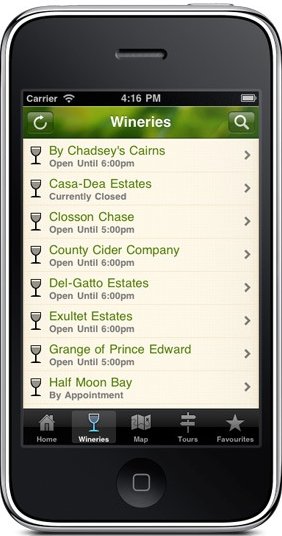
There’s a new iPhone application devoted to the up-and-coming wineries in Ontario’s Prince Edward County. WineTour is in the Apple app store now (although I’m at a client site today, so I won’t be able to download it until tonight).

Touring the wineries of Prince Edward County? Plan your trip with WineTour, and find your way around the area with ease. We’ve collected all of the details you need to get the most out of your visit — so you’ll know what’s on, where the nearest wineries are, and what hours they’re open.



Most of the information in WineTour is available without the need for an internet connection, so iPod Touch owners, or those with an iPhone or iPad who don’t have a data plan will find it a valuable companion while travelling.

WineTour features continuously updated open / closed status information to help you see which wineries are open now, which are closing soon, and which are “by appointment”. It also includes the contact info for each winery so you can easily call, email or visit their website for more information.

May 3, 2011

QotD: The LCBO’s Trend Report

Filed under: Cancon, Government, Quotations, Wine — Tags: , , — Nicholas @ 10:27

The recent LCBO report says that ‘People are buying Pinot Noir and Ripasso’. Roughly translated the message is ‘we’d like more people to buy these, and other wines in the $16–$20 range, and not the cheap South American stuff. Please be trendy and support our profits.’

[. . .]

In case you’re not clued into the workings of LCBO promotions I suggest you read the fine print on the inside back cover ‘this advertising is paid for by participating suppliers’. It’s no different than all the other fliers.

Billy Munnelly, “LCBO Trend Report”, Billy’s Best Bottles Wine Blog, 2011-04-20

April 14, 2011

More proof that you shouldn’t over-pay for wine

Filed under: Britain, Randomness, Wine — Tags: — Nicholas @ 08:58

I’ve discussed this before, but here’s another report on cheap versus expensive wine for the average person:

An expensive wine may well have a full body, a delicate nose and good legs, but the odds are your brain will never know.

A survey of hundreds of drinkers found that on average people could tell good wine from plonk no more often than if they had simply guessed.

In the blind taste test, 578 people commented on a variety of red and white wines ranging from a £3.49 bottle of Claret to a £29.99 bottle of champagne. The researchers categorised inexpensive wines as costing £5 and less, while expensive bottles were £10 and more.

The study found that people correctly distinguished between cheap and expensive white wines only 53% of the time, and only 47% of the time for red wines. The overall result suggests a 50:50 chance of identifying a wine as expensive or cheap based on taste alone — the same odds as flipping a coin.

While a more wine-oriented group of testers would probably do better, they’d do better in the sense of determining which of two similar wines was the more expensive — but not necessarily a lot better. We’re in a golden age for wine, as more and more producers of inexpensive wines adopt better techniques and equipment for even their vin extremely ordinaire.

Wine isn’t a simple product: people buy wine for lots of different reasons, and one of those reasons is to signal higher social status by buying more expensive wine. As you get above a certain price level, the quality increases more slowly but the “prestige” makes up the difference (for those interested in the social signalling, anyway).

I’ve discovered that my palate isn’t highly developed enough to detect and appreciate the additional quality that a $100 bottle of wine is supposed to display over a $40-$50 bottle. It may be that I lack the ability to discriminate sufficiently between the two . . . or it may be that the primary difference is in the “prestige” and not in the palate.

Earlier discussion of this topic here.

« Newer PostsOlder Posts »

Powered by WordPress