
A major transition is never easy, but it would be worth it. The strategy we recommend would lead to more government revenue for health care and education; a sustained commitment to the socially responsible use of alcohol; increased economic growth based on greater access to markets; a renewed emphasis on responsible environmental practices; and wider choice, more convenience and competitive prices for consumers.
The present beverage alcohol system took shape at the end of Prohibition. For decades, Ontario has made minor repairs to the system when a complete overhaul was needed. In our view the government should focus its role on effective regulation, and restructure the system from top to bottom to establish a more competitive model.
After 78 years, change is long overdue. It is time to transform Ontario’s beverage alcohol system for the 21st century.
November 29, 2012
QotD: Transforming Ontario’s wine market
November 28, 2012
Is Ontario finally “grown up enough” for private wine stores?
In the National Post, David Lawrason talks about the push for changes to Ontario’s Prohibition-era laws regarding the sale of wine in private stores:
The Wine Council of Ontario has flipped the switch on a website called www.mywineshop.ca that allows citizens to create their own virtual wine shop. It is a very bold and clever marketing/lobbying idea. And it is the first time an industry association has initiated a public campaign aimed at creating private wine stores in the province. Gutsy stuff.
In less than a week it has painted an appetite-whetting tapestry of what privatization might look like in Ontario, complete with store themes, stock selections and locations across the province as designed by its citizens. And it is giving the public a very direct way to lobby their local MPPs for change.
One of the big reasons the Ontario wineries and wine writers fear pushing too hard for this modernization and liberalization of our drinking law is that the KGBO LCBO has a long history of retribution against dissenters:
The other theme is fear of LCBO retribution. (Talk about “the elephant in the room”). Even our braveheart John Szabo remarked at the end of his piece that “I hope I don’t get put on an (LCBO) interdiction list for writing this”. An importing agent replying to John’s article said he really wanted to talk about the issue ‘off the record’ as he was concerned that being put on an interdiction list would put him out of business.
This fear of the LCBO, whether justified or not, is another compelling reason to re-think the government monopoly. The fear shouldn’t exist within an otherwise free and democratic society; but it does. I have been writing on wine for over 25 years and during that time I have been involved in thousands of conversations with wineries, importers and consumers on shortcomings of the current system. Only once did an individual agree to be quoted.
When your livelihood depends on access to a product controlled by a monopoly, you dare not get on the wrong side of the powers-that-be controlling that monopoly. They may not break legs or leave horse’s heads in the beds of critics, but they can directly freeze the critics out of their profession. An excellent way to limit dissent. Just the hinted threat can be enough to make a would-be critic decide to toe the line and shut the hell up.
October 6, 2012
Reporting from the St. Catharines Wine and Grape parade
Scott Feschuk goes back to St. Catharines to watch the parade go by:
In my hometown of St. Catharines, Ont., the last Saturday of September brings the Grape and Wine parade — a fun, child-friendly celebration of Niagara’s contribution to our national drunkenness. Join me as I attend the parade for the first time in 25 years:
9:48 a.m. We set up across from City Hall, just down from the viewing stand and just up from the elderly lady in the “Will work for wine” T-shirt. Behind us, at a church-run snack table, a sign announces that passersby are welcome to take a free apple as a gesture of God’s love. An Italian sausage, however, will set you back four bucks because the hydro company does not accept payment in love gestures.
9:54 The parade doesn’t start until 11 o’clock, which gives everyone plenty of time to brag about when they arrived downtown to Get a Good Spot. The exchange between two women in line for coffee is typical. “I got here around 8.” “Really? We were totally set up by 7:30.” Subtext: You are a terrible mother, first woman.
[. . .]
11:14 I didn’t know the Grape parade had a theme — and had I known, I’d have assumed it was Please Stop Laughing at Our Floats. But this year several of the floats commemorate the War of 1812, including one with a giant banner that reads: “1812-2012: 200 Years of Peace.” Being a stickler for historical accuracy and also a huge jerk, I loudly point out that the war didn’t end until 1814. Feschuk 1, Parade 0.
11:16 It’s still early, but if I had to pick my favourite War of 1812 re-enactor so far, it would definitely be the soldier in the period-accurate Nike cross-trainers.
[. . .]
12:27 The parade is almost over and there hasn’t been a single clown yet—not one. And where is the A&W Bear and why aren’t people on floats throwing candy and why isn’t everything exactly the same as it was in my childhood WHEN EVERYTHING WAS PERFECT AT ALL TIMES??
12:34 A final note: the Grape and Wine parade featured a number of cheerleading teams and academies — so many that I feel confident in stating for the record that we, as a nation, are good for cheerleaders. We do not require any more eight-year-old girls to paint on thick, sparkly eye makeup and thrust their pelvises in a sexualized manner. We are good for bare midriffs and self-esteem issues. Sure, Niagara may have lost most of its manufacturing jobs, but it’s in terrific shape if the key to prospering in the global economy turns out to be human pyramids.
August 29, 2012
The wine cellar: proper storage for your wines
Kelvin Browne in the National Post on the modern wine cellar:
I like wine cellars even more than I like wine, which is saying something. I used to have one in the basement of an 1870s stone house. This fantasy cellar had the ancient stone walls of the home’s original foundation, new rough-hewn granite floors and wine racks made from reclaimed oak by a perfectionist craftsman. It kept wine at the requisite 56F to 57F, with humidity about 70%. Who knew cellars were in basements for a reason, as temperature and humidity didn’t need much mechanical assistance here to be ideal for wine?
I loved the cellar and bought cases for it to make sure the room was picturesque — right out of a French château. The room had a 600-bottle capacity. Practically speaking, my partner and I would have been fine with a 24-bottle wine fridge, but antique chairs and an elaborate tasting table don’t suit such a setup.
After we sold the farmhouse, we disposed of the wine to friends, also indulging in a massive liquidation binge ourselves, starting with wine at breakfast.
The enduring lesson: If you like wine, you’re likely a sensualist who loves the total experience, and that includes where you store your horde.
I’ve always wanted to have a wine cellar like that, but the corner of my basement that serves as my wine cellar will have to do: I can’t even afford to keep that fully stocked (and it holds a lot less than 600 bottles). Instead of the custom-crafted redwood or polished glass and stainless steel that some high-end cellars can boast, I have a pair of wooden Ikea bottle racks. They may not have the look of the “good” racks, but they work just as well … and far less expensively.
August 16, 2012
QotD: Old wines
Some people poo-poo the idea of old wines because they lack the fresh fruit they expect to have in their wines. I for one embrace older wines, if for nothing else you’re tasting a piece of history. Hopefully by now you’ve seen the movie Sideways think back, to Maya and Miles sitting on her porch talking about old wines: “I like to think about the life of wine … How it’s a living thing. I like to think about what was going on the year the grapes were growing; how the sun was shining; if it rained. I like to think about all the people who tended and picked the grapes. And if it’s an old wine, how many of them must be dead by now. I like how wine continues to evolve, like if I opened a bottle of wine today it would taste different than if I’d opened it on any other day, because a bottle of wine is actually alive. And it’s constantly evolving and gaining complexity. That is, until it peaks … And then it begins its steady, inevitable decline.”
One of the oldest wines I can remember drinking was a 1970 Chateau Haut Bailly … it sticks in my mind cause it has special meaning in a couple of ways. It was the first time I had tried a wine from the year of my birth, and two I had it on the occasion of my engagement when my family had gathered around for a dinner to celebrate. I thought there was no better time to show off something old from a great Bordeaux vintage. Most dismissed the brownish liquid in their glass and turned their nose up at the interesting, and admittedly, odd smells emanating from the glass; but I relished in it and more people should learn and understand that if you spent X number of years cooped up in a bottle (in this case some 38 years +) you’d be a little crabby when you emerged too; but with a little time and a little air I’m sure you’d come around — start feeling like a more mature version of your old self … the same can be said for wine.
Michael Pinkus, “Tasting Old Wines from the Chateau”, Ontario Wine Review, 2012-08-16
July 27, 2012
The Ottawa Citizen calls for breaking up the booze monopolies
Ontario has an odd relationship with alcohol sales. Beer sales are controlled through a protected monopoly (The Beer Store, formerly known as the Brewer’s Retail), while liquor sales are mostly through the government-owned LCBO stores. There are a few exceptions: Ontario wineries are allowed to sell wine at the winery, and craft brewers can also do retail sales at the brewery. Certain privileged large wineries are allowed to sell their own products (not all of which are actually Ontario wines) through a limited number of retail stores, usually co-located with grocery stores.
An editorial in the Ottawa Citizen makes a good case to blow up the current system and take the government out of the retail sales market altogether:
There are two main arguments defenders make for protecting the LCBO from any more competition.
The first is that only a government-operated retail chain can keep alcohol out of the hands of children. That argument is so weak it barely deserves a response, yet it never seems to die. As mentioned above, private operators already sell alcohol, and must follow the rules. Corner stores sell cigarettes, which also have strict rules governing the age of the purchaser. And private stores are already selling alcohol under the LCBO banner, especially in areas where the population doesn’t justify a stand-alone LCBO store.
Under a good enforcement regime, with stiff penalties for non-compliance, private operators have every incentive to follow the rules.
The second argument is that the LCBO is a money-maker for the government, so most private-sector competition must remain illegal.
It’s an honest argument, but that’s about all it has going for it. Would we allow the state to tell private store-owners that they couldn’t sell, say, chairs, or T-shirts, because the government needs to corner that business?
The government should have the power to tax. It should have the power to restrict sales to minors, and set rules to enforce that. It should not have the power to elbow Canadians out of certain industries. Not only is this an unjustified use of the powers of the state, but it reduces competition, and the innovation that accompanies competition.
Marni Soupcoff agrees with the Citizen‘s editorial stance:
The Beer Store and the LCBO do a decent enough job that most Ontarians don’t get more exercised about their forced dominance than grumbling a bit here and there. That’s a shame because the anti-competitive nature of the laws keeping beer and wine out of grocery and convenience stores is truly antithetical to a free society, particularly when the health and safety concerns are so bogus. The laws also end up having the pernicious consequence of conditioning Ontarians to expect their government to limit their consumer choice, and businesses their freedom, which makes us more likely to accept further encroachments down the road.
That’s an abstract argument on which to base a campaign for a policy change. The better talking point might be the one U.S. libertarian writer Jacob Sullum raised last year in article about state liquor monopolies: if they were really that good at serving customers, they’d have no reason to exist. The point of government retailing alcohol is supposed to be to make the nasty stuff less accessible. If the government retailer is putting out glossy magazines glorifying the joys of wine and food pairings and offering fancy tasting rooms and convenient store hours, hasn’t it defeated its own (dubious) purpose? In the LCBO’s case, it seems particularly absurd that a marketing director in charge of “Food & Drink & Visual Merchandising” gets paid almost $140,000 a year to entice customers to consume a product deemed too dangerous to be sold in a Sobey’s.
June 13, 2012
Wine: drink what tastes best to you, not what the experts tell you to
Yet another blind taste test that didn’t come out the way it was “supposed” to:
At the Princeton tasting, led by George Taber, 9 wine judges from France, Belgium and the U.S. tasted French against New Jersey [TC: that’s the New Jersey] wines. The French wines selected were from the same producers as in 1976 including names such as Chateau Mouton-Rothschild and Haut Brion, priced up to $650/bottle. New Jersey wines for the competition were submitted to an informal panel of judges, who then selected the wines for the competition. These judges were not eligible to taste wines at the final competition The results were similarly surprising. Although, the winner in each category was a French wine (Clos de Mouches for the whites and Mouton-Rothschild for the reds) NJ wines are at eye level. Three of the top four whites were from New Jersey. The best NJ red was ranked place 3. An amazing result given that the prices for NJ average at only 5% of the top French wines.
A statistical evaluation of the tasting, conducted by Princeton Professor Richard Quandt, further shows that the rank order of the wines was mostly insignificant. That is, if the wine judges repeated the tasting, the results would most likely be different. From a statistically viewpoint, most wines were undistinguishable. Only the best white and the lowest ranked red were significantly different from the others wines.
There are good wines and bad wines. There are good wines and better wines. But my experience has always been that there’s a point of diminishing returns beyond which you’re paying more money for no appreciable improvement in the quality of the wine. In other words, beyond that point, you’re paying for the prestige of the label or the mystique of the brand not for anything intrinsic to the liquid in the glass. As I wrote last year:
We’re in a golden age for wine, as more and more producers of inexpensive wines adopt better techniques and equipment for even their vin extremely ordinaire.
Wine isn’t a simple product: people buy wine for lots of different reasons, and one of those reasons is to signal higher social status by buying more expensive wine. As you get above a certain price level, the quality increases more slowly but the “prestige” makes up the difference (for those interested in the social signalling, anyway).
I’ve discovered that my palate isn’t highly developed enough to detect and appreciate the additional quality that a $100 bottle of wine is supposed to display over a $40-$50 bottle. It may be that I lack the ability to discriminate sufficiently between the two … or it may be that the primary difference is in the “prestige” and not in the palate.
If you’re buying wine to have with a nice dinner, find your point of diminishing returns and don’t go beyond it: you’ll save yourself a lot of money over time and still enjoy your wine. If, on the other hand, you’re buying wine specifically to impress then go as expensive as you like.
May 30, 2012
Inter-provincial trade in wine comes a bit closer to legality
Gloria Galloway in the Globe and Mail:
Private member’s bills rarely make it this far. But politicians of all stripes rose to echo Mr. Albas’s argument that an 80-year-old wrong needs to be made right.
It is an issue that he says he has been hearing about from his constituents — and from wine growers and lovers across Canada — since the election campaign that brought him to Ottawa for the first time last year.
“Every single winery owner that I have spoken with supports this legislation,” Mr. Albas said in an interview with The Globe and Mail, “especially the small family wineries whose production is so low that they can’t sell through the liquor control monopoly.”
As it stands, anyone who wants to send wine from one province to another for his own consumption must route it through a provincial or territorial liquor control board and must pay the associated taxes and markups.
If a tourist from Saskatchewan visits a winery in Ontario and likes what she is tasting, she is not legally permitted to take it home with her or mail a few bottles to herself. In fact, she could be thrown in prison for up to three months for doing so.
On the other hand, a tourist from Texas could visit the same winery and send crates of the stuff back to his home in Austin.
Update: Whoops. Not so fast … Colby Cosh just sent a twitter update that makes me sad:
Did the NDP really block the wine bill? Why is this occupying more than about 30 seconds of Parliament’s time?
Oh, that’s nice. Thanks, Mr. Mulcair. Good going: that’ll show those wine-swilling Tories who’s boss, won’t it?
Update, the second: Apparently the NDP’s over-enthusiastic supporters talked out the available time to prevent the bill being voted on. This is enough to kill it for this session. Nice, work socialist horde!
The bill would have been sent to the Senate and likely passed into law, if the NDP had agreed to collapse debate and send it to a vote.
Mr. Albas thought he had a deal to do just that because members from all sides of the House were enthusiastic about amending the Prohibition-era Importation of Intoxicating Liquors Act that bans wineries across the country from sending their product to another province.
But six NDP MPs were so enthusiastic about their support for the bill, they used up all the available time in an apparent filibuster and Mr. Albas will now have to wait until the fall before he gets a second hour of debate and the chance to go to a vote.
An NDP spokesman said it was an honest mistake. Really? How absent-minded of them. Perhaps they should eat more oily fish.
‘‘This is the stuff that turns most Canadians off politics. It was completely uncalled for,” said Mr. Albas. “I’m disappointed the NDP used petty procedural games, rather than supporting the B.C. and Canadian wine industry.”
Update, 8 June: Well, somehow the filibuster didn’t stop the bill after all:
Canadians will soon be allowed to transport wines across provincial borders after MPs from all parties voted to support a private member’s bill to end the decades-old prohibition. Bill C-311, from British Columbia Tory MP Dan Albas, passed by a vote of 287-0 during third reading in the House of Commons Wednesday. The bill would also allow Canadians to shop for wines online and ship them across borders. “The wine industry has had this thorn in their side for 84 years. It’s time to free the grapes,” Mr. Albas told reporters before the vote. Under the 1928 Importation of Intoxicating Liquors Act, transporting wines is punishable by a $200 fine or even jail time.
May 27, 2012
QotD: Being a good host
With alcoholic ritual, the whole point is generosity. If you open a bottle of wine, for heaven’s sake have the good grace to throw away the damn cork. If you are a guest and not a host, don’t find yourself having to drop your glass and then exclaim (as Amis once did in my hearing) “Oh — thank heavens it was empty.” The sort of host who requires that hint is the sort of host you should have avoided in the first place.
Christopher Hitchens, Introduction to Everyday Drinking: The Distilled Kingsley Amis, 2008.
May 14, 2012
The shady back alleys of the wine trade
Benjamin Wallace (who wrote the fascinating book The Billionaire’s Vinegar, mentioned here in connection with a lawsuit), has a lengthy article in New York magazine about shady practices in the rare wine business, and the even shadier practitioners:
Among a privileged set, though, Kurniawan’s quirks and résumé gaps were of much less interest than his generosity. After one tasting, Wasserman hailed him for having “poured the sickest lineup of wines I have ever had in one evening” and told him that “the scepter, the crown, the ermine cape is yours.” Meadows, too, became a beneficiary of Kurniawan’s largesse, through which he tasted wines even he had never encountered. Grateful, he took pains to field Kurniawan’s often arcane queries about labeling and capsule nomenclature. “I thought at the time, ‘Jesus Christ, he must take these bottles to bed,’ ” Meadows says. Soon, he was publishing tasting notes based on Kurniawan bottles, lending his blue-chip imprimatur to the young man and his wines. Robert Parker, the world’s most powerful wine critic, also drank them and pronounced Kurniawan “a very sweet and generous man.”
[. . .]
In October 2004, Kurniawan posted on Parker’s website under the header “Last weekend where I tried to kill John Kapon with legendary wines!!” He wrote about an extravagant four-day run in New York in which he and a group of wine lovers had gorged on priceless Bordeaux and Burgundy. Kurniawan had brought with him what seemed an inexhaustible supply of hyperrarities from a “magic cellar” — including two cases of the extremely rare 1945 Romanée-Conti—which he said he’d bought from a collector in Asia for $2 million. Every night, the group would drink from Kurniawan’s stash and then end up at Cru, the Greenwich Village restaurant with a 150,000-bottle wine list, which stayed open as late as 3 a.m. as Kurniawan ordered one expensive bottle after another off the list.
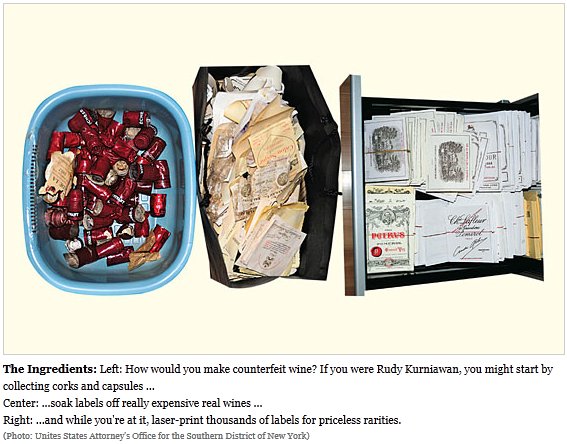
For instance, Kurniawan didn’t mention the five FedEx packages he received from Cru that year, containing the empty bottles from his wild nights at the restaurant. It wasn’t unusual for a customer to take away a memorable bottle after it was spent. But over the course of Cru’s six-year run until it closed in 2010, no other customer ordered as many bottles and then systematically claimed the empties. Kurniawan was building a bottle museum in his garage, he explained to the sommelier.
Though Kurniawan presented himself publicly as a mere wine lover, a buyer and not a seller, by the time he made his splash on the wine boards, he was already consigning at auction. And problems had cropped up. As early as 2003, Internet entrepreneur Eric Greenberg was threatening to sue online auction site Winebid over some “suspect/bad mags,” e-mailing, “My goal is to bury the consignor’s reputation in the wine world.” Soon after, he reported that he had spoken to the consignor, Rudy Kurniawan, and was convinced that he, too, had been duped by whoever sold him the wine.
H/T to Bob Tarantino for the link.
May 10, 2012
The Vintner’s Kwality Approximation
Michael Pinkus expresses the feelings of a lot of Ontario wine drinkers:
There has been a lot of talk by media-types lately about VQA … about how the VQA symbol is finding its way onto inferior wines; inferior, bland, uneventful, non-descript wine blends — the latest culprit in this category are whites … a growing segment of the LCBO market. These white blends seem to encompass the kitchen and the sink … everything is fair game in them, from Chardonnay Musque to Viognier to Riesling, Sauvignon Blanc (just name a white grape and it’s in there) and of course there’s always some Gewurztraminer thrown into the mix. I find myself on this topic after reading Rod Phillips’ musings, [who] went so far as to accuse the Ontario wine industry and the VQA of dumbing down wine — actually regressing us back to a time when Ontario wine was the laughing stock of the wine world.
[. . .]
Let’s get back to VQA … I’m gonna let you in on another highly guarded secret: VQA is NOT, repeat NOT a sign of quality … it’s a symbol of origin. That’s’ right, according to executive director, Laurie MacDonald, whom the Wine Writers’ Circle of Canada members had a meeting with back in 2011. She was adamant the VQA was all about origin — not quality … so why is the word “Quality” in the acronym? Good question … to which I would hazard a guess there is no really good answer besides it sounded good at the time; but I also offer you this: it sure sounds better than Questionable?
I’m sure, in the past, that you have tasted a wine with a big VQA symbol on it and thought “this is some nasty-ass sh*t … how did that pass VQA?” Yes there’s a tasting component to the process, but I have been assured by many a winery that they just think it’s cash grab by the VQA. It costs a winery $265.50 a shot to run tests through the VQA lab and get authorization to use the symbol on their bottles and a wine can be submitted up to 3 times.
I usually check any Ontario wine for the VQA symbol, and almost always put back any that don’t carry the “stamp of approval”, but I’ve certainly bought more than a few wines carrying the VQA symbol that were unpleasant drinking experiences.
In fairness, I’ve also bought more than a few French wines with AOC designations that failed to live up to expectations, and even more Italian DOC wines that were a waste of money. Wine, by its very nature, can’t be as consistent as other products, so things like the VQA/AOC/DOC are only guideposts, not destination markers. You still have to exercise judgement and roll the dice now and again.
April 3, 2012
Eliminating inter-provincial barriers to trade
Confederation in 1867 was supposed to create a single nation out of a group of separate British colonies in North America. In spite of that, in some areas, individual provinces treat one another as foreign entities for trading purposes. Alcohol, for example, is one product that gets special treatment for inter-provincial sales — almost always to interfere with or even prevent the purchase of alcohol in one province for consumption in another. 680News reports on the latest effort to harmonize the rules regarding alcohol sales across provincial borders:
Free my grapes will be the rallying cry on Parliament Hill on Tuesday as a committee hears from supporters of a private member’s bill seeking to erase a 1928 rule that restricts individuals from bringing wine across provincial borders.
Shirley-Ann George ran into that problem when she was visiting B.C. and then tried to join a wine club through a vineyard there, only to be told the vineyard couldn’t ship to her home in Ontario.
She decided to start up the Alliance of Canadian Wine Consumers to try to change it.
“You’ve got to be kidding,” is the most common refrain from people first learning about the rule, George said.
“Most Canadians don’t even know it is illegal. They think it’s silly, archaic and it’s time that the government started to think in the 21st century.”
Of course, the provinces are not keen to allow individuals to buy wine directly — that might threaten their respective monopolies (and the juicy profits they derive from being “the only game in town”). One of their current arguments against the bill is that it will somehow give Canadian wines an unfair advantage and that could cause issues with our international trade partners. I’m not sure how it benefits Canadian wineries to be shut out of selling to Canadian wine drinkers in other provinces, but I’m sure that they have some cockamamie statistical “proof” that they’ll trot out to bolster their argument.
March 29, 2012
Ontario grape growers’ current worry
Michael Pinkus summarizes the situation for the grape growers in Ontario who supply our wineries with much of their fruit:
Just this past Monday grape growers and winery owners lost a few hours of sleep … and that condition will continue until at least May. What pray-tell has our wine industry shaking in its collective boots so badly that they are willing to forego their already mutilated sleep pattern. Well I can tell you it’s not the usual stuff like taxation, health care and wild cat airline strikes. It’s also not the more specific things that haunt the wine industry like the price of grapes, LCBO involvement and VQA regulations … nope the winery owners and grape growers are once again in fear of Mother Nature — more specifically her henchman: Jack Frost.
[. . .]
The latest recorded frost in Niagara-on-the-Lake — according to one growers records — is May 15 … frost would essentially kill off a large number of buds, thus killing the potential of a long growing season with lots of grapes to choose from. “It’s either going to be a beautiful full crop with lots of options, or if we get frost, we’re looking at a very short crop season,” one winery principal told me. For Ontario wine lovers we’d better hope Jack doesn’t decide to make a last appearance, or we’ll all be drinking Chilean and Australian for our 2012. It’s gonna be a scary couple of months … Welcome to Ontario grape growing.
February 24, 2012
Prohibition-era restrictions finally coming down: Making it legal to cross provincial boundaries with wine
Of course, it’s only a private member’s bill, so there’s only a tiny chance that it will be enacted:
I recently spent four days in Kelowna, B.C. during the Canadian Culinary Championships, then another subsequent two days at home in Toronto, tasting B.C. reds. There are many intriguing and excellent new labels on the market. […] The vast majority however are not available on the shelves of the LCBO’s Vintages stores; and the prices of some that are available for order via local agents are bloated by 50% to 100% over retail in B.C., thanks to LCBO mark-ups.
Before you say ‘so what’s the point’ and click away, hear my tale. Their availability may improve dramatically before this year is out, and you may be able to access them at something closer to B.C. prices. Our archaic interprovincial wine shipping system is seeing its first official crack.
In the Air Canada departure lounge at Kelowna Airport I spent a few minutes talking to Ron Canaan, MP for Kelowna-Lake Country. He, along with MP Dan Albas of Okanagan-Coquihalla, have been championing a private members bill (C-311) that would make it legal for individuals to carry or import wines across provincial borders (which has been technically illegal since Prohibition almost 90 years ago). A website called freemygrapes.ca has the full story.
The bill passed Second Reading in the House of Commons in the last session, and Mr. Canaan is “confident” it will pass third reading and become law this year. He is hoping in early summer.
December 1, 2011
Nanny LCBO doesn’t think you can handle this label cartoon
Michael Pinkus writes about the LCBO‘s latest nanny twitch:
Stunningly Stupid … and if you happened into the LCBO this past weekend you might have noticed a cartoon-style label on a bottle of Bombing Range Red with a red sticker adorning a certain part of the label. For those who were curious and intrepid enough to remove the sticker, expecting to find profanity or nudity you were disappointed to find a glass of red wine that (with the right amount of imagination) might have resembled a bomb — or at least a glass with a bomb-style fuse. Is this a case of political correctness gone amok? Or is the LCBO afraid we’ll get bombed upon seeing the sight? Personally I am stunned at what the higher ups at the LCBO find offensive or what they think we are too … I don’t know … childish, immature, delicate (you pick your word) to see? As it turns out the truth is even more stunningly stupid then I originally thought. It was ordered to be applied by the LCBO Quality Assurance Department, because the pilot is holding a glass of wine and as part of the LCBO’s social responsibility function they don’t want to give you the impression that it is a responsible action to drink and fly … So instead of taking it as the cartoonish fun that it is, the LCBO has to go and ruin it; but the last laugh is on the Board, because anyone worth their salt will be peeling that sticker off post-haste with a “why the f**k did they cover that” question on their face and on their lips. Thanks for being there to save me LCBO, from the evils that men do.
Image of the “hidden” label from TonyAspler.com.


