Quotulatiousness

April 16, 2012

Member of the House of Lords offers £10 Million bounty for capturing Barack Obama and George Bush

Filed under: Britain, Politics, Religion, USA — Tags: , , , , , , — Nicholas @ 11:11

I’m not sure what they’re putting in the drinking water in the House of Lords, but whatever it is, it must be powerful:

During a recent visit to Pakistan, Lord Nazir Ahmed, a member of the British House of Lords who originally hails from Pakistani Kashmir, announced he was putting up a bounty of £10 million for the capture of U.S. President Barack Obama and his predecessor, George W. Bush. The announcement, made at a conference held in the Pakistani town of Haripur, came in response to a recent U.S. announcement offering a $10 million reward to anyone providing information leading to the capture of Hafiz Muhammad Saeed, founder of the Pakistani jihadi organization Lashkar-e-Taiba (LeT), and emir of LeT’s charity arm, Jamaatud Dawa.[1]

Stressing the seriousness of his offer, Lord Ahmed said he would back the bounty at any cost, even if it meant selling his house. Qazi Muhammad Asad, minister for education in the Khyber Pakhtunkhwa provincial government, was among those present at the conference at which the announcement was made.

Yes, it’s likely a fake story, but it’s too funny to check before running it.

Update: Oh, perhaps it’s a real story after all:

Lord Ahmed suspended from Labour Party after ‘offering £10m bounty for capture of Obama and Bush’

Lord Nazir Ahmed, 53, who in 1998 became the first Muslim life peer, was reported to have made the comments at a conference in Haripur in Pakistan.

A Labour Party spokesman said: “We have suspended Lord Ahmed pending investigation. If these comments are accurate we utterly condemn these remarks which are totally unacceptable.”

[. . .]

But Lord Ahmed complained that party chiefs had not spoken to him before announcing the move and challenged the party to produce evidence against him.

He had told the meeting that Mr Bush and ex-Labour prime minister Tony Blair should be prosecuted for war crimes however, he added, speaking from Pakistan.

[. . .]

Asked about the reported comments, he said: “I never said those words.

“I did not offer a bounty. I said that there have been war crimes committed in Iraq and Afghanistan and those people who have got strong allegations against them — George W Bush and Tony Blair have been involved in illegal wars and should be brought to justice.

“I do not think there’s anything wrong with that,” he said — adding that he was equally concerned that anyone suspected of terrorism should face justice as well.

“This sort of investment pays for itself ten-fold over a very short period of time”

Filed under: Economics, Government, Technology, USA — Tags: , , , , , — Nicholas @ 10:16

You see? This is what’s wrong with private enterprise, especially in California. Those wimps aren’t willing to invest in something that will “pay for itself” ten times over in a “very short period of time”. That’s why all the greatest economic advances have come from over-aged students, business council speechifiers, bureaucrats, and career apparatchiks!

If you believe calling your opponents names is a sign that you have lost the argument, then this new high-speed rail commercial from the California Alliance for Jobs — in which unexpectedly macho proponents of the $41 billion, $110 billion, $98.5 billion, $68.4 billion high-speed rail project deride skeptics as “wimps” — is pretty much the end of the line […]

What reveals the intellectual bankruptcy of the high-speed rail project is not the insults but that what is supposed to be a rousing propaganda piece comes off like an orientation video for new hires at a failing company.

The video’s cast includes hacks respected citizens from Operating Engineers Local 3, including Alliance for Jobs Executive Director Jim Earp, along with leaders from what’s usually referred to as the “business community” whose skill sets cluster around serving on business councils rather than doing any actual business. There’s also a career apparatchik and the founder of the “I Will Ride” Student Coalition, who is apparently a UC Merced senior but looks at least a decade too old.

[. . .]

Again, why not just claim the Fresno-Bakersfield line will end up carrying 38 million people, the entire population of California, every day? It would be no less accurate than the current claims, which have been made with no data on ticket costs, no comparative studies of existing bullet-train ridership, or anything else that can reasonably pass for due diligence.

Oh, and nobody actually knows where the bullet train will go to or from. (Past, present and possibly future candidates include Corcoran, Borden, Fresno, Anaheim, Los Angeles, San Francisco, and some guy named Dave’s rec room.) You wouldn’t build a patio with the amount of planning that’s gone into the high-speed rail project.

To put the headline into a bit of perspective, note that only one high speed rail line in the world is profitable. This is an old hobby horse of mine and I’ve posted about High Speed Railways a few times before.

Update: And to answer the question about why parts of Europe, Japan, and China have high speed rail systems and neither Canada nor the United States do, here’s a brief overview I wrote last year:

The best place to build a high speed rail system for the US would be the Boston-New York-Washington corridor (aka “Bosnywash”, for the assumed urban agglomeration that would occur as the cities reach toward one another). It has the necessary population density to potentially turn an HSR system into a practical, possibly even profitable, part of the transportation solution. The problem is that without an enormous eminent domain land-grab to cheat every land-owner of the fair value of their property, it just can’t be done. Buying enough contiguous sections of land to connect these cities would be so expensive that scrapping and replacing the entire navy every year would be a bargain in comparison.

The American railway system is built around freight: passenger traffic is a tiny sliver of the whole picture. Ordinary passenger trains cause traffic and scheduling difficulties because they travel at higher speeds, but require more frequent stops than freight trains, and their schedules have to be adjusted to passenger needs (passenger traffic peaks early to mid-morning and early to mid-evening). The frequency of passenger trains can “crowd out” the freight traffic the railway actually earns money on.

Most railway companies prefer to avoid having the complications of carrying passengers at all — that’s why Amtrak (and VIA Rail in Canada) was set up in the first place, to take the burden of money-losing passenger services off the shoulders of deeply indebted railways. Even after the new entity lopped off huge numbers of passenger trains from its schedule, it couldn’t turn a profit on the scaled-down services it was offering.

Ordinary passenger trains can, at a stretch, share rail with freight traffic, but high speed trains cannot. At higher speeds, the actual construction of the track has to change to deal with the physical problem of safely guiding the fast passenger trains along the rail. Signalling must also change to suit the far-higher speeds — and the matching far-longer safe braking distances. High speed rail lines cannot be interrupted with grade crossings, for the safety of passengers and bystanders, so additional bridges and tunnels must be built to avoid bringing road vehicles and pedestrians too close to the trains.

In other words, a high speed railway line is far from being just a faster version of what we already have: it would have to be built separately, to much higher standards of construction.

Getting back to the California HSR line; it goes from A to B on this map:

Okay, you think, at least Fresno will get some snazzy slick rail service . . . except this section will be built but not operated until further connecting sections are built . . . at a later date. Maybe. It will be the track, including elevated sections through Fresno, and the physical right-of-way, but no electrical system to power the trains; but that’s fine, because the budget doesn’t include any actual trains.

Stephen Harper’s “world view is based on the premise that the United States is in relative decline as a superpower”

Filed under: Cancon, Economics, USA — Tags: , , , , — Nicholas @ 09:39

Eugene Lang has an interesting view of how Stephen Harper has changed since coming to power and how this is reflected in Canada’s foreign policies:

Stephen Harper became Prime Minister six years ago with little interest in or experience of international affairs. He was a domestic policy wonk — particularly interested in economic and fiscal affairs. Yet, in about half a decade, he has fashioned the clearest Canadian foreign policy posture in at least a generation, whether you like that posture or not. We can now speak of a Harper Doctrine which forms the cornerstone of our foreign relations.

In a largely ignored interview with Maclean’s magazine last summer, the Prime Minster stated: “We also know, though, the world is becoming more complex, and the ability of our most important allies, and most importantly the United States, to single-handedly shape outcomes and protect our interests, has been diminishing, and so I’m saying we have to be prepared to contribute more, and that is what this government’s been doing.”

These remarks are an important insight into the Prime Minister’s perception of the changes in America’s geopolitical position, and how Canada should respond. They suggest his world view is based on the premise that the United States is in relative decline as a superpower, and that Canada must step up to the plate to help our distressed ally police the world. It is a striking acknowledgement. And it was not just words.

Canada has been needing to diversify its trading relationships to reduce its dependence on, and exposure to, the vagaries of the US economy and the meddling of the US government. President Obama’s recent decision to veto the Keystone XL pipeline is merely the latest spur to get Canada to work more closely with China and other growing economies rather than be subject to presidential whim in our dealings with the US.

During his first half-decade in office Stephen Harper was putting most of Canada’s economic eggs in the American basket, as had his predecessors — from Brian Mulroney to Jean Chrétien to Paul Martin. The Prime Minister was accused of willfully ignoring unprecedented economic opportunities in China.

But that is a thing of the past. Over the last year, the Harper government has embarked on the most ambitious trade and economic diversification agenda in memory. Ottawa is now pursuing free trade agreements with India and the European Union simultaneously. The government has done a 180 on Chinese trade and investment, actively and aggressively pursing both. Canada is trying hard to become a member of the Trans Pacific Partnership, a multi-lateral free trade agreement centred in Asia. And now Canada has begun free trade negotiations with Japan, the world’s third largest economy. Little of this was on Ottawa’s radar screen 18 months ago.

It’s my opinion that the US economy is being held back at least in part because of fears of what the federal government may do — instead of smoothing the worries of business, the government is stoking them and adding to the uncertainties that make business decision-making less bold. The more regulatory changes the government makes (or even hints that it might make), the less investment will be made in areas that might be affected by those changes. The current presidential election campaign with its naked fanning of class warfare isn’t helping the situation either.

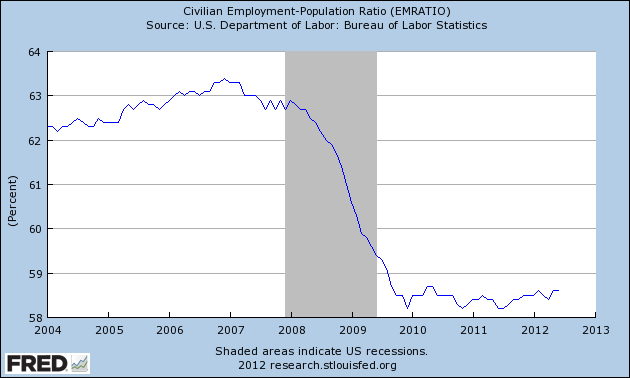
Since the global financial crisis, the evidence has mounted that the United States is in economic decline. Its system of government seems congenitally incapable of coming to grips with America’s fiscal crisis. For the first time in living memory, the U.S. recovery from recession has been weaker than Canada’s. The United States continues to have a higher unemployment rate than Canada, virtually unheard of historically. The American economy is amazingly resilient and might yet come back strong, but right now the evidence suggests a long period of relative economic stagnation south of the border. This is the most important structural change affecting Canada since Stephen Harper became Prime Minister.

April 15, 2012

Is crony capitalism the way of the American future?

Sheldon Richman on the distressing similarities shared by the Republican and Democratic parties:

So the presidential campaign is shaping up as a contest between a Democrat who says we had a free market from 2001 through 2008 and a Republican who . . . agrees — he says “[w]e are only inches away from ceasing to be a free market economy.” You can’t cease to be something you never were.

Thus Barack Obama claims and Mitt Romney implicitly concedes that the free market 1) has existed and 2) therefore presumably created the housing and financial debacle. This bodes ill for advocates of liberty and voluntary exchange.

Notice what will happen if this framing is widely accepted: Genuinely freed markets won’t make the list of feasible options. That will leave us with mere variations on a statist theme, namely, corporatism. How will voters choose among them? Most of those who abhor “socialism” (however they define it) will rally round Republican corporatism because of the pro-market rhetoric, while most who abhor the cruel “free market” (“Look at the hardship it created!”) will rush to Democratic corporatism because of its anti-market rhetoric.

And the winner will be: Corporatism. (That is, the use of government force primarily to benefit the well-connected business elite.) The loser? The people, who would benefit from freedom and freed markets — markets void of privileges and arbitrary decrees. That’s what maximizes consumer and worker bargaining power and enhances general living standards.

Implying a link between Walmart stores and hate groups

Filed under: Business, Politics, USA — Tags: , , — Nicholas @ 11:53

This is custom-made for drawing lazy conclusions:

Study Says The More Walmarts In The Area, The More Hate Groups There Are

This one’s sure to boil some blood over at Walmart headquarters: A new study says there’s a significant correlation between the amount of Walmart stores in an area and the number of hate groups existing in that same area. As the big-box stores proliferate, so do the groups.

LiveScience.com cites the study by professors at Penn State University, New Mexico State University and Michigan State University, which says that the amount of Wal-Mart stores in a county was more statistically significant than other factors usually associated with hate group participation. For example, the unemployment rate, high crime rates and low education.

As I’m just as lazy as the others who’ll jump on that eye-catching headline, here’s another lazy conclusion: because Walmart locates their stores in areas with growing population, so Walmart stores will also correlate with any number of other phenomena that require a minimum (but increasing) population.

Virginia county considering creating first virtual public high school

Filed under: Bureaucracy, Education, Media, Technology, USA — Tags: , , — Nicholas @ 10:50

In many ways, it’s a tribute to the resilience and determination of the educational establishment that it’s taken this long for a school district to even consider offering completely online classes:

Fairfax County schools could become the first in the Washington region to create a virtual public high school that would allow students to take all their classes from a computer at home.

No sports teams. No pep rallies. No lockers, no hall passes. Instead, assignments delivered on-screen and after-school clubs that meet online.

It’s a reimagination of the American high school experience. And it’s a nod to the power of the school choice movement, which has given rise to the widespread expectation that parents should have a menu of options to customize their children’s education.

Of course, it might not just be simple willingness to allow more choice on the part of the school district … there might be other pressures being applied:

Dozens of younger students have left Fairfax schools for the public Virginia Virtual Academy, the first statewide full-time virtual program. Open to any Virginia student in kindergarten through eighth grade, it is run by a Herndon firm — K12 Inc., the nation’s largest operator of public virtual schools — and enrolls nearly 500 students.

April 14, 2012

“The unipolar era has not been a success for America”

Filed under: Europe, Government, Middle East, USA — Tags: , , , , — Nicholas @ 10:55

Conrad Black examines the differences between the Cold War, when America had a clear mission, and the post-Cold War period, when America could be said to have completely lacked a coherent foreign policy:

Indeed, the overwhelming and relatively bloodless victory in the Cold War, the fruition of the brilliant American strategy of containment, left the United States as the only seriously Great Power in the world, a condition unique in the history of the nation-state, starting in the Middle Ages. As a result, there was, 20 years ago, a good deal of frothy (and, as it turns out, grossly premature) intellectual blather about the end of history and the political culmination of the world in democratic capitalism.

The unipolar era has not been a success for America. The great irony of these 20-something post-Cold War years has been that while the United States was the indispensable country in the triumph of capitalist democracy — its preservation from 1917 to 1941, and its outright victory in the following 50 years — it is not now one of the world’s best, or even better, functioning democracies.

Under the Clinton, Bush Jr., and Obama administrations, there has been no coherent strategy to replace the previous masterly and bipartisan missions to lead the West to victory in the Second World War and in the Cold War. Bill Clinton, on the world stage, as in America, and before that in the diminutive state of Arkansas, exuded bonhomous goodwill, extended free trade to Mexico, and expanded NATO into the former Soviet Union, suavely calling it “a partnership for peace.” He moved in the Balkans, but only when the Europeans, who started by calling the challenge posed by Bosnian massacres “The hour of Europe,” fell on their faces and started crying like frightened little pigs for America to end ethnic cleansing in the former Yugoslavia. And even then, nothing would have happened if the Republican leader in the Senate, Robert Dole, a bravely wounded veteran of the European theatre in the Second World War, had not legislated military orders (lift and strike) normally in the province of the commander-in-chief. There never really was a Clinton foreign policy: His responses to the early terrorist attacks (Khobar Towers, the African embassies, the USS Cole) were very inadequate.

George W. Bush, forced to deal with the monstrous outrage of the Sept. 11, 2001 terrorist attacks on New York and Washington, had a piercing, towel-snapping, locker room vision that since democracies do not engage in aggressive war, ergo, every country that was not already democratic should be propelled by the scruff of the neck and the small of the back toward democratization. Thus did Hamas replace Fatah in Gaza; the Muslim Brotherhood, (whose adherents had proudly murdered Anwar Sadat) is replacing Hosni Mubarak in Egypt; terrorist chaos is replacing Saleh in Yemen; and Hezbollah has more or less taken over from the Syrians in Lebanon. Trillions of dollars have been spent, along with over 6,000 American lives, in Afghanistan and Iraq, and it would be impetuous to forecast comparative stability and enlightenment in the near future of either country.

April 13, 2012

“Brzezinski[‘s] … realpolitik approach … is actually refreshing in today’s age of flippant air-bombing humanitarianism”

Filed under: Books, Economics, Government, History, Military, USA — Tags: , , , , , — Nicholas @ 08:24

Sean Collins reviews a pair of books that — rather than signing on to the idea of America as terminal-phase western Roman Empire — perhaps go too far in the other direction. The books are The World America Made by Robert Kagan and Strategic Vision: America and the Crisis of Global Power by Zbigniew Brzezinski:

It is clear that the US faces a number of challenges, especially with regard to its stagnant economy and gridlocked politics. But more and more, the country’s specific problems are overshadowed by creeping fears of national decline. This backdrop of decline extends beyond domestic economics to contemplating whether America’s influence in the world is diminishing, in particular relative to emerging powers like China.

[. . .]

Brzezinski is not only old, he’s old-school, too. His realpolitik approach, which includes Cold War concepts like containment, is actually refreshing in today’s age of flippant air-bombing humanitarianism. For example, he quite baldly comes out and calls for the US to lead an effort to expand the West (via NATO and the EU) to include Russia and Turkey. This, he says, is necessary to prevent Russia from striking out on its own, or allying with China. Brzezinski is also still very mindful that great-power politics have not disappeared, and could re-emerge more forcefully. More than once, he speculates that Asia today resembles Europe before the twentieth-century world wars, and argues for care to ensure that a new conflagration does not break out.

The two authors’ respective approaches to American relations with China illuminate their differences in approach. Kagan is blunt, arguing for an antagonistic stance. He calls on the US to ‘press for greater democratic and liberal reforms’ in China (and in other authoritarian nations), and to promote free trade and markets, and thus ‘push back’ against state capitalism in China. In contrast, Brzezinski urges a diplomatic approach, one that attempts to reach mutual agreement while preventing China from becoming a too-dominant regional power. He is opposed to the Obama administration’s recent ‘Asia pivot’, which calls for more US troops in the region. In an interview with Edward Luce in the Financial Times, Brzezinski warned: ‘We have to focus on Asia, but not in a manner that plays on everyone’s anxieties… It becomes very easy to demonise China and they will demonise us in return. Is that what we want?’

[. . .]

This is illustrated by their treatments of the recent wars in Iraq and Afghanistan. On the surface, the two seem to take very different lines. Kagan was bullish at the outset of both wars and, consistent with his general style in the book, he quickly skates right past such awkward issues. Brzezinski, in contrast, is damning, highlighting how the wars have undermined America’s ability to project its power. But the fact is that neither author really spends much time thinking about them. This is telling: both prefer to speculate about the future rather than face up to the reality of recent foreign-policy moves. Oddly, neither author examines either President George W Bush’s record or President Obama’s record. When Brzezinski does address the Bush administration’s foreign policy, his analytics go out the window and he just sneers. We are left believing that the interventions in Iraq and Afghanistan were nothing more than purely subjective mistakes made by Bush and his vice-president, Dick Cheney.

April 12, 2012

Reason.tv: Why Democrat vs. Republican is the Wrong Way to Look at the 2012 Election

Filed under: Government, Liberty, Media, Politics, USA — Tags: , , , — Nicholas @ 10:59

“We had a non-Obama president recently, his name was George W. Bush, it wasn’t all puppy dogs and rainbows,” says Reason’s Matt Welch. “Being Republican is not enough to counter Obama. Mitt Romney is not offering an alternative to Obama,” adds Reason.tv’s Nick Gillespie.

From Newt Gingrich’s inexplicable campaign chatter about a taxpayer-subsidized colony on the moon to Mitt Romney’s refusal to discuss any specific spending cuts he would implement as president, Republicans continue to offer no real substantive alternative to President Obama’s spendthrift economic policies.

Welch and Gillespie, the co-authors of “The Declaration of Independents: How Libertarian Politics Can Fix What’s Wrong with America,” hosted the discussion “Why Democrat vs. Republican is the Wrong Way to Look at the 2012 Election” at Reason Weekend, the annual donor event held by Reason Foundation (the nonprofit that publishes this website).

QotD: Atheists in America

Filed under: Liberty, Quotations, Religion, USA — Tags: , , — Nicholas @ 00:02

This ongoing conflict between sectarianism and secularism is the raison d’etre for a non-theist movement, and it is why categorical disrespect for godlessness matters. The assumption that religious belief is essential to morality advances mistrust of secular governance. Of course, religious people have a right to their biases, and the irreligious have a right to challenge them. Non-theists can always voice their opinions individually, but, like other ideological and demographic minorities, they need a movement to amplify their voices. And regardless of their individual psychic needs for recognition (which do not interest me), non-theists have a collective political need for a movement that encourages openness about disbelief: The more godlessness is normalised, the less it will seem inherently immoral, the more likely the perspectives of non-theists will be considered, instead of reflexively condemned.

What should they bring to the church/state debates? As a small, disrespected, irreligious minority, non-theists should appreciate freedom of conscience. Non-theism is often associated with hostility toward religion, thanks partly to the prominence of a few ‘New Atheists’, but it can and should promote respect for religious liberty. People who believe in no religions are not apt to privilege any one of them: evangelicals tend to be wary of Mormonism, as the Republican primaries have demonstrated, but to an atheist or agnostic, belief in the resurrection is no more or less worthy of respect than belief in the Angel Moroni.

Scepticism is a great leveller; it favours extending equal speech and religious rights to all orthodoxies, which is the essence of civil liberty. Freedom of conscience doesn’t distinguish between new, outré religions derided as cults and traditional mainstream faiths, as former American Civil Liberties Union executive director Ira Glasser tried explaining to an interviewer years ago. He was asked about the chanting, saffron-robed Hare Krishnas, who commanded little popular respect. They were ‘weird’, the interviewer remarked to Glasser. ‘I don’t know’, he replied. ‘Have you taken a look at the College of Cardinals?’

Wendy Kaminer “In America, atheists are still in the closet”, Spiked!, 2012-04-11

April 11, 2012

F-22 pilot air supply issue still not resolved

Filed under: Military, Technology, USA — Tags: , , — Nicholas @ 08:29

Strategy Page has an update on the F-22 and the ongoing investigation into air supply problems for the pilot:

The U.S. Air Force is admitting that it is having a problem with the pilot air supply on the F-22, a problem they have not been able to find the cause of. Despite this, the air force is going to continue flying its F-22s. The decision to keep flying was made because the air supply problems have not killed anyone yet and they are rare (once every 10,000 sorties.)

The 14 incidents so far were all cases of F-22 pilots apparently experiencing problems. The term “apparently” is appropriate because the pilots did not black out and a thorough check of the air supply system and the aircraft found nothing wrong. There have been nearly 30 of these “dizziness or disorientation” incidents in the last four years, with 14 of them serious enough to be called real incidents. Only one F-22 has been lost to an accident so far and, while that did involve an air supply issue, it was caused by pilot error, not equipment failure.

Meanwhile the air force is spending $7 million to install commercial oxygen status sensors in the air supply systems of its F-22 fighters. This is part of a year-long effort to find out what’s causing the air supply on F-22s to get contaminated and cause pilots to become disoriented or pass out. Twice in the past year the entire F-22 fleet was grounded because of the air supply problems. The first grounding lasted 140 days and ended last September. The second grounding lasted a week and ended five months ago. The 180 F-22s comprise the most powerful component of the air force’s air combat capability and the brass are eager to find out what is wrong.

April 8, 2012

The Military-Industrial Complex lives

Filed under: Military, Politics, USA — Tags: , , , , — Nicholas @ 10:55

From Strategy Page, where the US Army doesn’t want any more tanks right now, but the politicians (and their crony capitalist “friends”) want the tanks to continue to be built and upgraded:

The U.S. Army is fighting the politicians to avoid having to buy more M-1 tanks, or upgrade some older ones that do not need upgrades. What it comes down to is that the politicians want to keep the only American tank manufacturing plant open. It’s all about political posturing, votes and getting reelected. But the army wants to spend its shrinking budgets on things that will save lives in the next battle. At stake is several billion dollars. The generals cannot openly say that this is about buying votes versus buying lives, but that’s what it comes down to.

So far, over 9,000 American M-1 tanks have been produced and most of them subsequently updated at least once. But the army, seeking to save a billion dollars, wants to close the plant that builds and modifies the M-1. The closure would be for three years, and when it was reopened there would be a backlog of upgrades and parts orders to fill to keep the plant open until, perhaps, an M-1 replacement comes along. At the moment the generals do not have any firm plans for an M-1 replacement.

Politicians and the operators of the plant want to keep the plant open in order to save jobs, votes, and operating profits. This is basically a largely political decision that involves getting the money (from the taxpayers) to stay open by pretending that the army wants this. But the army leadership has not cooperated and has openly opposed this plan. How long the plant will remain in business is uncertain, as is the future of the M-1 tank.

Sexual humiliation as a tool of political control

Filed under: Government, Law, Liberty, USA — Tags: , , , , — Nicholas @ 10:15

Writing in the Guardian, Naomi Wolf discusses the ways the US government has incorporated sexual humiliation into their toolkit for dealing with both prisoners and innocent people:

In a five-four ruling this week, the supreme court decided that anyone can be strip-searched upon arrest for any offense, however minor, at any time. This horror show ruling joins two recent horror show laws: the NDAA, which lets anyone be arrested forever at any time, and HR 347, the “trespass bill”, which gives you a 10-year sentence for protesting anywhere near someone with secret service protection. These criminalizations of being human follow, of course, the mini-uprising of the Occupy movement.

Is American strip-searching benign? The man who had brought the initial suit, Albert Florence, described having been told to “turn around. Squat and cough. Spread your cheeks.” He said he felt humiliated: “It made me feel like less of a man.”

[. . .]

Believe me: you don’t want the state having the power to strip your clothes off. History shows that the use of forced nudity by a state that is descending into fascism is powerfully effective in controlling and subduing populations.

The political use of forced nudity by anti-democratic regimes is long established. Forcing people to undress is the first step in breaking down their sense of individuality and dignity and reinforcing their powerlessness. Enslaved women were sold naked on the blocks in the American south, and adolescent male slaves served young white ladies at table in the south, while they themselves were naked: their invisible humiliation was a trope for their emasculation. Jewish prisoners herded into concentration camps were stripped of clothing and photographed naked, as iconic images of that Holocaust reiterated.

[. . .]

The most terrifying phrase of all in the decision is justice Kennedy’s striking use of the term “detainees” for “United States citizens under arrest”. Some members of Occupy who were arrested in Los Angeles also reported having been referred to by police as such. Justice Kennedy’s new use of what looks like a deliberate activation of that phrase is illuminating.

Ten years of association have given “detainee” the synonymous meaning in America as those to whom no rights apply — especially in prison. It has been long in use in America, habituating us to link it with a condition in which random Muslims far away may be stripped by the American state of any rights. Now the term — with its associations of “those to whom anything may be done” — is being deployed systematically in the direction of … any old American citizen.

April 7, 2012

Arizona’s internet-trolls-go-to-jail bill

Filed under: Law, Liberty, Media, Technology, USA — Tags: , , , , , — Nicholas @ 11:21

Interestingly, aside from the occasional mention of the Arizona Cardinals, almost every post I’ve marked with the Arizona tag over the last three years is about stupid laws or bills that infringe constitutional rights. What up, Arizona?

April 4, 2012

The “Three Amigos” are not all that friendly at the moment

Filed under: Americas, Cancon, USA — Tags: , , , , , — Nicholas @ 10:56

A report on the “Three Amigos” meeting where President Barack Obama hosted President Felipe Calderon, and Prime Minister Stephen Harper at the White House:

Obama’s neglect of our nearest neighbors and biggest trade partners has created deteriorating relations, a sign of a president who’s out of touch with reality. Problems are emerging that aren’t being reported.

Fortunately, the Canadian and Mexican press told the real story. Canada’s National Post quoted former Canadian diplomat Colin Robertson as saying the North American Free Trade Agreement and the three-nation alliance it has fostered since 1994 have been so neglected they’re “on life support.”

Energy has become a searing rift between the U.S. and Canada and threatens to leave the U.S. without its top energy supplier.

The Winnipeg Free Press reported that Canadian Prime Minister Stephen Harper warned Obama the U.S. will have to pay market prices for its Canadian oil after Obama’s de facto veto of the Keystone XL pipeline. Canada is preparing to sell its oil to China.

Until now, NAFTA had shielded the U.S. from having to pay global prices for Canadian oil. That’s about to change.

Canada has also all but gone public about something trade watchers have known for a long time: that the U.S. has blocked Canada’s entry to the eight-way free trade agreement known as the Trans-Pacific Partnership, an alliance of the U.S., Australia, New Zealand, Vietnam, Malaysia, Peru, Chile, and Singapore. Both Canada and Mexico want to join and would benefit immensely.

So much for Canadian whingeing, right? Those snowback hosers are never happy. Relations with Mexico must be in better shape, yes? Uh, no:

Things were even worse, if you read the Mexican press accounts of the meeting.

Excelsior of Mexico City reported that President Felipe Calderon bitterly brought up Operation Fast and Furious, a U.S. government operation that permitted Mexican drug cartels to smuggle thousands of weapons into drug-war-torn Mexico. This blunder has wrought mayhem on Mexico and cost thousands of lives.

It’s fortunate for President Obama that the press is generally careful in their reporting … careful, that is, to avoid blaming Obama wherever possible.

Update: Ace has more on the unusually assertive Canadian position.

« Newer PostsOlder Posts »

Powered by WordPress