Quotulatiousness

January 8, 2015

Media man of the year for 2014 – Ben Trovato

Filed under: Media, Politics, USA — Tags: , , — Nicholas @ 03:00

At The Federalist Robert Tracinski nominates perhaps the most appropriate candidate for media man person of the year:

As the year winds to a close, it is traditional to pick a “man of the year,” or in our more enlightened age, a “person of the year.” I’ve never done that before, but this year there is one candidate who has left his mark so indelibly on 2014 that I would be remiss if I did not acknowledge his vast influence.

Thus, my own personal pick for 2014′s Person of the Year: Ben Trovato.

He has been everywhere and had a hand in just about every big story, from Ferguson to the University of Virginia. He has been most active in his usual fields, journalism and politics, but we can see his impact as far afield as espionage and even retail.

You’ve never heard of him? Maybe so, but you already know him very well.

For those who suspect that Ben Trovato is not a real, literal person, you’re right. But the whole point of old Ben’s influence is that it doesn’t matter whether he’s literally real. Or whether anything is literally real, for that matter.

I first heard of Ben Trovato while reading a curious little volume of unusual word origins. A number of these supposed etymologies, most of the really colorful ones, were attributed to “Ben Trovato.” The name is taken from an old Italian saying: se non è vero, è ben trovato. Roughly translated: if it’s not true, it’s a good story. These were the kind of word origins that you really wanted to be true, but for which there was no real evidence. In contemporary parlance, they are “too good to check.”

I think you can begin to see why 2014 has been the year of Ben Trovato. It has been a year full of things that were non vero, but which had really good narratives. Or at least really convenient narratives.

January 7, 2015

How to create an investment monoculture

Filed under: Economics, Government, USA — Tags: , , — Nicholas @ 03:00

At Coyote Blog, Warren Meyer explains how what must have seemed to be a simple, common-sense regulation change led almost inevitably to a housing market melt-down:

… a redefinition by governments in the Basel accords of how capital levels at banks should be calculated when determining capital sufficiency. I will oversimplify here, but basically it categorized some assets as “safe” and some as “risky”. Those that were risky had their value cut in half for purposes of capital calculations, while those that were “safe” had their value counted at 100%. So if a bank invested a million dollars in safe assets, that would count as a million dollar towards its capital requirements, but would count only $500,000 towards those requirements if it were invested in risky assets. As a result, a bank that needed a billion dollars in capital would need a billion of safe assets or two billion of risky assets.

Well, this obviously created a strong incentive for banks to invest in assets deemed by the government as “safe”. Which of course was the whole point — if we are going to have taxpayer-backed deposit insurance and bank bailouts, the prices of that is getting into banks’ shorts about the risks they are taking with their investments. This is the attempted tightening of regulation to which Kling refers. Regulators were trying for tougher, not weaker standards.

[…]

Anyway, what assets did the regulators choose as “safe”? Again, we will simplify, but basically sovereign debt and mortgages (including the least risky tranches of mortgage-backed debt). So you are a bank president in this new regime. You only have enough capital to meet government requirements if you get 100% credit for your investments, so it must be invested in “safe” assets. What do you tell your investment staff? You tell them to go invest the money in the “safe” asset that has the highest return.

And for most banks, this was mortgage-backed securities. So, using the word Brad DeLong applied to deregulation, there was an “orgy” of buying of mortgage-backed securities. There was simply enormous demand. You hear stories about fraud and people cooking up all kinds of crazy mortgage products and trying to shove as many people as possible into mortgages, and here is one reason — banks needed these things. For the average investor, most of us stayed out. In the 1980’s, mortgage-backed securities were a pretty good investment for individuals looking for a bit more yield, but these changing regulations meant that banks needed these things, so the prices got bid up (and thus yields bid down) until they only made sense for the financial institutions that had to have them.

It was like suddenly passing a law saying that the only food people on government assistance could buy with their food stamps was oranges and orange derivatives (e.g. orange juice). Grocery stores would instantly be out of oranges and orange juice. People around the world would be scrambling to find ways to get more oranges to market. Fortunes would be made by clever people who could find more oranges. Fraud would likely occur as people watered down their orange derivatives or slipped in some Tang. Those of us not on government assistance would stay away from oranges and eat other things, since oranges were now incredibly expensive and would only be bought at their current prices by folks forced to do so. Eventually, things would settle down as everyone who could do so started to grow oranges. And all would be fine again, that is until there was a bad freeze and the orange crop failed.

Government regulation — completely well-intentioned — had created a mono-culture. The diversity of investment choices that might be present when every bank was making its own asset risk decisions was replaced by a regime where just a few regulators picked and chose the assets. And like any biological mono-culture, the ecosystem might be stronger for a while if those choices were good ones, but it made the whole system vulnerable to anything that might undermine mortgages. When the housing market got sick (and as Kling says government regulation had some blame there as well), the system was suddenly incredibly vulnerable because it was over-invested in this one type of asset. The US banking industry was a mono-culture through which a new disease ravaged the population.

QotD: It’s all about the men

Filed under: Politics, Quotations, USA — Tags: , , , — Nicholas @ 00:01

Probably the most common stereotype of anti-sex worker feminists is that they’re all misandrists, and on the surface that certainly seems true. But a closer examination of the issue reveals a deeper motivation which more closely resembles an obsessive concern with men at the expense of women. Feminists are willing to deny models income in order to deny lads’ mags to men, and would rather see women in the porn industry unemployed rather than know that men can watch porn videos. “Sex trafficking” fetishists are willing to undermine the entire edifice of civil liberties for both sexes in order to stop men from having access to commercial sex. Anti-sex worker screeds go on and on about “ending men’s demand for sex”, or “teaching men they aren’t entitled to sex”, or “look at the awful things men say about ‘prostituted women’!” Men this, men that, men the other thing; men, men, Men, MEN, MEN! No matter how vociferously prohibitionists insist that their motive is women’s protection or “empowerment”, sex work prohibition has absolutely nothing to do with women: it’s all about the men.

Nearly every Western society has a long tradition of viewing sex as something “dirty” and “demeaning”; the idea of punishment is inextricably bound up with the concept of “correction”, so buried in the misandrist rhetoric spouted by prohibitionists is the notion that if Big Nanny just spanks men hard enough and often enough, they won’t have those dirty thoughts any more. The underlying pretext of punishing men for male sexuality, and restricting them from enjoying same, is not to hurt them but rather to “help” them by making them more like (asexual, idealized) women. To be sure, “fallen” women are to be “helped” as well wherever possible, but when it happens it’s merely a happy byproduct of the campaign to “improve” men; those women who refuse to be “saved” and to dutifully recite the feminist catechism thereafter will be thrown under the bus without the slightest hesitation.

Maggie McNeill, “All About the Men”, The Honest Courtesan, 2014-05-09.

January 5, 2015

Scott Aaronson on “white male privilege” as experienced at MIT

Filed under: Politics, USA — Tags: , , , , — Nicholas @ 04:00

Down in the comments on this post, Scott Aaronson gets extremely personal:

… You also say that men in STEM fields — unlike those in the humanities and social sciences — don’t even have the “requisite vocabulary” to discuss sex discrimination, since they haven’t read enough feminist literature. Here I can only speak for myself: I’ve read at least a dozen feminist books, of which my favorite was Andrea Dworkin’s Intercourse (I like howls of anguish much more than bureaucratic boilerplate, so in some sense, the more radical the feminist, the better I can relate). I check Feministing, and even radfem blogs like I Blame the Patriarchy. And yes, I’ve read many studies and task force reports about gender bias, and about the “privilege” and “entitlement” of the nerdy males that’s keeping women away from science.

Alas, as much as I try to understand other people’s perspectives, the first reference to my “male privilege” — my privilege! — is approximately where I get off the train, because it’s so alien to my actual lived experience. This is not, insanely, to suggest a lack of misogyny in the modern world! To whatever extent there is misogyny, one could say that there’s also “male privilege.” Rather it’s to suggest that, given what nerdy males have themselves had to endure in life, shaming them over their “male privilege” is a bad way to begin a conversation with them.

But I suspect the thought that being a nerdy male might not make me “privileged” — that it might even have put me into one of society’s least privileged classes — is completely alien to your way of seeing things. To have any hope of bridging the gargantuan chasm between us, I’m going to have to reveal something about my life, and it’s going to be embarrassing.

(sigh) Here’s the thing: I spent my formative years — basically, from the age of 12 until my mid-20s — feeling not “entitled,” not “privileged,” but terrified. I was terrified that one of my female classmates would somehow find out that I sexually desired her, and that the instant she did, I would be scorned, laughed at, called a creep and a weirdo, maybe even expelled from school or sent to prison. And furthermore, that the people who did these things to me would somehow be morally right to do them — even if I couldn’t understand how.

You can call that my personal psychological problem if you want, but it was strongly reinforced by everything I picked up from my environment: to take one example, the sexual-assault prevention workshops we had to attend regularly as undergrads, with their endless lists of all the forms of human interaction that “might be” sexual harassment or assault, and their refusal, ever, to specify anything that definitely wouldn’t be sexual harassment or assault. I left each of those workshops with enough fresh paranoia and self-hatred to last me through another year.

My recurring fantasy, through this period, was to have been born a woman, or a gay man, or best of all, completely asexual, so that I could simply devote my life to math, like my hero Paul Erdös did. Anything, really, other than the curse of having been born a heterosexual male, which for me, meant being consumed by desires that one couldn’t act on or even admit without running the risk of becoming an objectifier or a stalker or a harasser or some other creature of the darkness.

Of course, I was smart enough to realize that maybe this was silly, maybe I was overanalyzing things. So I scoured the feminist literature for any statement to the effect that my fears were as silly as I hoped they were. But I didn’t find any. On the contrary: I found reams of text about how even the most ordinary male/female interactions are filled with “microaggressions,” and how even the most “enlightened” males — especially the most “enlightened” males, in fact — are filled with hidden entitlement and privilege and a propensity to sexual violence that could burst forth at any moment.

Because of my fears — my fears of being “outed” as a nerdy heterosexual male, and therefore as a potential creep or sex criminal — I had constant suicidal thoughts. As Bertrand Russell wrote of his own adolescence: “I was put off from suicide only by the desire to learn more mathematics.”

At one point, I actually begged a psychiatrist to prescribe drugs that would chemically castrate me (I had researched which ones), because a life of mathematical asceticism was the only future that I could imagine for myself. The psychiatrist refused to prescribe them, but he also couldn’t suggest any alternative: my case genuinely stumped him. As well it might — for in some sense, there was nothing “wrong” with me. In a different social context — for example, that of my great-grandparents in the shtetl — I would have gotten married at an early age and been completely fine. (And after a decade of being coy about it, I suppose I’ve finally revealed the meaning of this blog’s title.) This is not, in any way, shape, or form, to suggest that I yearn for an era when women could be purchased as property. There were many times and places where marriages did not occur without both parties’ consent, but there was also a ritualized system of courtship that took much of the terror and mystery out of the process. Even that is not exactly what I “yearn” for; I merely say it’s what I felt “optimized” for.

All this time, I faced constant reminders that the males who didn’t spend months reading and reflecting about feminism and their own shortcomings — even the ones who went to the opposite extreme, who engaged in what you called “good old-fashioned ass-grabbery” — actually had success that way. The same girls who I was terrified would pepper-spray me and call the police if I looked in their direction, often responded to the crudest advances of the most Neanderthal of men by accepting those advances. Yet it was I, the nerd, and not the Neanderthals, who needed to check his privilege and examine his hidden entitlement! Contrary to what countless people have said, this is not intended to blame women for their choices — or even, really, to blame the Neanderthals. Rather, it’s intended to blame a culture that told male nerds since childhood that they’d be horrible people if they asked — even more horrible than if they didn’t ask! — thereby ceding the field to the Neanderthals by default.

So what happened to break me out of this death-spiral? Did I have an epiphany, where I realized that despite all appearances, it was I, the terrified nerd, who was wallowing in unearned male privilege, while those Neaderthal ass-grabbers were actually, on some deeper level, the compassionate feminists — and therefore, that both of us deserved everything we got?

No, there was no such revelation. All that happened was that I got older, and after years of hard work, I achieved some success in science, and that success boosted my self-confidence (at least now I had something worth living for), and the newfound confidence, besides making me more attractive, also made me able to (for example) ask a woman out, despite not being totally certain that my doing so would pass muster with a committee of radfems chaired by Andrea Dworkin — a prospect that was previously unthinkable to me. This, to my mind, “defiance” of feminism is the main reason why I was able to enjoy a few years of a normal, active dating life, which then led to meeting the woman who I married.

Now, the whole time I was struggling with this, I was also fighting a second battle: to maintain the liberal, enlightened, feminist ideals that I had held since childhood, against a powerful current pulling me away from them. I reminded myself, every day, that no, there’s no conspiracy to make the world a hell for shy male nerds. There are only individual women and men trying to play the cards they’re dealt, and the confluence of their interests sometimes leads to crappy outcomes. No woman “owes” male nerds anything; no woman deserves blame if she prefers the Neanderthals; everyone’s free choice demands respect.

That I managed to climb out of the pit with my feminist beliefs mostly intact, you might call a triumph of abstract reason over experience.

But I hope you now understand why I might feel “only” 97% on board with the program of feminism. I hope you understand why, despite my ironclad commitment to women’s reproductive choice and affirmative action and women’s rights in the developing world and getting girls excited about science, and despite my horror at rape and sexual assault and my compassion for the victims of those heinous crimes, I might react icily to the claim — for which I’ve seen not a shred of statistical evidence — that women are being kept out of science by the privileged, entitled culture of shy male nerds, which is worse than the culture of male doctors or male filmmakers or the males of any other profession. I believe you guys call this sort of thing “blaming the victim.” From my perspective, it serves only to shift blame from the Neanderthals and ass-grabbers onto some of society’s least privileged males, the ones who were themselves victims of bullying and derision, and who acquired enough toxic shame that way for appealing to their shame to be an effective way to manipulate their behavior. As I see it, whenever these nerdy males pull themselves out of the ditch the world has tossed them into, while still maintaining enlightened liberal beliefs, including in the inviolable rights of every woman and man, they don’t deserve blame for whatever feminist shortcomings they might still have. They deserve medals at the White House. This is obvious hyperbole.

H/T to Scott Alexander, who has much to say about both Aaronson’s painful confession and the rather over-the-top responses to it from the feminist community.

Morality in public, perversity in private?

Filed under: Media, Politics, Religion, USA — Tags: , , , — Nicholas @ 02:00

In the Washington Post, Nita Farahany looks at an interesting study published in the Archives of Sexual Behavior. The study gives away the game in the title — Do American States with More Religious or Conservative Populations Search More for Sexual Content on Google?

“In America, religiosity and conservatism are generally associated with opposition to non-traditional sexual behavior, but prominent political scandals and recent research suggest a paradoxical private attraction to sexual content on the political and religious right. We examined associations between state level religiosity/conservatism and anonymized interest in searching for sexual content online using Google Trends (which calculates within-state search volumes for search terms). Across two separate years, and controlling for demographic variables, we observed moderate-to-large positive associations between: (1) greater proportions of state-level religiosity and general web searching for sexual content and (2) greater proportions of state level conservatism and image-specific searching for sex. These findings were interpreted in terms of the paradoxical hypothesis that a greater preponderance of right-leaning ideologies is associated with greater preoccupation with sexual content in private Internet activity. Alternative explanations (e.g., that opposition to non-traditional sex in right-leaning states leads liberals to rely on private internet sexual activity) are discussed, as are limitations to inference posed by aggregate data more generally.”

The researchers found that the American states with the greatest proportion of individuals who self-identify as very religious, or consider religion to be an important part of their lives, engage in more active searches for sexual content online compared to states with fewer religious and conservative individuals. There was a direct correlation between the proportion of conservatives in a state and image-specific Internet sex searches documented in that state.

Their conclusion? More restrictive social norms drive behaviors underground. There are quite a few limitations of the study and alternative hypotheses that may drive the results, which the researchers acknowledge. But it’s still quite an interesting study.

QotD: Hollywood elites and the mere bourgeoisie in the audience

Filed under: Books, Business, Media, Quotations, USA — Tags: , , , , — Nicholas @ 01:00

… Hollywood movies are made by the elite for the elite, and that it is only with reluctance, or to pay the bills, does Hollywood turn out nutritious fare meant to please and sate the coarse palate of coarse commoners like me, as the popular blockbusters mentioned above.

I do not mean to dwell on this point, I merely ask that you, ladies and gentlemen of the jury, accept it as uncontested, since surely the counselor for the Defense of Hollywood dare not claim the actors and studios like us, want to be like us, or like what we like. Their entire claim to be an elite, and superior in taste, intellect, and moral insight to the pathetic bourgeoisie is dashed if they do not discriminate themselves from bourgeoisie tastes.

With these assumptions explicit, let us ponder the question.

Why are comic book movies better than Hollywood movies?

[…]

What is difficult is learning to appreciate and savor the artistic genius of Jack Kirby and Steve Ditko, of JRR Tolkien and CS Lewis, who wrote comic books and paperbacks, fairy stories and science fiction marketed to children. I have worked hard to lower my taste to appreciating the things as common and simple as fairy tales, and all the simple and true things under heaven. I hope one day my taste will be as coarse as that of St. Peter, who was a fisherman.

The elite of our culture have not yet shouldered that difficult task. We all know that the elite are out of touch with the tastes of the common man, but how far out of touch they are is something of a shock.

Allow me to quote from J.R.R. TOLKIEN by Jeremy Mark Robinson:

    Philip Toynbee declared, in 1961, that Tolkien’s ‘childish books had passed into a merciful oblivion’, a wonderful statement, just a tad inaccurate. In 1997, The Lord of the Rings was voted the top book of the 20th century by readers in a British bookstore’s poll (Waterstone’s). 104 out of 105 stores and 25,000 readers put The Lord of the Rings at the top (1984 was second).

    The results of the poll angered many lit’ry critics in the UK. Howard Jacobson, Mark Lawson, Bob Inglis, Germaine Greer and Susan Jeffreys, were among those irritated by Lord of the Rings‘ success among readers. The Daily Telegraph readers’ poll came up with the same results. The Folio Society also ran a poll (of 50,000 members), and Middle-earth was top again (Pride and Prejudice was second and David Copperfield was third).

    It was Tolkien’s incredible popularity that annoyed some critics and journos. Writers are nothing if not bitchy and envious of other people’s success, and British journalists have a long tradition of knocking down anyone who’s successful. So the popularity of The Lord of the Rings served to underline many of the prejudices of the literary establishment and media in the UK:

    (1) That people who liked Tolkien were geeks, anoraks, sci-fi nuts, college students, hippies, and so on.

    (2) That Tolkien’s fiction was juvenile, reactionary, sexist, racist, pro-militaristic, etc.

    (3) And it was badly written, simplistic, stereotypical, and so on.

    (4) And it was in the fantasy genre, which was automatically deemed as lightweight, as ‘escapist’, as fit only for adolescent boys. And so on and on.

What Mr. Robinson reports of these polls is underscored and emphasized by some that film critic and conservative commentator Michael Medved mentions about movies.

Allow me again to quote, this from a talk Mr. Medved gave at Hillsdale College:

    In years past, Hollywood also turned out popular and sympathetic portrayals of contemporary clergymen. Bing Crosby, Pat O’Brien and Spencer Tracy played earthy, compassionate priests who gave hope to underprivileged kids or comforted GI’s on the battlefield. Nearly all men of the cloth who appeared on screen would be kindly and concerned, if not downright heroic.

    In the last ten to fifteen years mainstream moviemakers have swung to the other extreme. If someone turns up in a film today wearing a Roman collar or bearing the title “Reverend,” you can be fairly sure that he will be either crazy or corrupt — or probably both.

John C. Wright, “Supermanity and Dehumanity (Complete)”, John C. Wright’s Journal, 2014-12-13.

January 4, 2015

The MPAA may have found the super-enforcement tool they think they need

Filed under: Law, Media, USA — Tags: , , , , — Nicholas @ 10:09

Russell Brandom explains why a slight change of wording in a recent court case may have handed the Motion Picture Association of America (MPAA) exactly the kind of power they’ve been demanding to crack down on piracy and “infringement”:

Hollywood’s war on piracy has reached a strange impasse. While the MPAA and others have launched lawsuits against US-based infringers, reaching offshore torrent sites like Isohunt and The Pirate Bay is still a slow process, and whenever a site is taken down, others quickly pop up to fill its place. As a result, the MPAA has consistently pushed for the power to block infringing sites from the internet: first by pushing for new laws like SOPA in 2011, then through a series of novel legal tactics. The fight has pitted them against some of the most powerful companies on the web, and drawn them into a long, secret battle with Google.

But leaked documents show that Hollywood has a new secret weapon in the fight, a little-known legal venue that’s poised to take on new powers over the digital realm. It’s called the International Trade Commission, a quasi-judicial agency that regulates imported goods as they enter the country. Traditionally, that means physical goods — if you want to ship in a boatload of fake iPhones, the ITC is the agency that will stop you — but the ITC recently gave itself the power to rule on data as it crosses US borders, as a result of a complex 3D printing case. If the ruling holds, it could have huge implications for the way data moves across the global web, and give the MPAA the site-blocking powers it’s been grasping at for years.

The heart of the case is a company called ClearCorrect, which 3D prints clear plastic braces custom-designed for each patient’s teeth. Much of the technology involved in the process is already under patent, but ClearCorrect has gotten around those patents by farming out its intricate computer modeling to an office in Pakistan. That modeling violates a number of US patents — and if ClearCorrect were shipping back the resulting braces in a box, it would be a simple case: the goods would be contraband, to be stopped at the border. But instead, ClearCorrect is only transmitting digital models from Pakistan and printing out the braces in local offices in Texas. The only thing coming in from Pakistan is raw modeling data. So what’s a trade commission to do?

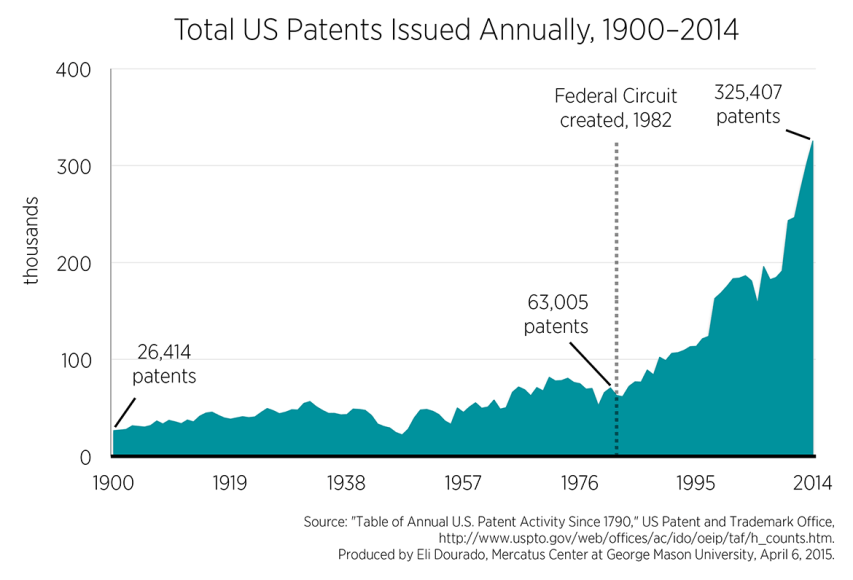
In April of last year, the ITC arrived at an answer with huge repercussions: stop the data at the border. The ITC is only supposed to rule on “articles,” which has usually been taken to mean physical goods, but last year’s ruling took it to include data too. That gives the ITC the power to stop ClearCorrect’s contraband braces data at the border, but it could have far greater implications. If a web service like Gmail or Facebook ends up on the wrong side of a patent dispute, the court could potentially forbid the service from transmitting data into the US until the dispute is resolved — making the cost of a losing a court battle astronomically higher. It would also require powerful new tools for monitoring data as it crosses national borders, a fundamental break from the international structure of the web. Aware of the huge issues at stake, the ITC stayed the ruling until the Federal Circuit weighs in later this year — but already, legal groups are reeling from the possible consequences.

January 3, 2015

Last year, “a Kentucky judge did something no federal judge has done since 1932”

Filed under: Business, Law, Liberty, USA — Tags: , , , , , — Nicholas @ 11:44

It’s been a very long time since a federal judge in Kentucky anywhere in the United States has struck down a “certificate of necessity” (CON) regulation:

Mighty oaks from little acorns grow, so last year’s most encouraging development in governance might have occurred in February in a U.S. district court in Frankfort, Ky. There, a judge did something no federal judge has done since 1932. By striking down a “certificate of necessity” (CON) regulation, he struck a blow for liberty and against crony capitalism.

Although Raleigh Bruner’s Wildcat Moving company in Lexington is named in celebration of the local religion — University of Kentucky basketball — this did not immunize him from the opposition of companies with which he wished to compete. In 2012, he formed the company, hoping to operate statewide. Kentucky, however, like some other states, requires movers to obtain a CON. Kentucky’s statute says such certificates shall be issued if the applicant is “fit, willing and able properly to perform” moving services — and if he can demonstrate that existing moving services are “inadequate,” and that the proposed service “is or will be required by the present or future public convenience and necessity.”

Applicants must notify their prospective competitors, who can and often do file protests. This frequently requires applicants to hire lawyers for the hearings. There they bear the burden of proving current inadequacies and future necessities. And they usually lose. From 2007 to 2012, 39 Kentucky applications for CONs drew 114 protests — none from the general public, all from moving companies. Only three of the 39 persevered through the hearing gantlet; all three were denied CONs.

Bruner sued, arguing three things: that the CON process violates the Constitution’s equal protection clause because it is a “competitors’ veto” that favors existing companies over prospective rivals; that the statute’s requirements (“inadequate,” “convenience,” “necessity”) are unconstitutionally vague; and that the process violates the 14th Amendment’s protections of Americans’ “privileges or immunities,” including the right to earn a living.

January 2, 2015

Debunking the “Broken Windows” theory of crime

Filed under: Law, USA — Tags: , , — Nicholas @ 07:51

In Mother Jones, Kevin Drum looks at the frequent claim on the political right that the “Broken Windows” model of policing was pivotal in reducing urban crime:

The “Broken Windows” theory suggests that tolerance of small acts of disorder creates an environment that leads to rising amounts of serious crime. So if police crack down on small offenses—petty vandalism, public lewdness, etc. — crime reductions will follow. George Kelling was one of the originators of the theory, and NYPD police commissioner Bill Bratton is one of its strongest proponents.

It sounds reasonable, but as Drum points out, it takes credit for improvements that it couldn’t have been driving:

Violent crime 1985-2012So here’s the thing: this is almost certainly wrong. Not even controversial. Just wrong: broken windows policing may well have been helpful in reducing New York’s crime rate, but there’s flatly no evidence that it’s been pivotal. It’s true that crime in New York is down more than it is nationally, but that’s just because crime went up more in big cities vs. small cities during the crime wave of the 60s through the 80s, and it then went down more during the crime decline of the 90s and aughts. Kelling and Bratton can dismiss this as ivory tower nonsense, but they should know better. The statistics are plain enough, after all.

Violent crime big vs small cities 1985-2010Take a look at the two charts on the right. The top one shows crime declines in six of America’s biggest cities. As you can see, New York did well, but it did no better than Chicago or Dallas or Los Angeles, none of which implemented broken windows during the 90s. The bottom chart is a summary of the crime decline in big cities vs. small cities. Again, the trend is clear: crime went up more during the 80s in big cities, but then declined more during the 90s and aughts. The fact that New York beat the national average is a matter of its size, not broken windows.

Now, none of this is evidence that broken windows doesn’t work. The evidence is foggy either way, and we simply don’t know. My own personal view is that it’s probably a net positive, but a fairly modest one.

Works that didn’t enter public domain, thanks to copyright extension

Filed under: Books, Law, Media, Science, USA — Tags: , , , — Nicholas @ 02:00

The Center for the Study of the Public Domain (at Duke Law), lists some of the better-known works that should have become public domain in the United States this year, except for the extension of copyright terms:

Works from 1958 that won't enter public domain

Current US law extends copyright for 70 years after the date of the author’s death, and corporate “works-for-hire” are copyrighted for 95 years after publication. But prior to the 1976 Copyright Act (which became effective in 1978), the maximum copyright term was 56 years — an initial term of 28 years, renewable for another 28 years. Under those laws, works published in 1958 would enter the public domain on January 1, 2015, where they would be “free as the air to common use.” Under current copyright law, we’ll have to wait until 2054. And no published works will enter our public domain until 2019. The laws in other countries are different — thousands of works are entering the public domain in Canada and the EU on January 1.

What books and plays would be entering the public domain if we had the pre-1978 copyright laws? You might recognize some of the titles below.

  • Chinua Achebe, Things Fall Apart
  • Hannah Arendt, The Human Condition
  • Isaac Asimov (writing as Paul French), Lucky Starr and the Rings of Saturn
  • Simone de Beauvoir, Mémoires d’une jeune fille rangée (Memoirs of a Dutiful Daughter)
  • Michael Bond, A Bear Called Paddington, with illustrations by Peggy Fortnum
  • Eugene Burdick and William Lederer, The Ugly American
  • Truman Capote, Breakfast at Tiffany’s
  • Agatha Christie, Ordeal by Innocence
  • John Kenneth Galbraith, The Affluent Society
  • Graham Greene, Our Man in Havana
  • Dr. Martin Luther King, Jr., Stride Toward Freedom: The Montgomery Story
  • Claude Lévi-Strauss, Anthropologie Structurale (Structural Anthropology)
  • Mary Renault, The King Must Die
  • Dr. Seuss, Yertle the Turtle and Other Stories
  • T.H. White, The Once and Future King

What a trove of books — imagine these being freely available to students and educators around the world. You would be free to translate these books into other languages, create Braille or audio versions for visually impaired readers (if you think that publishers wouldn’t object to this, you would be wrong), or adapt them for theater or film. You could read them online or buy cheaper print editions, because others were free to republish them. (Empirical studies have shown that public domain books are less expensive, available in more editions and formats, and more likely to be in print — see here, here, and here.) Imagine a digital Library of Alexandria containing all of the world’s books from 1958 and earlier, where, thanks to technology, you can search, link, annotate, copy and paste. (Google Books has brought us closer to this reality, but for copyrighted books where there is no separate agreement with the copyright holder, it only shows three short snippets, not the whole book.) You could use these books in your own stories — The Once and Future King was free to draw upon Sir Thomas Malory’s Le Morte d’Arthur (a compilation of King Arthur legends) because Malory’s work was in the public domain. One tale inspires another. That is how the public domain feeds creativity. Instead of seeing these literary works enter the public domain in 2015, we will have to wait until 2054.

QotD: The democratization of fame

Filed under: Media, Quotations, USA — Tags: , , — Nicholas @ 01:00

The radicalization of renown is good for America.

In these times of seemingly limited job and business opportunities, celebrity has become a goal attainable by all.

Gaining public attention by performing for the masses once required skills — deft strokes with ochre on the walls of Paleolithic caves, facility with trident and net in the Roman coliseum, recitation of iambic pentameter by the swath from the stage at the Globe.

Talent and practice were needed for popularity from the dawn of time until the debut of America’s Funniest Home Videos in 1990. And even then a contestant had to have steady hands and steely resolve to keep the video rolling while his son pedaled off an improvised plywood ramp trying to leap a row of Tonka toys on his Big Wheel and got whacked in the testicles.

But what does 18-year-old Bethany Mota who still lives at home with her parents (two-page spread, People, pp. 196-7) do? She does “reviews of new makeup, clothes, and other mall finds.” Her YouTube channel has 5.9 million subscribers. She “reportedly makes $40,000 a month.”

There are 10,900,000 teenage girls in America, an estimated 10,899,999 of whom have the same skill set as Bethany. This includes the teenage girl at my house who is presently locked in her bedroom sharing “reviews of new makeup, clothes, and other mall finds” with her 5.9 million Facebook friends. She is about to get pages 196 and 197, torn from People and heavily marked with a highlighter pen, shoved under her door. Bethany Mota, you are a beacon of hope.

P.J. O’Rourke, “Welcome to Showbiz Sharia Law: No talent? Kind of dim-witted? No shame? Perfect. The celebrity industry needs you — just don’t ever veil your face”, The Daily Beast, 2014-05-04

January 1, 2015

The Laffer Curve at 40

Filed under: Business, Economics, Government, USA — Tags: , , , , , — Nicholas @ 11:39

In the Washington Post, Stephen Moore recounts the tale of the most famous napkin in US economic history:

It was 40 years ago this month that two of President Gerald Ford’s top White House advisers, Dick Cheney and Don Rumsfeld, gathered for a steak dinner at the Two Continents restaurant in Washington with Wall Street Journal editorial writer Jude Wanniski and Arthur Laffer, former chief economist at the Office of Management and Budget. The United States was in the grip of a gut-wrenching recession, and Laffer lectured to his dinner companions that the federal government’s 70 percent marginal tax rates were an economic toll booth slowing growth to a crawl.

To punctuate his point, he grabbed a pen and a cloth cocktail napkin and drew a chart showing that when tax rates get too high, they penalize work and investment and can actually lead to revenue losses for the government. Four years later, that napkin became immortalized as “the Laffer Curve” in an article Wanniski wrote for the Public Interest magazine. (Wanniski would later grouse only half-jokingly that he should have called it the Wanniski Curve.)

This was the first real post-World War II intellectual challenge to the reigning orthodoxy of Keynesian economics, which preached that when the economy is growing too slowly, the government should stimulate demand for products with surges in spending. The Laffer model countered that the primary problem is rarely demand — after all, poor nations have plenty of demand — but rather the impediments, in the form of heavy taxes and regulatory burdens, to producing goods and services.

[…]

Solid supporting evidence came during the Reagan years. President Ronald Reagan adopted the Laffer Curve message, telling Americans that when 70 to 80 cents of an extra dollar earned goes to the government, it’s understandable that people wonder: Why keep working? He recalled that as an actor in Hollywood, he would stop making movies in a given year once he hit Uncle Sam’s confiscatory tax rates.

When Reagan left the White House in 1989, the highest tax rate had been slashed from 70 percent in 1981 to 28 percent. (Even liberal senators such as Ted Kennedy and Howard Metzenbaum voted for those low rates.) And contrary to the claims of voodoo, the government’s budget numbers show that tax receipts expanded from $517 billion in 1980 to $909 billion in 1988 — close to a 75 percent change (25 percent after inflation). Economist Larry Lindsey has documented from IRS data that tax collections from the rich surged much faster than that.

Unintended consequences – charities suffer due to US anti-terror measures

Filed under: Economics, Government, USA — Tags: , , , , — Nicholas @ 11:31

It’s actually rather amazing how powerful the US government can be … and we’re not talking about military power here. US banking laws are being exported to other nations without their consent or consultation, and there’s nothing non-US governments can do about it:

Now here’s a real surprise. The various anti-terror laws, terrorist financing laws, know your customer, illicit money tracking laws which now festoon the financial system have costs. Really, who would have thought it that bureaucratic regulations have real costs out there in the real world? It’s something of an amusement that it’s a rather lefty think tank, Demos, that brings us this news. For, of course, it tends to be those who are rather lefty who tell us that regulation is the cure for all our ills and no, of course not, regulations never have any costs they only do good things. You know, the Elizabeth Warren approach, piles of regulations on finance will be just wonderful, no one will ever lose out.

It particularly interests me as I’ve a very vague connection with a charity, Interpal, that has been hit by these sorts of regulations. Not, I hasten to add, that I am actually connected with that charity, only that I was once on a TV program with the head of it discussing their difficulties in gaining access to a bank account. The basic problem was that the Americans thought that they were less than kosher (the charity themselves obviously disagree) and that thus they shouldn’t have access to the banking system. This shouldn’t be all that much of a problem as they’re a UK charity and they were looking for access to the UK banking system. But that isn’t how it all works. If the Americans decide that they don’t think someone should have access to the banking system then they tell the bank that, well, you wouldn’t want us to come looking at your American banking licence if you were to offer an account with your UK licence, would you? And thus there is the leverage required to extend US law to other countries.

[…]

It’s not particularly the British government that is causing these problems although they have a part in it, to be sure. It’s the general international rules over who a bank may deal with, what they’ve got to know about them and what they’re doing with the money. Everyone seems quite happy with this as it stops (or hinders at least) drug dealing, money laundering and tax abuse. But it does have costs. Absolutely any set of regulations will affect people who are not the target of said regulations. If you insist that banks make a large effort to understand what their customers are doing then the banks will simply reject some customers as not being worth the candle. If perhaps handling money for some Islamic terrorist means bankers go to jail then bankers won’t handle the money of anyone who might be an Islamic terrorist: nor anyone who wanders around in Huddersfield in Islamic robes and states that they’re raising money to help the poor of Gaza. The manager of, say, Lloyds Bank in Huddersfield doesn’t know what the heck is going on in Gaza, who is linked to Hamas, who is not, who is delivering food and who is doing other less reputable things. And there’s no reason why she should either. So, the laws to prevent the one will lead to the other not gaining access to a bank account. This is really simple, simple, stuff.

This is what happens when people regulate.

It’s. Just. Wrong. Period.

Filed under: Law, Liberty, Military, USA — Tags: , , — Nicholas @ 02:00

Jacob Sullum on the always-hot-button topic of state torture:

In an interview on Sunday, NBC’s Chuck Todd asked former Vice President Dick Cheney if he was “OK” with the fact that a quarter of the suspected terrorists held in secret CIA prisons during the Bush administration “turned out to be innocent.” Todd noted that one of those mistakenly detained men died of hypothermia after being doused with water and left chained to a concrete wall, naked from the waist down, in a cell as cold as a meat locker.

Cheney replied that the end — to “get the guys who did 9/11” and “avoid another attack against the United States” — justified the means. “I have no problem as long as we achieve our objective,” he said.

Charles Fried, a Harvard law professor who served as solicitor general during the Reagan administration, and his son Gregory, a philosophy professor at Suffolk University, offer a bracing alternative to Cheney’s creepy consequentialism in their 2010 book Because It Is Wrong. They argue that torture is wrong not just when it is inflicted on innocents, and not just when it fails to produce lifesaving information, but always and everywhere.

That claim is bolder than it may seem. As the Frieds note, most commentators “make an exception for grave emergencies,” as in “the so-called ticking-bomb scenario,” where torturing a terrorist is the only way to prevent an imminent explosion that will kill many people. “These arguments try to have it both ways,” they write. “Torture is never justified, but then in some cases it might be justified after all.” The contradiction is reconciled “by supposing that the justifying circumstances will never come up.”

QotD: Henry Ford and the doubled wages – the real story

Filed under: Business, History, Quotations, USA — Tags: , , , , , — Nicholas @ 00:01

In 1913, turnover reached an unbelievable 370 percent, and Ford hired more than 50,000 people to maintain an average labor force of about 13,600. When profits swelled, he paid well for labor, creating an uproar when he doubled the basic wage to $5.00 a day, which triggered a virtual stampede of job seekers. Paying higher wages for labor was not altruistic in Ford’s eyes. Moreover, it wasn’t simply that Ford was trying to pay his workers “enough to buy back the product,” although he did preach a high-wage doctrine after the stock market crash in 1929. Rather, paying relatively high wages was, for Ford, a matter of smart business. He regarded well-paid skilled workers as important as high-grade material. By paying workers well, he effectively lowered his costs because higher wages reduced turnover and the need for constant training of new hires. (At the time, the newspapers saw Ford’s wage increase as an extraordinary gesture of goodwill.)

Mark Spitznagel, The Dao of Capital: Austrian Investing in a Distorted World, 2013.

« Newer PostsOlder Posts »

Powered by WordPress