Quotulatiousness

December 31, 2014

The (awful) people of Whole Foods

Filed under: Business, Health, Personal, USA — Tags: , , , — Nicholas @ 04:00

Many years ago, when we lived on “the Danforth”, we were occasional patrons of “The Big Carrot”, an early retail store for the self-consciously “alternative” set. If you wanted gluten-free, or dairy-free, or fair-trade, they were almost the only game in town in the late 80s and early 90s. The selection may not have been great at times, but they did try to provide a variety of foods that you couldn’t get at the mainstream supermarkets of the day. The employees seemed to be mostly good, helpful folks, but almost to a person the customers were incredibly self-centred, self-righteous, arrogant, and intolerant. I don’t know how the staff put up with the constant childish antics and unending whining from the customers. Whole Foods is a much bigger enterprise than Toronto’s Big Carrot … and they seem to have attracted exactly the same customer base:

The problem with Whole Foods is their regular customers. They are, across the board, across the country, useless, ignorant, and miserable. They’re worse than miserable, they’re angry. They are quite literally the opposite of every Whole Foods employee I’ve ever encountered. Walk through any store any time of day—but especially 530pm on a weekday or Saturday afternoon during football season — and invariably you will encounter a sneering, disdainful horde of hipster Zombies and entitled 1%ers.

They stand in the middle of the aisles, blocking passage of any other cart, staring intently at the selection asking themselves that critical question: which one of these olive oils makes me seem coolest and most socially conscious, while also making the raw vegetable salad I’m preparing for the monthly condo board meeting seem most rustic and artisanal?

If you are a normal human being, when you come upon a person like this in the aisle you clear your throat or say excuse me, hoping against hope that they catch your drift. They don’t. In fact, they are disgusted by your very existence. The idea that you would violate their personal shopping space — which seems to be the entire store — or deign to request anything of them is so far beyond the pale that most times all they can muster is an “Ugh!”

Over the years I have tried everything to remain civil to these people, but nothing has worked, so I’ve stopped trying. Instead, I walk over to their cart and physically move it to the side for them. Usually, the shock of such an egregious transgression is so great that the “Ugh!” doesn’t happen until I’m around the corner out of sight. Usually, all I get is an incredulous bug-eyed stare. Sometimes I get both though, and when that happens, I look them square in the eye and say “Move. Your. Cart.” I used the same firm tone as Jason Bourne, with the hushed urgency of Jack Bauer and the uncomfortable proximity of Judge Reinhold. From their reaction you’d think I just committed an armed robbery or a sexual assault. When words fail them, as they often do with passive aggressive Whole Foods zombies, the anger turns inward and they start to vibrate with righteous indignation. Eventually, that pent up energy has to go somewhere, and like solar flares it bursts forth into the universe as paroxysms of rage.

December 30, 2014

Tax-splaining a headline

Filed under: Business, Economics, Law, USA — Tags: , — Nicholas @ 03:00

The headline that grabs attention says that a vast number of US corporations pay absolutely no corporate taxes. Tim Worstall explains that this is quite true:

Timothy Taylor has a nice piece here on the subject:

    More than 90 percent of businesses, representing more than one-third of all business activity, in the United States are structured as flow-through entities — businesses that do not pay the corporate income tax, but rather pass profits through to owners who pay tax under the individual income tax.

    We have two (actually, more than two, but this is the distinction that matters to us here) forms of business ownership. The first is the C Corporation, what we all normally think of as a corporation. The second is an S corporation (in taxation, very like a partnership). And the important thing is that C corporations are the only ones that pay the corporate income tax. S corporations don’t: their owners pay individual income tax on the profits. So, if we saw a move from C to S corporations as the method of organisation then we’d see a reduction in corporate income tax paid. But not, possibly, a reduction in total tax paid on business profits.

And that is what seems to have happened at least in part:

    Back in 1980, nearly 80% of business income went to “C” corporations–so named after the applicable part of the tax code that governs them–which are what most of us think of when we think of a “corporation.” Back then, the remaining 20% was almost all sole proprietorships, which were just taxed as individual income. …..(…)…But C corporations now account for only about 30% of all business income. The share going to sole proprietorships hasn’t changed much. But much more corporate income is going to partnership and S corporations….(…)…Back in the 1960s, the corporate income tax often collected 4-5% of GDP. Since about 1990, it has more commonly collected 1-2% of GDP. Part of the reason is that a smaller share of business income is flowing through the conventional C corporation form.

That really is a large part of the explanation. It’s not that business profits are not being taxed, it’s that they’re being taxed in a different way. And that explains much of the fall in the corporate income tax revenues: and all too few people are over on the other side looking at the increase in individual income tax payments stemming from corporate profits.

So a legal change has drawn a lot of corporations to change how they are structured, so that profits are taxable in the hands of their individual owners, rather than in the imaginary hands of the corporate person. And another US tax quirk explains even more of the headline:

There is another point to be made here, about how we measure the share of corporate profits in the US economy. This has very definitely risen, this is absolutely true. And the tax bill hasn’t, that’s also true. A goodly part of the explanation is the above, about C and S corporations. But there’s this one more thing. Profits in the US economy includes all profits made in the US, by both Americans and foreigners. But it also includes foreign profits made by US corporations. Those tens of billions being made abroad by Google and Apple, Microsoft, they’re all included in the US profit share. And as we also know, those foreign profits aren’t paying the US corporate income tax because, entirely legally, they’re being used overseas to reinvest in those foreign businesses. My stick my finger in the air estimate of the difference those profits make is about 2% of US GDP. Meaning that if we measure US profits as 10% of GDP, then look at tax payments, we’re only seeing the tax payments from 8% of GDP (before we even look at the C and S corporation thing).

December 29, 2014

Western states and the female franchise

Filed under: History, Liberty, USA — Tags: , , , , — Nicholas @ 12:19

An interesting story from Maggie McNeill, discussing the career of Lou Graham, Seattle’s most famous madam:

As Thaddeus Russell explains in A Renegade History of the United States, the reason so many western states gave women the right to vote long before the eastern ones (or the country in general) had absolutely nothing to do with high-minded egalitarianism and everything to do with pragmatism and arse-kissing. You see, frontier populations are always disproportionately male because they tend to lack the sort of amenities “good” women tend to want. Accordingly, frontier towns fill up with lonely young men desperate for female company and usually possessed of money drawn from whatever industry the town is built on (whether that be mining, trapping, trade or whatever). Naturally, whores arrive to capitalize on this and so the minority of frontier populations which are female are usually made up largely of working girls. These ladies soon amass a disproportionate share of the wealth, and madams tend to become fabulously wealthy; in order to win their favor (the better to secure donations and investment in civic projects), city fathers all over the western US granted them suffrage. Seattle did this on November 23rd, 1883 and almost immediately regretted it; by the time the city had actually granted suffrage, the whores had been outnumbered by recently-arrived “good” women, who immediately repaid the “bad” sisters who had won the vote for them by electing “progressive” prohibitionists to enact new laws (and vigorously enforce old ones) restricting saloons, brothels, gambling and other “vices”. The result, naturally, was a dramatic loss of tax and license revenue, and by the time women’s suffrage was revoked by judicial fiat in 1887-88 the city’s finances were in shambles.

Talk about your unintended consequences!

Reason.tv Nanny of the Year for 2014

Filed under: Bureaucracy, Government, Liberty, USA — Tags: , , , , — Nicholas @ 12:08

Published on 29 Dec 2014

Our nation’s control freaks got even freakier in 2014 – from jetpacks to parking apps, eco-ATMs and powdered alcohol, they were determined to kill anything cutting edge.

They targeted everything from dogs in parks to births at home, and they’ll sic cops on you for hoarding or smelling bad. You might even get busted for doing things that are legal–like vaping while driving, warning motorists about speed traps, or putting up Christmas lights.

And whether it’s yanking chocolate milk, boogie boards, homemade libraries or sunscreen(?!), the control freaks are (all together now!): Doing it for the children.

It’s fitting, then, that 2014’s Nanny of the Year recipients justified their power grab on the same grounds (although the real reason may have more to do with protecting city officials from future caught-on-tape embarrassments).

Check out how one cop’s rant (“Obama has decimated the friggin’ Constitution”) embarrassed a city council into taking home this year’s top dishonors!

December 28, 2014

QotD: The art of politics

Filed under: Media, Politics, Quotations, USA — Tags: — Nicholas @ 00:01

The art of politics, under democracy, is simply the art of ringing it. Two branches reveal themselves. There is the art of the demagogue, and there is the art of what may be called, by a shot-gun marriage of Latin and Greek, the demaslave. They are complementary, and both of them are degrading to their practitioners. The demagogue is one who preaches doctrines he knows to be untrue to men he knows to be idiots. The demaslave is one who listens to what these idiots have to say and then pretends that he believes it himself. Every man who seeks elective office under democracy has to be either the one thing or the other, and most men have to be both. The whole process is one of false pretences and ignoble concealments.

H.L. Mencken, Notes on Democracy, 1926.

December 27, 2014

The Railroad Signal – New York Central Railroad Educational Documentary 1948

Filed under: History, Railways, Technology, USA — Tags: , — Nicholas @ 00:02

Uploaded on 30 Nov 2011

New York Central Railroad Educational Documentary from 1948 that gives an overview of railroad signals and related safe working infrastructure used by trains, as well as the ongoing improvements to the signalling systems due to technological advances.

The film was released as part of the NYC’s “Running the Railroad” series, and features many examples of different signalling systems in use by the New York Central Railroad, as well as lots of scenes of passenger and freight trains. .

QotD: Political morality

Filed under: Politics, Quotations, USA — Tags: , , , — Nicholas @ 00:01

There is in him, in his professional aspect, no shadow of principle or honour. It is moral by his code to get into office by false pretences, as the late Dr. [Woodrow] Wilson did in 1916. It is moral to change convictions overnight, as multitudes of American politicians did when the Prohibition avalanche came down upon them. Anything is moral that furthers the main concern of his soul, which is to keep a place at the public trough. That place is one of public honour, and public honour is the thing that caresses him and makes him happy. It is also one of power, and power is the commodity that he has for sale. I speak here, of course, of the democratic politician in his role of statesman – that is, in his best and noblest aspect.

H.L. Mencken, Notes on Democracy, 1926.

December 26, 2014

Normalizing US relations with Cuba

Filed under: Americas, Economics, Government, USA — Tags: , , — Nicholas @ 03:00

The United States has been in a Cold War state of tension with one of the poorest countries in the western hemisphere for half a century. The benefits of this strategy are hard to find (and harder to justify), but the drawbacks are pretty stark. The recent move by the Obama administration to move to more normal diplomatic and economic relations with Cuba may be driven by short-term petty political considerations, but the move is correct and rational on the larger scale. In The Federalist, Tom Nichols tries to talk the conservative base in off the window ledge by pointing out that there’s a strong conservative case as well:

Okay, everyone. Calm down.

There are a lot of reasons to be worried about the president’s decision to normalize relations with Cuba. Not least among them is that this is the least-adept foreign policy team in post-Cold War history (yes, I include the Carter and Bush 43 White Houses in that evaluation), and after six years of being taken to the cleaners by bad regimes, it feels like it’s happening again. It also looks too much like a quid pro quo for the release of an imprisoned American. And it’s being rationalized by the president himself in terms that show little understanding of the origins of the entire policy he’s about to overturn.

With all of that said, it’s still the right thing to do, and conservatives oppose it at their political peril.

Before we go any farther, however, what exactly are we actually talking about? To judge from the reaction of some conservatives, President Obama just proposed to send Fidel Castro a personal masseuse in a bikini stuffed with hundred-dollar bills. The fact of the matter is, we don’t know what will come from this, other than “normalization:” that is, the ability to establish an embassy, carry on diplomatic relations, and negotiate over trade. Congress — dominated by Republicans for the next two years — will have a large say in how all of that proceeds. So it’s important to maintain some perspective here, especially since there is only so much the president can do by fiat.

[…]

First and foremost, conservatives need to think carefully about the argument that Cuba is simply too evil a country to have a relationship with us. There is a moral “whataboutism” trap in that position, and liberals will gladly (and rightly) spring it. Many of the people thundering that we cannot even think of dealing with the Castros are the same conservatives who celebrate our massive, and utterly immoral, trade relations with China, a nominally Communist giant whose human rights abuses and mischief in the world dwarf Cuba’s.

Is our indulgence on China only because China is huge? Very well: I also note no similar outrage over our healthy relationship with much smaller Vietnam, a country in which American boys were killed and tortured, often with Chinese weapons and Chinese assistance. Other examples abound.

Yet we normalized relations with both nations. How many of us are wearing clothing with a “made in Vietnam” label right now? (I still can’t get used to that.) Think of it this way: all that cheap junk at your local department store eventually funds nuclear missiles aimed directly at the United States. Are we all ready for a China boycott and closing our Beijing embassy, or is moral outrage reserved only for small nations too broke to buy their way out of our condemnation, however justifiable?

December 25, 2014

Repost – “Fairytale of New York”

Filed under: Media, USA — Tags: , , , — Nicholas @ 00:03

Time:

“Fairytale of New York,” The Pogues featuring Kirsty MacColl

This song came into being after Elvis Costello bet The Pogues’ lead singer Shane MacGowan that he couldn’t write a decent Christmas duet. The outcome: a call-and-response between a bickering couple that’s just as sweet as it is salty.

QotD: Reactionary views on American Progressives

Filed under: Britain, History, Quotations, USA — Tags: , , , , — Nicholas @ 00:01

In America, progressivism focuses on pointing out how terrible American culture is and how much other people’s cultures are better than ours. If we celebrate Columbus Day, we have to spend the whole time hearing about what a jerk Columbus was (disclaimer: to be fair, Columbus was a huge jerk). If we celebrate Washington’s birthday, we have to spend the whole time hearing about how awful it was that Washington owned slaves. Goodness help us if someone tries to celebrate Christmas – there are now areas where if a city puts up Christmas decorations, it has to give equal space to atheist groups to put up displays about how Christmas is stupid and people who celebrate it suck. That’s … probably not the way to maximize cultural unity, exactly?

We are a culture engaged in the continuing project of subverting itself. Our heroes have been toppled, our rituals mocked, and one gains status by figuring out new and better ways to show how the things that should unite us are actually stupid and oppressive. Even the conservatives who wear American flag lapel pins and stuff spend most of their time talking about how they hate America today and the American government and everything else associated with America except for those stupid flag pins of theirs.

Compare this to olden cultures. If someone in Victorian Britain says “God save the Queen!”, then everyone else repeated “God save the Queen!”, and more important, they mean it. “England expects every man to do their duty” is actually perceived as a compelling reason why one’s duty should be done.

It would seem that the Victorian British are more on the Mormon side and modern Americans more like the Unitarians. And in fact, the Victorians managed to colonize half the planet while America can’t even get the Afghans to stop shooting each other. While one may not agree with Victorian Britain’s aims, one has to wonder what would happen if that kind of will, energy, and unity of purpose were directed towards a worthier goal (I wonder this about the Mormon Church too).

Reactionaries would go further and explore this idea in a depth I don’t have time for, besides to say that they believe many historical cultures were carefully optimized and time-tested for unifying potential, and that they really sunk deep into the bones of the populace until failing to identify with them would have been unthinkable. The three cultures they most often cite as virtuous examples here are Imperial China, medieval Catholicism, and Victorian Britain; although it would be foolish to try to re-establish one of those exactly in a population not thoroughly steeped in them, we could at least try to make our own culture a little more like they were.

Once again, the Reactionary claim is not necessarily that we have to brainwash people or drag the Jews kicking and screaming to Christmas parties. It’s just that maybe we should stop deliberately optimizing society for as little unity and shared culture as humanly possible.

Scott Alexander, “Reactionary Philosophy In An Enormous, Planet-Sized Nutshell”, Slate Star Codex, 2013-03-03.

December 23, 2014

Turning the United States into something like Scandinavia

Filed under: Economics, Europe, Government, USA — Tags: , — Nicholas @ 05:13

In his daily-or-so Forbes post, Tim Worstall explains the real reason why it will be somewhere between difficult and impossible to turn the United States into a Scandinavian mixed economy like Denmark:

The essence of the argument is that sure, we’d like quite a lot of equity in how the economy works out. Wouldn’t mind that large (but efficient! of which more later) welfare state. We’d also like to have continuing economic growth of course, so that our children are better off than we are, theirs than they and so on. And we can have that welfare state and equity just by taxing the snot out of everyone but that does rather impact upon that growth. So, the solution is to have as classically liberal an economy as one can, with the least regulation of who does what and how, then tax the snot out of it to pay for that welfare state. Not that Sumner put it in quite those words of course.

The lesson so far being that if the American left want to turn the US into Scandinavia, well, OK, but they’re going to have to pull back on most of the economic regulation they’ve encumbered the country with over the past 50 years.

The other point is an observation of my own. Which is that those Scandinavian welfare states are very local. To give you my oft used example, the national income tax rate in Denmark starts out at 3.76% and peaks at 15%. There’s also very stiff, 25-30% of income, taxes at the commune level. A commune being possibly as small as a township in the US, 10,000 people. The point being that this welfare state is paid for out of taxes raised locally and spent locally. Entirely the opposite way around from the way that the American left tells us that the US should work: all that money goes off to Washington and then the bright technocrats disburse it.

Instead they have what I call the Bjorn’s Beer Effect. You’re in a society of 10,000 people. You know the guy who raises the local tax money and allocates that local tax money. You also know where he has a beer on a Friday night. More importantly Bjorn knows that everyone knows he collects and spends the money: and also where he has a beer on a Friday. That money is going to be rather better spent than if it travels off possibly 3,000 miles into some faceless bureaucracy. I give you as an example Danish social housing or the vertical slums that HUD has built in the past. And if people think their money is being well spent then they’re likely to support more of it being spent.

[…]

So, the two things I would say need to be done as precursors to turning the united States into Scandinavia are the following. First we need to move back to a much less regulated, more classically liberal, economy. Secondly we need to push the whole tax system and welfare state provision down from the Federal government down to much smaller units. Possibly even right down to the counties. The first of these will generate the economic growth to pay for that expanded welfare state, the second make people more willing to pay for it.

If you find any American leftists out there willing to agree to these two preconditions do let me know. Because I’ve never met a single one who would think that those were things worth doing in order to get that social democracy they say they desire.

December 20, 2014

“The Freight Yard” – New York Central Railroad

Filed under: Business, History, Railways, USA — Tags: — Nicholas @ 00:03

Uploaded on 14 Apr 2011

New York Central Railroad (NYC) publicity film from the late 1940’s, part of their “Running the Railroad” series. Archival footage shows freight yards of all types, along with steam and diesel locomotives.

The New York Central Railroad (NYC), known simply as the New York Central in its publicity, was a railroad operating in the Northeastern United States. Headquartered in New York, the railroad served most of the Northeast, including extensive trackage in the states of New York, Pennsylvania, Ohio, Michigan, Indiana, Illinois, and Massachusetts, plus additional trackage in the Canadian provinces of Ontario and Quebec. The railroad primarily connected greater New York and Boston in the east with Chicago and St.Louis in the midwest along with the intermediate cities of Albany, Buffalo, Cleveland, Cincinnati, and Detroit. The NYC’s Grand Central Terminal in New York City is one of its best known landmarks.

December 19, 2014

Mark Steyn on the collapse of moral fibre at Sony

Filed under: Asia, Business, Media, USA — Tags: , , , — Nicholas @ 00:04

Mark Steyn is never one to hold back an opinion:

I was barely aware of The Interview until, while sitting through a trailer for what seemed like just another idiotic leaden comedy, my youngest informed me that the North Koreans had denounced the film as “an act of war”. If it is, they seem to have won it fairly decisively: Kim Jong-Un has just vaporized a Hollywood blockbuster as totally as if one of his No Dong missiles had taken out the studio. As it is, the fellows with no dong turned out to be the executives of Sony Pictures.

I wouldn’t mind but this is the same industry that congratulates itself endlessly — not least in its annual six-hour awards ceremony — on its artists’ courage and bravery. Called on to show some for the first time in their lives, they folded like a cheap suit. As opposed to the bank-breaking suit their lawyers advised them they’d be looking at if they released the film and someone put anthrax in the popcorn. I think of all the occasions in recent years when I’ve found myself sharing a stage with obscure Europeans who’ve fallen afoul of Islam — Swedish artists, Danish cartoonists, Norwegian comediennes, all of whom showed more courage than these Beverly Hills bigshots.

While I often find Mark Steyn’s comments amusing and insightful, the real lesson here may not be the spineless response of Sony, but the impact of a legal system on the otherwise free actions of individuals and organizations: if Sony had gone ahead with the release and someone did attack one or more of the theatres where the movie was being shown, how would the legal system treat the situation? As an act of war by an external enemy or as an act of gross negligence by Sony and the theatre owners that would bankrupt every single company in the distribution chain (and probably lead to criminal charges against individual theatre managers and corporate officers)? While I disagree with Sony’s decision to fold under the pressure, I can’t imagine any corporate board being comfortable with that kind of stark legal threat … Sony’s executives may have been presented with no choice at all.

I see that, following the disappearance of The Interview, a Texan movie theater replaced it with a screening of Team America. That film wouldn’t get made today, either.

Hollywood has spent the 21st century retreating from storytelling into a glossy, expensive CGI playground in which nothing real is at stake. That’s all we’ll be getting from now on. Oh, and occasional Oscar bait about embattled screenwriters who stood up to the House UnAmerican Activities Committee six decades ago, even as their successors cave to, of all things, Kim’s UnKorean Activities Committee. American pop culture — supposedly the most powerful and influential force on the planet – has just surrendered to a one-man psycho-state economic basket-case that starves its own population.

Kim Jong-won.

Eugene Volokh makes some of the same points that Steyn raises:

Deadline Hollywood mentions several such theater chains. Yesterday, the Department of Homeland Security stated that there was “no credible intelligence” that such threatened terrorist attacks would take place, but unsurprisingly, some chains are being extra cautious here.

I sympathize with the theaters’ situation — they’re in the business of showing patrons a good time, and they’re rightly not interested in becoming free speech martyrs, even if there’s only a small chance that they’ll be attacked. Moreover, the very threats may well keep moviegoers away from theater complexes that are showing the movie, thus reducing revenue from all the screens at the complex.

But behavior that is rewarded is repeated. Thugs who oppose movies that are hostile to North Korea, China, Russia, Iran, the Islamic State, extremist Islam generally or any other country or religion will learn the lesson. The same will go as to thugs who are willing to use threats of violence to squelch expression they oppose for reasons related to abortion, environmentalism, animal rights and so on.

Rape culture

Filed under: Government, Law, USA — Tags: — Nicholas @ 00:02

Michael Brendan Dougherty on the real rape culture in the United States:

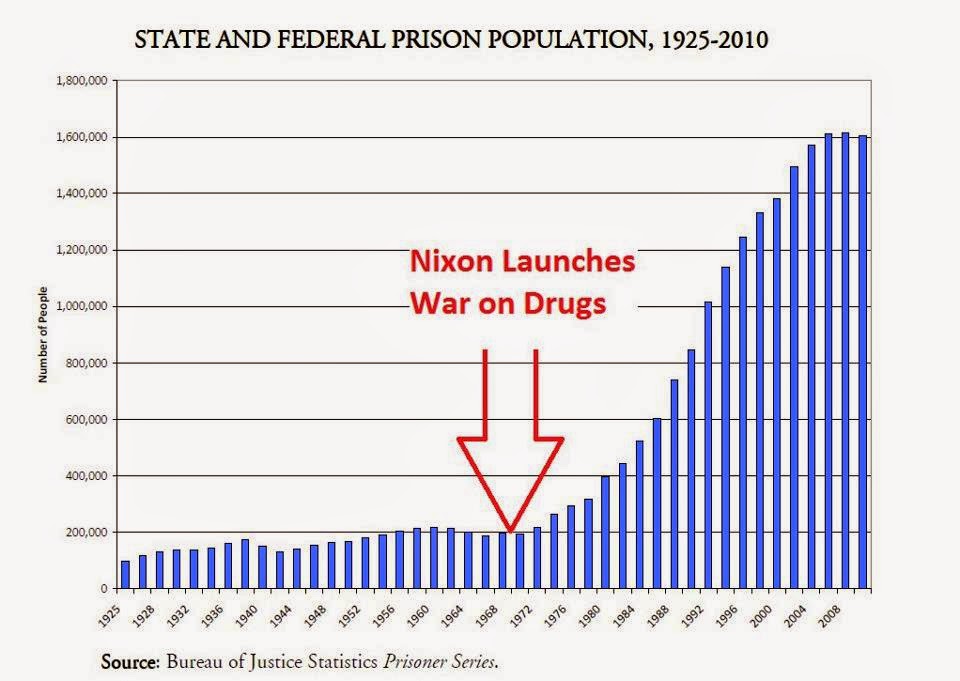
… we don’t have to descend to the netherworld of Greek life to find evidence of an insidious rape culture. There are indeed state-supported institutions where gang rape is used as ritual initiation. There are institutional authorities that meet this culture with indifference or outright support. And we file the poor souls of this system under the heading: deserving victims. We joke in ways that suggest that if these rape victims did not want it, they should never have put on a prison uniform.

In this manner, rape is treated as a feature of our justice system when it happens to prisoners, rather than what it is: another grave crime.

[…]

Statistics on rape are notoriously unreliable. In or out of prison, victims often fear reporting on their assailants. And so the above statistics are likely to underestimate the problem. But we do know that once you include the prison population, men are raped more often in the United States than women.

In prison, men may become the victim of repeated gang rapes. Prisoners can be locked into cells with the men who prey on them. Some live under the constant threat of sexual assault for decades. Their efforts to report their rape are ignored or even punished, both by prison personnel and an inmate culture that destroys “snitches.” The threat of rape is so pervasive it causes some inmates to “consent” to sex with certain prisoners or officers as a way of avoiding rape by others.

Acceptance of prison rape is a stinking corruption. No conception of justice can include plunging criminals into an anarchic world of sexual terror. And obviously it thwarts any possibility of a rehabilitative justice that aims to restore criminals to lawful society. Inmates are not improved or better integrated into society through physical and psychological torture.

QotD: The twin rise and fall of unions and manufacturing

Filed under: Business, Economics, History, Quotations, USA — Tags: , , , — Nicholas @ 00:01

Unions only help if the underlying economic situation is that the employer is able to charge a great deal more for the amount of product generated per worker-hour than the worker is getting — there is headroom for the worker’s wage to expand into while the manufacturer still makes a net profit. (If the manufacturer doesn’t make a net profit the business collapses and nobody gets paid.)

During the age that manufacturing nostalgisists remember nostalgically, this was true. For most of that period (roughly 1870-1970), the capital goods required to manufacture in a way price-competitive with the U.S. were so expensive that almost nobody outside the U.S. could afford them, and in the few places that could they were mainly preoccupied with supplying their domestic markets rather than the U.S. World War II prolonged this period by hammering those “few places” rather badly.

In that environment, U.S. firms could profit-take hugely, benefited by being scarce suppliers not just to the U.S. but (later on) to the whole world. And unions could pry loose enough of that margin to make manufacturing jobs comfortably middle-class.

All that ended in the early 1970s. A good marker for the change is the ability of the Japanese to make cheap cars for export and sell them for the U.S.

In the new world, the profit margins on manufactured goods narrowed dramatically. The manufacturing firms could no longer effectively ignore overseas competition in the U.S. domestic market. U.S. consumers no longer had to to pay the large price premiums required to sustain domestic manufacturing wages at pre-1970 levels, and they jumped right on that option.

In this environment, unions don’t help because they have almost no negotiating room. If they bid up workers’ wages, the jobs will evaporate or move overseas – not because corporations are being “greedy” but because they can no longer charge the prices that would allow such high wages to be sustained. Too much foreign labor and capital is ready to pounce on the first hint of price-taking.

Eric S. Raymond, “Why labor unions have lost their moxie”, Armed and Dangerous, 2014-11-29.

« Newer PostsOlder Posts »

Powered by WordPress