
Published on 17 Aug 2016
Today I break down the book: Grant And Lee: A Study In Personality And Generalship By J.F.C Fuller
Here’s a quick break down of the two personalities
Grant: common sense, logical, simple plans with incredible precise execution, the ability to bring a whole lot of moving pieces into focus, and finally the ability to think clearly under stress.
Lee: The ability to motivate his men to an incredible degree, an extremely kind man, very good at doling out troops to his commanders when in a defensive situation.This video goes into more detail on all of this, I hope you enjoyed!
September 8, 2017
Grant Vs Lee Who Was The Better General?
Comments Off on Grant Vs Lee Who Was The Better General?
September 7, 2017
Argentina expresses interest in laser death-beam-equipped USS Ponce
Those sneaky Argentines, trying to grab some surplus seagoing laser switchblade technology:
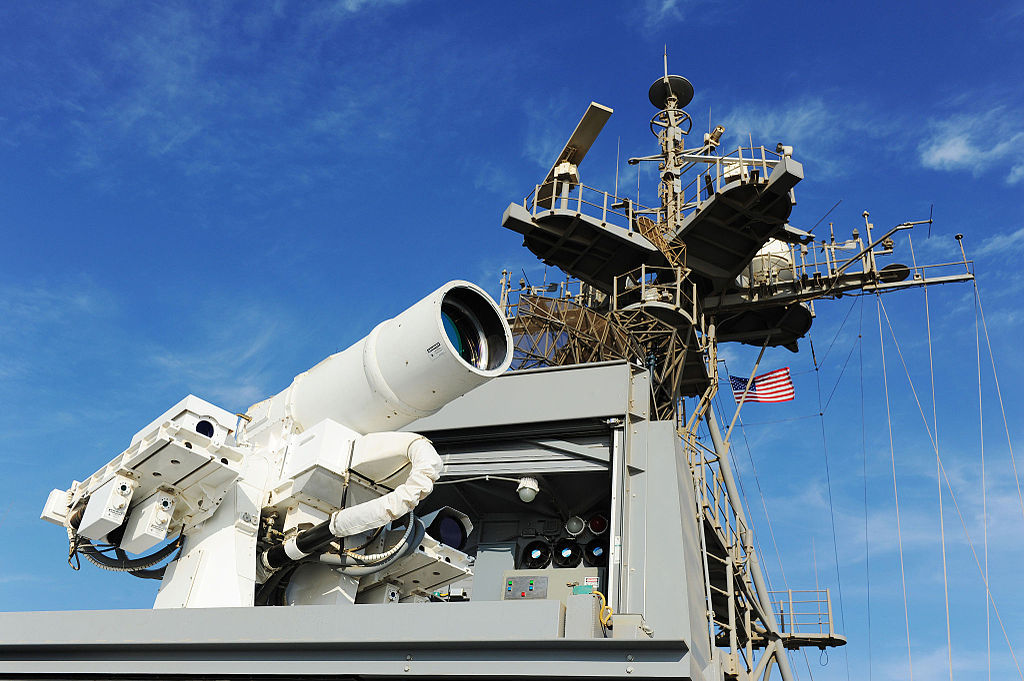
The U.S. Navy Afloat Forward Staging Base (Interim) USS Ponce (AFSB(I)-15) conducts an operational demonstration of the Office of Naval Research (ONR)-sponsored Laser Weapon System (LaWS) while deployed to the Arabian Gulf.
Date. 16 November 2014 (via Wikimedia)
Argentina reportedly wants to buy the US Navy’s laser death ray testbed warship, the fearsomely named USS Ponce.
According to the Mail on Sunday, the Argentinians are interested in buying the 46-year-old former landing platform (dock) from the American Navy when she is decommissioned next year.
“Senior Pentagon sources have confirmed talks are ongoing with the Argentinians over a Landing Platform Dock vessel capable of launching 800 troops, six helicopters and 2,000 tons of equipment into a war zone,” reported the paper, contrasting this with the Royal Navy’s HMS Ocean, which is very similar to the Ponce’s original configuration.
As regular readers know, the mighty Ponce has spent the last few years blasting various targets into bits using a shiny new $40m laser cannon and the US Navy even deployed her to the Gulf a few years ago.
To North American readers: if you’re wondering why this reads a bit oddly even by ordinary Register standards, it’s because the word “ponce” in British usage is a bit, um, odd. It’s taken as read that the primary purpose of an Argentine-flagged Ponce would sooner or later be intended for use in “liberating” the Falkland Islands:
The Ponce would be far from the first former US warship acquired by Argentina. In 1951 the Second World War cruiser USS Phoenix, a veteran of the Pearl Harbour attack by Japan, was bought by Argentina. She was renamed ARA General Belgrano – and sunk by British nuclear submarine HMS Conqueror during the 1982 Falklands War. Doubtless the same fate would befall the Ponce if Argentina tried the same trick again.
Comments Off on Argentina expresses interest in laser death-beam-equipped USS Ponce
QotD: The United Nations, the “ratty old sofa of geopolitics”
Years ago I asked my father why a ratty old sofa was still in the house. He replied simply: It’s there because it’s there. The words had a strange finality about them. Almost metaphysical in their profundity. What we were talking about was a sofa purchased years ago, used and abused by the family, and then unceremonious shunted into an obscure room when the newer model arrived. As I recall on delivery day there had been talk of carting away the ratty old sofa. The haulers had offered to take it — for a price. My father balked and so it has remained. A dusty old sofa living out its days, slowly crumbling into the parquet.
The philosophy of furnishing a suburban home is important. It reveals something about the human psyche. When we spend a lot of time and effort bringing something into our lives, we become reluctant to dispense with it. When that particular something is a big and bulky item, requiring much effort to remove, lethargy places its death grip upon it. Think of how many things in your life where you can say: It’s there because it’s there.
Gingerly moving from the life of individuals to the life of nations we run into the same problem. Things that are there because no one has bothered to get rid of them. In the dim and distant recesses of the national memory a purpose was once understood. That purpose is long done and gone. Habit and lethargy defend the otherwise indefensible. This brings us to the ratty old sofa of geopolitics: The United Nations.
In one of those fits of New Deal liberalism that has cost America so much in treasure — and occasionally blood — it was resolved after the Second World War that world peace would be secured by creating a council of nations. This was suppose to be a new and improved version of the League of Nations. The much maligned League had been set-up after the First World in a fit of Wilsonian liberalism. It too was designed to secure world peace. Rather than junk the original concept entirely the United Nations simply tweaked it. As generations of history textbooks have wisely explained the neo-league had a Security Council which recognized the reality of Great Power politics.
[…]
The UN has been far more successful than the League of Nations in one very important way: It has survived. The most important thing for any bureaucracy is to survive. Accomplishing its intended goal is secondary if not outright dangerous. If the War on Poverty had been won why would we need three-quarters of the federal government? If complete world peace existed then the UN would look even more pointless than it does now.
The key to the UN’s survival has been one thing: Guilt tripping the United States. Suggesting that if the US failed to fund the UN it would lead to war and devastation through out the globe. Financially the UN cannot survive without American largesse. Diplomatically it exists at the sufferance of the American government, occupying prime Manhattan real estate in defiance of economics and common sense. Had they put the General Assembly building in Newark perhaps the foreign diplomats would have all gone home by now.
Richard Anderson, “The Greatest Waste of Money On Earth”, The Gods of the Copybook Headings, 2015-09-29.
Comments Off on QotD: The United Nations, the “ratty old sofa of geopolitics”
September 6, 2017
When in doubt, cry “Fascist!” or “Racist!”
Brendan O’Neill on Facebook recently:
The left’s greatest mistake so far this century has been to accept at face value the establishment’s explanation for why people gave it a bloody nose. Stunned by Brexit, dizzied by Hillary’s loss, the establishment has gone into serious moral and political meltdown. It can only understand the various populist revolts against it as mass acts of racism, maybe even fascism, as the handiwork of demagogues who “got at” the people and twisted our minds. I mean, why else would anyone reject such wonderful institutions as the EU and the Democratic elite…? And, for shame, most of the left has embraced this propaganda, this made-up horror story. They have nodded along to this perverse politics of fear born of a wounded establishment’s fury with the “deplorable” demos. All those Antifa and commentators out there screaming “OMG, fascists everywhere!” think they’re being radical when in truth they are the unwitting spindoctors of the old establishment, bit-part players in a top-down narrative of hysteria that has no relation to reality.
Comments Off on When in doubt, cry “Fascist!” or “Racist!”
September 4, 2017
The mental health crisis on campus
In Spiked, Naomi Firsht shares the concerns of Jonathan Haidt about the rise of mental health issues at US universities:
The heightened vulnerability of college students has had a chilling effect on discussion in the academic world, and Haidt sees this in his day-to-day experience on campus. “There is a rapidly spreading feeling that we are all walking on eggshells, both students and faculty. That we are now accountable, not for what we say, but for how anyone who hears it might take it. And if you have to speak, thinking about the worst reading that anyone could put on your words, that means you cannot be provocative, you cannot take risks, that means you will play it safe when you speak… This is what I’m seeing in my classes when topics related to race or gender come up – which we used to be able to talk about 10 years ago, but now it’s painful and there’s a lot of silence.”
This is disastrous for academic life, as Haidt points out: “A university cannot function if people will not put their ideas forth, will not contest ideas that they think are wrong, will not stand up for ideas that they think are right.”
He is keen to emphasise that this is not a right-left issue. “Several people on the left are noticing that college students are less effective politically as activists, as progressives, when they have this morality and this ethos with such heavy concept creep.”Haidt believes there is a mental-health crisis on campus: “I have never seen such rapid increase in indicators of anxiety and depression as we have seen in the past few years”, he says. But his suggested approach is unlikely to find favour with student communities fond of Safe Spaces and therapeutic puppy-petting. “If you think about it as a mental-health crisis”, he explains, “then you might be tempted to say: we need more help, more counselling, more protection for those who are suffering from mental illness. But if you look at it that way you will miss the broader pattern, which is that for 20 to 30 years now, Americans have been systematically undermining the development of resilience or toughness of their children.” Referencing the work of Lenore Skenazy, author of Free-range Kids, he concludes: “We have made our children too safe to succeed.”
In his forthcoming book Misguided Minds: How Three Bad Ideas Are Leading Young People, Universities, and Democracies Toward Failure, Haidt claims that certain ideas are impairing students’ chances of success. Those ideas being: your feelings are always right; what doesn’t kill you makes you weaker; and the world is divided into good people and bad people. “If we can teach those three ideas to college students”, he says, “we cannot guarantee they will fail, but we will minimise their odds at success”.
So how can we resolve the problem of vulnerability among young Americans? Haidt says part of the solution must begin in childhood and will require parents to give their children daily periods of “unsupervised time”. “We have to accept the fact that in that unsupervised time there will be name-calling, conflict and exclusion. And while it’s painful for parents to accept this, in the long-run it will give them children that are not suffering from such high rates of anxiety and depression.”
Comments Off on The mental health crisis on campus
How to Pronounce UK Place Names – Anglophenia Ep 23
Published on 21 Jan 2015
Anglophenia’s Siobhan Thompson teaches Science Friction’s Rusty Ward — and the rest of America — how to pronounce difficult British place names.
Learn how to pronounce even more British place names here: http://www.bbcamerica.com/anglophenia/2014/01/pronounce-deliberately-offputting-british-place-names/
Visit the Anglophenia blog: http://www.bbcamerica.com/anglophenia
Comments Off on How to Pronounce UK Place Names – Anglophenia Ep 23
September 2, 2017
QotD: All aboot that Canajan accent, eh?
I was also delighted to learn that “rhotacized speech — that is, speech in which the “R” sound is somehow disfigured — tends to be amusing for English speakers.” As an English speaker with a rhotic, Canadian accent, I delight in my English wife’s non-rhotic pronunciations of “hair” (“hehhh”) and “there” (“thehhh”), and often find myself parroting her when she says them to the point where selectively rhoticizing and de-rhoticizing our speech has become a running gag in our family.
Cory Doctorow, “The true story behind the ERMAHGERD meme just makes us love it more”, BoingBoing, 2015-10-16.
Comments Off on QotD: All aboot that Canajan accent, eh?
September 1, 2017
“Antifa looks increasingly like the militant wing of Safe Space fanaticism”
Brendan O’Neill posting to Facebook a few days back:
People are shocked by images of antifa activists beating up normal, peaceful right-wing protesters in Berkeley or physically shoving right-wing people off Boston Common. Why? This is what happens when you tell an entire generation that other people’s ideas are dangerous, that their speech is toxic, that their words can wound you and traumatise you: you invite that generation to shut people down, to use any means necessary to ensure “dangerous” ideas are not expressed and do not cause injury to people’s self-esteem or sense of safety. We are starting to see what happens when speech is talked about as a form of violence: it green-lights actual violence against certain forms of speech. If speech is violence, shouldn’t it be met with violence? Antifa looks increasingly like the militant wing of Safe Space fanaticism, the bastard offspring of a culture that elevates mental safety over intellectual liberty, and people’s feelings over public freedom.
Comments Off on “Antifa looks increasingly like the militant wing of Safe Space fanaticism”
August 31, 2017
Words and Numbers: Do Americans still have freedom of speech?
Apparently, James and Antony have given up the YouTube version of Words and Numbers and reverted to an audio-only version (at least I can still embed the player version):
These days, everybody is nervous about what you can say in public without getting slammed by retribution. But is that a free-speech problem, or does it only become one when the police start showing up? Do we live in a truly tolerant society if voicing an opinion, even if it doesn’t land you in jail, ends up ending your career? Antony and James explore these intricate issues.
Comments Off on Words and Numbers: Do Americans still have freedom of speech?
“Harvey is not Katrina”
Nicole Gelinas on the crucial differences between the situation faced by New Orleans during Hurricane Katrina and that currently faced by Houston after being inundated by Hurricane Harvey:
The Houston region has received record rain, more falling in less than a week than it usually does in a year, and at least 30 people, including a Houston police officer, have died. Harvey, however, is not Katrina. One measure of this difference is in electricity provision. After Katrina, New Orleans was almost entirely without power for weeks. In Houston, by contrast, 94 percent of customers still had power as of early Wednesday.
Though we won’t know for sure for a while, the fact that Houston has kept the power on is likely in part a legacy of infrastructure investment after previous storms. Five years ago, Hurricane Ike actually cut power to 95 percent of Houston. But, as NPR reported after the storm, the city’s power company, CenterPoint, took steps after Ike, as well as after Tropical Storm Allison in 2001, to upgrade the grid, spending $400 million. Houston, helped by $50 million in federal money, cut down tens of thousands of trees along power lines and outfitted poles with the ability to re-route electricity away from damaged routes toward undamaged ones.
With power, hospitals can continue to operate; even Ben Taub Hospital, surrounded by water, kept the power on. Stores, too, have quickly begun to reopen. Power also means that people whose homes didn’t flood can stay put, lessening the burden on police to keep neighborhoods safe from looters. If the power stays on — as it should, now that worst of the storm is over — Houston should do well. If it goes out, the city will have far more serious problems.
[…]
Empty neighborhoods and business districts invite looting. Houston had already arrested 15 people as of late Tuesday for allegedly trying to steal everything from liquor to an ATM, and for attempted robbery, as well. These arrests, plus a nighttime curfew, are a good sign; after Katrina, New Orleans police officers failed to keep control over the city, both because of the severity of the damage, which left most of the city empty and dark, but also due to their longstanding poor performance. Harris County district attorney Kim Ogg and Houston police chief Art Acevado have already set the right tone to deter wrongdoing. Ogg said Tuesday that thieves “are going to feel the full weight of the law,” and Acevedo said he would push for tough sentences for people convicted. In New Orleans, by contrast, state and local officials’ apocalyptic invocation of “martial law,” rather than calm reliance on the rule of normal law, only exacerbated the sense of chaos.
With some, though not most, Houston neighborhoods now deserted, state law enforcement have a role to play here, as well, with federal support. A competent local police force will be busy, after a storm, in helping still-populated areas. In turn, state police and the National Guard, who have less experience interacting with people on a neighborhood level, can help by patrolling and securing empty areas. To that end, Texas has already activated the National Guard, adding 12,000 people to safety efforts, as well as for rescue and food distribution.
Oh, and as Caroline Baum points out, don’t be misled by idiotic claims that hurricane damage is somehow good for the economy:
You will no doubt hear assertions that the rebuilding effort will provide a boost to contractors, manufacturers and GDP in general. But before these claims turn into predictable nonsense about all the good that comes from natural disasters, I thought it might be useful to provide some context for these sorts of events.
The destruction wrought by a hurricane and flooding qualifies as a negative supply shock. Normal production and distribution channels are destroyed or disrupted. Producers have to find less-efficient (i.e. more expensive) ways to transport their goods. The net effect is lost output and income, and higher prices.
Over the years, I’ve observed a tendency among economists and traders to view such events through a demand-side prism. They see lost income translating into reduced spending on goods and services, which might even warrant some largesse from the central bank.
Of course, that is precisely the wrong medicine. Supply shocks reduce output and raise prices. The Federal Reserve’s interest-rate medicine affects demand. Lower interest rates will increase the demand for gasoline, among other goods and services, but they have no effect on supply. An easing of monetary policy under such circumstances would increase demand for already curtailed supply, raising prices even more.
But wait. What about all the new construction and investment necessitated by the devastation? Homeowners will have to rebuild. Businesses will have to replace destroyed or damaged plants and equipment. Pretty soon, we should start to hear about a boost to GDP growth.
In the short run, yes. But focus on the prefix, “re,” as in re-building and re-placing. After a natural disaster, housing starts are bound to increase, but there will be no net addition to the supply of homes. Capital spending will increase as well, but it will not expand the nation’s capital stock.
She also provides a link to this very topical essay by Frédéric Bastiat: That Which Is Seen and That Which Is Unseen. In short, we see the spending caused by the need to repair damages (in this case from the flooding), but we don’t see what might have been done if the money hadn’t needed to be spent just to replace existing stock.
Comments Off on “Harvey is not Katrina”
QotD: Standardized production versus customization
Standardization is the inevitable byproduct of industrialization. Yes, mass-market frocks do not fit as well as custom-made ones; yes, cabinets rolled out of factories by the thousands do not fit their owners as well as ones hand-made by your friendly local carpenter. That’s because the amount of additional labor required to customize handmade cabinets and sink installations to the height of the chef is trivial, and adds little to the cost of the job. On the other hand, stopping your assembly line and retooling to produce a different size adds quite a lot of cost. So does carrying multiple sizes of cabinets in inventory.
Arndt lightheartedly suggests going to customized kitchens, perhaps do-it-yourself ones. I suggest that Arndt price the tool kit that would be needed to make your own reasonably functional and attractive kitchen cabinets. Be sure to add in, too, the hours of labor that would be needed to do this, and the space you’d need in your home to build said cabinets. Go price custom cabinets, versus the one-size-fits-most available from Ikea or your local big box retailer. Compare these numbers. Suddenly you see why women happily embraced mass-produced kitchens that weren’t quite the ideal height.
Megan McArdle, “Kitchen Design Isn’t Sexist. It Liberated Women”, Bloomberg View, 2015-10-18.
Comments Off on QotD: Standardized production versus customization
August 30, 2017
“Houston is built on what amounts to a massive flood plain”
While nobody expects 50 inches of rain to fall in one storm, Houston is still badly situated to withstand flooding even from lesser weather events due to its location on a flood plain:
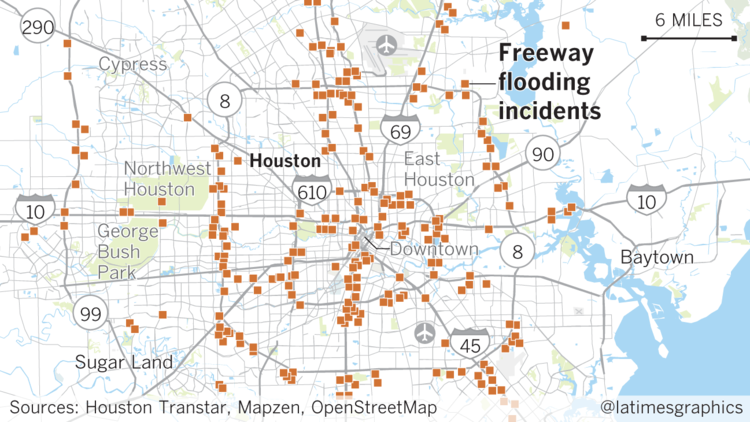
Houston is built on what amounts to a massive flood plain, pitted against the tempestuous Gulf of Mexico and routinely hammered by the biggest rainstorms in the nation.
It is a combination of malicious climate and unforgiving geology, along with a deficit of zoning and land-use controls, that scientists and engineers say leaves the nation’s fourth most populous city vulnerable to devastating floods like the one caused this week by Hurricane Harvey.
“Houston is very flat,” said Robert Gilbert, a University of Texas at Austin civil engineer who helped investigate the flooding of New Orleans after Hurricane Katrina. “There is no way for the water to drain out.”
Indeed, the city has less slope than a shower floor.
Harvey poured as much as 374 billion gallons of water within the city limits, exceeding the capacity of rivers, bayous, lakes and reservoirs. Experts said the result was predictable.
The storm was unprecedented, but the city has been deceiving itself for decades about its vulnerability to flooding, said Robert Bea, a member of the National Academy of Engineering and UC Berkeley emeritus civil engineering professor who has studied hurricane risks along the Gulf Coast.
The city’s flood system is supposed to protect the public from a 100-year storm, but Bea calls that “a 100-year lie” because it is based on a rainfall total of 13 inches in 24 hours.
“That has happened more than eight times in the last 27 years,” Bea said. “It is wrong on two counts. It isn’t accurate about the past risk and it doesn’t reflect what will happen in the next 100 years.”
Some of the blame (a lot of the blame) for locating vulnerable properties in flood-prone areas is due to the US government’s flood insurance program:
Texans, watch out. An aftershock is following behind the catastrophic flooding produced by Hurricane Harvey in coastal Texas: The National Flood Insurance Program (NFIP) is coming up for reauthorization.
The main lesson that the public and policymakers ought to learn from Harvey is: Don’t build in flood plains, and especially don’t rebuild in flood plains. Unfortunately, the flood insurance program teaches the exact opposite lesson, selling subsidized insurance whose premiums do not come close to covering the risks home and business owners in flood prone areas face.
As a result, the NFIP is currently $25 billion in debt.
Federally subsidized flood insurance represents a moral hazard, Kevin Starbuck, Assistant City Manager and former Emergency Management Coordinator for the City of Amarillo, argues, because it encourages people to take on more risk because taxpayers bear the cost of those hazards.
Federal Emergency Management Agency data shows that from 1978 through 2015, 3.8 percent of flood insurance policyholders have filed repetitively for losses that account for a disproportionate 35.5 percent of flood loss claims and 30.5 percent of claim payments, Starbuck says. Most of these properties were grandfathered in before the NFIP issued its flood insurance rate maps. The NFIP is not permitted to refuse them insurance or charge them rates based on the actual risks they face.
Clearly, taxpayers should not be required to subsidize people who choose to build and live on flood plains. When Congress reauthorizes the NFIP, it should initiate a phase-in of charging grandfathered properities premiums commensurate with their risks. This will likely lower the market values of affected homes and businesses and thus send a strong signal to others to avoid building and living in such risky areas.
Comments Off on “Houston is built on what amounts to a massive flood plain”
August 28, 2017
Sexism in the original Star Trek
Dave Leigh stands up for Gene Roddenberry:
… the most infamous case is in part a running gag throughout the series. It’s dictated in the Guide, runs the length of the series, and culminates in the final episode. And I’m pretty sure that very few people other than Gene Roddenberry himself knew that it was a running gag.
It’s sexism.
First… history. And this part is well-known. When the first pilot (“The Cage”) was delivered, Roddenberry cast his future wife, Majel Barrett, as “Number One”, the coldly logical second-in-command of the Enterprise. When the studio rejected that pilot and commissioned a second one, they made a few demands. They wanted to “get rid of the guy with the ears” (as Roddenberry told it). They also wanted to axe Number One, because they claimed that their test audiences didn’t like a woman as executive officer. For decades, Roddenberry told the joke that he kept the alien and married the woman because the other way ’round wouldn’t be legal. He also transferred Number One’s coldly logical nature to Mister Spock.
In the years that followed, many fans and critics completely forgot this story when examining the rest of the series. For instance, there’s the fact that the captain’s yeoman is always a pretty female. This is by decree. In fact, the Guide describes the character as follows:
YEOMAN — Played by a succession of young actresses, always lovely. One such character has been well established in the first year, “YEOMAN JANICE RAND”, played by the lovely Grace Lee Whitney. Whether Yeoman Rand or a new character provided by the writer, this female Yeoman serves Kirk as his combination Executive Secretary-Valet-Military Aide. As such, she is always capable, a highly professional career girl. As with all female Crewman aboard, during duty hours she is treated co-equal with males of the same rank, and the same level of efficient performance is expected. The Yeoman often carries a small over-the-shoulder case, a TRICORDER, about the size of a small handbag, which is also an electronic recorder-camera-sensor combination, immediately available to the Captain should he be away from his Command Console.
In the real-world Navy, a yeoman is simply a clerk. Most of them are men. But in Star Fleet, this is women’s work, at least superficially. Note that in other respects these women were to be treated co-equally. What isn’t women’s work — ever (in the original series) — is the Captaincy. And this is stated explicitly in the very last episode of the series, “The Turnabout Intruder”.
Now, this has been retconned over and over, but this episode was deliberate, and it was conceived and outlined by Gene Roddenberry. By now you probably know that I don’t like retcons because they suck. They’re poor explanations that say, “it didn’t happen”. It’s better to explain why it did happen. And to do that, we have to start with an understanding of what Star Trek was for. It was first and foremost a platform for storytelling. Fantastic elements were readily employed whenever they served a storytelling need. It’s one of the strengths of science fiction:
“I was working in a medium, television, which is heavily censored, and in contemporary shows I found I couldn’t talk about sex, religion, politics and all or the other things I wanted to talk about. It seemed to me that if I had things happen to little polka-dotted people on a far-off planet I might get past the network censors, as Swift did in his day. And indeed that’s what we did.”
— Gene Roddenberry
“Convicting Arpaio of contempt of court was like busting Al Capone on tax evasion”
Jon Gabriel on Il Donalduce‘s pardon of the world-class authoritarian scumbag and all-around thug, ex-Sheriff of Maricopa County, Joe Arpaio:
President Trump asked the crowd last week at his Phoenix rally, “Was Sheriff Joe convicted for doing his job?” Had the hall been filled with an accurate cross-section of Arpaio’s former constituents, the answer would have been a resounding “no.”
Nevertheless, Trump pardoned the ex-sheriff on Friday, though he had not yet been sentenced and had shown zero remorse for his crime.
America’s self-proclaimed “toughest sheriff” was convicted of criminal contempt of court last month after refusing to obey court orders. This most recent legal battle involved numerous federal attempts to get Arpaio to stop racially profiling residents of Maricopa County.
Not only did Arpaio refuse, he bragged about it. “Nobody is higher than me,” he said. “I am the elected sheriff by the people. I don’t serve any governor or the president.”
Many conservatives outside of Arizona celebrated his headline-grabbing antics, but they don’t know the real story. I’m a conservative Maricopa County resident who has lived under Arpaio throughout his decades-long reign. Arpaio was never a conservative; he just played one on TV.
I saw his love of racial profiling firsthand, especially on my daily commutes through the tiny Hispanic community of Guadalupe, Ariz. When conducting these “sweeps,” helicopters buzzed houses, an 18-wheeler marked “Mobile Command Center” was planted in the center of town, and countless sheriff’s deputies stood on the roadsides, peering into the cars rolling by. Being Caucasian, I was always waved through. The drivers ahead and behind me weren’t so lucky.
Washington’s laxity in border enforcement led many right-of-center Americans to appreciate more robust enforcement, even when it regularly included authoritarian scenes like the one in Guadalupe. But even if you turn a blind eye to the human cost of such race-based enforcement, Arpaio’s other misdeeds are legion.
Comments Off on “Convicting Arpaio of contempt of court was like busting Al Capone on tax evasion”
QotD: Gramscian damage
Americans have never really understood ideological warfare. Our gut-level assumption is that everybody in the world really wants the same comfortable material success we have. We use “extremist” as a negative epithet. Even the few fanatics and revolutionary idealists we have, whatever their political flavor, expect everybody else to behave like a bourgeois.
We don’t expect ideas to matter — or, when they do, we expect them to matter only because people have been flipped into a vulnerable mode by repression or poverty. Thus all our divagation about the “root causes” of Islamic terrorism, as if the terrorists’ very clear and very ideological account of their own theory and motivations is somehow not to be believed.
By contrast, ideological and memetic warfare has been a favored tactic for all of America’s three great adversaries of the last hundred years — Nazis, Communists, and Islamists. All three put substantial effort into cultivating American proxies to influence U.S. domestic policy and foreign policy in favorable directions. Yes, the Nazis did this, through organizations like the “German-American Bund” that was outlawed when World War II went hot. Today, the Islamists are having some success at manipulating our politics through fairly transparent front organizations like the Council on American-Islamic Relations.
But it was the Soviet Union, in its day, that was the master of this game. They made dezinformatsiya (disinformation) a central weapon of their war against “the main adversary”, the U.S. They conducted memetic subversion against the U.S. on many levels at a scale that is only now becoming clear as historians burrow through their archives and ex-KGB officers sell their memoirs.
The Soviets had an entire “active measures” department devoted to churning out anti-American dezinformatsiya. A classic example is the rumor that AIDS was the result of research aimed at building a ‘race bomb’ that would selectively kill black people.
On a different level, in the 1930s members of CPUSA (the Communist Party of the USA) got instructions from Moscow to promote non-representational art so that the US’s public spaces would become arid and ugly.
Americans hearing that last one tend to laugh. But the Soviets, following the lead of Marxist theoreticians like Antonio Gramsci, took very seriously the idea that by blighting the U.S.’s intellectual and esthetic life, they could sap Americans’ will to resist Communist ideology and an eventual Communist takeover. The explicit goal was to erode the confidence of America’s ruling class and create an ideological vacuum to be filled by Marxism-Leninism.
Eric S. Raymond, “Gramscian damage”, Armed and Dangerous, 2006-02-11.
Comments Off on QotD: Gramscian damage


