
Published on 31 Aug 2017
Mead was a very popular drink during the 17th century and before, but fell out of favor by the 18th century due to the rise of Beer and Ale. Nevertheless, recipes for Mead can be found in books written in the 1700’s and today Jon goes in depth on this fascinating drink.
September 16, 2017
“Mead” – The Drink That Fell From Favor
Comments Off on “Mead” – The Drink That Fell From Favor
QotD: The US housing market
… up until fairly recently, the home mortgage market was the most conservative financial market out there. The market was not a big money maker because risks were very low and the money was steady. The home mortgage market was the realm of community banks who held the mortgages as assets for the life of the loan. It was the 3-6-3 lifestyle. Borrow from the financial markets at three percent, make home mortgages at six percent and hit the links at 3:00 PM. That all changed in the early 1990’s when Democrat policymakers passed the Community Reinvestment Act and then forced banks to make loans that were far more risky in areas that the banks, for good reasons traditionally stayed away from. Then through Fannie Mae and Freddie Mac the “policymakers” bundled the good and bad paper and sold it on the financial markets creating the current mess. What I don’t understand is how increased home ownership was supposed to increase rents.
Home ownership has been a policy of multiple administrations since WW2, as has suburbanization. There are a bunch of reasons for this. One big one was that the policymakers were, for a bunch of reasons, not fond of urban life. It was considered dirty, old fashioned and perhaps most importantly a big target. This was not a small consideration to people coming back from all those ruined cities overseas.
John C. Carlton, “Who ‘Stole’ The Country’s Wealth, The Rich, Or Government ‘Policy Makers?'”, The Arts Mechanical, 2015-10-16.
Comments Off on QotD: The US housing market
September 15, 2017
Will Google’s quasi-monopoly last as long as AOL’s did?
In the big picture, I’m concerned with Google’s current market power and their ability to quash online freedom of speech almost at will (if not directly, through pressure on other companies to co-operate, or else: “Nice little business you’ve got here, Mr. Forbes. It’d be a shame if something happened to its Google search results…”). Google is huge and has fingers in an unimaginable number of pies, but it is still subject to market forces, as was an earlier behemoth of the online world:
The film [You’ve Got Mail] was released in 1998. Amazon was founded in 1994 and had its IPO in 1997. It was about to crush big discount bookstores — does anyone still remember the other big chain, Borders? — and nobody had a clue. There isn’t a single mention in the film of Amazon or online sales.
But the Internet is mentioned. It’s right there in the title of the movie. You’ve Got Mail, for those who are old enough to remember, was a tagline for America Online, the largest Internet service provider in the dial-up era of the 1990s. For millennials, let me explain: we had to connect our computers to a phone line, and an internal modem would place a phone call to a local data center from which it could download information at impossibly slow speeds. […]
AOL is there in the film’s title, because that’s how our protagonists are communicating: by trading e-mails on their dial-up AOL connections.
AOL’s high point was its merger with Time Warner in 2000. It was all downhill, rapidly, from there. Dial-up was quickly surpassed by broadband, and as the Web developed, nobody needed a “Web portal” any more. Again, for younger readers, let me explain. When you managed to get to this exciting new thing called the World Wide Web, how did you know what sites to go to or how to access information? Before the Google search, before Facebook, before Twitter, you went to a Web portal, a launching off point that gathered links and directed you to various sources for news, entertainment, shopping, etc. These Web portals had a huge amount of influence — until they didn’t.
Now here’s the fun part. At the same time nobody was paying much attention to Amazon because Barnes and Noble was going to crush all competitors and control the book business, there was widespread panic about the unstoppable monopoly power of AOL.
AOL was going to gain a monopoly because of its death grip on instant messaging. The “computer editor” for The Guardian worried that this was putting AOL “on its way to world domination.” The AOL-Time Warner deal raised “concerns that its merger would create a media powerhouse that would level competitors, dominate the Internet, and control consumer choice.”
A Wired podcast talked about fears of a Sun-AOL monopoly, but they didn’t call that sort of thing a “podcast” yet because the iPod hadn’t been invented. The audio clip was an MP3 file, and they suggested you listen to it on a Sonique MP3 player from Lycos. The Sonique stopped being produced about a year later. Lycos was a major Web portal, and according to Wikipedia, it was “the most visited online destination in the world in 1999.” It was bought by a multinational conglomerate for $12.5 billion at the peak of the dot-com bubble.
Whatever is left of Lycos was last sold for $36 million in 2010, though that deal seems to have collapsed in acrimony later on. Sic transit gloria mundi.
Comments Off on Will Google’s quasi-monopoly last as long as AOL’s did?
“Assemble the squad”
Severe weather is coming, and the media know their role. Joe Bob Briggs has been there, and speaks from his own experience:
News executives love disasters. They get to act like Chuck Norris and Assemble the Squad.
“Maginnis, you cover first responders.”
“Wilson, get over to NOAA and stay on those maps.”
“Kelly, official press briefings. Work with Yurozawski to keep tabs on every emergency room within a 300-mile radius.”
“Bergram, you’re Cop Shop, but we’ll keep the aperiodic radio tracking the locals.”
“Ramstein, find that German guy who gets a hard-on for global warming.”
By the time a managing editor or a news director gets finished “covering this mother like blubber on a seal,” you’ve got thirty people who feel like they’re crammed into a D-day troop carrier, waiting for somebody to throw open the landing door and engage the Nazis. They have lust in their eyes. They’re hopped up like nekkid trance drummers at Burning Man.
You know those reporters clinging to lampposts in 120-mile-per-hour winds on the pier at Sanibel Island?
Same thing. They’re pumped. They’re wild. They’re getting all orgasmic from the needle burns on their cheeks as the gooey red juice of the hurricane danger zones envelop them in delirious wet convulsions.
I know. I was one of those guys.
Comments Off on “Assemble the squad”
QotD: The sexist TV shows of the 1960s
Speaking of a different world, there was one big barrier to entry into [the original Star Trek]: its ladies. I’m still not quite sure how to deal with the way women were treated in the show. I’ve found that when watching many movies or shows from the ’60s and ’70s, it’s incredibly hard to relate the characters — not just because plot pacing was slower and diction was different than it is on TV today, but because I’m almost guaranteed to be disappointed by the way the story treats women. Generally, one just has to accept that there is going to be out-and-out sexism in a lot of old movies and TV, and you can either toss out the whole thing or watch it from afar like you’re in a museum, analyzing an ancient culture.
Megan Geuss, “I watched Star Trek: The Original Series in order; you can too, Or: Filling the gaps in your cultural knowledge is equal parts boring and fun”, Ars Technica, 2015-09-05.
Comments Off on QotD: The sexist TV shows of the 1960s
September 14, 2017
Ken Burns and Lynn Novick: The Vietnam War Is the Key to Understanding America
Published on 13 Sep 2017
Nick Gillespie interviews Ken Burns and Lynn Novick about their new documentary series: The Vietnam War.
The Vietnam War led to more than 1.3 million deaths and it’s one of the most divisive, painful, and poorly understood episodes in American history.
Documentarians Ken Burns and Lynn Novick have spent the past decade making a film that aims to exhume the war’s buried history. Their 10-part series, which premieres on PBS next week, is a comprehensive look at the secrecy, disinformation, and spin surrounding Vietnam, and its lasting impact on two nations. The 18-hour film combines never-before-seen historical footage, with testimonies from nearly 80 witnesses, including soldiers on both sides of the conflict, leaders of the protest movement, and civilians from North and South Vietnam.
A two-time Academy Award winner, Burns is among the most celebrated documentary filmmakers of our time, best-known for the 1990 PBS miniseries The Civil War, which drew a television viewership of 40 million. He and Novick are longtime collaborators, and in 2011 she co-directed and produced Prohibition with Burns. In 2011, Reason’s Nick Gillespie interviewed Burns that film and the role of public television in underwriting his work.
With the release of The Vietnam War, Gillespie sat down with Burns and Novick to talk about the decade-long process of making their new film, and why understanding what happened in Vietnam is essential to interpreting American life today.
Produced by Todd Krainin. Cameras by Meredith Bragg, Mark McDaniel, and Krainin.
Full interview transcript available at http://bit.ly/2x0e5U4
Comments Off on Ken Burns and Lynn Novick: The Vietnam War Is the Key to Understanding America
QotD: The 1970s economic mess
He then goes on to blather about the policies of the 1970’s. I lived through the 1970’s and what you need to understand was that the governing motive of policymakers then was panic. The “policymakers,” by and large Democrats, screwed up as badly as possible and just couldn’t get a grip on what [the problems] really were.
John C. Carlton, “Who ‘Stole’ The Country’s Wealth, The Rich, Or Government ‘Policy Makers?'”, The Arts Mechanical, 2015-10-16.
Comments Off on QotD: The 1970s economic mess
September 13, 2017
Our Amazing Debt (Cosmos Parody)
Published on 12 Sep 2017
The math behind the National Debt is so complex that Reason TV decided to lean on “Cosmos” to explain it.
—-
We are about to begin a journey beyond ordinary human understanding. Lost somewhere between immensity and eternity. Join me, as we explore: Our Amazing DebtWe are all made of star stuff. And in America, we are all born more than $61 thousand in debt.
The collective debt we owe as a country now stands at $20 trillion, a level of debt unfathomable to our contemptible caveman ancestors.
How can we comprehend the sheer magnitude of the national debt? With our starship of imagination.
This is the USS Dumbitdownforme and it cost $12 billion to construct: all financed through debt. We didn’t have the money to build it and we didn’t want to raise taxes to pay for it, but we really wanted it. So, like a fiscal wormhole, we’ve used debt to puncture the reality of financial constraints, connecting what we want now to even more money we promise to pay later.
$20 Trillion is not just a lot of money, it’s all the money, and then some.
If we could round up all the US currency in existence–every dollar bill, every quarter, every penny–we’d still need another $18 trillion. All the gold that has ever been mined couldn’t even cover half of our debt.
Yet our story doesn’t end here.
Like our ever-expanding universe our debt is constantly growing larger. This year we will pay more than $250 billion on interest payments. Not the debt, just the fee for borrowing money.
Much as cosmic expansion will inevitably lead to the heat death of our own universe, the debt, too, is unsustainable. As nature seeks balance, so to will our creditors.
Will the government gut spending? Defund entitlements? Devalue our currency?
One day, perhaps in our lifetime, we will discover the answers and reach the limit of our amazing debt. But for now we can only behold this awesome force that binds all Americans, bewitching us with the fascinating possibility, that maybe, just maybe, we’re all f***ed.
Written and produced by Austin Bragg, Meredith Bragg, and Andrew Heaton. Edited by Austin Bragg.
Comments Off on Our Amazing Debt (Cosmos Parody)
QotD: The changed nature of “class”
For a while communists went around looking lost [after the collapse of the Soviet Union]. Umberto Ecco referred to them as “defrocked priests” who have lost their vision of paradise. And then … And then they decided we just hadn’t tried it hard enough or well enough.
But by the time they found this “new vision” (these doomsday cults never admit they were wrong, you know) they had given up on the idea of the proletariat conquering the bourgeoisie and rich, and had instead turned into sort of missionaries of victims and wounded people.
Instead of social class meaning what it meant to Marx, which was entirely economics based, it now meant “group vaguely aligned through some (usually natural) characteristic.” So we have the oppressed class of oh, gay people who come from all backgrounds and regions and who face differing levels of acceptance from family and society, but who are deemed to be all equally victimized, and as such to need equal intervention from the elites to make them whole. Then there are racial groups, so factionalized that at some point we’re all going to become a race of one.
The elites took to this new way of viewing society like ducks to water, partly because you don’t actually need to do anything to help anyone anywhere. Like Marx, who mistreated his illegitimate son from the woman who was somewhere between an indentured servant and a slave to his family, even as he preached social revolution and the triumph of the lower classes, they can simply preach acceptance and talk about how poor victims suffer without bothering to notice that their neighbor is unemployed and surviving on cat food. If you ask them about this particular instance, they’ll tell you that, well, come the revolution he will have a job and food… Meanwhile they’re working for the greater cause of bringing about the revolution.
And thus, more dreary than the “quality” that consisted of unpleasant people doing unpleasant things, we have the taste makers hailing the new “quality” which consists of “fighting patriarchy” or “white hegemony” or whatever latest crazycakes lens is applied to society. Yep, the people with the power are accusing other people of keeping them down because they have a vagina or can tan or whatever. (And the proof of this is the Dolezals of the world who find great rewards in pretending to be victims.)
Sarah A. Hoyt, “The Quality of Writing”, According to Hoyt, 2015-10-11.
Comments Off on QotD: The changed nature of “class”
September 12, 2017
QotD: Mandatory voting is still a stupid idea
My old boss, William F. Buckley Jr., often said liberals don’t care what you do so long as it’s compulsory (though he probably borrowed the line from his friend M. Stanton Evans).
There’s probably no better illustration of this illiberal streak in liberalism than the idea of “compulsory voting.” The argument usually goes like this: Voter turnout in America is low. Low voter turnout is bad. Therefore, we should make voting mandatory. (This argument is most popular after an election like last week’s when things don’t go so well for Democrats.)
When asked why low voter turnout is bad, one usually gets a mumbled verbal stew of Norman Rockwell–esque pieties about enhanced citizenship, reduced polarization, and, on occasion, veiled suggestions that Washington would get its policies right — or I should say left — if everyone voted.
To call most of these arguments gobbledygook is a bit unfair — to gobbledygook. First note that this logic can be applied to literally every good thing, from brushing your teeth to eating broccoli. Moreover, the notion that forcing people who don’t care about politics to vote will make them more engaged and thoughtful citizens is ludicrous. We force juvenile delinquents (now called “justice-involved youth” by the Obama administration) and other petty criminals to clean up trash in parks and alongside highways. Is there any evidence this has made them more sincere environmentalists? If we gave every student in the country straight As, that would make all the education trend lines look prettier, but it wouldn’t actually improve education.
This sort of enforced egalitarianism is reminiscent of Kurt Vonnegut’s short story “Harrison Bergeron,” set in a society where everyone must be equal. Above-average athletes are hobbled to make them conform with the unathletic. The smart are made dumb. Ballet dancers are weighed down so they can’t jump any higher than normal people. The prettier ones must wear masks.
[…]
Even the ancient left-wing assumption that if we could politically activate the downtrodden masses of the poor and the oppressed to storm the polling stations, we might topple the supposed tyranny of privilege and inequality is wrong, too. The overwhelming consensus among political scientists who’ve looked at the question is that universal turnout would not change the results of national elections. It would, however, probably have a positive effect on local elections for school boards and municipal governments, because these low-turnout elections are monopolized by entrenched bureaucrats and government unions (and that’s the way they like it, by the way).
Jonah Goldberg, “Progressives Think That Mandatory Voting Would Help Them at the Polls”, National Review, 2015-11-13.
Comments Off on QotD: Mandatory voting is still a stupid idea
September 11, 2017
Harvey, Irma, and Frédéric – the “Broken Window Fallacy” returns
Jon Gabriel tries to set the record straight on what a natural disaster means for the economy (hint, ignore anyone who says the GDP will rise due to the recovery efforts):
Ever since Hurricane Harvey slammed into Texas two weeks ago, we’ve seen countless images of heroic rescues, flooded interstates and damaged buildings.
As awful as the human toll was, it was not as bad as many of us feared. But it will take months to repair the homes, businesses and infrastructure of Houston and the surrounding area. The same will be true in Florida after Hurricane Irma.
The economic impact could be felt for years, but many economists and financial experts think there’s a silver lining.
The Los Angeles Times crowed that Harvey’s destruction is expected to boost auto sales. CNBC reported that Harvey “could be a slight negative for U.S. growth in the third quarter, but economists say it may ultimately provide a tiny boost to the national economy because of the rebuilding in the Houston area.”
Even Goldman Sachs is looking at the bright side, noting that there could be an increase in economic activity, “reflecting a boost from rebuilding efforts and a catchup in economic activity displaced during the hurricane.”
Economically speaking, it’s great news that all this damage in Texas and Florida needs to be fixed, right? Not only does this mean big bucks for cleanup crews, but think of all the money that street sweepers, construction workers and Home Depots will rake in.
And what about all those windows broken by the high winds? This will be the Golden Age of Texas Glaziery!
Not so fast.
All of this is based on a misunderstanding of what the GDP actually measures. It’s a statistic that often gets mentioned in the newspapers and on TV, but it is almost always used in a way that misleads people about what is happening in the economy. GDP — Gross Domestic Product — is intended to show the approximate total of goods and services produced in a national economy. Thus, when the GDP goes up, it means that the current period being measured recorded more goods and services produced than in the previous period.
When a natural disaster like a hurricane, earthquake, flood, or tornado strikes a city, state or region, all the work required to fix the damage will artificially boost the recorded GDP for that year. But the affected area isn’t that much richer than it was before, despite the GDP going up, because the GDP does not measure the losses suffered during the natural disaster.
This is where Frédéric comes in. I’m referring to the French economist and author Frédéric Bastiat, who brilliantly illustrated the GDP misunderstanding in his essay “What Is Seen and What Is Not Seen“:
In the economic sphere an act, a habit, an institution, a law produces not only one effect, but a series of effects. Of these effects, the first alone is immediate; it appears simultaneously with its cause; it is seen. The other effects emerge only subsequently; they are not seen; we are fortunate if we foresee them.
There is only one difference between a bad economist and a good one: the bad economist confines himself to the visible effect; the good economist takes into account both the effect that can be seen and those effects that must be foreseen.
Yet this difference is tremendous; for it almost always happens that when the immediate consequence is favorable, the later consequences are disastrous, and vice versa. Whence it follows that the bad economist pursues a small present good that will be followed by a great evil to come, while the good economist pursues a great good to come, at the risk of a small present evil.
The GDP problem I identified at the start of this post is a general case of what Bastiat called the “Broken Window Fallacy”:
Have you ever been witness to the fury of that solid citizen, James Goodfellow, when his incorrigible son has happened to break a pane of glass? If you have been present at this spectacle, certainly you must also have observed that the onlookers, even if there are as many as thirty of them, seem with one accord to offer the unfortunate owner the selfsame consolation: “It’s an ill wind that blows nobody some good. Such accidents keep industry going. Everybody has to make a living. What would become of the glaziers if no one ever broke a window?”
Now, this formula of condolence contains a whole theory that it is a good idea for us to expose, flagrante delicto, in this very simple case, since it is exactly the same as that which, unfortunately, underlies most of our economic institutions.
Suppose that it will cost six francs to repair the damage. If you mean that the accident gives six francs’ worth of encouragement to the aforesaid industry, I agree. I do not contest it in any way; your reasoning is correct. The glazier will come, do his job, receive six francs, congratulate himself, and bless in his heart the careless child. That is what is seen.
But if, by way of deduction, you conclude, as happens only too often, that it is good to break windows, that it helps to circulate money, that it results in encouraging industry in general, I am obliged to cry out: That will never do! Your theory stops at what is seen. It does not take account of what is not seen.
It is not seen that, since our citizen has spent six francs for one thing, he will not be able to spend them for another. It is not seen that if he had not had a windowpane to replace, he would have replaced, for example, his worn-out shoes or added another book to his library. In brief, he would have put his six francs to some use or other for which he will not now have them.
Let us next consider industry in general. The window having been broken, the glass industry gets six francs’ worth of encouragement; that is what is seen.
If the window had not been broken, the shoe industry (or some other) would have received six francs’ worth of encouragement; that is what is not seen.
And if we were to take into consideration what is not seen, because it is a negative factor, as well as what is seen, because it is a positive factor, we should understand that there is no benefit to industry in general or to national employment as a whole, whether windows are broken or not broken.
Now let us consider James Goodfellow.
On the first hypothesis, that of the broken window, he spends six francs and has, neither more nor less than before, the enjoyment of one window.
On the second, that in which the accident did not happen, he would have spent six francs for new shoes and would have had the enjoyment of a pair of shoes as well as of a window.
Now, if James Goodfellow is part of society, we must conclude that society, considering its labors and its enjoyments, has lost the value of the broken window.
From which, by generalizing, we arrive at this unexpected conclusion: “Society loses the value of objects unnecessarily destroyed,” and at this aphorism, which will make the hair of the protectionists stand on end: “To break, to destroy, to dissipate is not to encourage national employment,” or more briefly: “Destruction is not profitable.”
Related: Shared by Thomas Forsyth on Facebook:

Comments Off on Harvey, Irma, and Frédéric – the “Broken Window Fallacy” returns
September 10, 2017
British Malaya – US Equipment – Boobytraps I OUT OF THE TRENCHES
Published on 9 Sep 2017
It’s time for another exciting episode of Out Of The Trenches again, this episode talks about British Malaya in WW1, the French and British equipment the US troops used and traps.
Comments Off on British Malaya – US Equipment – Boobytraps I OUT OF THE TRENCHES
QotD: Peak oil
Witness, brothers and sisters, witness. The oil, it’s going to run out. Peak production of the world’s oilfields has either passed or is about to pass; from here on out it’s rising oil prices forever. Now we wave our hands and pronounce that the energy-guzzling capitalist West (and especially Amerikka) is so addicted to cheap oil that its decadent empire will collapse, collapse I tell you. Barely concealed gloating follows.
There are so many mutually-reinforcing idiocies here that it’s hard to know where to start. As I was thinking of writing about this, one of my commenters pointed out that above $32 per barrel it becomes economical to build Fischer-Tropf plants and make your oil out of coal. This is old tech; the Germans did it during WWI. At slightly higher price points, MHD generators to burn garbage start to look good.
These are instances of a more general phenomenon: markets adapt to price shifts! To wreck an economy with oil-price rises, they’d have to spike so fast and so far that you somehow couldn’t run the cement trucks to build the Fischer-Tropf plants. Not gonna happen.
In fact, the long-term trend will be that the amount of oil invested per constant-dollar value of goods produced in the U.S. economy drops faster than the price of oil rises. This is a safe prediction not because manufacturers have all bought into Green ideology but because they want to make money. This means that they have a market incentive to use their inputs (including oil) a efficiently as possible, and to substitute less expensive inputs for more expensive ones. It’s called capitalism, and it works.
(And, by the way, the cheapest input of all is information. Buckminster Fuller pointed out forty years ago that as technologies mature, the products tend to get smaller and lighter and less energy-intensive and smarter. Your cellphone today weighs less than it used to, and costs less oil to produces than it used to, because its design is smarter. Information has replaced mass. This trend will continue and accelerate.)
The peak-oil collapse scenario is not credible for five minutes to anybody who understands market economics. But the sort of people who believe it are blinded by their own prejudices; fundamentally they think market economics is an invention of the Devil. They need to believe in the collapse, because they need to believe that the wickedness of Americans and capitalists and Republicans will be punished.
Eric S. Raymond, “Peak Oil — A Wish-Fulfillment Fantasy for Secular Idiots”, Armed and Dangerous, 2005-11-13.
Comments Off on QotD: Peak oil
September 9, 2017
QotD: Picketty’s unsupported inequality claims
Piketty’s definition of wealth does not include human capital, owned by the workers, which has grown in rich countries to be the main source of income, when it is combined with the immense accumulation since 1800 of capital in knowledge and social habits, owned by everyone with access to them. Once upon a time, Piketty’s world without human capital was approximately our world, that of Ricardo and Marx, with workers owning only their hands and backs, and the bosses and landlords owning all the other means of production. But since 1848 the world has been transformed by what sits between the workers’ ears.
The only reason in the book to exclude human capital from capital appears to be to force the conclusion Piketty wants to achieve. One of the headings in Chapter 7 declares that “capital [is] always more unequally distributed than labor.” No it isn’t. If human capital is included — the ordinary factory worker’s literacy, the nurse’s educated skill, the professional manager’s command of complex systems, the economist’s understanding of supply responses — the workers themselves, in the correct accounting, own most of the nation’s capital — and Piketty’s drama falls to the ground.
Finally, as he candidly admits, Piketty’s own research suggests that only in the United States, the United Kingdom, and Canada has income inequality increased much, and only recently. In other words, his fears were not confirmed anywhere from 1910 to 1980; nor anywhere in the long run at any time before 1800; nor anywhere in Continental Europe and Japan since World War II; and only recently, a little, in the United States, the United Kingdom, and Canada. That is a very great puzzle if money tends to reproduce itself as a general law. The truth is that inequality goes up and down in great waves, for which we have evidence from many centuries ago down to the present, which also doesn’t figure in such a tale.
Deirdre N. McCloskey, “How Piketty Misses the Point”, Cato Policy Report, 2015-07.
Comments Off on QotD: Picketty’s unsupported inequality claims
September 8, 2017
New pro-Hillary website gets panned … even by otherwise pro-Clinton sites
Peter Daou’s Verrit, a new website for Hillary Clinton supporters, isn’t getting rave reviews even from pro-Clinton sources:
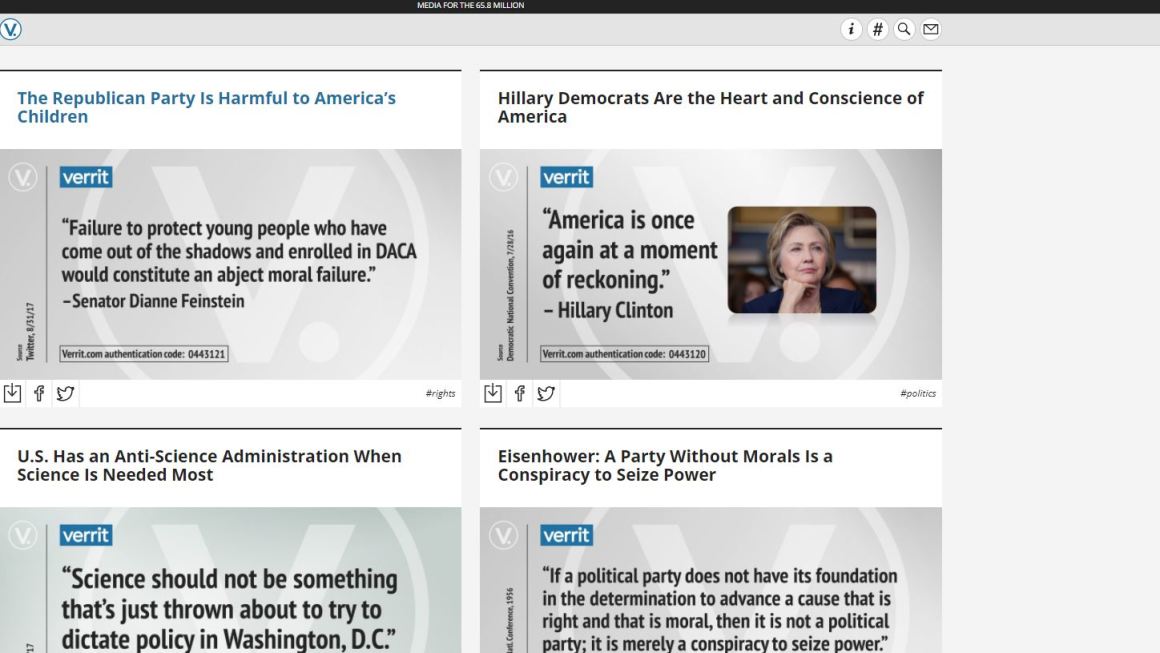
This Pro-Hillary Website Looks Like North Korean Agitprop
Peter Daou, the prickly pro-Clinton operative, has launched a propaganda rag so shameless it would make Kim Jong Un blush.Who would buy stock in a twice-defeated presidential candidate?
If the candidate under question is Hillary Clinton, that zealous buyer would be Peter Daou, one-time rocker, seasoned political blogger, former campaign adviser to John Kerry and Hillary Clinton, ambitious litigant, propagandist and internet entrepreneur. A couple of days ago, Daou launched his self-funded Verrit.com, a slavishly pro-Clinton site (endorsed by Hillary!) to carry on her failed crusade.
The derision greeting Verrit is so universal it inspires sympathy for Daou, as Gizmodo, the Washington Post, Outline, New Republic, New York, The Ringer and others have broken its back with their snap judgments. “Verrit, a Media Company for Almost Nobody,” read one headline. “No One Asked for Verrit, But Here We Are,” stated another. “What Is Verrit and Why Should I Care? (Unclear; You Shouldn’t.),” said a third. “Peter Daou Continues to Embarrass Hillary Clinton,” asserted the best in show.
People, people! It’s only a website!
Granted, Verrit is a goofy website, as websites go. If you don’t possess the courage to visit it right now, here’s a description: Imagine if Matt Drudge created a Hillary fan site, only instead of listing news stories in a text-heavy fashion, he arranged them on the Web equivalent of 3×5 cards, and in addition to typing headlines onto the cards, he pulled out salient facts and stats from the stories (called “verrits”). Each card carries a unique serial number that you can plug into the Verrit database to prove … well, I don’t know exactly what it proves other than Verrit drew its facts and stats from the news source cited.
Comments Off on New pro-Hillary website gets panned … even by otherwise pro-Clinton sites


