
Published on 25 Aug 2017
Let’s talk about “sports”—that thing where we gather around to watch a muscular stranger put a regulation-size ball in a specific location.
Why are taxpayers forced to pony up cash for athletic ventures that don’t benefit them? Franchise owners routinely extort massive stadium subsidies through threats of relocation and fake promises of economic revitalization. Universities jack up student rates to subsidize athletic programs that should be self-sustaining. And the Olympics is economically devastating to every municipality foolish enough to get suckered by one of the oldest scams around.
Mostly Weekly host Andrew Heaton explores the sports phenomenon and why we should quit throwing other people’s money at it.
Links, past episodes, and more at https://reason.com/reasontv/2017/08/25/stop-subsidizing-sports
Script by Sarah Siskind with writing assistant from Andrew Heaton and David Fried.
Edited by Austin Bragg and Siskind.
Produced by Meredith and Austin Bragg.
Theme Song: Frozen by Surfer Blood.
August 27, 2017
Stop Subsidizing Sports!
Why The Rich Like High Taxes
Published on 16 Aug 2017
When politicians raise taxes on the rich, what do the rich do to protect their $$$? This Prof. shows how high taxes actually made America less equal.
The Myth of Equality in the 1950s (video): Another myth of the 1950s is that there was economic equality. Prof. Brian Domitrovic explains why this is a myth. https://www.youtube.com/watch?v=wLl9wOivHdc
How Cronyism is Hurting the Economy (video): Prof. Jason Brennan explains why cronyism, like the tax cuts for certain businesses in the 1950s, is bad for the economy and argues why limiting the government’s power would help solve the problem. https://www.youtube.com/watch?v=gSgUENZ9O94
The Good Ol’ Days: When Tax Rates Were 90 Percent (article): Andrew Syrios compares the tax rates in the 1950s to those of the 1980s and today https://mises.org/library/good-ol-days-when-tax-rates-were-90-percentTRANSCRIPT:
For a full transcript please visit: http://www.learnliberty.org/videos/why-the-rich-like-high-taxes/
August 26, 2017
QotD: The American Constitution
All things considered, this New Republic piece on Randy Barnett and the libertarian constitutional movement is really pretty good. But I thought this part was revealing:
Barnett believes the Constitution exists to secure inalienable property and contract rights for individuals. This may sound like a bland and inconsequential opinion, but if widely adopted by our courts and political systems it would prohibit or call into question basic governmental protections — minimum wages, food-safety regulations, child-labor laws — that most of us take for granted. For nearly a century now, a legal counterculture has insisted that the whole New Deal project was a big, unconstitutional error, and Barnett is a big part of that movement today.
If your entire program is called into question by the notion that individuals have property and contract rights, maybe the problem is with your program.
And to the extent that, as believed by many, the Supreme Court’s eventual accommodation to the New Deal was the product of duress in the form of FDR’s court-packing scheme, then isn’t that accommodation, in fact, illegitimate?
Glenn Reynolds, Instapundit, 2015-08-31.
August 25, 2017
Solving the mystery of the fate of H.L. Hunley‘s crew
When the Confederate submarine H.L. Hunley was found, the bodies of the crew were still in their duty positions within the vessel, as if they’d been unaware or unable to do anything to save the situation. Sarah Knapton reports on what is now believed to have killed the crew almost instantaneously:
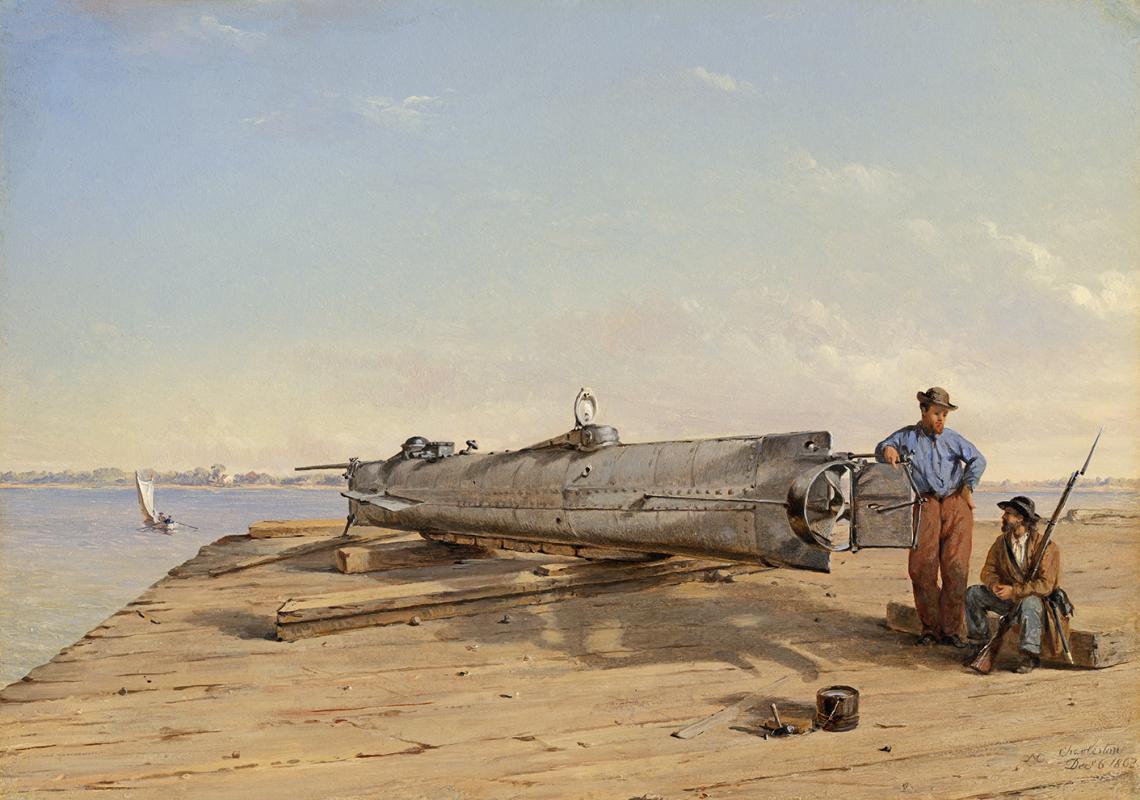
“Submarine Torpedo Boat H.L. Hunley, Dec. 6, 1863″ by Conrad Wise Chapman.
“The inventor of this boat, a man named Hunley, can be seen; also a sentinel. This boat, it was at first thought would be very effective; twice it went out on its mission of destruction, but on both occasions returned with all the crew dead. After this had happened the second time, someone painted on it the word ‘coffin.’ There was just room enough in it for eight men, one in front of the other, with no possibility of anyone sitting straight. The third time it started out, it never came back, nor was anything ever heard from it, but as one of the United States men-of-war in the harbor (USS Housatonic) was sunk at about the same time, the supposition was that they both went to the bottom together. Other objects to be seen in the picture are, Sullivan’s Island, and a Dispatch boat.” – Conrad Wise Chapman, 1898 (via Wikimedia)
The mystery of how the crew of one of the world’s first submarines died has finally been solved – they accidentally killed themselves.
The H.L. Hunley sank on February 17 1864 after torpedoing the USS Housatonic outside Charleston Harbour, South Carolina, during American Civil War.
She was one of the first submarines ever to be used in conflict, and the first to sink a battleship [Housatonic was actually a sloop-of-war, not a battleship].
It was assumed the blast had ruptured the sub, drowning its occupants, but when the Hunley was raised in 2000, salvage experts were amazed to find the eight-man crew poised as if they had been caught completely unawares by the tragedy. All were still sitting in their posts and there was no evidence that they had attempted to flee the foundering vessel.
Now researchers at Duke University believe they have the answer. Three years of experiments on a mini-test sub have shown that the torpedo blast would have created a shockwave great enough to instantly rupture the blood vessels in the lungs and brains of the submariners.
“This is the characteristic trauma of blast victims, they call it ‘blast lung,'” Dr Rachel Lance.
“You have an instant fatality that leaves no marks on the skeletal remains. Unfortunately, the soft tissues that would show us what happened have decomposed in the past hundred years.”
The Hunley‘s torpedo was not a self-propelled bomb, but a copper keg of 135 pounds of gunpowder held ahead and slightly below the Hunley‘s bow on a 16-foot pole called a spar
The sub rammed this spar into the enemy ship’s hull and the bomb exploded. The furthest any of the crew was from the blast was about 42 feet. The shockwave of the blast travelled about 1500 meters per second in water, and 340 m/sec in air, the researchers calculate.
August 24, 2017
Teaching history in the South – the “Lost Cause” school of historiography
Warren Meyer gives some background on how most people in the Southern US were taught the history of the “War Between the States”:
The Lost Cause School: I want to provide some help for those not from the South to understand the southern side of the statue thing. In particular, how can good people who believe themselves not to be racist support these statues? You have to recognize that most folks of my generation in the South were raised on the lost cause school of Civil War historiography. I went to one of the great private high schools in the South and realized later I had been steeped in Lost Cause. All the public schools taught it. Here is the Wikipedia summary:
The Lost Cause of the Confederacy, or simply Lost Cause, is a set of revisionist beliefs that describes the Confederate cause as a heroic one against great odds despite its defeat. The beliefs endorse the virtues of the antebellum South, viewing the American Civil War as an honorable struggle for the Southern way of life, while minimizing or denying the central role of slavery. While it was not taught in the North, aspects of it did win acceptance there and helped the process of reunifying American whites.
The Lost Cause belief system synthesized numerous ideas into a coherent package. Lost Cause supporters argue that slavery was not the main cause of the Civil War, and claim that few scholars saw it as such before the 1950s. In order to reach this conclusion, they often deny or minimize the writings and speeches of Confederate leaders of the time in favor of later-written revisionist documents. Supporters often stressed the idea of secession as a defense against a Northern threat to their way of life and say that threat violated the states’ rights guaranteed by the Union. They believed any state had the right to secede, a point strongly denied by the North. The Lost Cause portrayed the South as more profoundly Christian than the greedy North. It portrayed the slavery system as more benevolent than cruel, emphasizing that it taught Christianity and civilization. In explaining Confederate defeat, the Lost Cause said the main factor was not qualitative inferiority in leadership or fighting ability but the massive quantitative superiority of the Yankee industrial machine.
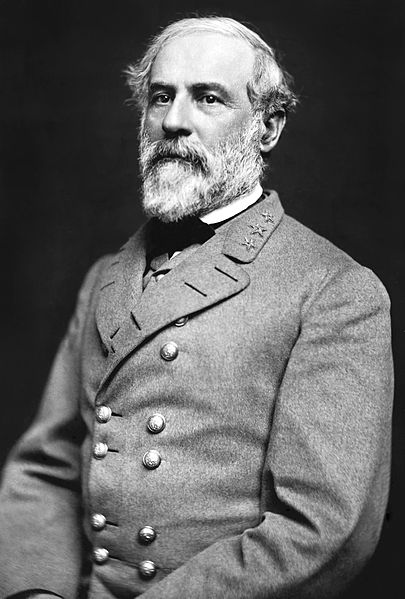
Obviously this was promoted by the white supremacists after the war, but in the 20th century many well-meaning people in the South who are not racist and by no means want to see a return of slavery or Jim Crow still retain elements of this story, particularly the vision of the Confederacy as a scrappy underdog. But everything in these two paragraphs including the downplaying of slavery in the causes of the Civil War was being taught when I grew up. It wasn’t until a civil war course in college (from James McPherson no less, boy was I a lucky dog there) that I read source material from the time and was deprogrammed.Confederate General Robert E. Lee, commander of the Army of Northern Virginia (via Wikimedia)
The comparisons of the current statue removal to Protestant reformation iconoclasm seem particularly apt to me. You see, growing up in the South, Confederate generals were our saints. And the word “generals” is important. No one I knew growing up would think to revere, say, Jefferson Davis. Only the hard-core white supremacists revered Jefferson Davis. Real lost cause non-racist southerners revered Robert E. Lee. He was our Jesus (see: Dukes of Hazard). Every town in the south still has a Robert E Lee High School. Had I not gone to private school, I would have gone to Houston’s Lee High (I had a friend who went to college at Lehigh in New Jersey. Whenever he told folks in the South he went there, they would inevitably answer “yes, but where did you go to college.”) So Lee was by far and away at the top of the pantheon. Then you had folks like Stonewall Jackson and J.E.B. Stuart who were probably our Peter and Paul. Then all the rest of the generals trailing off through the equivalents of St. Bartholomew or whoever. We even had a Judas, General James Longstreet, who for a variety of reasons was reviled by the Lost Cause school and was blamed for many of Lee’s, and the South’s, losses.
If you want to see the Southern generals the way much of the South sees them, watch the movie Gettysburg, which I like quite a bit (based on the book Killer Angels, I believe, also a good read). The Southern Generals are good, talented men trying to make the best of a losing cause. Slavery is, in this movie, irrelevant to them. They are fighting for their beloved homes in the South, not for slavery. The movie even has Longstreet saying something like “we should have freed the slaves and then fired on Fort Sumter.”
The movie Gettysburg is excellent, but if you don’t know much about the actual battle, you might end up thinking the entire conflict revolved around the 20th Maine…
August 23, 2017
QotD: “Beer”
“Lager” is an inherently ambiguous word these days. It can mean “wonderful, full-bodied, malty, highly hopped beer aged for weeks,” or it can mean “soap-flavored water for pussies who are frightened by actual beer.” In other words “American beer.”
“Steve H.” Little Tiny Lies, 2004-09-30. Originally posted on the old blog 2004-10-01 (no longer online).
August 21, 2017
Joss Whedon’s ex-wife on Whedon’s affairs
Kai Cole at The Wrap:
I’ve been asked some questions by the press recently about my divorce from Joss Whedon, to whom I was married for 16 years. There is misinformation out there and I feel the best way to clear up the situation is to tell my truth. Let me begin by saying I am a very private person and the act of writing this is antithetical to who I am and everything I stand for. Yet, at the same time, I feel compelled to go on the record and clear up some misperceptions. I don’t think it is fair to me or other women to remain silent any longer.
I met Joss in 1991. I was driving across the country from Massachusetts on a whim, and met him when I was passing through Los Angeles. We fell in love and I moved to L.A. so we could be together.
I was with him when his Buffy the Vampire Slayer script was adapted, and the resulting movie released. It was painful to see how his vision was interpreted by the production team and on our honeymoon to England in 1995, I urged him to figure out how to turn it into a TV show. He didn’t want to work in television anymore, following in his father’s and grandfather’s footsteps, but I convinced him it was the fastest way to get the experience he needed, so he could direct his own films someday. I had no idea, in that lovely garden in Bath, that it would change everything.
There were times in our relationship that I was uncomfortable with the attention Joss paid other women. He always had a lot of female friends, but he told me it was because his mother raised him as a feminist, so he just liked women better. He said he admired and respected females, he didn’t lust after them. I believed him and trusted him. On the set of Buffy, Joss decided to have his first secret affair.
Fifteen years later, when he was done with our marriage and finally ready to tell the truth, he wrote me, “When I was running Buffy, I was surrounded by beautiful, needy, aggressive young women. It felt like I had a disease, like something from a Greek myth. Suddenly I am a powerful producer and the world is laid out at my feet and I can’t touch it.” But he did touch it. He said he understood, “I would have to lie — or conceal some part of the truth — for the rest of my life,” but he did it anyway, hoping that first affair, “would be ENOUGH, that THEN we could move on and outlast it.”
Joss admitted that for the next decade and a half, he hid multiple affairs and a number of inappropriate emotional ones that he had with his actresses, co-workers, fans and friends, while he stayed married to me. He wrote me a letter when our marriage was falling apart, but I still didn’t know the whole truth, and said, “I’ve never loved anyone or wanted to be with anyone in any real or long-term way except for you ever. And I love our life. I love how you are, how we are, who you are and what we’ve done both separately and together, how much fun we have…” He wanted it all; he didn’t want to choose, so he accepted the duality as a part of his life.
Solar Eclipse: Republicans, Democrats, & Libertarians React!
Published on 20 Aug 2017
How are Republicans and Democrats, conservatives and liberals, reacting to tomorrow’s solar eclipse?
With the mixture of denial and panic that they bring to virtually every issue, from regulations to crime to climate change.
Fortunately, there is a third way, one grounded in rational debate, respect for the limits and power of science, and sound policy.
For links and info, go to https://reason.com/reasontv/2017/08/20/solar-eclipse-denialism-and-alarmism
Script and editing by Sarah Rose Siskind.
Starring Andrew Heaton, Sarah Rose Siskind, and Jim Epstein.
Produced by Andrew Heaton and Sarah Rose Siskind.
QotD: The (long-running) decline of written science fiction
The problem with the Rabbits is not that left-wing politics is dessicating and poisoning their fiction. While I have made the case elsewhere that SF is libertarian at its core, it nevertheless remains possible to write left-wing message SF that is readable, enjoyable, and of high quality – Iain Banks’s Culture novels leap to mind as recent examples, and we can refer back to vintage classics such as Pohl & Kornbluth’s The Space Merchants for confirmation. Nor, I think, is the failure of Rabbit fiction to engage most SF fans and potential fans mainly down to its politics; I think the Evil League is prone to overestimate the popular appeal of their particular positions here.
No, I judge that what is dessicating and poisoning the Rabbit version of SF is something distinct from left-wing political slant but co-morbid with it: colonization by English majors and the rise of literary status envy as a significant shaping force in the field.
This is a development that’s easy to mistake for a political one because of the accidental fact that most university humanities departments have, over the last sixty years or so, become extreme-left political monocultures. But, in the language of epidemiology, I believe the politics is a marker for the actual disease rather than the pathogen itself. And it’s no use to fight the marker organism rather than the actual pathogen.
Literary status envy is the condition of people who think that all genre fiction would be improved by adopting the devices and priorities of late 19th- and then 20th-century literary fiction. Such people prize the “novel of character” and stylistic sophistication above all else. They have almost no interest in ideas outside of esthetic theory and a very narrow range of socio-political criticism. They think competent characters and happy endings are jejune, unsophisticated, artistically uninteresting. They love them some angst.
People like this are toxic to SF, because the lit-fic agenda clashes badly with the deep norms of SF. Many honestly think they can fix science fiction by raising its standards of characterization and prose quality, but wind up doing tremendous iatrogenic damage because they don’t realize that fixating on those things (rather than the goals of affirming rational knowability and inducing a sense of conceptual breakthrough) produces not better SF but a bad imitation of literary fiction that is much worse SF.
Eric S. Raymond, “SF and the damaging effects of literary status envy”, Armed and Dangerous, 2014-07-30.
August 20, 2017
QotD: The rich
During his visit to the U.S., the pope will probably talk about income inequality, and many reporters will nod approvingly, write down the quotes, and then hand them off to the unpaid intern to be transcribed. It’s a big issue. An important one. In the view of many progressives, the ultra-super-rich extracted all their money from the poor. Think of Bill Gates in a homeless shelter, kicking over cots at 2 a.m. and blackjacking transients, demanding they fork over $49.99 for a Windows 95 license, and you get the idea. The ultra-rich have probably pooled their money to develop space-based matter-dematerialization beams just so they can transport the coins from the “have a penny, take a penny” trays at the gas station.
The “rich” are never people like the Clintons, who acquired their wealth by the sweat of their brows, toiling in the harsh icy policy-mines of Davos. They’re not the guys who make a bundle off some clever bit of tech, sell the company, then pledge to spend a fraction of their fortune on outfitting polar bears with inflatable vests to help them survive their imminent inundation in the boiling waters of the Arctic. They’re not people like John Kerry, who married his way into a pile of money derived from a ubiquitous condiment; they’re not people like Apple CEO Tim Cook, because c’mon, he’s gay. They’re not the Kennedys, because the Kennedys could strike oil on their Hyannis Port compound, pay African orphans a dollar a day to work the pumps by hand, build a pipeline that ran through a protected Monarch-butterfly preserve, and the media would still hang halos over their heads because JFK was martyred in Dallas by a free-floating toxic cloud of right-wing hatred that inhabited the brain of a well-meaning Marxist.
These are rich people, but they’re good rich people, because you can imagine any one of them writing a check to Planned Parenthood with the words “keep up the excellent mammograms” in the memo line.
No, the bad rich people are hedge-fund managers, people who inherited something, and well-paid CEOs of companies that make things we don’t like or resent having to pay too much to get. They need to be taxed good and hard, according to advocates of the confiscatory state such as the nimbus-haired Bernie Sanders. Nothing says “the future and its bright new ideas” like the image of a liver-spotted limb thrusting deep into someone else’s pocket and pulling out the guts of a golden goose. Sanders’s proposals were estimated to cost $18 trillion over ten years, an amusing projection — apparently after a decade the economy just seizes up and we’re reduced to paying for our bread with chickens or bits of ironmongery.
James Lileks, “It’s Time to Fix America’s Income-Inequality Crisis Once and for All!”, National Review, 2015-09-24.
August 19, 2017
How to Safely Watch The Eclipse or CNN
Published on 18 Aug 2017
Remy has a few helpful tips for safely watching large orange balls of gas.
Written by Remy. Produced by Austin Bragg
August 18, 2017
Refuting the “Canadians supported the Confederacy” slur
A tweet from Colby Cosh linked to this informative little section of the “Canada in the American Civil War” page at Wikipedia:
The statement about Canadians sympathizing with the South is complete balderdash. https://t.co/KELtAZ7YN1 https://t.co/e4in2IPaTu
— Colby Cosh (@colbycosh) August 16, 2017
Canadians in the Union Army
The best recent estimates are that between 33,000 and 55,000 men from British North America (BNA) served in the Union army, and a few hundred in the Confederate army. Many of these men already lived in the United States; they were joined by volunteers signed up in Canada by Union recruiters.
Canada refused to return about 15,000 American deserters and draft dodgers.
Calixa Lavallée was a French-Canadian musician and Union officer during the American Civil War who later composed the music for “O Canada”, which officially became the national anthem of Canada in 1980. In 1857, he moved to the United States and lived in Rhode Island where he enlisted in the 4th Rhode Island Volunteers of the Union army during the American Civil War, attaining the rank of lieutenant.
Canadian-born Edward P. Doherty was a Union Army officer who formed and led the detachment of Union soldiers that captured and killed John Wilkes Booth, the assassin of Lincoln, in a Virginia barn on April 26, 1865, 12 days after Lincoln was fatally shot. Canadian-born Sarah Emma Edmonds was a noted Union spy.
One of the longest living Canadians to have fought in the American Civil War was James Beach Moore who died August 29, 1931.
Anderson Ruffin Abbott was a Toronto-born son of free people of color who had fled Alabama after their store was ransacked. Canada’s first Black physician, he applied for a commission as an assistant surgeon in the Union Army in February 1863, but his offer was evidently not accepted. That April, he applied to be a “medical cadet” in the United States Colored Troops, but was finally accepted as a civilian surgeon under contract. He served in Washington, D.C. from June 1863 to August 1865, first at the Contraband Hospital which became Freedmen’s Hospital. He then went to a hospital in Arlington, Virginia. Receiving numerous commendations and becoming popular in Washington society, Abbott was one of only thirteen black surgeons to serve in the Civil War, a fact that fostered a friendly relationship between him and the president. On the night of Abraham Lincoln’s assassination, Abbott accompanied Elizabeth Keckley to the Petersen House and returned to his lodgings that evening. After Lincoln’s death, Mary Todd Lincoln presented Abbott with the plaid shawl that Lincoln had worn to his 1861 inauguration.
At least 29 Canadian-born men were awarded the Medal of Honor.
The usual assortment of internal links to other Wikipedia articles are omitted because I’m too damned lazy to recreate ’em. They’re all available on the original page.
August 16, 2017
Thompson SMG in 30 Carbine
Published on 17 Oct 2016
When the US military released a request for what would become the M1 Carbine in 1940, the Auto-Ordnance Corporation offered up a Thompson submachine gun simply rechambered for the new .30 Carbine cartridge. This entailed a new magazine, a receiver modified for the longer magazine, and a new barrel and bolt face – but the other Thompson parts could remain unchanged from the standard .45 ACP models. This made the submission a pretty cheap and easy effort for Auto-Ordnance … which is a good thing, considering that it was almost assured to be rejected.
The stipulations for the new carbine included a weigh requirement of 5 pounds, and the Thompson weighed more than double that (in both .45ACP and .30 Carbine forms). Only a few were made, and the one submitted for military testing was rejected outright on the basis of weight. This example is serial number 1, and resides at the Cody Firearms Museum.
August 15, 2017
Cathy Young talks to James Damore
At Reason Cathy Young interviews former Google employee James Damore, who was fired after an internal memo he wrote criticizing the company’s diversity policies “went viral”:
James Damore, a former software engineer at Google, was suddenly propelled to fame after an internal memo he wrote criticizing diversity policies at the company leaked to the media. The document, sometimes labeled a “manifesto” (and, less kindly, a “screed” and a “rant”), asserted that the gender disparities in tech jobs are at least partly the result of innate differences between the sexes (primarily of women being more people-oriented and less attracted to such work) and that the diversity programs intended to boost the number of women at Google are counterproductive and possibly illegal.
While the document proposed alternative ways to make the workplace at Google more female-friendly, it was widely labeled “anti-diversity” and “anti-woman.” After 28-year-old Damore was identified as the author of the memo, he was fired for “perpetuating gender stereotypes.”
Since then, the controversy has raged unabated — perhaps unsurprisingly, since it touches on many hot-button, polarizing issues from gender equity in the workplace to freedom of speech. A few days ago, I wrote about the debate for USA Today. I interviewed Damore via Google Hangouts text chat on Friday. The transcript has been lightly edited for style, flow and clarity.
Cathy Young: All this must be a little overwhelming?
James Damore: Yes, especially since I tend to be pretty introverted.
CY: Did you think when you wrote the memo, that it could become public at all, let alone as such a huge story?
JD: No, definitely not, I was just trying to clarify my thoughts on Google’s culture and use it to slowly change some of our internal practices.
CY: You’ve mentioned in other interviews that you decided to write this memo after attending a staff meeting on diversity at Google.
JD: Yes, I decided to write my thoughts down after attending a particular “Diversity and Inclusion Summit,” although I had seen many of the problems in our culture for a while.
CY: Who was this summit for? All employees, or employees at a certain level?
JD: It was generally for high level employees in my organization that were interested in diversity efforts.
CY: Does Google have a lot of diversity events? Do any of them have mandatory attendance, or is it primarily for those interested in the issue?
JD: Google has many diversity events, including many during our weekly company-wide meeting (TGIF). They’ve also recently made “Unconscious Bias” training, which is ideologically similar, mandatory for those that want to evaluate promotions, all managers, and all new hires.
CY: You’ve mentioned that the summit that prompted the memo had some material that you found disturbing and offensive. I don’t know how specific you can be, but any examples?
JD: They outlined some of the practices where employees were being treated differently based on their gender or ethnicity at Google and during the hiring process. For example, there’s special treatment during the interviews (like more being given) and there are high priority queues for team matching after an employee gets hired. Also, there were calls to holding individual managers accountable for the “diversity” of their team, which would inevitably lead to managers using someone’s protected status (e.g. gender or ethnicity) during critical employment situations.
Brendan O’Neill on the similarities of the Alt-Right and the Ctrl-Left
Posting to Facebook on Monday, he wrote:
It’s becoming so clear now why the war of words between SJWs and the new white nationalists is so intense. It isn’t because they have huge ideological differences — it’s because they have so much in common. Both are obsessed with race, SJWs demanding white shame, the alt-right responding with white pride. Both view everyday life and culture through a highly racialised filter. SJWs can’t even watch a movie without counting how many lines the black actor has in comparison with the white actor so that they can rush home and tumblr about the injustice of it all. Both have a seemingly boundless capacity for self-pity. Both are convinced they’re under siege, whether by patriarchy, transphobia and the Daily Mail (SJWs) or by pinkos and blacks (white nationalists). Both have a deep censorious strain. And both crave recognition of their victimhood and flattery of their feelings. This is really what they’re fighting over — not principles or visions but who should get the coveted title of the most hard-done-by identity. They’re auditioning for social pity. “My life matters! My pain matters! I matter!” The increasing bitterness and even violence of their feud is not evidence of its substance, but the opposite: it’s the narcissism of small differences.


