Americans learned several misleading lessons from World War II. The first and greatest error was overestimating the effectiveness of military force. World War II — the last conflict in which the world’s great powers went toe-to-toe against each other, with no holds barred — created a new understanding of how wars are fought and won. But wars since then have not fit this paradigm, and many of our subsequent military mistakes came as a result of misapplying World War II’s lessons.
Lyndon Johnson led the country into a massive military commitment in South Vietnam in part because of misplaced faith in what the United States could accomplish by force of arms. The Johnson administration convinced itself that fighting modern wars was a branch of management science, akin to running a large corporation like General Motors, and that America’s military was a versatile instrument that could be dialed up or down to deliver precisely calibrated levels of violence, tailored to meet any foreign policy challenge. World War II also led many Americans to conclude that liberal democracy could be imposed on foreign peoples through the application of what George W. Bush’s administration would later call “shock and awe.”
It turns out that, even in the age of precision weapons, military power is a blunt instrument, ill-suited to nation-building, except in rare circumstances and at great cost. Germany and Japan — our preferred examples — are highly idiosyncratic. Liberal democracy flourished in each only after the deaths of millions of citizens and the reduction of their societies to rubble. Americans haven’t shown much stomach for projects of this scope after 1945.
E. M. Oblomov, “The Greatest Generation and the Greatest Illusion: Success in World War II led Americans to put too much faith in government—and we still do.”, City Journal, 2017-12-28.
March 9, 2020
QotD: The wrong lessons learned from World War II
March 7, 2020
QotD: “Jim Crow” laws
Now, there is a debate as to the intent and the effect of these laws, mostly because the Left has re-imagined that period in American history. The official version of the Civil Rights era is a fantasy with little connection to reality. What is not under dispute is that these laws existed and they had a negative impact on blacks. Black institutions did not receive public support. Blacks were denied access to the legal system, which often denied them justice when the victims of white malfeasance.
The best argument against these sorts of laws is that they created a second class of citizens, as a legal construct. You cannot have democracy if you have second class citizens, as democracy assumes all men being equal before the law. If the effect of Jim Crow was separate and equal, then maybe they would fit into democracy. In reality, they were separate and unequal, even accounting for the differences in the races. Therefore, as a legal construct, they violated the ideal of equality before the law.
The Z Man, “The Jim Snow Laws”, The Z Blog, 2019-12-01.
March 6, 2020
August von Mackensen in WW2, Stolen Wine, and America – WW2 – Out of the Foxholes 007
World War Two
Published 5 Mar 2020In this episode of Out of the Foxholes, we answer some community questions on what August von Mackensen did in World War Two, if there was a shortage on French wines and what the Axis’ perception of the Monroe Doctrine was.
Ask your own question for Out of the Foxholes here: https://community.timeghost.tv/c/Out-…
Join us on Patreon: https://www.patreon.com/TimeGhostHistory
Or join The TimeGhost Army directly at: https://timeghost.tvFollow WW2 day by day on Instagram @World_war_two_realtime https://www.instagram.com/world_war_t…
Join our Discord Server: https://discord.gg/D6D2aYN.
Source list: http://bit.ly/WW2sourcesHosted by: Indy Neidell
Written by: Rune Væver Hartvig
Produced and Directed by: Spartacus Olsson and Astrid Deinhard
Executive Producers: Bodo Rittenauer, Astrid Deinhard, Indy Neidell, Spartacus Olsson
Creative Producer: Joram Appel
Post-Production Director: Wieke Kapteijns
Research by: Rune Væver Hartvig
Edited by: Mikołaj Cackowski
Map animations: Eastory (https://www.youtube.com/c/eastory)Colorizations by:
Julius Jääskeläinen – https://www.facebook.com/JJcolorization/
Ruffneck88 – https://commons.wikimedia.org/wiki/Fi…Sources:
Narodowe Archiwum Cyfrowe
IWM F 3551
Library of Congress
Wine Bottles by Ivan from the Noun Project
Spider by Sneha from the Noun Project
Spider Web by Valerie Lamm from the Noun ProjectSoundtracks from the Epidemic Sound:
Trabant 33 – “When in Bavaria”
Philip Ayers – “Trapped in Maze”
Johannes Bornlof – “The Inspector”Archive by Screenocean/Reuters https://www.screenocean.com.
A TimeGhost chronological documentary produced by OnLion Entertainment GmbH.

Bren Ten: The Most Tactical Pistol!
Forgotten Weapons
Published 30 Sep 2015http://www.patreon.com/ForgottenWeapons
Hammer price: $2,500
The Bren Ten is an interesting story of handgun development and business failure. The gun was first developed by Dornaus & Dixon, with the consulting help of the iconic Col. Jeff Cooper. It was intended to be a handgun to improve upon the venerable 1911 in every way.
To satisfy the adherents to the theory of large-caliber handgun cartridges, the gun was designed around a new 10mm cartridge designed by Norma. This cartridge would propel a 200 grain bullet at 1200 fps from a 5 inch barrel, making it the most powerful service handgun cartridge in production. It would use a 10-round magazine, and also be convertible to .45ACP.
The gun itself was based on the excellent Czech CZ-75 (made at Brno, which is where the “Bren” portion of the pistol’s name came from). It had full length slide rails, a DA/SA trigger that could be carried cocked and locked, and nice big sights.
Unfortunately, a combination of production quality problems, inadequate magazine design, preorders, and other issues led to the company quickly falling into tough financial straits. The guns were only manufactured for about 2 years before bankruptcy ended production. Some had been shipped without magazines, and Bren Ten magazines remain a sought-after commodity today.

March 5, 2020
“Maybe … Trump’s victory caused an unusual number of spontaneous abortions in Ontario”
Colby Cosh on the recently published findings of a p-hacking conspiracy study on how the election of President Donald Trump was reflected in the birth ratio of liberals in Ontario:

Front view of Toronto General Hospital in 2005. The new wing, as shown in the photograph, was completed in 2002.
Photo via Wikimedia Commons.
On Monday there came a surprising piece of science news from BMJ Open, an open-access title affiliated with the British Medical Journal. It seems two researchers from Mount Sinai Hospital in Toronto, an endocrinologist and a statistician, have convinced themselves that the election of Donald Trump to the American presidency in November 2016 had a nerve-shattering effect on Ontario. The province of Ontario, that is, not the Los Angeles suburb.
Trump’s victory, according to the researchers, was so awful that, like a war or a disaster, it briefly altered the sex ratio in live births in the province. This is, I should say, a fairly well-established effect of extreme social traumas. When mothers experience physiological stress, the uterine environment becomes less hospitable, and male fetuses, more vulnerable to such changes, become less likely to survive pregnancy. (This makes sense from a Darwinian standpoint, because girls are more valuable than boys in replacing population after a calamity.)
In 2020 nobody should need me to say that a cute, counterintuitive scientific “result” like this, appearing in the newspapers on literally the day of its publication, should be greeted with extreme skepticism. The sex ratio at birth, always expressed in medical literature as a ratio of boys to girls, tends to hover around 1.06 under natural circumstances. (Even in an advanced civilization, things even out within the age cohort over the next 20 years as the lads explore dirt bikes, rock fights, and roofs.)
The Mount Sinai researchers, Ravi Retnakaran and Chang Ye, had records of the sexes of all children born in Ontario from April 2010 to October 2017. Even in a place as large as Ontario, the ratio naturally bounces around randomly between 1.1 and 1.0, and there are seasonal effects that the duo corrected for.
There is no obvious signature of a Trump effect in a scatterplot of the adjusted data, which serves as a warning that the effect being claimed may be an artifact of analysis. But when you apply “segmented regression” using the same parameters as Retnakaran and Ye, you find that the (unadjusted) ratio dipped to 1.03 in March 2017, the fifth month after Trump’s win, and then climbed to 1.08 in June and July before reverting to the long-term norm.
Chain Your Woman to the Stove – Feminism in the 1930s | BETWEEN 2 WARS I 1938 Part 2 of 4
TimeGhost History
Published 4 Mar 2020Under the yoke of economic depression and more and more authoritarian rulers, Western women face renewed misogyny, patriarchy, and decreasing independence. But not all women think this is such a bad thing.
Join us on Patreon: https://www.patreon.com/TimeGhostHistory
Hosted by: Indy Neidell
Written by: Spartacus Olsson
Directed by: Spartacus Olsson and Astrid Deinhard
Executive Producers: Bodo Rittenauer, Astrid Deinhard, Indy Neidell, Spartacus Olsson
Creative Producer: Joram Appel
Post-Production Director: Wieke Kapteijns
Research by: Spartacus Olsson
Edited by: Daniel Weiss
Sound design: Marek KamińskiSources:
Bundesarchiv_Bild:
101III-Alber-174-14A, 102-04517A, 102-17313, 102-17818,
111-098-069, 137-055879, 146-1973-010-31, 146-1975-069-35,
146-1976-112-03A, 146-2006-205, 146-2008-0271,
183-2000-0110-500, 183-2005-0502-502, 183-2005-0530-500,
183-E10868, 183-E20457, 183-H28245, 183-J02040,
183-S08630, 183-S68014, 183-S68021, 183-S68029,
noun_pipe By Icon Lauk,
noun_company By wardehpillai,
noun_Farmer By Francisca Muñoz Colina.Colorizations by:
– Daniel Weiss
– Norman StewartSoundtracks from Epidemic Sound:
– “Sophisticated Gentlemen” – Golden Age Radio
– “The Inspector 4” – Johannes Bornlöf
– “Magnificent March 3” – Johannes Bornlöf
– “Last Point of Safe Return” – Fabien Tell
– “Step On It 5” – Magnus Ringblom
– “First Responders” – Skrya
– “Step Lightly” – Farrell Wooten
– “Try and Catch Us Now” – David Celeste
– “Not Safe Yet” – Gunnar Johnsen
– “The Dominion” – Bonnie Grace
– “The Charleston 3” – Håkan ErikssonA TimeGhost chronological documentary produced by OnLion Entertainment GmbH.
From the comments:
TimeGhost History
2 days ago (edited)
So, we take a little break from the geopolitical developments in 1938 to look at the situation of women in the Western World in 1938. We’ve received a lot of requests on the WW2 channel to cover the situation on the home fronts. While we do mention it in the weekly episodes, and War Against Humanity covers the horrid parts of it, WWII was so much more. It literally changed the world’s culture in just six years. To do that subject justice we have asked Anna to join us as host for a new monthly WW2 series: On the Homefront.A few years back Anna was a regular feature on German YouTube on her own channel and some of the bigger YouTube entertainment channels. She left YouTube to finish her studies, and because she was searching for more depth than YT entertainment content was offering her. As Astrid’s and my daughter, and having grown up with Indy around all the time, she has a passion for human history form childhood, especially cultural history.
She also has a personal relationship to this time through her grandparents, Herbert and Renate, Astrid’s parents who served in Germany during the war, on the front and at home. Herbert, a career administrator and later NCO in the Wehrmacht engineer corps, went on after the war to work for the British as translator, and then as a public servant supporting the creation of the Bundeswehr, the German defense forces, and eventually Germany’s contribution as NATO member.
Renate’s father, a bank director, died under mysterious circumstance in 1936 after repeatedly refusing to pay out money belonging to Jewish families to the Nazis. Her mother and sisters soldiered on under the Nazis as best they could, When the war broke out they first suffered under the Allied bombing, losing their home three times. When the bombing became a daily occurrence, Renate was drafted to the German flak and only barely survived the war.
Several years after the war Herbert and Renate met and started a family together. They both passed away only a few years ago, late enough so that Anna had a chance to spend countless hours over 23 years listening to their war stories, and what they took away from it: hope for a better world, and the knowledge that what happened in Germany between 1933 and 1945, must never happen again. Please join us to welcome Anna, our daughter to TimeGhost.
Spartacus

Fallen flag — The Clinchfield Railroad
This month’s fallen flag article in Classic Trains magazine recounts the story of the Carolina, Clinchfield & Ohio, later known as the Clinchfield Railroad:

Clinchfield Railroad SD40 locomotive number 3002 at Spartanburg, SC in February 1968.
Roger Puta photo via Wikimedia Commons.
The Clinchfield was different. It was conceived by men who had the vision and resources to do things right. It was built to the highest engineering standards of the early 20th century. It never went through a financial failure or reorganization. Indeed, the Carolina, Clinchfield & Ohio Railway was the antithesis of traditional railroad evolution.
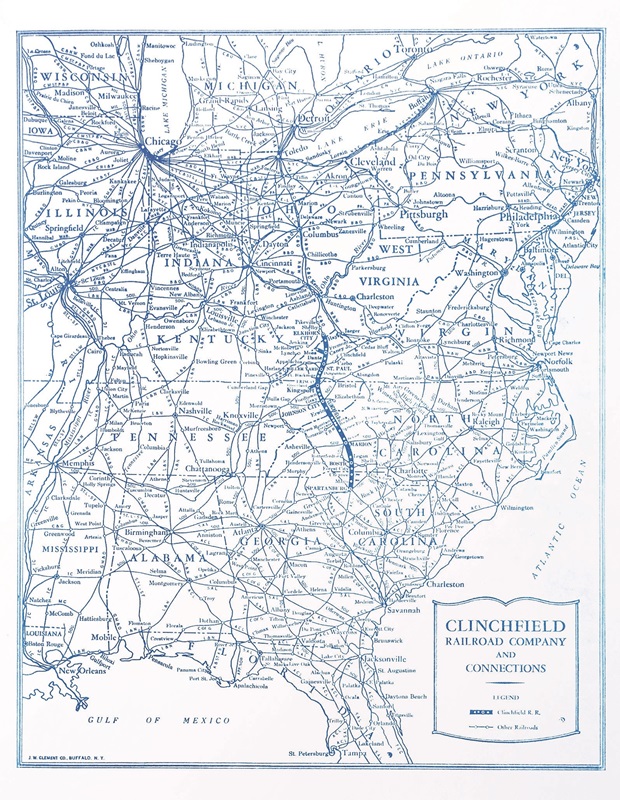
In 1902, a wealthy regional businessman, George L. Carter, began stitching together an integrated industrial enterprise to develop vast coal deposits in the Clinch (River) Fields of southwest Virginia and to deliver the coal across the southern Appalachian mountains to markets in the Carolinas and to ships calling at Wilmington, Charleston, Savannah, and Jacksonville. Carter, from whom Howard Hughes could have learned a thing to two about secrecy, operated using the South & Western Railway banner. The name said everything … and nothing. The S&W was chartered from any point on the Atlantic Ocean to any point on the Great Lakes. Carter agents seized by legal means and/or physical occupation key terrain features through the mountains in competition with the Chesapeake & Ohio and the Southern Railway.
Clinchfield Railroad map. The Clinchfield’s 277-mile, 5-state line stretched from Elkhorn City, Kentucky, to Spartanburg, South Carolina.
Map via Classic Trains.Within that generous charter was the idea of building a railroad to haul coal south and merchandise in both directions between the Midwest and the Southeast. The plans also incorporated development of several on-line cities to consume coal and make products from regional resources to diversify and grow the freight business. Finally, a steamship line was organized to move coal beyond the ports to customers in the Caribbean.
By 1905, Carter realized he needed far more capital than he could personally provide. Reluctantly, he managed to convince Blair & Co., a big Wall Street investment house, to finance the project. M. J. Caples, an engineer with mining and railroad experience, laid out and then built a magnificent low-grade, high-capacity railroad. Tunnels, steel viaducts, generous fills, and rocky cuts appeared as needed. More than 4 percent (almost 10 miles) of the line was underground in 55 tunnels. With construction of the 277-mile railroad well advanced, its name was changed to Carolina, Clinchfield & Ohio Railway in 1908.
Coal began flowing across the 242 miles from Dante, Va., to Spartanburg, South Carolina, in 1909 while the owners and engineers debated how to cross the Cumberland mountains into the Ohio River valley. Between 1912 and 1915, a 35-mile extension including what was then the 10th-longest tunnel in the U.S. created a through route connecting Chesapeake & Ohio at Elkhorn City, Kentucky, with the three major southeastern carriers (Seaboard at Bostic, North Carolina; Atlantic Coast Line and Southern at Spartanburg). In constant-value dollars, the five-state CC&O was the most expensive railroad ever built in the U.S.
March 4, 2020
QotD: Tax cuts “for the rich”
This is why populism and nationalism, taken to their natural conclusions, always lead to statism. The state is the only expression of the national or popular will that encompasses everybody. So, the more you talk about how the fundamental unit of society is a mythologized collective called “The People” or the nation, the more you are rhetorically empowering the state.
Sure, the Constitution begins with the words “We the People,” but that is not a populist sentiment — it’s a statement of precedence in terms of authority: The people come before the government (not the European notion of the state). The spirit of the Constitution is entirely about the fact that The People are not all one thing. It places the rights of a single person above those of the entire federal government! It assumes not only that the people will disagree among themselves, but that the country will be better off if there is such disagreement. No populist frets about the tyranny of the majority. American patriots do.
But if you recognize that humans create wealth with their brains and their industry and that it therefore belongs to them, you’ll be a little more humble about the state’s “right” to take as much as it wants to spend how it wants. Human ingenuity is the engine of wealth creation, and there is no other.
But that doesn’t mean government doesn’t play a role. Because, as I said, there will be no wealth creation if there is no rule of law. There will be no investment or ingenuity if there is no guarantee that you will be able to collect on that investment or reap the benefits of your innovation. Without such an environment, the biggest mob wins. And when the mob wins, children starve to death in what should be one of the richest countries in the world.
Jonah Goldberg, “America and the ‘Original Position'”, National Review, 2017-12-22.
March 3, 2020
Michael Bloomberg, self-appointed nanny
Via Instapundit, Karen Kataline shares a look at the things that bother Michael Bloomberg about you:

Former New York City Mayor Mike Bloomberg speaking with supporters at a campaign rally in Phoenix, Arizona on 1 February, 2020.
Photo by Gage Skidmore via Wikimedia Commons.
Take Michael Bloomberg … please! What drives this man with the freedom to enjoy his wealth in 65 billion different ways, to spend his time trying to curtail the freedoms and choices of others, even down to the size soda they drink and the amount of salt they ought to be allowed to sprinkle on their spinach?
Coloradans know all too well that the former New York Mayor and Democratic Presidential Candidate spent boatloads of cash pushing state legislators to clamp down on their God-given right to defend themselves and their families. He has pushed freedom-sucking and blatantly biased “Red Flag” bills in numerous other states around the country.
Mayor Busybody simply can’t stop telling others what to do. It seems to be an obsession with him — or maybe, a compulsion too. I gained insight into this when I returned to a New York Times article from 2009 that described Bloomberg’s eating habits.
“He dumps salt on almost everything, even saltine crackers. He devours burnt bacon and peanut butter sandwiches. He has a weakness for hot dogs, cheeseburgers, and fried chicken, washing them down with a glass of merlot. And his snack of choice? Cheez-Its.”
Obsessive-Compulsive Disorder (OCD) is about control. Controlling one’s out-of-control thoughts, feelings, and behavior by attempting to control his external environment. Consciously or unconsciously, those afflicted do this in vain, to the point where they feel unable to control the compulsion as well (as in excessive hand-washing).
Most sufferers aren’t dangerous unless they have 65 billion dollars and a God-complex.
The Times went on to report this delicious insight:
“… he (Bloomberg) is known to grab food off the plates of aides and, occasionally, even strangers. (‘Delicious,’ he declared recently, after swiping a piece of fried calamari from an unsuspecting diner in Staten Island.)”
Behavior like this exhibits a staggering and extreme lack of boundaries. The Times seems to only snicker at this, but it’s painfully clear that Bloomberg has great difficulty respecting the basic boundaries of civil society. No wonder it’s so easy for him to help himself to your freedoms and your choices when he can’t stop helping himself to your calamari.
Arnhem by Antony Beevor Book Review
TIK
Published 18 Jun 2018Antony Beevor’s book Arnhem is good — but it contains a flawed argument. So flawed, that there’s a ton of counter evidence that shows it doesn’t work. Here, I will explain the events of the Nijmegen battle, what Beevor’s incorrect statement is, why he has to say it like he did, and how he could have done things differently.
Check out the pinned comment below for more information, notes, links, and sources.
Don’t forget to subscribe if you like history or gaming! And hit the little bell icon to be notified when videos like this are uploaded.
Please consider supporting me on Patreon and help make more videos like this possible https://www.patreon.com/TIKhistory
From the comments:
TIK
1 year agoSelected Bibliography/Sources
Brereton, L. The Brereton Diaries: The War in the Air in the Pacific, Middle East and Europe, 3 October 1941-8 May 1945. Kindle, 2014.
Frost, J. A Drop Too Many. Kindle, 2009.
Hastings, M. Armageddon. Pan Books, 2004.
Robert J. Kershaw, It Never Snows in September. Ian Allan Publishing, 2007.
Mead, R. General Boy: The Life of Lieutenant General Sir Frederick Browning. Kindle, 2010.
Middlebrook, M. Arnhem 1944: The Airborne Battle, 17-29 September. 2009.
Neillands, R. The Battle for the Rhine 1944. Kindle, 2014.
Poulussen, R.G. Lost at Nijmegen. Kindle, 2011.
Ryan, C. A Bridge Too Far. Kindle, 1974
Urquhart, R. Arnhem. Kindle, 1958.
Sosabowski, S. Freely I Served. Kindle, 1982.Links
My “REAL Operation Market Garden” documentary https://youtu.be/vTUC79o4Kmc
“The BAD BOY of Operation Market Garden” A video on General ‘Boy’ Browning https://youtu.be/Dvv8GQIRYVU
The “Who to Blame? John Frost on Operation Market Garden’s Failure” video https://youtu.be/7C_HoMVhKAI
My discussion of Market Garden’s True Purpose using Monty vs Eisenhower’s Memoirs https://youtu.be/f79KgQVL3MM
A video on Kampfgruppen where I talk about some of the Market Garden Kampfgruppen https://youtu.be/zKWczZkQ130
My Book review of It Never Snows in September https://youtu.be/-RRdWCyHpG8
My A Bridge Too Far Book Review video https://youtu.be/D6vDlbsOkQEAdd me on Twitter @TIKhistory
Thanks for watching, bye for now!

March 2, 2020
The Trouble With Tumbleweed
CGP Grey
Published 1 Mar 2020Director’s commentary: https://www.youtube.com/watch?v=rbHQO…
## Crowdfunders:
Bob Kunz, Steven Snow, John Buchan, Nevin Spoljaric, Donal Botkin, Phil Gardner, Chris Chapin, Richard Jenkins, Martin, Steven Grimm, سليمان العقل, Colin Millions, Michael Mrozek, Saki Comandao, Jason Lewandowski, Andrea Di Biagio, David F Watson, rictic, Ben Schwab, Marco Arment, Elliot Lepley, Shantanu Raj, emptymachine, Bobby, Chris Amaris, George Lin, Mikko, Derek Bonner, Derek Jackson, Orbit_Junkie, Ron Bowes, Tómas Árni Jónasson, Henry Ng, Jordan Earls, Joshua Jamison, Nick Fish, Nick Gibson, Robert Webb, Jeffrey Podis, Thunda Plum, Awoo, David Tyler, Fuesu, iulus, Kevin Costello, Michael Reilly, Tyler Bryant, Kermit Norlund, chrysilis, David Palomares, Erik Parasiuk, ken mcfarlane, Leon, Tristan Watts-Willis, Veronica Peshterianu, Bear, Emi, Esteban Santana Santana, Freddi Hørlyck, John Rogers, Maarten van der Blij, Peter Lomax, Rhys Parry, ShiroiYami, Dag Viggo Lokøen, John Lee, Maxime Zielony, Elizabeth Keathley, Frederick The Great, Luxe Gifts, Rebecca Wortham, Bryan McLemore
Music by Music by: http://www.davidreesmusic.com
Wikipedia says:
A tumbleweed is a structural part of the above-ground anatomy of a number of species of plants, a diaspore that, once it is mature and dry, detaches from its root or stem, and rolls due to the force of the wind. In most such species, the tumbleweed is in effect the entire plant apart from the root system, but in other plants, a hollow fruit or an inflorescence might serve the function. Tumbleweed species occur most commonly in steppe and arid ecosystems, where frequent wind and the open environment permit rolling without prohibitive obstruction.
Apart from its primary vascular system and roots, the tissues of the tumbleweed structure are dead; their death is functional because it is necessary for the structure to degrade gradually and fall apart so that its seeds or spores can escape during the tumbling, or germinate after the tumbleweed has come to rest in a wet location. In the latter case, many species of tumbleweed open mechanically, releasing their seeds as they swell when they absorb water.
The tumbleweed diaspore disperses seeds, but the tumbleweed strategy is not limited to the seed plants; some species of spore-bearing cryptogams — such as Selaginella — form tumbleweeds, and some fungi that resemble puffballs dry out, break free of their attachments and are similarly tumbled by the wind, dispersing spores as they go.
[…]
In the family Amaranthaceae (i.e. broadly defined to include Chenopodiaceae), several annual species of the genus Kali are tumbleweeds. They are thought to be native to Eurasia, but when their seeds entered North America in shipments of agricultural seeds, they became naturalized in large areas. In the cinema genre of Westerns, they have long been symbols of frontier areas. Kali tragus is the so-called “Russian thistle”. It is an annual plant that breaks off at the stem base when it dies, and forms a tumbleweed, dispersing its seeds as the wind rolls it along. It is said to have arrived in the United States in shipments of flax seeds to South Dakota, perhaps about 1870. It now is a noxious weed throughout North America, dominating disturbed habitats such as roadsides, cultivated fields, eroded slopes, and arid regions with sparse vegetation. Though it is a troublesome weed, Kali tragus also provides useful livestock forage on arid rangelands.

March 1, 2020
“When you’re driving a fancy car, you’re an avatar for everyone else’s bad boss, useless trust-fund roommate, or absent workaholic father”
At Car and Driver, Ezra Dyer confirms what most of us already suspected about the folks who drive expensive rides:

Excuse us if you’ve already devoured the latest volume of the Journal of Transport & Health, but the March issue contains the results of a novel experiment that tested a cherished automotive stereotype. The study is entitled “Estimated Car Cost as a Predictor of Driver Yielding Behavior for Pedestrians,” but you can think of it as, “Are BMW drivers really jerks or what?”
Okay, so it was more nuanced than that. The authors of the study sent four pedestrians — black female, black male, white female, white male — to crosswalks in the Las Vegas area to see how many drivers would yield. The overall results were pretty dismal, with a yield rate of only about 28 percent out of 461 cars. Cars yielded more often to female and white pedestrians than male and nonwhite pedestrians, although not enough either way to register as statistically significant. The only factor that consistently predicted yielding behavior was the value of the car. Notably, the study’s authors estimated the book value on all 461 cars, so the 2004 Mercedes S-class that’s worth $5000 didn’t get ascribed automatic snob appeal.
[…]
However, if you’re driving an actual exotic, something way far up the food chain, behavior changes again. Everyone yields to the Rolls or the Lambo because cars like that are so over the top, they make you interesting by association. Plus: most people don’t know anybody with a car like that; thus they can’t associate it with anyone awful. The ultra-expensive car, and the driver, are a curiosity. What’s that guy’s deal? He probably invented that fake grass that goes between the pieces of sushi. And good for him! But the guy in the 911? He can wait an extra two turns at the four-way intersection. Probably deserves it.
Our not-scientific conclusions: If you expect fellow road users to demonstrate courtesy, you should drive either a 1984 Renault Alliance or a Lamborghini Aventador SVJ roadster. But either way, and to everybody in between: Yield at the damn crosswalks.
February 29, 2020
Dardick Model 1500: The Very Unusual Magazine-fed Revolver
Forgotten Weapons
Published 12 Nov 2019This is Lot 1953 in the upcoming RIA December Premier auction.
The Dardick 1500 was a magazine-fed revolver designed by David Dardick in the 1950s. His patent was granted in 1958, and somewhere between 40 and 100 of the guns were made in 1959, before the company went out of business in 1960. The concept was based around a triangular cartridge (a “tround”) and a 3-chambered, open-sided cylinder. This wasn’t really of direct benefit to a handgun, but instead was ideal for a high rate of fire machine gun, where the system did not need to pull rounds forward or backward to chamber and eject them. In lieu of military machine gun contract, Dardick applied the idea to a sidearm.
The Model 1500 held 15 rounds, inside a blind magazine in the grip. It was chambered for a .38 caliber cartridge basically the same as .38 Special ballistically. A compact Model 1100 was also made in a small numbers, with a shorter grip and correspondingly reduced magazine capacity (11 trounds). A carbine barrel/stock adapter was also made. The guns were a complete commercial failure, with low production and lots of functional problems. Today, of course, they are highly collectible because of that scarcity and their sheer mechanical weirdness.
http://www.patreon.com/ForgottenWeapons
Cool Forgotten Weapons merch! http://shop.bbtv.com/collections/forg…
Contact:
Forgotten Weapons
6281 N. Oracle #36270
Tucson, AZ 85704
I’ve always had an interest in the Dardick, from their appearance in some of L. Neil Smith’s science fiction novels. I linked to an earlier article of his, and commented:
As Neil pointed out in one of his books, the Dardick was the answer to a bad crime writer’s prayers: it was literally an automatic revolver. (For those following along at home, an “automatic” has a magazine holding the bullets which are fed into the chamber to be fired by the action of the weapon: fire a bullet, the action cycles, clearing the expended cartridge and pushing a new one into place, cocking the weapon to fire again. A “revolver” holds bullets in the cylinder, rotating the cylinder when the gun is fired to put a new bullet in line with the barrel to be fired. The Dardick is the only example I know of that combines both in one gun.)

February 28, 2020
Is the world ready for Trump versus Bernie?
At Rotten Chestnuts, Severian considers the strong possibility that Bernie Sanders will capture the Democratic presidential nomination and face Donald Trump in the general election:

Before we get into it, can we all just pause for a second to savor the delicious irony of the Democrats suddenly discovering, after all these many many many years, that Socialism is bad? I almost feel sorry for poor ol’ Bernie. For going on four decades now, the Dems have treated him like the little kid at the grown-ups’ table. Who hasn’t been there on Thanksgiving? “Mommy, Uncle Henry’s breath smells really bad.” We’re all thinking it, kiddo, but you can’t say it. They’ve been silently agreeing with him about the need to turn America into the USSA all these years, and now they’re gonna take him behind the woodshed for it? Really?
This is point #1 in the argument, increasingly common out here in the political badlands, that Bernie Sanders is Bizarro World Donald Trump. Back in 2016, the weirdest thing for those of us not wedded to Team Republican — for that vanishingly rare breed, that is, who regard politics as politics, not sportsball in neckties — was how normal Trump sounded. This guy is supposed to be the ultimate anti-Establishment candidate, right? So why is he saying stuff that has been GOP orthodoxy since the 1970s? And why are they hammering him for it?
[…]
This is where he’s most dangerous. Like Trump was in 2016, Bernie 2020 can be seen as a pure protest candidate, a giant “fuck you” to The System. Hell, in my increasingly frequent black-pill moments, I contemplate voting for the guy — we’re not voting our way out of what’s coming, as Z Man always says, so we might as well get started. A few years of life under the Septuagenarian Stalin will give us some valuable prep for when things get really interesting under La Presidenta por Vida Alexandria Ocasio-Cortez.
Moreover, there can be great power in being the only guy in the room who’s willing to state the obvious. In this case, it has been obvious for a long time that the Democratic Party are a bunch of godless commies. Literally commies, or at least Bolshie-curious. Obvious, but always verboten to say … until now. Sanders has a rabid base that, even if you assume the “official” numbers are all lies, can’t be much less than 20% of the entire Party. Those hardcore Bernie Bros can’t possibly have any illusions about who he is and what he wants. That’s what they want, too, and again: twenty percent. The Media paints anyone to the Right of Rachel Maddow as a “white supremacist,” but can you imagine how different American politics would be if 20% of the GOP were open, avowed Klansmen?
Those are the “positives,” for lack of a better term, of Bernie being the Democratic nominee. If this is what The People really, really want — and it’s crystal clear that a lot of them do — then we should at least have a good, long, hard “national conversation” about giving it to them. Cuba, as Bernie keeps informing us, does after all have 100% literacy and free health care, and the Chinese are great at lifting people out of poverty. Let’s talk about that, live on national television, and see where it takes us.
The Robin Hood complex – Social banditry theory and myth making
The Cynical Historian
Published 15 Dec 2016There’s one historical theory that people keep deluding themselves with, and it’s about time I pointed it out. Social banditry, or the “Robin Hood theory” is problematic at best and cultural misanthropy at worst.
Social bandit or social crime is a term invented by the Marxist historian Eric Hobsbawm in his 1959 book Primitive Rebels, a study of popular forms of resistance that also incorporate behavior characterized by law as illegal. He further expanded the field in the 1969 study Bandits. Social banditry is a widespread phenomenon that has occurred in many societies throughout recorded history, and forms of social banditry still exist, as evidenced by piracy and organized crime syndicates. Later social scientists have also discussed the term’s applicability to more modern forms of crime, like street gangs and the economy associated with the trade in illegal drugs.
————————————————————
References:
Boessenecker, John. “California Bandidos.” Southern California Quarterly 80, i4 (Dec. 1, 1998), 419-434.Hall-Patton, Joseph. Pacifying Paradise: Violence and Vigilantism in San Luis Obispo. San Luis Obispo: California Polytechnic – San Luis Obispo thesis, 2016. http://www.digitalcommons.calpoly.edu…
Hobsbawm, Eric. Primitive Rebels: Studies in Archaic Forms of Social Movement in the 19th and 20th Centuries. New York: WW Norton & Company, 1965. https://amzn.to/2L6TDY0
Hobsbawm, Eric. Bandits. Rev. ed. New York: The New Press, 2000. https://amzn.to/2L4RagK
Rediker, Marcus. Outlaws of the Atlantic: Sailor, Pirates, and Motley Crews in the Age of Sail. Boston, Mass.: Beacon Press, 2014. https://amzn.to/2OasYf4
Linebaugh, Peter and Marcus Rediker. The Many-Headed Hydra: Sailors, Slaves, Commoners, and the Hidden History of the Revolutionary Atlantic. Boston, Mass.: Beacon Press, 2000. https://amzn.to/2JKq8tN
https://en.wikipedia.org/wiki/Social_…
https://en.wikipedia.org/wiki/Zorro
https://en.wikipedia.org/wiki/Pancho_…
https://en.wikipedia.org/wiki/Joaquin…
https://en.wikipedia.org/wiki/Salomon…
https://en.wikipedia.org/wiki/Black_B…
————————————————————
Patreon:
https://www.patreon.com/CynicalHistorianLET’S CONNECT:
https://twitter.com/Cynical_History
—————————————–
Hashtags: #History #SocialBanditry #PrimitiveRebellion #RobinHood #BillyTheKid