Count up the victims of World War I, and American tourists will be pretty far down the list. But victims they were. When the conflict broke out, thousands of Americans were overseas visiting the cathedrals of Florence or the museums of London. They woke up one morning to find the ships that were supposed to take them back had been conscripted into the war effort, or refused to sail for fear of enemy fire. The banks that were supposed to cash their travelers’ checks were panicking, or devoting all their funds to the war effort, or dealing with a million other things. The hotels that were supposed to house them were closed indefinitely, their employees rushing to enlist out of patriotic fervor. And so thousands of frantic Americans, stuck in a foreign continent with no money and nowhere to stay, showed up at the door of the US Embassy in London and said – help!
The US Consulate in London didn’t know how to solve these problems either. But Herbert Hoover, still high on his decision to pivot to philanthropy and public service, calls them up and asks if he can help. They say yes, definitely. Hoover gets in touch with his rich friends, passes around the collection plate, and organizes a Committee For The Assistance Of American Travelers. Then he gets to work, the way only he can:
Within 24 hours, Hoover’s committee had its own stationery, and within forty-eight it was operating a booth in the ballroom of the Savoy Hotel as well as three other London locations. Through his business connections, Hoover managed to bypass restrictions on telegraph service and open a transatlantic line to allow Americans to wire money to stranded friends and relatives. In a city suddenly flooded with refugees, he reserved for American travelers some two thousand rooms in hotels or boardinghouses. He issued a press release proclaiming that his Residents’ Committee was assuming charge of all American relief work in the city, and that in doing so it had the blessings of its honorary chairman, Walter Hines Page, the US ambassador to London.
… which is totally false. Hoover is starting to display a pattern that will stick with him his whole life – that of crushing competing charities. He begins a lobbying effort to get the US Embassy to ban all non-Hoover relief work, focusing on the inefficiency of having multiple groups working on the same problem. When the US Assistant Secretary Of War arrives in London to coordinate a response, he is met on the dock by Hoover employees, who demand he consult with Hoover before interfering in the US tourist issue. Eventually the Embassy, equally exasperated by Hoover’s pestering and impressed with his results, agrees to give him official control of the relief effort.
After two months of work, Hoover and his Committee have repatriated all 120,000 US tourists, supporting them in style until it could find them boat tickets. All of its loans and operating costs have been repaid by grateful tourists, and its budget is in the black. The rescued travelers are universal in their praise for Hoover, partly because Hoover has threatened to ruin any of them who get too critical:
Other complainants were received with less patience, including a hotheaded professor of history from the University of Michigan, who wrote to accuse the Residents’ Committee of mistreatment. Hoover refuted his charges indignantly and comprehensively, copying his response to the president of the university and its board of regents. After a meeting with his employer, the professor returned Hoover an abject retraction and apology.
Scott Alexander, “Book Review: Hoover”, Slate Star Codex, 2020-03-17.
August 23, 2020
August 22, 2020
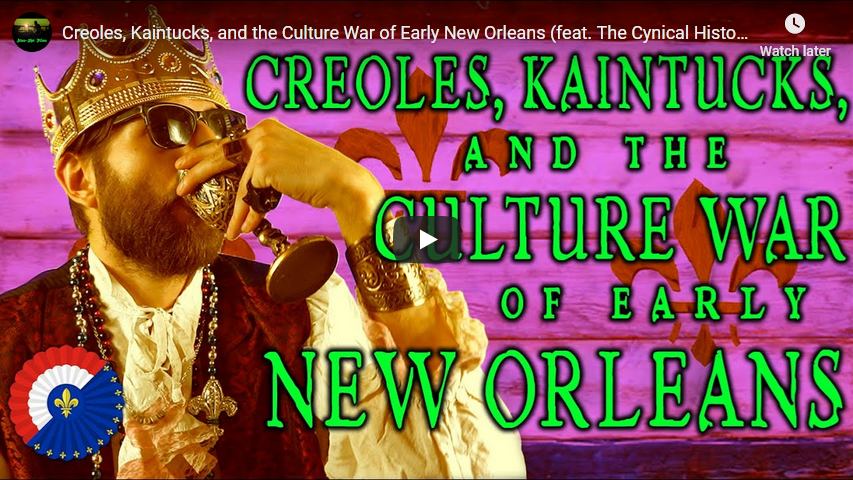
Creoles, Kaintucks, and the Culture War of Early New Orleans (feat. The Cynical Historian)
Atun-Shei Films
Published 21 Aug 2020For #ProjectFrance, I collaborated with @The Cynical Historian to teach y’all about the cosmopolitan cultural exchange between revolutionary France and a country called the United States of America in the late 18th and early 19th century. In this video, I discuss the contentious relationship between Anglo-Americans and French Creoles in New Orleans in the years after the Louisiana Purchase.
Support Atun-Shei Films on Patreon ► https://www.patreon.com/atunsheifilms
Leave a Tip via Paypal ► https://www.paypal.me/atunsheifilms (All donations made here will go toward the production of The Sudbury Devil, our historical feature film)
Buy Merch ► teespring.com/stores/atun-shei-films
#NewOrleans #History
Watch our film ALIEN, BABY! free with Prime ► http://a.co/d/3QjqOWv
Reddit ► https://www.reddit.com/r/atunsheifilms
Twitter ► https://twitter.com/atun_shei~REFERENCES~
[1] Lo Faber. “Anglo-Americans” (2018). 64Parishes https://64parishes.org/entry/anglo-am…
[2] Richard Campanella. Bienville’s Dilemma: A Historical Geography of New Orleans (2008). University of Louisiana at Lafayette, Page 170-171
[3] Peter J. Kastor. “Louisiana Purchase and Territorial Period” (2018). 64Parishes https://64parishes.org/entry/louisian…
[4] Daniel Rasmussen. American Uprising: The Untold Story of America’s Largest Slave Revolt (2011). Harper Perennial, Page 16
[5] Kimberly S. Hanger. Bounded Lives, Bounded Places: Free Black Society in Colonial New Orleans, 1769-1803 (1997). Duke University Press, Page 54-56
[6] Mary Gehman. The Free People of Color of New Orleans (2009). Sheridan Books, Page 49-51
[7] Rasmussen, Page 159-163
QotD: Sex-differentiated status hierarchies
Girls can win by winning in their own hierarchy — by being good at what girls value, as girls. They can add to this victory by winning in the boys’ hierarchy. Boys, however, can only win by winning in the male hierarchy. They will lose status, among girls and boys, by being good at what girls value. It costs them in reputation among the boys, and in attractiveness among the girls. Girls aren’t attracted to boys who are their friends, even though they might like them, whatever that means. They are attracted to boys who win status contests with other boys.
“whatever that means”. Heh. Shivvy way to say, “which means nothing”.
When JP discusses sex differences, he could be reading CH posts. Whatever one thinks of the criticisms leveled against him (some are valid), he does have a decent grasp of the sexual market and how men and women navigate divergent routes through an ocean of mate prospects to get what they want.
However, this is one of the rare instances when I disagree with his premise. He’s generally correct that, at least within the bounds of our current cultural arrangement, women have two status hierarchies available to them while men only have one. Our gynarcho-tyranny not only encourages but aggressively impresses upon women the urgency and even moral duty of succeeding in male domains (leaning in), while simultaneously encouraging men to sacrifice their status within their own male domains to make way for more women (and consequently rendering themselves less sexually attractive to women who are now their equal or higher in social status).
Women who do succeed in the man’s world can expect to ascend the intrafemale status ladder (more precisely, the intra-feminist status ladder), but where JP is wrong is assuming these women don’t also suffer an SMV status loss the near-equivalent of the SMV status loss suffered by men who succeed at girlie games of one-uppance.
Just as girls aren’t attracted to effeminate males, and other men are repulsed by nancyboys, the inverse is as true: men aren’t attracted to masculine, status-striving girls, and other women don’t subconsciously look up to mouthy careerist shrikes with the same mix of envy and admiration that they look up to physically beautiful women.
CH, “Sex-Based Status”, Chateau Heartiste, 2018-06-04.
August 21, 2020
Virtuesplaining Blazing Saddles
Paul du Quenoy says that Mel Brooks is cancelled after all:
It seems like only yesterday that HBO Max, the financially troubled American cable television network’s new film streaming service, signalled its virtue by removing Gone With The Wind from viewing so that the classic film could be properly “contextualised” as what presenter and University of Chicago film professor Jacqueline Stewart calls “a prime text for examining expressions of white supremacy in popular culture”. She believes this is useful for the “re-education” of audiences who might otherwise stray into thoughtcrime.
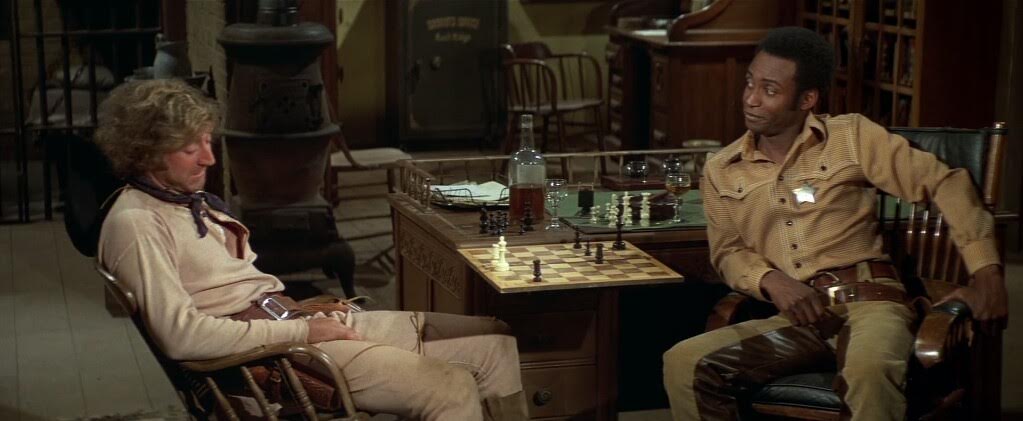
Mel Brooks’s smash hit 1974 comedy Blazing Saddles, which seems to have been added to HBO Max since the Gone With The Wind dust up and is known for its liberal use of the feared and loathed “n-word”, arrived with a similarly patronising disclaimer already installed. In a three-minute introduction that apparently cannot be skipped over, Stewart is there again, this time to inform viewers that “racist language and attitudes pervade the film”, while instructing them that “those attitudes are espoused by characters who are portrayed here as explicitly small-minded, ignorant bigots … The real, and much more enlightened, perspective is provided by the main characters played by Cleavon Little and Gene Wilder”.
Thanks, Aunt Jacqueline. If you have not seen Blazing Saddles – and if you are under the age of forty there is an excellent chance some prudish authority figure sanitised it out of your cosseted millennial existence – it stands as one of the greatest, and the certainly the funniest, anti-racist films of all time. Based on a story by Andrew Bergman, Brooks conceived it as a scathing send-up of racism and the hypocrisy that still enabled it after the great civil rights victories of the 1960s. Brooks’s idiom was a parody of the classic Western, by then an exhausted genre that had, among other flaws, become inanely predictable and was much criticised for leaving out minorities. A landmark of American film, Blazing Saddles was selected in 2006 for inclusion in the US National Film Registry, which recognises “culturally, historically, or aesthetically significant films” worthy of preservation.
Drenched in hilarity – and by my count using the “n-word” 17 times in its 93-minute run – the plot involves a conspiracy by an avaricious U.S. state attorney general who wants to drive white settlers off land he needs to complete a profitable railroad project. After having outlaws wreak mayhem on the townspeople, he recommends that the governor appoint a black sheriff to restore law and order, cynically assuming that their racism will cause them to reject the new lawman and give up. Despite a rough initial reception, the sheriff outwits attempts to get rid of him and, with the help of a washed up but sympathetic alcoholic gunslinger, leads the townspeople to victory, winning their love and respect before moving on to other brave deeds.
While HBO no longer wants to risk having its paying customers think for themselves (and what stale corporate outfit uneasily transitioning to a crowded new market wouldn’t?), it could rightly be said that anyone dumb enough to miss the film’s message might be a recent product of Anglo-American higher education. I do not mean this at all facetiously. Decaying and run by a self-important clerisy whose demands to be taken seriously only become shriller as it declines in reach and vitality – and from which any participant can be dismissed for even the slightest speech or behavioural infraction – academia naturally discourages humour. Jokes, which can almost always cause some kind of offence, are simply too risky to be told or laughed at, even in private. Finding the wrong thing funny can invite career-hobbling accusations that one has demeaned a student or colleague and thereby made them feel unacceptably “uncomfortable” or even physically “unsafe”. Perceived flippancy bruises sanctified “professional seriousness” in a way tantamount to sacrilege. The only tolerated exceptions are a kind of solemn irony that offers comfort in coping with academia’s increasing irrelevance and a resigned gallows humor about its ever more limited prospects.
August 20, 2020
The attractive nuisance of conspiracy theories
In The Critic, Michael Coren pours scorn on the fans of QAnon and other conspiracy theories:

QAnon alleged clues about the NYC bombing, 10 December 2017.
Wikimedia Commons.
For those outside of the increasingly bizarre and surreal loop, something called QAnon is a pretty big thing in the United States, with increasing influence internationally. It’s a far-right conspiracy theory claiming that a secret deep state plot is at work against Donald Trump, who is the only person capable of smashing the power of a Satan-worshipping cabal of pedophiles composed of liberal and Democrat politicians, Hollywood celebrities, and high-profile mainstream media figures. There, nothing at all odd or bonkers about that. It goes on to allege that a planned coup by Hilary Clinton, Barack Obama, and – as always – George Soros was only prevented when President Trump hired former FBI director Robert Mueller to investigate.
The people who embrace all of this, and there are a large and increasing number of them, roar all sorts of quasi-religious language in their tweets and posts, speak of “The Storm” and “The Great Awakening” and are convinced that once they’re victorious, thousands of their enemies will be detained, incarcerated, likely sent to Guantanamo Bay, and the military will the take over the nation. Everyone loves a happy ending.
There’s plenty more involved, and every conspiracy theory one can imagine generally comes into play. Dive into social media and you’ll find the Q zealots, but look around a Trump campaign event and their posters and slogans will be just as common. Indeed, Republican candidate Marjorie Taylor Greene, a proud believer in QAnon, recently won the congressional nomination in Georgia’s 14th district. In that this area gave its last Republican candidate 76% of the vote it’s virtually impossible that Greene will not be a member of Congress. Many in her party were appalled but Donald Trump tweeted, “Congratulations to future Republican Star Marjorie Taylor Greene on a big Congressional primary win in Georgia against a very tough and smart opponent. Marjorie is strong on everything and never gives up — a real WINNER!” In other words, this is a serious concern.
Outside of democratic politics, the so-called Pizzagate scandal was part of the QAnon maze of lunacy. False claims were made that hacked personal e-mail accounts had revealed the existence of a child-sex ring involving several leading Democrat politicians. The whole thing was, it was alleged, based in a pizzeria in Washington DC. A North Carolina conspiracy believer then travelled to DC and opened fire in the restaurant with a high-powered weapon.
It’s likely that the people behind the entire Q madness are making a great deal of money and it could be that they’re not even directly politically motivated. Whatever their motives, it’s all gone well beyond its origins and was pushed into high gear when the apparently genuine case of the Jeffrey Epstein scandal came to light. His alleged links to senior lawyers, Democrats, and a member of the royal family, plus a bewildering suicide, were meat and drink to every conspiracy theorist with a mum’s basement worth the name.
Wikipedia says:
QAnon[a] (/kjuːəˈnɒn/) is a far-right conspiracy theory detailing a supposed secret plot by an alleged “deep state” against President Donald Trump and his supporters. The theory began with an October 2017 post on the anonymous imageboard 4chan by “Q”, who was presumably an American individual, but probably became a group of people. Q claimed to have access to classified information involving the Trump administration and its opponents in the United States. NBC News found that three people took the original Q post and expanded it across multiple media platforms to build internet followings for profit. QAnon was preceded by several similar anonymous 4chan posters, such as FBIAnon, HLIAnon (High-Level Insider), CIAAnon, and WH Insider Anon.
Q has accused many liberal Hollywood actors, Democratic politicians, and high-ranking officials of being members of an international child sex trafficking ring. Q also claimed that Trump feigned collusion with Russians to enlist Robert Mueller to join him in exposing the ring and preventing a coup d’état by Barack Obama, Hillary Clinton, and George Soros. “Q” is a reference to the Q clearance used by the U.S. Department of Energy. QAnon believers commonly tag their social media posts with the hashtag #WWG1WGA, signifying the motto “Where We Go One, We Go All”.
August 19, 2020
He calls it “unintended consequences”. I disagree … these consequences are very much intended
Brad Polumbo is being far too generous to Californian politicians by saying the impending collapse of the state’s entire gig economy was not the intended result of passing “worker protection” laws that penalized success:

UBER 4U by afagen is licensed under CC BY-NC-SA 2.0


This Friday, Uber and Lyft are set to entirely shut down ride-sharing operations in California. The businesses’ exit from the Golden State will leave hundreds of thousands of drivers unemployed and millions of Californians chasing an expensive cab. Sadly, this was preventable.
Here’s how we got to this point.
In September of 2019, the California state legislature passed AB 5, a now-infamous bill harshly restricting independent contracting and freelancing across many industries. By requiring ride-sharing apps such as Uber and Lyft to reclassify their drivers as full employees, the law mandated that the companies provide healthcare and benefits to all the drivers in their system and pay additional taxes.
Legislators didn’t realize the drastic implications their legislation would have; they were simply hoping to improve working conditions in the gig economy. The unintended consequences may end up destroying it instead.
Here’s why.
AB 5 went into effect in January, and now, a judge has ordered Uber and Lyft to comply with the regulation and make the drastic transformation by August 20. Since compliance is simply unaffordable, the companies are going to have to shut down operations in California.
Their entire business model was based upon independent contracting, so providing full employee benefits is prohibitively expensive. Neither Uber nor Lyft actually make a profit, and converting their workforce to full-time employees would cost approximately $3,625 per driver in California. As reported by Quartz, “that’s enough to boost Uber’s annual operating loss by more than $500 million and Lyft’s by $290 million.”
Essentially, California legislators put these companies in an impossible position. It makes perfect sense that they’d leave the state in response. It’s clear that despite the good intentions behind the ride-sharing regulation, this outcome will leave all Californians worse off.
August 18, 2020
Political polarization, or why Liberals and Conservatives really don’t understand each other
John Miltimore discusses the findings of Jonathan Haidt on the differences in moral worldviews of conservative and liberal Americans which seem to explain why communication across the political “aisle” is so difficult:
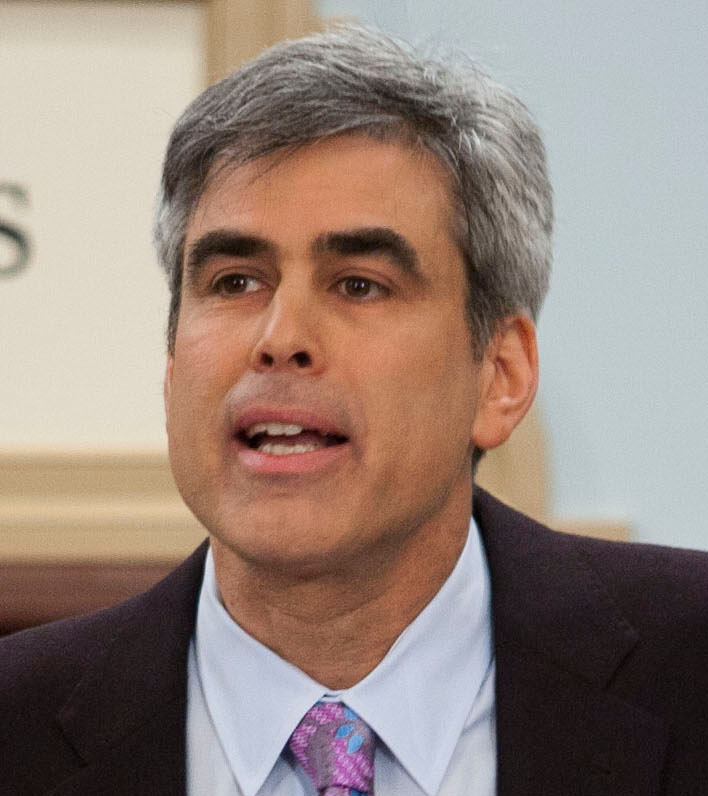
Jonathan Haidt at the Miller Center of Public Affairs in Charlottesville, Virginia on 19 March, 2012.
Photo via Wikimedia Commons.
During a TED talk a number of years ago, Haidt shared his discovery that contrary to the idea that humans begin as a blank slate — “the worst idea in all psychology,” he says — humans are born with a “first draft” of moral knowledge. Essentially, Haidt argues, humans possess innate but malleable sets of values “organized in advance of experience.”
So if the slate is not blank, what’s on it?
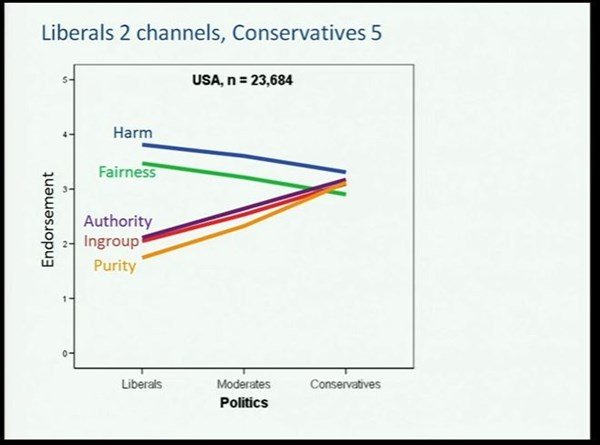
To find out, Haidt and a colleague read the most current literature on anthropology, cultural variations, and evolutionary psychology to identify cross-cultural matches. They found five primary categories that serve as our moral foundation:
- Care/harm: This foundation is related to our long evolution as mammals with attachment systems and an ability to feel (and dislike) the pain of others. It underlies virtues of kindness, gentleness, and nurturance.
- Fairness/reciprocity: This foundation is related to the evolutionary process of reciprocal altruism. It generates ideas of justice, rights, and autonomy. [Note: In our original conception, Fairness included concerns about equality, which are more strongly endorsed by political liberals. However, as we reformulated the theory in 2011 based on new data, we emphasize proportionality, which is endorsed by everyone, but is more strongly endorsed by conservatives.]
- Loyalty/betrayal: This foundation is related to our long history as tribal creatures able to form shifting coalitions. It underlies virtues of patriotism and self-sacrifice for the group. It is active anytime people feel that it’s “one for all, and all for one.”
- Authority/subversion: This foundation was shaped by our long primate history of hierarchical social interactions. It underlies virtues of leadership and followership, including deference to legitimate authority and respect for traditions.
- Sanctity/degradation: This foundation was shaped by the psychology of disgust and contamination. It underlies religious notions of striving to live in an elevated, less carnal, more noble way. It underlies the widespread idea that the body is a temple which can be desecrated by immoral activities and contaminants (an idea not unique to religious traditions).
[…]
What Haidt found is that both conservatives and liberals recognize the Harm/Care and Fairness/Reciprocity values. Liberal-minded people, however, tend to reject the three remaining foundational values — Loyalty/betrayal, Authority/subversion, and Sanctity/degradation — while conservatives accept them. It’s an extraordinary difference, and it helps explain why many liberals and conservatives in America think “the other side” is bonkers.
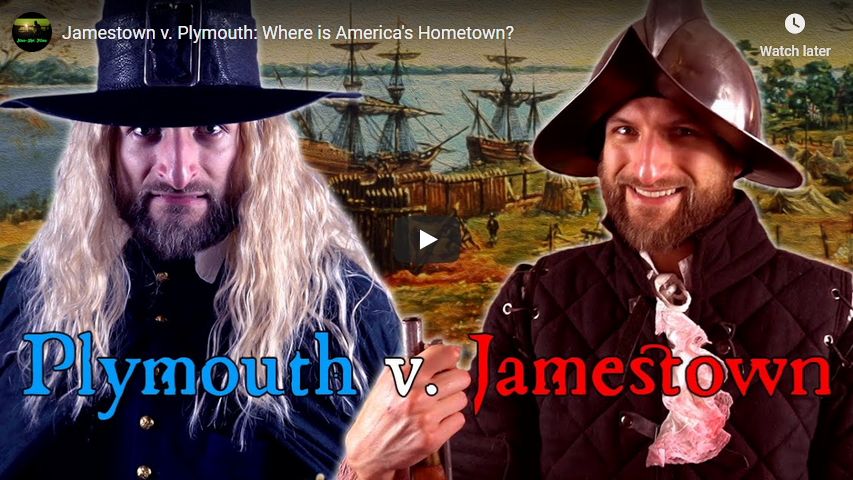
Jamestown v. Plymouth: Where is America’s Hometown?
Atun-Shei Films
Published 11 Feb 2020With the help of the Witchfinder General, I examine the historical mythology surrounding Jamestown and Plymouth, the first two permanent English colonies in the continental United States. Can we confidently point to the founding of these two settlements as the origin of American identity and culture? No, thou knave!
Support Atun-Shei Films on Patreon ► https://www.patreon.com/atunsheifilms
#Jamestown #Plymouth #AmericanHistory
Watch our film ALIEN, BABY! free with Prime ► http://a.co/d/3QjqOWv
Reddit ► https://www.reddit.com/r/atunsheifilms
Twitter ► https://twitter.com/alienbabymovie
Instagram ► https://www.instagram.com/atunsheifilms
Merch ► https://atun-sheifilms.bandcamp.com
August 16, 2020
Surviving the surrender of Japan as allied Prisoners of War
Seventy-five years ago, the war in the Pacific had ended with the surrender of Japanese imperial forces after the atomic bombing attacks at Hiroshima and Nagasaki. The war may have technically ended, but there was still plenty of danger for the surviving POWs in various camps around the Japanese home islands. George MacDonnell was a Canadian soldier who had been captured in the fall of Hong Kong early in the Japanese swathe of conquest that engulfed so many areas. He had been held as a slave labourer at a prison camp in the mountains of northern Honshu in Iwate Prefecture. In Quillette, he tells how his captivity came to an end:
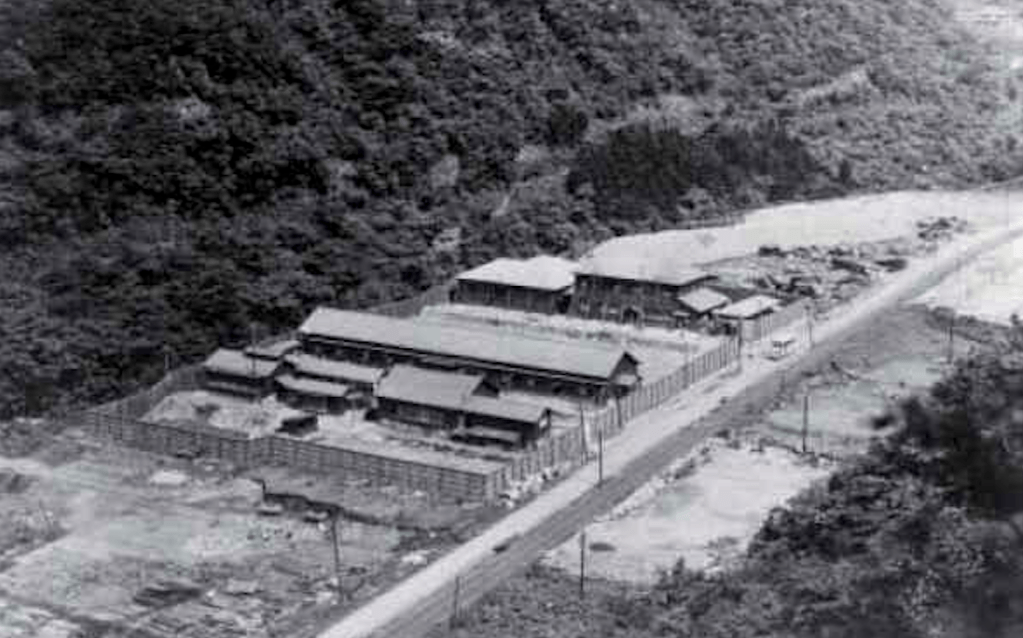
US Navy aerial photo of Ohashi prison camp in 1945.
It was noon on August 15th, 1945. The Japanese Emperor had just announced to his people that his country had surrendered unconditionally to the Allied Powers.
To those of us being held at Ohashi Prison Camp in the mountains of northern Japan, where we’d been prisoners of war performing forced labour at a local iron mine, this meant freedom. But freedom didn’t necessarily equate to safety. The camp’s 395 POWs, about half of them Canadians, were still under the effective control of Japanese troops. And so we began negotiating with them about what would happen next.
Complicating the negotiations was the Japanese military code of Bushido, which required an officer to die fighting or commit suicide (seppuku) rather than accept defeat. We also knew that the camp commander — First Lieutenant Yoshida Zenkichi — had written orders to kill his prisoners “by any means at his disposal” if their rescue seemed imminent. We also knew that we could all easily be deposited in a local mine shaft and then buried under thousands of tons of rock for all eternity without a trace.
We had no way of notifying Allied military commanders (who still hadn’t landed in Japan) as to the location of the camp (about a hundred miles north of Sendai, in a mountainous area near Honshu’s eastern coast), whose existence was then unknown. Because of the devastating American bombing, Japan’s cities had been reduced to rubble, its institutions were in chaos, and millions of Japanese were themselves close to starvation, much like us. The camp itself had food supplies, such as they were, for just three days.
Lieut. Zenkichi seemed angry, and felt humiliated by the surrender. Yet he appeared willing to negotiate our status. And after some stressful hours, we reached an agreement: The Japanese guards would be dismissed from the camp, while a detachment of Kenpeitai (the much feared Military Police) would provide security for Zenkichi, who would confine himself to his office.
To our delight, the local Japanese farmers were friendly, and agreed to give us food in exchange for some of the items we’d managed to loot from the camp’s remaining inventory — though, unfortunately, not enough to feed the camp. Meanwhile, through a secret radio we’d been operating, we learned that the Americans were going to conduct an aerial grid search of Japan’s islands for prison camps. We followed the broadcasted instructions and immediately painted “P.O.W.” in eight-foot-high white letters on the roof of the biggest hut.
Two days later, with all of our food gone, we heard a murmur from the direction of the ocean. The sound turned into the throb of a single-engine airplane flying at about 3,000 feet altitude. Then, suddenly he was above us — a little blue fighter with the white stars of the US Navy painted on its wings and fuselage. But the engine noise began to fade as he went right past us. Please, God, I thought — let him see our camp.
Churchill and Roosevelt vow to destroy all Nazis – WW2 – 103 – August 15, 1941
World War Two
Published 15 Aug 2020Winston Churchill and Franklin Roosevelt issue a charter that lays out their thoughts for the future, the Soviets are in trouble on two fronts, and Adolf Hitler repeats his orders to those who failed to heed them the first time.
Join us on Patreon: https://www.patreon.com/TimeGhostHistory
Or join The TimeGhost Army directly at: https://timeghost.tvFollow WW2 day by day on Instagram @World_war_two_realtime https://www.instagram.com/world_war_two_realtime
Between 2 Wars: https://www.youtube.com/playlist?list…
Source list: http://bit.ly/WW2sourcesWritten and Hosted by: Indy Neidell
Director: Astrid Deinhard
Producers: Astrid Deinhard and Spartacus Olsson
Executive Producers: Astrid Deinhard, Indy Neidell, Spartacus Olsson, Bodo Rittenauer
Creative Producer: Joram Appel
Post-Production Director: Wieke Kapteijns
Research by: Indy Neidell
Edited by: Iryna Dulka
Sound design: Marek Kamiński
Map animations: Eastory (https://www.youtube.com/c/eastory)Colorizations by:
– Daniel Weiss
– Julius Jääskeläinen – https://www.facebook.com/JJcolorization/
– Cassowary Colorizations – https://www.cassowarycolor.com/
– Norman Stewart – https://oldtimesincolor.blogspot.com/
– Denis Marinov from WikimediaSources:
– Bundesarchiv, CC-BY-SA 3.0: Bild_146-2005-0030, Bild_146-1971-070-61
– Imperial War Museum: E 1416, E 7014, E 3450E, E 7008, E 3438E, E 15023
– Narodowe Archiwum Cyfrowe
– Mil.ru
– egor7 from WikimediaArchive by Screenocean/Reuters https://www.screenocean.com.
A TimeGhost chronological documentary produced by OnLion Entertainment GmbH.
From the comments:
World War Two
3 days ago
Although the US has been steadily edging towards more and more support for the Western Allies since outbreak of war almost two years ago, it is this week that an active involvement in WW2 by the United States starts taking form. Let’s be clear though: both the US public, and the US administration are still staunchly opposed to sending in troops and becoming an active belligerent. But the tone of public and political discourse has begun to change, as it becomes increasingly obvious exactly how horrendous the threat is that humanity faces from Naziism.

August 14, 2020
“The End of the War to End All Wars” – The Great War – Sabaton History 080 [Official]
Sabaton History
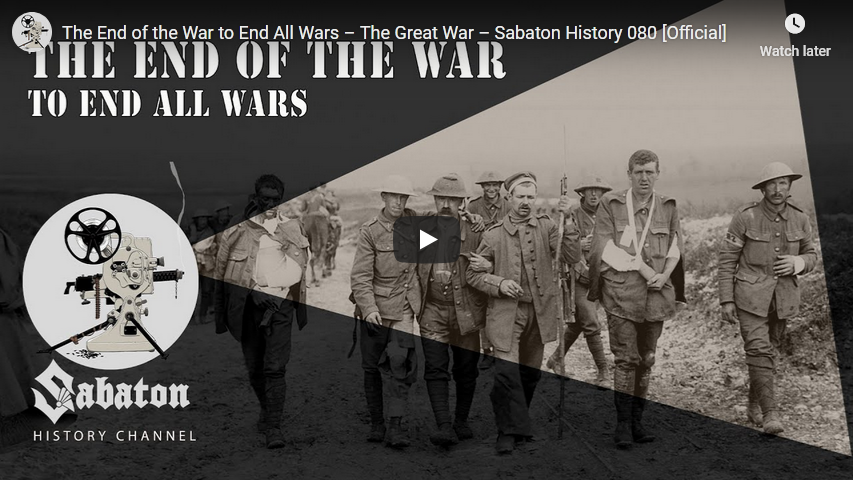
Published 13 Aug 2020November 11, 1918. The end of the Great War. A war that was also dubbed “the war to end all wars”. And many truly wished that the war’s countless horrors, which had caused the terrible deaths of millions of soldiers and civilians, and had left so many of its survivors crippled and scarred for the rest of their lives, would never repeat themselves. But could this truly be the war that ended the need for war? Was there a solution that promised everlasting peace? Could war even be outlawed? Or was mankind doomed to repeat itself?
Support Sabaton History on Patreon: https://www.patreon.com/sabatonhistory
Listen to The Great War (where “The End of the War to End All Wars” is featured): https://music.sabaton.net/TheGreatWar
Watch the Official Lyric Video of The End of the War to End All Wars here: https://www.youtube.com/watch?v=oXnnb…
Listen to Sabaton on Spotify: http://smarturl.it/SabatonSpotify
Official Sabaton Merchandise Shop: http://bit.ly/SabatonOfficialShopHosted by: Indy Neidell
Written by: Markus Linke and Indy Neidell
Directed by: Astrid Deinhard and Wieke Kapteijns
Produced by: Pär Sundström, Astrid Deinhard and Spartacus Olsson
Creative Producer: Joram Appel
Community Manager: Maria Kyhle
Executive Producers: Pär Sundström, Joakim Broden, Tomas Sunmo, Indy Neidell, Astrid Deinhard, and Spartacus Olsson
Post-Production Director: Wieke Kapteijns
Edited by: Karolina Dołęga
Sound Editing by: Marek Kaminski
Maps by: Eastory – https://www.youtube.com/c/eastory
Archive by: Reuters/Screenocean https://www.screenocean.com
Music by SabatonSources:
Icons from The Noun Project by: Vectors Point, Locad, Gan Khoon Lay, RF_Design & banjirolove
National Archives NARA
Library of Congress
Bundesarchiv
Bibliothèque nationale de France
Library of Scotland
Imperial War Museums:Q 43463, Q5733, HU 105641, Q 12363, HU 105641, Q 3117,Q 5733, Q 56637, IWM Q 10378, Q 3117,Q 86635, Q 23760, HU 110852, Q 7815, PST5277,
Archives of New Zealand
TRAJAN 117 from Wikimedia
Srg36 from Wikimedia
F l a n k e r from Wikimedia
Guilherme Paula from Wikimedia
Narodowe Archiwum CyfroweAn OnLion Entertainment GmbH and Raging Beaver Publishing AB co-Production.
From protests to riots to …
In the Claremount Review of Books, Angelo M. Codevilla looks at historical patterns that may prefigure what is going on in major urban areas today:
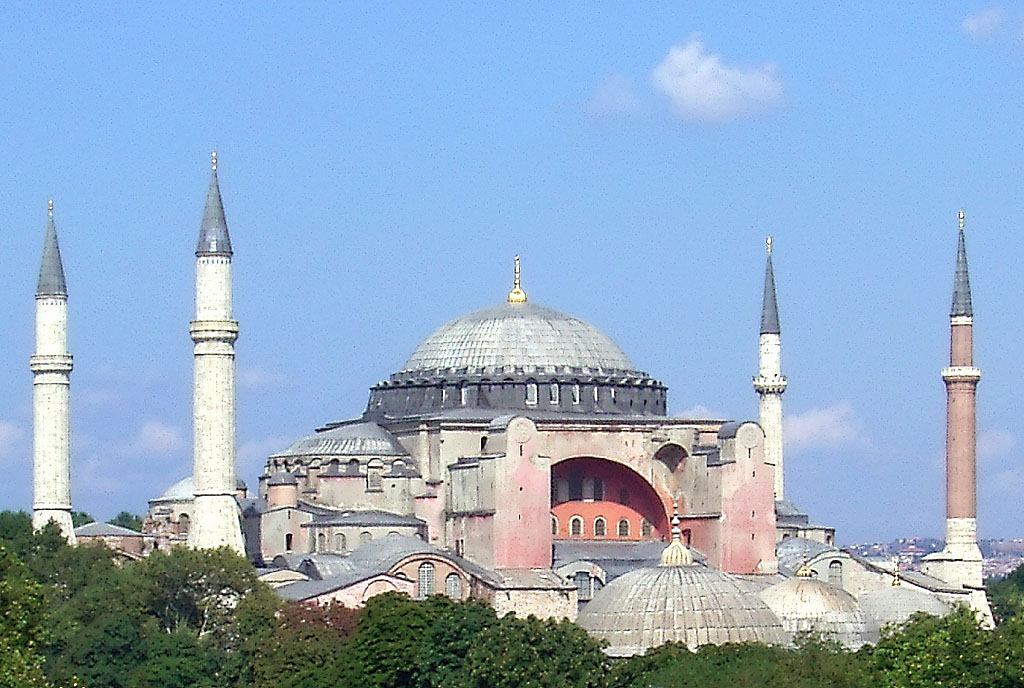
Hagia Sophia in the Faith district of Istanbul, 18 November 2004.
Photo by Robert Raderschatt via Wikimedia Commons.
The Americans who confess other people’s racism absolve themselves inexpensively by a moral mechanism common to humanity: the more I profess to hate evil, the more I showcase my own goodness. Such confessions, however, have a particular history of tragedy in Christian civilization. Again and again over the centuries, persons who have imagined themselves cleansed by ritual confessions have believed themselves elevated above the rest of humanity and, hence, entitled to oppress or even annihilate those around them. Today’s self-purifiers, arms outstretched in supine submission, who then countenance violence against persons, property, and cultural symbols, are mostly unwitting protagonists in yet another chapter of a hoary history.
Although Judeo-Christianity teaches that perfection is not of this world, nevertheless the Old Testament (see the Book of Daniel) and the New (Revelation, chapter 20) refer tangentially to a final state in human affairs in which all evil will have been defeated and the virtuous will have triumphed over their enemies. In the Book of Revelation, this final stage is to last for a thousand years. Jesus Christ’s warnings notwithstanding, people have hearkened periodically to “false prophets” who brandish the prospect of ultimate vengeance over evil. Between the 11th and 16th centuries, any number of movements of this sort used ritual confessions to cleanse themselves, and energized the mobs that waged Europe’s bloodiest wars of that age. Thereafter, though such movements secularized their terms, they fit into the same moral and intellectual categories. Now as ever, they are about destroying civilization in the name of altering the human condition.
But whereas revolutionary movements from the Middle Ages to roughly the middle of the 20th century opposed the ruling classes wholeheartedly and found no friends among them, this generation’s movements have intense, problematic relations with those classes, about which more below.
Today we see scenes of monuments which had stood for decades, now destroyed and defaced, as well as the forceful cancellation of names from circulation. Smashing others’ idols was, and remains, a staple of tribal warfare. The Old Testament recalls the divine command to destroy idols, and the clashes between Christian and Muslim armies always aimed as much at symbols as at people. The Song of Roland contains a lyrical account of Charlemagne’s iconoclasm in his campaign against the Saracens. In the 6th century, Emperor Justinian made Constantinople’s Hagia Sophia cathedral the Christian world’s biggest and most important church. The Muslims who added that city to the Ottoman Empire in 1453 killed its priests, toppled its statues, and made it into the principal mosque of the Muslim caliphate at war with Christendom. In 1923, Kemal Atatürk, Turkey’s modernizer, turned the building into a museum in order to end that war. But in July 2020 Turkey’s Islamist president Recep Erdogan, consistent with his hostility to Judeo-Christian civilization, turned it into a mosque again and began covering up what remain of the Christian frescoes on its walls. Destroying symbols, however, has had no place within Christian civilization. As the equivalent of torturing dead men, it has always been the work of cowards likelier to run from living enemies. On the other hand, war against statues, paintings, books, biographies, etc., has been a defining feature of civilization’s revolutionary enemies, consistent with their chosen identities as alien tribes.
What follows is a glance at the bloody history of this little-known flaw. It is a tale whose cautionary moral Aleksandr Solzhenitsyn best expressed: the line between good and evil runs not between persons — never mind between parties, classes, or races — but down the middle of every human heart. That is central to our civilization.
H/T to David Warren for the link.
August 12, 2020
CGP Grey was WRONG
CGP Grey
Published 11 Aug 2020‣ What Was TEKOI? (original version): https://www.youtube.com/watch?v=PCeMC…
‣ What Was TEKOI? (corrected version): https://www.youtube.com/watch?v=PCeMCwxayp0
‣ TEKOI Commentary: https://www.youtube.com/watch?v=ufsYK…
## CrowdfundersBob Kunz, John Buchan, Nevin Spoljaric, Donal Botkin, BN-12, Chris Chapin, Richard Jenkins, Phil Gardner, Martin, Steven Grimm, سليمان العقل, David F Watson, Colin Millions, Saki Comandao, Ben Schwab, Jason Lewandowski, Marco Arment, Shantanu Raj, rictic, emptymachine, George Lin, Henry Ng, Thunda Plum, Awoo, David Tyler, Fuesu, iulus, Jordan Earls, Joshua Jamison, Nick Fish, Nick Gibson, Tyler Bryant, Zach Whittle, Oliver Steele, Kermit Norlund, Kevin Costello, Derek Bonner, Derek Jackson, Mikko , Orbit_Junkie, Ron Bowes, Tómas Árni Jónasson, Bryan McLemore, Alex Simonides, Felix Weis, Melvin Sowah, Christopher Mutchler, Giulio Bontadini, Paul Alom, Ryan Tripicchio, Scot Melville, Bear, chrysilis, David Palomares, Emil, Erik Parasiuk, Esteban Santana Santana, Freddi Hørlyck, John Rogers, Leon, Peter Lomax, Rhys Parry, ShiroiYami, Tristan Watts-Willis, Veronica Peshterianu, Dag Viggo Lokøen, John Lee, Maxime Zielony, Julien Dubois, Elizabeth Keathley, Nicholas Welna
## Music
David Rees: http://www.davidreesmusic.com
QotD: The circle of recycled life
2. As soon as they are completed millions of these colorful and compelling 100% recyclable advertising supplements are shipped by truck to the various regional receiving centers of the U.S. Post Office.
3. From those centers, any number of allocated pallets of these colorful and compelling 100% recyclable advertising supplements are broken out, put on U.S. Post Office trucks and delivered to local postal carrier destinations inside northern California.
4. My personal Paradise postal carrier and hundreds of others report for work at local postal carrier centers throughout northern California and load up their vans with enough of these colorful and compelling 100% recyclable advertising supplements to deliver one or more to each and every house on their route.
5. My very polite personal Paradise postal carrier parks her van at the end of my block and loads her sack with these colorful and compelling 100% recyclable advertising supplements.
6. She comes up my walk, up the porch stairs, and deposits my full share of these colorful and compelling 100% recyclable advertising supplements into my mailbox with a clang every day between one and three in the afternoon.
7. Hearing the clang I sigh and wend my weary way to the front door and open my mailbox and pluck out said colorful and compelling 100% recyclable advertising supplements.
8. With a heavier sigh I go back in, trudge through my house, out my back door to the alley, and place the colorful and compelling 100% recyclable advertising supplements into my Recycling bin with the rest of the week’s mound.
9. Tomorrow the huge, lumbering Paradise Waste Management Recycling garbage truck will stop and empty my Recycling bin into its maw and haul all the colorful and compelling 100% recyclable advertising supplements off to the Chico California Recycling and Brand New Mountain of Garbage center.
10. The collected colorful and compelling 100% recyclable advertising supplements will then be shipped, by truck, to the center for turning recyclable paper into … recycled paper which will then be used by a concerned and responsible corporation for their twice-weekly colorful and compelling advertising supplements printed on 100% recycled paper.
Wash. Rinse. Repeat. Next year, as sure as spring brings septic system failures to Paradise, postage will increase because the U.S. Postal Colorful and compelling 100% recyclable advertising supplements “Service” will need more money to keep The Recycled Circle of life going.
Gerard VanderLeun, “The Circle of Recycled Life”, American Digest, 2018-06-01.
August 11, 2020
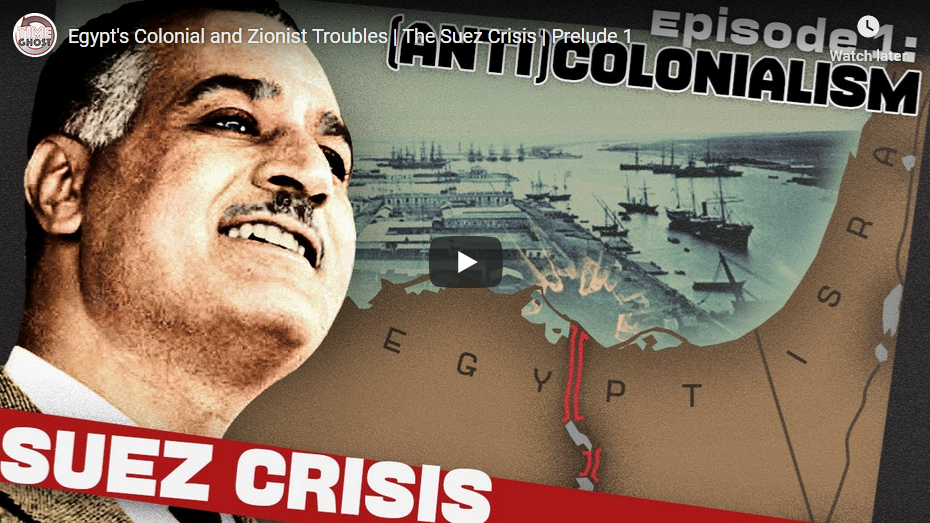
Egypt’s Colonial and Zionist Troubles | The Suez Crisis | Prelude 1
TimeGhost History
Published 10 Aug 2020Recently independent Egypt, under President Gamal Abdel Nasser, navigates the turbulent waters of the Cold War, seeking national autonomy, while negotiating its relations with the British Empire, United States, and the Soviet Union. The question is, how will Egypt realize its self-determination with these powers vying for dominance in the region?
Join us on Patreon: https://www.patreon.com/TimeGhostHistory
Hosted by: Indy Neidell
Written by: Joram Appel and Francis van Berkel
Director: Astrid Deinhard
Producers: Astrid Deinhard and Spartacus Olsson
Executive Producers: Astrid Deinhard, Indy Neidell, Spartacus Olsson, Bodo Rittenauer
Creative Producer: Joram Appel
Post-Production Director: Wieke Kapteijns
Research by: Joram Appel
Image Research: Ian Irungu, Shaun Harrison & Karolina Dołęga
Edited by: Karolina Dołęga
Sound design: Marek KamińskiColorizations:
Mikolaj UchmanVisual Sources:
National Archives NARA
Library of Congress Geography and Maps Department
Tropenmuseum
Wellcome Images
National Army Museum of New Zealand
Imperial War Museum: HU70788,
National Photo Collection of Israel
Fortepan – ID 32790
Bibliotheca AlexandrinaMusic:
“Descending Mount Everest” – Trailer Worx
“Dreamless Nights” – The New Fools
“March Of The Brave 10” – Rannar Sillard
“Break Free” – Fabien Tell
“The Unexplored” – Philip Ayers
“It’s Not a Game” – Philip Ayers
“Foreign Signs” – Philip AyersArchive by Screenocean/Reuters https://www.screenocean.com.
A TimeGhost chronological documentary produced by OnLion Entertainment GmbH.
From the comments:
TimeGhost History
1 hour ago (edited)
Welcome to the first episode of our series on the Suez Crisis! It’s a 7-episode wild ride through secretive international collusion, clashing nations, and imperial anxieties. It’s a watershed moment in a variety of entangled histories: decolonization, the Arab-Israel Conflict, the rise of America as a superpower, the growing power of the UN, and much much more. It’s a lot to take in, but we hope that we’ve made this series as digestible (and enjoyable!) as possible. Thanks to our TimeGhost Army members for choosing this series. Want to be part of the effort that makes stuff like this happen? Join us at patreon.com/timeghosthistory or https://timeghost.tv.Cheers,
Francis.