
One of the things I keep trying to explain to my “woke” colleagues, when they stand tall and righteous and put their shoulders back and say that Heinlein was racisthomophobicsexist or that great authors of the past should have been better than to follow the prejudices of their time, is that when you’re immersed in your time, you don’t see the prejudices and the blind spots.
I have a little more insight into how culture shapes what’s possible to think, because I changed my culture as an adult. While this can be done (obviously) and immigrants should be encouraged to do it, (or go home), the acculturation is never complete. What happens is that you acquire a sort of cultural double vision. Depending on how far your acculturation goes, you’ll see the defects in thought or at least the unquestioned assumptions in one of the countries better, but also have a strong feeling of being outside enough to see some flaws in your dominant culture. In my case, for instance, I see the flaws in Portugal very clearly, like the obsession with speed over diligence or being decisive over being right, but I still see some in the US which is why sometimes I say “what people born and raised here don’t see.”
I have, of course, even more insight, due to being a conservative in the US, in a culture and profession (the arts/publishing) that is not only majority left, but majority extreme left. For many years, the only way to stay at least plausibly under cover was to see what they were seeing, and what they expected.
But without that, most people are blind to the … ah, unconscious or unthinking parts of their culture. Heck, even with what I’ve been through, I still tend to accept a lot of things unconsciously, unless I step back and go “Now wait a minute.”
Sarah Hoyt, “Slouching Into Shackles”, According to Hoyt, 2018-04-27.
August 11, 2020
QotD: Our culture shapes what we can see
August 10, 2020
Donald MacLean: The First of the Cambridge Five
The Cold War
Published 22 Jun 2020Our historical documentary series on the history of the Cold War continues with a video on the famous Cambridge Five and Donald Maclean in particular — a real Cold War-era spy story
Support us on Patreon: https://www.patreon.com/thecoldwar or Paypal: http://paypal.me/TheColdWar
✔ Merch store ► https://teespring.com/stores/thecoldwar
✔ Instagram ► http://www.instagram.com/thecoldwartv#ColdWar #Maclean #CambridgeFive

FDR’s “New Deal” and the Great Depression
The Great Depression began with the collapse of the stock market in 1929 and was made worse by the frantic attempts of President Hoover to fix the problem. Despite the commonly asserted gibe that Hoover tried laissez faire methods to address the economic crisis, he was a dyed-in-the-wool progressive and a life-long control freak (the Smoot-Hawley Tariff Act which devasted world trade was passed in 1930). Franklin D. Roosevelt won the 1932 election by promising to undo Hoover’s economic interventions, yet once in office he turned out to be even more of a control freak than Hoover. His economic and political plans made Hoover’s efforts seem merely a pale shadow.
For newcomers to this issue, “New Deal” is the term used to describe the various policies to expand the size and scope of the federal government adopted by President Franklin Delano Roosevelt (a.k.a., FDR) during the 1930s.
And I’ve previously cited many experts to show that his policies undermined prosperity. Indeed, one of my main complaints is that he doubled down on many of the bad policies adopted by his predecessor, Herbert Hoover.
Let’s revisit the issue today by seeing what some other scholars have written about the New Deal. Let’s start with some analysis from Robert Higgs, a highly regarded economic historian.
… as many observers claimed at the time, the New Deal did prolong the depression. … FDR and Congress, especially during the congressional sessions of 1933 and 1935, embraced interventionist policies on a wide front. With its bewildering, incoherent mass of new expenditures, taxes, subsidies, regulations, and direct government participation in productive activities, the New Deal created so much confusion, fear, uncertainty, and hostility among businessmen and investors that private investment, and hence overall private economic activity, never recovered enough to restore the high levels of production and employment enjoyed in the 1920s. … the American economy between 1930 and 1940 failed to add anything to its capital stock: net private investment for that eleven-year period totaled minus $3.1 billion. Without capital accumulation, no economy can grow. … If demagoguery were a powerful means of creating prosperity, then FDR might have lifted the country out of the depression in short order. But in 1939, ten years after its onset and six years after the commencement of the New Deal, 9.5 million persons, or 17.2 percent of the labor force, remained officially unemployed.
Writing for the American Institute for Economic Research, Professor Vincent Geloso also finds that FDR’s New Deal hurt rather than helped.
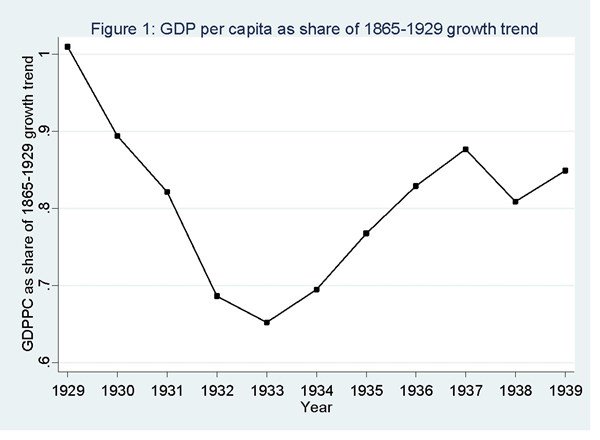
… let us state clearly what is at stake: did the New Deal halt the slump or did it prolong the Great Depression? … The issue that macroeconomists tend to consider is whether the rebound was fast enough to return to the trendline. … The … figure below shows the observed GDP per capita between 1929 and 1939 expressed as the ratio of what GDP per capita would have been like had it continued at the trend of growth between 1865 and 1929. On that graph, a ratio of 1 implies that actual GDP is equal to what the trend line predicts. … As can be seen, by 1939, the United States was nowhere near the trendline. … Most of the economic historians who have written on the topic agree that the recovery was weak by all standards and paled in comparison with what was observed elsewhere. … there is also a wide level of agreement that other policies lengthened the depression. The one to receive the most flak from economic historians is the National Industrial Recovery Act (NIRA). … In essence, it constituted a piece of legislation that encouraged cartelization. By definition, this would reduce output and increase prices. As such, it is often accused of having delayed recovery. … other sets of policies (such as the Agricultural Adjustment Act, the National Labor Relations Act and the National Industrial Recovery Act) … were very probably counterproductive.
Here’s one of the charts from his article, which shows that the economy never recovered lost output during the 1930s.
August 8, 2020
Andrew Sullivan – “[T]he Kendi test: does the staff reflect the demographics of New York City as a whole?”
In his latest Weekly Dish, Andrew Sullivan looks at an earnest diversity initiative of The Newspaper Guild of New York:
I’m naming this after Ibram X. Kendi because his core contribution to the current debate on race is the notion that “any measure that produces or sustains racial inequity between racial groups” is racist. Intent is irrelevant. I don’t think many sane people believe A.G. Sulzberger or Dean Baquet are closet bigots. But systemic racism, according to Kendi, exists in any institution if there is simply any outcome that isn’t directly reflective of the relevant racial demographics of the surrounding area.
The appeal of this argument is its simplicity. You can tell if a place is enabling systemic racism merely by counting the people of color in it; and you can tell if a place isn’t by the same rubric. The drawback, of course, is that the world isn’t nearly as simple. Take the actual demographics of New York City. On some measures, the NYT is already a mirror of NYC. Its staff is basically 50 – 50 on sex (with women a slight majority of all staff on the business side, and slight minority in editorial). And it’s 15 percent Asian on the business side, 10 percent in editorial, compared with 13.9 percent of NYC’s population.
But its black percentage of staff — 10 percent in business, 9 percent in editorial — needs more than doubling to reflect demographics. Its Hispanic/Latino staff amount to only 8 percent in business and 5 percent in editorial, compared with 29 percent of New York City’s demographics, the worst discrepancy for any group. NYT’s Newsroom Fellowship, bringing in the very next generation, is 80 percent female, 60 percent people of color (including Asians), and, so far as I can tell, one lone white man. And it’s why NYT‘s new hires are 43 percent people of color, a definition that includes Asian-Americans.
But notice how this new goal obviously doesn’t reflect New York City’s demographics in many other ways. It draws overwhelmingly from the college educated, who account for only 37 percent of New Yorkers, leaving more than 60 percent of the city completed unreflected in the staffing. It cannot include the nearly 19 percent of New Yorkers in poverty, because a NYT salary would end that. It would also have to restrict itself to the literate, and, according to Literacy New York, 25 percent of people in Manhattan “lack basic prose literary skills” along with 37 percent in Brooklyn and 41 percent in the Bronx. And obviously, it cannot reflect the 14 percent of New Yorkers who are of retirement age, or the 21 percent who have yet to reach 18. For that matter, I have no idea what the median age of a NYT employee is — but I bet it isn’t the same as all of New York City.
Around 10 percent of staffers would have to be Republicans (and if the paper of record nationally were to reflect the country as a whole, and not just NYC, around 40 percent would have to be). Some 6 percent of the newsroom would also have to be Haredi or Orthodox Jews — a community you rarely hear about in diversity debates, but one horribly hit by a hate crime surge. 48 percent of NYT employees would have to agree that religion is “very important” in their lives; and 33 percent would be Catholic. And the logic of these demographic quotas is that if a group begins to exceed its quota — say Jews, 13 percent — a Jewish journalist would have to retire for any new one to be hired. Taking this proposal seriously, then, really does require explicit use of race in hiring, which is illegal, which is why the News Guild tweet and memo might end up causing some trouble if the policy is enforced.
And all this leaves the category of “white” completely without nuance. We have no idea whether “white” people are Irish or Italian or Russian or Polish or Canadians in origin. Similarly, we do not know if “black” means African immigrants, or native black New Yorkers, or people from the Caribbean. 37 percent of New Yorkers are foreign-born. How does the Guild propose to mirror that? Ditto where staffers live in NYC. How many are from Staten Island, for example, or the Bronx, two places of extremely different ethnic populations? These categories, in other words, are incredibly crude if the goal really is to reflect the actual demographics of New York City. But it isn’t, of course.
My point is that any attempt to make a specific institution entirely representative of the demographics of its location will founder on the sheer complexity of America’s demographic story and the nature of the institution itself. Journalism, for example, is not a profession sought by most people; it’s self-selecting for curious, trouble-making, querulous assholes who enjoy engaging with others and tracking down the truth (at least it used to be). There’s no reason this skillset or attitude will be spread evenly across populations. It seems, for example, that disproportionate numbers of Jews are drawn to it, from a culture of high literacy, intellectualism, and social activism. So why on earth shouldn’t they be over-represented?
And that’s true of other institutions too: are we to police Broadway to make sure that gays constitute only 4 percent of the employees? Or, say, nursing, to ensure that the sex balance is 50-50? Or a construction company for gender parity? Or a bike messenger company’s staff to be reflective of the age demographics of the city? Just take publishing — an industry not far off what the New York Times does. 74 percent of its employees are women. Should there be a hiring freeze until the men catch up?
The Cold War & Decolonization — History Summarized
Overly Sarcastic Productions
Published 7 Aug 2020Keep safe and stylish with a Red-And-Blue facemask from Volante Design, or DONATE to help students in public schools receive high-quality masks for free — https://bit.ly/2DwE9O7
August of 2020 marks the 75th anniversary of the end of the Second World War. So I wanted to make a video about that. That was a bad idea…
What do you get when a Classically-Minded historian ventures about 2,000 years outside of their comfort zone? A mess. A well-intentioned mess is what you get. BUT a mess that we can learn from! So join me as we dig into the aftermath of the Second World War to analyze the origins of the Cold War and the decolonization of European Empires.
SOURCES & Further Reading: The Cold War by Gaddis, The Wars of French Decolonization by Clayton, British decolonization, 1946-1997 by McIntyre, The Cold War’s Killing Fields by Chamberlin, The Cold War: A Very Short Introduction by McMahon, and “Crash Course European History [Parts 42-47]” by Green.
This video was edited by Sophia Ricciardi AKA “Indigo”. https://www.sophiakricci.com/
Our content is intended for teenage audiences and up.DISCORD: https://discord.gg/kguuvvq
PATREON: https://www.Patreon.com/OSP
MERCH LINKS: https://www.redbubble.com/people/OSPY…
OUR WEBSITE: https://www.OverlySarcasticProductions.com
Find us on Twitter https://www.Twitter.com/OSPYouTube
Find us on Reddit https://www.Reddit.com/r/OSP/
From the comments:
Overly Sarcastic Productions
1 hour ago (edited)
Some clarifications:
North Africa did of course see conflict, the Pacific did get occupied — even the places that didn’t (eg: India) still paid for the war. Damn double-negatives.That weird Romania-Hungary-Russia border is a holdover from WWII. The border lasted until 1946 and was changed in 1947. Later in the video you’ll see the more familiar borders.
Indonesia declared Independence in 1945 (Like Vietnam), but the Netherlands didn’t withdraw until 1949, hence my mention of ’49.

“The show exploits the most extreme disaster LARPers, but their visions of the apocalypse are typical”
Jen Gerson does a bit of disaster-watching, or rather not so much watching disasters as watching people prepping for disasters:

If you spend a few hours devoted to consuming episodes of the reality TV show Doomsday Preppers, it becomes impossible to avoid this obvious conclusion: doomsday preppers are probably the least prepared of any of us to survive the apocalypse.
Take Season 2, Episode 14, for example, in which a 44-year-old man in Hawaii believes that he will use his intuition and limited backcountry skills to survive a tsunami — his first such intuition is to get into a boat.
More typically, the television show documents Middle American families who believe they can buy their way out of society’s collapse by burying bunkers and stockpiling food, weapons and tactical gear.
Most of them seem paranoid. A few come off as genuinely disturbed. All of them seem sad.
Ask them what they’re so afraid of and they will list their apocalypse of choice: electromagnetic pulse, financial collapse, famine, drought, coup, a population-devastating plague.
The show exploits the most extreme disaster LARPers, but their visions of the apocalypse are typical. We were all prepared for zombies, and aliens — the surround-sound end-of-the world in which we would take up arms against invading forces and ferry our children to the bug-out Eden in the mountains.
Nobody pictured the apocalypse would like this; stuck at home for months at a time, pounding Oreos and beer at 11 a.m. and watching Doomsday Preppers on Netflix while faking a work day on the couch. For most, heroism has been an act of idleness.
August 6, 2020
Fallen flag — The Lehigh and Hudson River Railway
 This month’s Classic Trains featured fallen flag is a northeastern railway I didn’t know much about, the Lehigh and Hudson River. If you asked me to complete the phrase “Lehigh and …”, I’d most likely have said “New England”, which was a larger operation but is perhaps only remembered now as the second major American railway to file for abandonment after the New York, Ontario & Western. The L&HR earned its keep primarily as a bridge line, with additional revenues from online anthracite coal mines. From the original founding in 1881, it operated until it was incorporated into Conrail in 1976.
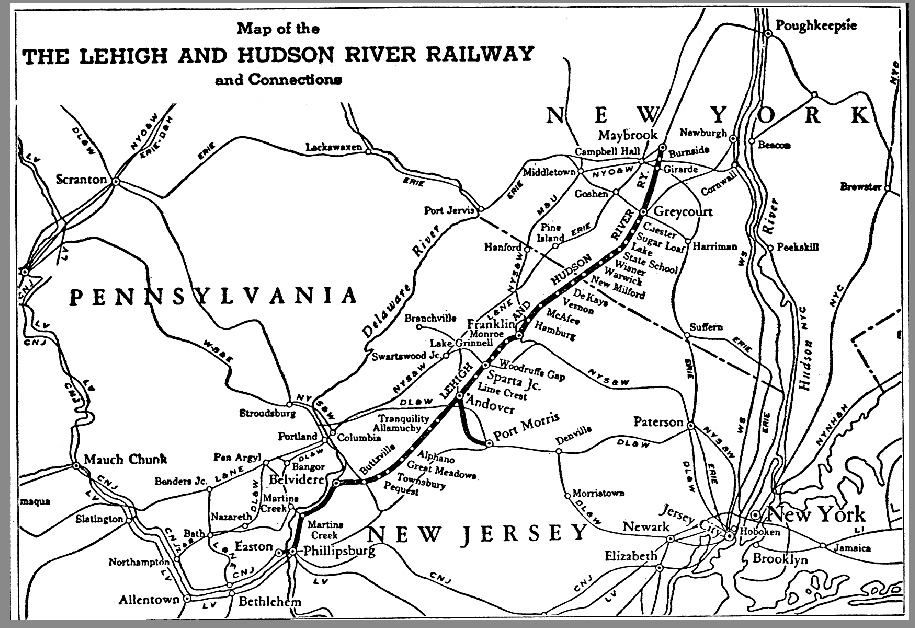
L&HR’s origins date to 1860, when arrival of the New York & Erie Railroad, at Greycourt, New York, 10 miles north of Warwick, prompted construction of the Warwick Valley Railroad under the leadership of Grinnell Burt. The Warwick Valley operated as a 6-foot-gauge feeder to the same-gauge NY&E, using the big road’s equipment for two decades. Around 1880, WV assumed its own operations, was standard-gauged, and built the 11-mile Wawayanda Railroad, which tapped agricultural and mineral sources at McAfee, New Jersey. Further extension southward soon followed.
Two projected competitive lines were combined as the Lehigh & Hudson River Railroad, extending from a Pennsylvania Railroad connection at Belvidere, New Jersey, on the Delaware River, to Hamburg, New Jersey, where three miles of isolated Sussex Railroad track linked it to the Warwick Valley. In 1882 the extensions were folded into the 61-mile Lehigh & Hudson River Railway.
In addition to the New York & Erie’s mainline business at Greycourt, its Newburgh Branch provided access to Hudson River carferries crossing to the New York & New England’s Fishkill Landing. Anthracite coal, particularly from mines of affiliate Lehigh Coal & Navigation, was a major eastbound commodity. Anticipating completion of the Poughkeepsie Bridge a few miles upstream, the Orange County Railroad built north of Greycourt to connect with the New York, Ontario & Western at Burnside in 1890. Via trackage rights, this provided a first connection with the Central New England & Western at Campbell Hall, New York. Within a year, the Orange County was extended from Burnside to CNE’s new Maybrook yard.
Simultaneously, trackage rights were obtained from the Pennsy over 13 miles of its Belvidere-Delaware Division (“Bel-Del”) to Phillipsburg, New Jersey. There, disconnected subsidiaries undertook bridging the Delaware to access Easton, Pennsylvania, and the Jersey Central and Lehigh Valley. The bridge also opened in 1890, creating a three-state route of about 85 miles. The L&HR thus fulfilled the prescient vision of the line’s 1861 directors, who reported, “It was well understood by those … promoting the construction of the Warwick Valley Railroad, that in all probability it would be but a link in a great chain destined to be one of the most important thoroughfares, and to effect an important influence upon the commerce and manufacturers of an extensive section of our country …” Additional links soon extended the chain of this “important thoroughfare.”

The Lehigh and Hudson River Railway bridge over the Delaware River between Easton, Pennsylvania and Phillipsburg, New Jersey. Easton, the Lehigh River Dam feeding the Delaware Canal, and the Northampton Street Bridge are in the background.
Photo by Zeete via Wikimedia Commons.
QotD: Selling booze to the immature
I am, by the way, fully aware of how innovation works — that most of civilization has occurred because someone, somewhere said: “Y’know, I bet if we just changed …” — but that’s confusing improvement with extension. Tinned fruity-flavored gin is not an improvement.
I know that raspberry-flavored beer may have caused more people to take to beer drinking, but that’s changed things, and not for the better. Go into any bar and look at what beers are on tap these days. Barely a drinkable one available, and worse, they’ve pushed all the decent beers into bottles (or out of stock) while hipsters and chickies are catered to with the latest fad, Strawberry IPA [pause to be sick].
Basically, booze manufacturers are changing their products to appeal to people who don’t like booze. In the old days of marketing, we used to call that pointless endeavor “catching eels” (try catching an eel in mid-air when someone tosses it in your direction and you’ll see what I’m talking about). Not only is it pointless, it’s mercurial because what’s popular today won’t be popular tomorrow as your fickle new customers chase after the next “Flavor Of The Month”, and you’ll have gone from catching one eel to catching multiple eels. That’s something they don’t teach in the Marketing section of the typical MBA course because MBAs are all about theory (“line extension”, “product enhancement”, etc.). And don’t tell me I’m talking nonsense because I’ve seen the curricula.
Kim du Toit, “Gilding the Lily #268”, Splendid Isolation, 2018-05-24.
August 3, 2020
Recycling is a SCAM!
J.J. McCullough
Published 29 Jun 2019Recycling is a disaster. This video was sponsored by Loonie Politics! Sign up using the code word “McCullough” for 25% off! https://looniepolitics.com/register/
Visit the channel of guest star Demetrios: https://www.youtube.com/channel/UCNKV…
An in-depth look at Canadian recycling:
https://globalnews.ca/news/5199883/ca…The Vice video I mentioned:
https://www.youtube.com/watch?v=Pv1UP…FOLLOW ME:
🇨🇦Support me on Patreon! https://www.patreon.com/jjmccullough
🤖Join my Discord! https://discord.gg/3X64ww7
🇺🇸Follow me on Instagram! https://www.instagram.com/jjmccullough/
🇨🇦Read my latest Washington Post columns: https://www.washingtonpost.com/people…
🇨🇦Visit my Canada Website http://thecanadaguide.com

QotD: History or “Her” story?
In my last year in college, I had American Literature taught by a Fullbright exchange professor. I will never forget the moment the poor man — talking to a class of 36, all women as such classes often are — let slip the innocent word “him” to mean an indeterminate gender. He paused, went white, his eyes widened, and he said, “I mean, I mean, he or she.”
Meanwhile, the class of 36 was staring at him in puzzlement. It took us a while to take it all apart and realize he thought we’d be offended by the use of “he” to mean someone generic, of indeterminate gender.
I think we patted him kindly on the shoulder and told him that no, really, we weren’t offended. The usage was the same in Portuguese and we’d been told it was the same in most Indo-European languages. And who on Earth would get offended over semantics? The language was the language. It meant nothing about us personally.
This was of course before I married, came to the U.S. and found that for the American woman circa 1985, the language was not just personal, it was personally offensive.
I remember standing in horror underneath a bookstore section proudly labeled Herstory.
Of course the etymology of the word history is not his + story, the sort of pseudo-clever deduction about language that I was used to from the near-illiterate elderly people in the village. (It would be too complex and involve Portuguese, but there was this old farmer who had somehow deduced from the Portuguese word for farmer that farmers were the only ones who would be saved at the end of time.)
History, of course, is not originally an English word. It comes from the Latin historia — meaning a relation of events — by way of the French estoire, meaning story. Note please that in neither of those languages does “his” mean “belonging to him.” And that making the same sort of illiterate assumptions about the French word, we’d get “It is oire.”
I thought that the store must have hired an illiterate employee, but no, over the next ten years, in various circumstances, and possibly still except for the fact that I’ve learned to silence such fools with a death glare, I’ve come across the same smug-idiot assumption and “corrections” of the English word, so as to “fight against the patriarchy.”
That this is done by people who paid more money than I make in a couple of years for a college degree, and who, doubtlessly, think that etymology is a dish made with onions, or perhaps a conspiracy of the patriarchy fills me with a sort of dull rage that has no outlet.
Sarah Hoyt, “The Semantic Whoredom of the Left”, PJ Media, 2018-05-11.
August 2, 2020
Words are verbal tools, but tools can be weaponized
In this week’s newsletter, Andrew Sullivan analyzes the roots of wokeness:
In the mid-2010s, a curious new vocabulary began to unspool itself in our media. A data site, storywrangling.org, which measures the frequency of words in news stories, revealed some remarkable shifts. Terms that had previously been almost entirely obscure suddenly became ubiquitous — and an analysis of the New York Times, using these tools, is a useful example. Looking at stories from 1970 to 2018, several terms came out of nowhere in the past few years to reach sudden new heights of repetition and frequency. Here’s a list of the most successful neologisms: non-binary, toxic masculinity, white supremacy, traumatizing, queer, transphobia, whiteness, mansplaining. And here are a few that were rising in frequency in the last decade but only took off in the last few years: triggering, hurtful, gender, stereotypes.
Language changes, and we shouldn’t worry about that. Maybe some of these terms will stick around. But the linguistic changes have occurred so rapidly, and touched so many topics, that it has all the appearance of a top-down re-ordering of language, rather than a slow, organic evolution from below. While the New York Times once had a reputation for being a bit stodgy on linguistic matters, pedantic, precise and slow-to-change, as any paper of record might be, in the last few years, its pages have been flushed with so many neologisms that a reader from, say, a decade ago would have a hard time understanding large swathes of it. And for many of us regular readers, we’ve just gotten used to brand new words popping up suddenly to re-describe something we thought we knew already. We notice a new word, make a brief mental check, and move on with our lives.
But we need to do more than that. We need to understand that all these words have one thing in common: they are products of an esoteric, academic discipline called critical theory, which has gained extraordinary popularity in elite education in the past few decades, and appears to have reached a cultural tipping point in the middle of the 2010s. Most normal people have never heard of this theory — or rather an interlocking web of theories — that is nonetheless changing the very words we speak and write and the very rationale of the institutions integral to liberal democracy.
What we have long needed is an intelligible, intelligent description of this theory which most people can grasp. And we’ve just gotten one: Cynical Theories: How Activist Scholarship Made Everything About Race, Gender and Identity, by former math prof James Lindsay and British academic, Helen Pluckrose. It’s as deep a dive into this often impenetrable philosophy as anyone would want to attempt. But it’s well worth grappling with.
What the book helps the layperson to understand is the evolution of postmodern thought since the 1960s until it became the doctrine of Social Justice today. Beginning as a critique of all grand theories of meaning — from Christianity to Marxism — postmodernism is a project to subvert the intellectual foundations of western culture. The entire concept of reason — whether the Enlightenment version or even the ancient Socratic understanding — is a myth designed to serve the interests of those in power, and therefore deserves to be undermined and “problematized” reason whenever possible. Postmodern theory does so mischievously and irreverently — even as it leaves nothing in reason’s place. The idea of objective truth — even if it is viewed as always somewhat beyond our reach — is abandoned. All we have are narratives, stories, whose meaning is entirely provisional, and can in turn be subverted or problematized.
During the 1980s and 1990s, this somewhat aimless critique of everything hardened into a plan for action. Analyzing how truth was a mere function of power, and then seeing that power used against distinct and oppressed identity groups, led to an understandable desire to do something about it, and to turn this critique into a form of activism. Lindsay and Pluckrose call this “applied postmodernism”, which, in turn, hardened into what we now know as Social Justice.
August 1, 2020
Secret Briefing: The Pedersen Device
Forgotten Weapons
Published 8 Aug 2016http://www.patreon.com/ForgottenWeapons
Welcome to your briefing on the new equipment we are issuing for the Spring Offensive of 1919. With this new secret weapon, we can finally push the Germans out of France and end the war!

July 31, 2020
Xi Jinping and the “Chinese dream”
Zineb Riboua outlines possible ways for the West to counter ongoing Chinese economic espionage:

President Donald Trump and PRC President Xi Jinping at the G20 Japan Summit in Osaka, 29 June, 2019.
Cropped from an official White House photo by Shealah Craighead via Wikimedia Commons.
Since 2012, Chinese President Xi Jinping’s favourite catchphrase has been “the Chinese dream”. In stark contrast to the evil, capitalistic American dream, Xi’s alternative vision of progress teaches that the only route to prosperity is through rigid adherence to collectivist ideology.
The Chinese state embodies a very particular ideology. Over the last few decades, it has aggressively ramped up its economic and political capital through business and enterprise, inextricably tying itself to the economic fortunes of both developed and developing countries. It is now seeking to use the economic capital it has accumulated to force its political agenda into reality.
That is why the role of private companies in China is unparalleled. Milton Friedman defined corporate social responsibility in terms of private companies’ sole duty to make a profit, and then increase that profit. Chinese companies appear to be exempt from this rule because they interact with the state in a unique and troubling way.
The current state of the Chinese political and economic landscape is no accident. When Deng Xiaoping spoke in the 1980s of building a “socialism with Chinese characteristics”, this is probably exactly what he had in mind. The Chinese Communist party has succeeded in weaponising local market forces in such a way that it now holds all the cards in its nation’s dealings with the outside world, both political and economic, because the line between the public and the private is non-existent.
This strategy has not gone unnoticed. Thanks to the Chinese Communist party’s recent conduct – unprecedented aggression in Hong Kong, the appalling genocide of the Uyghur people and a costly unwillingness to share information relating to the coronavirus outbreak – the state of its internal affairs has come into sharp focus on the international stage.
Unsurprisingly, the hawkish US has placed itself at the forefront of counter-Chinese rhetoric. Secretary of state Mike Pompeo said recently: “We gave the Chinese Communist party and the regime itself special economic treatment, only to see the CCP insist on silence over its human rights abuses as the price of admission for Western companies entering China.”
QotD: Princess may have to wait to be rescued
“I cry myself to sleep,
And I wear skinny jeans.
I have a lumberjack beard,
and I cry when I wake up.”What’s amazing was that my lyrics fit every single whiny soy-boy vanilla song.
Someday all the princesses are going to look around and wonder why the princes are all married to homosexual exotic animal dealers or are simply not interested. The girlzz will be friend-zoned and will answer their biological urge to be a mother with the sperm banked by a stranger.
Paul Piatt, responding to a post on Mewe, 2020-04-29. (Reposted by permission.)
July 30, 2020
QotD: The “strong female protagonist” in movies and on TV
Now I perfectly understand the legitimacy of feminist concerns regarding the portrayal of women in the media as consistently demure, retiring, and subservient to men. I grant that, in most of the action/adventure movies that I saw growing up, women would typically twist an ankle or get captured and then require rescuing by the swashbuckling male hero — and I realize how galling this must have been to generations of women. And therefore, a certain correction was undoubtedly in order. But what is problematic now is the Nietzschean quality of the reaction, by which I mean, the insistence that female power has to be asserted over and against males, that there is an either/or, zero-sum conflict between men and women. It is not enough, in a word, to show women as intelligent, savvy, and good; you have to portray men as stupid, witless, and irresponsible. That this savage contrast is having an effect especially on younger men is becoming increasingly apparent.
In the midst of a “you-go-girl” feminist culture, many boys and young men feel adrift, afraid that any expression of their own good qualities will be construed as aggressive or insensitive. If you want concrete proof of this, take a look at the statistics contrasting female and male success at the university level. And you can see the phenomenon in films such as Fight Club and The Intern. In the former, the Brad Pitt character turns to his friend and laments, “we’re thirty year old boys;” and in the latter, Robert De Niro’s classic male type tries to whip into shape a number of twenty-something male colleagues who are rumpled, unsure of themselves, without ambition — and of course under the dominance of an all conquering female.
It might be the case that, in regard to money, power, and honor, a zero-sum dynamic obtains, but it decidedly does not obtain in regard to real virtue. The truly courageous person is not threatened by another person’s courage; the truly temperate man is not intimidated by the temperance of someone else; the truly just person is not put off by the justice of a countryman; and authentic love positively rejoices in the love shown by another. And therefore, it should be altogether possible to hold up the virtue of a woman without denying virtue to a man. In point of fact, if we consult the “all conquering female” characters in films and TV, we see that they often exemplify the very worst of the traditional male qualities: aggression, suspicion, hyper-sensitivity, cruelty, etc. This is what happens when a Nietzschean framework has replaced a classical one.
Bishop Robert Barron, “The Trouble With the ‘You Go Girl’ Culture”, Word on Fire, 2016-10-18.


